Figuring out the best domain name registrar in Australia really boils down to what you actually need. A small business might want an all-in-one package that includes hosting, while a developer is going to care more about having powerful management tools. The right choice always strikes a balance between clear pricing, local Aussie support, and a smooth setup for Australian business requirements.
Why Your Choice of Domain Registrar Matters
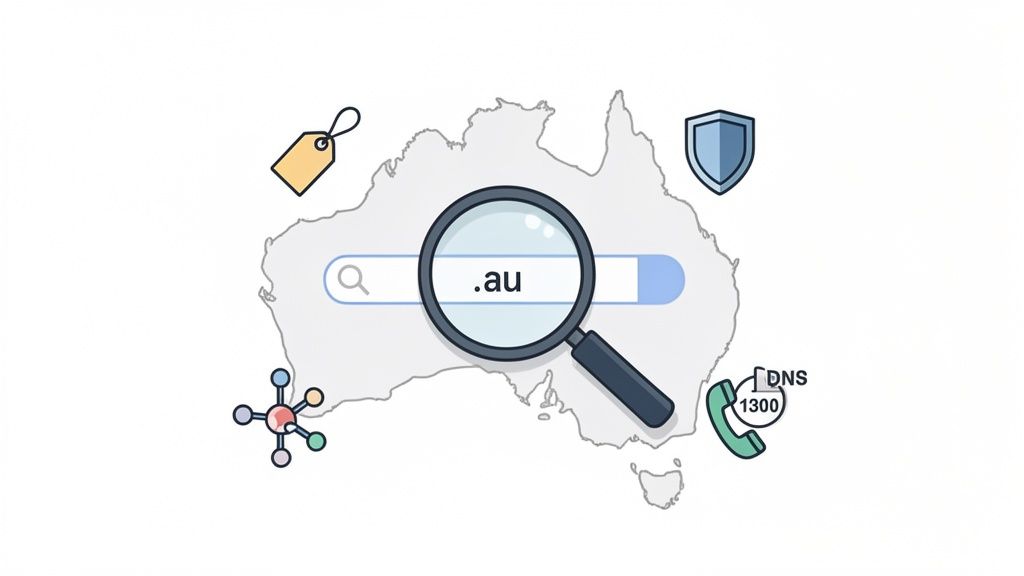
Picking a domain registrar isn't just about buying a web address; it's the first real step in shaping your online identity and building trust with your local customers. Think of your registrar as the partner responsible for keeping your digital front door open. A bad choice can lead to sneaky renewal fees, painful support experiences, and technical headaches right when you can least afford them.
For instance, a local Melbourne café needs its .com.au domain to be rock-solid, especially during the weekend rush for online orders. If their DNS (Domain Name System) fails and their registrar's support team is offshore and slow to respond, they could lose a serious amount of business. An Australian-based registrar, on the other hand, can offer fast, expert help that understands the local landscape.
The Power of a Local Domain
Grabbing an Australian domain instantly signals to customers that you're a genuine local business, which is a massive trust factor. The market reflects this, too. Australia's domain space saw a huge 27.4% year-over-year jump in registrations, with the classic .com.au extension making up a whopping 74% of all domains. This growth just goes to show how much businesses value that local identity, as a .au domain can give your local SEO a real boost and build instant credibility.
Your domain registrar isn't just a supplier; they're the guardian of your online brand. Choosing one with transparent pricing, solid security, and accessible Aussie support is a core business decision, not just a tech task.
Key Factors for Australian Businesses
When you’re weighing up the best domain name registrars in Australia, a few crucial things come into play that are far more important than just the initial price tag.
- .au Eligibility: How easy does the registrar make it to verify your ABN/ACN for
.com.auor.net.audomains? The newer, shorter.audirect domain has its own set of rules, and a good registrar will make this process painless. - Transparent Pricing: Are renewal fees and GST spelled out clearly? It’s a classic trick for registrars to hook you with a cheap first-year offer, only to jack up the price significantly when it’s time to renew.
- Local Support: Can you actually talk to someone in Australia when you're stuck? Having access to local phone or ticket support means you get quick, knowledgeable help from someone who gets it.
While we're zeroed in on what Aussie businesses need, general advice on picking a domain, like finding the best domain name for students, can offer some handy universal tips. At the end of the day, the right registrar is the one that fits what you're trying to do, whether that's launching a personal blog or a nationwide e-commerce store. For a deeper dive into the newer local domain options, take a look at our guide on .au, Australia's new top-level domain.

Performance you can feel, backed by clients who depend on it. Read how our support and uptime create long‑term customer success.Power Your Business with Better Hosting
Digging Into What Makes a Great Domain Registrar
When you’re trying to find the best domain name registrar in Australia, it’s easy to get drawn in by a flashy, low price for the first year. But picking the right partner for your online presence goes a lot deeper than that. A genuinely good registrar provides a solid foundation built on clear pricing, easy compliance with local rules, powerful tech tools, and support you can actually talk to.
These core features are what really separate a bargain-basement provider from a true business partner. The most common trap? That initial registration fee. A registrar might dangle a .com.au domain for just a few bucks, but the real cost is often hiding in the renewal price, which can easily be double or triple the introductory offer. That cheap domain suddenly becomes a major long-term expense.
Seeing Past the Price Tag: The True Cost
When you're comparing prices, you have to look at the multi-year cost. A registrar that’s genuinely affordable is upfront about its renewal fees and includes GST in every price they show you. The last thing you want is a surprise 10% jump in cost when you get to the checkout.
For example, you might see a .com.au advertised for $9.95. But digging into the fine print could reveal a renewal cost of $29.95 per year, plus GST. If you plan on keeping that domain for five years, your true cost isn't just under ten dollars—it’s closer to $130.
A registrar’s pricing transparency says a lot about how they do business. If renewal fees and taxes are buried in the fine print, that's a massive red flag. Always go with registrars who put all the costs out in the open.
Make sure you can find a clear breakdown of all potential costs:
- Registration Fee: The price for your first year.
- Renewal Fee: What you’ll pay every year after that.
- Transfer Fees: The cost to move your domain in or out.
- GST Inclusion: A clear confirmation that all prices include Goods and Services Tax.
Getting Your .au Domain: Eligibility and Verification Made Easy
To register a domain ending in .au—like .com.au or .net.au—you have to meet specific rules set by the .au Domain Administration (auDA). The big one is having an Australian presence, which you usually prove with a valid Australian Business Number (ABN) or Australian Company Number (ACN). The domain you choose also needs to have a "close and substantial connection" to your registered business name or what you do.
The best registrars in Australia make this whole verification thing painless. Instead of a clunky, manual process, a top provider builds the ABN/ACN validation right into their checkout system.
For example, a provider like UpTime Web Hosting streamlines this by simply asking for your ABN during registration and validating it automatically. This gets rid of any friction and makes sure your domain is compliant from the get-go, saving you from potential registration delays or cancellations. For any Australian business, this is a must-have feature.
Your DNS: Management, Control, and Security
Your Domain Name System (DNS) is the engine that connects your domain name to your website and email. If it's poorly managed, you're looking at website downtime, security risks, and a whole lot of frustration. A great registrar gives you a control panel that's easy to use, so you can manage your DNS records without needing a degree in computer science.
Here are the key DNS features to look out for:
- An Intuitive Control Panel: You should be able to update A, CNAME, and MX records without any hassle.
- DNSSEC Support: This adds a layer of security (Domain Name System Security Extensions) to protect your visitors from being redirected to malicious sites.
- Fast Propagation: When you make a change, you want it to take effect quickly across the globe.
Without these, simple jobs like pointing your domain to a new web host or setting up a professional email address turn into a massive headache.
Why Local Australian Support Actually Matters
When your website goes down or your email just stops working, you need help, and you need it fast. This is where having local Australian support really shines. Many of the big international registrars outsource their support, which often means long waits, communication issues, and talking to people who have no idea about Australian-specific things like auDA policies.
A registrar with a dedicated Australian team you can reach on a 1300 number or via a local helpdesk is a completely different world. They work in your time zone and have the right expertise to fix problems quickly. Whether it’s a tricky DNS issue or a question about how to manage domain name transfers, speaking to someone who gets the local landscape is a huge advantage.
Matching a Registrar to Your Business Needs
Let's be honest: trying to find the single "best" domain registrar in Australia is a bit of a myth. The right choice for your business is always the one that fits your specific goals. A solo entrepreneur launching their first online store has completely different priorities than a digital agency managing a portfolio of 50 client websites.
This is where we need to look past a simple price-per-domain comparison. Instead of just asking, "who is the cheapest?", the better questions are, "who makes my job the easiest?" and "who has the tools that will help me scale down the track?". Figuring out what your business actually needs is the first real step toward making a smart, strategic decision.
This whole process—weighing up price, support, and the technical features you'll need—can be a lot clearer when you map it out.
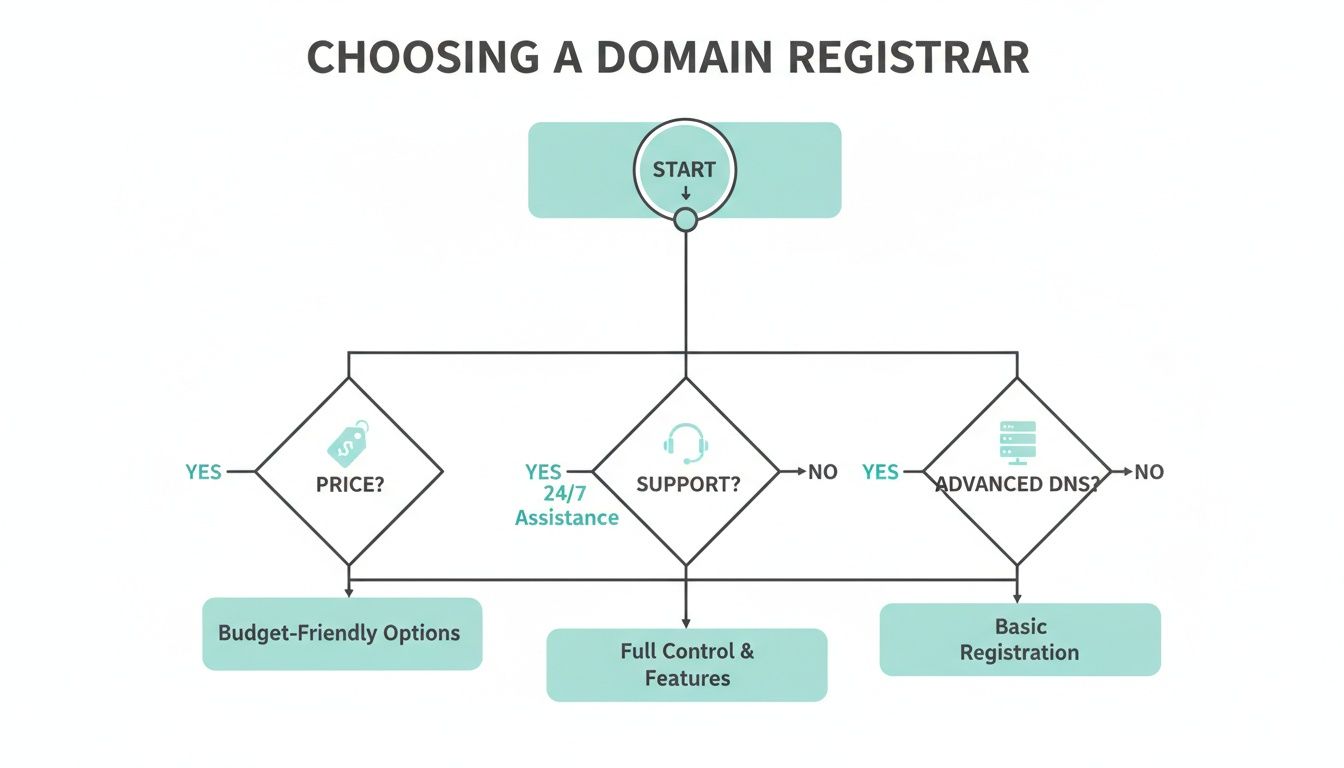
As the flowchart shows, the best registrar for you hinges on what you value most: sticking to a tight budget, having reliable tech support on hand, or needing advanced DNS features for more complex projects.
The All-in-One Solution for Small Businesses
For a small business owner—whether you're a local plumber, run a boutique café, or are just starting an e-commerce store—convenience and simplicity are everything. The last thing you need is the headache of juggling different providers for your domain, hosting, and email when you should be focused on growing your business.
The ideal registrar for this situation is one that bundles all the essentials into a single, easy-to-manage platform. Look for providers who offer an integrated experience. For example, a registrar that is also a top-notch web host, like UpTime Web Hosting, gets rid of the technical drama of pointing your domain's DNS records to a separate hosting server. It's all set up to work together from day one.
Key features for small businesses to look for include:
- Bundled Web Hosting: Getting your domain and hosting from the same Australian provider streamlines billing and makes support so much simpler.
- Integrated Website Builders: Tools like the Sitejet website builder, often included in hosting plans, let you build a professional-looking site without touching a line of code.
- Free SSL Certificates: This is a non-negotiable for security and SEO, and it should always be included at no extra cost.
- Professional Email Hosting: The ability to quickly set up an email like
info@yourbusiness.com.augives you instant credibility.
For a small business, time is your most precious asset. Choosing a registrar that offers a complete, integrated online package means less time spent on tech admin and more time looking after your customers. The goal is efficiency, not just the lowest upfront price.
Tools for Web Agencies and Developers
The world looks very different for a web agency or a freelance developer. When you're managing domains for multiple clients, efficiency comes from powerful management tools and features that let you work at scale. A basic, consumer-grade control panel just isn't going to cut it.
The priority here shifts to a robust client management portal. You need the ability to handle bulk registrations, renewals, and DNS updates without having to log in and out of dozens of different accounts. An agency-focused registrar understands this workflow and gives you the tools to make it seamless.
Imagine this scenario: an agency needs to register .com.au domains for five new clients. A registrar with bulk registration tools lets them submit all five at once, including the ABN verification, saving a huge amount of time compared to doing each one individually. White-labelling is another game-changer, allowing the agency to offer domain management services to its clients under its own brand.
This demand for advanced, scalable solutions is a key driver in the local market. In fact, Australia commands a solid 6.70% share of the revenue in the Asia Pacific domain registrar market. The broader APAC market is projected to jump from USD 265.46 million to USD 460.04 million by 2033, with agency-level demand in Australia expected to grow at a 6.7% CAGR. This just goes to show the growing need for registrars that can support complex cloud deployments. You can dig into these trends by reading the full report on the domain registrar market.
Specialised Needs for .au Domain Investors
There's a smaller, more specialised group of users who focus almost exclusively on the Australian domain market. These are your domain investors, brand protection specialists, or businesses that manage a huge portfolio of .au domains. For these experts, deep knowledge of local policies is non-negotiable.
This type of user needs a registrar with a proven track record in the Australian market. They're looking for advanced services that go far beyond a simple registration form.
Key things for .au specialists to consider:
- Domain Backordering Services: The ability to automatically try and register a domain the second it expires and drops.
- Expertise in auDA Policy: Access to support staff who genuinely understand the ins and outs of
.aurules, including eligibility and dispute resolution. - Advanced Portfolio Management: Tools built to manage hundreds or thousands of domains, with features for bulk updates, filtering, and reporting.
Ultimately, choosing the best domain name registrar in Australia comes down to a bit of self-assessment. By figuring out your own profile—whether you’re a small business needing simplicity, an agency needing scale, or a specialist needing deep expertise—you can cut through the noise and pick a partner that truly helps you get the job done.
Host your website with our 5-star rated, cPanel website hosting plans.
Super fast servers, with security included and hosted in your choice of Australian Data Center.
View cPanel Plans
Integrating Your Domain with Essential Services
Okay, so you’ve snagged the perfect domain name. That’s a huge first step, but it’s really just the beginning. Think of it like buying a block of land – now you need to actually build the house. The best domain registrars in Australia don’t just sell you the address; they help you connect it to all the essential services that bring your website to life, like hosting, professional email, and security.
Choosing a registrar that is also a top-tier web host, like UpTime Web Hosting, makes this whole process worlds easier. Instead of juggling different providers, logins, and support teams, you get everything under one roof. This means things like DNS configuration often happen automatically, you have one number to call if something goes wrong, and the entire experience is seamless from day one.
The Power of Bundled Hosting and Email
One of the biggest wins of bundling is how neatly it handles web hosting. When your domain and hosting are with the same company, you don't have to mess around with complex DNS settings to point your domain to a separate server. It just works. This alone saves a ton of time and helps you dodge common technical hiccups that can knock your site offline.
Beyond hosting, setting up a professional email address (you@yourdomain.com.au) is non-negotiable for building brand credibility. A registrar that bundles email hosting makes this incredibly straightforward.
- Instant Professionalism: An email address tied to your domain looks far more trustworthy to customers than a generic Gmail or Outlook account ever will.
- Simplified Setup: With a bundled service, creating new mailboxes is usually just a few clicks inside your control panel.
- Centralised Support: If you have an issue with your email, you know exactly who to call—the same team that manages your domain and hosting.
For a detailed walkthrough, check out our guide on how to set up your business email and start building that professional brand identity.
Essential Security Add-Ons
In today's digital world, security isn't just a nice-to-have; it's a must. A quality registrar gets this and bundles crucial security features to protect your digital assets from the moment you register. This integrated approach creates a safer, more efficient, and better-performing online presence.
Here are the key security services you should be looking for:
- Free SSL Certificates: An SSL certificate encrypts the connection between your website and your visitors. It’s absolutely essential for security, trust, and even SEO. This should always be included for free with your hosting.
- Malware Scanning: Proactive scanning helps catch and remove malicious code before it can do any damage to your site or your visitors.
- DDoS Protection: Distributed Denial-of-Service (DDoS) attacks are designed to flood your server and take your website offline. A strong firewall is your first line of defence.
The importance of these integrated security measures can't be overstated. The Australian managed DNS market—which is tightly linked to domain reliability—is projected to hit USD 1,029.7 million by 2030. DDoS protection is the leading security segment in this market, which tells you just how critical it is to choose a registrar that bundles strong security to keep your site online.
Choosing an all-in-one Australian provider isn't just about convenience. It’s a strategic decision to build a more secure and resilient online foundation, managed by a single trusted partner who understands the local landscape.
Once you've secured your domain and have these core services in place, it’s time to think about what your visitors will see. Understanding the key elements of modern website design will help you build a site that not only looks great but also works hard for your business.
Getting Your Hands on a .au Domain (or Moving an Existing One)
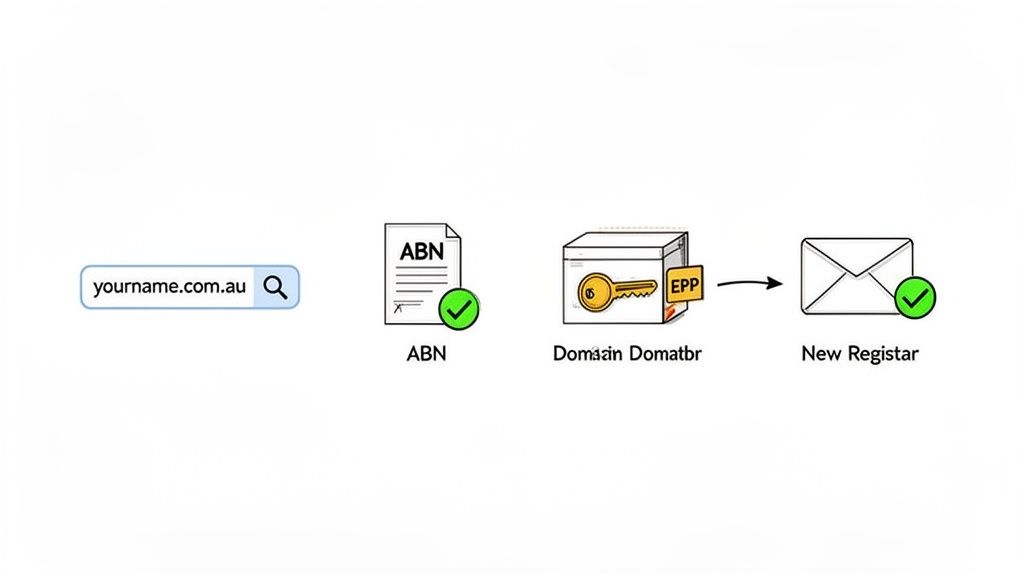
Grabbing your perfect .au domain name, or moving your current one to a better provider, can sound a bit technical. But honestly, it's a pretty straightforward process.
With a supportive registrar that has its act together, these steps are completely manageable. Let’s break down exactly what’s involved in registering a brand new domain and transferring one you already own. Knowing the ropes helps you spot a good registrar—they’re the ones who make it all feel easy.
How to Register a New Australian Domain
Nailing down a new .au domain is a huge first step for your online presence. It all comes down to finding a name that’s free, proving you’re eligible to own it, and then making it yours.
Here’s how it usually plays out:
Find Your Name: First things first, use your chosen registrar's search tool to see if the domain you want is available. A new bakery in Sydney might look for
sydneyfreshbakes.com.au. If that's taken, the registrar will usually throw out some alternatives likesydneyfreshbakery.net.auorsydneybakes.au.Prove You're Aussie: This is the big one for
.audomains. During checkout, you'll need to enter your Australian Business Number (ABN) or Australian Company Number (ACN). A top-notch registrar builds this check right into the signup process, so it verifies your details on the spot to make sure you meet auDA's rules.Enter Your Details: Next, you’ll provide your contact information, which gets linked to the domain. This is just your name, business name, address, and email.
Seal the Deal: Once your eligibility is confirmed, you just need to complete the purchase. Double-check the registration period (it's usually 1 to 5 years) and the final cost, including GST.
A great registrar makes this feel effortless. The ABN/ACN check should be a simple, integrated part of the checkout, not some clunky afterthought that leaves you waiting for a manual follow-up.
How to Transfer Your Existing .au Domain
Not happy with your current domain provider? If you’re fed up with high renewal fees, terrible support, or a clunky dashboard, moving your domain is a no-brainer. The process is designed to be secure, meaning only the rightful owner can actually authorise the move.
The whole thing hinges on getting a special password for your domain. It’s called an EPP code (or sometimes an 'auth code'). Think of it as the key that proves you own the domain and gives your new registrar permission to take over.
Here’s what that looks like in practice:
Get Your EPP Code: Log into your current registrar’s control panel. You’re looking for an option to get your EPP code, usually tucked away in the domain management or security settings. If you can’t spot it, you might need to ping their support team and ask for it.
Unlock Your Domain: For security, most domains are "locked" to stop anyone from transferring them without permission. You’ll need to switch this lock off in your current registrar’s dashboard before you can start the transfer.
Start the Transfer on the New Side: Head over to your new registrar’s website and kick off the domain transfer. They'll ask for the domain name you're moving and the EPP code you just got.
Click the Approval Email: This is a crucial step. An email will be sent to the official registrant email address listed for the domain. You must click the approval link inside it to give the final go-ahead. It’s a security check to make sure it's really you.
For a more detailed breakdown, our guide on how to manage domain name transfers walks through the common sticking points and how to solve them. A registrar with clear instructions and local Aussie support can make this whole process a walk in the park, ensuring your domain moves smoothly without any downtime.
Your Top Questions About Australian Domains Answered
When you're dealing with Australian domains, a few questions always pop up, especially around the local rules and what you'll really end up paying. Getting these answers straight from the get-go is the key to picking the right registrar and managing your online brand without any nasty surprises down the track.
Let's clear the air and tackle some of the most common points of confusion for Aussie business owners.
What Are the Rules for Registering a .com.au Domain?
Grabbing a .com.au domain isn't just a matter of seeing if the name is free. You have to meet specific eligibility rules laid out by the .au Domain Administration (auDA), the official body that keeps the .com.au space trusted and exclusive to legitimate Aussie businesses.
The main hurdle is proving you have an 'Australian presence'. For most businesses, this is pretty straightforward – you just need a valid:
- Australian Business Number (ABN)
- Australian Company Number (ACN)
But it doesn't stop there. The domain name you choose must also have a 'close and substantial connection' to your registered business. This means the name should be an exact match, a common acronym, or a clear abbreviation of your legal or trading name. It can also relate directly to the products or services you're known for. So, if your company is "Sydney Fresh Bakes Pty Ltd," then sydneyfreshbakes.com.au is a perfect, compliant choice.
Should I Register My Domain and Hosting Together?
For most small and medium businesses, the answer is a resounding yes. Keeping your domain registration and web hosting under one roof is simply the most practical way to go. While some tech purists might argue for separating them, the sheer convenience of a bundled solution usually wins out, especially when your focus should be on your business, not juggling multiple tech providers.
Bundling your domain and hosting with a single Australian provider like UpTime Web Hosting just makes life easier. Support is streamlined, billing is consolidated into one payment, and the technical side of things is often handled for you. It saves you time and sidesteps those frustrating setup headaches.
Think about it: one login, one bill, and one phone number to call when you need help. This completely avoids the classic blame game where your domain registrar points the finger at your hosting company (and vice versa) whenever an issue arises.
What Is the True Cost of a .au Domain Name?
The "true cost" of a .au domain is rarely the flashy, low price you see advertised for the first year. That's a classic hook many registrars use. The real cost shows up when it's time to renew, and that price can be much, much higher. A good, transparent registrar will be upfront about all of these costs from day one.
To get the full picture of what you'll be paying, you need to check a few things:
- Renewal Price: This is the big one. What will it cost you each year to keep the domain? Always confirm this before you hit the buy button.
- WHOIS Privacy: Some registrars include this for free to shield your personal details from public view, while others will sting you with an extra annual fee for it.
- GST: Make sure any price you see includes GST, otherwise you'll get a 10% surprise at the checkout.
It’s also important to grasp what "domain ownership" actually means. You're not buying the domain outright; you're leasing the exclusive right to use it. To get a better handle on this, our article explaining if you really own your domain name breaks it down clearly. A quality registrar ensures you have total control over that lease.