
When you're searching for "cheap web hosting Australia," you're not just looking for the lowest number on a price tag. You're hunting for the best possible value. And real value? That's finding an affordable plan that doesn't skimp on the essentials your Aussie business needs to actually succeed online.
This guide is all about helping you strike that perfect balance between cost and the critical stuff—like local server performance, solid security, and support you can actually count on.
What "Cheap" Web Hosting in Australia Really Means
Think of your web hosting like the physical location of your shop. A cheap shopfront miles away from your customers might save you on rent, but it makes it a whole lot harder for people to find you and come inside. It’s the same with web hosting. A "cheap" plan with servers in the US or Europe will mean painfully slow loading times for your Australian visitors, which is a killer for user experience and your Google rankings.
The goal here isn't to find the absolute rock-bottom price. It’s to make an intelligent investment. That means finding a hosting partner who provides a solid, reliable foundation for your website without charging you for bells and whistles you don't need. In Australia’s crowded market, this is more important than ever.
The Booming Australian Digital Space
The demand for quality online platforms is absolutely surging. In fact, Australia's cloud hosting and data services industry has ballooned into a $3.9 billion market, growing at a healthy 8.1% each year for the past five years. This isn't just big corporations; it's an explosion of e-commerce stores, local small businesses, and startups all carving out their space online.
A tell-tale sign of this growth is the sheer number of active Australian domain names. They jumped from 1.3 million to 1.7 million—a whopping 27.3% increase in just one year. With more businesses getting online every day, the need for quality, affordable local hosting has never been greater. For a deeper dive into these numbers, you can check out the industry growth data from IBISWorld.
The smartest way to look at "cheap" web hosting isn't just about saving a few dollars a month. It's about investing in a service that delivers speed, security, and support. This ensures your website can grow with your business, free from frustrating lag or nasty surprise fees down the track.
This guide will walk you through finding that sweet spot. We’ll cover the non-negotiables, the red flags to watch out for, and how to pick a plan that feels like it was made just for you.

Performance you can feel, backed by clients who depend on it. Read how our support and uptime create long‑term customer success.Power Your Business with Better Hosting
The Hidden Costs of Choosing the Cheapest Plan
Picking the absolute cheapest web hosting can feel a lot like booking a budget flight. The ticket price looks like a bargain, but then you get hit with surprise fees for your bags, for picking a seat, for a sip of water… and suddenly, that great deal isn't so great anymore. The same thing happens when you're looking for cheap web hosting Australia; the headline price often hides trade-offs that end up costing you a lot more down the track.
This isn't just about scaring you off a good deal; it's about being smart with your money. The biggest trap with cheap hosting is the oversold server. This is where a provider crams far too many websites onto a single machine to cut their own costs. Think of it as a highway during peak hour—everyone’s journey slows to a crawl. For your website, that means sluggish performance and frustrating downtime, usually right when your customers are trying to buy something.
When "Cheap" Becomes Expensive
It's not just about speed, either. Many of these bargain-basement plans slice away at services that are absolutely vital for any serious business website. These hidden costs tend to pop up at the worst possible moments, turning a small glitch into an expensive disaster.
Here are a few practical examples:
- Limited Technical Support: Imagine your e-commerce site goes down at 8 PM on a Friday night during a sale. A cheap host with only business-hour support means you're losing money until Monday morning. You need 24/7 support.
- Expensive Add-ons for Essentials: You launch your site and realise it doesn't have an SSL certificate. The "cheap" host then charges you an extra $5 a month for this basic security feature, instantly making your plan 50% more expensive.
- Recovery and Cleanup Fees: If your site gets hacked (and on a cheap, insecure server, the risk is higher), a budget host might sting you with a massive fee to clean it up or restore it from a backup—assuming they even have one. This can turn a security breach into a financial crisis.
The real cost of a hosting plan isn't just the monthly fee. It's that fee plus the lost revenue from downtime, the price of essential add-ons, and the hours you'll waste sorting out problems that shouldn't have happened in the first place.
At the end of the day, you want a plan that offers genuine value, not just a low sticker price. For a deeper dive into the common pitfalls people fall into, this guide on 12 web hosting mistakes and how to avoid them is a great read.
Plenty of providers, including our team here at UpTime Web Hosting, believe in transparent pricing where all the critical features are built-in from the start. This approach gives you a solid, reliable foundation for your business, so you're not left worrying about surprise costs blowing your budget.
Non-Negotiable Features Every Hosting Plan Needs
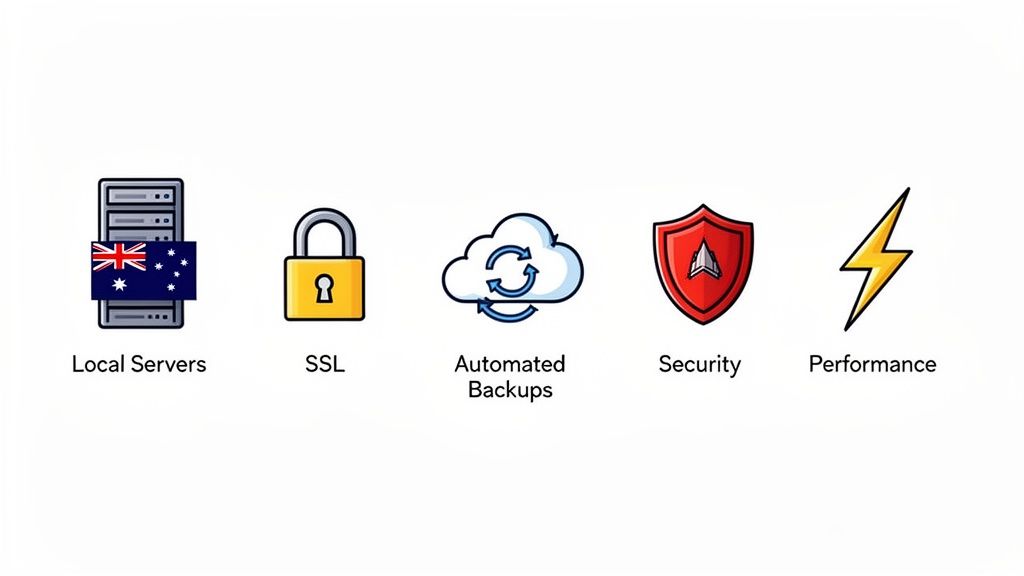
When you’re sifting through cheap web hosting options in Australia, it’s easy to get bogged down in technical jargon. The best way to cut through the noise is to focus on a core checklist of features that are absolutely essential for any serious website.
These aren't just nice-to-haves; they are the bedrock of your site's speed, security, and reliability.
Think of it like buying a car. You wouldn't even look at a model without an engine, brakes, and airbags, no matter how cheap it was. The same logic applies to your web hosting. Getting these fundamentals right from day one will save you from massive headaches and costs down the track.
This demand for quality, affordable hosting is actually reshaping the market. Australia's cloud hosting sector is now valued at a massive $3.9 billion, with over 2,200 providers all competing for your business. This boom is being driven by startups and SMEs who just need reliable, local web hosting that works.
Local Australian Servers for Peak Performance
Where your website's data is physically stored matters. A lot. If you're targeting an Australian audience, your hosting provider must have servers located right here in Australia. This is non-negotiable for one simple reason: latency.
Latency is just the technical term for the time it takes data to travel from the server to your visitor's screen. For example, if your server is in Sydney and your customer is in Perth, the data transfer is fast. But if your servers are in Dallas or London, the delay is much longer, resulting in a sluggish, frustrating website.
A slow website doesn't just annoy users—it actively hurts your business. Faster load times are directly linked to better user engagement, higher conversion rates, and improved search engine rankings for local searches.
Having local servers is the single most effective way to ensure a snappy experience for your Aussie customers. To get a better handle on this, check out our detailed guide on how your hosting service affects website speed.
Essential Security Layers: SSL and Backups
In today's online world, security isn't optional. There are two features that form the absolute baseline for protecting your website and your customers.
Free SSL Certificate: An SSL (Secure Sockets Layer) certificate encrypts the connection between your website and its visitors. It's what puts the "s" in "https" and displays that little padlock icon in the browser's address bar. Without it, browsers will flag your site as "Not Secure," which instantly kills visitor trust and hurts your SEO. Any host worth their salt provides a free SSL certificate as standard.
Automated Backups: Imagine you accidentally delete a crucial page or a plugin update breaks your site. An automated backup is your one-click "undo" button. A good provider will offer automated, off-site backups (meaning they're stored in a different physical location), making sure you can recover from almost any disaster with minimal fuss.
Performance Enhancers Like LiteSpeed
Finally, look for modern performance tech built right into the plan. A key one to watch for is LiteSpeed Web Server. It’s a high-performance replacement for older, clunkier server software that can handle more traffic and serve pages much faster, especially for popular platforms like WordPress.
When paired with caching tools, LiteSpeed can give your site a noticeable competitive edge without you having to lift a finger. It’s what ensures your cheap web hosting Australia plan delivers performance that feels anything but cheap.
Host your website with our 5-star rated, cPanel website hosting plans.
Super fast servers, with security included and hosted in your choice of Australian Data Center.
View cPanel Plans
How to Spot Hosting Red Flags and Hidden Fees
Finding a great deal on cheap web hosting in Australia isn't just about the advertised price; it's about looking past the flashy marketing claims. Many providers use some clever tactics to make a plan seem more appealing than it really is, which can leave you with a bigger bill and a whole lot of frustration down the track. Let's get you equipped to spot the common traps before you commit.
One of the most frequent red flags is deceptive introductory pricing. You'll see an incredibly low price, maybe something like $2.99 per month, but this rate often only applies if you pay for two or three years upfront. The real surprise comes when it's time to renew, and the price suddenly triples or quadruples. Always, always look for the renewal rate, not just the shiny initial offer.
Another classic is the "unlimited" storage promise. This sounds fantastic, of course, but it almost always comes with a catch hidden deep in the terms of service. This catch is usually an inode limit—a cap on the total number of individual files and folders you can have.
The Problem with "Unlimited" Promises
An inode limit can be surprisingly easy to hit. For example, a typical WordPress site with a few plugins and a blog can easily have 20,000 files (inodes). An "unlimited" plan with a secret 50,000 inode limit gives you far less room to grow than you think. Once you hit that hidden ceiling, your website might stop working correctly, or you'll be forced into an expensive and immediate upgrade.
Similarly, you need to be wary of unexpected fees for services that really should be standard. Some budget hosts will charge you extra for things like:
- Website Migrations: You decide to switch hosts for a better deal, but your new provider wants to charge you $150 to move your website files over. A quality provider often includes this for free.
- Security Cleanup: If your site gets compromised, some budget hosts will charge a hefty fee just to remove the malware.
- Essential Backups: They might say they offer backups, but restoring your site from one could come with an unexpected service fee. It's a nasty surprise when you're already stressed.
The gold standard for honest Australian web hosting is transparent, GST-inclusive pricing without lock-in contracts. This ensures the price you see is the price you pay, and you have the freedom to leave if the service doesn't meet your expectations.
Reading the fine print is absolutely vital. Before you sign up for anything, ask direct questions about renewal costs, inode limits, and any potential fees for support or restoration services. For an extensive checklist of what to watch out for, our knowledge base articles can arm you with the right questions to ask.
To arm yourself further, you can explore this detailed breakdown of 12 web hosting mistakes you can make and how to avoid them. A trustworthy host will always be upfront about these details, helping you make a truly informed decision from day one.
Choosing The Right Hosting Plan For Your Website
Alright, let's move from theory to action. Picking the right hosting plan isn't about finding the "best" one, but the one that's the best fit for you. After all, the ideal choice for a local plumber’s website is worlds away from what a web developer needs to manage a dozen client projects.
By understanding these key differences, you can find cheap web hosting in Australia that delivers exactly what you need without paying for extras you’ll never touch.
Let's walk through a few common scenarios.
For Small Business Owners
If you run a small Aussie business, your top priorities are probably reliability and simplicity. You just need your hosting to work, so you can focus on running your actual business, not fiddling with server settings.
For example, a local cafe needs a simple website with their menu, opening hours, and a contact form. A hosting plan that includes dependable email hosting with their own domain name (e.g., info@yourbusiness.com.au) is crucial for building trust.
For most small businesses, a solid, affordable shared hosting plan is the perfect starting point. Our hosting services are designed for this exact need, providing all the essential tools—professional email, a fast-loading website for local customers—all wrapped up in one predictable monthly cost.
This decision tree gives you a quick way to spot potential red flags with providers, especially around dodgy pricing, unclear resource limits, and nasty hidden fees.
As you can see, transparent pricing and clear resource limits are just as critical as that attractive introductory price. Don't get caught out.
For WordPress Website Owners
Running a WordPress site? Then performance is everything. A slow WordPress site is a sure-fire way to send potential customers clicking away in frustration.
You'll want to look for hosting plans specifically optimised for WordPress. This means they come with performance-enhancing tech like LiteSpeed Web Server and smart caching tools like AccelerateWP.
These features aren't just buzzwords; they're designed to make your WordPress site absolutely fly. They handle the unique demands of WordPress far more efficiently than a generic, one-size-fits-all hosting setup. For example, LiteSpeed Caching can dramatically reduce your site's load time by pre-building pages so they are ready to serve instantly. To find hosts that excel in this area, it's worth checking out reviews of top-tier Australian web hosting providers.
For Web Developers And Agencies
Now, if you're a developer or an agency managing sites for clients, your needs are a different beast entirely. You're juggling multiple projects and need serious resources and flexibility.
A practical example is a freelance developer who builds five small business sites. Instead of buying five separate cheap plans, they can use a single reseller hosting account. A game-changing feature for you is uncapped add-on domains. This lets you host numerous client websites under a single, beefy hosting account without being nickel-and-dimed or hitting an annoying, arbitrary limit.
Generous CPU and memory are also non-negotiable. You need that power to ensure every site you manage stays fast and responsive, even when one of them gets a sudden traffic spike. It's about more than just cost; it's about making smart, informed decisions and understanding the nuances of choosing the right web hosting provider to handle these complex demands.
The most effective way to choose a hosting plan is to first define your primary goal. Whether it's establishing a simple business presence, optimising a high-traffic blog, or managing a portfolio of client sites, clarity on your needs will point you directly to the most suitable and cost-effective solution.
Your Hosting Decision Checklist
To help bring all this together, use this simple checklist. It’s a great way to cut through the noise and focus on what truly matters for your specific situation. Just jot down your own needs in the final column as you compare different hosting plans.
| Feature/Consideration | Why It Matters | My Requirement |
|---|---|---|
| Local Data Centres | Faster load times for Australian visitors and better SEO rankings locally. | e.g., "Must have Sydney or Melbourne server." |
| Free SSL Certificate | Secures your site (HTTPS), builds visitor trust, and is essential for e-commerce. | e.g., "Yes, need it for my online store." |
| Automatic Backups | Your safety net. Protects you from data loss due to errors or hacks. | e.g., "Daily backups are non-negotiable." |
| Server Performance | Affects site speed and user experience. Look for SSDs, LiteSpeed, etc. | e.g., "WordPress-optimised with LiteSpeed." |
| Security Features | Firewalls, malware scanning, and other tools to protect your site from threats. | e.g., "Must include active malware scanning." |
| Resource Limits | Check CPU, RAM, and storage to ensure you have room to grow. | e.g., "At least 2GB RAM and 50GB storage." |
| Customer Support | You need fast, helpful support when things go wrong. Check for 24/7 options. | e.g., "24/7 Australian-based support." |
| Scalability | Can you easily upgrade your plan as your website traffic grows? | e.g., "Clear upgrade path to a VPS." |
By ticking off these boxes, you’ll be in a much stronger position to choose a hosting plan that not only fits your budget but also sets your website up for long-term success.
Wrapping It Up: Making a Smart Investment in Your Online Presence
The real goal isn't just to find the cheapest web hosting in Australia—it's to find the smartest. It’s about looking beyond that initial price tag to find genuine, lasting value. A smart choice today is what prevents those costly, hair-pulling headaches tomorrow.
Remember the essentials we've talked about, the things that form the bedrock of any successful website: fast local servers, a free SSL certificate, and automated backups. These aren't fancy extras; they're your absolute baseline for performance and security.
Think about it: a host with local servers means your Aussie customers get that zippy experience they expect, which has a direct line to your reputation and your sales. If you want to dive deeper into getting this stuff right, we’ve got plenty more in our knowledge base articles.
Your website is one of your most critical business assets. The hosting is the foundation it’s all built on. Choosing a provider that offers these core features isn’t just about buying server space—it's an investment in a reliable partner who's genuinely there to help your business succeed.
By making these non-negotiables a priority and picking a quality provider like UpTime Web Hosting, you’re not just buying a plan. You're securing a platform ready to grow right alongside your business, and that's something that gives you real peace of mind.
Register your new domain name at competitive market prices including free domain add-ons like privacy, DNS Hosting, Custom Nameservers and Forwarding.
Always the best price and no nasty renewal price hikes.
Register A Domain Name
A Few Common Questions About Affordable Hosting
Jumping into the world of web hosting can bring up a lot of questions, especially when you're trying to find that sweet spot between a great price and a quality service. Here are some of the most common things people ask when looking for cheap web hosting in Australia.
Can I Actually Run an E-commerce Store on a Cheap Plan?
You absolutely can, but you need to be smart about it. For any kind of online store, there are a few things that are completely non-negotiable. You'll need a free SSL certificate to keep your customers' data safe, enough grunt to handle all your product photos, and rock-solid uptime so you don't lose sales.
A basic shared hosting plan is often perfectly fine for a small shop that's just getting its sea legs. But keep in mind, as your customer base grows and more people start visiting your site, you’ll eventually need to step up to a plan with a bit more power. If you want to dive deeper into keeping your site safe, check out our guide on website security best practices.
Do I Really Need Australian-Based Support?
One hundred percent, yes. When something goes wrong with your website, you need to talk to someone who's in your timezone and understands the local landscape. Trying to get help from a support team on the other side of the world can quickly turn a small glitch into hours of painful, costly downtime.
Having local support simply means you get faster, more relevant help right when you need it most.
The real value of a hosting plan isn't just the server tech; it's the person you can call who actually picks up the phone and knows how to help when things go sideways.
What's the Difference Between Disk Space and Bandwidth?
It helps to think of your hosting plan like a physical retail shop.
- Disk Space is your storeroom out the back. It's the total amount of room you have to keep all your website files—everything from images and videos to emails and databases.
- Bandwidth is like the size of your shop's front door. It dictates how much data can flow between your website and your visitors at any one time. A wider door means more people can come in at once without causing a bottleneck.
For a brand-new website, most standard plans will give you more than enough of both to get started. You can browse our hosting services to see plans with plenty of room to grow.
Ready to get your website online with a fast, secure, and affordable platform? At UpTime Web Hosting, we offer reliable Australian hosting with all the essentials built-in, backed by expert local support that's here when you need it. https://uptimewebhosting.com.au