

When you're looking for the best email hosting Australia has to offer, your checklist should be simple: local servers, GST-inclusive pricing, and genuine Australian support. UpTime Web Hosting nails this, blending the security of data sovereignty with the straightforward value of cPanel hosting. It's an ideal setup for Australian small and medium-sized businesses.
Why Australian Businesses Need Local Email Hosting
Choosing an email host isn't just another IT task to tick off a list; it's a strategic business decision. For Aussie companies, going with a local provider gives you real, tangible advantages that directly boost performance, tighten up security, and build customer trust.
When your emails are flying through servers in Sydney or Melbourne, that physical closeness slashes latency. What does that mean for you? Your messages send and receive faster, both for your team and your Australian customers. It’s an instant performance upgrade.
But it’s about more than just speed. It’s about protecting your most sensitive business conversations. Local hosting keeps your data on Australian soil—a principle known as data sovereignty. This isn't just a buzzword; it's critical for staying compliant with the Australian Privacy Act and earning the confidence of customers who are, quite rightly, asking where their data is being stored. You can get a deeper understanding of this in our guide on why it's important to host your website in Australia.
The Core Benefits of Choosing Local
When you make a local host your priority, you unlock a few key benefits that international providers often can't compete with:
- Improved Email Deliverability: Emails sent from Australian IP addresses are seen as more trustworthy by local networks, which means they're far less likely to get mistakenly flagged as spam. Your important messages actually land where they're supposed to.
- Enhanced Security and Compliance: Your data is shielded by Australian law. This gives you a clear legal framework for data privacy and security that’s perfectly aligned with local business standards.
- Accessible, Real-Time Support: When something goes wrong, you get to speak to a support team that works in your time zone, understands the local market, and is just a 1300 number away. No more waiting until 2 AM for a reply.
- Simplified Billing: Every cost is in Australian dollars and includes GST. It completely removes the headache of currency conversions and gives you clear, predictable expenses.
Choosing a local email host is like hiring a local accountant; they get the specific rules, environment, and expectations of doing business in Australia. It’s a foundational step in building a resilient and trustworthy online presence.
This focus on local infrastructure is a vital piece of a smart online strategy. In the same way local hosting meets specific regional needs, a well-rounded local business digital strategy should also focus on optimising your presence for local search to connect with Australian customers effectively.

Performance you can feel, backed by clients who depend on it. Read how our support and uptime create long‑term customer success.Power Your Business with Better Hosting
Comparing Australian Email Hosting Solutions
Picking the right email hosting is a bigger decision than just getting an inbox up and running. For Australian businesses, there are really three distinct paths you can go down: bundled cPanel hosting, dedicated email suites like Google Workspace or Microsoft 365, and the much more technical route of hosting it all yourself. Each one comes with its own trade-offs in cost, features, and the amount of hands-on management required.
The digital side of Australian business is growing fast, and that means we need solutions that can keep up. In fact, the local web hosting market is expected to hit AUD 4.07 billion in 2025, largely thanks to a boom in e-commerce and the big shift to cloud services. As your business grows online, your email system has to be able to handle the load without becoming a headache or a major expense.
This decision tree can help you visualise which path might be best for your business.
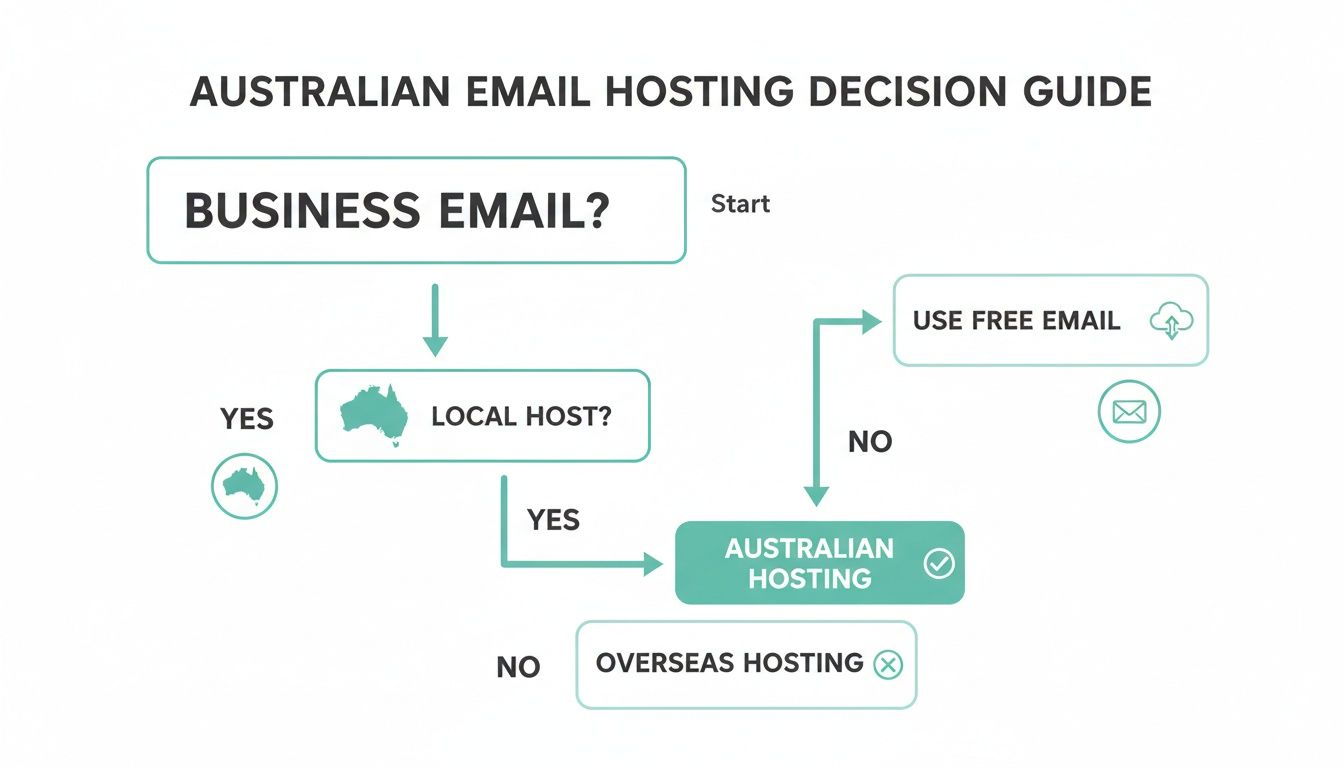
The main takeaway here is pretty clear: for any kind of professional communication, a free email service just doesn't cut it. That pushes businesses towards a choice between a local or an international paid provider.
Bundled cPanel Email Hosting: The All-in-One Solution
For most small to medium Australian businesses, bundled hosting is the most direct and budget-friendly option out there. This is what you often get included with web hosting plans, like those from UpTime Web Hosting, and it brings your website and email management together under one simple cPanel dashboard.
Here’s a practical example:
Imagine a local plumbing business in Perth with five staff. They need professional emails like info@perthplumbingsolutions.com.au, accounts@..., and one for each plumber. With a bundled plan, they can create all these accounts in minutes right from their web hosting panel, without any extra per-user cost. For step-by-step instructions, our knowledge base article on creating an email account in cPanel shows just how simple this is.
This approach delivers fantastic value. Many plans let you create unlimited email accounts and come with plenty of storage and solid security, all without the monthly per-user fees that dedicated suites charge.
Dedicated Email Suites: Power and Collaboration
On the other hand, you have dedicated suites like Google Workspace and Microsoft 365. These are heavy-duty platforms built from the ground up for teamwork. They give you top-tier email interfaces, plus integrated video calls, cloud storage, and document editing tools that are essential for teams that need to collaborate in real-time.
But all that power has a price tag—a recurring fee for every single user, every single month. For a growing team, those costs can really start to add up.
Let's look at another practical example:
A marketing agency in Melbourne with 15 staff members lives and breathes shared documents, client video calls, and synced calendars. For them, paying the monthly fee for Google Workspace is a no-brainer. The productivity they gain from using Google Docs, Meet, and Shared Drives easily justifies the cost.
While these suites are excellent, you have to be honest about whether your team will actually use all the bells and whistles. Paying for advanced collaboration tools that nobody touches is just money down the drain.
The core difference is clear: bundled hosting prioritises value and simplicity for essential business email, while dedicated suites prioritise advanced collaboration at a premium price. Your choice depends entirely on which of these your business values more.
Self-Hosted Email Servers: The Expert’s Path
The third road is setting up and managing your own email server. This gives you absolute control and customisation, but it’s a path best left to businesses with serious in-house technical skills and resources. While you get to skip the subscription fees, the hidden costs in time, maintenance, and security management are huge.
If you run your own server, you're the one on the hook for everything:
- Security: Setting up and constantly updating firewalls, malware scanners, and spam filters.
- Deliverability: Protecting your server’s IP reputation so your emails don't end up in spam folders.
- Uptime: Making sure the server is always online and figuring out how to do maintenance without taking everyone offline.
- Backups: Building and managing a bulletproof backup and disaster recovery plan.
For the vast majority of Australian businesses, the risks and technical workload of self-hosting are just not worth it. The simplicity, reliability, and security you get from a professional hosting provider is almost always the smarter, more practical choice.
To help you see the differences at a glance, we've put together a simple comparison table.
Email Hosting Solutions Comparison for Australian SMBs
This table breaks down the key differences between the three main approaches to help you decide which one aligns best with your business needs.
| Feature | Bundled Hosting (e.g., UpTime Web Hosting) | Dedicated Suite (e.g., Google Workspace) | Self-Hosted Email Server |
|---|---|---|---|
| Best For | Small to medium businesses, startups, and sole traders needing professional, low-cost email. | Teams that rely heavily on real-time collaboration tools like shared documents, calendars, and video conferencing. | Large enterprises or tech companies with dedicated IT staff and specific compliance or customisation needs. |
| Cost Structure | Usually included with a web hosting plan. No extra per-user fees, making it highly predictable and affordable. | Per-user, per-month subscription. Costs scale directly with the number of employees. | High initial setup cost for hardware/software, plus ongoing expenses for maintenance, security, and staff time. |
| Management | Simple management through a control panel like cPanel. No technical expertise required. | User-friendly admin console. Requires some setup but is generally easy to manage day-to-day. | Requires expert-level knowledge of server administration, security protocols, and email deliverability. |
| Key Features | Unlimited email accounts, generous storage, webmail access, robust spam filtering. | Advanced email interface, integrated cloud storage (Drive/OneDrive), video conferencing (Meet/Teams), document editors. | Complete control over every aspect of the email environment, from security policies to software customisation. |
| Data Sovereignty | Excellent, especially with an Australian host like UpTime, ensuring data is stored locally. | Data is often stored in global data centres; location can sometimes be selected but may not be guaranteed locally. | Full control. You decide exactly where your data is stored, making it ideal for strict compliance requirements. |
Ultimately, choosing the best email hosting Australia offers means finding the solution that fits your operations, team size, and budget without creating unnecessary complexity. For most SMBs, bundled hosting hits that sweet spot of professionalism, affordability, and ease of use.
Essential Criteria for Evaluating Email Hosts
Choosing the right email host isn't just about sticking your domain name on an email address; it’s about setting up a professional, secure, and reliable channel for your business communications. Get this decision right now, and you'll save yourself from a world of deliverability nightmares, security breaches, and support headaches down the track.
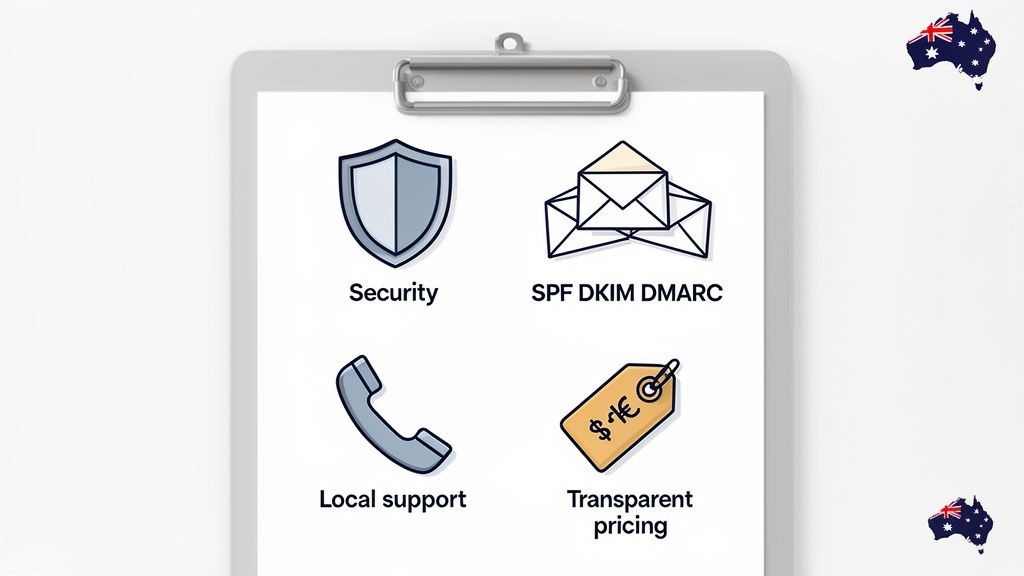
This means you need to look past the flashy marketing and dig into the technical nuts and bolts. We’re talking about the quality of the security, the provider's technical backbone, and how easy it is to get a real person on the phone when you need help. Let’s break down the non-negotiables every Aussie business should be looking for.
Deliverability and Email Authentication
If your emails are landing in spam folders, you might as well have not sent them at all. Strong deliverability is what gets your messages into your customers' inboxes, and that hinges on proper email authentication. These are the technical standards that prove to other email servers that you are who you say you are.
Three protocols form the bedrock of good email authentication:
- SPF (Sender Policy Framework): This is a record that lists all the mail servers authorised to send emails from your domain. Think of it like a bouncer with a guest list—if the server trying to send your email isn't on that list, it gets flagged as suspicious.
- DKIM (DomainKeys Identified Mail): This adds a digital signature to your outgoing emails, which the recipient's server can then check. It confirms the message hasn't been fiddled with in transit, which is a massive defence against phishing and spoofing.
- DMARC (Domain-based Message Authentication, Reporting & Conformance): This protocol is the final piece of the puzzle. It tells receiving servers what to do if an email fails the SPF or DKIM checks—either stick it in quarantine or reject it completely. It's the ultimate enforcer for your authentication policies.
A quality Australian host will make setting up these records a straightforward process, often through simple tools in cPanel or with clear, easy-to-follow guides like our knowledge base article on configuring DNS for email. Without solid authentication, your sender reputation takes a hit, and all your marketing efforts go to waste.
Security and Data Protection
In an age where cyber threats are a constant reality, security can't just be a line item; it has to be a priority. Your email account is a treasure trove of sensitive client data, internal chats, and financial information. For a small business, a breach can be absolutely catastrophic.
Your evaluation should put providers that offer multi-layered security front and centre. This should include proactive malware and virus scanning on every single email, both incoming and outgoing, to stop threats before they even get near your network. On top of that, look for DDoS-protected firewalls that shield servers from attacks designed to knock your services offline.
Another critical piece is a reliable backup system. A top-tier host won't just perform regular, automated backups of your email data; they'll store them off-site. This is crucial. It means that even if there's a server-wide disaster, your communications can be restored quickly and fully. If you want to learn more about blocking threats, you can explore resources on premium email filtering solutions.
Local Support and Accessibility
When something goes wrong, the quality of tech support suddenly becomes the most important thing in the world. For Australian businesses, the difference between local and offshore support is night and day. Having access to a team in your time zone who actually understands the local business environment is priceless.
Keep an eye out for providers that offer a 1300 number for direct phone support. It’s a simple thing, but it’s often a dead giveaway of a genuine local presence. It means you can talk to an Australian-based expert who can sort your problem out efficiently, instead of wrestling with time zone differences and language barriers with an offshore call centre.
Transparent Pricing and Hidden Costs
Finally, let's talk money. That advertised monthly fee is often just the tip of the iceberg. The best email hosting Australia has to offer is transparent, with all the costs laid out plainly from the get-go.
Always check for GST-inclusive pricing. A provider that shows prices in AUD and includes GST isn't just focused on the Australian market; they're saving you from a nasty surprise at the checkout. Be very wary of plans that seem ridiculously cheap—they often come with hidden fees for essentials like SSL certificates, backup restorations, or ridiculously tight storage limits. A good host bundles these features into their plans, giving you predictable, straightforward value.
The demand for integrated and reliable communication tools is only growing. Australia's hosted PBX market, which often goes hand-in-hand with email hosting for unified communications, generated around AU$360 million in 2024 and is expected to grow significantly. This trend just highlights how much Aussie SMBs rely on local providers who can deliver the low-latency, high-quality services they need.
When you're weighing up potential hosts, don't forget to look for advanced features like email forwarding with rules, which can seriously streamline your inbox management and help automate your workflows.
Host your website with our 5-star rated, cPanel website hosting plans.
Super fast servers, with security included and hosted in your choice of Australian Data Center.
View cPanel Plans
Real-World Email Hosting Scenarios for Aussie Businesses
Knowing the features of an email hosting solution is one thing, but seeing how it stacks up in the real world is what really counts. Let's shift from theory to practice and look at how different Australian businesses can find the right fit for their day-to-day operations. These examples show how the right choice can fuel growth, simplify workflows, and lock in a professional image.
For a lot of businesses, the journey begins with needing a professional email address to match their new website. If you're just starting out, our knowledge base has a great guide on how to set up your business email to build that all-important credibility from day one.
The Startup Founder Building a Brand
Picture a solo entrepreneur in Adelaide launching a new consulting business. Her main goal is to look professional and credible from the get-go. Handing out a business card with jane.consulting@gmail.com just doesn't cut it when you're pitching to serious clients; it instantly chips away at her perceived expertise.
For this founder, a bundled hosting plan from a provider like UpTime Web Hosting is perfect. It's affordable and dead simple. When she buys web hosting for her new site, she gets professional email hosting included, letting her create jane@adelaideconsulting.com.au straight away. That small change completely transforms how her brand is perceived, showing she’s a serious, established business.
Practical Takeaway: A bundled plan is the smartest way to get a professional email and web presence at the same time. It saves money and cuts out the technical headaches. For a founder watching every dollar, this all-in-one value is a significant advantage.
The eCommerce Store Managing Transactional Emails
Now, think about a growing online store in Brisbane selling handmade leather goods. Every time a customer makes a purchase, abandons a cart, or needs a shipping update, an automated email has to go out. The reliability of these transactional emails is everything—if they land in spam or don't arrive at all, it means more support tickets, lost sales, and a dent in their reputation.
This eCommerce business needs an email solution that guarantees top-notch deliverability. By using a local Australian host, their emails are sent from Australian IP addresses, which massively reduces the chances of being flagged as spam by local providers like BigPond or TPG. The solid infrastructure means thousands of order confirmations and shipping updates are sent and received without a problem, keeping the customer experience seamless.
Practical Takeaway: For e-commerce, deliverability isn't a feature; it's a core business requirement. Choosing a local host with a strong reputation for sending from clean, Australian IP addresses directly protects revenue and customer satisfaction.
The Digital Agency Juggling Multiple Clients
Finally, let’s look at a digital agency in Sydney managing websites and online marketing for 20 different clients. Each client needs multiple email addresses for their sales, support, and staff. The agency needs a way to handle all these accounts without getting bogged down in admin or facing crazy costs.
This is where the cracks in per-user pricing models really start to show. Trying to manage 20 separate Google Workspace or Microsoft 365 subscriptions would be an administrative nightmare and incredibly expensive. Every client would need their own subscription, creating a tangled mess of billing and user management.
Practical Takeaway: For a digital agency, the sheer simplicity of a single cPanel plan that offers unlimited email accounts is a game-changer. They can create and manage every single client email address from one dashboard, giving them a scalable and ridiculously cost-effective solution that dedicated suites just can't compete with. This centralised setup saves the agency countless hours and thousands of dollars every year.
Why UpTime Web Hosting Is a Top Choice in Australia
After wading through all the technical jargon around deliverability, security, and local support, it's pretty clear what most Aussie businesses need. The best email hosting Australia can offer isn't about flashy features; it's about getting the fundamentals right and keeping things simple. This is exactly where UpTime Web Hosting shines, offering a solution that feels like it was built specifically for Australian small and medium-sized businesses (SMBs).
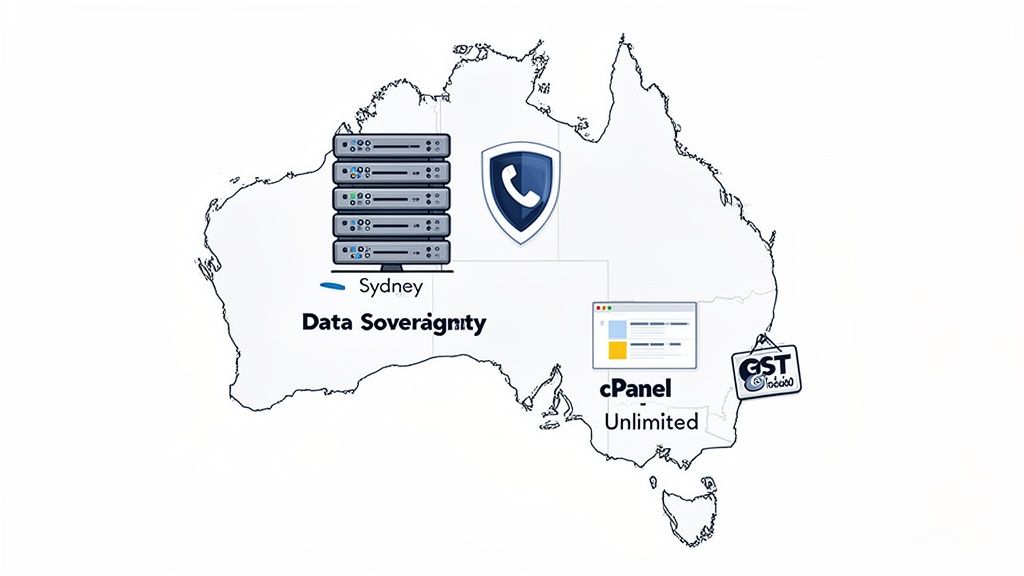
The real kicker is UpTime's 100% Australian infrastructure. With servers physically located in Sydney, your business data stays right here on Aussie soil. This isn't just a nice-to-have; it ensures you’re automatically aligned with local privacy laws and data sovereignty rules. On a practical level, it also means lower latency, so your emails send and arrive that little bit faster—a small win that adds up over thousands of daily communications.
Unbeatable Value with cPanel Hosting
UpTime Web Hosting’s cPanel plans tackle a major headache for many SMBs: per-user pricing. Instead of paying for every single email address, their plans let you create unlimited email accounts. For a growing business or a digital agency juggling multiple clients, this is a massive cost saving.
Let's look at a practical example. A small real estate agency in Brisbane with 10 agents needs a professional email for each person. A service like Google Workspace could set them back over $100 a month. With UpTime, they can set up all 10 accounts—plus extras for admin@ and info@—all under one affordable web hosting plan.
On top of that, you get a bunch of essential features bundled in at no extra cost, things other providers often charge for:
- Free SSL Certificates: To keep communications encrypted and show customers you're legitimate.
- Robust Security Suite: This includes proactive malware scanning and DDoS-protected firewalls to keep threats at bay.
- Generous Storage: Plenty of space for your emails and website files, so you're not constantly hitting a ceiling and being pushed to upgrade.
Transparent Pricing and Local Support
Dealing with international providers often means confusing pricing and support that's only available when you're asleep. UpTime cuts through all that nonsense with clear, GST-inclusive pricing in Australian dollars. No nasty surprises from currency conversions, making your budgeting simple and predictable.
But for many business owners, the real peace of mind comes from knowing that if something goes wrong, expert help is just a local phone call away. UpTime’s Australian-based support team, reachable on a 1300 number, is a huge advantage that delivers real, timely help when you need it most.
This commitment to keeping your business online is backed by a solid service level agreement. You can see their dedication to performance firsthand by reading about their 99.9% up-time guarantee on web hosting. It's not just marketing fluff; it's a documented promise that your business communications will be there when you need them.
Finally, UpTime offers no lock-in contracts, giving you the freedom to adapt as your business changes. It's this combination of local infrastructure, all-inclusive features, honest pricing, and accessible Aussie support that makes UpTime Web Hosting such a compelling choice. It’s a service built by Aussies, for Aussies, that just gets what local businesses need to thrive.
Your Questions About Australian Email Hosting, Answered
Making the final call on email hosting can feel like a big step. To clear up any lingering doubts, I've put together answers to the most common questions we hear from Australian businesses.
Can I Migrate My Existing Emails to a New Australian Host?
Yes, absolutely. Any decent provider, like UpTime Web Hosting, makes this a core part of their service. Most cPanel hosting plans come with built-in tools that simplify moving your emails from an old host.
Practical Example: If you're shifting from an international provider because your emails are painfully slow, a good local host will have a clear, proven process for importing your entire mailbox. For instance, UpTime's knowledge base article on migrating your emails provides a step-by-step guide. This means when you flick the switch, all your old messages are right there, and your business doesn't skip a beat.
The ability to seamlessly migrate existing emails is a key indicator of a customer-focused host. Look for providers who offer built-in tools or direct support, as this saves significant time and prevents the stress of potentially losing important business data during the switch.
What Is the Difference Between Email Hosting and Web Hosting?
It's a common point of confusion. Web hosting is the service that stores your website's files and makes them available online. Email hosting, on the other hand, is purely about managing your emails—the sending, receiving, and storing.
Many of the best Aussie providers, including UpTime Web Hosting, bundle both services together in their cPanel plans. This is a huge plus.
When you sign up for web hosting, you also get professional email addresses linked to your domain (like your.name@yourbusiness.com.au), which looks far more credible than a generic Gmail or Outlook account. A good way to think of it is that your web hosting is your business's physical address, while your email hosting is your branded, professional letterbox. If you want a deeper dive, this Bluehost article breaks down the differences nicely.
How Many Email Accounts Can I Create with My Hosting Plan?
This varies wildly and is a critical point to check. Many international providers will cap the number of email accounts you can have or charge you per user, which gets expensive fast as your team expands.
This is where a quality Australian host like UpTime Web Hosting really shines. Most of their cPanel plans let you create an unlimited number of email accounts. For a growing business, this is a game-changer. You can set up new mailboxes for staff or departments without ever worrying about extra fees.
- Practical Example: A local real estate agency with 15 agents can create an individual email for each one, plus mailboxes for
sales@andrentals@, all under a single, affordable plan. - The Alternative: With a service like Google Workspace, you'd be paying a separate monthly fee for every single one of those 17+ accounts. The bundled cPanel option is just far more cost-effective.
Is Australian-Based Email Hosting More Secure?
In short, yes. And for a few very important reasons. First, your data is physically stored on servers within Australia, meaning it's governed by Australian privacy laws. This gives you data sovereignty—you know precisely where your sensitive business information is and which legal framework protects it.
Second, local providers often have security measures specifically geared for the region. UpTime Web Hosting, for instance, doesn't treat security as an optional extra. These protections come standard on their plans:
- Free SSL Certificates: Encrypts all data moving between your email client and the server.
- Proactive Malware Scanning: Constantly on the lookout for threats in your inbox and sent items.
- DDoS-Protected Firewalls: Shields your email service from attacks designed to knock it offline.
- Encrypted Off-Site Nightly Backups: Your data is safely copied to a separate, secure location every night, just in case.
These layers work together to provide robust protection for your business communications, offering a level of security and legal peace of mind that many overseas hosts just can't match.
Ready to secure a professional, reliable, and 100% Australian email solution? UpTime Web Hosting offers all the features your business needs, from unlimited accounts and robust security to expert local support. Explore our cPanel hosting plans today and give your business the professional edge it deserves.