
Getting a .au domain is the first real step to cementing your business's identity online in Australia. It’s your digital handshake, telling every visitor straight away that you're a local, trustworthy operation. The whole process is pretty straightforward: you pick the right domain (like .com.au or the newer, shorter .au), make sure you're eligible, and then sign up through an accredited registrar.
Your First Step in the Australian Digital Space
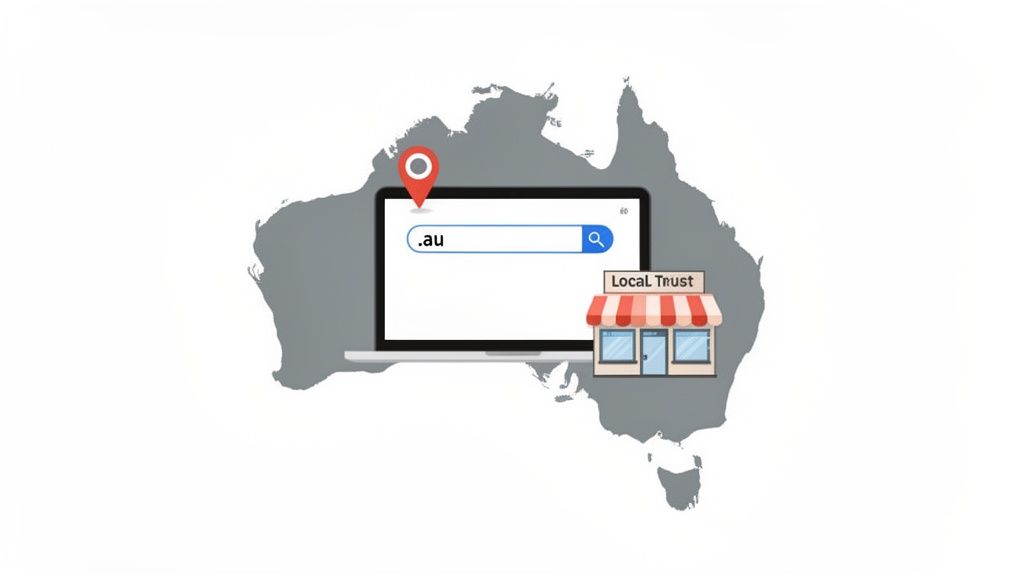
Registering a domain name here isn't just a tech task to tick off a list; it's a core business decision. Think of it as your street address on the internet. It’s what people will type in to find you, it’s a massive part of your brand, and it's absolutely crucial for building credibility with an Aussie audience.
To get started, it helps to understand the basics of domain name registration. In simple terms, you're claiming a unique name that points people to your website. Without it, you're practically invisible online.
Why a .au Domain Really Matters
Choosing a .au domain immediately tells people you're based in Australia. That small detail has a surprisingly big impact on how customers see you and can even give you a leg up in local search rankings. The truth is, Australians generally prefer to shop with and support local businesses, and your web address is the very first clue you give them.
And it's a booming market. The demand for Australian domains is stronger than ever, with well over 1.7 million already registered. The classic .com.au is still king, making up 64% of all registrations. In just one year, over 363,000 new .com.au domains were snapped up, which shows just how much confidence there is in the local digital economy.
Choosing a local domain isn't just about branding; it's a trust signal. When a customer sees '.com.au', they know they're dealing with an Australian entity, which can make all the difference in their decision to click, engage, or buy.
This guide will walk you through everything you need to know, step by step. We’ll cut through the jargon and give you a clear roadmap that covers:
- Picking the right extension: We’ll break down the difference between the traditional .com.au and the newer .au so you can decide what’s best for your brand.
- Checking your eligibility: You’ll find out exactly what you need, like an ABN, to qualify for a .au domain.
- The registration process: From brainstorming available names to finalising your purchase with a registrar.
By the time you're done, you'll be ready to lock in the perfect domain for your business. And if you're just at the beginning of your journey, you might also want to check out our guide on the essentials of starting an online business in Australia.

Performance you can feel, backed by clients who depend on it. Read how our support and uptime create long‑term customer success.Power Your Business with Better Hosting
How to Choose the Perfect Australian Domain Name
Picking a domain name is one of the biggest calls you'll make for your business. It's not just a web address; it's your brand's digital handshake, the sign above your virtual door, and the first thing customers will remember about you. A great name is a cinch to recall, easy to type, and tells people exactly what you're about.
Your first major decision is the extension. In Australia, you've got a few options, each with its own vibe. The classic .com.au is the undisputed heavyweight champ for commercial businesses, instantly telling everyone you're a registered Aussie entity. Then there's .net.au, which is traditionally the turf of tech companies and network providers. The new kid on the block, .au direct, offers a shorter, sharper alternative that’s quickly catching on.
Getting this choice right from the start shapes how your brand is seen online.
Decoding the .au Domain Extensions
Your choice of extension isn't just a style preference; it sends a clear signal to your audience and comes with specific eligibility rules. Nailing this is key to making a smart, strategic decision for your brand.
Here’s a quick look at how the popular .au domain extensions stack up, helping you decide which one is the right fit for your business.
Comparing Popular .au Domain Extensions
| Domain Extension | Primary Use Case | Eligibility Requirement | Best For |
|---|---|---|---|
| .com.au | Commercial entities | Must have an ABN/ACN | Most Australian businesses, from retail to services. |
| .net.au | Network infrastructure | Must have an ABN/ACN | IT companies, internet service providers, tech startups. |
| .org.au | Non-profit organisations | Must be a registered non-profit | Charities, community groups, and associations. |
| .au | General use | Must have a verifiable Australian presence | Any Australian business or individual looking for a modern, short name. |
For most businesses, the real tussle is between .com.au and the direct .au. The first has decades of trust built in, while the second is all about being modern, sleek, and memorable.
Brainstorming a Brandable and Effective Name
Once you've locked in an extension, it’s time to get creative. The trick is to find a name that's both practical and brandable—something that sticks in a customer's mind but is also dead simple to find and share.
Here are a few pointers to get your brainstorming session rolling:
- Keep It Short and Sweet: Shorter domains are easier to type and harder to get wrong. Think 'bunnings.com.au', not 'bunningshardwareandgardensupplies.com.au'.
- Make It Easy to Say and Spell: If you find yourself having to spell your domain name out over the phone, it’s a sign it's too complicated. Ditch the weird spellings, hyphens, and numbers.
- Mirror Your Brand: Your domain should give people a hint about what you do. For instance, a plumber in Perth might go for 'perthplumbingsolutions.com.au'—it’s clear, descriptive, and great for local search.
- Think About the Future: Steer clear of trendy buzzwords that might sound dated in a couple of years. You want a name that can grow right alongside your business.
A great domain name should be intuitive. If customers can guess your web address without being told, you’ve found a winner. This effortless discovery is a powerful marketing asset.
For a deeper dive into the creative process, our guide on finding catchy names for websites is packed with extra tips and tricks.
The Power of Local Identity
Grabbing an Aussie domain name plugs you straight into the local market. The .au domain family is a genuine powerhouse, with around 4.3 million registrations tied to Australia, making it one of the most popular country-code domains on the planet. This shows just how much Aussie businesses value that local connection. Globally, country-code domains like .au are growing by 2.4% each year as more businesses focus on their regional identity. You can dig into more of these global domain trends on Openprovider.com.
Let’s look at a local Melbourne café. They could be weighing up two options:
- melbournebestcoffee.com.au This name is an absolute gem for search engine optimisation (SEO). Anyone Googling "best coffee Melbourne" is going to find it.
- mbc.au This is short, modern, and super brandable. It would look fantastic on merchandise, social media handles, and business cards.
There’s no single right answer here; it all boils down to your business goals. Are you trying to get found easily in search results, or are you building a snappy, memorable brand?
Often, the smartest play is to register both. This protects your brand and helps you capture traffic from all angles. It ensures that whether a customer is searching for your services or recalling your brand name, they land exactly where you want them.
Making Your Domain Name Official
Alright, you've done the brainstorming, picked the perfect extension, and landed on a domain name that just feels right. Now it’s time to make it officially yours. This part of the journey is pretty straightforward, but it involves a few key steps to properly secure your new digital address. It all starts with one simple, crucial check.
First things first, you need to use a domain availability checker. Every accredited registrar has one of these tools on their site. Its job is to confirm if the name you want is actually free. Just because a website doesn't load when you type in a name doesn't mean it's up for grabs—it could be registered but sitting unused.
Pop your desired domain into the checker, and it’ll tell you instantly if it's available or already taken. If someone else has it, the tool will usually suggest some alternatives, maybe with a different extension or a slight tweak to the name. But if it’s free? Great! You can add it straight to your cart and kick off the registration process.
This visual guide breaks down those initial steps, from thinking up your ideal name to checking if it's available before you buy.
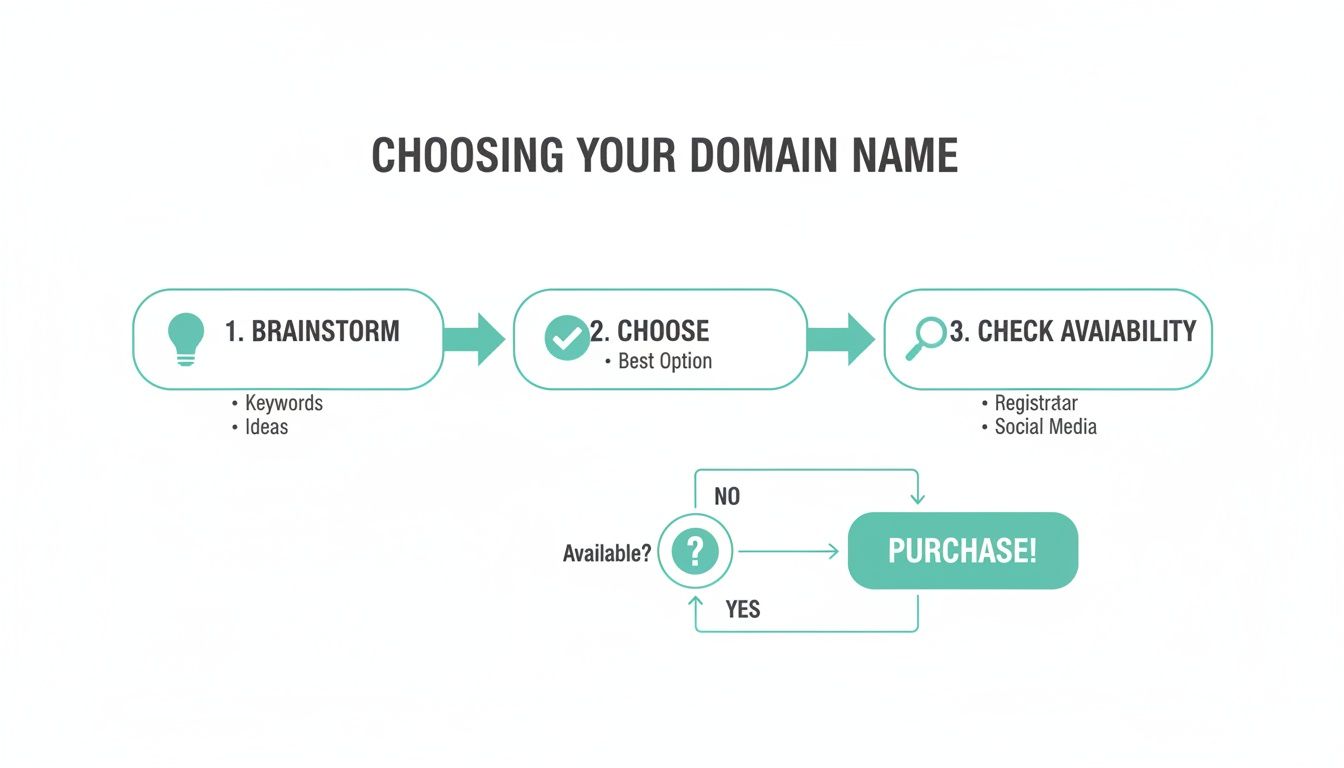
As the flowchart shows, checking for availability is the critical gateway between choosing a name and actually owning it.
Getting Your Registrant Information Spot On
Once you've confirmed your domain is available, you’ll be taken to the registration form. This is where you enter your details as the official owner, known as the registrant. The accuracy of this information is non-negotiable. It’s your legal proof of ownership and the primary contact info for any official notices from your registrar or auDA.
Here’s what you’ll need to provide:
- Registrant Name: The legal name of your business or your personal name.
- ABN/ACN: Your Australian Business Number or Australian Company Number is essential to meet the .au eligibility rules.
- Contact Details: A current email address and phone number that you check regularly.
A common mistake is using a generic or temporary email address. If you lose access to that inbox, you could easily miss critical renewal reminders or security alerts, which could mean losing your domain entirely. Always use a primary business email you have full control over.
Deciding on Your Registration Period
Next up, you have to decide how long you want to register the domain for. In Australia, you can typically register .au domains for a period of one to five years. While a one-year registration is the cheapest option upfront, locking it in for longer has some serious advantages.
For instance, a business that’s in it for the long haul might register for five years. This not only locks in the current price, shielding you from future price hikes, but it also cuts down on admin. You won't have to think about renewing it for half a decade.
Registering your domain for a longer period is a signal of stability. Search engines may interpret a longer registration as an indicator of a legitimate, long-term project, which can be a small but positive factor for your online credibility.
More importantly, it helps you avoid the nightmare scenario where a competitor snatches up your domain the second it expires because you missed a renewal email. The peace of mind that comes with a longer registration is often well worth the initial investment.
Choosing a Registrar and Finalising Your Purchase
The final step is to review your order and complete the payment. This is also where you officially choose a provider to handle your registration, known as a domain registrar.
Picking the right partner here is crucial for the long-term health of your domain. A good registrar offers transparent pricing, solid security features, and accessible local support. They’re the manager of your domain, helping you with everything from the initial setup to renewals and transfers down the track. For a bit more guidance, have a look at our detailed comparison of the best domain name registrars in Australia.
Once your payment goes through, the domain is officially registered to you. You'll get a confirmation email with all the details of your purchase. Congratulations—you now own a new piece of Australian digital real estate! From here, your next steps will be connecting it to your web hosting and building out your online presence.
Host your website with our 5-star rated, cPanel website hosting plans.
Super fast servers, with security included and hosted in your choice of Australian Data Center.
View cPanel Plans
Connecting Your Domain and Securing Your Identity
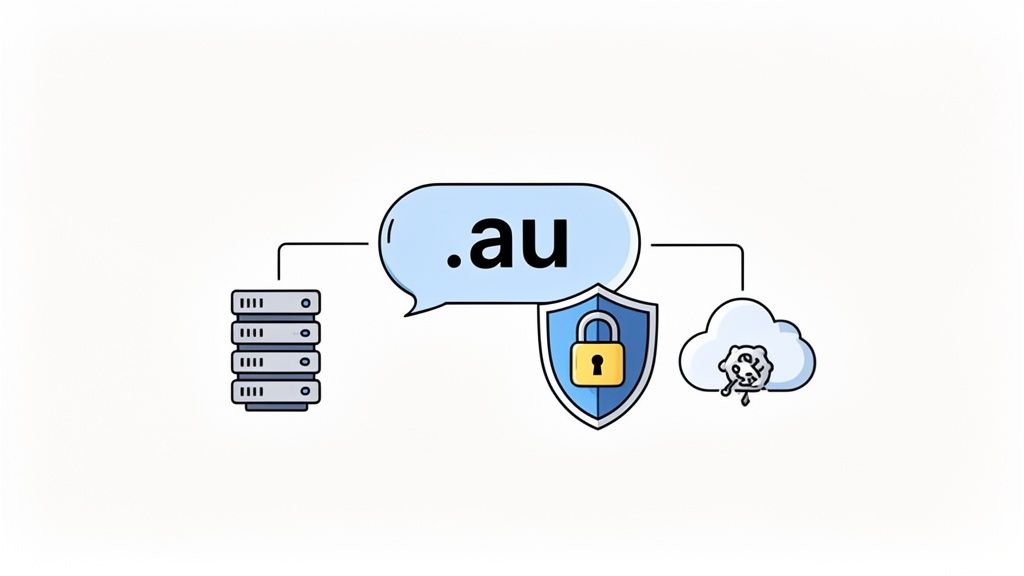
Getting your Australian domain name registered is a massive win, but it’s really just the first step. The real work begins now: bringing your domain to life by hooking it up to your website and wrapping it in security to protect your brand.
Think of your domain as a street address and your website as the house. Right now, they aren’t connected. To link them, you need to configure your domain's Domain Name System (DNS) settings. DNS is the internet's phonebook, translating your memorable domain name into the numerical IP address where your website actually lives on a server.
Making the Connection with Nameservers
This whole translation process is managed by things called nameservers. When you sign up for web hosting, your provider will give you at least two nameserver addresses. It’s your job to plug these into your domain registrar's control panel.
For instance, your hosting provider might give you nameservers that look something like this:
ns1.yourhost.com.auns2.yourhost.com.au
By pointing your domain to these nameservers, you're telling the global DNS system exactly where to send visitors who type in your web address. The update isn't instant; it can take a few hours for the changes to ripple across the internet. Once they do, your domain will successfully lead people straight to your website.
This simple update is the technical handshake between your domain registrar and your web host. Getting it right is essential for ensuring your website, emails, and other online services function correctly under your new domain name.
Once your website is live, setting up a professional email address is a logical next step. Our guide on how to set up your domain email can walk you through that process, which helps build even more trust in your brand.
Shielding Your Personal Information
When you register a domain name in Australia, your personal details—name, address, email—are added to a public database called WHOIS. This is a requirement for domain ownership, but it also leaves you wide open to spammers, data miners, and all sorts of unwanted contact.
This is where WHOIS Privacy (sometimes called Domain Privacy) comes in. It’s a service offered by most registrars that masks your personal contact information in the public WHOIS database, swapping it out for the registrar's generic details instead.
Imagine you're an online store owner in Brisbane. Without WHOIS Privacy, your home address could be publicly visible, creating both a security and a personal privacy risk. By flicking this service on, you protect your personal info while keeping full legal ownership of your domain. It's a must-have.
Advanced Security for Your Domain
Beyond basic privacy, you need to think about fortifying your domain against more serious threats like hijacking and spoofing. Two key technologies give you this advanced level of protection: DNSSEC and Registry Lock.
- DNSSEC (Domain Name System Security Extensions): This adds a layer of authentication to your DNS records. It uses digital signatures to guarantee that when a visitor types in your domain, they land on your actual website and not a malicious fake one. Think of it as a tamper-proof seal for your site's directions.
- Registry Lock: This is one of the highest levels of security you can get. It prevents any unauthorised changes to your domain at the registry level itself, including transfers, deletions, or nameserver updates. To make any changes, you have to go through a multi-step verification process, making it nearly impossible for hijackers to seize control.
For any kind of e-commerce business, these security measures are completely non-negotiable. They protect your reputation and safeguard the trust your customers place in you when they hand over their personal and financial details. By securing your domain, you're not just protecting an asset; you're building a foundation of trust for your entire online operation.
Managing Your Domain for Long-Term Growth
Getting your domain name registered is a huge win, but the job isn't over. Think of your domain as a critical business asset, not just a one-time purchase. It needs ongoing attention to protect your brand and support your business as it grows.
The single most important part of this is making sure your domain never expires. An expired domain can be snapped up by a competitor in minutes. Suddenly, all your hard-earned traffic is being redirected to their site, or they're holding your brand name hostage. The damage to your brand, customer trust, and search engine rankings can be devastating.
The Lifesaver Known as Auto-Renewal
The easiest way to sidestep this disaster is to switch on auto-renewal with your registrar. It's a simple feature that automatically renews your domain before it expires, usually charging the payment method you have on file. It’s a tiny setting that delivers massive peace of mind.
Imagine a busy plumbing business in Sydney has a chaotic week and completely forgets their renewal date. Without auto-renewal, their domain could lapse overnight. Their website and emails would go dark, and a rival company could register their exact domain name. The financial cost and reputational hit of recovering from that would dwarf the small annual renewal fee.
Enabling auto-renewal is the most effective thing you can do to protect your primary digital asset. It's just a simple toggle in your account dashboard that can save you from the catastrophic loss of your online identity.
If you're ever worried about your domain's status, it helps to understand what happens when a domain name has expired and what the recovery process looks like.
Transferring Your Domain with Confidence
As your business evolves, you might find a better deal or service elsewhere and decide to switch providers. Moving your domain from one registrar to another is called a domain transfer. It’s a completely standard procedure, but you need to handle it with care to avoid any hiccups.
To prevent someone from moving your domain without your permission, registrars use a Transfer Lock (sometimes called a Registry Lock). When this is on, your domain is frozen in place. Before you can start a transfer, you’ll need to log into your current registrar’s account and turn this lock off.
Once it's unlocked, you'll get an authorisation code (often called an EPP code). You'll give this code to your new registrar to kick off the transfer. The whole process can take a few days, but any good registrar will keep you in the loop every step of the way.
Common Mistakes to Avoid
Good domain management really comes down to avoiding simple but costly mistakes. Just staying on top of your details and settings is half the battle.
Here’s a practical checklist of common slip-ups that can catch out even seasoned business owners:
- Outdated ABN/ACN Details: Your eligibility for a .au domain is directly tied to your Australian business registration. If your ABN or ACN lapses or the details change, you could lose the right to your domain. Make sure you update your registrar immediately if your business status changes.
- Using a Personal or Old Email: It’s tempting to use a personal
gmail.comaddress or an old ISP email likebigpond.com, but it’s a huge risk. If you lose access to that inbox, you’ll miss critical renewal reminders and security alerts. Always use a primary business email that you check daily. - Ignoring WHOIS Accuracy: The contact information in your WHOIS record has to be current. It's not just for public records; it’s how registrars and auDA (the .au domain administrator) send you official notices. Incorrect info can lead to compliance problems or, in the worst case, a lost domain.
Answering Your Australian Domain Questions
Even after you've got the basics down, it’s normal to have a few questions rattling around when you're registering a domain in Australia. The rules here have their own quirks, and getting a straight answer can make all the difference. Let's tackle the most common queries we hear from Aussie business owners.
How Long Does Domain Registration Take?
This is one of the first things people ask, and the good news is, the actual registration part is practically instant. Once you've picked your name, popped in your details, and paid up, your registrar locks in that domain for you within minutes.
But there's a small catch. While the domain is officially yours straight away, it can take a little while for it to work properly across the globe. This waiting game is called DNS propagation, and it can take anywhere from a few hours up to 48 hours. It's the time it takes for the internet's global network of servers to update and learn where your new domain is supposed to point.
So, while you own it immediately, you might need to be patient for a day or two before your website and emails are 100% reliable for everyone, everywhere.
Can I Register a .au Domain Without an ABN?
This is a big one. For the classic business extensions like .com.au and .net.au, the answer is generally no. These are specifically for commercial outfits, so you’ll need to provide a valid Australian Business Number (ABN) or Australian Company Number (ACN) to prove you're eligible.
Things are a bit more flexible with the newer, direct .au domains, though. To snag one of these, you just need a verifiable Australian presence. An ABN or ACN is the most common proof, but you can also use other identifiers, such as:
- An Australian driver's licence
- An Australian passport
- An Australian Trademark number
This cracks the door open for individuals, sole traders who might not have an ABN, or other local entities to get a shorter, sharper domain name. For the full list of eligibility criteria, check out auDA's helpful .au direct knowledge base article.
The bottom line is that every .au domain requires a clear connection to Australia. It's this rule that keeps the .au namespace trusted and lets visitors know they're dealing with a local.
What Happens If My Business Details Change?
Businesses evolve—you might move office, rebrand with a new trading name, or update your ABN. When that happens, it's absolutely critical to update your domain's registrant information straight away.
Your contact information, especially your email and ABN/ACN, is your proof of ownership. If it's out of date, you could miss vital renewal reminders or security alerts from your registrar. Even worse, if auDA does an eligibility check and finds your details don't line up with the official business register, your domain could be suspended or even deleted.
Here’s a real-world example:
Imagine a Melbourne consulting firm, "Innovate Solutions Pty Ltd," moves from Collingwood to a new office in Richmond. They must log into their domain registrar's portal and update the address in their domain's WHOIS contact info. If they forget, any official letters or notices will go to the old address, which could lead to serious headaches.
Making these updates is usually a simple job in your registrar’s control panel. For bigger shifts like a change of business ownership, you'll likely need to follow a formal "Change of Registrant" process, which you can learn more about on our domain name services page.
Can I Register a Domain Name That Is Already Taken?
In a word: no. Domain names are unique real estate. Once a name is registered, it's off the market until it expires and gets released back into the wild. You simply can't register yourbusiness.com.au if another company already has it.
But don't despair—you still have options:
- Try a Different Extension: If
yourbusiness.com.auis gone, isyourbusiness.auoryourbusiness.net.auavailable? - Make a Small Tweak: Think about adding a location or a keyword that makes sense. If "fastplumbing.com.au" is taken, you could try "fastplumbingsydney.com.au".
- Contact the Owner: You can use a WHOIS lookup tool to find the owner's details (if they aren't hidden by privacy) and make an offer to buy it. Be warned, this can get expensive and is often a long shot.
- Use a Backorder Service: Some registrars offer a service that tries to automatically register the domain for you the instant it expires. It’s a competitive game, and there’s no guarantee of success.
The best approach is always to have a few alternative names up your sleeve before you start the registration process for your Australian domain name.
Ready to secure your Australian domain name and build a powerful online presence? At UpTime Web Hosting, we make the process simple and secure. Find your perfect .au domain and get started with our fast, reliable, and 100% Australian hosting today.
Register Your Domain Name Here