You’ve probably run into this already without realising it.
A client asks where their customer data is stored. Your accountant mentions privacy obligations. Your web developer says your site is “hosted in Australia”, so you assume that box is ticked. Then someone brings up “data sovereignty”, and suddenly it sounds like one of those terms that only lawyers and enterprise IT teams need to worry about.
For a small business, that’s the wrong way to look at it.
If your website collects enquiries, your online store takes orders, your staff use business email, or your booking system stores customer details, you’re handling data that matters. Australian data sovereignty hosting is about keeping control of that data under Australian legal and operational control, not just renting server space somewhere nearby. That distinction affects privacy compliance, breach response, customer trust, and the contracts you sign with suppliers.
Why Australian Businesses Must Care About Data Sovereignty
A common small business scenario goes like this. You run a clinic, tradie business, agency, online shop, or professional service. Your website is live, emails are flowing, bookings are coming in, and everything works. Then a customer asks whether their information stays in Australia.
That’s usually the moment the issue becomes real.

For years, many businesses treated hosting as a speed-and-price decision. Faster page loads, enough storage, decent support. Those things still matter, but they’re no longer the whole picture. The Australian Government’s 2022 Data Strategy aims to make Australia a data-driven society by 2030, and it puts secure data practices at the centre of that goal. At the same time, about 59% of Australian businesses use cloud services, which increases the pressure to keep data under Australian jurisdiction and aligned with rules such as the NDB scheme, as outlined in Sprintlaw’s overview of Australian data sovereignty requirements.
It’s not just an IT issue
If your site stores contact forms, invoices, medical details, support tickets, or payment-related records, hosting decisions affect more than uptime.
They affect:
- Customer trust. People want to know who can access their information.
- Legal exposure. Privacy obligations don’t disappear because a third-party provider is involved.
- Operational control. When something goes wrong, you need access to logs, backups, and support without cross-border confusion.
- Supplier risk. A provider’s ownership structure can matter as much as server location.
A lot of business owners first encounter this through a simple question: “Are your servers in Australia?” That’s a useful question, but it isn’t enough on its own.
Practical rule: If your host only talks about location and avoids questions about ownership, access, backups, and legal jurisdiction, keep digging.
What this means for your website and email
Think about the systems most SMEs rely on every day:
- WordPress websites collecting lead forms
- eCommerce stores storing customer names, addresses, and order histories
- Business email holding contracts, personal details, and internal discussions
- Client portals used by accountants, consultants, and agencies
All of these create data trails. If that data sits in a setup controlled by offshore entities, your compliance position can become murky very quickly.
For businesses comparing infrastructure options, it helps to understand the benefit of cloud hosting for Australian websites while also asking where control sits, not just where performance comes from.
Why this matters now
Australian businesses aren’t being asked to become privacy specialists overnight. But they are expected to act sensibly, especially when handling customer information. Hosting is one of the easiest places to make a better decision early instead of cleaning up a mess later.
That’s why Australian data sovereignty hosting matters. It turns a vague compliance concern into a concrete business decision you can control.

Performance you can feel, backed by clients who depend on it. Read how our support and uptime create long‑term customer success.Power Your Business with Better Hosting
Data Residency versus True Data Sovereignty
Many individuals often misunderstand this point.
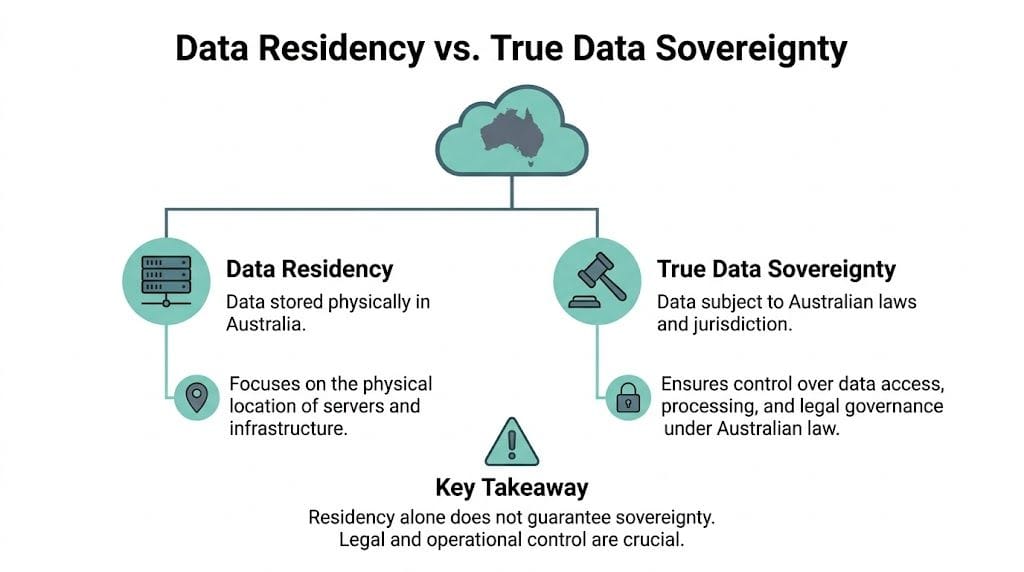
They hear “Australian hosting” and assume the problem is solved. Sometimes it is. Often it isn’t. The reason is simple: data residency and data sovereignty are related, but they’re not the same thing.
Data residency means where the data sits
Data residency is the physical location of your data.
If your website files, database, and backups are stored on servers in Sydney or Melbourne, your data has Australian residency. That’s useful. It can support local performance, simpler compliance discussions, and clearer operational handling.
But residency only answers one question: where is the data stored?
It doesn’t answer:
- Who owns the provider
- Which laws may apply to the provider
- Whether backups or admin access go offshore
- Whether foreign support staff can reach the system
- Whether a parent company overseas can be compelled to disclose data
True sovereignty means who has legal and operational control
Now use a simple analogy.
You rent a storage unit in Sydney. Your boxes are physically in Australia. That’s residency. But if the company that owns the storage facility is controlled from another country and can be legally forced to hand over access, then your control isn’t purely Australian. That’s a sovereignty problem.
The same logic applies to hosting.
According to NEXTDC’s explanation of sovereignty versus residency, data residency does not guarantee data sovereignty. True sovereignty means the data is subject to Australian law and shielded from extraterritorial access demands such as those that can arise under the US CLOUD Act. That distinction matters even more under the 2024 Privacy Act reforms, where businesses may need to show real control rather than just local server placement.
Data in Australia can still be exposed to foreign legal reach if the provider’s ownership or operating model sits outside Australia.
A practical example for a small business site
Say you run a WooCommerce store selling locally made products.
Your host advertises “Australian servers”. Good start. But then you learn that:
- the parent company is overseas
- backups are replicated outside Australia
- support engineers in other countries can access the environment
- some system analytics are processed offshore
You still have local residency for some parts of the setup. You may not have true sovereignty.
Now compare that with a provider that keeps hosting, backups, staffing, and access controls inside Australia, with contracts that support that arrangement. That’s much closer to the intended goal.
A simple comparison
| Concept | What it answers | What it does not guarantee |
|---|---|---|
| Data residency | Is the data physically stored in Australia? | Australian-only legal control |
| Data sovereignty | Is the data controlled under Australian law and operations? | Nothing by itself. It usually requires residency plus ownership and access controls |
What to ask when providers use vague wording
Marketing language can blur this distinction. If a host says “local infrastructure” or “APAC region”, that’s not the same as a clear sovereignty answer.
Ask these instead:
- Are you Australian owned and operated?
- Are all backups kept in Australia?
- Can offshore staff access customer systems or support tools?
- Do any subprocessors handle data outside Australia?
- Does your contract state Australian jurisdiction for hosted customer data?
If you’re weighing local hosting against multinational cloud platforms, this comparison of Australian hosting and global cloud providers is a useful starting point for thinking about ownership, access, and support layers, not just server geography.
Once you understand this distinction, a lot of hosting claims become much easier to read. “Hosted in Australia” might be enough for some low-risk uses. For customer records, sensitive business information, and regulated workloads, sovereignty is the bigger question.
Australia's Key Data Laws and Your Obligations
Most small business owners don’t need to memorise legislation. They do need to know where the pressure points are.
In Australia, there isn’t one single all-purpose data localisation law that covers every business in every situation. Instead, sovereignty obligations come from a mix of privacy rules, sector requirements, government frameworks, and customer contracts. That’s why the issue can feel confusing. The rules don’t always arrive under one label.
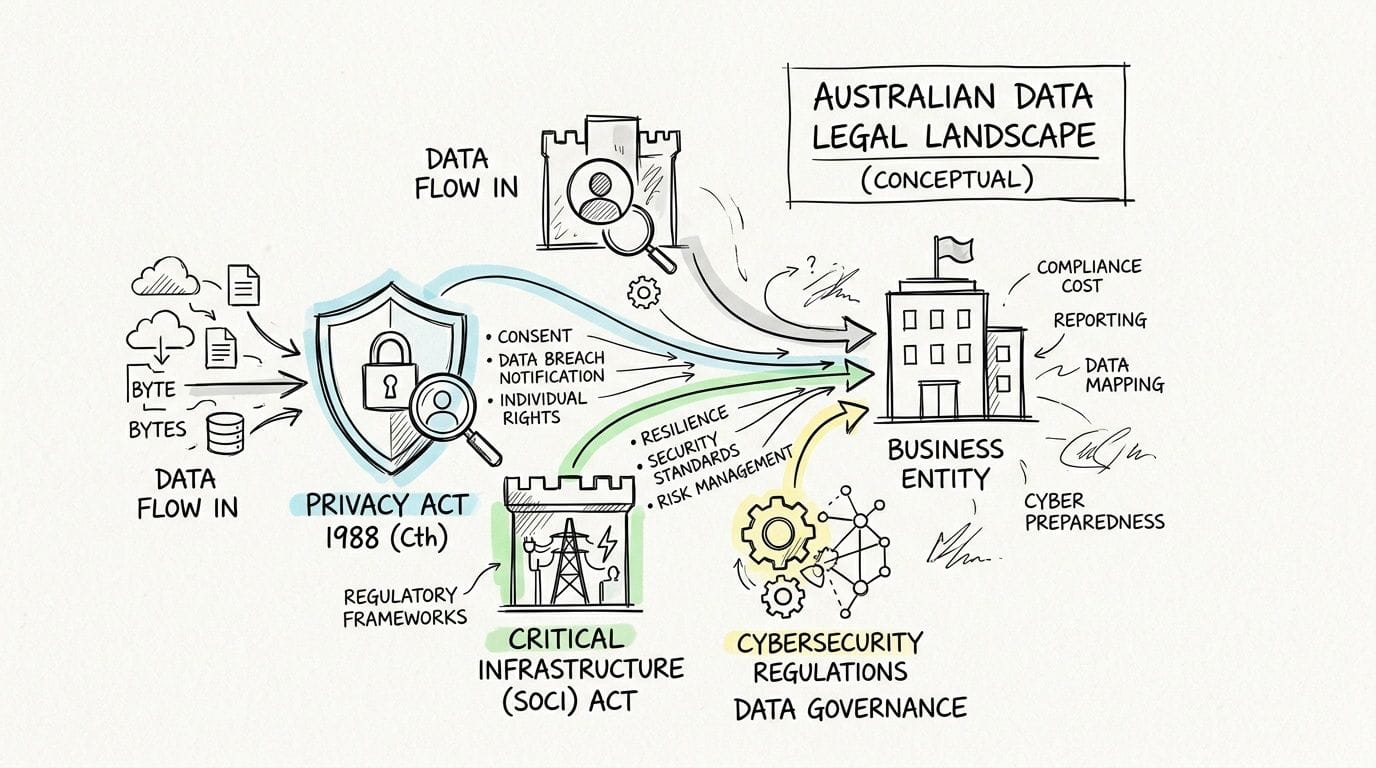
The Privacy Act and cross-border risk
A key concept for many businesses is APP 8, which deals with cross-border disclosure. In plain language, if your business sends personal information overseas, or allows it to be accessed overseas through the way your systems are set up, that can create obligations and risk for you.
This is one reason hosting choices matter. Your provider may be handling storage, backups, admin access, monitoring, or support. If any of those functions cross borders, you may have more to answer for than you expected.
A lot of organisations are now thinking more seriously about reclaiming data sovereignty because control over records, systems, and access rights has become a governance issue, not just a technical one.
The 2024 reforms changed the stakes
The legal environment became much sharper with the recent reforms.
As reported by Australian Cyber Security Magazine’s analysis of offshore cloud risks and Privacy Act changes, the 2024 Privacy Act reforms introduced tiered penalties that can reach $50 million for serious interferences, or 30% of annual turnover, and qualifying breaches must be reported to the OAIC within 72 hours.
That changes the practical conversation for SMEs.
A breach isn’t just about whether data was exposed. It’s also about how quickly you can determine:
- what happened
- what data was involved
- where logs are stored
- who has access
- whether third parties are involved
- how fast you can notify the regulator
When data, backups, and admin visibility are fragmented across foreign systems, breach response gets harder at the exact moment speed matters most.
Sector rules can be even stricter
Some industries have tighter expectations than general business websites.
Healthcare is the obvious example. The My Health Records Act prohibits health data from leaving Australia. Finance, government contracting, and critical infrastructure often face local hosting expectations through regulation, procurement rules, or contractual clauses. Even outside those sectors, many customer agreements now include language such as “customer data must be hosted in Australia” and “no offshore support access”.
If you run an agency, software business, online retailer, or service firm, that means client contracts may impose sovereignty obligations before a regulator ever does.
What this means in day-to-day business terms
Legal obligations usually show up in ordinary moments, not dramatic ones.
| Business situation | Why hosting control matters |
|---|---|
| Customer asks where their data is kept | You need a clear, truthful answer |
| A client contract requires Australian hosting | Your provider must support that promise |
| A breach occurs | You need fast access to logs, backups, and support |
| A supplier audit lands in your inbox | You need documentation, not guesswork |
Many businesses tighten their cybersecurity and data protection settings only after a scare. It’s better to line up hosting, access controls, and backup arrangements before legal urgency forces the issue.
The real obligation
You don’t need perfection. You need demonstrable control.
That means choosing providers carefully, understanding where your data flows, and making sure your contracts don’t inadvertently undermine your compliance position. For many SMEs, that’s the difference between being able to answer client questions confidently and having to admit they’re not really sure where the data goes.
Host your website with our 5-star rated, cPanel website hosting plans.
Super fast servers, with security included and hosted in your choice of Australian Data Center.
View cPanel Plans
Achieving Sovereignty with Technical and Contractual Controls
Data sovereignty isn’t achieved by a single checkbox. It comes from layers.
A provider can place a server in Australia and still leave gaps through offshore backups, foreign ownership, remote admin access, or vague contract terms. Real control comes from the technical setup and the paperwork matching each other.
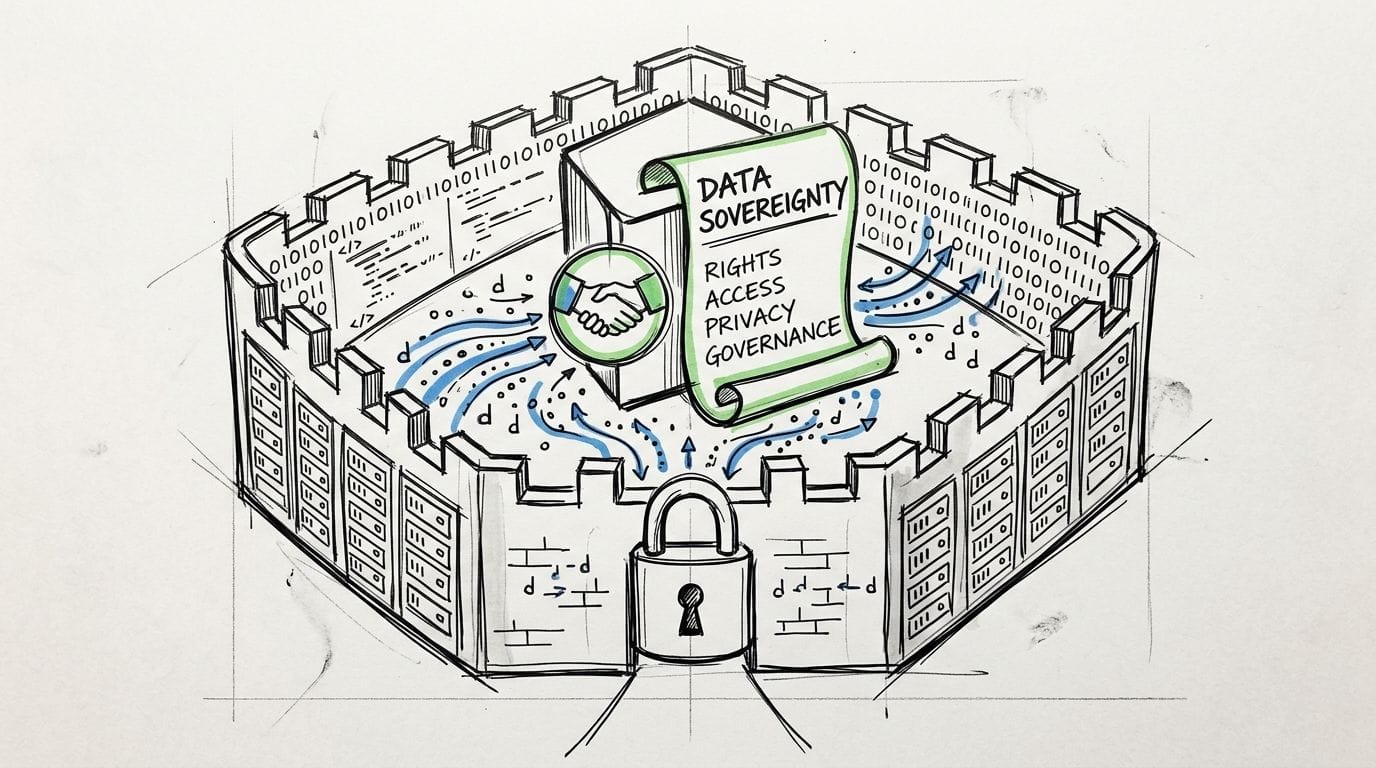
Start with the hosting environment
The first layer is straightforward. Your data centres, servers, storage, and backups should be in Australia if sovereignty is the goal.
But don’t stop there. Ask whether the provider also keeps these functions onshore:
- Support access for troubleshooting and account help
- Backup storage for disaster recovery copies
- Monitoring and logging used during incidents
- Administrative tooling that can expose customer data
- Subprocessors involved in support, analytics, or infrastructure management
A local server with offshore backup replication is a common weak spot. So is an Australian front-end service backed by overseas support systems.
The government gold standard
For businesses wanting a strong benchmark, the Australian Government’s Hosting Certification Framework is useful because it turns broad ideas into concrete criteria.
According to Macquarie Data Centres’ guide to Australian data centre sovereignty, the HCF sets out three certification levels, and Certified Strategic is the highest sovereignty standard. To reach it, data centres must be Australian-owned, located in Australia, staffed by Australian personnel, and use geo-locking so data movement stays restricted to certified Australian facilities. The framework aligns directly with the PSPF.
That matters even if you’re not a government buyer. It gives private businesses a practical reference point for what “serious about sovereignty” looks like.
Key test: Ask whether data can move offshore for backups, analytics, support, or parent-company operations. If the answer is unclear, sovereignty is unclear.
Contracts matter as much as infrastructure
Technical controls are only half the job. Your agreement with the provider should support the same outcome.
Look for contract terms covering:
- Australian jurisdiction for the service relationship and hosted data
- Approved subprocessors and where they operate
- Access restrictions on support and engineering staff
- Data deletion rules when the service ends
- Backup handling so copies don’t remain overseas
- Audit or documentation rights so you can answer client due diligence questions
This is also why some businesses look at adjacent tools with strong control and verification models, including blockchain solutions for enterprises, when they need more transparent audit trails around records and transactions. It doesn’t replace hosting governance, but it shows how operational control and provable integrity often need to work together.
A simple way to assess a provider
You don’t need a procurement department to do a sensible review. Use this quick lens:
| Layer | What to confirm |
|---|---|
| Ownership | Is the provider Australian owned, or controlled offshore? |
| Location | Are servers and backups kept in Australia? |
| People | Are support and admin staff based in Australia? |
| Movement | Is data geo-locked so it doesn’t transit offshore? |
| Contract | Do the terms match the provider’s marketing claims? |
For example, UpTime Web Hosting states that it is Australian owned and provides local hosting with encrypted off-site backups in Australia across Sydney, Melbourne, Brisbane, and Perth. For an SME, those are the kinds of specifics worth looking for in any provider because they map directly to sovereignty questions.
Security controls still matter
Sovereignty doesn’t replace security basics. You still want encryption, access control, malware scanning, DDoS protection, and disciplined backup practices.
A sovereign setup with weak security is still weak. A secure setup with offshore legal exposure is still exposed. You need both.
This is the accurate depiction. Australian data sovereignty hosting works when legal control, technical design, staffing, and contracts all point in the same direction.
The Hidden Risks of Non-Sovereign Hosting
The biggest problem with non-sovereign hosting is that it often looks fine right up until you need to prove control.
Your website may run smoothly. Support may be quick. Pricing may be attractive. None of that tells you whether your business can confidently answer a client questionnaire, handle a privacy incident, or explain who can access customer data behind the scenes.
Foreign legal reach is the part many businesses miss
A provider can advertise Australian data centres and still sit inside an ownership structure that exposes customer data to foreign legal demands. That’s the risk behind discussions of the US CLOUD Act and similar extraterritorial issues. The technical location of the server doesn’t always decide the legal story.
For a small business, that can create an awkward gap between what you believe and what your provider can guarantee.
If you tell customers their information is “kept in Australia”, they may hear “and controlled only here”. Those aren’t always the same promise.
Hidden movement happens in the background
Many sovereignty problems don’t come from the main hosting environment. They come from all the side channels around it.
Examples include:
- Backups copied to overseas storage
- Support systems accessed by offshore teams
- Monitoring platforms that process log data outside Australia
- Third-party plugins or tools sending user information elsewhere
- Parent-company administration performed under non-Australian legal regimes
These issues are easy to miss because they sit outside the main website dashboard. Your site owner sees “Sydney server” and assumes the rest follows.
It may not.
AI and analytics create a new sovereignty gap
There’s also a newer challenge that doesn’t get discussed enough. You can store data onshore and still lose sovereignty when you process it elsewhere.
As noted in Kate Carruthers’ discussion of Australia’s compute sovereignty gap, Australia’s limited local research compute capacity can force organisations to use foreign cloud platforms for AI and analytics. In practice, that means data may reside in Australia but leave local control when businesses analyse customer behaviour, run machine learning workloads, or use advanced data tools. The result can be sovereignty that is more symbolic than real.
If your customer data is hosted locally but analysed on foreign infrastructure, your sovereignty position may weaken exactly where your business is becoming more data-driven.
Why this matters for ordinary SMEs
You don’t need to be training large AI models to feel this issue.
A retailer might export customer behaviour data into an overseas analytics platform. A marketing agency might use offshore tools to process client datasets. A healthcare-adjacent business might adopt software with support access from outside Australia. Each step can create a gap between “local hosting” and “local control”.
If you’re trying to move away from multinational setups, these alternatives to global hosting brands in Australia are worth reviewing as part of a broader sovereignty check, especially if your current provider talks more about global scale than Australian jurisdiction.
The risk isn’t only legal. It’s operational. Once your systems depend on offshore layers, proving compliance and responding to incidents gets slower, murkier, and more expensive.
Your Checklist for Choosing a Sovereign Hosting Provider
Most provider pages make broad claims. You need sharper questions.
This checklist works well for business owners, office managers, developers, and agencies doing due diligence. You don’t need to ask every question in technical language. What matters is whether the provider gives clear, direct answers.
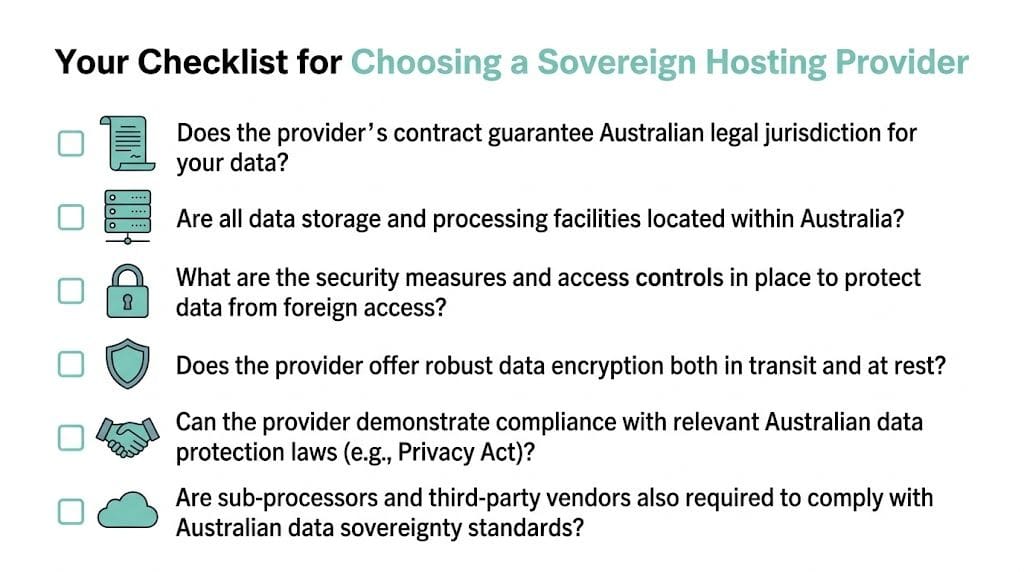
The six questions that matter most
- Who owns the business?
Ask whether the provider is fully Australian owned and operated. If ownership sits offshore, follow up on how that affects legal jurisdiction and access rights. - Where are all copies of my data kept?
Don’t just ask about the live server. Ask about backups, snapshots, staging copies, and disaster recovery systems. - Who can access my hosting environment?
You want to know whether support staff, system administrators, and contractors are based in Australia or can operate from overseas. - What do your contracts say?
Marketing copy is helpful, but contracts are what matter when something goes wrong. Look for jurisdiction, subprocessors, deletion terms, and access limits. - How is data protected?
Ask about encryption, malware scanning, firewalling, DDoS protection, and account access controls. Sovereignty without security still leaves you exposed. - Can you help me answer client compliance questions?
Good providers should be able to explain their setup clearly enough for you to pass that information to clients, auditors, or procurement teams.
A quick red-flag table
| If a provider says this | Treat it as a warning sign |
|---|---|
| “We have APAC infrastructure” | That may include countries outside Australia |
| “Your site is hosted locally” | That may not cover backups or admin access |
| “Our support is global” | Ask exactly who can access your systems |
| “We use trusted third parties” | Ask where those third parties operate |
Useful follow-up questions
If the first answers sound polished but vague, send these:
- Are your backups stored only in Australia?
- Do any offshore staff have access to support tools or customer environments?
- Do you use overseas subprocessors for monitoring, security, or analytics?
- Can you confirm Australian jurisdiction in writing?
- What happens to my data when I cancel the service?
The right provider won’t act annoyed by careful questions. They’ll expect them.
Match the hosting type to the data risk
Different services need different levels of scrutiny.
- Simple brochure sites still need sensible local hosting if they collect enquiry forms.
- WordPress and WooCommerce sites need closer attention because they often hold customer and order data.
- Managed VPS environments need especially clear answers on admin access, backups, and subcontracting.
- Email hosting deserves the same scrutiny as website hosting because inboxes often hold the most sensitive information in the business.
When you compare options, review the provider’s pages for the relevant service type, such as cPanel hosting, WordPress hosting, Windows hosting, managed VPS, business email, and knowledge base articles covering backups, security, and support processes. A trustworthy setup is usually visible across both product pages and documentation, not hidden behind sales language.
Register your new domain name at competitive market prices including free domain add-ons like privacy, DNS Hosting, Custom Nameservers and Forwarding.
Always the best price and no nasty renewal price hikes.
Register A Domain Name
Australian Data Hosting Frequently Asked Questions
Is sovereign hosting always more expensive?
Not always. Local sovereign hosting can cost more in some cases because Australian infrastructure, staffing, and compliance controls aren’t free. But the cheapest option on paper can become expensive if it creates contract problems, audit headaches, or a slow breach response.
For many SMEs, the better question is whether the price difference is justified by clearer legal control and easier compliance. Often it is.
Will an Australian host slow down my site for overseas visitors?
Usually, Australian hosting is a strong fit for businesses serving Australian customers first. If most of your traffic, customers, and staff are here, local hosting often improves the experience that matters most.
If you also serve overseas visitors, performance can still be managed with sensible caching, image optimisation, and content delivery techniques. You don’t need to give up sovereignty just because a few users come from other regions.
If my servers are in Australia, am I fully covered?
No. Server location is only part of the picture.
You still need to look at ownership, support access, backups, subprocessors, contracts, and any third-party software on the site. That’s why the difference between residency and sovereignty matters so much.
What if my developer uses international plugins or SaaS tools?
That’s common, and it’s one of the easiest ways to create hidden offshore data flows.
Ask your developer what tools send form submissions, analytics data, customer records, or admin logs to third parties. A locally hosted website can still leak data sovereignty through add-ons and integrations.
Does this only matter for big companies or government?
No. Small businesses often face it through customer contracts, industry expectations, or privacy obligations tied to ordinary website activity.
A local medical practice, accountant, migration agent, retailer, and NDIS provider can all run into the same basic question: who controls the data, and under which law?
What should I move first if I want better sovereignty?
Start with the systems that hold the most customer or operational information.
That usually means:
- Website hosting
- Backups
- Client portals
- Databases behind forms, bookings, or eCommerce
If those foundations are messy, moving one minor app won’t solve much.
Do I need to understand every law myself?
No. But you should understand enough to ask your provider the right questions and recognise vague answers.
A good host should explain its setup plainly. If the explanation gets slippery when you ask about ownership, offshore access, or backups, trust that instinct and keep looking.
Can local hosting support future needs like analytics and AI?
Sometimes yes, sometimes partly. In these situations, planning matters.
If your business expects to do more with customer analytics, automation, or AI tools, ask early where that processing happens. Hosting your site in Australia is a strong start, but future workflows may introduce new data paths. It’s easier to design for sovereignty now than unwind offshore dependencies later.
If you want a practical starting point, UpTime Web Hosting provides Australian-owned hosting with servers in Sydney, Melbourne, Brisbane, and Perth, along with local backups, WordPress, cPanel, Windows hosting, email, and managed VPS options. For small businesses trying to align website performance with Australian data sovereignty hosting requirements, that gives you a concrete base for asking the right questions and keeping control closer to home. Not sure where your website is currently hosted? Use the free Site Location and Performance Check website to find out and perform a quick secuirty check too.