

In short
A .com domain is a web address ending in .com, such as example.com. It is a generic, global extension that anyone can register if the chosen name is available. The literal address com.com is different: it is one already-registered domain name, not the place where all .com domains are managed.
Key takeaways
- A .com domain is global and is not assigned to a particular country.
- The literal com.com domain is already registered and is not a universal registration or login portal.
- Australian businesses should compare .com with .com.au based on audience, eligibility and brand protection needs.
- The first-year price should be checked alongside renewal, transfer, privacy, DNS and support costs.
- A domain registration provides time-limited rights that must be renewed and kept under the business's control.
In this guide
- What is a .com domain?
- Does com.com mean the same thing as .com?
- Should an Australian business choose .com or .com.au?
- How do you choose a good .com domain name?
- How do you register a .com domain?
- What should you check before paying?
- How do you keep a .com domain secure and under your control?
- What else do people ask about .com domains?
- What should you do next?
For an Australian business, the practical question is not simply whether .com is popular. The domain must suit the audience, remain affordable after the introductory period and stay under the organisation's control.
What is a .com domain?
.com is a generic top-level domain, or gTLD, used at the end of an address such as example.com. It is global rather than country-specific and is open for general registration when a particular name is available.
The IANA delegation record for .com classifies it as a generic top-level domain and identifies VeriSign Global Registry Services as the registry operator. ICANN explains that .com was originally intended for commercial organisations, although it is now used by individuals and organisations for many purposes.
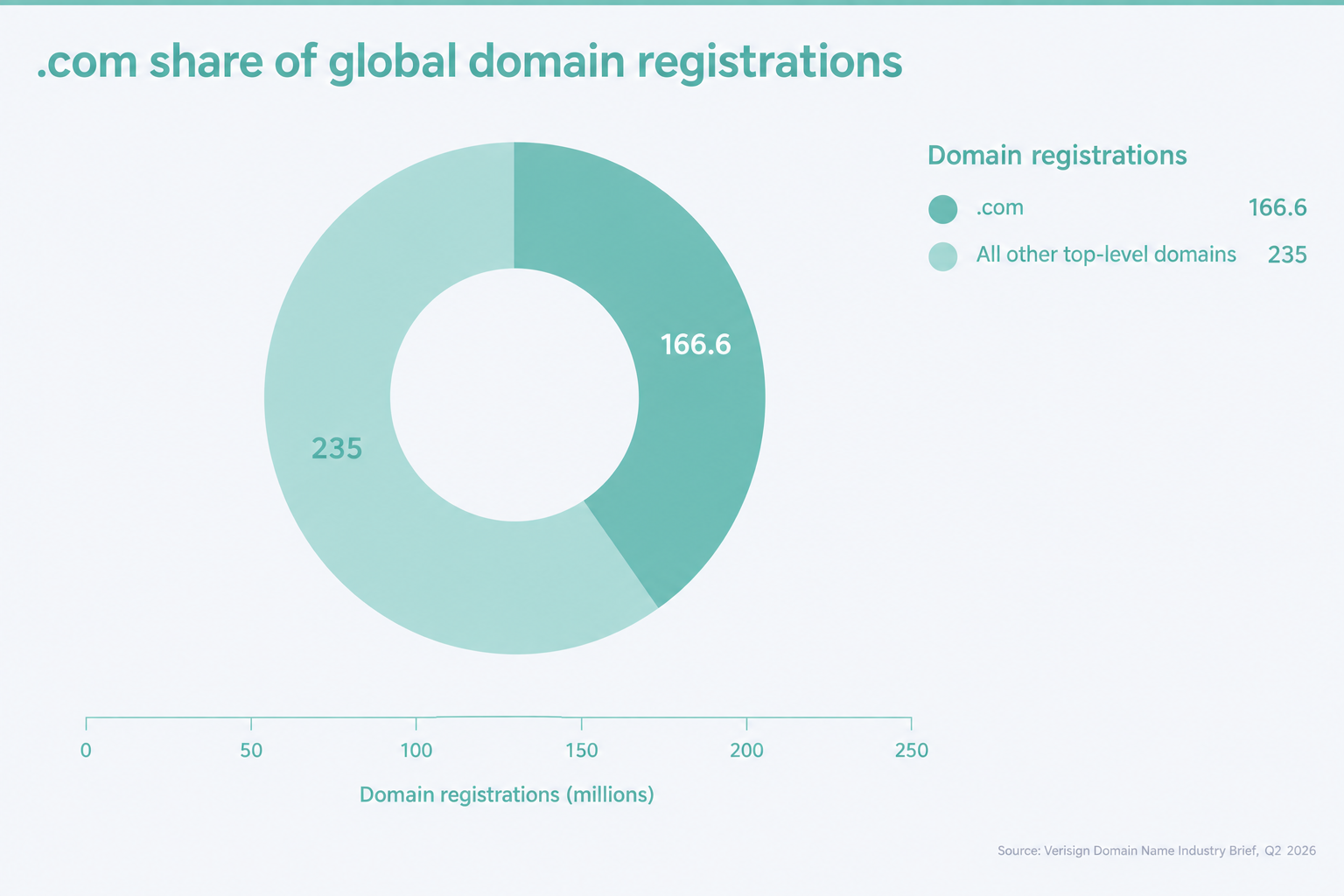
The Verisign Domain Name Industry Brief for Q2 2026 reported 401.6 million registrations across all top-level domains at 30 June 2026. Of these, 166.6 million were .com registrations and 235.0 million used other extensions, giving .com a share of about 41.5%. These figures count registrations, not active websites.
Registering the domain reserves the address for the registration term. It does not automatically create a website, mailbox or server space, which is why domain names and web hosting are separate services.
A .com ending also does not produce an automatic search advantage. Google states that a site's top-level domain does not determine its performance in Search; relevance, quality and other ranking signals still matter.
The .com ending identifies a global domain namespace, not a country, safety rating or hosting plan.

Performance you can feel, backed by clients who depend on it. Read how our support and uptime create long‑term customer success.Power Your Business with Better Hosting
Does com.com mean the same thing as .com?
No. .com is the extension used by millions of separate domains, while com.com is one specific domain made from the name com plus the .com extension.
As at 30 September 2026, the Verisign RDAP record for com.com shows that com.com is already registered. It is not the registry, a shared sign-up page or the account area for every address ending in .com.
ICANN explains that a registrant manages a domain through the registrar or reseller used for registration. There is therefore no universal .com login. The relevant login is the account provided by the business that registered or manages the domain.
An address such as accounts.com.com would be a subdomain controlled by the registrant of com.com. It would not be an independently registered, ordinary .com domain.
A .com domain means any available name ending in .com, while com.com is one specific name that is already taken.
Should an Australian business choose .com or .com.au?
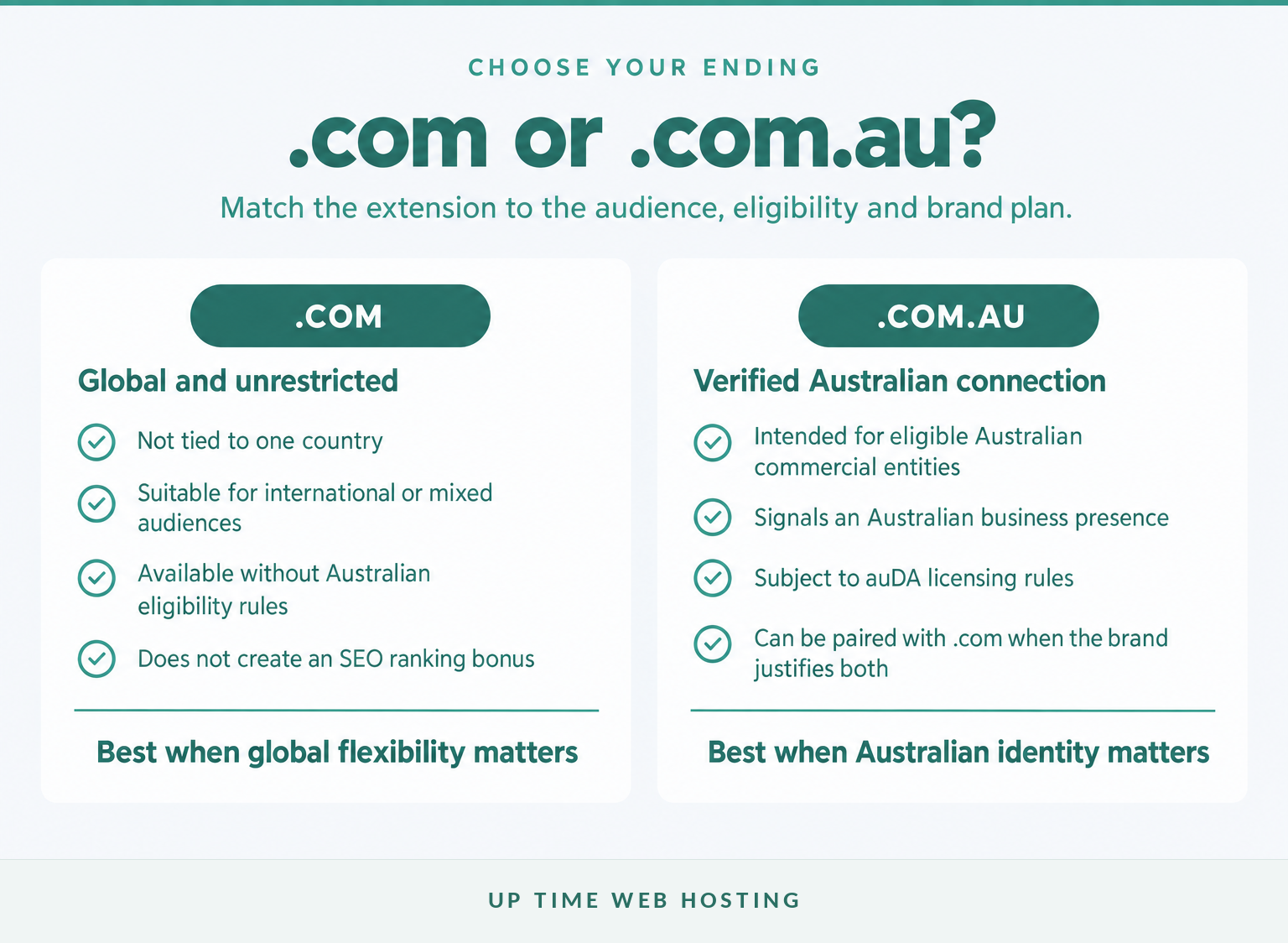
For a business focused mainly on Australian customers, .com.au may communicate local presence more clearly; for a broader international audience, .com is the more neutral choice. Some businesses register both and redirect one to the main site when the extra cost is justified.
auDA's comparison of .com.au and .com says .com.au is intended for commercial entities with an Australian connection and requires eligibility information at registration and renewal. The site’s .au domain registration guide explains the Australian process in more detail.
Google treats .com as a generic top-level domain. Its international-site guidance says country-code domains provide a strong geographic signal, but this does not mean every Australian business using .com.au will outrank a .com site.
Registering both can also reduce confusion if the brand is valuable enough to justify the ongoing cost. Cyber.gov.au recommends considering similar domain variations where criminals could otherwise use a lookalike address to impersonate a business.
Use .com for global flexibility, .com.au for a verified Australian signal, or both when the brand value justifies it.
Host your website with our 5-star rated, cPanel website hosting plans.
Super fast servers, with security included and hosted in your choice of Australian Data Center.
View cPanel Plans
How do you choose a good .com domain name?
Start with the business or brand name, not a list of keywords. The strongest option is easy to hear, spell, type and remember without an explanation.
Australian Government domain guidance recommends a name that represents the brand, remains short and is unlikely to be confused with another business.
Use these checks before settling on a name:
- Say the address aloud and ask whether someone could type it correctly after hearing it once.
- Avoid unnecessary numbers, repeated letters and hyphens that need to be explained.
- Check close spelling variations, plural forms and matching .com.au availability.
- Make sure the name still suits the business if products, locations or services change.
- Use the same wording consistently on the website, email addresses and marketing material.
The guide to choosing a domain name provides more naming ideas and practical checks.
Domain availability does not create trade mark rights. The Australian Government warns that using a domain which infringes another party's trade mark can lead to legal action, so check business names and Australian trade marks before committing to the brand.
The strongest .com name is easy to hear, type and remember and does not create trade mark confusion.
How do you register a .com domain?
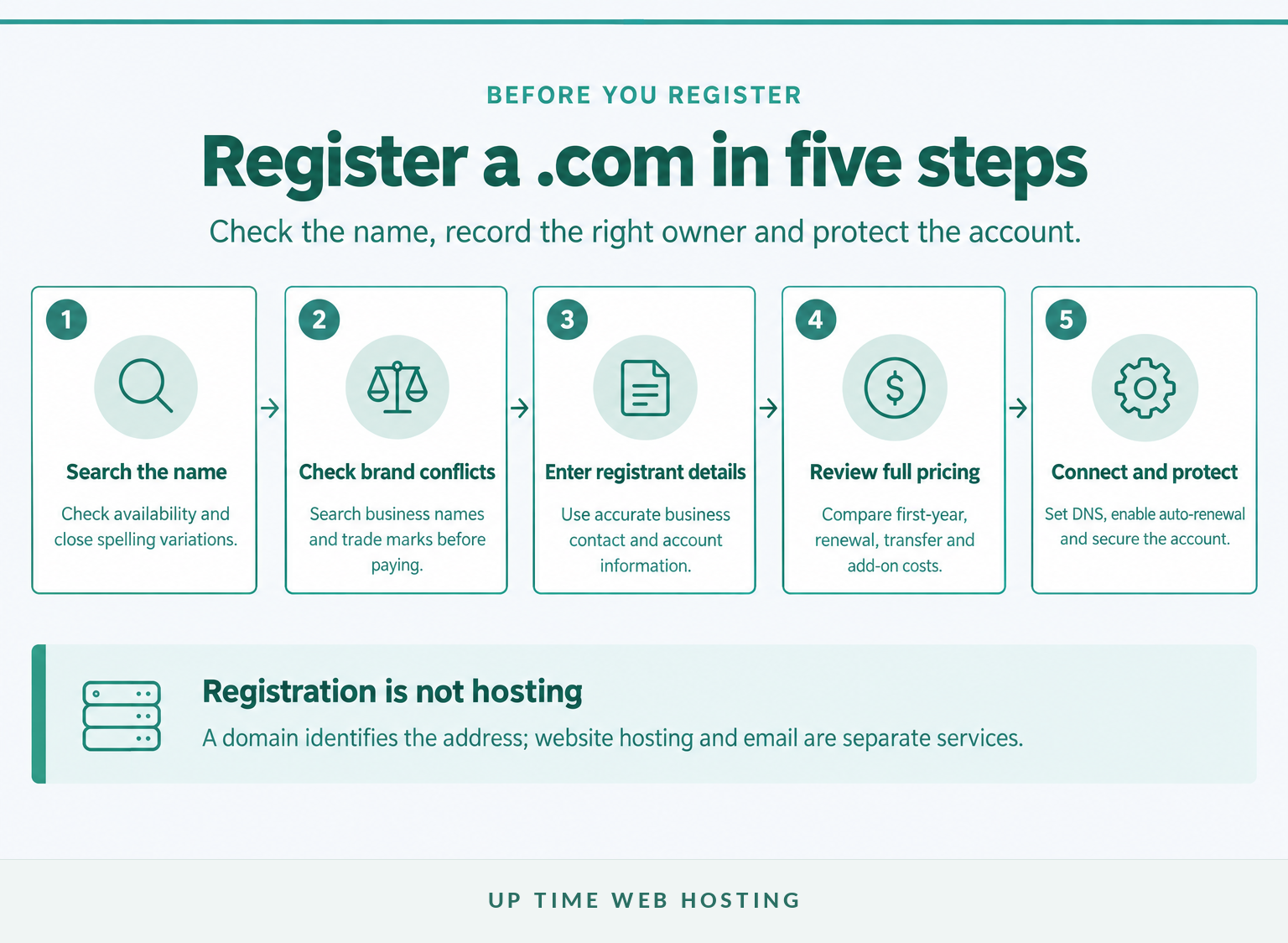
A .com domain is registered through a domain registrar or reseller rather than through a central .com sign-up page. The process normally takes only a few minutes when the name is available and the registrant details are ready.
ICANN's registration-process guide explains that registrars accept domain applications, while the registry operator maintains the authoritative database for the extension.
- Search the exact name. Check the preferred .com address and sensible spelling variations. Prepare two or three alternatives rather than adding random words to an unsuitable name.
- Check brand conflicts. Search Australian business names and trade marks, even if the domain itself is available.
- Create the management account. Use an email address controlled by the business, not the personal account of an employee, contractor or developer.
- Enter accurate registrant details. Choose the registration term and review the renewal conditions. ICANN says domain registrations are typically held for one to 10 years and must be renewed to remain active.
- Connect the services. Set the nameservers or DNS records for the website and email, then enable account security and renewal reminders.
Registration is a short process, but the registrant details, renewal settings and DNS access determine who stays in control.
What should you check before paying?
Do not judge a .com offer only by the first-year headline. Check the renewal price, account controls, included DNS features and support arrangements before submitting payment.
| Check | What to confirm before purchase |
|---|---|
| First-year price | The amount payable now and whether another service must also be purchased |
| Renewal price | The normal annual cost after any introductory period |
| Registrant | The business or authorised owner will be recorded correctly |
| Account security | Multi-factor authentication, recovery options and domain locking are available |
| DNS and email | DNS management, forwarding or mail services are included or clearly priced |
| Transfers and support | Transfer requirements, support access and any extra administration fees are clear |
A free or heavily discounted first year is not automatically a poor deal, but it should be compared over the period the business expects to keep the name. There is no single universal .com price because retail pricing, inclusions and renewal charges vary between providers.
Keep the invoice, registration agreement and account-recovery information in the organisation's records. ICANN requires registrants to provide accurate details and keep them current, so an inaccessible former employee's email address can become an operational risk.
The renewal price and account controls matter more than a headline first-year discount.
Register your new domain name at competitive market prices including free domain add-ons like privacy, DNS Hosting, Custom Nameservers and Forwarding.
Always the best price and no nasty renewal price hikes.
Register A Domain Name
How do you keep a .com domain secure and under your control?
Treat the domain account as critical business infrastructure because it can control the website, DNS and email. Losing access can interrupt services or allow another party to impersonate the business.
Use these controls:
- Register the domain in the correct business or authorised person's name.
- Use a business-controlled email address for account recovery and renewal notices.
- Enable multi-factor authentication and domain locking where available.
- Turn on auto-renewal and add a separate calendar reminder before expiry.
- Give at least two authorised people access to renewal information without sharing one password.
- Record nameservers, DNS changes and the provider responsible for each service.
Cyber.gov.au advises domain owners to renew before expiry, while ICANN advises keeping contact and payment information current. The distinction between account access and legal control is covered further in the guide to domain ownership.
Keep the domain account protected, renewed and recorded in the business's name so the website and email remain under business control.
What else do people ask about .com domains?
These short answers address the most common questions about .com country status, safety, use and email. Each answer applies to the extension generally, not to the specific com.com domain.
What domain is com?
A .com domain is a generic top-level domain, or gTLD, used at the end of addresses such as example.com. It was originally associated with commercial organisations but is now open to individuals and organisations worldwide. IANA classifies .com as generic. It is not assigned to one country.
Is .com the safest domain?
No. A .com ending does not prove that a website or email is safe. Security depends on the organisation controlling the domain, HTTPS and certificate settings, account protection, software updates, hosting security and user behaviour. Cyber.gov.au recommends checking the full URL and using HTTPS before entering information or making a payment.
Why is .com used?
.com is widely used because it is established, internationally recognised and not restricted to one country or business type. Many organisations choose it for a global-facing address. Its familiarity can help people remember a web address, but Google says the top-level domain itself does not receive a ranking advantage.
Can a .com be an email?
Yes. A registered .com domain can be used after the @ symbol in email addresses, such as accounts@example.com. The domain alone does not create a mailbox. The owner must add email hosting or another mail service and configure the domain's DNS, including the required MX records. Australian Government guidance confirms domains are used for business email.
A .com domain can support a website and business email, but the extension alone does not provide safety, hosting or better rankings.
Experience Microsoft 365 Business Standard for free for 30 days.
Up to 25 users with full access to email, OneDrive and Teams. Includes full versions of desktop apps of Outlook, Word, Excel, PowerPoint and more.
Try Microsoft 365
What should you do next?
Write down the first-choice name and two clean alternatives, then check availability and trade mark conflicts. Decide whether .com, .com.au or both best match the audience, budget and long-term brand plan.
Use Up Time Web Hosting's domain registration page to check the preferred name, then register only after the renewal cost, registrant details and account controls are clear.