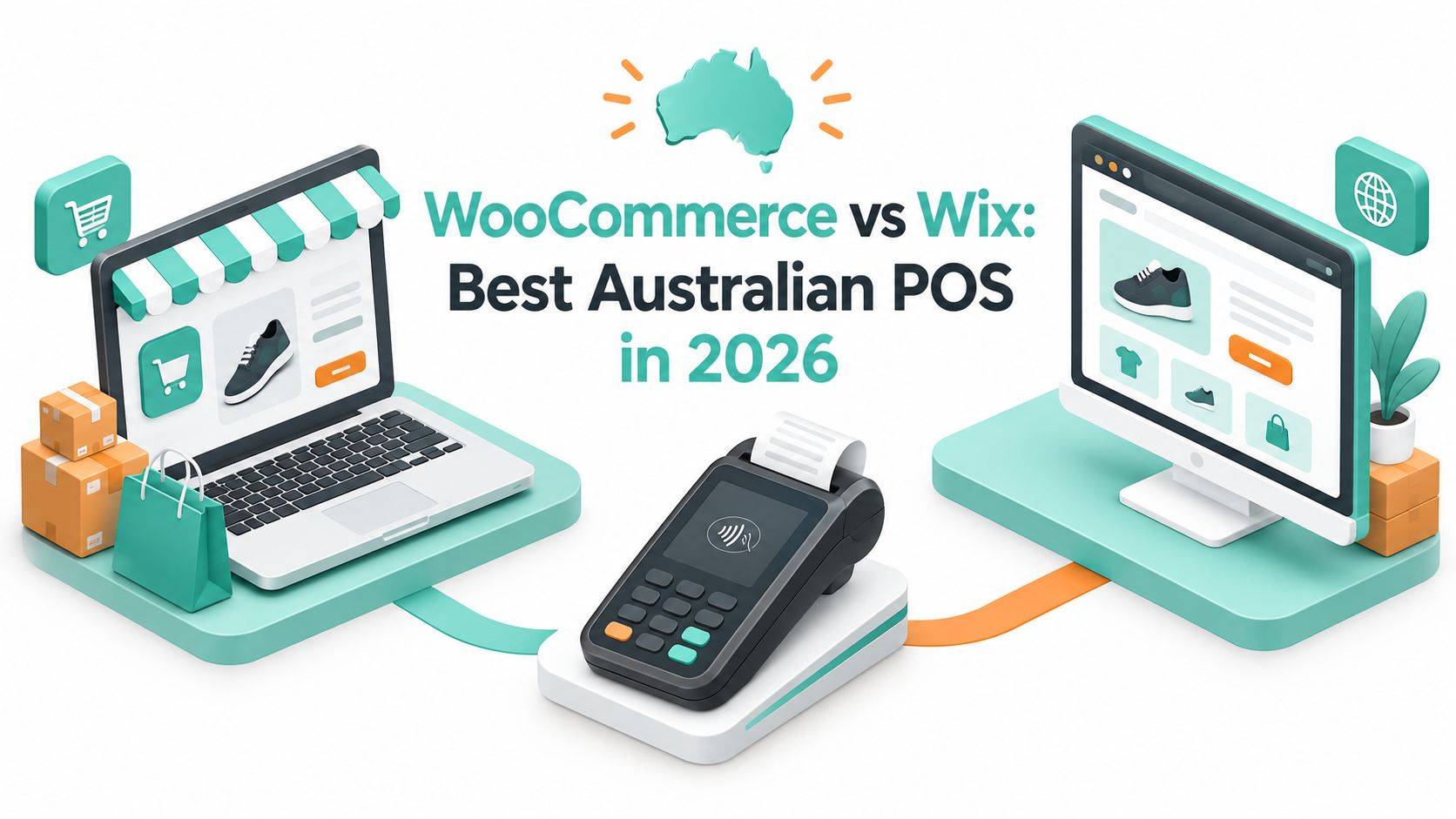
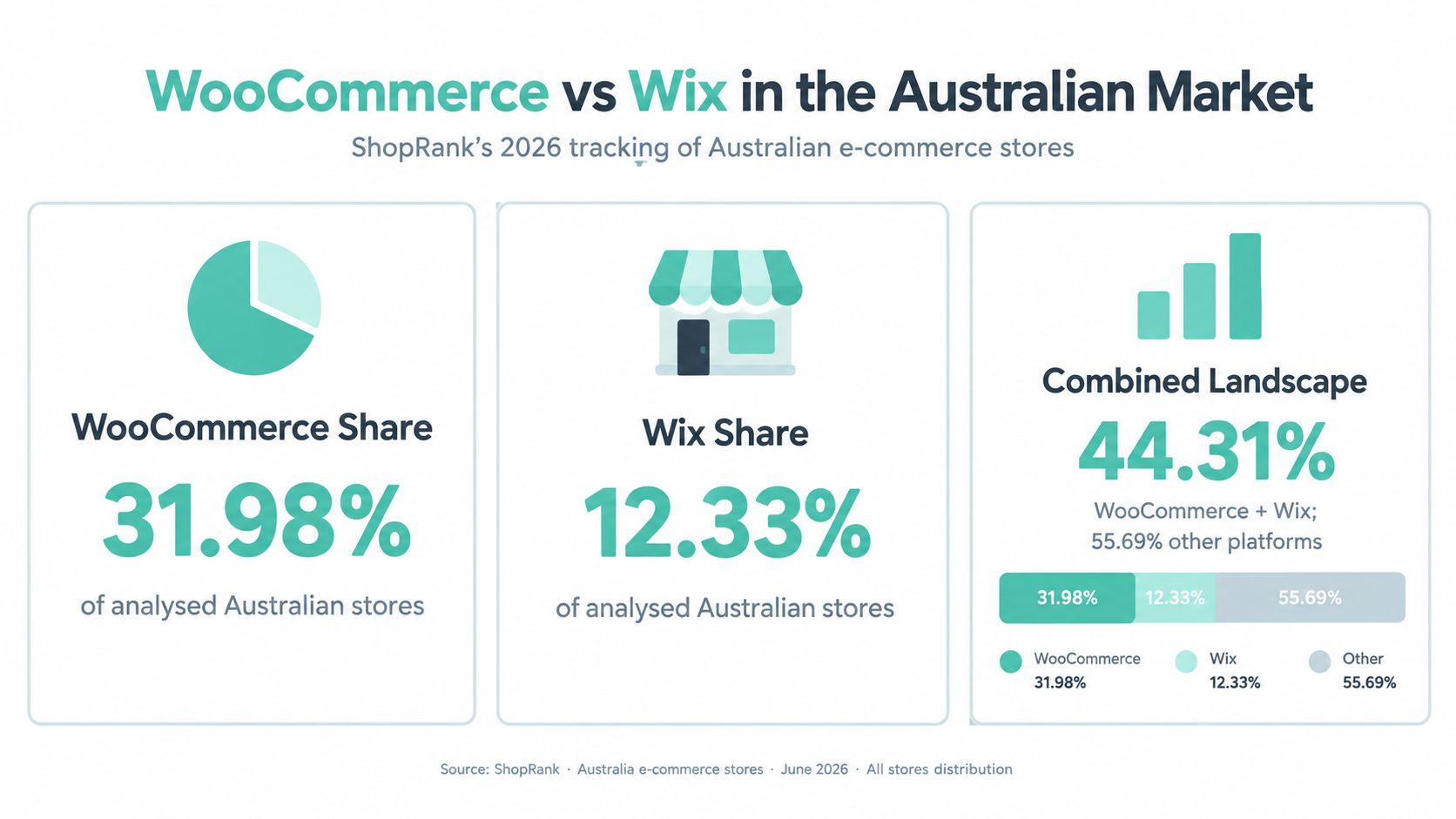
WooCommerce is the stronger long-term choice for many Australian businesses, with 31.98% of analysed Australian e-commerce stores compared with Wix's 12.33% in ShopRank's 2026 tracking. Wix remains the easier launch option, but the local market gap shows that WooCommerce is already a mainstream platform for Australian merchants, not a niche technical choice.
That difference matters when you're choosing the foundation for a store. Local adoption affects the availability of developers, Australia-specific guidance, payment integrations, hosting options and migration experience. A platform can look simple on day one and become expensive or restrictive once you need better shipping rules, local checkout options, content marketing or a more controlled hosting environment.
| Decision area | WooCommerce | Wix |
|---|---|---|
| Setup | WordPress, hosting and plugin configuration required | Bundled builder and hosting |
| Australian payments | Broad gateway and extension flexibility | Wix Payments isn't available in Australia, so external processors are required |
| Hosting control | Choose and tune the hosting stack | Hosting remains within Wix |
| GST billing | Configure tax settings through WooCommerce | Wix charges Australian GST, with an ABN exemption workflow available |
| Shipping | Australia Post integration can return address-based quotes | Simpler configuration, with less technical control |
| Long-term flexibility | High, with access to code, plugins and hosting | More constrained by the hosted environment |
| Best fit | Growing, customised or content-led stores | Small businesses prioritising speed and low maintenance |
Table of Contents
- WooCommerce vs Wix in the Australian Market
- Setup and Ease of Use
- Pricing and Total Cost of Ownership
- Payment Gateways and Checkout for Australian Stores
- Hosting, Performance and Local Australian Infrastructure
- Scalability, Extensions and Marketing Tools
- Which Platform Fits Your Australian Business

Performance you can feel, backed by clients who depend on it. Read how our support and uptime create long‑term customer success.Power Your Business with Better Hosting
WooCommerce vs Wix in the Australian Market
The Australian data changes the usual framing. ShopRank's independent 2026 tracking estimated 106,237 Australian stores on WooCommerce and 40,944 on Wix eCommerce, with WooCommerce holding 31.98% of analysed Australian e-commerce stores and Wix holding 12.33%. That's a 19.65 percentage point gap, and WooCommerce appeared in about 2.6 times as many Australian stores as Wix in that dataset. ShopRank's Australian platform tracking also placed WooCommerce behind Shopify overall but firmly in second place.
A separate Australian technology snapshot from WM Tips detected e-commerce platforms on 18.4% of Australian websites. Among those detected platforms, WooCommerce held 47.4%, while Wix eCommerce held 3.0%. The same snapshot placed Shopify at 24.7% and Squarespace Commerce at 3.2%, making WooCommerce the dominant open-source commerce option in that sample.
Why local adoption changes the risk
Market share isn't a guarantee that one platform will suit your business. It does, however, create a practical support network. Australian agencies are more likely to have WooCommerce experience, local hosting companies publish more WordPress guidance, and developers can usually work with a larger pool of established extensions and migration tools.
That matters when a store needs something beyond a standard product catalogue. A local retailer may need Australia Post shipping quotes, GST-inclusive pricing, subscriptions, wholesale rules or a WordPress content hub. WooCommerce's open structure gives an agency more places to solve the problem. Wix can be the right answer for a straightforward store, but its hosted environment means the available solution depends more heavily on what Wix and its app marketplace support.
Practical rule: Choose the platform that matches the changes you expect to make, not only the site you can launch today.
The local market also affects exit options. WooCommerce stores can move between compatible Australian hosts, subject to a proper migration plan. Wix simplifies infrastructure by keeping it bundled, but that convenience also ties the store more closely to Wix's environment. For a closer Australian comparison of the hosting models, see this WooCommerce, Wix and Shopify hosting comparison.
Setup and Ease of Use
Wix wins the first-day experience. You create an account, choose a template, use the visual builder, add products and configure the store from one dashboard. Hosting, SSL and the site builder are bundled, so a business owner doesn't need to compare server environments before publishing a basic catalogue.
WooCommerce has more decisions because it sits on WordPress. You choose hosting, install WordPress, add WooCommerce, select a theme, configure shipping and payments, and check that the required extensions work together. A technically confident owner may complete a basic setup in a few hours, while a beginner may need a full day or more. Those are practical estimates rather than fixed delivery times, because product complexity and hosting support make a substantial difference.
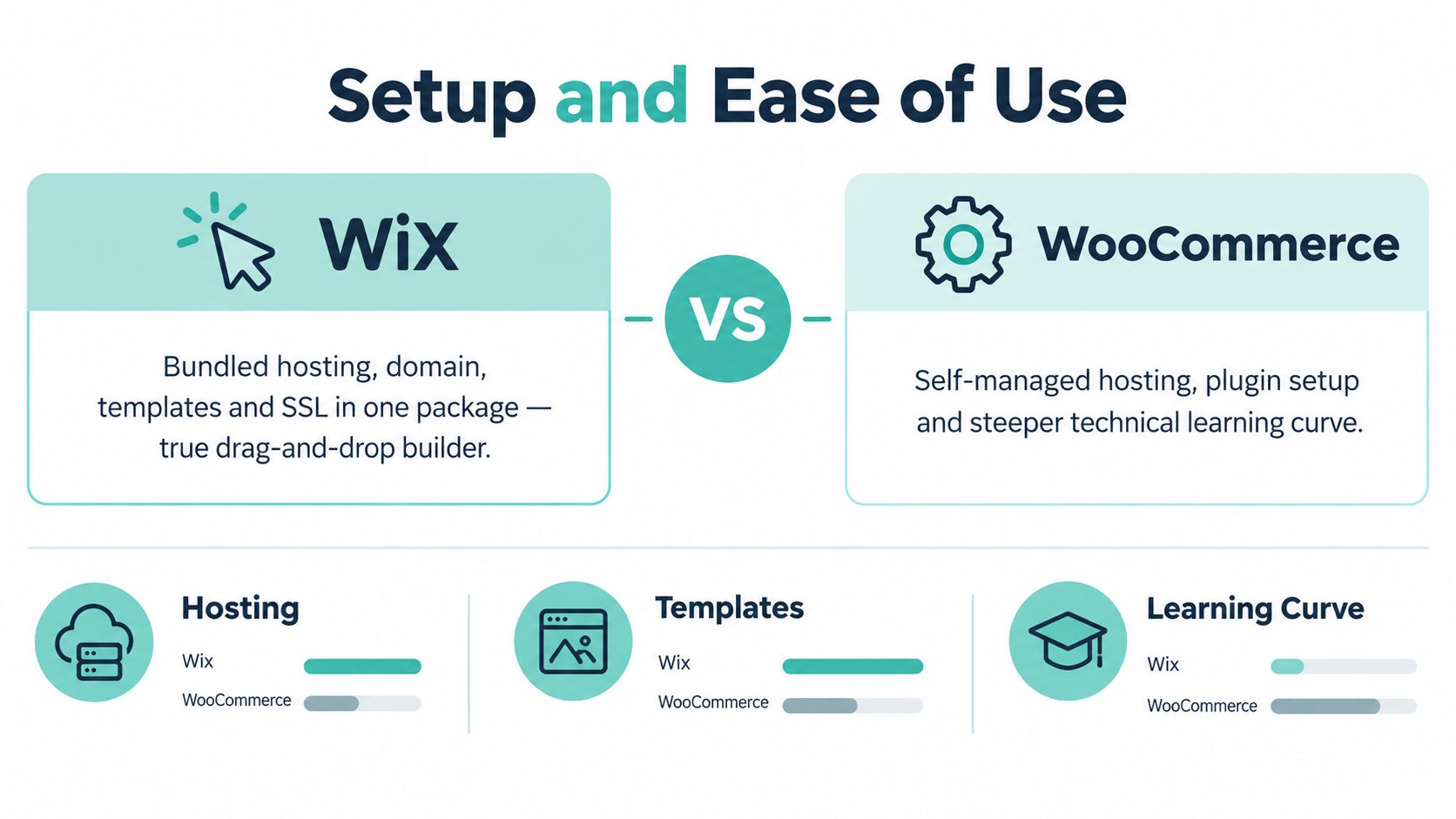
The two launch paths
A small Australian candle business with a simple domestic catalogue might favour Wix. The owner can spend time on product photography, delivery information and customer enquiries instead of troubleshooting WordPress updates. If the site only needs standard products, basic pages and a conventional checkout, Wix's bundled approach removes work that doesn't create direct customer value.
A growing food brand with editorial content, subscription products or custom delivery zones has a different problem. WooCommerce takes longer to organise, but the owner can choose Australian hosting, add the relevant extensions and adjust the site as the business model develops. This explanation of what WooCommerce is is useful for owners who understand WordPress as a website platform but haven't yet worked with its commerce layer.
| Setup question | Wix | WooCommerce |
|---|---|---|
| Who manages hosting? | Wix | The merchant, host or agency |
| How much technical choice exists? | Limited but simple | Broad and more demanding |
| What happens after launch? | Wix manages platform maintenance | Updates, backups and extension compatibility need attention |
| Can the site evolve freely? | Within Wix's supported environment | Through themes, plugins, code and hosting changes |
Wix reduces the number of operational decisions. WooCommerce gives those decisions back to you. That trade-off works well when the business has someone responsible for maintenance, or when the hosting provider and agency have clearly defined what they manage.
Host your website with our 5-star rated, cPanel website hosting plans.
Super fast servers, with security included and hosted in your choice of Australian Data Center.
View cPanel Plans
Pricing and Total Cost of Ownership
The headline subscription is a poor way to compare these platforms. Wix bundles infrastructure into its plan, while WooCommerce separates the software from hosting, domains, themes, extensions, maintenance and support. One model is easier to forecast, while the other lets you pay for a stack that reflects your actual requirements.
Australian businesses also need to account for GST on Wix billing. Wix charges Australian GST on premium subscriptions, apps and products, while an Australian business with an ABN may be eligible for a tax exemption after adding the ABN to its payment details. The Wix GST guidance for Australia lists the workflow as Premium Subscriptions > More Actions > Update Payment Method > Edit Details, followed by the ABN field and Update.
What each cost model includes
Wix's advantage is predictability. You receive a bundled service rather than separate invoices for hosting, SSL and the core builder. That can be valuable for a sole trader who wants to approve one recurring platform expense and avoid maintaining a plugin stack.
WooCommerce itself is free, but the store isn't free to operate. You'll need WordPress hosting and a domain, and you may choose a paid theme, backup service, security service, payment extension, advanced shipping tool or agency maintenance plan. Each addition should earn its place. A subscription extension may be justified for a recurring-revenue business, while a complex page builder may be unnecessary for a small catalogue.
Ownership test: List every service the store needs over its expected operating life. Compare that complete stack, not the free WooCommerce download against a Wix plan shown in isolation.
The cheaper option depends on the business. Wix can be the lower-effort choice for a stable, uncomplicated store. WooCommerce can offer better cost control when the business needs custom workflows, wants to change hosts or intends to build content and commerce on the same WordPress installation. The financial risk isn't only monthly spending. A platform that cannot accommodate a future requirement may create a rebuild, data-cleaning and migration project later.
Payment Gateways and Checkout for Australian Stores
For Australian merchants, the payment question is more important than a generic ease-of-use score. Wix Payments isn't available in Australia, so Wix stores need external processors such as Stripe, PayPal, eWay, Fat Zebra or Braintree. Those services can work, but each integration introduces configuration, account verification and support considerations outside Wix's own payment environment.
WooCommerce takes a different approach. Its plugin architecture allows a store to connect payment services through official or third-party extensions, then configure the checkout around the products, delivery model and customer requirements. The available options can include Stripe, PayPal, eWay, Braintree, Afterpay and Zip, although the exact setup, fees and merchant approval depend on the provider and extension.
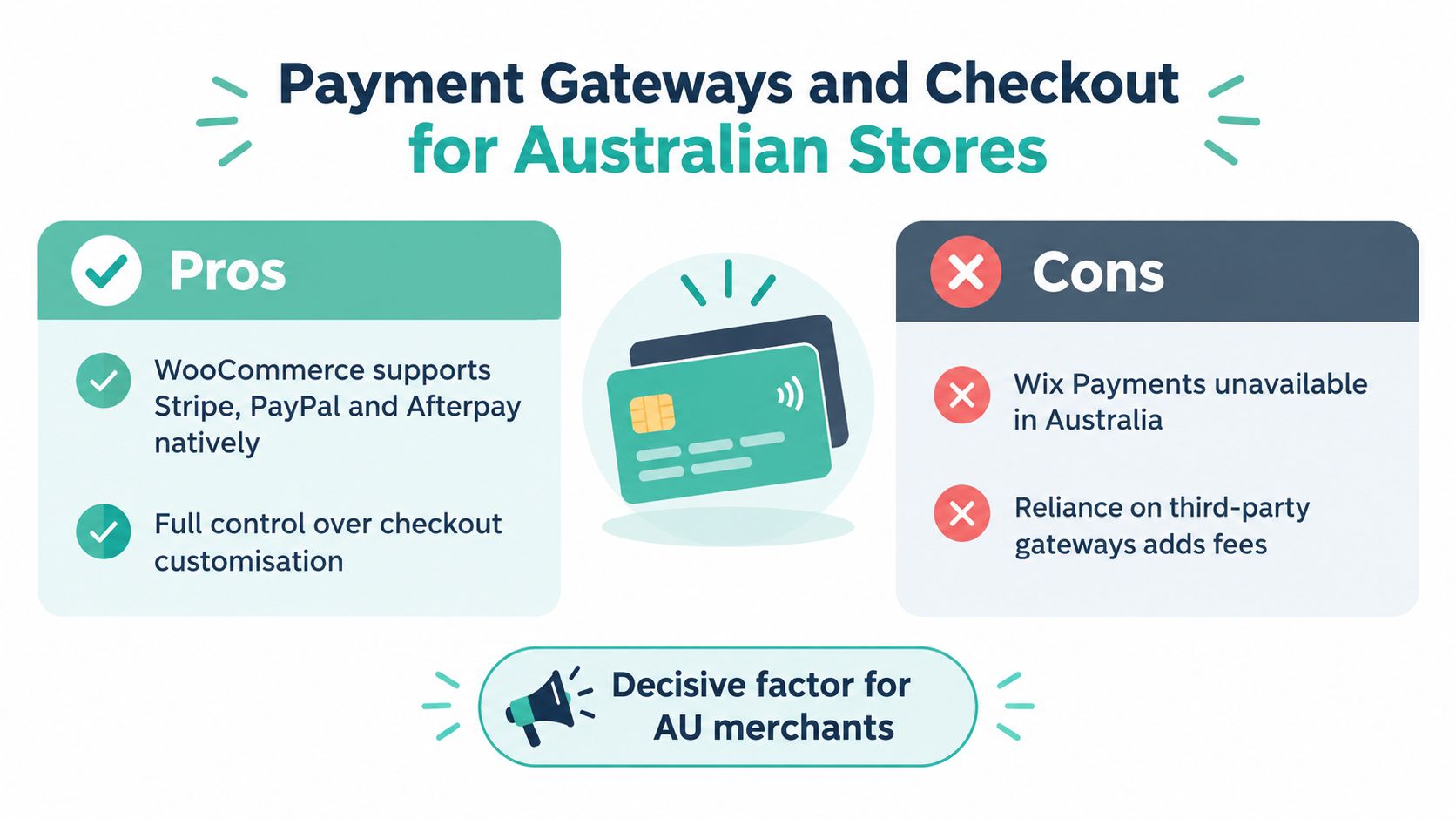
Checkout friction starts before payment
An Australian checkout should make the customer's obligations clear. Display prices in AUD, explain delivery coverage, show GST treatment consistently and provide payment choices that suit the audience. Buy-now-pay-later services such as Afterpay or Zip may matter to a particular customer base, but adding them without reviewing refunds, settlement and reconciliation can create back-office problems.
WooCommerce gives developers more control over fields, checkout layout, shipping logic and order data. That control is useful when a business needs separate delivery rules for metropolitan and regional addresses, trade customer pricing or an order form that collects information for fulfilment. It also creates more responsibility, because every checkout extension must be tested after WordPress, WooCommerce or gateway updates.
Wix is more contained. That reduces the number of moving parts, but it can also make structural checkout changes harder. A business that only needs a conventional product, address and card payment flow may prefer the simpler route. A merchant that needs local gateway choice and a custom checkout should assess the payment stack before choosing a template.
The Australian shopping cart optimisation guide is a useful reference for reviewing checkout content, form friction and trust signals. Don't choose a platform until you've tested the full journey, from product page through payment confirmation and refund handling.
Hosting, Performance and Local Australian Infrastructure
Wix removes hosting from the merchant's workload. The platform controls the infrastructure, delivery layer and update schedule, which suits businesses that don't want to manage servers or diagnose a slow plugin. That convenience also means the merchant can't choose the underlying hosting location or tune server settings independently.
WooCommerce gives you control over the stack beneath the store. An Australian business can select a host with infrastructure in Sydney, Melbourne, Brisbane or Perth, then work with the provider or agency on caching, image delivery, PHP resources, database performance and security controls. Local infrastructure doesn't automatically make every store fast, but it gives the team more ways to investigate and improve the experience for Australian visitors.
Control comes with maintenance
The strongest WooCommerce setup is organised rather than improvised. The hosting plan should support the store's product catalogue and traffic profile, backups should be recoverable, and updates should be tested before they reach checkout. A business that installs extensions without ownership rules can turn WooCommerce's flexibility into a fragile collection of dependencies.
The WooCommerce hosting guide for Australian businesses outlines the type of managed environment a store may consider. UpTime Web Hosting, for example, provides Australian hosting with cPanel, LiteSpeed, CloudLinux, free SSL, malware scanning, DDoS-protected firewalls and encrypted off-site nightly backups. Those are service components to evaluate, not substitutes for proper configuration and ongoing monitoring.
Wix is often the sensible choice when no one inside the business can handle maintenance and the catalogue is uncomplicated. WooCommerce is more appropriate when the business needs control over hosting, caching, image delivery or server-level settings, and has a host or agency prepared to manage that responsibility.
Register your new domain name at competitive market prices including free domain add-ons like privacy, DNS Hosting, Custom Nameservers and Forwarding.
Always the best price and no nasty renewal price hikes.
Register A Domain Name
Scalability, Extensions and Marketing Tools
A store's first constraint is often not its product count. It's the workflow around the products. Wholesale pricing, subscriptions, multi-channel feeds, editorial content, regional delivery rules and customer segmentation can expose the difference between a curated builder and an open WordPress stack.
WooCommerce can connect the shop to WordPress publishing, SEO extensions, email platforms and custom integrations. Tools such as Yoast SEO or Rank Math can provide detailed control over metadata, schema, redirects and indexation. Mailchimp, Klaviyo and HubSpot can connect through dedicated integrations or other implementation methods, depending on the required workflow.
Wix provides a more controlled environment and an app marketplace for common needs. That makes compatibility easier to manage in many simple cases, but it also means the merchant must work within the features and integrations Wix supports. A business with standard products and uncomplicated marketing may never experience that boundary. A business planning wholesale portals, complex pricing or extensive content commerce should test the desired workflow before committing.
Growth requires an operational owner
More extensions don't automatically create a better store. They create more potential failure points, update decisions and support tickets. WooCommerce works best when someone owns the stack, documents the integrations and removes plugins that no longer serve a clear purpose.
Wix works when the business values a narrower set of supported options and wants platform maintenance handled centrally. WooCommerce works when the business sees its website as an operating system for sales, publishing, fulfilment and customer data. The better choice is the one whose operational burden the business can support.
Which Platform Fits Your Australian Business
Choose Wix if you need to publish quickly, have a straightforward domestic catalogue and don't want to manage hosting, updates or plugin compatibility. It suits a sole trader launching a small lifestyle brand, a local retailer testing online sales or a service-led business with a modest product range and conventional checkout.
Choose WooCommerce if local payment flexibility, Australian hosting control, custom shipping, subscriptions, wholesale rules or content-led acquisition are central to the plan. It also fits agencies building client stores and businesses that expect their workflows to become more specialised over time.
A practical decision comes down to four questions:
- Catalogue and fulfilment: Do you need custom shipping rules, Australia Post address-based quotes or multiple fulfilment paths?
- Payment requirements: Will the store need external Australian processors, Afterpay, Zip or a checkout designed around a particular customer segment?
- Technical ownership: Who will handle updates, backups, security and extension conflicts?
- Future changes: Is the business likely to add wholesale, subscriptions, deeper SEO publishing or integrations?
For a simple store that values launch speed, Wix may minimise friction. For a growing Australian business that wants to control its infrastructure and avoid being boxed into a fixed environment, WooCommerce is usually the more adaptable foundation. The Australian comparison of WooCommerce and other commerce platforms can help you test that decision against your hosting, payment and growth priorities.
UpTime Web Hosting provides Australian infrastructure for WordPress and WooCommerce stores, with local support, cPanel hosting, security features, backups and performance tooling. If you're comparing WooCommerce and Wix and want to assess a self-hosted setup without guessing at the hosting layer, visit UpTime Web Hosting to review the available services.