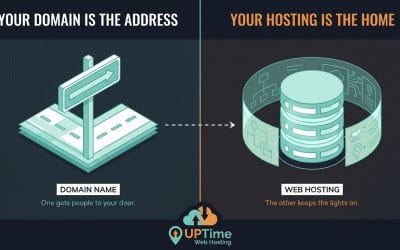

On the hunt for affordable web hosting in Australia? It can feel like wading through a sea of deals that look a bit too good to be true. And often, they are.
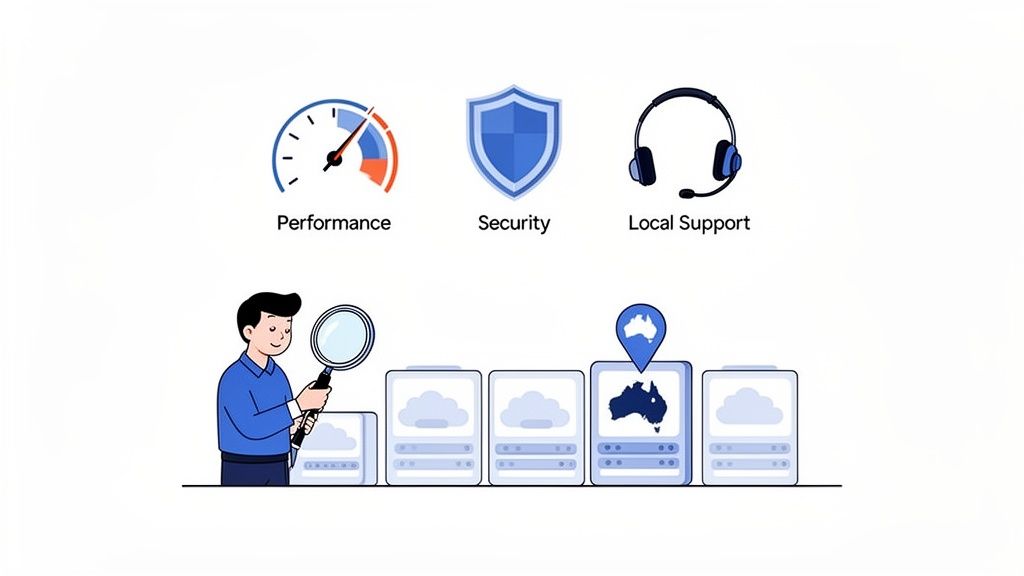
The simple truth is that the cheapest option is almost never the best value, especially when your website is the lifeblood of your small business. Real value is a mix of solid performance, must-have security, and support from people who are actually awake when you are.
Why Finding True Value in Australian Web Hosting Matters
Staring at dozens of hosting plans can be overwhelming. It’s easy for Aussie small business owners to get lured in by the lowest monthly price, only to find themselves stuck with a painfully slow website, shocking renewal fees, and a support team that’s nowhere to be found when things go wrong.
This guide is designed to cut through that noise. We're focused on what "affordable" really means for a business in Australia.
It’s not just about the number on the invoice. Genuine value is that sweet spot where performance, security, and local support come together to help your business grow, without those nasty hidden costs. Understanding this is key, whether you're choosing a host or finding true value in affordable services for small business.
The Problem with Price-Only Shopping
When you chase the absolute lowest price, you almost always end up making compromises that can hurt your business down the track.
A bargain-basement host might be cutting corners on their server maintenance, which means slower load times for your visitors. Did you know the average load time for Australian small business sites is a sluggish 5.6 seconds? That's well above the three-second mark where people start to lose patience.
A slow website doesn't just annoy potential customers; it can directly impact your search engine rankings and, ultimately, your sales. On top of that, these dirt-cheap plans often leave out critical features, forcing you to buy them later as expensive add-ons.
Why Local Hosting Is a Game Changer
One of the single biggest factors in getting real value is choosing a provider with Australian data centres. Hosting your website locally gives you tangible benefits that overseas providers just can't compete with.
- Superior Speed: It’s simple physics. When your website’s data is stored closer to your visitors, it loads much, much faster. This slashes latency and creates a snappy, responsive experience for your users.
- SEO Advantage: Search engines like Google pay attention to site speed. A faster site can lead to better visibility in search results, especially for your target Australian audience.
- Local Support: When something goes wrong, you want to talk to a support team that operates on your time zone. Australian-based support means you get help when you actually need it, not hours later after a sleepless night.
Choosing a local host is about more than just speed; it's about data sovereignty and ensuring your business complies with Australian privacy principles. You can learn more about why it’s important to host your website in Australia in our detailed guide. This ensures your customer data is protected under local laws, building trust and credibility.

Performance you can feel, backed by clients who depend on it. Read how our support and uptime create long‑term customer success.Power Your Business with Better Hosting
Unpacking the Real Costs of Australian Web Hosting
That tempting low monthly price you see splashed across a web hosting ad? It's usually just the tip of the iceberg. True affordability goes way beyond the signup offer. To find the best affordable web hosting Australia has to offer, you've got to look beneath the surface and understand the real costs involved.
It's all about total value. You need to ask what you're actually getting for your money. A plan that looks like a bargain can quickly become a budget-breaker if essentials like backups and security are quietly sold as expensive "add-ons".
Core Resources: Your Website's Engine
Think of your website's core resources like the engine in a car. It doesn't matter how shiny the paint job is if the engine is weak and struggles to get up a hill. Web hosting is the same; it relies on a few key parts to give your visitors a fast, smooth experience.
SSD Storage: This is your website's filing cabinet. Modern NVMe SSD storage is the gold standard here—it's like a high-speed digital library that lets your server find and deliver files almost instantly. More storage gives you room to grow, but the speed is what ensures visitors aren't left drumming their fingers, waiting for your site to load.
CPU and RAM: If storage is the library, then CPU (Central Processing Unit) and RAM (Random Access Memory) are the librarians. The CPU is the brain processing all the requests, and RAM is the short-term memory holding data for quick access. A plan with not enough CPU or RAM will slow down or even crash under a bit of traffic, just like a single librarian trying to handle a hundred requests at once.
Bandwidth: This is simply the amount of data your site can transfer to visitors each month. You’ll see plenty of hosts advertising 'uncapped' or 'unlimited' bandwidth, but this always comes with a fair use policy. For most small Aussie businesses, these plans are perfectly fine—it's more about preventing abuse than offering infinite resources.
These are the absolute foundations of your website's performance. Skimping on them with a rock-bottom plan almost always leads to a slow, frustrating site that drives potential customers away. For a deeper look, check out our guide on finding the right balance when you're web hosting on a budget.
The Australian Advantage: Pricing and Performance
Choosing a local provider has some serious perks that go beyond just supporting an Aussie business. It directly impacts your bottom line and your website's success, and there's a good reason the demand for local hosting is booming.
The Australian web hosting services market hit an impressive AUD 3.67 billion in value, and it's projected to climb to AUD 10.42 billion by 2034. That growth is fuelled by businesses just like yours demanding local data centres that make their websites faster for Australian audiences. You can read more about these Australian web hosting market trends.
A key advantage is transparent pricing. Reputable Australian hosts display prices inclusive of GST. This means the price you see is the price you pay, with no surprise 10% tax added at the checkout.
On top of that, local servers in cities like Sydney or Melbourne drastically cut down latency—the physical time it takes for data to travel from the server to your visitor's screen. Lower latency means a faster-loading website, which is a massive factor for keeping users happy and getting a good spot in search engine rankings.
Hidden Costs That Erode Value
The biggest difference between a genuinely affordable host and a cheap one often comes down to the hidden fees. These are the costs that don't make it into the flashy headline price but can quickly add up, turning that "bargain" into a financial headache.
Keep an eye out for these common traps:
- Steep Renewal Fees: This is a classic. Many providers lure you in with a massive discount for the first year, only to triple or even quadruple the price when it's time to renew. Always, always check the standard renewal rate.
- Paid Backups: Your website data is invaluable. Some hosts charge extra for automated backups or, worse, hit you with a hefty fee to restore your site from a backup right when you need it most.
- Essential Security Add-ons: Things like malware scanning and firewalls aren't optional luxuries; they are absolute necessities. A cheap host might offer a low base price but then charge monthly fees for these critical protections.
- Domain Renewal Hikes: A "free" domain for the first year is a common perk, but make sure you check the renewal cost. It can be significantly higher than what you'd pay at a dedicated domain registrar.
Matching Your Website to the Right Hosting Type
Choosing the right type of hosting is a bit like picking the right vehicle for a job. A zippy little hatchback is perfect for city commuting, but you wouldn't use it to haul furniture across the country. In the same way, the hosting that powers a simple blog is completely different from what a growing online store needs.
To find truly affordable web hosting in Australia, the first step is always to match the hosting environment to your website's specific demands. Let's break down the most common options with some simple analogies to make it crystal clear.
Shared Hosting: The Apartment Building
Think of Shared Hosting as living in an apartment building. It’s the most cost-effective way to get a fantastic address (your place on the web) because you share the building’s resources—like the server's CPU, RAM, and bandwidth—with other tenants.
This model is incredibly popular, and for good reason. Affordable shared web hosting in Australia, like our Budget Web Hosting, can start from just a few dollars a month, making it a brilliant entry point for new websites, personal blogs, and small businesses just getting their start.
- Best For: New websites, personal blogs, online portfolios, and small businesses with low to moderate traffic.
- Key Advantage: It’s the most budget-friendly option, hands down. You get all the essential features needed to get online without a huge upfront investment.
- Key Consideration: Because you're sharing resources, a sudden traffic spike on a neighbour's website could potentially slow yours down. It's less of an issue with modern hosts that manage resources well, but it's still a factor to keep in mind.
Managed WordPress Hosting: The Serviced Apartment
Now, let's imagine that apartment is a serviced apartment. This is Managed WordPress Hosting. It’s often built on a shared foundation, but it's specifically designed and fine-tuned for one resident: WordPress. The building manager (that’s the hosting provider) takes care of all the maintenance for you.
This includes handling WordPress core updates, running daily security scans, and managing performance-boosting features like caching. It's the perfect hands-off solution for anyone who wants to focus on creating great content, not wrestling with technical upkeep.
A managed plan takes all the guesswork out of running a fast, secure WordPress site. It’s like having an expert IT team on call, ensuring everything is finely tuned for peak performance—a massive time-saver for any busy business owner.
VPS Hosting: The Townhouse
As your website grows, you might find you need more space and control than an apartment can offer. This is where a Virtual Private Server (VPS) comes in. Think of it as owning a townhouse. You're still part of a larger property, but you have your own dedicated space, your own walls, and your own resources.
A VPS gives you a guaranteed slice of the server’s CPU and RAM that is yours and yours alone. This delivers far more power, stability, and flexibility than shared hosting, making it ideal for websites with growing traffic, e-commerce stores, or custom applications. You get a serious boost in control without the huge cost of a standalone house (a dedicated server). For an even deeper dive, you can learn more about the common types of web hosting in our detailed guide.
Specialised Hosting: The Custom Workshop
Finally, some websites have very specific technical needs, much like a workshop that requires specialised tools. Windows/ASP.NET hosting is a perfect example of this. While the vast majority of hosting runs on a Linux operating system, certain applications are built using Microsoft technologies like ASP.NET and require a Windows server to function properly.
This is a less common but absolutely essential option for businesses or developers using specific Microsoft frameworks. Honestly, if you’re not sure if you need it, you almost certainly don’t. But for those who do, finding a reliable Australian provider offering this is critical.
Which Affordable Hosting Type Is Right for You?
Feeling a bit overwhelmed by the options? Don't be. This quick-glance table breaks down the most popular affordable hosting options in Australia, helping you choose based on your website's needs, your technical skill, and your budget.
| Hosting Type | Best For | Typical Price Range (AUD/Month) | Key Advantage | Key Consideration |
|---|---|---|---|---|
| Shared Hosting | Beginners, personal blogs, small business sites, low-traffic websites. | $5 – $15 | The most affordable way to get a professional site online. | Resources are shared, so a neighbour's site can affect yours. |
| Managed WordPress | WordPress users who want speed, security, and zero technical hassle. | $15 – $40 | Optimised performance and automated WordPress maintenance. | Less flexibility for non-WordPress applications. |
| VPS Hosting | Growing businesses, e-commerce stores, developers needing more control. | $20 – $80+ | Dedicated resources mean more power and stability. | Requires more technical knowledge to manage (unless it's managed). |
Ultimately, the "right" choice is the one that fits your current needs while giving you a little room to grow. Don't pay for a townhouse when an apartment will do just fine, but be ready to move when your website starts to take off!
The flowchart below shows how seemingly small choices can lead to very different cost outcomes, helping you steer clear of common financial traps.
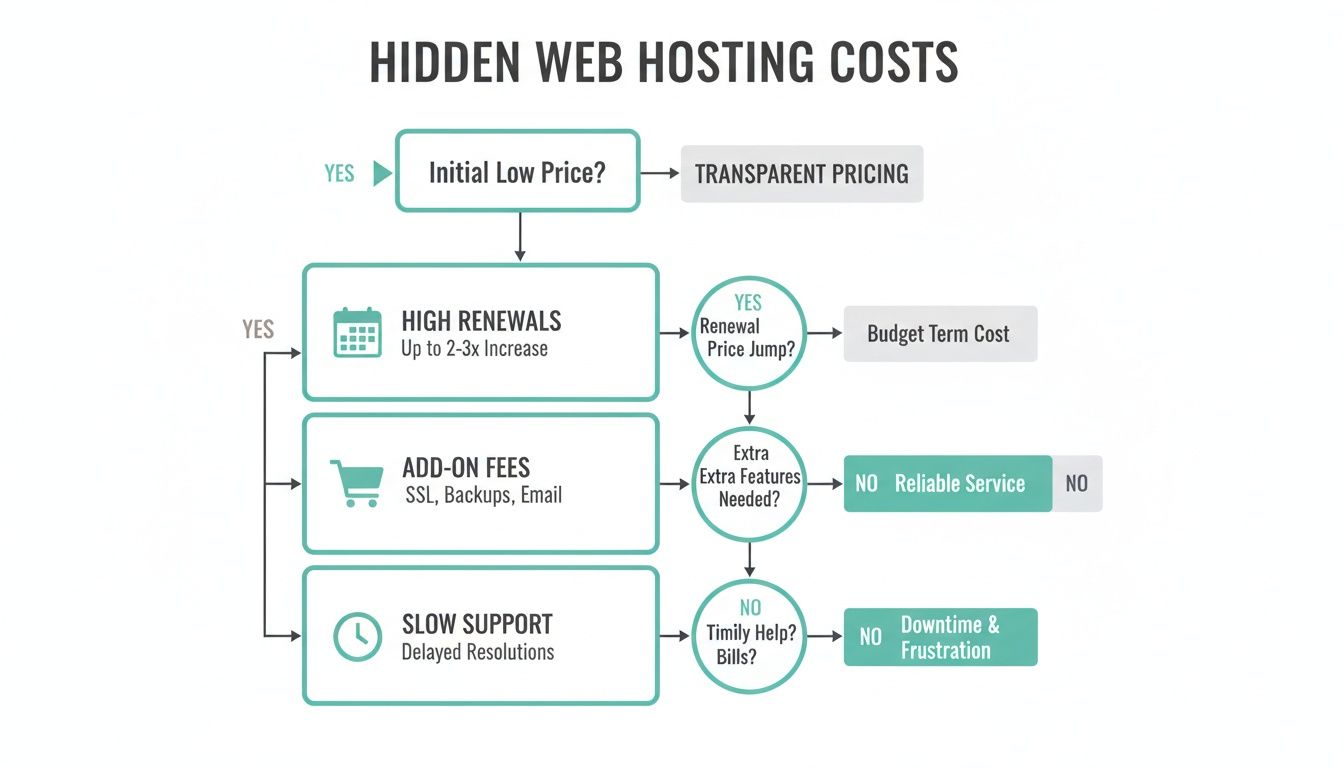
As you can see, the initial price is just the starting point. The real value is found when you factor in things like renewal rates and the quality of support you'll receive when you need it most.
Host your website with our 5-star rated, cPanel website hosting plans.
Super fast servers, with security included and hosted in your choice of Australian Data Center.
View cPanel Plans
Essential Features That Define High-Value Hosting
It’s easy to get drawn in by a low price tag, but when you’re looking for affordable web hosting Australia has to offer, the real value isn’t in the initial cost. It’s in the features that come standard, not the ones tacked on later as pricey extras. The smartest move you can make is shifting your mindset from finding the cheapest plan to hunting down the best investment.
Think of it like buying a car. That base model looks like a steal, but the moment you add essentials like air conditioning or modern safety features, the price suddenly isn't so attractive. A great hosting provider bundles the critical components into their standard plans, giving you a complete, road-ready package right from the get-go.
Security Your Website Cannot Live Without
In today’s online world, solid security isn’t just a nice-to-have; it's the bedrock of trust between you and your visitors. For any small business, a couple of features are completely non-negotiable.
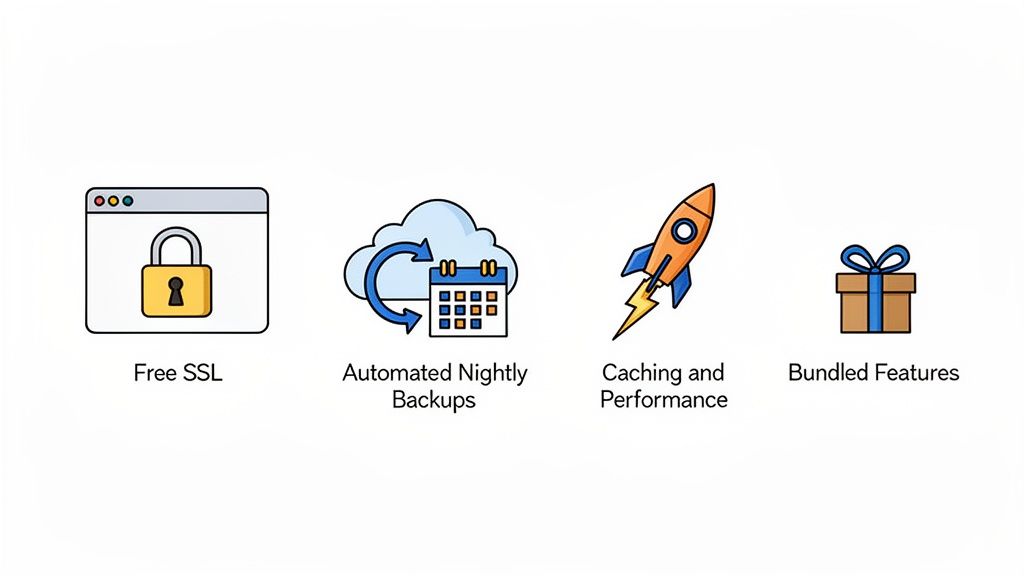
First up is a free SSL Certificate. This is what adds that little padlock icon to the browser bar, encrypting the connection between your website and your customers. Without it, Google Chrome will slap a big "Not Secure" warning on your site, which is a surefire way to scare off potential customers and hurt your search rankings.
Next are automated daily backups. Think of this as your ultimate undo button. If your site ever gets hacked, or even if a simple plugin update goes haywire, having a clean, recent backup means you can restore everything with minimal fuss and downtime. A host that makes you pay extra for this is simply not offering good value.
For Australian small businesses, the hallmarks of a quality provider go beyond the basics. Look for things like free malware scans, DDoS protection, nightly backups, and generous resource limits. These are signs of a host that's serious about reliability and your security.
Performance Boosters That Work for You
A slow website is a business killer. It frustrates visitors and tells Google not to bother sending people your way. While the server hardware itself plays a part, high-value hosts now include sophisticated performance tools that speed things up without you needing a degree in computer science.
Keep an eye out for these game-changers:
- LiteSpeed Web Server: This is a modern, high-performance replacement for the old-school Apache web server. It’s built from the ground up to handle more traffic and deliver your website’s content much faster, especially for popular platforms like WordPress.
- Built-in Caching (like AccelerateWP): Caching is like having a pre-made copy of your website ready to go. Instead of building the page from scratch for every visitor, a tool like AccelerateWP serves up a lightning-fast snapshot. This dramatically slashes loading times and makes your site feel incredibly snappy.
These technologies hum away in the background, making sure your website gives your Aussie audience the fast, smooth experience they expect. Of course, there’s more to it than just that. You can dive deeper in our guide on the top 10 factors to consider when choosing web hosting services.
The Hallmarks of a Genuine Value Provider
Beyond the tech specs, the best affordable Australian hosts prove their worth through their service and policies. Small businesses should be looking for providers who can confidently boast 99.9% uptime and impressively quick server response times.
When you're comparing plans, run through this quick checklist to separate the true value-providers from the rest:
- Does it include a free SSL Certificate? (Essential for security and trust)
- Are automated nightly backups included for free? (Your ultimate safety net)
- Does it use performance tech like LiteSpeed and caching? (For a faster visitor experience)
- Is Australian-based support available in your time zone? (Critical when you need help)
- Is GST included in the advertised price? (No nasty surprises at checkout)
If you’re getting a "yes" to all of these, you’re on the right track. You’ve likely found a plan that offers genuine, long-term value, not just a cheap introductory price that will bite you later.
Your Actionable Checklist for Choosing a Hosting Plan
You've explored the costs, compared the hosting types, and you know what features are non-negotiable. Now it's time to put that knowledge into practice and lock in your decision with confidence.
Think of this as your final pre-flight check before your website takes off. Walking through these steps will help you sidestep the common traps and find a hosting partner that genuinely gets what your business needs.
Step 1: Assess Your Real Needs
Before you even glance at a pricing page, take a moment to look at your own project. The "best" hosting plan is completely relative to what you're actually building. A plan that’s perfect for a simple blog will buckle under the pressure of a busy online store.
Ask yourself a few honest questions:
- What's the main job of my website? Is it a straightforward portfolio to show off your work, a blog for sharing ideas, or a full-blown e-commerce site that will be processing payments?
- How much traffic do I really expect? Be realistic here. Are you hoping for a few hundred visitors a month to get started, or are you moving an established site that already gets thousands of hits a day?
- What are my tech skills like? Are you comfortable tinkering with server settings, or do you need a completely hands-off, managed solution that takes care of all the technical heavy lifting for you?
Answering these first saves you from overspending on power you don't need, or worse, underpowering your site and creating a frustrating experience for visitors from day one.
Step 2: Set a Realistic Budget
With your needs mapped out, you can now set a budget that makes sense. Remember what we talked about earlier—focus on the total value, not just the flashy introductory price. The cheapest plan often becomes the most expensive one down the track when you factor in slow performance, missing features, and wasted time.
A huge part of budgeting is looking at the renewal price. Lots of hosts lure you in with massive first-year discounts, only to triple the cost when it's time to renew. A good, trustworthy provider will be upfront and transparent about their standard pricing.
Pro-Tip: Before you commit, give the provider's support team a quick test. Send a pre-sales question through their ticket system or email. How fast they reply and the quality of their answer will tell you a whole lot about the service you can expect once you're a paying customer.
Step 3: Prioritise Australian Servers
For any business targeting an Aussie audience, this is a deal-breaker. Local servers, physically located in cities like Sydney or Melbourne, slash latency. This makes your website load significantly faster for your visitors here in Australia.
This isn't just a minor tweak; it's a massive factor for user experience and your SEO rankings. Check a provider's website for clear information on their data centre locations. If they're cagey about where their servers actually are, treat it as a red flag.
Step 4: Vet Providers Through Local Reviews
Reviews are your window into the real, day-to-day customer experience. Don't just rely on big international review sites; actively seek out feedback from other Australian small business owners. Look for patterns in what people are saying.
Are customers consistently raving about the helpful, local support team? Are there repeated complaints about unexplained downtime or sluggish speeds? This kind of feedback is gold for separating the great providers from the ones who just have slick marketing.
Step 5: Clarify the Website Migration Process
If you're moving an existing website, the migration process is a critical hurdle. A clumsy or poorly handled move can lead to stressful downtime and lost business. The best affordable Australian hosts make this whole process painless.
Check their policy on a few key things:
- Is the migration free? Many high-value providers will move your site at no cost as an incentive to win your business.
- What's the process like? A quality host will have a clear, documented procedure. Many have helpful knowledge base articles that explain how to transfer your website to a new host, which gives you a great sense of what to expect.
- What is their money-back guarantee? Make sure they have a clear, no-fuss guarantee. This gives you a risk-free window to properly test their performance and support.
Once you’ve picked an affordable Australian web hosting plan that ticks all your boxes, the next crucial step is actually getting your website online. For a step-by-step walkthrough, check out a practical guide on how to publish a website. This resource can really help bridge the gap between choosing your host and seeing your site go live.
By following this checklist, you can move forward knowing you’ve made a well-researched, value-driven decision that's right for your business.
Got Questions? Here Are Some Quick Answers
Jumping into the world of web hosting can feel like learning a new language. To help you make the right call with confidence, we've pulled together answers to the most common questions we hear from Australian small business owners.
Is an Australian Host Really Better Than a Cheaper US One?
For any business targeting an Australian audience, the short answer is a resounding yes. While a US-based hosting plan might look cheaper at first glance, the performance you sacrifice is a huge deal.
Local servers, say in Sydney or Melbourne, drastically cut down on latency—that's the physical delay it takes for your website's data to travel across the globe. For your Aussie visitors, this means a noticeably faster website, which is a massive factor in keeping people on your site and boosting your SEO.
On top of that, a local host gives you:
- Support in Your Time Zone: Get help when you're actually working, not in the middle of the night.
- GST-Inclusive Pricing: What you see is what you pay. No nasty 10% tax surprise at checkout.
- Australian Privacy Law Compliance: Your customer data is handled according to local laws, which goes a long way in building trust.
That small difference in the monthly fee is a smart investment for a faster site, a better experience for your customers, and a lot less hassle for you.
What Is cPanel and Do I Actually Need It?
Think of cPanel as the dashboard for your car. You don't need to be a mechanic to check the fuel or turn on the air conditioning, right? cPanel is just like that, but for your website. It's a simple, visual control panel that lets you manage everything without touching a single line of code.
Instead of wrestling with complex commands, you just click icons to do things like:
- Install WordPress with a couple of clicks.
- Create professional email addresses (like
info@yourbusiness.com.au). - Manage your website's files and databases.
- Check in on how your site is performing and who's visiting.
For beginners and most business owners, cPanel is an absolute lifesaver. It turns tricky technical jobs into simple point-and-click tasks, saving you a mountain of time and frustration. The best affordable hosts in Australia include it as standard. If you're curious, you can get a better idea of what it's all about by checking out how to log into cPanel in our knowledge base.
How Easily Can I Upgrade My Plan as My Website Grows?
This is a big one. Any good hosting provider knows your needs today won't be your needs next year, and they should make it dead simple to scale up.
The process should be completely seamless. As your traffic picks up, you should be able to move from a starter plan to a bigger one—or even jump to a more powerful option like a VPS—with little to no downtime.
Before you sign up with anyone, make sure you ask what their upgrade path looks like. A host that’s invested in your success will have a clear, easy process that lets your website handle more visitors without breaking a sweat.
This forward-thinking approach means you're never paying for resources you don't need, but you've always got the power ready for when your business really takes off.
Are 'Uncapped' or 'Unlimited' Plans Truly Unlimited?
This is a classic marketing term that trips a lot of people up. The honest answer is no, nothing is truly infinite. Every plan runs on what’s called a 'fair use' policy.
It’s a bit like an all-you-can-eat buffet. You’re welcome to have as much as you can reasonably eat, but the policy is there to stop one person from backing up a truck and taking all the food home. In hosting, 'uncapped' simply means that for 99% of normal websites—blogs, portfolios, local business sites—you'll never get close to hitting a limit.
These policies are really there to stop abuse, like someone using a cheap shared hosting plan to store massive video files or run a file-sharing service, which would hog resources and slow things down for everyone else on the server. For a typical business, an 'uncapped' plan gives you all the room you need to grow without ever worrying about hitting a hard limit.
Ready to get your website online with a host that's fast, secure, and genuinely affordable for Aussies? At UpTime Web Hosting, we pack all the essentials—from free SSL and automated backups to LiteSpeed performance—into straightforward, GST-inclusive plans. See the difference that local support and great tech can make by visiting https://uptimewebhosting.com.au to find the perfect plan for your business today.