
You're probably staring at a half-finished website brief, two browser tabs full of pricing pages, and a question that keeps getting harder the longer you look at it. Wix looks simple. Shopify looks safe. WooCommerce looks flexible. For an Australian business owner, the fundamental issue isn't picking a platform with the prettiest demo, it's choosing one that won't later burden you with hidden costs, slow pages, or a checkout that's harder to maintain than the store itself.
| Criterion | Wix | Shopify | WooCommerce (Self-Hosted) |
|---|---|---|---|
| Best fit | Service-led sites, simple stores, brand-first businesses | Store-first businesses, managed ecommerce, fast setup | Content-heavy sites, custom builds, ownership-focused businesses |
| Pricing model | Bundled subscription | Bundled subscription | Software is free, hosting and add-ons are separate |
| Cost predictability | Fairly predictable | Very predictable | Variable, depends on hosting and plugins |
| Technical control | Low to moderate | Moderate | High |
| Setup effort | Low | Low to moderate | Moderate to high |
| Local hosting control | Limited | Limited | Full control if you choose an Australian host |
| Checkout control | Basic to solid | Strong, managed checkout | Fully customisable |
| SEO flexibility | Good for simpler needs | Strong for ecommerce defaults | Strongest for deep control and content-led builds |
| Support model | Platform support | Platform support | Host plus WordPress ecosystem |
| Typical Australian fit | Small businesses wanting speed and simplicity | Retailers who want a managed store | Businesses that want ownership and local performance |
If you're mapping the whole decision to a practical Australian selling setup, the starting point is understanding how these platforms behave once the site is live, not just how they look during onboarding. UpTime Web Hosting's own overview of online selling in Australia is a useful reference point because it frames the choice around store structure, hosting, and local delivery rather than abstract feature lists.
Table of Contents
- Choosing Your Online Storefront in Australia
- At a Glance Comparing Wix Shopify and WooCommerce
- Understanding the Full Cost of Running an Online Store in Australia
- Ease of Use vs Long-Term Flexibility
- Performance SEO and Security for AU Audiences
- Extensibility and Support for Local Businesses
- Final Verdict Which Platform Is Best for You

Performance you can feel, backed by clients who depend on it. Read how our support and uptime create long‑term customer success.Power Your Business with Better Hosting
Choosing Your Online Storefront in Australia
A florist in Geelong, a builder in Penrith, and a clothing label in Brisbane can all say they need an “online store”, but they usually mean three different things. One needs bookings and a few products. One needs fast browsing and a clean checkout. One needs full control over content, search visibility, and future expansion.
That's why wix vs shopify vs woocommerce isn't really a feature fight, it's a business model decision. In Australia, the market already shows a clear tilt towards the major hosted and WordPress-based options, with Shopify leading at 21.46%, WooCommerce at 14.44%, and Wix at 10.12% in one independent ecommerce market snapshot (Wise Internet). The split tells you something practical, local merchants are leaning towards platforms that reduce setup friction, but they're not all choosing the same kind of control.
Practical rule: if the site's first job is to explain the business and the store is secondary, don't force a commerce-first platform into a content-first job.
Wix usually suits owners who want to publish quickly and keep the site visually tidy without managing too many moving parts. Shopify suits merchants who care most about the selling workflow. WooCommerce suits the business that wants the site, the content, and the store to live together without being boxed into a hosted template system.
For an Australian SMB, the right question is not “which one is strongest on paper?” It's “which one will still make sense after launch, after payments, after GST, and after the first round of growth?” That's the lens that keeps you from choosing a platform for the demo instead of the business.
At a Glance Comparing Wix Shopify and WooCommerce
The quickest way to separate these three is to look at what each platform is optimised to do. Wix is a website builder with ecommerce attached. Shopify is a commerce platform with website features attached. WooCommerce is a WordPress commerce layer that becomes powerful when you're willing to own more of the stack.
Here's the practical comparison I use with Australian clients before I ever talk about themes or plugins. If this table already points you in one direction, that's usually not an accident.
| Criterion | Wix | Shopify | WooCommerce (Self-Hosted) |
|---|---|---|---|
| Core identity | Design-led site builder | Managed ecommerce engine | Open-source commerce on WordPress |
| Setup style | Drag-and-drop, beginner-friendly | Guided, commerce-focused | More technical, but highly flexible |
| True cost pattern | Subscription plus optional apps | Subscription plus apps and transaction architecture | Hosting, plugins, maintenance, and support |
| Ownership | Platform-controlled | Platform-controlled | Highest ownership and portability |
| Content strength | Strong for simple pages and blogs | Good enough for basic content | Strong for SEO, content hubs, and service pages |
| Checkout management | Easy, standardised | Managed, reliable, commerce-first | Fully customisable, but you manage more of it |
| Scaling feel | Good until complexity grows | Strong for retail growth | Strong when a business wants tailored architecture |
If you want a deeper platform-by-platform breakdown, UpTime Web Hosting has a direct WooCommerce vs Shopify comparison that's worth reading alongside your own quote sheet. It helps because the decision is rarely about “features” alone, it's about which stack creates the fewest operational surprises.
Wix is the low-friction option for people who'd rather spend time on branding than on tooling. Shopify is the safer bet when the store is the business. WooCommerce is the serious option when you want the site to grow around your content, your structure, and your hosting choice.
A common mistake is treating WooCommerce like a bargain because the software itself is free. That overlooks the full scope. The only sensible comparison is what each platform costs after you add the things a typical Australian business needs.
Host your website with our 5-star rated, cPanel website hosting plans.
Super fast servers, with security included and hosted in your choice of Australian Data Center.
View cPanel Plans
Understanding the Full Cost of Running an Online Store in Australia
A lot of platform pricing content is misleading because it stops at the sticker price. That is not how Australian businesses buy websites. They pay for hosting, apps, payment processing, backups, security, support, and the inconvenience of fixing the whole thing when something stops working.
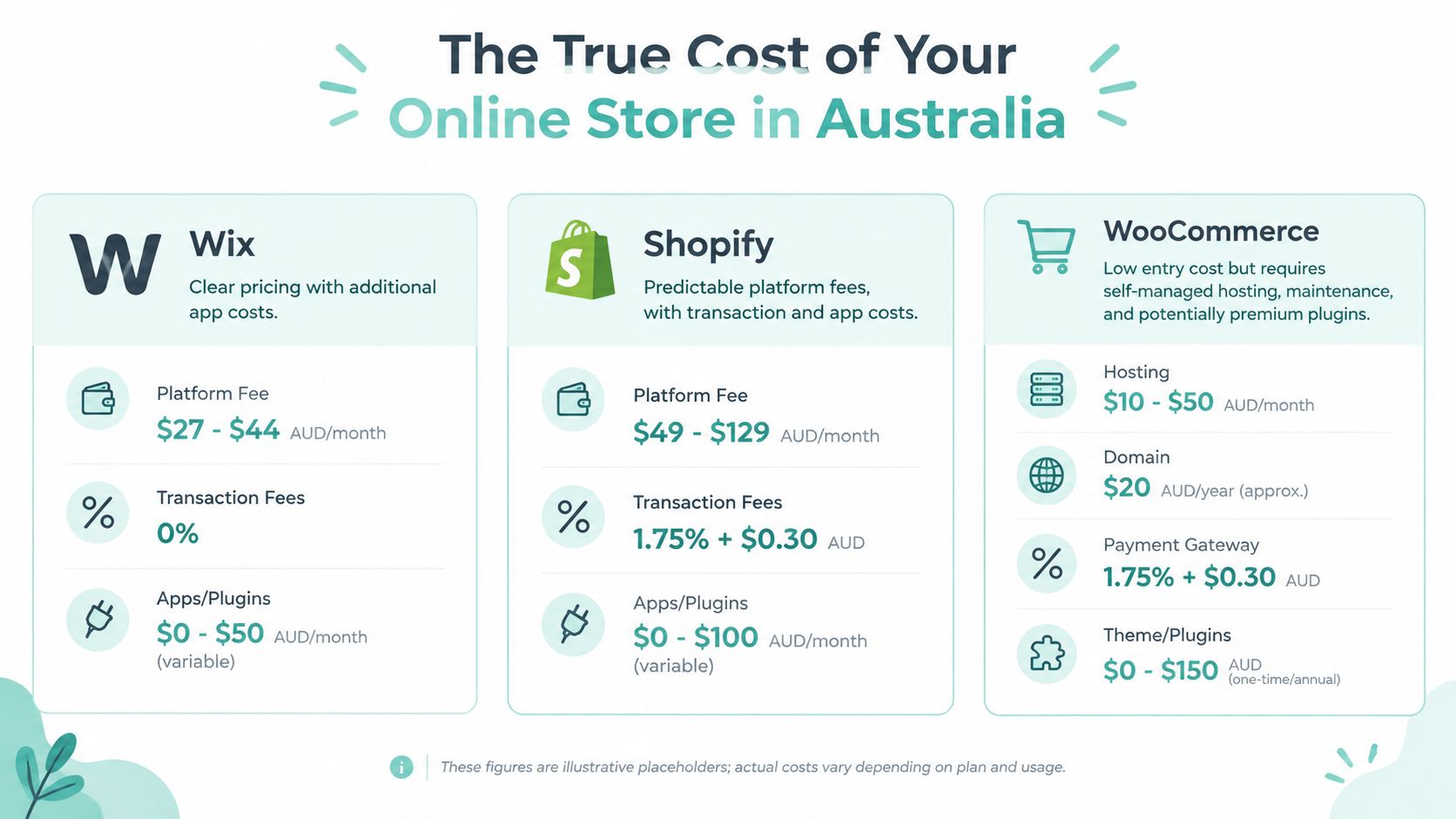
The best starting point is the cost spread itself. Australian comparison material shows WooCommerce can run from roughly A$25 to A$350+ per month once hosting and essentials are included, while cited Shopify plans can start from A$149/month and Wix from A$55/month (Shopify Australia comparison). That does not make WooCommerce more expensive by default, it makes it more variable.
What Australian businesses pay for
Wix and Shopify package a lot into the plan. That includes hosting, checkout infrastructure, and the comfort of knowing the bill usually behaves the same each month. WooCommerce is different. The software is free, but the live store still needs hosting, security, updates, and often premium plugins or a better theme.
Cost rule that matters: if you want predictability, compare the full monthly stack, not the headline plan price.
That is why hosted platforms feel cleaner for owners who do not want to manage every technical line item. WooCommerce can still be the smarter spend when a business is comfortable making hosting a deliberate choice, especially if the site needs custom structure or content-heavy growth.
For Australian operators, the hosting decision matters more than it first appears. A self-hosted store on local infrastructure can keep more control in your hands, and that can be the right fit when you care about how the site performs, how it is maintained, and what you are locked into over time. A practical guide to annual web hosting cost helps separate the true hosting bill from the rest of the stack.
Payments and checkout change the maths
Australian comparison sources place payment processing around 1.75% + A$0.30 for Shopify Payments, Wix Payments, and WooPayments in the models they cite (Merchant Compare). On top of that, Shopify is cited by its own AU-facing material as outperforming WooCommerce checkout by 17% in a global study, which matters because checkout quality is where revenue is won or lost.
A smarter way to budget
For a simple shop, the platform bill might look manageable on day one. The cost gap usually widens when you add SEO tools, shipping apps, email tools, backup systems, and the time you or your developer spend maintaining the stack. That is why the core choice is often between a subscription that hides complexity and a self-hosted setup that shows it.
If you want the lowest possible entry bill, Wix or Shopify can look tidy. If you want more control over the true operating cost, WooCommerce on the right host gives you that choice.
Ease of Use vs Long-Term Flexibility
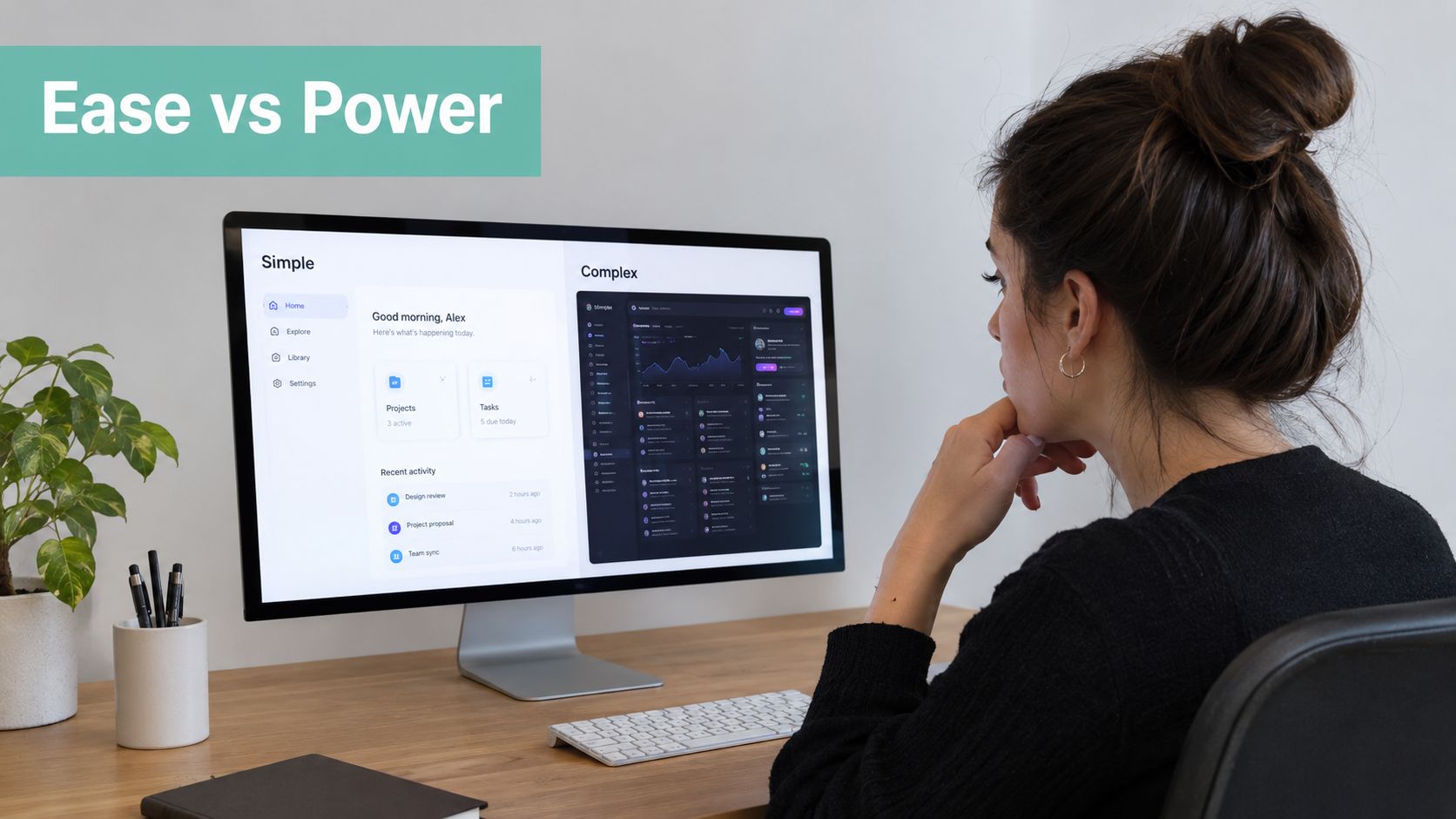
The easiest platform on day one is not always the best platform on day 500. That's the tension behind these three options. Wix keeps the editing experience friendly and visual. Shopify keeps the commerce workflow tight. WooCommerce gives you far more room, but expects more from you in return.
Where Wix feels easiest
Wix suits the owner who wants to move sections around, update a service page, add a few products, and get on with the week. It's the least intimidating of the three if you're not technical. For a local consultant, photographer, or clinic that only needs a modest shop, that simplicity can be enough.
The trade-off is that this convenience comes with boundaries. Once the business wants more complex product logic, deeper content structure, or tighter control over how the store behaves, you're working within the limits of the builder.
Why Shopify feels organised
Shopify is easier than WooCommerce because it narrows the decisions. That sounds like a small thing, but it matters. You're not thinking about hosting stacks or plugin compatibility every time you change something. You're running a store inside a managed environment, and that suits merchants who want a structured way to sell.
The downside is that Shopify's structure is also its restraint. You get a lot of reliability, but less freedom to reshape the underlying architecture the way a WordPress build can.
WooCommerce rewards patience
WooCommerce is the most flexible because it sits inside WordPress, and WordPress is built for content as much as commerce. That makes it a strong option when a business wants product pages, service pages, guides, and local landing pages to work together in one system. For Australian lead generation, that flexibility can be the difference between a nice store and a site that effectively ranks and converts.
UpTime Web Hosting's WordPress and Wix comparison is a useful read here because it speaks to the underlying ownership question, not just the visual editor. If you want a site you can shape over time, that distinction matters.
A good platform doesn't just help you launch. It decides how much of your future you can still change without rebuilding.
Performance SEO and Security for AU Audiences
For Australian businesses, speed isn't abstract. A customer in Perth doesn't care that a platform is fast somewhere else in the world. They care whether the page opens quickly on their connection, whether the checkout feels stable, and whether the site feels local enough to trust.
Performance starts with hosting
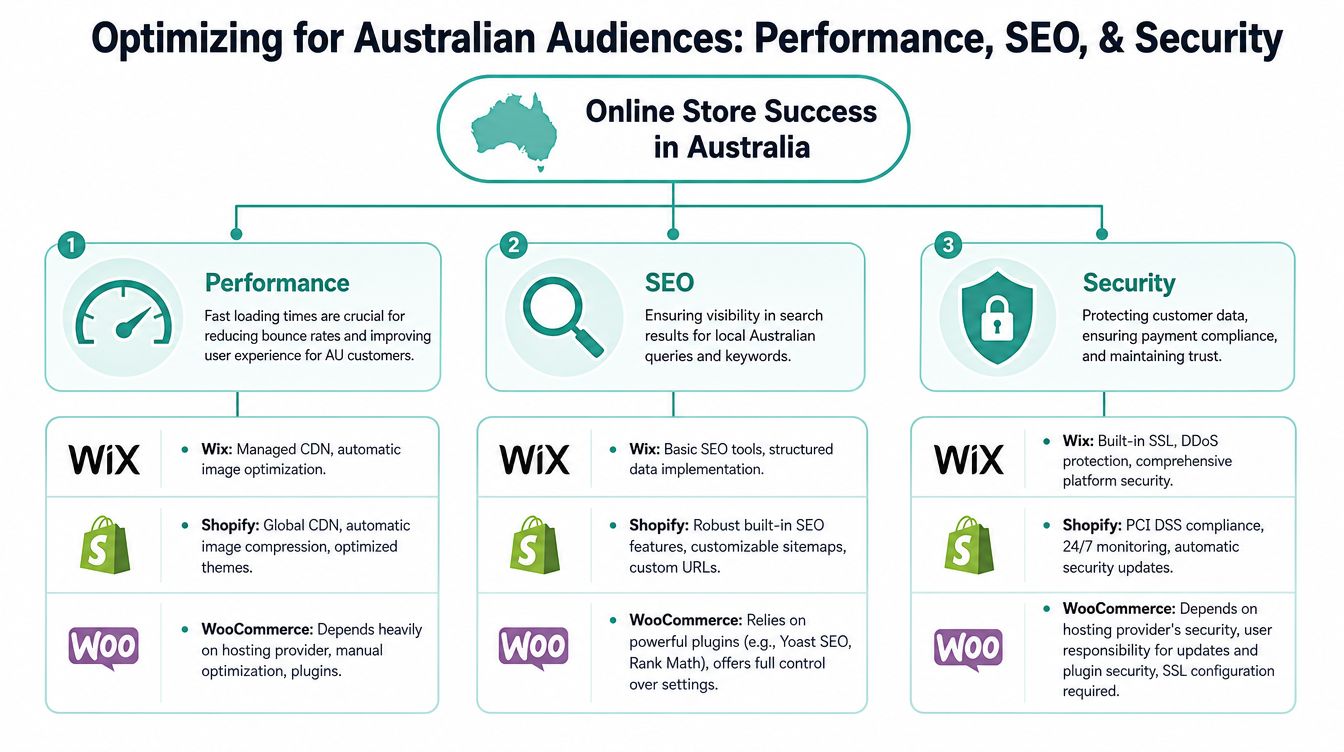
Wix and Shopify handle much of the infrastructure for you, which removes a lot of risk. Wix uses a managed approach with optimisation behind the scenes. Shopify does the same, with a commerce-first environment that takes care of much of the heavy lifting. That's good for owners who want less maintenance.
WooCommerce is different because performance depends heavily on the hosting provider and how the store is built. That's also why a well-hosted WooCommerce site can be the smartest option for Australian businesses that care about local speed, local support, and tuning the site for domestic customers rather than a generic global audience.
SEO control depends on the business model
The strongest SEO setup isn't always the one with the most tools. It's the one that matches the structure of the business. Shopify handles ecommerce SEO well out of the box. Wix offers solid basics for smaller sites. WooCommerce gives you the deepest control, especially when the website is content-led and the store is just one part of the acquisition mix.
The difference matters most when the business is a website first and a store second. That's exactly the case where WooCommerce becomes hard to ignore, because it gives you more room to build pages, cluster content, and shape the architecture around search intent. For a useful external resource on that side of the problem, SemDash's guide to winning web page architecture is a strong companion read.
Security is shared differently
Wix and Shopify manage most of the security burden inside the platform. WooCommerce splits that responsibility between the host, WordPress, plugins, and the business owner. That sounds like more work because it is more work. But it also gives you more control over where the security and performance layers sit.
UpTime Web Hosting's ecommerce site optimisation guide is relevant here because it focuses on the practical side of keeping an online store fast and stable. That's the primary concern for AU businesses, not whether a platform can tick a feature box.
Register your new domain name at competitive market prices including free domain add-ons like privacy, DNS Hosting, Custom Nameservers and Forwarding.
Always the best price and no nasty renewal price hikes.
Register A Domain Name
Extensibility and Support for Local Businesses
No platform gives you everything in the box. What matters is how easily you can add the things Australian businesses rely on, like shipping tools, accounting integrations, booking flows, and local payment support.

Closed ecosystems versus open plugins
Wix and Shopify make app selection feel tidy. That's helpful because it reduces uncertainty. You're choosing from a curated marketplace rather than digging through the entire web for compatibility. The downside is that recurring app fees can stack up, and if a niche Australian workflow isn't supported cleanly, you may have to work around the platform.
WooCommerce goes the other way. Its plugin ecosystem is broad enough that you can usually find a path for almost any requirement, from advanced shipping logic to localised content features. The trade-off is quality control. A wide ecosystem means more choice, but also more responsibility for testing, updates, and compatibility.
Support insight: the more custom the build, the more valuable local developer help becomes when something breaks on a Friday afternoon.
Local services matter more than abstract features
Australian businesses often need integrations that don't show up in generic global comparisons. That includes delivery workflows, payment services, and accounting setups that behave properly with local billing and GST. In practice, Shopify is often the easiest of the three when you want a polished app ecosystem, while WooCommerce gives you more room if a local tool needs custom handling.
If you're looking at Shopify's ecosystem from a revenue-growth perspective, CartBoss has a useful article on strategies for boosting sales on Shopify. It's worth reading because it shows how much can be added around the core platform once the store is live.
Support feels different on each stack
Wix and Shopify lean on platform support and guided onboarding. WooCommerce leans on the broader WordPress world plus your host. That makes the quality of your hosting partner matter more than most first-time owners realise. For businesses that want Australian support, local servers, and a cleaner ownership model, that host relationship can be a key differentiator.
Final Verdict Which Platform Is Best for You
If you run a service business, a small brand, or a creative business that wants a polished site and only light selling, Wix is the easiest place to start. It keeps the build simple and the admin light. If your business is product-first and you want a managed ecommerce system that handles the store with minimal technical overhead, Shopify is the cleanest fit.
If your website is really a content engine, a lead-generation asset, or a custom ecommerce build that needs more control over SEO, structure, and ownership, WooCommerce is the stronger long-term option. That's especially true when you host it properly in Australia, because local performance and local support can matter more than any glossy feature list. The trust signal matters too, since seven in ten Australian SMEs with a domain name choose a .au domain according to auDA (auDA trust report).
A better answer isn't “pick the cheapest platform”. It's “pick the platform that keeps your costs, performance, and support predictable as you grow”. If you want a store that feels local, loads quickly for Australian customers, and gives you room to expand without rebuilding later, WooCommerce on Australian hosting deserves serious attention.
If you're deciding between Wix, Shopify, and WooCommerce for an Australian site, UpTime Web Hosting can help you choose the hosting setup that matches the platform instead of fighting it. Their team offers Australian hosting, WordPress support, and ecommerce-focused infrastructure built for local businesses that need speed, security, and clear pricing. Visit UpTime Web Hosting to compare hosting options and plan a store that's ready for Australian customers from day one.