

When you're deciding where to host your website, one of the biggest—and most overlooked—choices is whether to go with one of the many Australian owned web hosting companies or an overseas provider. The difference is massive, a bit like choosing between a local mechanic who understands Australian road conditions and a generic international chain that just follows a script.
Why Australian Owned Web Hosting Matters
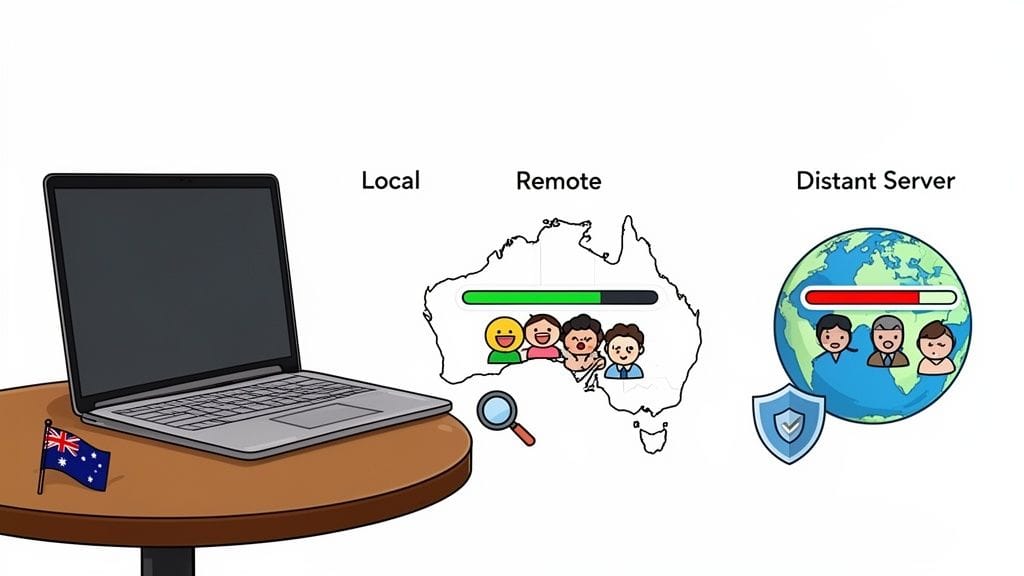
Picking a web host can feel like a maze of technical jargon, but boiling it down to a simple choice—local or international—can make all the difference. Opting for a local Aussie host isn't just about patriotism; it’s a smart business move that directly impacts your site's speed, security, and even your search rankings.
Think of it this way: a local coffee shop knows your order and the neighbourhood gossip, giving you a personal touch you just can't get from a massive global chain. In the same way, Australian web hosts are built from the ground up to serve the local market.
Before we dive deep into the technical side, let's look at the key differences at a glance.
Local vs International Hosting At a Glance
| Feature | Australian Owned Hosting | International Hosting |
|---|---|---|
| Server Location | In Australia (Sydney, Melbourne, etc.) | Overseas (USA, UK, Singapore) |
| Website Speed | Faster for Australian visitors | Slower due to physical distance |
| SEO Impact | Better rankings in Australian search results | Potential disadvantage in local SEO |
| Data Laws | Governed by Australian Privacy Act | Subject to foreign laws (e.g., US CLOUD Act) |
| Support | Local, same-time-zone support | Often outsourced, time zone delays |
| Economy | Supports local jobs and tech industry | Profits go offshore |
As you can see, the choice has real-world consequences for your business and your customers. Let's break down exactly what these differences mean for you.
Faster Speeds and Better SEO
The number one reason to host locally is speed. Simple as that. When your website's files are stored on servers physically located in Australia, the data has a much shorter trip to get to your Australian visitors. This travel time is what tech folks call latency.
Less distance means lower latency, which translates directly to faster page load times. For a customer in Brisbane, a website hosted in Sydney will always feel snappier and more responsive than one hosted in Dallas or Dublin. For example, the latency from a Sydney server to a user in Melbourne might be around 10-15 milliseconds, whereas from a US server, it could be over 200 milliseconds.
And speed isn't just a nice-to-have. A tiny one-second delay in page load time can cause a 7% drop in conversions.
Google knows this, which is why it rewards faster websites with better positions in search results. By hosting locally, you're giving your site a home-ground advantage for Australian search queries, making it easier for local customers to find you.
Enhanced Security and Data Sovereignty
Here's a big one: data sovereignty. When you host in Australia, your business and customer data are kept on Australian soil. This means it's protected by Australian laws, specifically the Privacy Act.
This is absolutely critical for any business that collects personal information—from a simple email newsletter sign-up to a full-blown eCommerce checkout. It gives your customers peace of mind knowing their data is handled under a legal framework they know and trust.
If you want to get into the nitty-gritty, we've put together a full guide on why it's important to host your website in Australia.
Supporting the Local Tech Economy
Choosing an Australian host does more than just benefit your own business. It contributes to a thriving local industry. When you choose an Aussie-owned host, your money stays here—it helps create local jobs, drives innovation, and builds up our national digital infrastructure.
Plus, it means you get expert support from people who are in your time zone, understand your market, and are ready to help when you actually need it. No more waiting until 3 AM for a reply from a support team on the other side of the world. A practical example is needing urgent help at 4 PM on a Friday; a local team in Sydney is there to assist, whereas an international team may not be available until your Monday.

Performance you can feel, backed by clients who depend on it. Read how our support and uptime create long‑term customer success.Power Your Business with Better Hosting
Decoding the Technology Behind Great Australian Hosting

Alright, now that you see why picking a local host is such a smart move, it’s time to lift the bonnet and check the engine. The technology powering your website is what makes the difference between a lightning-fast site and a slow, frustrating one.
Getting your head around these core components will give you the confidence to properly compare Australian-owned web hosting companies.
First, let's talk about latency again—that’s just the technical word for the time it takes data to travel. Think of it like posting a parcel. Sending something from Sydney to Melbourne is always going to be faster than sending it from Sydney to Texas. It's the same deal for your website's data. Shorter distance means quicker delivery.
This is exactly why having servers located in Australia is non-negotiable if your customers are here. Every millisecond counts online, and local servers give you an instant head start on speed.
The Foundation of Performance
But a great server location is just the beginning. The software running on that server is just as critical. Many hosting providers still use older, slower web server tech like Apache. Modern Australian hosts, on the other hand, have moved on to LiteSpeed Web Server.
Imagine two checkout counters at a supermarket. One has an old, clunky cash register where everything is manual. The other is a modern, tap-and-go system. LiteSpeed is the tap-and-go option—it’s built to handle more customers and process transactions far more efficiently. This means your website can handle way more visitors at once without ever slowing down.
To take performance and stability a step further, the best hosts use a technology called CloudLinux. This is absolutely essential in a shared hosting environment, where dozens of websites live on the same physical server.
Think of a shared server like an apartment building. Without a good building manager, one noisy tenant having a party (a single website using too many resources) could disrupt everyone. CloudLinux is that building manager, giving each website its own secure, isolated "apartment" with a guaranteed set of resources.
This isolation is a game-changer. It makes sure that a sudden traffic spike or a rogue script on someone else's website won’t slow down or crash your own. It creates a much more stable and predictable environment for everyone. There are a lot of upsides to this approach, and you can learn more about the benefits of cloud hosting in our other guide.
Supercharging Speed with Caching
Even with fast servers and slick software, there’s one more layer that makes a massive difference: caching. Tools like AccelerateWP work by creating a "snapshot" of your website and keeping it ready to go.
Here's how it works in practice: When someone visits your site, the server usually has to build the page from scratch—fetching your theme files, plugins, text, and images. Caching pre-assembles that page. So, instead of building it new for every single person, the server just delivers the ready-made snapshot almost instantly.
It’s the difference between a barista grinding beans and brewing a fresh coffee for every customer versus having a fresh pot hot and ready to pour. This simple trick dramatically cuts down the server's workload, giving your visitors near-instant load times.
When you're comparing Australian-owned web hosting companies, keep an eye out for these key technologies. They're your guarantee that your website is built on a foundation designed for speed, reliability, and a fantastic user experience.
Optimising Your WordPress or eCommerce Website
If your business relies on a WordPress or eCommerce website, you’ve probably realised that a generic, one-size-fits-all hosting plan just doesn't cut it. Specialised optimisation isn't a "nice-to-have" feature; it's absolutely essential for keeping your site fast, secure, and ready for customers. Choosing one of the many Australian owned web hosting companies that focuses on platform-specific features can be the single biggest difference between a thriving online business and one that’s constantly struggling.
This is especially true for WordPress, the platform powering a huge portion of the web. With that kind of dominance, quality Australian hosts know they need to deliver solutions that are finely tuned for how WordPress actually works.
What 'WordPress Optimised' Really Means
So, what does 'WordPress Optimised' actually mean on the ground? It’s a hosting environment that has been specifically configured from the server up to make your WordPress site faster, more secure, and far more reliable. A massive part of this is server-level caching.
Instead of just leaving it all to a plugin, server-side caching (using tools like AccelerateWP) creates a ready-to-serve version of your site directly on the server. Think of it like your favourite barista having your regular coffee order ready the moment you walk in the door, instead of grinding the beans and starting from scratch every single time. This approach massively reduces the work the server has to do and gets pages to your visitors in a flash. You can learn more about this in our guide on how to improve WordPress speed with a cache plugin.
Another game-changer is resource isolation, often handled by systems like CloudLinux. On standard shared hosting, your site is in a big open-plan office with dozens of other websites. If a "noisy neighbour" suddenly gets a huge surge of traffic, they can hog all the server's attention, slowing your site to a crawl or even knocking it offline.
Resource isolation acts like a soundproof wall, giving your website its own guaranteed slice of server power. This means no matter what happens on other sites, your performance stays stable and predictable—something that's absolutely vital during a big sale or marketing campaign.
Critical Optimisations for Australian eCommerce
For any online store, every single millisecond counts. Speed is directly linked to revenue, and a slow, clunky checkout is the fastest way to lose a sale. This is where hosting with an Australian-owned company gives you a real, tangible edge.
Low-latency connections are a must. When your store is hosted right here in Australia, the round trip between your website and local payment gateways like eWay, Stripe, or Afterpay is incredibly quick. This simple fact can shave precious moments off the transaction time, dramatically reducing the chances of a frustrated customer abandoning their cart.
Just look at this real-world example:
- An online boutique in Perth was seeing a painful 40% cart abandonment rate.
- After digging in, they found their checkout page was taking 4.5 seconds to load because their host’s servers were in the US.
- They switched to a local host in Sydney, and their checkout load time dropped to just 1.8 seconds.
- Within a month, their cart abandonment rate fell to 25%, directly boosting their monthly revenue.
This shows how a simple technical decision—where your website lives—can have a huge impact on your bottom line. Of course, once you've sorted your hosting, choosing the best email marketing software for ecommerce is the next step to re-engage those customers and turn recovered carts into loyal fans.
Host your website with our 5-star rated, cPanel website hosting plans.
Super fast servers, with security included and hosted in your choice of Australian Data Center.
View cPanel Plans
Choosing Between Linux and Windows Hosting
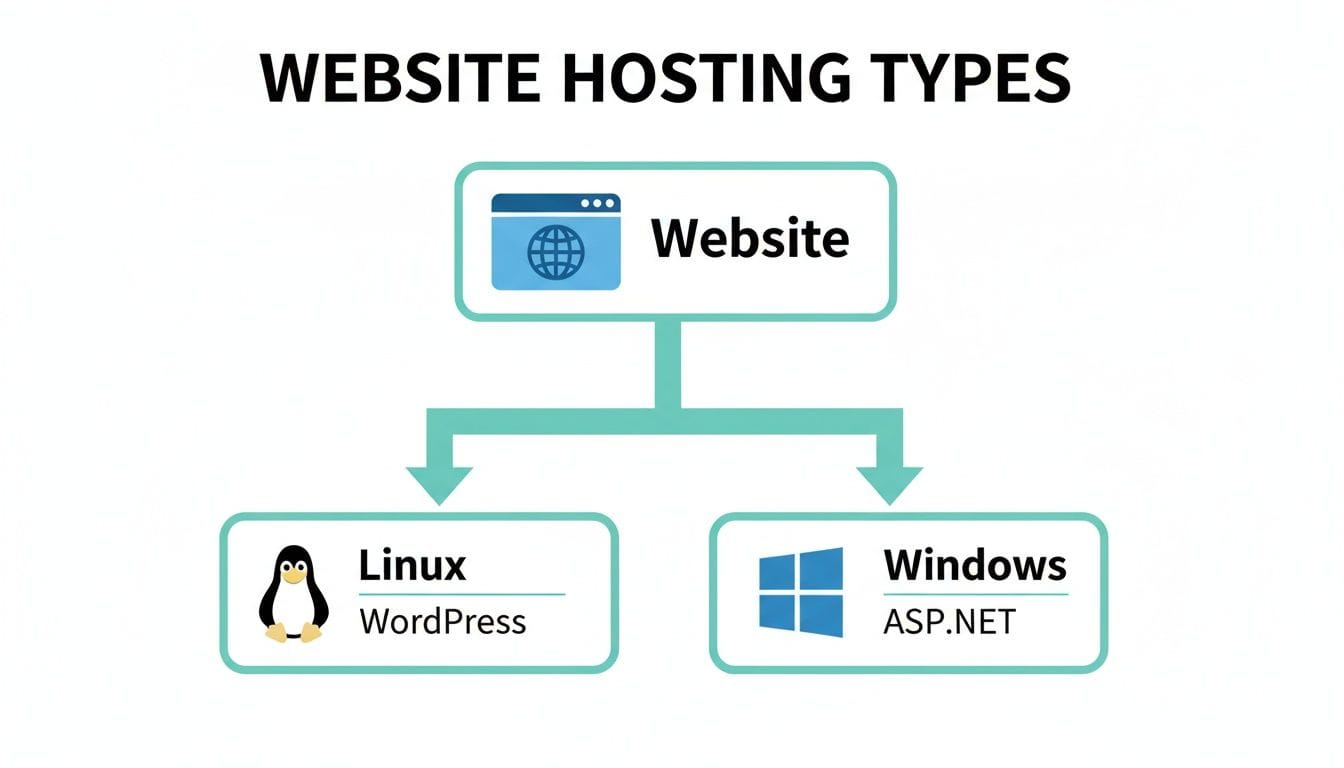
When picking a plan from Australian owned web hosting companies, many business owners get stuck on the Linux versus Windows decision. It’s a common hurdle, but the good news is that it’s far simpler than it sounds.
This choice has absolutely nothing to do with what’s on your personal computer, whether it's a Windows laptop or an Apple Mac. It's all about the specific technology your website is built on.
Think of your website as a car and the hosting operating system as its fuel. A petrol engine needs petrol, and a diesel engine needs diesel—you just can’t mix and match. In the same way, your website’s code needs a specific server environment to run properly.
The Clear Choice for Most Websites
For the vast majority of websites, Linux hosting is the default and correct choice. It’s the natural home for the most popular open-source software used to build websites today.
You should choose Linux hosting if your website is built with:
- WordPress: The world’s most popular Content Management System (CMS).
- Joomla or Drupal: Other widely-used CMS platforms.
- PHP & MySQL: The scripting language and database combination that powers most dynamic websites, including virtually all major eCommerce platforms like Magento and WooCommerce.
Because Linux is open-source, it also tends to be more cost-effective. The widespread use of control panels like cPanel makes managing a Linux server straightforward and familiar for developers and business owners alike. If you need a reliable platform for your WordPress or PHP-based site, it's wise to explore options with a proven track record, such as our Australian cPanel hosting services.
In short, if you are unsure which to choose, you almost certainly need Linux hosting. It's the industry standard for a reason, offering the greatest compatibility, community support, and cost-efficiency for modern web development.
When Windows Hosting is Necessary
While it’s less common, Windows hosting is absolutely essential for a specific set of use cases. You must choose a Windows server environment if your website or application was specifically developed using Microsoft technologies.
This is the only option if your site requires:
- ASP.NET (Active Server Pages): A framework for building web applications developed by Microsoft.
- MSSQL (Microsoft SQL Server): A database management system that is often used in conjunction with ASP.NET.
- Other Microsoft-specific applications: Any proprietary software that explicitly requires a Windows server to function.
For example, a custom-built inventory management system developed for a manufacturing company using .NET and connecting to an MSSQL database would demand Windows hosting.
Trying to run this on a Linux server would be like trying to run an iPhone app on an Android phone—it simply won't work. The technologies are fundamentally incompatible.
How to Evaluate Australian Web Hosting Companies
So, you're ready to pick a provider? Fantastic. This part is all about giving you a solid framework to cut through the marketing noise and find a genuine partner for your business. It's time to look past just the price and figure out what really counts for an Aussie business like yours.
Glancing at a provider's website is one thing, but knowing what you’re really getting takes a closer look. The real difference between an average host and a great one often comes down to the quality of their local support, transparent pricing, and how flexible they are with contracts. This is where the best Australian-owned web hosting companies truly stand out.
Look Beyond the Price Tag
While your budget is always a consideration, the cheapest plan is almost never the best value in the long run. A quality Aussie host is upfront about all costs, including GST, so you know exactly what you're paying from day one.
But the biggest differentiator is the support you get when you need it. Ask yourself a few questions:
- Is the support team actually based in Australia and working in my time zone?
- Can I call them on a 1300 number for a real conversation, or am I stuck logging a ticket and waiting?
- Are they a proper Australian company, or just a reseller for a huge overseas corporation?
A quick look at a provider's "About Us" page and contact details can tell you a lot. A physical Australian address and a local phone number are strong indicators of a true local business, not just a storefront for a US company.
This distinction becomes critical when you run into trouble at 4 PM on a Friday. A local team gets the urgency and is right there during your business hours. You can get a clearer picture of what to look for by reading up on what defines the best Australian web hosting.
Understand Key Technical and Security Features
To make a truly informed choice, you need to compare providers on more than just their marketing claims. Let's focus on the core resources and security features that will directly affect how your website performs and how safe it is.
Be cautious of vague promises like "unlimited storage." Instead, you want to see clear allocations for:
- Disk Space: How much storage you actually get for your website files, databases, and emails.
- CPU & RAM: This is the processing power and memory given to your account. It's what determines how well your site handles visitor traffic.
- Security Tools: Check for the non-negotiables like free SSL certificates (to enable HTTPS), daily offsite backups, and powerful malware scanning.
When looking at web hosting companies, it's also smart to think about their network. The quality of their upstream connections has a direct impact on your site's speed and reliability. Digging into the best internet providers for business in Australia can give you a bit of insight into the quality of the networks your potential host might be using.
To help you compare apples with apples, we've put together a checklist of the most important things to look for.
Essential Checklist for Choosing Your Australian Host
Use this table to methodically assess potential providers and ensure you're getting a service that truly supports your business goals.
| Evaluation Criterion | What to Look For | Why It Matters for Your Business |
|---|---|---|
| Local Support | An Australian address and a 1300 number. Support available during AU business hours. | When something goes wrong, you need fast help from a team that understands the local context. |
| Transparent Pricing | Clear pricing that includes GST. No hidden fees or massive renewal price hikes. | Predictable costs are essential for budgeting. You shouldn't get a nasty surprise after your first year. |
| Contract Flexibility | Month-to-month billing options without being locked into long-term contracts. | Your business needs can change. You shouldn't be stuck in a multi-year plan that no longer fits. |
| Server Location | Data centres located in Australia (e.g., Sydney, Melbourne). | Improves website speed for your local customers and helps with data sovereignty compliance. |
| Security Features | Free SSL, daily offsite backups, firewall, and malware scanning included as standard. | Protects your website, customer data, and brand reputation from threats without extra cost. |
| Clear Resource Limits | Specific amounts for disk space, RAM, and CPU. Avoid vague "unlimited" promises. | Ensures your website has the power it needs to run smoothly and handle traffic without unexpected throttling. |
| Independent Operation | Check if they are a genuine Australian-owned company, not just a reseller. | A true local host has more control over their infrastructure and is more invested in the Australian market. |
Ultimately, choosing from the many Australian-owned web hosting companies is about finding a partner who puts reliability and genuine local service first. Look for that clear, honest pricing, flexible month-to-month contracts, and an unwavering commitment to keeping your data safe on Australian shores.
Making the Switch to a Local Australian Host
The thought of moving your website to a new host can feel pretty overwhelming. Packing up all your files, databases, and emails sounds like a massive technical headache, and it's easy to worry about things breaking or your site going down.
But here’s the good news: with the right partner, switching to one of the top-tier Australian owned web hosting companies is a surprisingly simple and pain-free process. A quality local provider knows all about these migration jitters and has built their process to make the move as smooth as possible. In fact, many offer a free migration service where their own experts handle everything for you, giving you total peace of mind.
Understanding the Migration Process
Moving to your new Australian host isn’t a risky leap in the dark. It’s more like a carefully planned house move, following a clear set of steps designed to ensure nothing gets lost and the lights stay on the whole time.
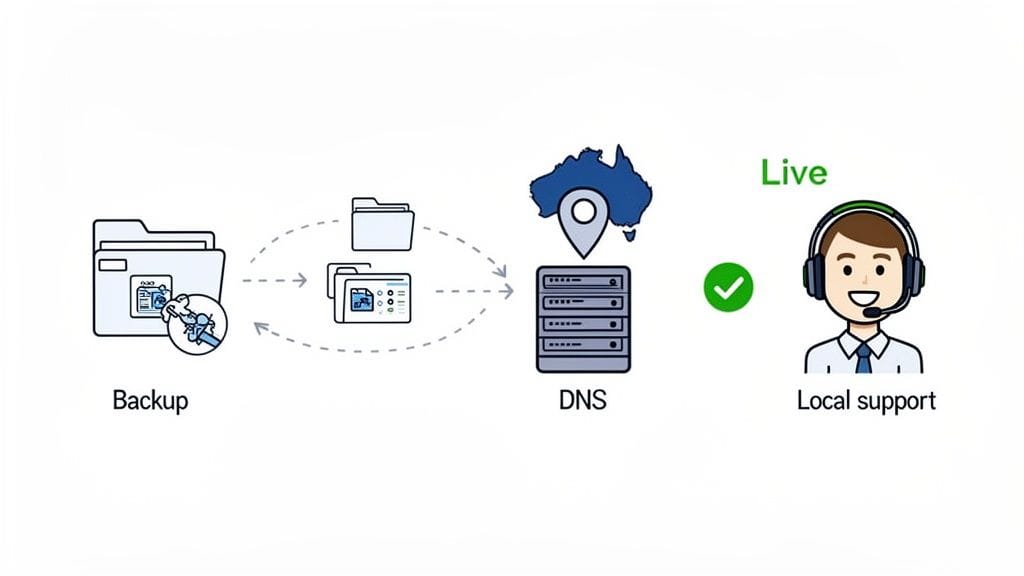
The process almost always follows these core steps:
- Full Website Backup: First things first, a complete backup of your current website is created. This is a perfect snapshot that includes all your files (images, themes, plugins) and your databases, which hold all your precious content and user info.
- Transfer to the New Server: Your new Aussie host then securely moves these backup files over to your new hosting account on their local servers.
- Setup and Testing: Once the files are in place, the technical team restores your site on the new server. They’ll give you a way to check it out—either with a temporary link or by tweaking your computer's local 'hosts' file—so you can see it live before anyone else does. This is your chance to make sure it all works perfectly.
This testing phase is absolutely vital. It lets you click through your site, test your contact forms, and make sure everything looks and works exactly as it should. It’s a crucial quality check before you flip the final switch.
Going Live with Your New Host
Once you’ve given the thumbs-up and confirmed your site is running flawlessly in its new home, it’s time to go live. This last step involves updating your domain's DNS (Domain Name System) records. Think of DNS as the internet's address book for your website.
All you need to do is update your domain’s nameservers to point to your new Australian host. This change tells the internet, "Hey, send all visitors over to this new, faster server now!" The update can take a few hours to spread across the web, but for your visitors, the transition is usually completely seamless.
And if you’re the hands-on type who wants to manage the process yourself, a good host will have your back with excellent support. For example, our guide on migrating your WordPress site gives you step-by-step instructions.
Ultimately, partnering with a supportive Australian web host turns a dreaded task into a straightforward upgrade for a faster, more secure, and locally-supported website.
Register your new domain name at competitive market prices including free domain add-ons like privacy, DNS Hosting, Custom Nameservers and Forwarding.
Always the best price and no nasty renewal price hikes.
Register A Domain Name
Your Australian Hosting Questions, Answered
Thinking about moving to a local web host can bring up a lot of questions. It's a big decision, so it's only natural to want clear answers before you make a move. Let's tackle some of the most common queries we hear from Australian business owners just like you.
Will My Website Actually Be Faster on an Australian Host?
Yes, without a doubt. The biggest drain on your website’s speed for local visitors is physical distance. It’s a concept called latency, which is just the time it takes for data to travel from the server to your customer's screen.
Think of it this way: if your website is hosted on a server in Dallas, USA, the data has to travel thousands of kilometres across the Pacific to reach someone in Perth. Move that same website to a server in Sydney, and the journey is drastically shorter. That difference can easily slash your load time from a frustrating 3-4 seconds down to less than 2 seconds. For an online store, that’s the difference between a sale and a lost customer.
Is Moving My Website to an Australian Host a Huge Hassle?
It’s easy to think migrating a website is a massive technical headache, but a good local host makes the process completely painless. Most reputable providers, including UpTime Web Hosting, handle the entire move for you, and they often do it for free.
Their expert team will typically take care of everything:
- A full backup of all your website files and databases.
- The secure transfer of your site to its new Australian server.
- Thorough testing to make sure everything works perfectly before flicking the switch.
This means you get all the benefits of faster local hosting with practically zero downtime and none of the stress.
Why Should My Small Business Care About 'Data Sovereignty'?
Data sovereignty sounds like a big, corporate term, but it’s incredibly important for any Australian business. It simply means your business and customer data is stored on Australian soil, under the protection of the Australian Privacy Act.
If you collect any customer information at all—even just a name and email from a contact form—hosting locally is a powerful signal of trust. It shows your customers you take their privacy seriously.
By choosing an Australian host, you're guaranteeing that your customers' data is shielded from foreign laws, like the US CLOUD Act, which could give overseas governments access to it. It’s a simple way to build your brand’s reputation and give your customers peace of mind.
This commitment is a key reason to choose a provider who prioritises Australian infrastructure. For a deeper dive, have a look at our article on why it's important to host your website in Australia.
Ready to feel the difference a true local partner makes? At UpTime Web Hosting, we’re all about delivering fast, secure, and reliable hosting with expert Australian support. Take a look at our WordPress and cPanel hosting plans and see for yourself.