

You are likely reading this after one of two moments.
Either you’ve just seen your hosting renewal land in your inbox and the “cheap” plan isn’t cheap anymore, or your site is running slowly and support keeps replying with generic answers that don’t fix the problem. That’s the point where many Australian business owners realise hosting isn’t merely a monthly line item. It affects enquiries, online sales, search visibility, admin time, and how hard it is to leave when the service goes downhill.
That’s why affordable web hosting no contracts matters significantly in Australia. The primary advantage isn’t only a lower starting price. It’s keeping control. You want the freedom to move if support is poor, the confidence that your site is hosted locally where it makes sense, and pricing that doesn’t punish you later with add-ons and lock-in terms.
The Hidden Trap of Long-Term Hosting Contracts
A lot of businesses get trapped the same way.
They launch a new site, pick a bargain plan, prepay for a long term deal, and move on to more urgent work. For a while, it feels sorted. Then the site slows down, emails take ages to get answered, and every small request turns into a ticket loop with someone who doesn’t understand the urgency of an Australian business trying to serve Australian customers.
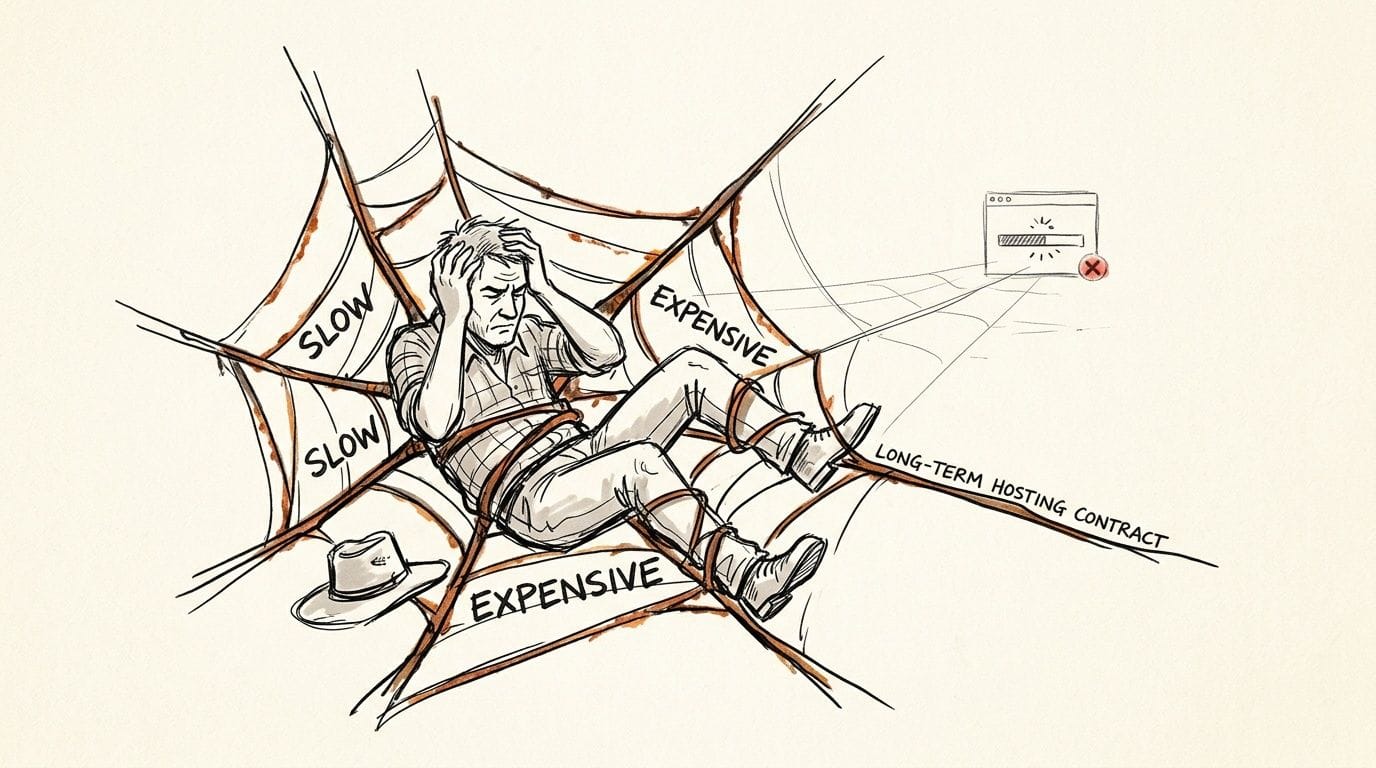
A common example looks like this. A local tradie, consultant, clinic, or online shop signs up because the promo price is tiny. Six months later, they realise the plan doesn’t include something basic they assumed was standard, or support takes too long when the site goes down, or the dashboard is packed with upsells. By then, leaving feels harder than staying.
Why the pain gets worse over time
Long-term hosting contracts create friction in all the wrong places:
- You delay fixing the problem because you’ve already paid.
- You tolerate poor performance because moving sounds technical.
- You keep spending on a setup you no longer trust.
That last point matters more than most owners expect. A bad host doesn’t only cost money. It costs time, patience, and credibility. If your website loads slowly or throws errors when someone is trying to enquire, book, or buy, your business wears the damage, not the host.
Most hosting regret starts with a low intro price and ends with a business owner saying, “I just want something straightforward that works.”
Leaving shouldn’t feel like a breakup with paperwork
If a provider makes cancellation hard, that’s a warning sign in itself. A decent no-contract host should make the exit process visible and boring. No mystery steps. No chasing invoices. No confusing retention games. If you want to see what a clear cancellation process looks like, this guide on how to cancel your hosting plan is the sort of transparency businesses should expect before they sign up, not after they’re frustrated.

Performance you can feel, backed by clients who depend on it. Read how our support and uptime create long‑term customer success.Power Your Business with Better Hosting
What No-Contract Web Hosting Really Means
A Brisbane tradie signs up on a cheap hosting promo because the monthly number looks harmless. Three months later, the key question is not the sticker price. It is whether the host is still worth paying for next month, and whether leaving will be easy if it is not.
That is what no-contract hosting changes.
No-contract web hosting often means you pay month to month, with no long prepaid term locking you in and no cancellation penalty if the service stops fitting your business. The host still has to keep your site online, fast enough, and supported properly. The difference is simple. They have to earn each renewal instead of relying on sunk cost.
For Australian businesses, that matters more than it first appears. A local business website is often tied to email, enquiry forms, booking systems, and customer records. If the host is slow, support is hard to reach, or the data sits somewhere that creates privacy concerns, the cheap plan can start affecting day-to-day operations. That is why no-contract hosting is primarily about control over total cost of ownership, not merely billing flexibility.
What you should expect from a genuine no-contract plan
A proper no-contract offer is often easy to recognise:
- Monthly billing is available without forcing a 12, 24, or 36-month prepayment
- Cancellation is straightforward from the client area or through a clear support process
- Renewal pricing is visible before you buy
- Included features are spelled out so you are not guessing about SSL, backups, email, or migration
- Data handling is clear if your business needs Australian hosting or wants to avoid unnecessary offshore risk
That last point gets missed in a lot of generic overseas advice. For an Australian small business, data location and support hours can affect cost as much as the base plan. If a problem hits at 9 am Sydney time and your provider only responds on another timezone’s schedule, you pay for that delay in lost leads and wasted staff time.
What no-contract does not mean
No-contract hosting does not mean lower quality. It does not mean the provider is informal about uptime, backups, or security. In many cases, it means the opposite. Hosts offering month-to-month terms know customers can leave quickly, so they have a stronger reason to keep support useful, billing clear, and performance consistent.
Shared hosting is still the starting point for many small businesses. A clear shared hosting plan for Australian small business websites should show the actual monthly rate, what resources are included, and whether common extras are bundled or sold separately.
The same principle applies across other business software as well. Owners comparing hosting often run into the same pricing tricks they see in tools marketed as the cheapest crm for small business. The lesson is the same. Low entry pricing only helps if the full cost stays reasonable once the business is using the service.
A practical way to read the offer
Read the plan details like you are checking next quarter’s expenses, not today’s promo banner.
Ask these questions:
- Can the plan be cancelled at any time without a fee?
- What will the normal monthly price be after any introductory discount?
- Are backups, SSL, email, and migrations included or extra?
- Is support available during Australian business hours?
- If customer data matters to your business, where is it hosted and backed up?
If those answers are hard to find, the plan is likely designed to look cheaper than it appears.
Practical rule: no-contract hosting means freedom to stay because the service works, not pressure to stay because leaving is annoying.
Judging True Affordability Beyond the Sticker Price
A Brisbane business owner signs up for a $4.99 hosting deal, then spends the next three months paying extra for backups, fixing email issues, and waiting overnight for support replies from overseas. The hosting bill still looks cheap. Running the site does not.
That is the gap between price and affordability.
For Australian businesses, the better measure is total cost of ownership. The monthly fee matters, but so do the costs that sit around it: slower load times for local customers, paid add-ons for basic features, time lost to support delays, migration work when you outgrow the plan, and data handling questions if customer information is stored offshore.
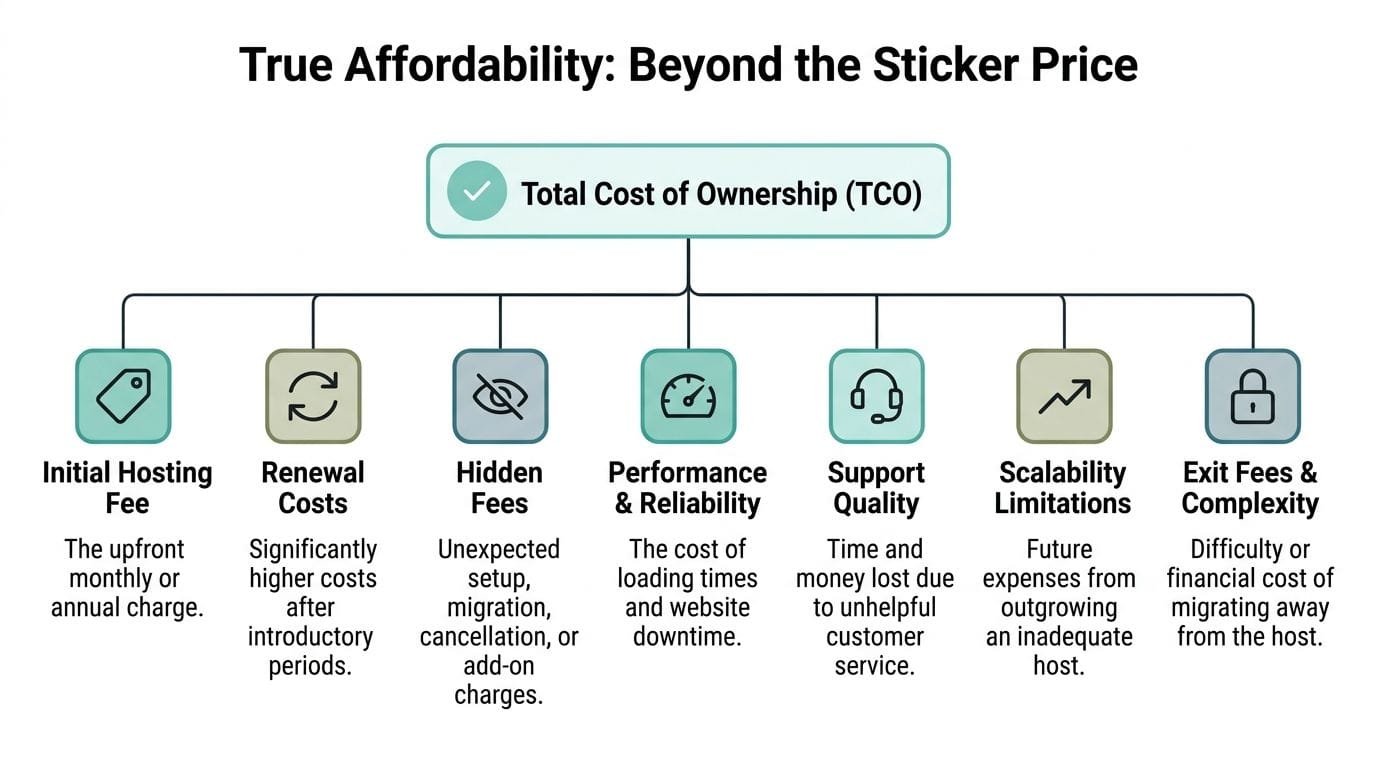
The invoice is only part of the cost
Low pricing can make sense. A small brochure site, tradie website, or local service business often does fine on a modest shared plan.
The problem starts when the advertised rate excludes things a business site needs. SSL, backups, email filtering, malware scanning, staging, and migration help are common examples. Buy each one separately and the “budget” plan frequently ends up costing more than a straightforward month-to-month service that bundles the basics.
A practical comparison looks like this:
| Cost area | Cheap-looking plan | Affordable plan |
|---|---|---|
| Base hosting | Intro price that jumps later | Clear monthly rate from the start |
| SSL | Sometimes charged separately | Usually included |
| Backups | Extra fee or limited access | Included or clearly priced |
| Support | Slow queue, generic replies | Timely help that solves the issue |
| Migrations | DIY or paid add-on | Help included or transparently quoted |
| Data handling | Vague server location | Clear hosting and backup location |
Hidden costs hit small teams hardest
Large companies can absorb a few wasted hours. A small Australian business often cannot.
If your site is slow, contact forms fail, or support takes half a day to respond, someone inside the business picks up that cost. It is often the owner. That means time off quotes, sales follow-up, bookings, or customer service. Cheap hosting becomes expensive the moment it starts stealing working hours.
This is also why local context matters. A host aimed at North America or Europe may remain usable, but the trade-off is real if your customers are in Australia and your team needs help during Australian business hours. Price should be weighed against response time, local performance, and whether the provider is clear about where data is stored and backed up.
Affordability should hold up after month one
A good no-contract plan should make sense after the promo ends.
Check whether the regular monthly rate is easy to find. Check whether GST is shown clearly. Check whether backups can be restored without another fee. Check whether leaving is simple if the service does not suit you.
The same buying habit helps across the rest of your software stack. Businesses comparing hosting often run into the same pricing tricks found in tools marketed as the cheapest crm for small business. The lesson is simple. Entry pricing only matters if the ongoing cost stays predictable once the business is actively using the service.
A better test for “affordable”
Ask one direct question: what will this hosting cost my business over the next 12 months, in money and in staff time?
If the answer is hard to calculate, the offer is probably built around friction, add-ons, or both. For a closer look at the charges that tend to appear after signup, this guide to the hidden costs of budget web hosts is worth reading.
Affordable hosting keeps the full cost predictable, including performance, support, and compliance considerations that matter to Australian businesses.
Host your website with our 5-star rated, cPanel website hosting plans.
Super fast servers, with security included and hosted in your choice of Australian Data Center.
View cPanel Plans
An Actionable Checklist for Choosing an Australian No-Contract Host
A good hosting shortlist should get shorter fast.
If a provider can’t clearly answer where your site is hosted, what’s included, how billing works, and what support looks like when something breaks, move on. Australian businesses don’t need more hosting jargon. They need a service that fits local performance and compliance realities.
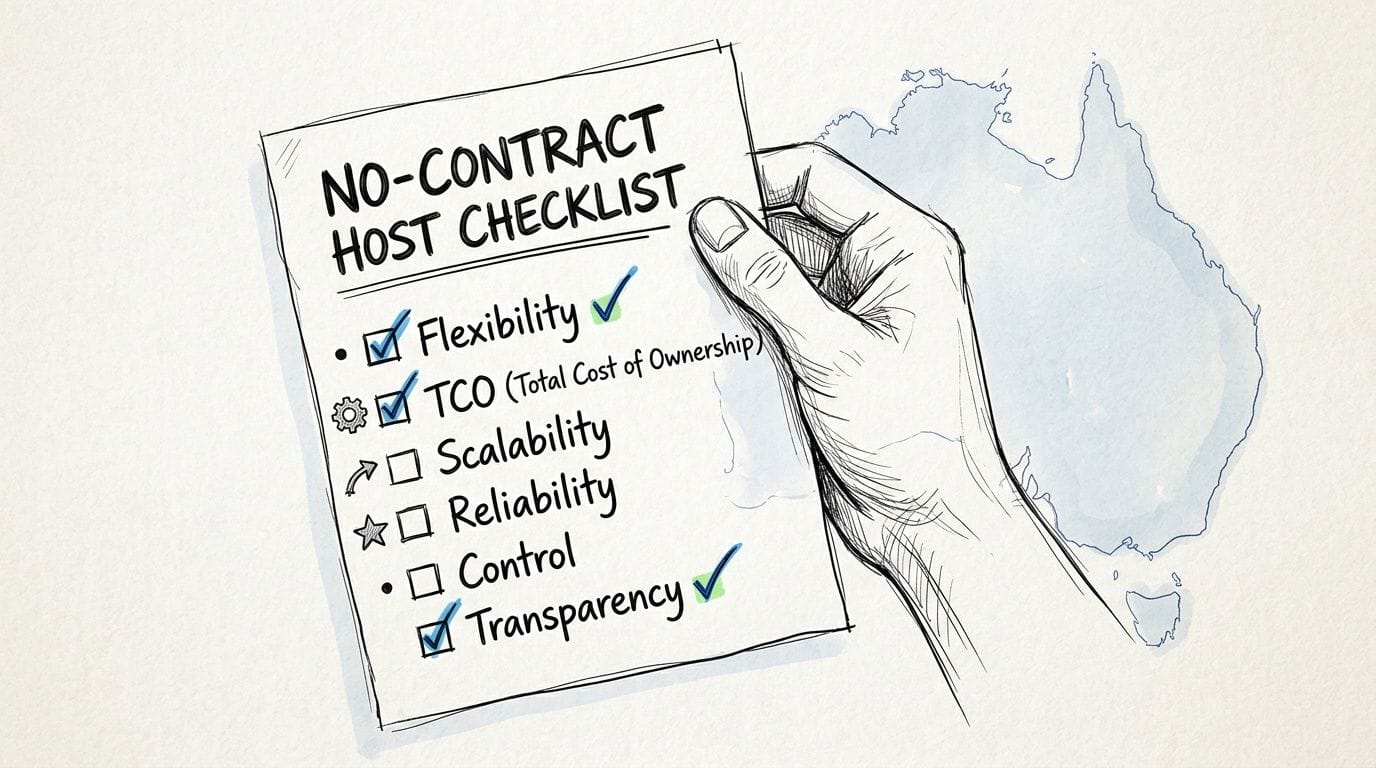
Check where the servers are
For an Australian audience, server location isn’t a minor detail. It affects how the site feels to your visitors and can shape compliance decisions too.
Vistaprint’s AU-focused hosting article notes that international providers with US/EU data centres can result in significantly slower load times for Australian users. It also suggests that many Australian SMEs prioritize AU-hosted servers to comply with the Privacy Act 1988 and keep latency low.
If your customers are in Sydney, Melbourne, Brisbane, Perth, or regional Australia, ask the host exactly where the website is hosted. “Global network” is not the same as a clearly stated Australian server location.
Confirm support is Australian
A local phone number helps. So does ticket support that answers in plain English and understands what a business site outage means during local trading hours.
Look for signs the support team is local:
- A visible AU contact path such as a 1300 number or call-back option
- Support hours that make sense here, not only in another timezone
- Knowledge base articles written for Australian customers
- Billing and tax language that reflects Australian business practice
Read pricing like an accountant, not a shopper
Owners often get caught here.
A good checklist item is to screenshot the signup page and ask, “If I hand this to my bookkeeper, would they understand the ongoing cost?” If the answer is no, the plan isn’t transparent enough.
Look for:
- GST-inclusive pricing
- No forced annual prepayment
- Clear mention of what renews and at what rate
- No vague upsell steps during checkout
Match the plan to the site you run
A brochure site, a WordPress blog, and an an eCommerce store don’t have the same needs.
For example:
- A small service business site typically needs reliability, email, SSL, backups, and easy support.
- A content-heavy WordPress site needs a better performance stack and room to grow.
- An online store needs stable speed, stronger security, and support that can help when checkout issues appear.
If you want a broader buying framework, this guide on factors to consider when choosing web hosting services is a useful comparison tool.
Don’t buy hosting for the homepage you’ve got today if you already know the site will need bookings, ecommerce, or member logins later.
Hosting Price Examples and Common Red Flags
A pricing page can tell you a lot before you read a single review.
The main thing to watch is whether the host makes the deal easier to understand or harder. Honest providers simplify the decision. Risky ones bury the true cost inside promos, exclusions, and vague wording.
Example one with transparent pricing
A transparent no-contract offer usually looks like this:
- A clear monthly price
- A visible note if there’s a first-invoice discount
- Included features listed plainly
- No cancellation fee hidden in the terms
- GST treatment explained for Australian customers
That’s workable. You can budget for it. You can compare it. You can leave if service drops.
Example two with deceptive pricing
A deceptive model often follows another pattern:
- The headline price is tiny
- The low rate only applies if you prepay for a long period
- Renewal pricing is hard to find
- Essentials are sold as add-ons
- Support quality is impossible to verify before buying
That’s how businesses end up paying more for a service they thought would save money.
Web Hosting Red Flags to Avoid
| Red Flag | Why It’s a Problem |
|---|---|
| “From” pricing with no clear renewal explanation | You can’t judge the true ongoing cost |
| Compulsory long prepayment | It removes the flexibility you wanted from no-contract hosting |
| SSL, backups, or security sold separately | The cheap base plan may not cover business basics |
| No clear Australian business details | It raises questions about support, billing, and accountability |
| Vague “unlimited” claims | Every hosting environment has limits somewhere |
| Hard-to-find cancellation terms | Leaving may be more painful than joining |
| No visible server location | You can’t assess local performance suitability |
| Checkout packed with pre-ticked extras | The final bill may look very different from the advertised one |
A simple rule that works in practice
If the host talks more about discounts than service, slow down.
Affordable web hosting no contracts should feel easy to evaluate. If the provider won’t explain the stack, support model, billing terms, and exit path clearly, there’s a good chance you’ll pay for that confusion later.
How UpTime Delivers on the No-Contract Promise
If you apply the checklist above to a local provider, the practical questions are straightforward. Is the service contract-free, are the servers in Australia, is pricing transparent, and are the essentials bundled in rather than drip-fed as add-ons.
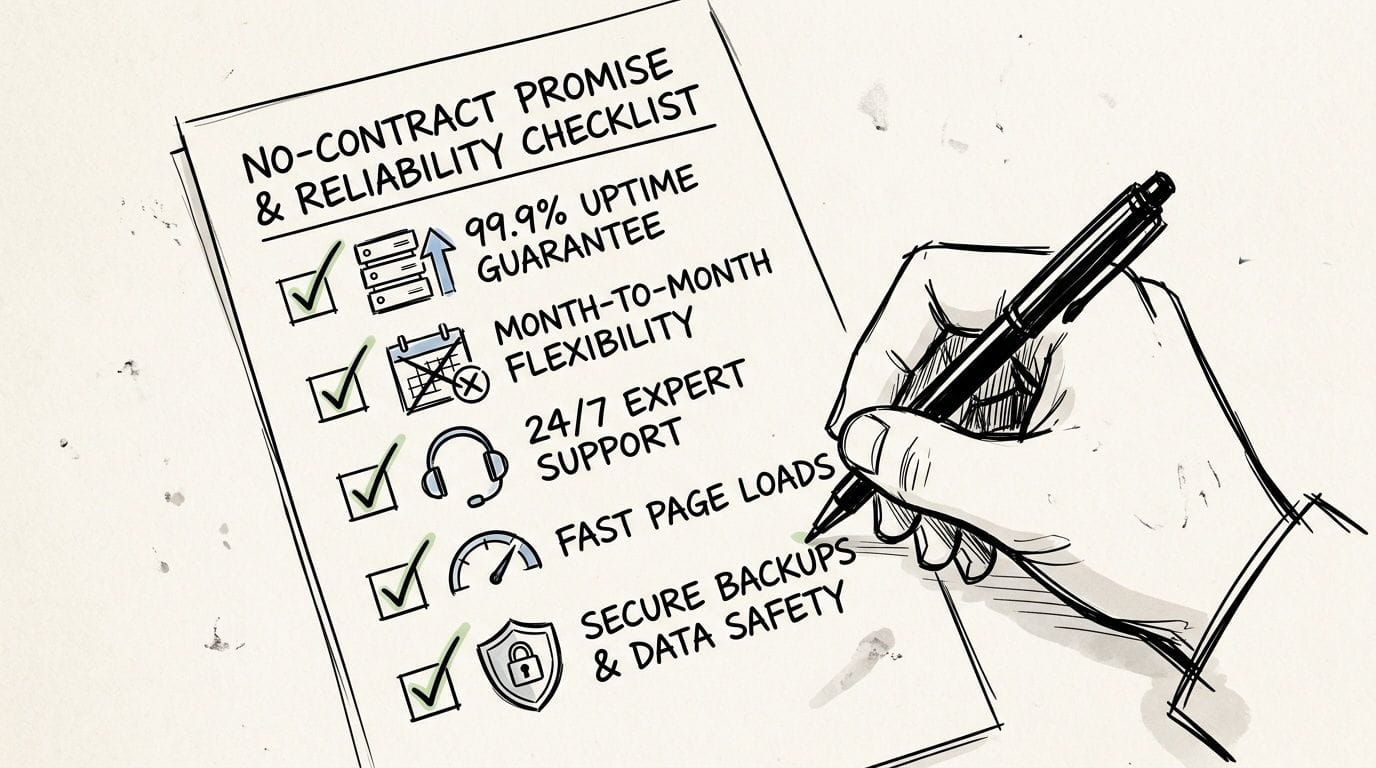
UpTime Web Hosting fits that model in a factual, practical way. It is Australian owned, offers no-contract hosting, includes GST in pricing, and provides local infrastructure in Sydney, Melbourne, Brisbane and Perth. The stack also includes cPanel, free SSL, malware scanning, DDoS-protected firewalls, encrypted off-site nightly backups, CloudLinux, LiteSpeed and AccelerateWP.
Why the performance stack matters
The stack is not fluff. It changes how a site behaves under normal business use.
Australian businesses using local hosting with performance stacks like LiteSpeed and AccelerateWP frequently experience faster page load times compared to standard Apache setups, with many local providers maintaining high levels of uptime. For owners, that translates into a simpler question. Does the site feel fast and dependable when customers are trying to use it?
The no-contract part only works if moving is manageable
A host can promise flexibility, but it still needs to reduce the hassle of switching. Migration support matters because many business owners avoid moving for an extended period because they assume it will be disruptive.
If you’re considering a move, this page on moving your website to UpTime Web Hosting shows the sort of migration information a provider should make easy to find before signup.
What this means for a small business owner
In plain terms, the no-contract promise only has value when four things are true:
- The monthly cost is readable
- The platform includes the basics
- Support is local and reachable
- You’re not punished for changing your mind
That’s the standard worth using, no matter which provider you compare.
Register your new domain name at competitive market prices including free domain add-ons like privacy, DNS Hosting, Custom Nameservers and Forwarding.
Always the best price and no nasty renewal price hikes.
Register A Domain Name
Frequently Asked Questions
Is no-contract hosting only for very small websites
No. It suits small business websites, blogs, brochure sites, and many ecommerce setups. The key issue isn’t the billing model. It’s whether the hosting environment includes the performance, security, backups, and support your site needs.
Is moving to a no-contract host difficult
Often, the hard part is deciding to move, not the move itself. A host that offers migration help, clear support, and a readable process removes most of the friction. If a provider makes migration sound mysterious, that’s often a sign they’re relying on inertia.
Does no-contract mean the price will change every month
Not necessarily. It means you’re not locked into a long term agreement. A well-run host can still offer stable, predictable pricing. What you’re trying to avoid is the combination of lock-in plus unclear renewals plus paid add-ons for basics.
Is affordable hosting good enough for a business site
Yes, if “affordable” includes the features the business needs. For many Australian sites, that means local hosting, SSL, backups, decent support, and a platform that performs well without endless upsells.
Should I care whether the host is Australian
If your customers are in Australia, yes. Local hosting can make support easier, performance more suitable for local visitors, and compliance decisions clearer for businesses handling customer data.
If you want a hosting setup that keeps pricing clear, support local, and billing flexible, take a look at UpTime Web Hosting. It offers Australian-based no-contract hosting, local server options, and the core features most small businesses need without turning every essential into an add-on.