You're staring at a familiar problem. The phone is ringing, the quote requests are patchy, the site's getting some traffic, and now someone's telling you to “do SEO” while another person says to “run Google Ads”. For an Australian SME, that's not a theory question, it's a cash-flow question.
Search Engine Optimization vs Search Engine Marketing is really a decision about speed, control, and budget horizon. In Australia, where Google dominates the search market, the choice isn't about spreading effort across lots of engines, it's about how you win visibility inside one overwhelmingly important channel, and whether you need leads now or can build an asset that compounds over time (AMA on SEO vs SEM).
| Criterion | SEO | SEM (Google Ads) |
|---|---|---|
| Main goal | Earn organic visibility | Buy immediate visibility |
| Typical pace | Slower to start, stronger over time | Fast to launch, stops when spend stops |
| Control | Lower control over placement, higher control over content | High control over targeting, bids and ad copy |
| Cost shape | Upfront work plus ongoing maintenance | Ongoing media spend and management |
| Best use | Long-term demand capture | Launches, promotions and competitive keywords |
If you're a Sydney plumber, a Melbourne eCommerce store, or a Perth B2B supplier, the right answer usually isn't “one or the other”. It's which one gets the first dollar, and when the second channel joins the plan.
Table of Contents
- Why Australian Businesses Are Asking SEO vs SEM Right Now
- What SEO and SEM Mean in 2026
- Side-by-Side Comparison of SEO and SEM
- Cost, Timeline and ROI in the Australian Market
- Running Each Channel in Practice for an AU Business
- Combining SEO and SEM Without Doubling Your Spend
- AI Search and Zero-Click Results Change the Equation
- Decision Checklist and Frequently Asked Questions

Performance you can feel, backed by clients who depend on it. Read how our support and uptime create long‑term customer success.Power Your Business with Better Hosting
Why Australian Businesses Are Asking SEO vs SEM Right Now
A Melbourne retailer launches a new product line on a tight budget. The owner needs sales this month, not “eventually”, but also knows paid clicks can become a monthly bill that never really stops. That is the SEO vs SEM decision for most Australian small businesses, a budget-and-timeline call, not a definitions exercise.
Google's grip on Australia's search market is the reason the choice feels so sharp. StatCounter data shows Google has held about 95% of desktop search share in recent years, so organic and paid effort are both fighting for visibility in the same dominant place. For a local business, even a small ranking lift or a better ad position can matter because so much of the search audience sits in one place.
Practical rule: if you need enquiries this week, use SEM. If you need a cheaper acquisition asset over the next few months, build SEO.
The mistake I see most often is businesses treating the two channels like rivals. They are different tools for different timing problems. SEM gives you immediate visibility because you pay to appear for a keyword query, while SEO is the slower work of earning that visibility through content, technical quality, and authority building (AMA on what is SEO marketing).
For local operators, search behaviour makes the decision even harder. AI answers, map packs, and zero-click results can take attention away before a user ever reaches your site, which means basic rankings alone are no longer enough. A practical local SEO guide for Australian businesses is more useful than another generic comparison article, because local intent is where most SMB decisions get made.
What you should expect from this decision
- Short-term pressure: SEM handles campaigns, launches, promotions and urgent lead flow.
- Long-term value: SEO reduces dependence on paid clicks if you keep publishing and improving.
- Budget reality: you will not fund both aggressively at the start unless cash flow is comfortable.
- Control question: SEM gives tighter control today, SEO gives more durable control later.
The right answer depends on whether your business needs demand now or a cheaper acquisition base later.
What SEO and SEM Mean in 2026
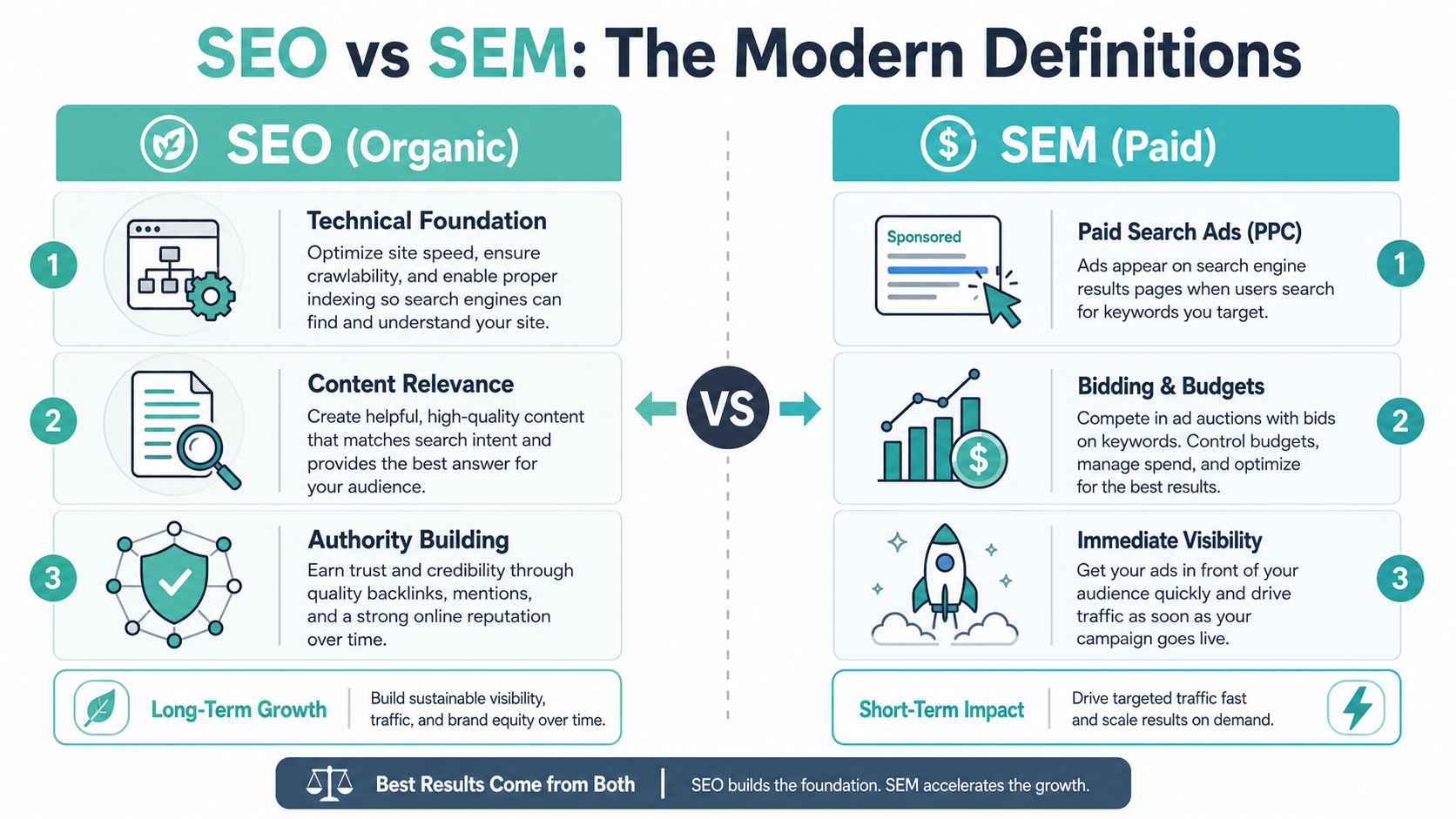
Search engine optimisation is the work of improving unpaid visibility. That means shaping pages, fixing technical issues, building relevant content, and strengthening the signals that help a page rank organically. Search engine marketing, in modern Australian usage, usually means paid search, mainly Google Ads and PPC. Older marketing language used SEM as the umbrella term for the whole search channel, but that definition is less useful now because most business decisions are made around paid search on Google and the organic result set, not around a broad category label (AMA on SEO vs SEM).
What each channel controls
SEO controls what you can earn over time. You influence content relevance, technical health, authority signals, and local usefulness. SEM controls what you can buy today, through keywords, bids, ad copy, and geographic targeting. Optimizely describes SEM campaigns as involving location, keywords, text ads, bidding strategy and budget allocation, which is exactly why it behaves like a paid acquisition system, not a vague visibility tactic (Optimizely on search engine marketing).
For Australian SMBs, the difference is control versus rental. SEO builds a search asset you keep improving, while SEM buys access to the same search results for as long as the budget runs. If you want the technical side of that asset to hold up, a practical SEO service overview is more useful than generic advice because it focuses on the work that supports rankings, not the marketing jargon around it.
In Australia, both channels are mostly Google-centric because of that market concentration. That matters for planning. You are not building two separate search strategies across many engines, you are deciding how much of your effort should go into organic placement and how much should go into paid placement on the same SERP.
Where the old definitions break down
The old blue-links model is already too simple. Search now includes snippets, map packs, shopping units, and AI-assisted answers. Zero-click results also change what a good search result looks like, because a user can get an answer, a phone number, or a map direction without ever landing on your site. That means SEO is no longer just about ranking a page, it is about being visible in the parts of search that surface before the click.
Search engine optimisation now has to work for humans and systems at the same time. Pages need to be clear enough for users, structured enough for crawlers, and useful enough to show up in features that sit above the classic result links. SEM has also narrowed in practice, because paid search ads now compete directly against AI summaries, maps, shopping placements, and other high-attention SERP elements. The result is simple. You need landing pages that convert quickly, and ad copy that earns the click before the searcher stops scanning.
That is why the old comparison articles feel stale. They stop at organic versus paid, while the current decision is really about whether your business can win attention in a search result that may never produce a traditional visit.
Host your website with our 5-star rated, cPanel website hosting plans.
Super fast servers, with security included and hosted in your choice of Australian Data Center.
View cPanel Plans
Side-by-Side Comparison of SEO and SEM
The cleanest way to compare them is by decision criteria, not by buzzwords. Australian SMBs care about timing, cash flow, and whether the channel produces leads when the owner is checking the inbox at 7 a.m.
| Criterion | SEO | SEM (Google Ads) |
|---|---|---|
| Time to results | Slower, because pages need to earn visibility | Faster, because ads can appear once campaigns are live |
| Typical Australian cost pattern | Content, technical work, local landing pages, and ongoing upkeep. Budget pressure is usually lower per click, but higher upfront. | Ad spend plus campaign management. Costs move with auction pressure, and local service keywords in Australia can get expensive fast. |
| Budget control | Better for businesses that can invest steadily over time | Better for businesses that need to cap spend tightly and pause fast |
| Control | Less control over placement, more control over site quality and organic relevance | More control over targeting, bids, ad messaging, and location settings |
| Traffic longevity | Can keep sending traffic after the work is done | Stops when the budget pauses |
| Measurement | Organic impressions, clicks, average position, CTR, conversions, assisted leads | Paid clicks, CPC, impression share, conversions, call tracking |
| Typical timeline for local SMBs | Plan on months, not weeks, before the channel starts carrying real lead volume | Often live the same day, with useful signal coming quickly if the account is set up properly |
The trade-off that matters
SEO is a compounding play. Once content and technical improvements start working, they can keep earning traffic without paying for every click. SEM is a precision buying play. You pay for visibility on the keyword you want, and you can turn it up or down quickly.
That's why I don't recommend asking which one is “better”. Ask which one fits the business stage and the budget window. A new accountant in Adelaide often needs SEM first because the owner needs calls now. A niche eCommerce brand in Brisbane may prefer SEO first if it can wait for category pages and product content to rank. If the business has enough cash flow to support both, I'd use SEM to buy immediate demand and SEO to build the asset that lowers reliance on ads later.
How to read the KPI stack
SEO is measured through Search Console and analytics, not vague “awareness”. SEM is measured through paid placement and CPC-driven visibility. The practical point for Australia is that rankings and ads should be checked with the right location, device and language settings, because a Melbourne result, a Perth result, and a mobile result can look very different. That is the part most generic reports miss, and it is why a local benchmark matters more than a broad global average.
Use Factors.ai benchmarking guide for a cleaner way to compare visibility and performance against realistic search conditions. If you are also sorting out the operational side of the site, UpTime Web Hosting SEO services and hosting support is the practical kind of service page that shows how delivery and hosting issues can affect what you can execute.
Core trade-off: SEO buys durability, SEM buys speed. If you can't afford to wait, pay for the traffic. If you can't afford to keep paying forever, build the organic asset.
Cost, Timeline and ROI in the Australian Market
Australian SMBs usually get this wrong by asking for a single “price for SEO” or a single “monthly Google Ads budget”. That is the wrong question. The right question is what result you need, how fast you need it, and how much cash flow the business can carry while the channel ramps.
Timeline first, then spend
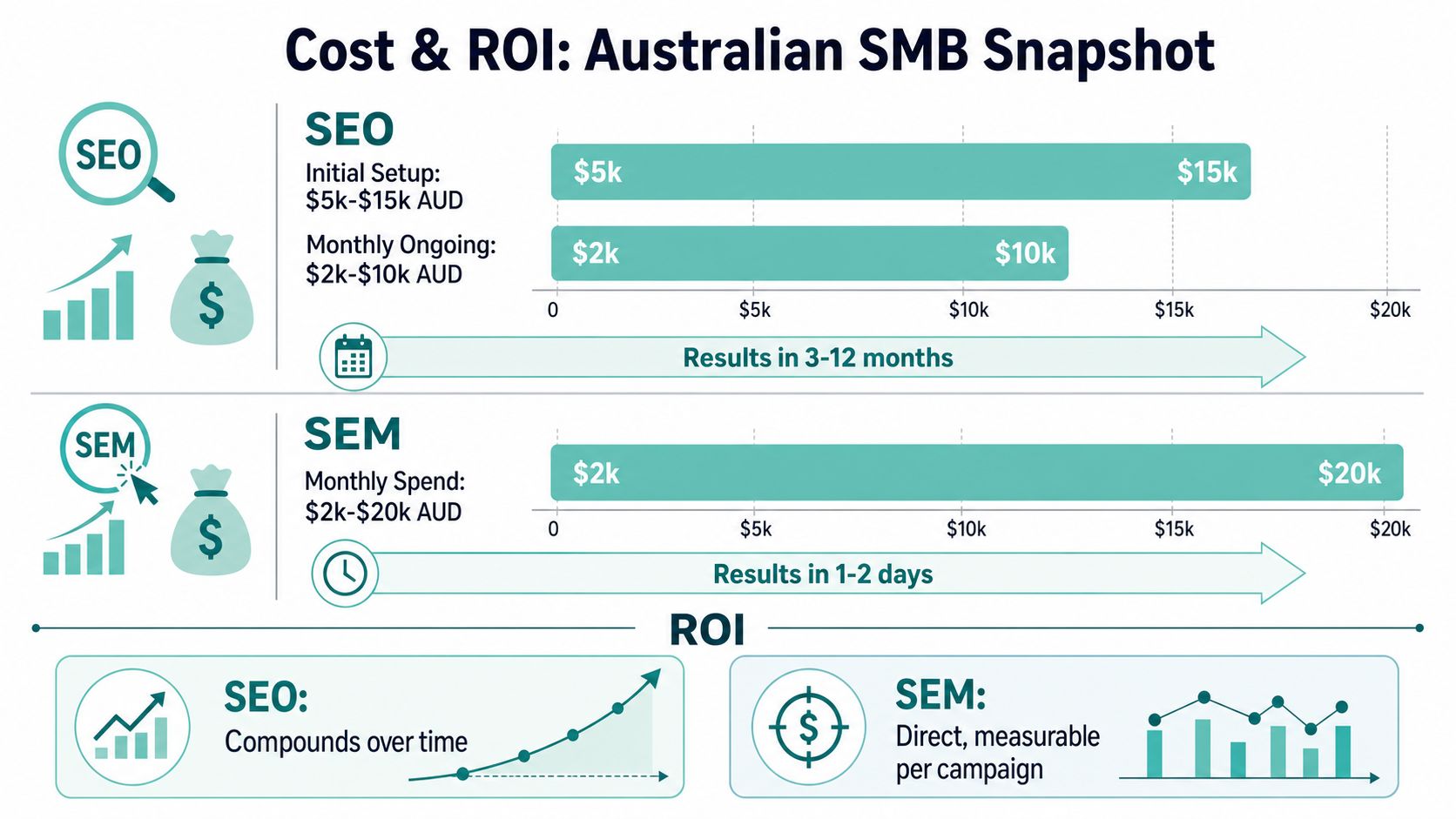
SEM gives immediate visibility because you pay to appear for a query. SEO takes longer because the site needs content, authority, and technical work before it starts to compound. That difference shapes the budget far more than any generic “SEO versus SEM” debate.
For SEO cost context, Growth 4 Trades SEO cost guide is useful because it treats SEO as an ongoing investment, not a one-off task. That matters for local businesses that need a plan they can keep funding without guessing at hidden work.
What a practical split looks like
If a business needs leads immediately, I put the heavier spend into SEM first and use SEO to bring down reliance on ads over time. If the business has a longer runway, I push more budget into SEO content, technical fixes and local landing pages first, then add SEM for high-intent terms and seasonal pushes.
Australian search is concentrated, and that changes the maths. A few keywords can soak up budget fast, especially in Melbourne, Sydney and other competitive local markets, while AI answers and zero-click results reduce the number of clicks available from some searches. In that setting, you do not buy traffic just because it is there. You buy the channel that matches the time frame and margin profile of the business.
A realistic split depends on whether the keyword is competitive, how strong the site already is, and whether the landing page can convert. You do not need a neat formula to decide. You need a clear priority.
Budget rule: if the owner cannot tolerate a quiet first quarter, SEM needs a real slice of the budget. If the owner can tolerate slow build and wants better long-term economics, SEO should lead.
For hosting and technical support that keep the site fast and stable while the work is underway, UpTime Web Hosting SEO hosting support is a practical reference point. The point is simple. SEO and paid search both suffer when the site is slow, unstable or hard to trust.
Simple ROI thinking
- SEO ROI: stronger when the business can wait for compounding results.
- SEM ROI: stronger when the business needs measurable demand capture now.
- Combined approach: strongest when one channel informs the other and the budget is phased instead of stretched too thin.
If you sell a service with high customer value, paying for click volume can still make sense. If the margins are tight and the sales cycle is longer, organic visibility matters more because every paid click hurts more.
Running Each Channel in Practice for an AU Business
For a Sydney tradie or a Melbourne eCommerce store, execution starts with keyword intent and landing page readiness. If the page cannot handle the search term, the channel will waste money or time.
SEO execution that doesn't waste time
For SEO, I start with keyword research, page intent and internal structure. Informational queries belong in guides and service explainers, while local commercial terms belong on dedicated service or location pages. Ahrefs is blunt about this point, SEO is best for informational keywords, which is why you should not force every query into a sales page.
The technical side matters more than most owners expect. Site speed, uptime, SSL and mobile usability affect whether users stay on the page and whether search engines trust the site. For local businesses, Google for local business guidance is a useful reminder that clean setup and clear business information support local visibility.
SEM execution that respects local intent
SEM starts with campaign structure, not just keywords. You set the geographic location, choose the target queries, write the ads, and map each ad group to a matching landing page. Mailchimp's point is simple, SEM visibility depends on how much you're willing to pay on the platform, so the ad needs a budget that matches the market and a page that converts.
Local hosting and performance feed straight into paid results. UpTime Web Hosting's Australian hosting stack, including local support and performance features, matters here because slow landing pages waste paid clicks. If the site loads badly, your CPC spend gets burnt before the lead form even appears.
The practical checklist I use
- Match the keyword to intent. Informational terms suit SEO, purchase-ready terms suit SEM.
- Set Australia as the location. Keep the campaign tied to the market you serve.
- Write local ad copy. Use the language your customers use in Australia.
- Build mobile-first landing pages. Paid traffic is unforgiving on clunky pages.
- Measure conversions, not vanity metrics. A click only matters if it leads somewhere useful.
For businesses already working through local visibility setup, that Google guidance is a practical starting point because it keeps the focus on the mechanics that move enquiries.
Register your new domain name at competitive market prices including free domain add-ons like privacy, DNS Hosting, Custom Nameservers and Forwarding.
Always the best price and no nasty renewal price hikes.
Register A Domain Name
Combining SEO and SEM Without Doubling Your Spend
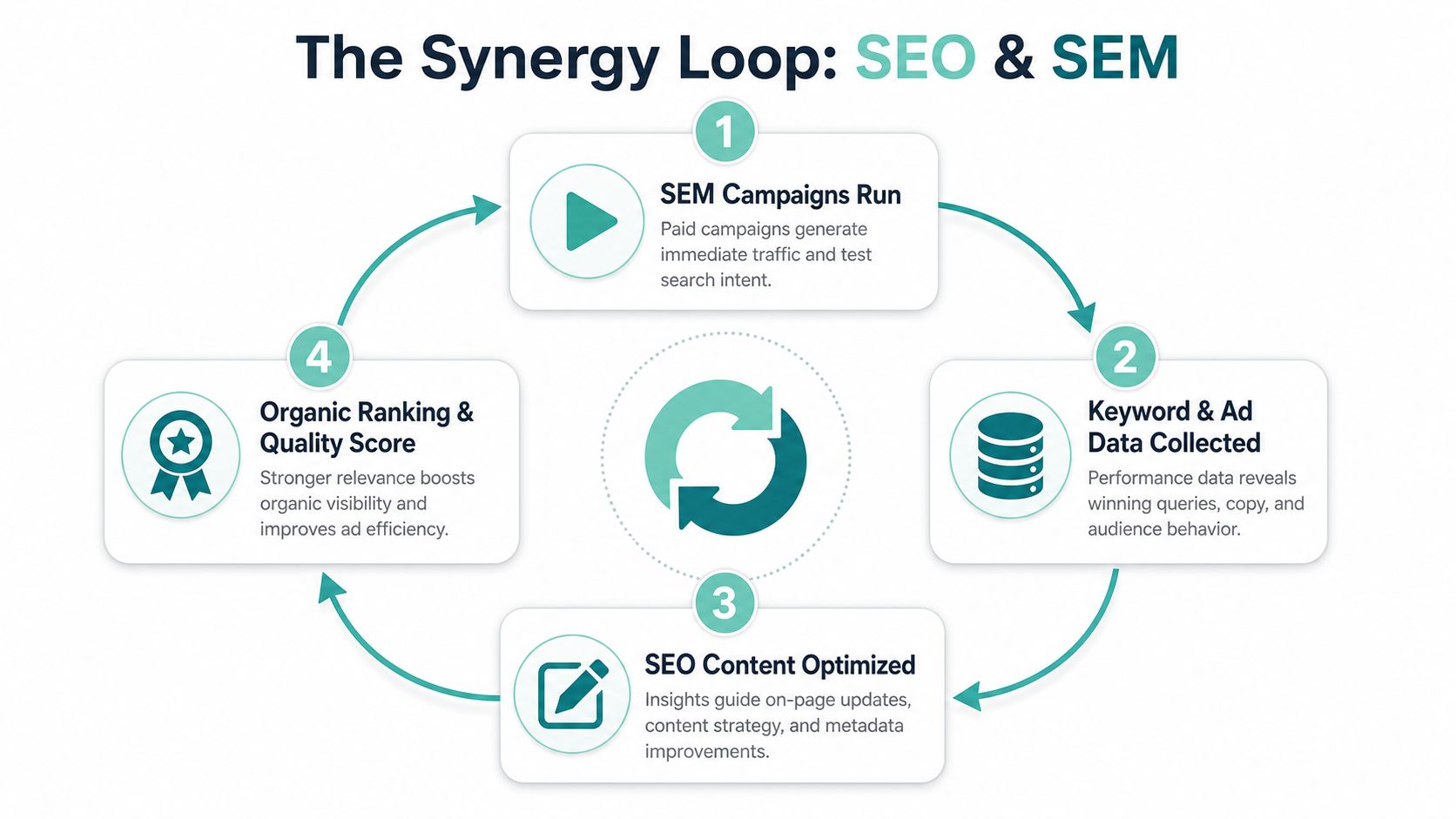
Australian SMBs waste money when they run SEO and SEM as two separate plans with two separate budgets and no shared logic. The better move is simple. Use paid search to learn what converts, then feed that insight into SEO so you are not paying to discover the same thing twice.
How the loop works
SEM gives you immediate keyword feedback. You can see which queries bring enquiries, which ad angles get clicks, and which searches chew through budget without producing leads. That information should shape SEO content, page structure and service copy. If a paid keyword converts, build a stronger organic page for it, add a focused FAQ block, or tighten the landing page around that intent.
SEO then takes pressure off paid search over time. Once your organic presence is strong on a high-intent query, you can move paid spend toward terms you do not yet own organically or toward new offers you want to test. That is the smarter way to spend in Australia, where search demand is concentrated and wasted clicks show up quickly in the account.
The win is overlap, not duplication. Good organic pages can support stronger ad relevance, better landing page experience and tighter messaging across both channels. That can help paid performance without forcing you to pour more money into the auction.
What this looks like in real businesses
A Brisbane eCommerce store can run branded search ads and shopping campaigns while building category SEO around the product groups people search for. A Perth services firm can use local SEM for urgent, high-intent terms while publishing location pages, project examples and service pages that build organic visibility over time.
The logic is straightforward. Use SEM for speed and testing. Use SEO for durability and lower dependence on the ad auction. The best informational content does more than attract organic traffic. It also feeds remarketing audiences, gives your ads a clearer message to match, and supports better landing page relevance, which matters for keeping paid costs under control.
My rule: never scale both channels blindly at once. Scale the one that proves demand first, then let the other channel absorb what the first one learns.
If your site is slow, fix that before you try to make both channels work harder. how to improve website speed is worth prioritising because slow pages drag down paid conversion rates and make organic performance harder to trust.
AI Search and Zero-Click Results Change the Equation
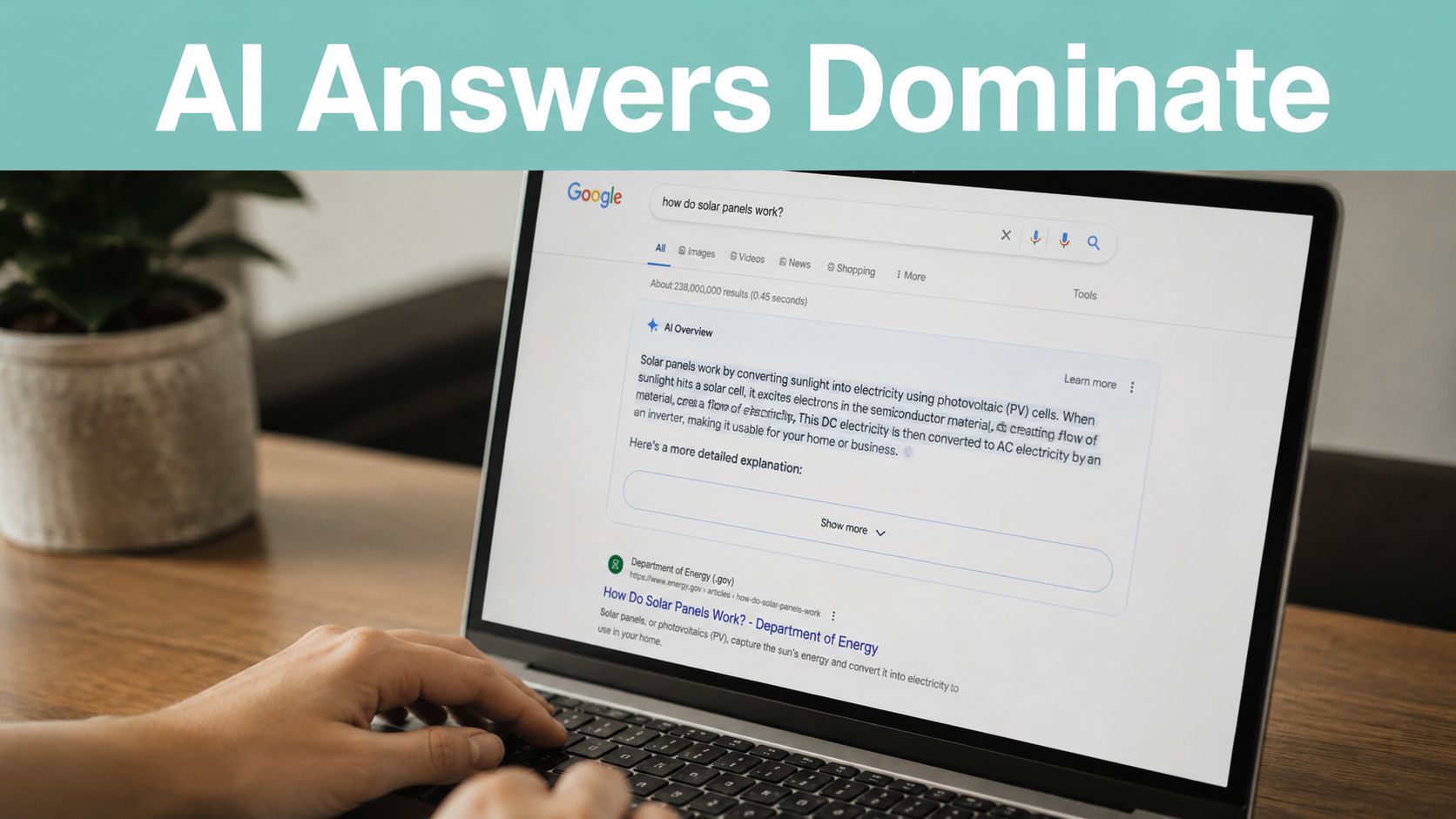
The old debate assumed the only question was whether you rank or pay. That's too narrow now. AI-generated answers, rich results and zero-click discovery are changing how people interact with search, including in Australia, and that changes what each channel needs to do.
What this means for SEO
SEO can't just chase rank positions anymore. Content needs to be structured so AI systems can understand entities, service areas and intent quickly. That means clear headings, tight answers, strong internal linking and local relevance. The goal is not only to rank, but to be usable when search surfaces summarise information before the click.
What this means for SEM
SEM still matters, but the click is more valuable when intent is high. If users are getting answers directly in the results, you want the searches where they still need to compare, book, enquire or buy. SEM should lean into those moments instead of chasing broad curiosity terms that never convert.
How to measure properly now
Organic impressions, clicks, average position, CTR and conversions in Google Search Console and analytics matter more than a vanity ranking screenshot. AU-local tracking also matters, because a query can look strong globally and still underperform in the Australian market. That's why the measurement layer matters as much as the channel choice.
This is the part many SEO vs SEM articles skip. The decision is no longer just unpaid versus paid, it's whether your search plan is built for a SERP where answers, maps, shopping and AI summaries can intercept the user before a website visit ever happens.
Experience Microsoft 365 Business Standard for free for 30 days.
Up to 25 users with full access to email, OneDrive and Teams. Includes full versions of desktop apps of Outlook, Word, Excel, PowerPoint and more.
Try Microsoft 365
Decision Checklist and Frequently Asked Questions
Use this checklist before you spend another dollar.
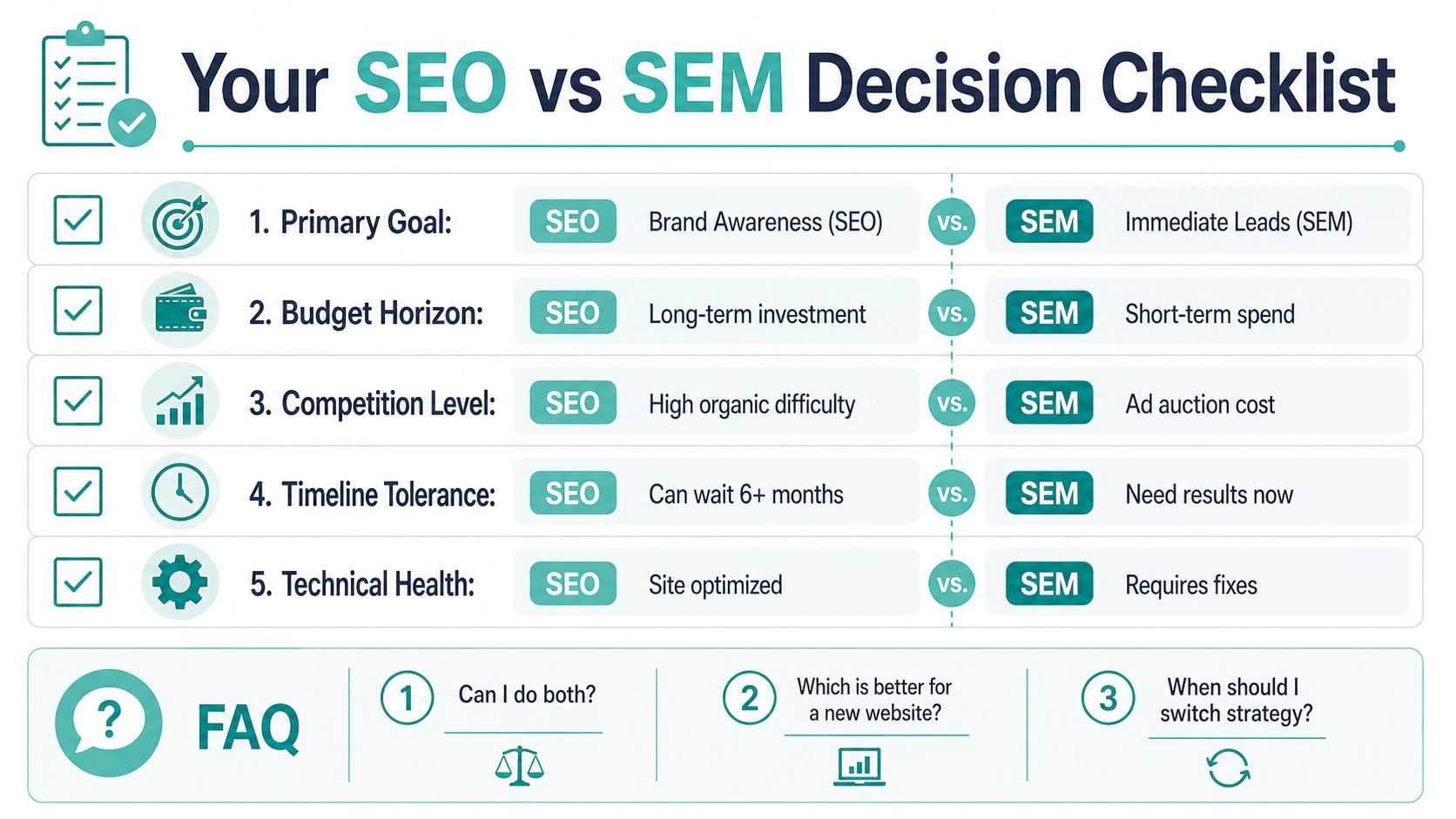
Decision checklist
- Primary goal: choose SEO if brand visibility and long-term demand capture matter most, choose SEM if you need immediate leads.
- Budget horizon: choose SEO if you can invest before the payoff arrives, choose SEM if you need short-term spend with clear control.
- Competition level: choose SEO if you can outlast competitors on content and technical quality, choose SEM if the ad auction is the only realistic fast entry point.
- Timeline tolerance: choose SEO if you can wait, choose SEM if the business needs action now.
- Technical health: choose SEO first if the site already has a decent foundation, choose fixes first if the site is slow, unstable or thin.
Frequently asked questions
How long does SEO take in Australia?
Long enough that you should not rely on it for an urgent lead target. For a new or weak site, expect a slower build and plan around months, not days.
Is SEM worth it for a small local business?
Yes, if the offer is high intent and the landing page is ready to convert. It's often the fastest way to get local visibility when the business can justify the click cost.
Should I split budget evenly between SEO and SEM?
No. Split it by urgency. Put more into SEM when speed matters, and shift more into SEO when you want a durable acquisition asset.
Is AI search replacing both channels?
No. It's changing how both channels work. SEO needs content that AI systems can interpret, and SEM needs sharper intent targeting. Neither disappears.
If you want a straight answer for your own site, audit the current traffic, the conversion path and the technical setup first, then decide whether to start with SEO, SEM, or a staged mix of both. If you want help getting that foundation right, contact UpTime Web Hosting and ask for the hosting and site-performance support that keeps your search work from leaking traffic.