
You're preparing to put your business online, and the name that feels right is available in one .au namespace but caught up in a claim in another. That can be confusing when all you wanted was a simple web address. Au domain registration involves more than choosing a name: you need the right Australian eligibility evidence, the namespace that fits your organisation, and a plan to keep the licence information current.
Table of Contents
- The Moment You Realise Your Dream .au Name Comes With Strings
- How the .au Namespace Is Actually Built
- Australian Presence and Namespace Eligibility Explained
- Choosing Between au Direct and the Older Namespaces
- Registering Your .au Domain Step by Step
- Renewals, Transfers and Ongoing Eligibility
- Common Pitfalls and Priority Hold Traps
- Your .au Registration Checklist

Performance you can feel, backed by clients who depend on it. Read how our support and uptime create long‑term customer success.Power Your Business with Better Hosting
The Moment You Realise Your Dream .au Name Comes With Strings
A Melbourne café owner settles on a name for her new website. She searches for it in .au direct, expecting to register the shorter address and get on with the launch. Instead, the name appears to be tied up in a Priority Application connected to an older .com.au licence. The café can't claim the name because it looks unused or because the new business has a strong claim to the brand.
That kind of surprise makes more sense once you know that .au is a regulated namespace administered under auDA's policies, not a free-for-all. The rules affect who can register a name, which namespace they can use, and what happens if existing licence holders have competing claims. A dormant-looking domain can still have a licence holder or an unresolved allocation issue.

For a small business, it helps to treat a domain as a business asset rather than a quick online purchase. The name should be checked against your eligibility, your intended use and any competing claims. If the name is central to your brand, practical Australian intellectual property tips can help you think about trade marks and brand protection alongside the domain search.
The useful starting point: check eligibility, compare namespaces and plan for ownership and renewal before you build your website around a name.
How the .au Namespace Is Actually Built
Read a .au address like a street address with layers. .au is the country-code top-level domain, the Australian sign at the end. The label immediately before it tells you which namespace you're in, and sometimes another label comes before that. For example, in shop.example.com.au, com.au is the namespace and example is the name chosen within it.
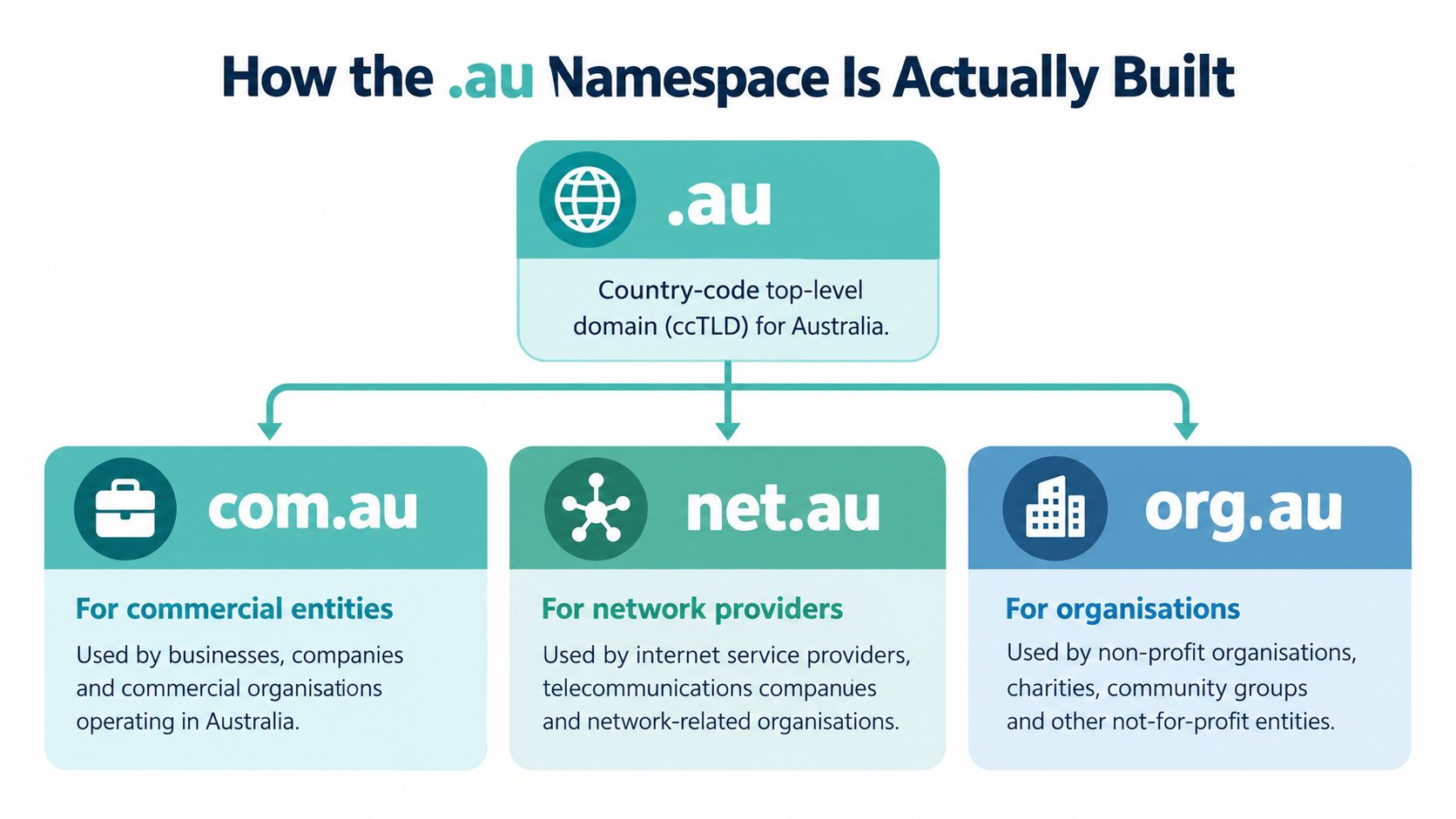
The layers and what they signal
Traditional namespaces include com.au, net.au, org.au, asn.au and id.au. They help indicate the type or intended use of a domain, but they don't replace the eligibility rules for each namespace. A business looking for a familiar commercial address may consider com.au; a community organisation may consider org.au or asn.au, depending on its circumstances.
Some namespaces are restricted to particular sectors. gov.au is for eligible government bodies, and edu.au is for eligible educational institutions. They aren't general options for any applicant with an Australian connection.
The newer .au direct format places the chosen name immediately before .au, as in example.au, without an extra namespace label. It's a general-use option for eligible applicants. AuDA introduced .au on 5 March 1986, and .au direct launched on 24 March 2022, expanding the available naming format for Australians (auDA's account of .au's history and .au direct, auDA's 2021–22 annual report).
If you're weighing up what the shorter format means for your own site, this overview of Australia's .au domain options offers a useful companion explanation. The practical lesson is to check the rules for the exact ending you want, not assume every .au address is interchangeable.
Host your website with our 5-star rated, cPanel website hosting plans.
Super fast servers, with security included and hosted in your choice of Australian Data Center.
View cPanel Plans
Australian Presence and Namespace Eligibility Explained
To register a .au domain, you need to show a legitimate Australian connection and satisfy the rules for your chosen namespace. In plain English, that can mean you're an Australian citizen or permanent resident, an Australian-registered company or registrable body, or a foreign company with an Australian Registered Body Number (ARBN). An Australian trade mark can also support eligibility in applicable cases.
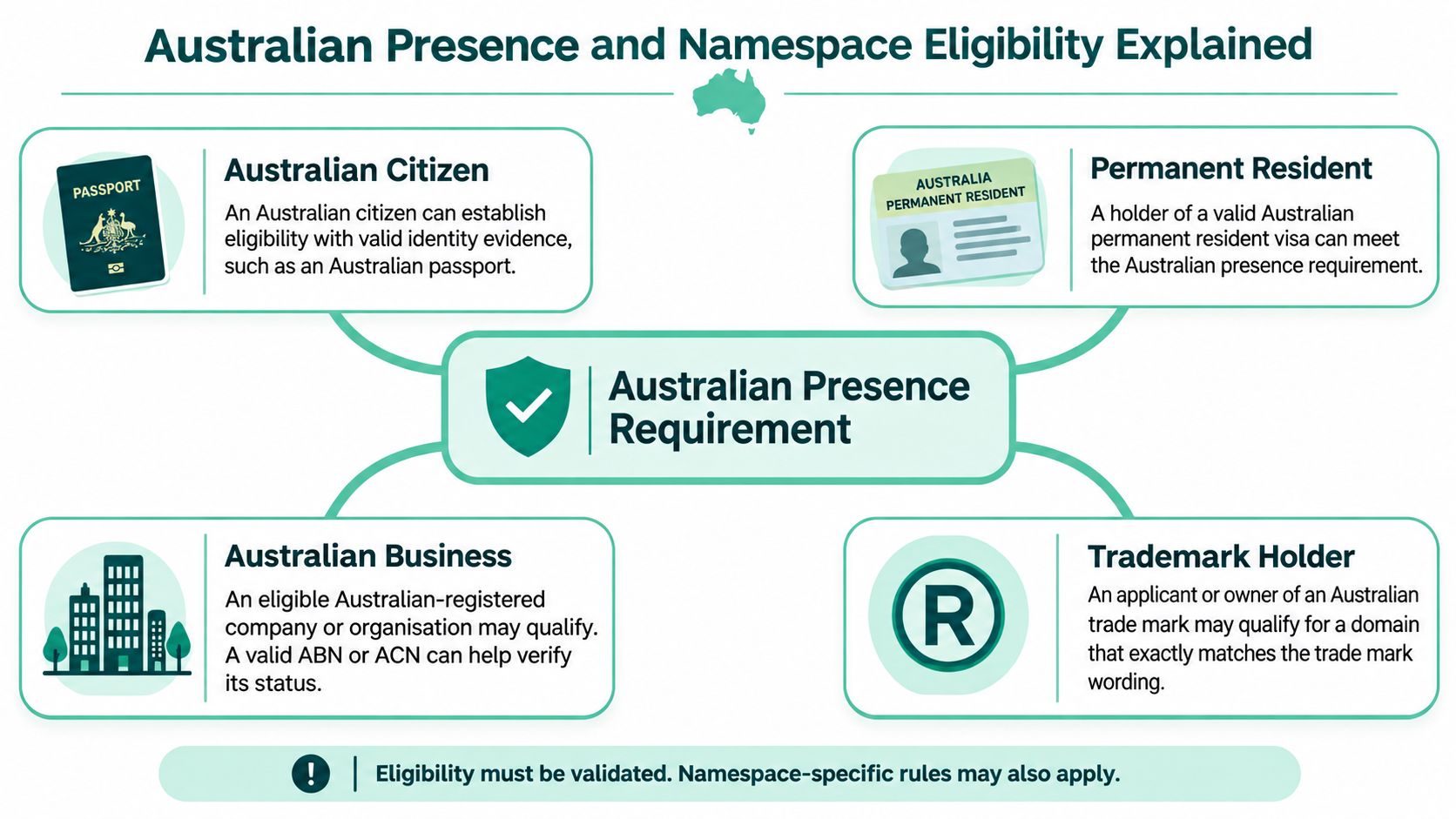
Match the evidence to the applicant
A sole trader may use an Australian Business Number (ABN) to demonstrate the relevant business connection. A company may use its registration details, such as an ABN or ACN, and a foreign company trading in Australia may rely on an ARBN or an eligible Australian trade mark. An individual applying on the basis of residency may need identity or residency evidence through the registrar's verification process.
.au direct is a general-use namespace, but it still requires validated Australian presence. .com.au has a more specific commercial connection requirement: eligible applicants include commercial entities registered to trade in Australia, foreign companies with an ARBN, and owners or applicants of Australian trade marks. .org.au is for eligible non-commercial organisations, such as associations and charities, rather than a general-purpose business address.
For an SME, the ABN is often operationally useful because it connects the licence to the business entity rather than an employee who may later leave. This doesn't remove the need to keep the business details accurate. The applicant remains responsible for the evidence supporting eligibility, and auDA's rules require registrars to check identity, Australian presence, namespace eligibility and name availability before issuing a licence (auDA's registrar rules). For a plain-English explanation of why business details matter, see why an ABN can be needed for an Australian domain.
Eligibility isn't just a signup hurdle. Changes to ownership, legal structure or business records can affect whether the licence holder still qualifies. Treat the supporting evidence as a record to maintain, not a box to tick once.
Choosing Between au Direct and the Older Namespaces
The best name ending depends on your audience, eligibility and whether the name is available. Shorter doesn't automatically mean safer or better. A familiar .com.au name may be the more dependable choice for a business if a matching .au direct name has unresolved priority claims.
| Namespace | Purpose | Eligibility | Best for |
|---|---|---|---|
| com.au | Commercial namespace | Australian commercial connection | Businesses serving Australian customers |
| net.au | Network-related namespace | Namespace-specific eligibility | Eligible network or infrastructure use |
| org.au | Non-commercial organisations | Eligible organisation | Associations and charities |
| id.au | Individual use | Australian presence and applicable rules | Individuals seeking a personal address |
| .au direct | General-use name directly before .au | Validated Australian connection | People and organisations seeking a shorter format |
The table is a starting point, not a substitute for checking the rules for your circumstances. A company might qualify for more than one namespace, but each application is assessed under the rules for that particular option. For an additional look at commercial naming considerations, see this guide to com domain registration.
Check for competing priority claims
When .au direct launched, eligible holders of existing .au licences could claim an exact-match name through the priority process. That means a name that looks free in a search may still be subject to a Priority Hold or unresolved competing applications. A name with matching .com.au, .net.au or other existing licences deserves particular care before you base a rebrand on the direct version.
If your preferred name is uncontested across the relevant namespaces, registering the versions that matter to your brand can help protect customers from confusion. If the .au direct name is under an unresolved claim, don't assume it will be allocated to you soon. Keep using a stable, eligible legacy domain while you check the status and consider advice on any significant brand or legal risk.
Registering Your .au Domain Step by Step
A smooth application starts before you open a registrar's search page. Gather the evidence that matches the applicant and namespace: this might be an ABN, ACN, ARBN, Australian trade mark details or identity and residency evidence. If the domain should belong to a company, use a company-controlled account and make the business the licence holder where appropriate.
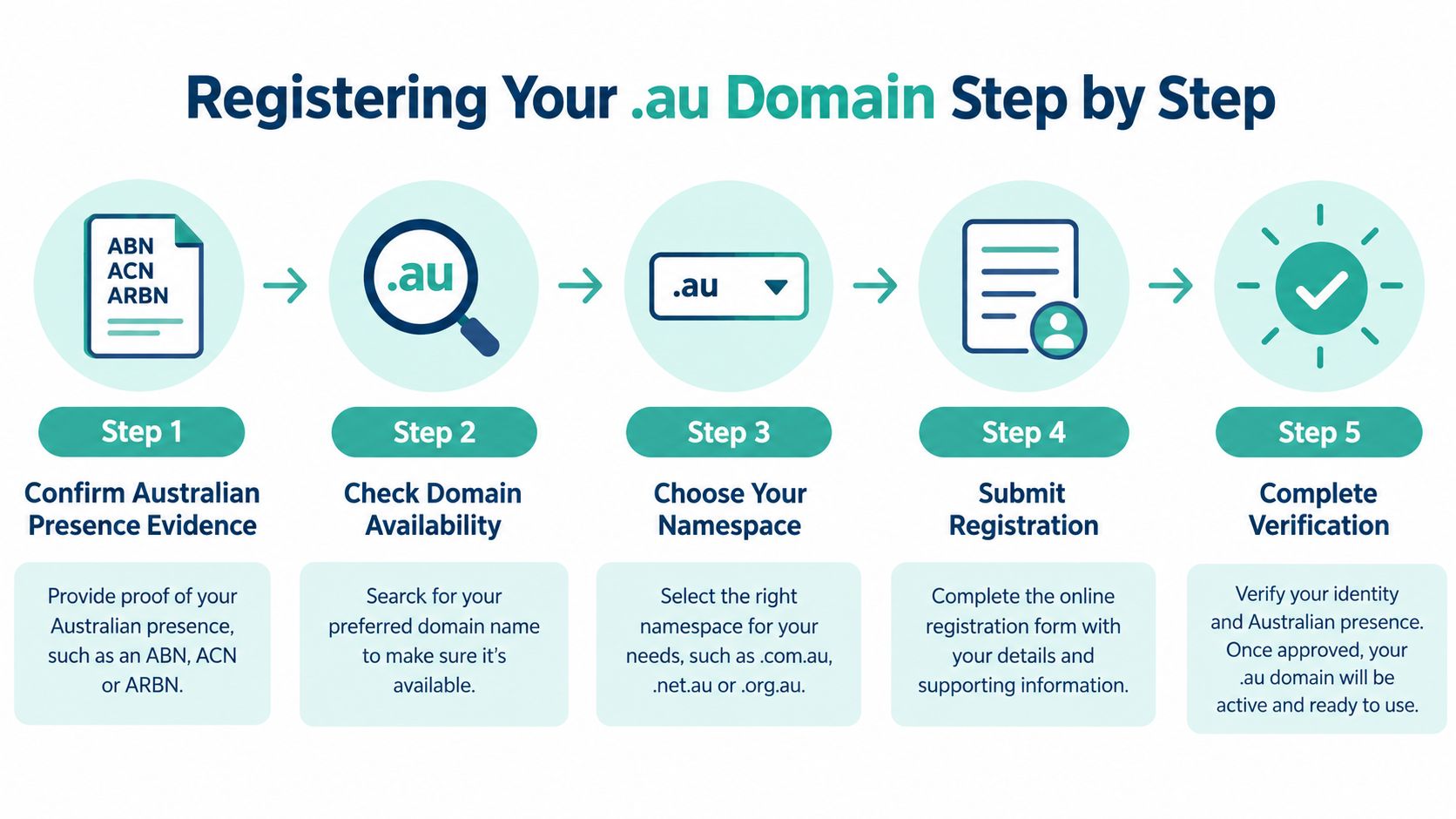
From name search to confirmation
Choose an auDA-accredited registrar and search the exact name in the namespace you intend to use. It's sensible to search the matching .au direct and third-level versions too, especially if you're protecting a business name. Check whether the result is available, reserved, or affected by a Priority Hold before moving forward.
Then review the proposed name against the applicable syntax rules. Under the open second-level rules, a domain must be at least two characters long, can use letters, numbers and hyphens, and can't begin or end with a hyphen. The name must also meet the specific namespace requirements and not be deceptively similar to another .au name (auDA's open-2LD eligibility and allocation policy).
A licence can be issued for a term from one to five years, so choose a period that suits your organisation's record-keeping and renewal process. Before submitting, check that the registrant name, contact email and eligibility information are accurate. The registrar will carry out the required checks; once the registry allocates the licence, keep the confirmation and account access with the business.
There's no pre-registration reservation for an open .au name. Allocation is generally first come, first served, once eligibility and the other requirements are met. If you've found a suitable, available name, prepare the evidence first and submit promptly rather than assuming you can hold it while paperwork is gathered.
Register your new domain name at competitive market prices including free domain add-ons like privacy, DNS Hosting, Custom Nameservers and Forwarding.
Always the best price and no nasty renewal price hikes.
Register A Domain Name
Renewals, Transfers and Ongoing Eligibility
A .au licence is an ongoing responsibility. When renewal comes around, the registrant must still meet the eligibility rules and confirm that the supporting details remain current. If a business closes, stops trading or changes its legal structure, the person responsible for the domain should check whether the licence holder continues to qualify before renewing or transferring it.
The same care applies when moving a domain between providers or changing the entity that holds it. A transfer to another registrar is different from an ownership change: the first moves management, while the second changes the licence holder. Either can prompt a need to check account control and eligibility evidence. If you're considering a provider move, this guide to transferring domain names can help you prepare.
Keep ownership attached to the business
A common problem begins with a practical shortcut. An employee or contractor registers the domain using a personal email address, then leaves the organisation. The business may still use the domain, but recovering access can become difficult if no one else controls the account.
Record-keeping rule: track the licence holder, evidence type, registrar account owner and renewal date in a shared business asset register.
Keep contact details current and use an account the business controls. If ownership or eligibility changes, don't wait for a renewal reminder to investigate. auDA's reporting describes active compliance checks, making accurate records important beyond the original application (auDA annual reports and corporate reporting). In practice, lifecycle changes are when an old assumption about eligibility or control can become a real problem.
Common Pitfalls and Priority Hold Traps
The short .au direct name may look like the obvious choice, but contested names can remain unresolved. In November 2025, auDA reported approximately 3,000 .au direct names still in contention, so priority issues aren't merely theoretical (auDA's 2025 licensing rules review issues paper).
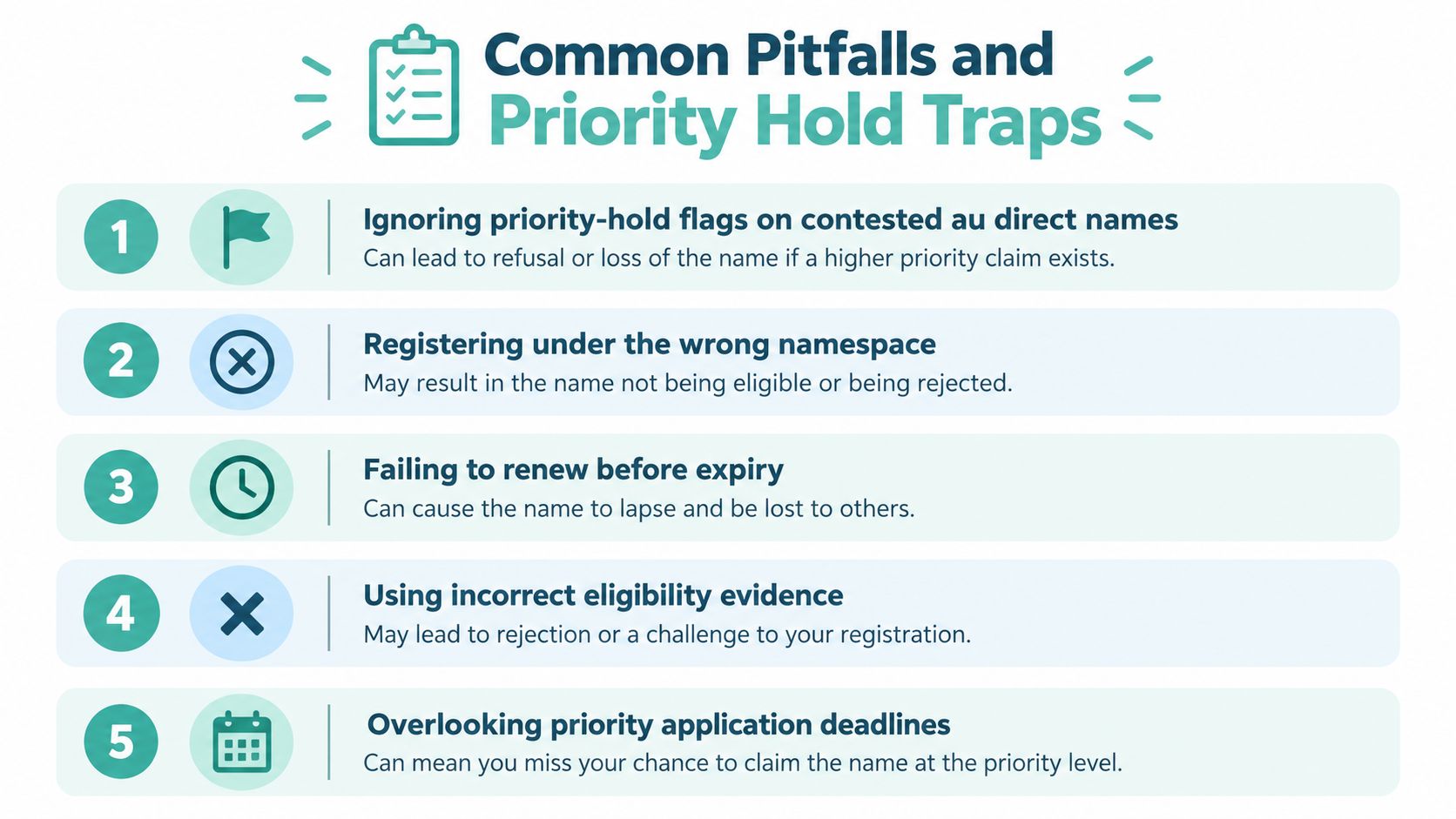
Small oversights, awkward outcomes
- Ignoring a priority flag: A café builds its launch plan around a matching .au direct name, then finds it can't be allocated while competing applicants remain. Check Priority Hold status before committing to the name.
- Using the wrong account owner: A staff member registers the domain under a personal email and later leaves. Put the registrar account and recovery details under business control.
- Treating the ABN as optional: A business changes details but leaves the domain record untouched. Keep the evidence current and check it when the business changes.
- Letting renewal reminders go stale: The notice goes to an address no one monitors. Maintain the registrant contact and record the renewal date internally.
- Skipping brand checks: A business registers a name without checking for similar Australian trade marks. Search for potential conflicts and seek appropriate advice if the name is central to your brand. For help protecting personal information associated with a domain, see the guide to privacy on .au domain names.
When applications for a contested .au direct name remain in contention, the name can't currently be allocated until all but one applicant withdraw. That makes the safest short-term choice clear: use an eligible, uncontested domain you can control while the issue is unresolved. The shortest name isn't always the soundest purchase.
Experience Microsoft 365 Business Standard for free for 30 days.
Up to 25 users with full access to email, OneDrive and Teams. Includes full versions of desktop apps of Outlook, Word, Excel, PowerPoint and more.
Try Microsoft 365
Your .au Registration Checklist
Before you register, run through this list with the person who'll manage the domain after purchase:
- Confirm Australian presence: gather the evidence that fits the applicant, such as an ABN, ACN, ARBN, Australian trade mark details or residency documentation.
- Choose the namespace: make sure its intended use and eligibility rules fit your organisation.
- Search related names: check .au direct and the relevant third-level option, not just your first preference.
- Check priority status: look for a Priority Hold or competing claim before relying on a shorter name.
- Review the name and term: confirm the name meets the namespace rules, then select a licence period from one to five years.
- Use a controlled account: keep the licence, evidence and renewal details accessible through a company-managed account.
Keep the domain with the business, not with the person who happened to register it. At renewal, confirm eligibility and contact details again, especially after ownership or organisational changes. Once the name is secure, consider how you'll use it for a website and business email, and look for an Australian provider that can manage the domain alongside hosting and email if that suits your setup.
UpTime Web Hosting offers Australian domain registration, domain management, DNS hosting and domain forwarding, alongside local website hosting and email services. If you're ready to check a name and plan where your Australian business website will live, visit UpTime Web Hosting.