In short
Some domains are expensive because the price may come from the registry, a premium-name classification or a current owner selling on the aftermarket. Before buying, identify which price you are seeing and check the renewal fee, because a high purchase price may be one-off or may return every year. (icann.org)
Key takeaways
- A domain can have a standard registration price, a registry-premium price or an aftermarket seller price.
- A registry-premium domain may renew at either the standard rate or a premium rate, depending on the registry policy.
- An aftermarket seller's asking price is separate from the domain's future registration and renewal charges.
- ICANN requires accredited registrars to make renewal and restoration fees available for generic domains.
- Australian buyers must confirm the relevant auDA eligibility and transfer rules as well as the price.
Contents
- Why can one domain have three different kinds of price?
- What makes a standard domain extension cost more?
- How can I tell whether the price will repeat at renewal?
- Is it worth paying for a premium domain?
- How to get cheaper domains?
- What should Australian buyers check before paying?
- Frequently asked questions about expensive domains
- What should you do before registering?
The expensive number shown by a domain search tool is not always the annual cost. Work out who set the price, what the name will cost to renew and whether a sensible alternative exists before treating the asking price as a measure of value.
Why can one domain have three different kinds of price?
One domain can carry a high price because of its extension, a premium classification applied by the registry or a resale offer from its current holder. Identifying the price type tells you whether the large amount is likely to be an initial payment, a recurring cost or both.
Which price are you actually seeing?
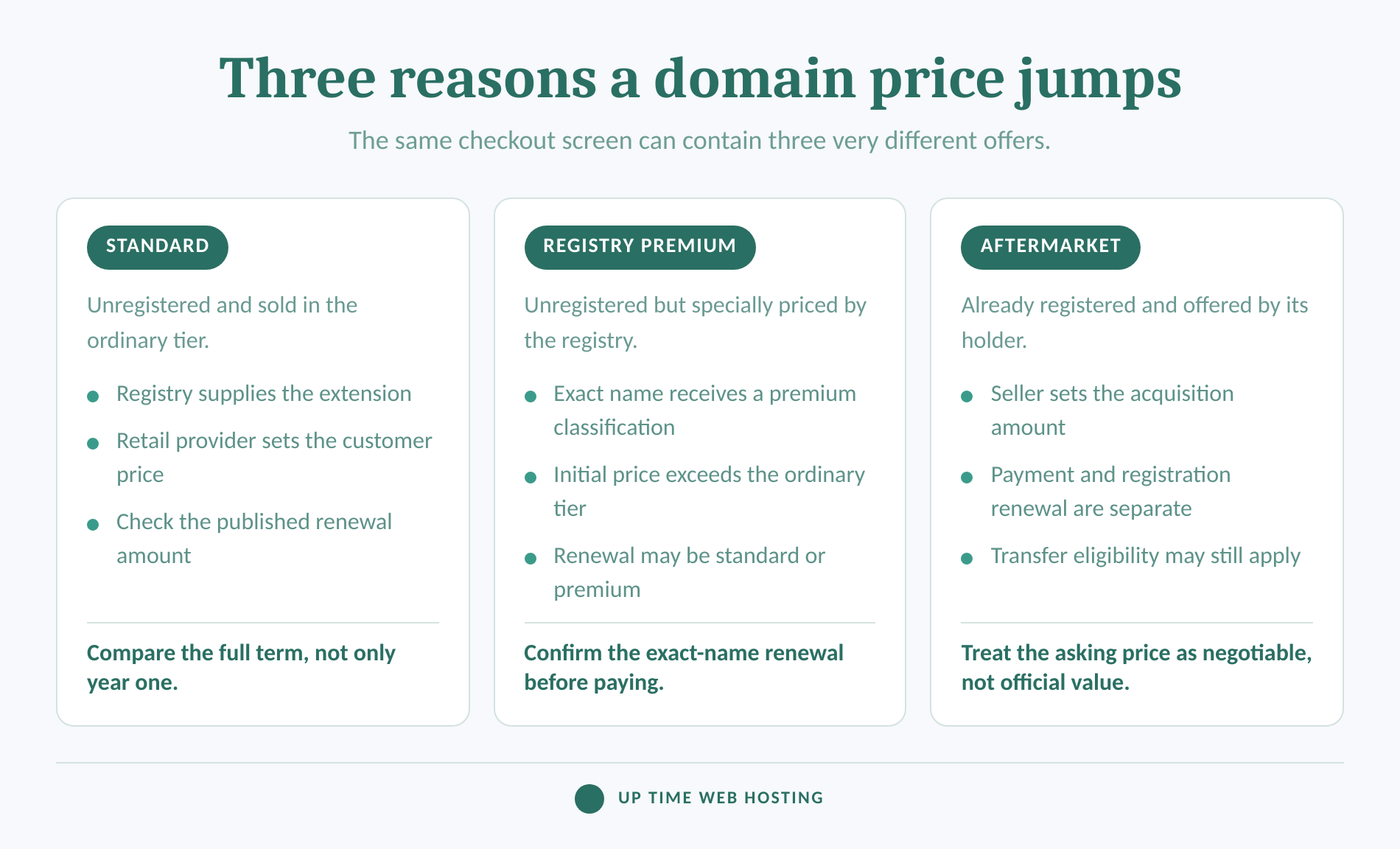
ICANN's domain registration process explains that a registry operator maintains the database for a top-level domain, while a registrar handles the registration transaction and customer agreement. A third pricing layer appears when someone has already registered the name and offers it for sale. (icann.org)
Standard registration: The name is unregistered and is being sold under the extension's ordinary pricing tier. The registry supplies the underlying registration service, while the retail provider determines the amount and terms shown to the customer.
Registry-premium registration: The name is still unregistered, but the registry has classified that exact word or character combination as premium. A short or commercially attractive name can therefore cost more than another available name using the same extension.
Aftermarket purchase: The name has already been registered. Its current holder or seller sets an acquisition price, which may be fixed or open to negotiation. ICANN's 2024 Board report on marketplace pricing data confirms that secondary-market sales are not governed by ICANN agreements. (icann.org)
A search result saying that a domain is available to buy does not always mean the name is unregistered. It may mean an aftermarket seller is willing to transfer the existing registration after receiving the agreed amount.
The first question is not why the domain is expensive, but who set the price.

Performance you can feel, backed by clients who depend on it. Read how our support and uptime create long‑term customer success.Power Your Business with Better Hosting
What makes a standard domain extension cost more?
A standard domain may cost more because each extension has its own registry pricing and each retail provider sets its own customer price. The billing term, currency, tax treatment and included management services can also change the amount shown at checkout.
For Australian names, auDA's wholesale pricing explanation states that the registry layer has a wholesale price while registrars and resellers set their own public retail prices. The page also flags a wholesale change taking effect on 1 October 2026, so a retail quote should not be treated as permanent. (auda.org.au)
Check four details when two standard domains have different prices:
- The extension: Different top-level domains can have different underlying charges and billing periods.
- The retail terms: Providers can price their domain management and related services differently.
- The displayed term: A two-year total should not be compared directly with a one-year price.
- The opening discount: A low registration offer may return to an ordinary retail rate at renewal.
A higher price is not proof that an extension will rank better. Google Search Central's May 2026 FAQ says the top-level domain does not itself improve a site's performance in Google Search. Some country-code domains can still help communicate the market a business serves, but price is not a search-ranking feature. (developers.google.com)
For current Australian examples and the difference between registration and renewal, see the guide to annual domain cost. (uptimewebhosting.com.au)
A costly extension reflects its pricing rules and retail terms, not automatic search value.
How can I tell whether the price will repeat at renewal?
Read the renewal amount for the exact name rather than relying on the extension's general price table. A premium label does not reveal whether the premium applies once, at every renewal or under a different schedule.
Which costs should you write down?
| Cost | What to confirm before payment |
|---|---|
| Initial payment | The amount due now and whether it is registration or an aftermarket acquisition |
| Renewal | The amount currently quoted for the next term and whether premium pricing continues |
| Billing term | The number of years covered by each displayed amount |
| Transfer | Any fee and whether a transfer adds time to the registration |
| Post-expiry renewal | The amount and deadline if the domain expires but remains renewable |
| Redemption or restoration | The later recovery fee if the domain enters a restoration period |
As of August 2026, ICANN's registrant guidance on renewal fees requires accredited registrars to make renewal, post-expiration renewal and redemption or restoration fees reasonably available for generic domains. The guidance also says fees can change with notice, so save the current terms rather than assuming the displayed renewal will never move. (icann.org)
Registry-premium policies are not all the same. One ICANN-filed registry policy allows a premium name to have higher creation and renewal fees. Another filed policy applies the premium to the first-year registration and renews the name at the standard rate. (portal.icann.org)
An aftermarket seller's payment is also separate from renewal. After the transfer, the domain may renew at the extension's standard rate or retain a premium renewal classification. Ask for the exact renewal amount attached to the name, not just the seller's purchase price.
Once the domain is registered, keep its account owner, contact details, expiry date and payment method current. The practical steps are covered in the domain renewal process.
The safe number is the full holding cost, with renewal and recovery written down before payment.
Host your website with our 5-star rated, cPanel website hosting plans.
Super fast servers, with security included and hosted in your choice of Australian Data Center.
View cPanel Plans
Is it worth paying for a premium domain?
A premium domain can be worth buying when the name creates clear business value that realistic alternatives cannot provide. It is not worth the premium merely because the registry or seller has attached a large number to it.
Estimate the holding-period cost by adding the initial payment, each renewal due during that period and any required transfer or management charges. Then test the domain against four questions:
- Is the exact name central to an established business or product brand?
- Will customers find it noticeably easier to remember, spell or say than the alternatives?
- Can the business afford the renewal even if the opening payment is treated as spent money?
- Would a clear modifier or another suitable extension work without creating confusion?
Do not justify a premium purchase solely with expected search rankings. Google's current guidance says keywords in a domain have little ranking effect by themselves, and a high asking price does not change that.
The asking price is also not proof of future resale value. For an aftermarket name, it shows what the seller wants. The buyer still has to decide whether the name produces enough practical value for that particular business.
A premium domain is worth it only when its business value exceeds the cost of realistic alternatives.
How to get cheaper domains?
Start by changing the name structure rather than accepting the first expensive result. A short modifier, another suitable extension or a firm walk-away budget can preserve the idea without committing the business to an unjustified purchase or recurring fee.
What should you change first?
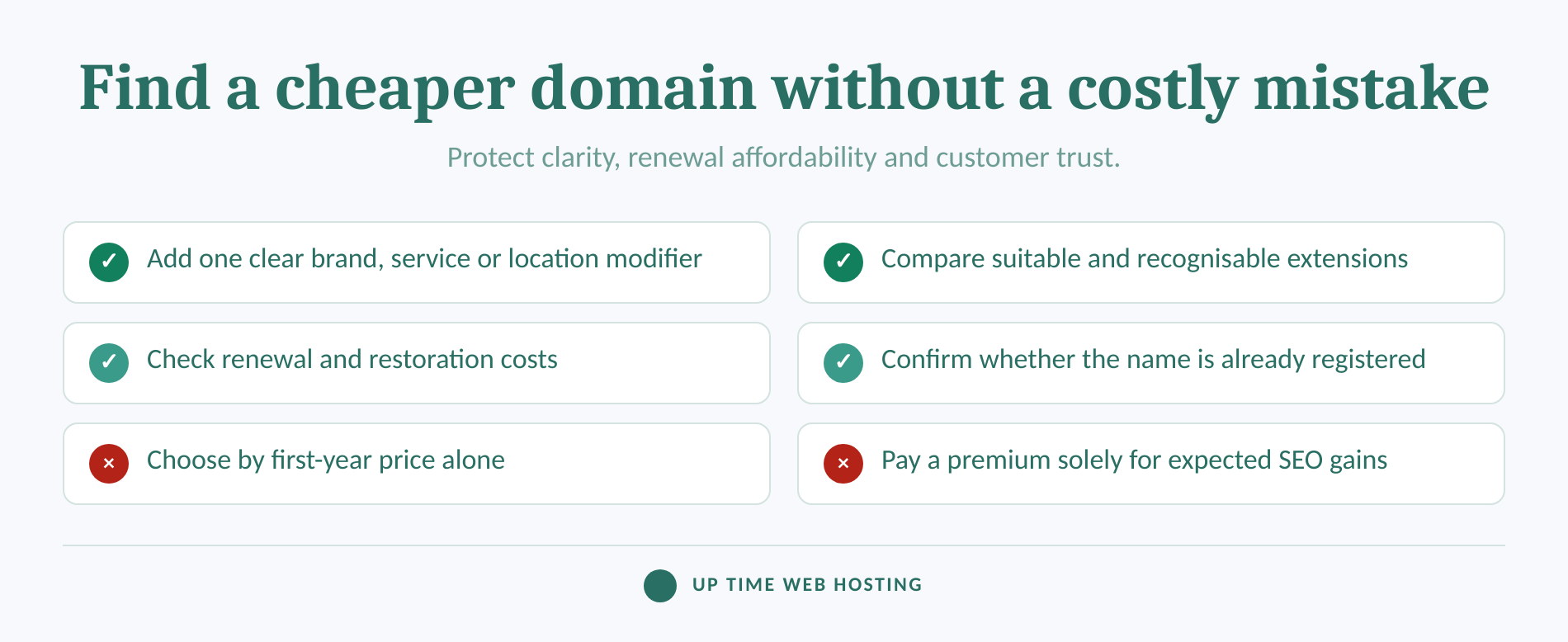
Add a concise word that clarifies the business, service or location. A natural two-word brand is often easier to explain than a forced spelling chosen only because the exact one-word domain is expensive.
Compare extensions that customers will recognise and trust. A cheaper ending is not useful if people repeatedly type the wrong address or assume the business uses a different domain.
Compare the renewal, restoration, support and management terms rather than sorting providers by the first-year number. The guide to choosing an Australian domain registrar explains the service questions that sit behind the price.
If the domain appears to be an aftermarket listing, use ICANN's Registration Data Lookup guidance to check the available registration data and registrar information. Public owner details may be redacted, but the lookup can still help confirm that the name is already registered. (icann.org)
For a resale, decide the maximum amount before contacting the seller. A buyer who has several acceptable names can walk away from a price that has no sensible connection to the project's budget.
The cheapest useful alternative usually comes from changing the name, not chasing the smallest first-year price.
What should Australian buyers check before paying?
An Australian buyer considering a .au domain must check eligibility and allocation rules as well as price. An aftermarket agreement cannot transfer a .au licence to someone who does not meet the requirements for that namespace.
What changes when the domain ends in .au?
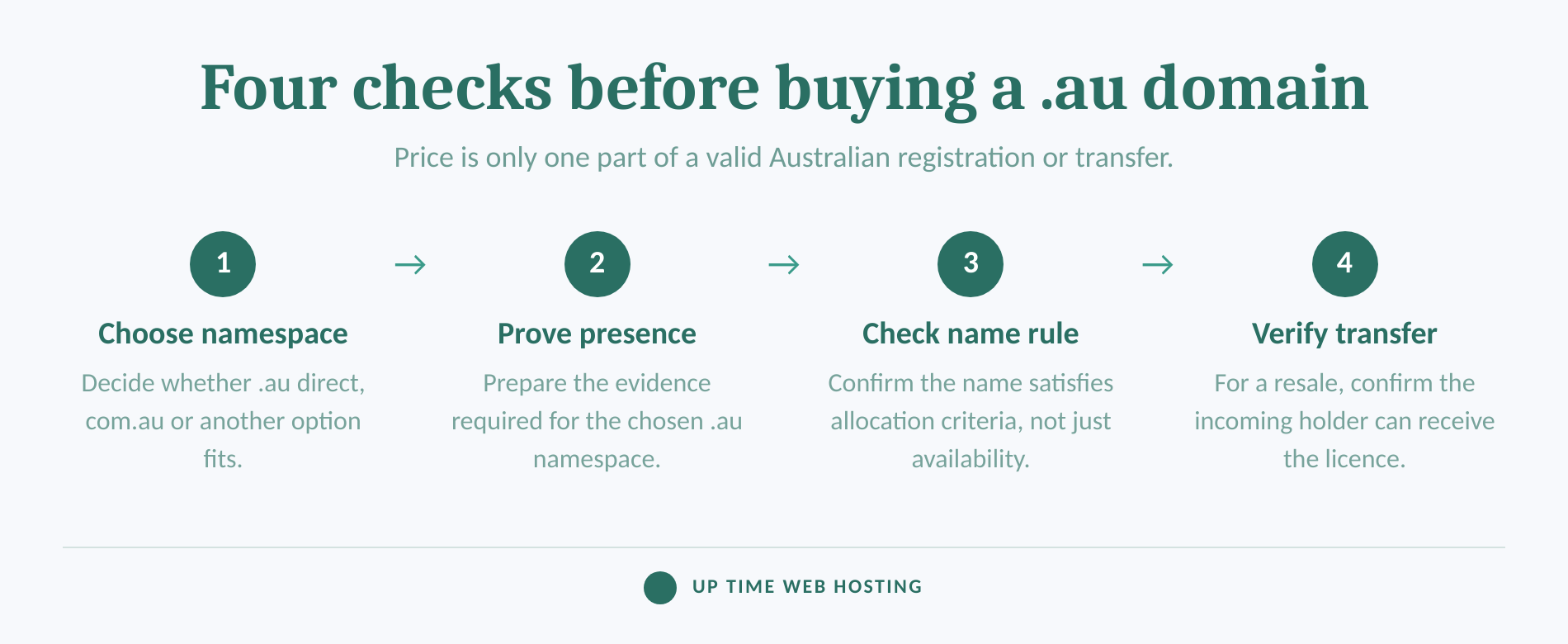
The current auDA 2026 Licensing Rules define a .au domain as a time-limited licence rather than permanent property. The rules also define the licence fee as a combination of a registry wholesale amount and a registrar retail amount. (auda.org.au)
Before paying for a standard or aftermarket .au name:
- Choose the correct namespace, such as .au direct or com.au.
- Confirm the incoming registrant has the required Australian presence.
- Check that the chosen name satisfies the namespace's allocation criteria.
- For a resale, confirm that the licence can be transferred to the proposed buyer.
auDA's transfer guidance says the incoming holder must be eligible at the date of transfer. The seller's willingness to accept payment does not replace that test. (auda.org.au)
The detailed evidence and namespace tests are covered in the guide to Australian domain registration requirements.
For a .au purchase, eligibility and transfer rules matter as much as the agreed price.
Register your new domain name at competitive market prices including free domain add-ons like privacy, DNS Hosting, Custom Nameservers and Forwarding.
Always the best price and no nasty renewal price hikes.
Register A Domain Name
Frequently asked questions about expensive domains
These four questions cover the main price decisions buyers face before registering or acquiring a domain. Each answer assumes that the exact renewal and transfer terms still need to be confirmed for the chosen name.
Why are certain domains more expensive?
Certain domains cost more because the registry charges more for the extension or labels that exact name as premium, or because an existing registrant is reselling it. The retail provider may also add its own pricing and services. The renewal price must be checked separately from the amount due today.
What is the cheapest domain ever?
There is no permanent record-holder for the cheapest domain because promotions, currencies, registration terms and included services change. A domain advertised at no cost or a very low first-year price can renew at a normal rate later. The useful comparison is the total cost over the period you expect to keep it.
Is it worth paying for a premium domain?
A premium domain can be worth paying for when the name is central to an established brand, easy for customers to remember and affordable after every renewal is counted. It is not worth the premium simply because the seller asks a high price or because someone claims the extension will improve search rankings.
How to get cheaper domains?
Get a cheaper domain by changing the name before accepting a poor extension or a high aftermarket price. Add a clear modifier, compare suitable extensions, check several providers' renewal and recovery fees, and avoid paying for a premium solely for SEO. If the preferred name is registered, decide on a firm walk-away budget.
The cheapest-looking domain is not necessarily the cheapest domain to keep.
What should you do before registering?
Before registering, save the checkout page or quote showing the initial amount, term, renewal fee and any premium label. If any recurring cost is missing, ask for it in writing before paying.
Check the full term and renewal amount, then search current domain availability and pricing. (uptimewebhosting.com.au)