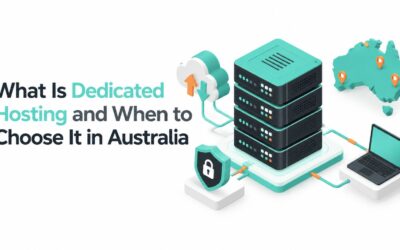
So, what exactly is dedicated server hosting, and why is it often called the top tier of web hosting?
Think of it this way: a dedicated server is an entire physical server that's 100% yours. All of its computing power, memory (RAM), and storage space are reserved exclusively for your website or application. This isn't about sharing or partitioning resources; it's about having the whole machine to yourself.
It's the natural next step for any online business that has started to feel the performance limits of a shared environment.
What Is Dedicated Server Hosting Really?
Let’s use an analogy. Think of web hosting like finding a place for a restaurant.
Shared hosting is like renting a single table in a massive, noisy food court. You’re constantly competing for space and service with everyone else around you. A Virtual Private Server (VPS) is a decent step up—it’s like having your own private booth. You get more space and privacy, but you’re still sharing the main kitchen and staff with all the other diners.
Dedicated server hosting, on the other hand, is like owning the entire restaurant building. The kitchen, the chefs, the staff—everything works just for you. You have total control over the menu (software), the decor (configurations), and the quality of service, guaranteeing your customers get the best experience without any compromises.
This diagram helps illustrate that progression, showing how you gain more control and performance as you move from shared to dedicated.
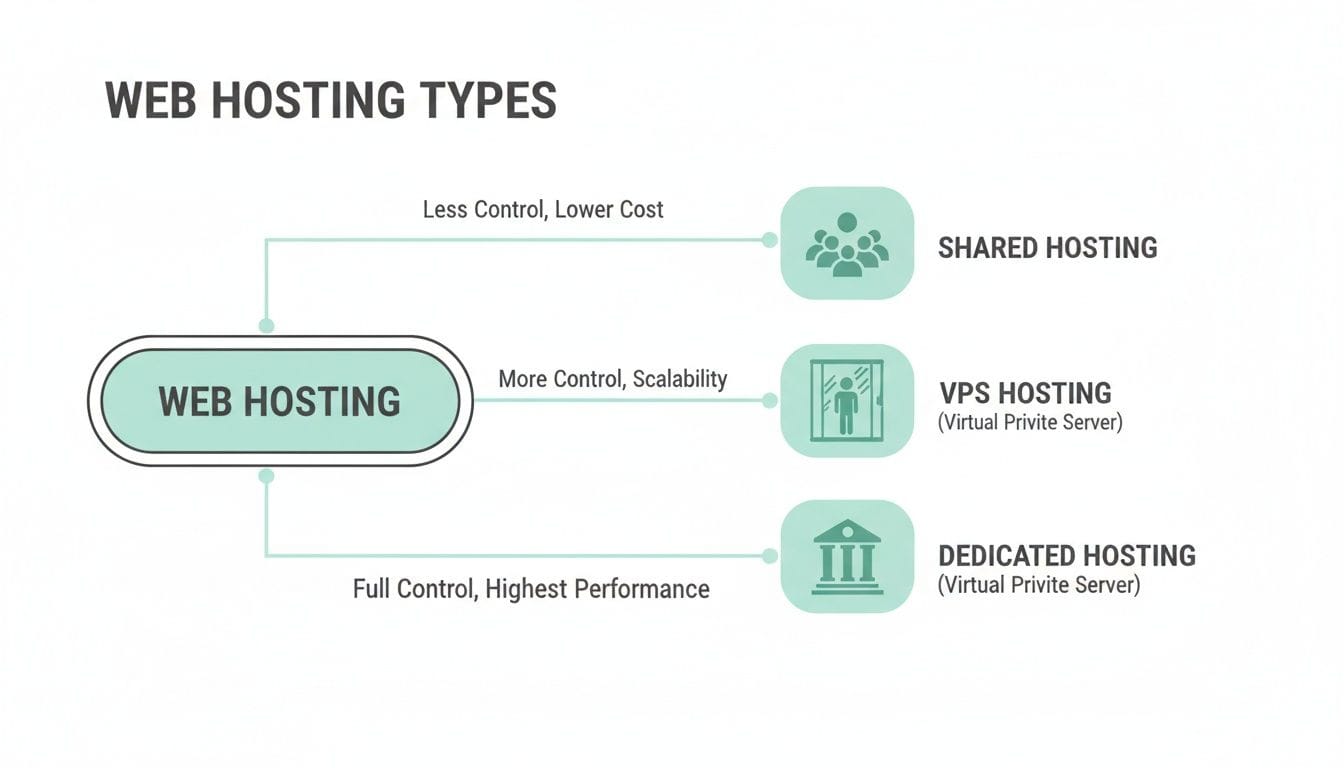
As you can see, the trade-off is moving from a low-cost, entry-level setup to a premium, exclusive environment. For a growing business, that shift directly translates into better performance, stronger security, and happier customers.
Who Truly Benefits from a Dedicated Server?
While a dedicated server isn't necessary for every website, it becomes a crucial investment for businesses hitting a certain scale or with specific operational needs. If your business fits one of these descriptions, it's likely time to consider making the move.
- High-Traffic eCommerce Stores: An online shop gearing up for a big sales event like Boxing Day simply can't risk slowdowns or crashes. A dedicated server ensures you can handle thousands of simultaneous shoppers without a hiccup, protecting your sales and your brand's reputation.
- SaaS and Application Providers: If you deliver software as a service (SaaS) or run complex web applications, you probably need very specific software or hardware setups. A dedicated server gives you the freedom to install a custom operating system, unique control panels, and specialised security protocols that your application requires.
- Businesses with Strict Security Needs: For any organisation handling sensitive customer details, financial data, or confidential records, an isolated server isn't just a nice-to-have; it's a must. Dedicated hosting completely removes the risk of "cross-contamination" from other websites, which is a known vulnerability in shared environments.
A dedicated server isn’t just about more power; it’s about guaranteed resources. You never have to worry about a "noisy neighbour"—another website on your server consuming all the resources and slowing your site down.
Dedicated vs Shared vs VPS Hosting at a Glance
To make the differences crystal clear, it helps to see the three main hosting types side-by-side. Understanding these key trade-offs will help you match your hosting choice with your business goals. For a more detailed breakdown, you can learn more about the common types of web hosting in our guide.
Here's a quick comparison table that translates the technical distinctions into real-world business advantages.
| Feature | Shared Hosting | VPS Hosting | Dedicated Server Hosting |
|---|---|---|---|
| Performance | Variable; affected by other sites. | Stable, but still shares hardware with others. | Guaranteed and consistently high. |
| Security | Lower; vulnerabilities on one site can affect others. | Moderate; isolated but shares physical server. | Highest; completely isolated environment. |
| Control | Very limited; provider manages everything. | Root access, but limited by hypervisor. | Complete root access and hardware control. |
| Cost | Lowest; most affordable option. | Mid-range; balances cost and performance. | Highest; a premium investment. |
Ultimately, choosing dedicated hosting is an investment in stability, security, and performance. While it comes at a higher cost, the complete control and guaranteed resources are invaluable for businesses that depend on their online presence to succeed.

Performance you can feel, backed by clients who depend on it. Read how our support and uptime create long‑term customer success.Power Your Business with Better Hosting
The Business Case for a Dedicated Server
Deciding to move to a dedicated server isn’t just a tech upgrade; it’s a serious business decision. It’s about solving the growing pains that hold your website back and unlocking real benefits you can see on your bottom line. Think of it as an investment in the reliability, security, and future of your entire online operation.
The most common reason businesses make the switch is to escape the "noisy neighbour" problem. On a shared or VPS server, a traffic spike on another website can slow yours to a crawl, costing you sales and frustrating visitors.
With a dedicated server, all the server's resources are yours and yours alone. This guarantees your site’s performance stays consistently fast, even when you’re slammed with traffic. That isolation is the foundation of the whole argument for going dedicated.
Next-Level Performance and Rock-Solid Reliability
For any growing business, website performance isn't just a nice-to-have; it's absolutely essential for keeping customers happy and making sales. A slow website actively hurts your revenue and tarnishes your brand. A dedicated server gives you the raw horsepower needed to deliver a lightning-fast experience, every single time.
- Handle Traffic Spikes with Confidence: An Australian retailer can finally stop worrying about their site crashing during massive sales events like Boxing Day or Click Frenzy. A dedicated server is built to take the heat, protecting your revenue when it matters most.
- Give Users a Better Experience: Faster load times mean people stick around longer and are less likely to "bounce" away to a competitor. A snappy, responsive site keeps customers happy and brings them back.
- Boost Your SEO Rankings: Search engines like Google reward fast, reliable websites. The superior performance of a dedicated server can give you a real edge in search rankings, driving more free, organic traffic your way.
This kind of reliability is why so many Aussie businesses are upgrading. The demand for robust hosting is booming as companies realise it's critical infrastructure for growth. In fact, Australia's web hosting market is set to grow at a compound annual rate of 11.00% between 2026 and 2035, which just goes to show how vital this has become.
A Secure Fortress for Your Data
In a world full of cyber threats, protecting your customer data isn't optional. Shared hosting comes with a built-in risk: a security hole on one website can potentially spill over and affect every other site on that server.
A dedicated server completely removes that risk. By giving you a totally isolated environment, you’re essentially building a digital fortress around your website and data. This is non-negotiable for earning customer trust and meeting compliance standards.
This level of security is crucial for any business handling personal information, payment details, or sensitive client files. It delivers peace of mind for you, your partners, and most importantly, your customers.
Total Control and Customisation
A dedicated server is a blank canvas for your developers. Unlike shared hosting, where you’re stuck with the provider’s one-size-fits-all setup, a dedicated server gives you complete freedom to build the exact environment you need.
Imagine you run a software-as-a-service (SaaS) company. You might need a specific database version, a niche programming library, or a custom security setup for your app to run perfectly. With root access on a dedicated server, your team can install and configure any software they want, fine-tuning the entire system for peak performance.
This freedom also applies to your long-term strategy. As your business grows, you'll need to scale your IT infrastructure, and having a plan from the start is key. Understanding data center migration best practices ensures your initial investment pays off for years to come. At the end of the day, a dedicated server isn't just another line item on an invoice; it's a powerful asset that fuels your growth, which is a vital part of your overall website creation and maintenance costs.
Choosing Between Managed and Unmanaged Hosting
So you’ve decided that a dedicated server is the right move for your business. That’s a great step. But now you’re facing another critical choice that will define your entire hosting experience: do you go with managed or unmanaged hosting?
Think of it like buying a high-performance car. Do you just want the keys so you can tinker with it yourself, or do you want a full-service pit crew on standby to handle all the maintenance for you?
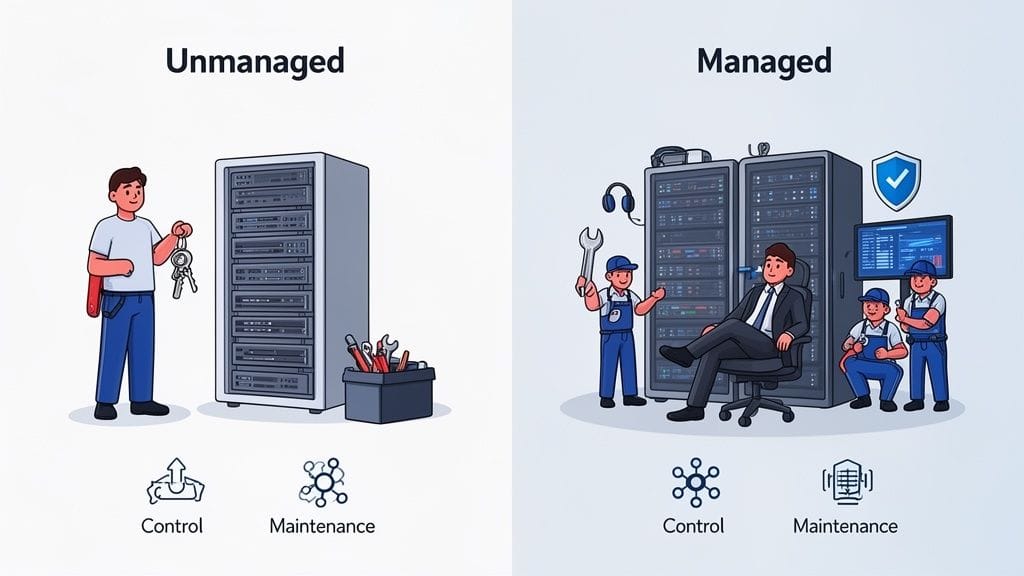
This decision really boils down to a trade-off between total control and total convenience. To make the right call, you need to be honest about your team’s technical skills, how much time you have, and your budget.
Unmanaged Hosting: The DIY Approach
Unmanaged dedicated hosting is exactly what it sounds like. Your provider gives you the physical server and a network connection, and the rest is up to you. You get handed the "keys" with full root access, giving you complete and total control over every nut and bolt of your machine.
This means you’re on the hook for everything:
- Installing the operating system (like Linux or Windows).
- Setting up all your software, from control panels to security tools.
- Performing every security update, software patch, and bit of ongoing maintenance.
- Monitoring the server for problems and troubleshooting any issues that pop up.
This approach is perfect for seasoned developers, system administrators, or any business with an in-house IT team that lives and breathes this stuff. The biggest advantage is the absolute freedom to build a completely custom setup tailored to your specific needs. Just be prepared for the significant time and expertise it demands.
Managed Hosting: The Full-Service Pit Crew
On the flip side, managed dedicated hosting is like having your own expert pit crew. A team like ours at UpTime Web Hosting takes care of all the complex, time-consuming technical heavy lifting so you can get back to what you do best—running your business.
With managed hosting, your provider essentially becomes your outsourced server administration team. You get all the power of a dedicated server without the headache of managing it.
Here’s what a typical managed service from a good provider includes:
- Initial Setup and Configuration: We’ll get your server up and running with the right OS and control panel from day one.
- 24/7 Proactive Monitoring: Our team watches your server around the clock, catching performance issues or security threats before they become big problems.
- Security Management: We handle all the critical security patches and updates, keeping your server locked down against vulnerabilities.
- Expert Technical Support: When something does go wrong or you just need advice, you have a team of experts ready to help.
This is the ideal choice for most small and medium businesses that don't have a dedicated server guru on staff. While it does come at a higher price than an unmanaged plan, the peace of mind and time saved are often invaluable. For those looking for a middle ground, exploring our affordable virtual private servers can be a good next step.
Making the Right Choice for Your Business
So, how do you decide? It helps to ask yourself a few direct questions to figure out which path is truly right for your business.
A Quick Checklist to Guide Your Decision:
- Do we have an IT team or a server expert on staff?
- Yes: You have the skills needed for unmanaged hosting.
- No: Managed hosting is the much safer bet.
- Do I want to spend my time on server updates and troubleshooting?
- Yes: Unmanaged gives you the hands-on control you're looking for.
- No: Managed hosting will free up your time for other priorities.
- Is our main goal business growth or technical management?
- Technical Management: Unmanaged hosting fits right into that workflow.
- Business Growth: Managed hosting lets you focus on your customers and strategy.
- Is having 24/7 expert support a top priority for us?
- Yes: This is a core feature of any good managed hosting plan.
- No: You're comfortable handling emergencies on your own.
For the vast majority of Australian SMBs, the answer tends to be pretty clear. Managed dedicated server hosting offers that perfect mix of raw performance and expert support, ensuring your online operations run like a dream without needing a sysadmin on your payroll.
Host your website with our 5-star rated, cPanel website hosting plans.
Super fast servers, with security included and hosted in your choice of Australian Data Center.
View cPanel Plans
How to Choose the Right Server Hardware
Trying to pick the right hardware for your dedicated server can feel like you’re reading another language. All those acronyms—CPU, RAM, SSD—can be a bit much. But getting this part right is absolutely vital. It’s the difference between having a powerhouse server that hums along perfectly and paying for horsepower you’ll simply never use.
So, let's break down the core components. I find it helps to think of your server as a high-end workshop, custom-built for your website or application.
The CPU: The Brain of the Operation
The Central Processing Unit, or CPU, is your server’s brain. It’s what does all the thinking, crunching the numbers and carrying out the instructions that make your website actually work. A more powerful CPU means it thinks faster and can handle more jobs at once.
Imagine the CPU is the head chef in a busy restaurant. A chef with more training and a bigger team (more cores and a higher clock speed) can get more orders out simultaneously, especially during the dinner rush.
- For Example: A dynamic website, like a busy e-commerce store with a multi-step checkout, leans heavily on the CPU. It needs to process user requests, query the database, and run application logic all at once. A strong, multi-core CPU makes sure that even as more customers pile in, the site stays snappy and responsive.
- In contrast: A simple portfolio site that just serves up static images and text doesn't need a top-of-the-line processor. A standard CPU would be more than enough to handle its light workload.
When you’re looking at CPUs, you need to have a rough idea of how many "orders" your site will be taking at its busiest. For a bit more guidance, our knowledge base offers a deeper look into how to choose the right CPU for your project.
RAM: The Server's Short-Term Memory
Random Access Memory, or RAM, acts as the server's short-term workspace. It holds all the data and applications that are currently active, giving the CPU near-instant access to them. The more RAM you have, the more things your server can juggle at the same time without slowing to a crawl.
Think of RAM as your chef's countertop space. More space means they can prep multiple dishes at once, keeping everything organised and the kitchen flowing. If that counter gets too cluttered, everything grinds to a halt.
When a server runs out of RAM, it's forced to shuffle data back and forth from its much slower long-term storage (the hard drive). This process, known as "swapping," is a classic performance killer and can make even a powerful server feel sluggish.
Where RAM Really Matters:
- A Membership Site: A learning portal with hundreds of users logged in at once needs plenty of RAM to keep every user's session active and responsive.
- A Large Database: If your server runs a big MySQL or MSSQL database, you need enough RAM to cache common queries and data. This dramatically speeds up how quickly your application gets the information it needs.
- Content Management Systems: Platforms like WordPress and Magento absolutely love RAM, especially if you have a lot of plugins running. More RAM lets them serve pages much faster.
Storage: The Filing Cabinet
Storage is where your server keeps everything for the long haul—the operating system, your website's code, all your images, videos, and databases. It's the workshop's main filing cabinet. The two main options you'll see are traditional Hard Disk Drives (HDDs) and modern Solid State Drives (SSDs).
While HDDs are cheap and offer huge amounts of space, SSDs are in another league when it comes to speed. They have no moving parts, and this makes a massive difference in how fast your website loads for visitors.
- HDD (Hard Disk Drive): Think of this as a classic, metal filing cabinet. It's affordable and can hold a lot, but it takes a moment to physically find and pull out the right file. It's best used for things like backups or archival storage, where speed isn't the top priority.
- SSD (Solid State Drive): This is a high-tech digital filing system that brings up files instantly. It's the absolute best choice for hosting your live website and databases because it directly slashes page load times.
For something like a video portfolio site or an online store with thousands of high-res product photos, fast SSD storage isn't just a nice-to-have, it's essential. The quicker the server can read those image files, the faster they appear on your visitor's screen. You can learn more about the differences in our guide on choosing the right storage type.
Bandwidth: The Data Highway
Finally, there's bandwidth. This is the data highway connecting your server to the rest of the internet. It dictates how much data can move to and from your server in a set amount of time. More bandwidth means you can handle more visitors and larger files without creating a traffic jam.
Imagine it’s the main road leading to your restaurant. A narrow laneway will get clogged fast if too many people try to arrive at once. A multi-lane highway, on the other hand, can handle a huge rush of visitors without any slowdowns. If your site streams high-definition video or offers large file downloads, generous bandwidth is a must for a smooth user experience.
Essential Security and Backup Strategies
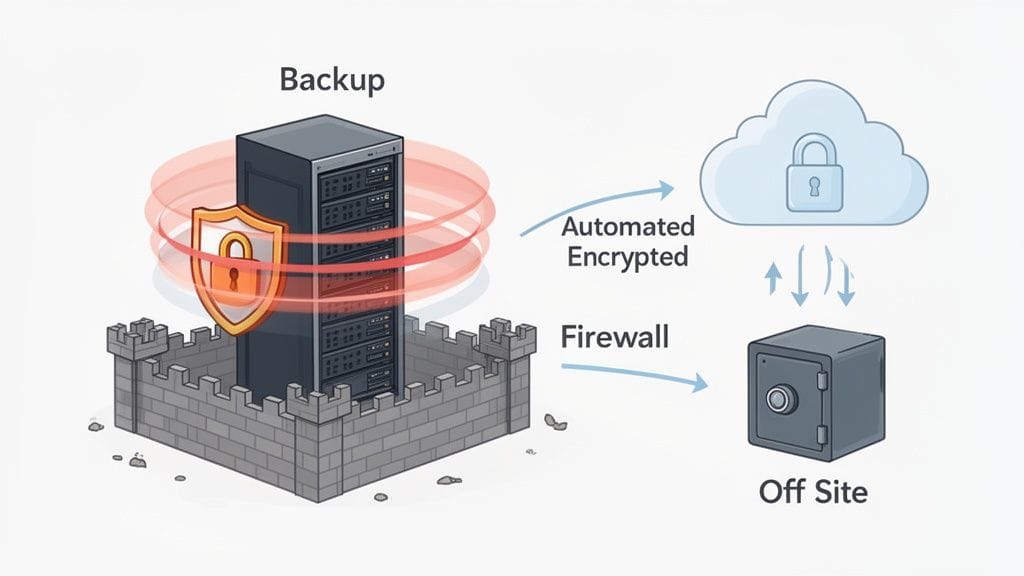
Think of your dedicated server as your private digital fortress. It's an incredibly secure space, but even the strongest fortress needs its gates guarded and a rock-solid plan for when things go wrong. With a dedicated server, you have total control over security, which is great. But it also means the responsibility for protecting it lands squarely on your shoulders.
Building a layered defence isn’t just some tech buzzword; it’s absolutely essential for protecting your business from the ground up.
This all starts with being proactive—stopping threats before they ever get a chance to cause damage. A properly configured firewall is your first line of defence. It’s like a bouncer at a club, inspecting every bit of traffic trying to get in or out. It's programmed to block malicious requests and prevent unauthorised access, forming a critical barrier around your server.
But let's be real, a firewall alone won't stop every single threat. That’s exactly why a layered approach is so important. You need multiple shields protecting your data and your uptime.
Building a Layered Defence
A truly comprehensive security strategy involves several key practices working together. Each layer tackles a different type of risk, creating a robust defence that can stand up to a wide range of attacks.
- DDoS Protection: A Distributed Denial-of-Service (DDoS) attack is a brute-force attempt to knock you offline by flooding your server with junk traffic. A DDoS-protected network, like the one we run at UpTime Web Hosting, filters out this malicious traffic before it even reaches your server, keeping your website online and running smoothly.
- Regular Malware Scans: Just like your home computer, a server can get infected with malware. Running automated, regular scans is crucial for catching and removing any malicious code that might have slipped through your other defences.
- Routine Software Updates: Outdated software is one of the most common backdoors attackers use to get in. Keeping your operating system, control panel, and all your applications updated with the latest security patches closes these known vulnerabilities for good.
This multi-pronged approach ensures that even if one layer is somehow breached, others are standing by to stop an attack in its tracks.
Your Lifeline: An Automated Backup Strategy
Here’s a hard truth: no security system is completely foolproof. Hardware can fail out of the blue, people make mistakes, and a determined attacker might just find a way in. When disaster strikes, your backup is the only thing standing between a minor headache and a catastrophic business failure.
Imagine a ransomware attack encrypts all your server files at 3 AM. Without a recent, reliable backup, your business is effectively gone. With a good backup, you can restore your data and be back online in hours, not weeks.
The real secret to an effective backup plan is automation and location. Relying on someone to do manual backups is a recipe for disaster—they’re easy to forget and almost always inconsistent. An automated system that runs daily ensures you always have a recent recovery point ready to go.
This is especially true for Australian businesses that depend on their online presence. As you can read the full research on the dedicated server hosting market, this infrastructure is becoming more vital every day, especially for high-traffic sites needing top-tier performance and security.
On-Server vs Off-Site Backups
It’s vital to understand the difference between where your backups are stored.
- On-Server Backups: These are quick to create and restore from because they're stored on the same machine as your live data. The downside? If the whole server fails, gets hacked, or is physically damaged, your backups are gone along with everything else.
- Off-Site Backups: These backups are sent to a completely separate, secure location—often a specialised cloud service. This protects you from server-level disasters like hardware failure, fire, or a total system compromise.
Honestly, the best strategy uses both. But for a truly resilient setup that gives you genuine peace of mind, an automated, encrypted, and off-site solution is completely non-negotiable. You can learn more by exploring the benefits of our secure cloud backup solutions, which are designed to provide exactly that.
Finding the Best Australian Hosting Provider
Picking your hosting provider is just as crucial as choosing the server hardware itself. Think of the right partner as an extension of your own team—someone who ensures your business stays online, fast, and secure. This decision is about so much more than just comparing prices; it’s about looking at the factors that genuinely create a reliable foundation for your Australian business.
When your customers are mainly in Australia, the server’s location is an absolute game-changer. Hosting your website in a local data centre, say in Sydney or Melbourne, drastically cuts down latency—that’s the physical delay it takes for data to travel. Lower latency means quicker page loads, a much better experience for your users, and even a small boost to your local SEO rankings.
Why Local Data Centres Matter
Beyond raw speed, using an Australian data centre is vital for data sovereignty. Many businesses, especially those in finance, healthcare, or the legal fields, face strict rules about where their customer data can be stored. Keeping that data on Australian soil ensures you’re ticking those compliance boxes and holding onto your customers' trust.
The market backs this up. Australia's data centre market, which is the very bedrock of quality dedicated server hosting, was valued at USD 4.8 billion in 2026 and is tipped to hit USD 7.9 billion by 2034. You can check out more on this growth in the Australia data center market on IMARC Group's report. This boom is being fuelled by businesses just like yours demanding better performance and local control over their data.
Look for Truly Australian Support
Picture this: your server goes down at 2 AM on a Saturday. The last thing you want is to be shuffled through to an international call centre that has no clue about your setup. Real, 24/7 Australian-based support is not just a nice-to-have; it's a must. You need a team that answers the phone quickly, understands the local landscape, and has the authority to fix your problem on the spot.
Your hosting provider is your first call in an emergency. Make sure it's a team that's awake, available, and empowered to help you when you need it most.
A Checklist for Vetting Australian Providers
As you start comparing your options, use this checklist to see past the marketing fluff and focus on what really counts. For an even deeper look, check out our guide on selecting from the top Australian web hosting providers.
- Transparent Pricing: Is GST included right from the start? Are there sneaky fees for setup, extra bandwidth, or essential security features? A provider you can trust puts all the costs on the table.
- Clear Uptime Guarantees (SLAs): Look for a Service Level Agreement (SLA) that promises a specific uptime figure (like 99.9%). Even better, find out what happens if they don’t meet it—do you get a service credit?
- Local Infrastructure: Do they run their own hardware in Australian data centres? Get them to confirm the exact locations to make sure you're getting that low latency for your audience.
- Genuine Aussie Support: Is their support team actually in Australia and available around the clock by phone and support ticket?
At UpTime Web Hosting, we’ve built our services around these exact ideas. Our servers are housed in secure data centres across Australia, our support team is 100% local, and our pricing is always upfront. We invite you to explore our dedicated server plans to see how we put these principles into practice to help Australian businesses succeed.
Register your new domain name at competitive market prices including free domain add-ons like privacy, DNS Hosting, Custom Nameservers and Forwarding.
Always the best price and no nasty renewal price hikes.
Register A Domain Name
Common Questions About Dedicated Servers
When you're thinking about moving up to a dedicated server, a few practical questions always come to mind. Let's get straight into the answers to help you figure out your next steps.
How Much Does a Dedicated Server Cost in Australia?
So, what’s the damage? In Australia, you can expect a dedicated server to cost anywhere from a few hundred to over a thousand dollars per month.
The final price really boils down to three things: the raw hardware specs (CPU, RAM, and storage), whether you want it managed or prefer to handle it yourself, and how much network bandwidth you’ll be using.
Be sure to find a provider with transparent, all-in pricing. You don’t want to be surprised by hidden fees for GST, setup, or essential security. As a rough guide, a solid managed server might start around $250/month, while a high-performance machine for a busy e-commerce site could easily be $600/month or more.
How Hard Is It to Move My Site to a Dedicated Server?
The thought of migrating your website can be daunting, but it doesn't have to be a nightmare. With the right host, it can be surprisingly painless.
If you go for an unmanaged server, the ball is entirely in your court. You'll be responsible for moving all your files, databases, and getting everything reconfigured. It takes a fair bit of technical skill and very careful planning to pull off without a hitch.
A quality host like UpTime Web Hosting, on the other hand, can take this completely off your plate. Our expert team offers managed migration assistance, handling the entire transfer for you. We make sure the switch is smooth and stress-free with next to no downtime. If you want to see what’s involved, check out our guide on planning your website migration.
The whole point of a managed migration is to make the switch feel seamless. Your provider does all the heavy lifting, so you can just focus on enjoying the performance boost from your new server without the technical headaches.
Can I Upgrade My Dedicated Server in the Future?
Absolutely. One of the best things about a dedicated server is that it can grow right alongside your business. You’re not locked into your day-one configuration forever.
As your traffic picks up or your applications need more grunt, upgrading is a standard process. Bumping up the RAM or switching to faster SSD storage are common requests we handle all the time. A good provider will manage these upgrades with minimal disruption, ensuring your server keeps up with your success. This long-term flexibility is a major reason why businesses invest in their own dedicated hardware.
Is a Dedicated Server Better Than a Cloud Server?
This is a classic question, but one isn't "better" than the other—they just solve different problems.
A dedicated server gives you guaranteed performance and a predictable monthly bill. Because you’re not sharing the hardware with anyone, you get 100% of the resources you pay for, all the time. This makes it the perfect choice for high-traffic sites, online stores, or SaaS platforms where consistent, reliable speed is non-negotiable.
Cloud servers offer fantastic flexibility, letting you scale resources up or down almost instantly. The trade-off? This can lead to unpredictable costs and performance "noisy neighbour" issues from others on the shared platform. For businesses that need maximum, reliable power for their money, a dedicated server almost always comes out on top for value.
Ready to feel the difference a local, high-performance hosting partner can make? UpTime Web Hosting offers premium dedicated servers right here in Australian data centres, backed by our 24/7 expert support. Find the perfect plan to grow your business at https://uptimewebhosting.com.au.