
Here's the real difference between Sitejet and Wix: it all comes down to whether you're after a quick and easy DIY experience or a professional-grade tool built for serious performance. Your choice really depends on what you value more—simplicity right now, or long-term speed and control.
Choosing Your Australian Website Builder
Welcome to the 2026 showdown for Australian businesses trying to pick between the Sitejet builder and Wix. This guide is designed to cut through all the marketing hype and focus on what actually matters for Aussie small businesses: local server performance, GST-inclusive pricing, and support from people who are actually in Australia.
While everyone's heard of Wix, Sitejet is the powerful alternative built for getting professional results. We're going to break down the real differences from an Australian perspective so you can figure out which one is the right fit. Let's start with a quick look before we dive deep into performance, cost, and how they stack up for the local market.
Sitejet vs Wix At a Glance
The Aussie website builder scene has a few big names, but the right choice isn't always the most obvious one. In 2026, Wix holds a massive market share among DIY builders here, mostly because they have a Sydney data centre which helps with load times.
But Sitejet, which you can only get through Australian hosts like UpTime Web Hosting with servers in Sydney, Melbourne, and Perth, is quickly becoming a favourite for performance-focused businesses. To give you a clear picture of the main differences, here’s a quick comparison:
| Feature | Sitejet (via UpTime Hosting) | Wix |
|---|---|---|
| Target Audience | Web designers, agencies, and performance-focused SMBs | Beginners, solo entrepreneurs, and DIY users |
| Hosting Location | Australian servers (Sydney, Melbourne, Perth) | Global CDN with a Sydney Point of Presence |
| Pricing Model | Bundled, transparent AUD pricing with GST included | Tiered USD plans, GST added at checkout |
| Core Strength | Professional workflow, customisation, and local speed | Extreme ease of use and fast initial setup |
| Support | 24/7 Australian-based team via phone and tickets | Global support system with knowledge base and email |
At the end of the day, picking the right platform means looking past the flashy templates and drag-and-drop editors. You need to consider things like hosting infrastructure, the real cost once GST is added, and whether you can get quality local support. These are the details that truly matter for success in the Australian market.
For a deeper look at what you should be prioritising, check out our guide on the best website builder for small business Australia.

Performance you can feel, backed by clients who depend on it. Read how our support and uptime create long‑term customer success.Power Your Business with Better Hosting
Comparing Performance and Hosting in Australia
When an Aussie customer lands on your website, their first impression isn't your design or your products—it's how quickly your page loads. A slow website is a deal-breaker, and the single biggest factor influencing speed is your hosting. This is where the Sitejet vs Wix debate gets really interesting for Australian businesses, because their approaches couldn't be more different.
Wix operates on a massive, global scale. They use a Content Delivery Network (CDN) with a local Point of Presence (PoP) in Sydney. This is a good thing – it means a saved, or cached, version of your site is stored here, which is much faster than pulling data from the US. Still, the core processing might happen oceans away, creating a small but noticeable delay.
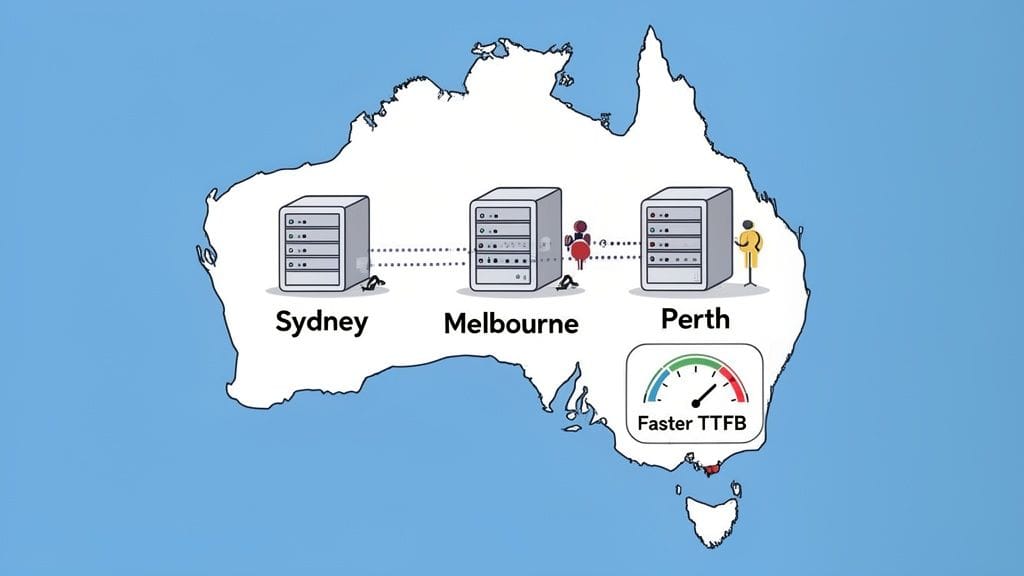
On the other hand, Sitejet offered through UpTime Web Hosting is run on dedicated Australian servers, with hardware physically located in Sydney, Melbourne, and Perth. This isn't just a temporary cache; your entire website lives and breathes on Aussie soil. This guarantees the data's journey to your visitor is as short as it can possibly be.
The East Coast vs West Coast Latency Test
Let's break this down with a real-world example. Imagine you have two potential customers: one in Sydney and another way over in Perth.
With Wix, your Sydney customer gets a pretty quick experience because they're right near the local server. But the visitor in Perth is over 3,000 kilometres away. Their request has to shoot across the entire continent, which adds precious milliseconds—or even seconds—of latency to the load time.
Now, picture that same scenario with Sitejet hosted on UpTime's network. The Sydney visitor gets a snappy response from the local Sydney server. But critically, the Perth visitor connects to the local Perth server. By handling the request at the closest physical point, you slash latency and deliver a consistently fast site for all Australians, not just those on the east coast.
This geographical advantage is a huge deal. A fast Time to First Byte (TTFB)—which measures how quickly a server responds to a request—is a key ranking factor for Google. Localised hosting gives you a better TTFB for a wider Aussie audience, which can directly help your SEO.
Under the Bonnet: Server Technology
Beyond just location, the tech powering the hosting makes a world of difference. Wix uses a proprietary, closed system. You get no say or insight into the server software—it's a complete black box. It’s built for simplicity, but you miss out on any serious performance tuning.
Sitejet through UpTime is the polar opposite, running on a high-performance stack engineered for speed.
- LiteSpeed Web Servers: These are known in the industry for being significantly faster than older Apache servers, handling website traffic far more efficiently.
- AccelerateWP Caching: This is a powerful, server-level caching system built to make dynamic sites fly. It pre-builds pages so they are ready to be served instantly, cutting down on lag.
This combination gives you a much faster foundation to build on. While Wix is certainly not slow, it's a one-size-fits-all solution. Sitejet on an optimised Australian network provides a serious performance advantage. If you're exploring your options, it's worth understanding the best alternatives to global hosting brands in Australia to see how local infrastructure stacks up.
The Real-World Impact for Your Business
So, what does this tech talk actually mean for your business? This performance gap has real consequences that can affect both your user experience and, ultimately, your bottom line.
Practical Scenario: A Perth-based Plumbing Business
A plumber in Perth has a website designed to capture emergency call-outs. A frantic potential customer with a burst pipe Googles "emergency plumber Perth" on their phone.
- On Wix: Their site, served from Sydney, takes an extra second or two to appear due to that cross-country latency. In a panic, the customer gets impatient, hits the back button, and calls a competitor whose site loaded faster.
- On Sitejet (with UpTime): The site loads almost instantly from the local Perth server. The customer finds the phone number in a flash, makes the call, and the plumber lands a high-value job.
This isn't just about shaving off a few milliseconds. It's about converting visitors into paying customers at the most critical moments. For any Australian business targeting a national audience—especially those outside of Sydney—the benefits of a distributed, local hosting network are undeniable.
Untangling the True Cost: AUD Pricing vs Hidden Fees
When you're comparing Sitejet and Wix, the price you see on the front page is rarely the price you'll end up paying. To get a real handle on the costs for your Aussie business, you have to look past the flashy discount offers and dig into what you'll be paying long-term, including GST, renewal fees, and any "extras" that turn out to be essential.
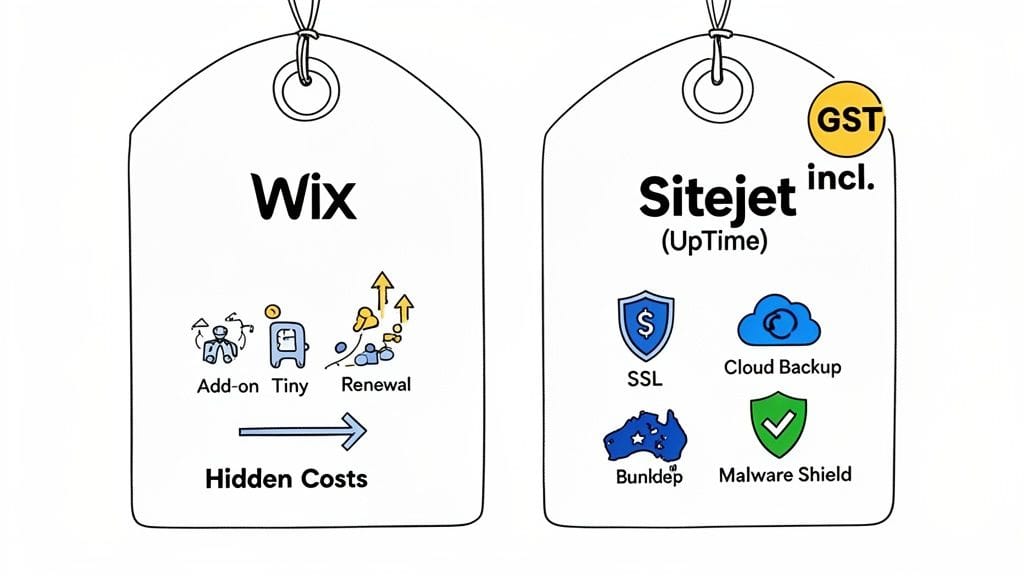
Wix is brilliant at getting people in the door with low-cost or "free" plans. But to run a proper business website, you'll hit a paywall pretty quickly. The plans are usually priced in USD, which means you’re not just paying the advertised price; you're also copping currency conversion fees and the 10% GST that gets tacked on at the end. That advertised price just jumped up without you doing a thing.
On top of that, many of the tools you need to grow—think advanced booking systems or customer loyalty programs—aren't built-in. You have to get them from the Wix App Market, and most of the good ones come with their own monthly subscription fees. These can stack up fast, blowing your budget out over time.
The All-Inclusive Sitejet Model
Sitejet, especially when you get it through an Australian provider like UpTime, is a completely different story. The pricing is in Australian Dollars (AUD) right from the start, and GST is already included. What you see is what you pay. No nasty surprises on your invoice. If you want to understand why this matters so much, it's worth reading up on the real difference between AUD pricing vs USD web hosting.
This all-in-one approach covers features, too. A bunch of critical security and maintenance tools that often cost you extra with other platforms are simply part of the deal.
- Free SSL Certificate: This is the little padlock that tells customers your site is secure. It's vital for trust and SEO, and it's included.
- Daily Backups: Your entire website gets backed up automatically every single night. That's serious peace of mind.
- Proactive Malware Scanning: Your site is always being watched for digital threats, keeping your business and your customers safe.
These aren't just nice-to-haves; they represent real money saved. With Wix, getting similar backup and security features often means paying for separate apps, adding another line item to your monthly bill.
The biggest financial trap we see businesses fall into is the renewal price shock. Many global platforms lure you in with a massive first-year discount, only to double or triple the price when it’s time to renew. Always, always check the full-term cost, not just the intro offer.
A Two-Year Cost Breakdown
Let’s make this real. Here’s a look at the total cost over two years for a typical Aussie small business that needs a professional website with solid security and performance. This gives you a proper apples-to-apples comparison.
Two-Year Cost Comparison: Sitejet vs Wix for a Typical Aussie Business
This table breaks down the likely expenses over 24 months. We're looking at a standard business website, so no complex custom features, just the essentials to operate professionally and securely online.
| Cost Component | Sitejet (via UpTime Hosting) | Wix (Comparable Plan) |
|---|---|---|
| Hosting & Builder (24 months) | Transparent AUD pricing, GST-inclusive. No renewal price hikes. | USD pricing converted to AUD, plus 10% GST. Renewal price is often significantly higher. |
| SSL Certificate | Included Free | Included Free |
| Automatic Daily Backups | Included Free | Often requires a paid app (e.g., ~$10-15/month). |
| Malware Scanning | Included Free | May require a paid security app (e.g., ~$15-25/month). |
| Currency Conversion Fees | None (AUD billing) | Applied by your bank to every single USD payment. |
| Estimated 2-Year Total | Lower, predictable cost with no hidden fees or renewal shocks. | Significantly higher due to renewal hikes, app costs, GST, and conversion fees. |
As you can see, the simple-looking price tag on a Wix plan can quickly get complicated and expensive for an Australian business. The straightforward, all-inclusive AUD pricing of Sitejet through a local host like UpTime gives you predictable costs and much better value over the long haul. It lets you focus on your business, not on navigating a maze of surprise fees.
Host your website with our 5-star rated, cPanel website hosting plans.
Super fast servers, with security included and hosted in your choice of Australian Data Center.
View cPanel Plans
Exploring Design Flexibility and Developer Tools
Picking between Sitejet and Wix isn't just a simple feature comparison. It’s really about matching the platform’s core philosophy to your own skills, your business goals, and how you prefer to work. One gives you absolute simplicity, perfect for beginners, while the other delivers the kind of structured control and deep customisation that professionals and agencies need. Getting your head around this fundamental difference is the key to choosing the right tool for your Aussie business.
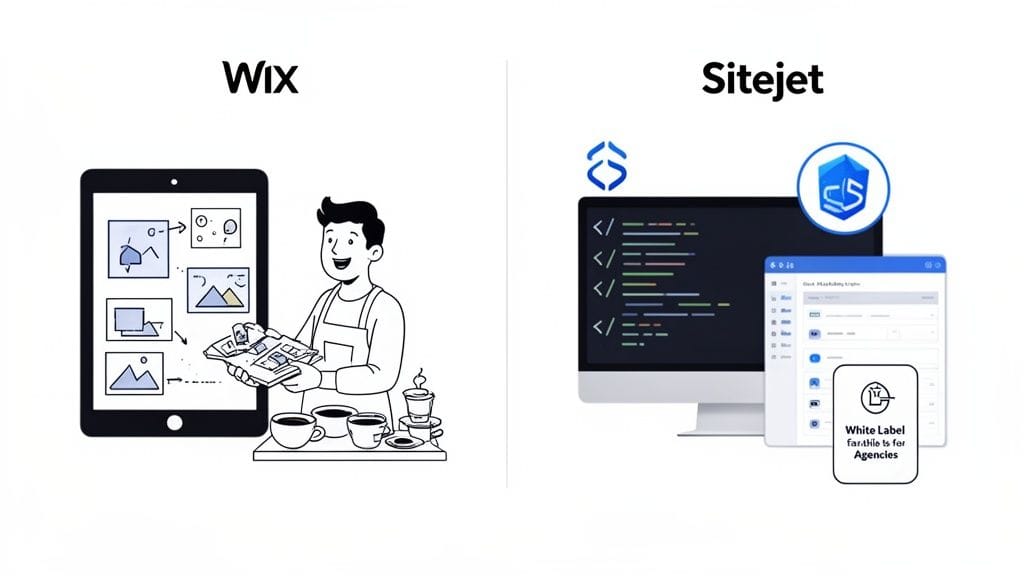
Wix has pretty much built its empire on being accessible. Its drag-and-drop editor is famous for a reason—it lets anyone, regardless of their tech skills, grab an element and move it anywhere on the page. Don't like where that button is? Just click and drag it somewhere else. It’s a very visual, free-form approach that feels incredibly intuitive when you first start.
And if even that sounds like too much work, Wix offers its Artificial Design Intelligence (ADI). You just answer a few questions about your business, and its AI spits out a complete website for you in a matter of minutes. For getting a basic site online with next to no effort, it's an impressive bit of tech.
The Beginner's Fast-Track with Wix
For a new Aussie business owner, the appeal of Wix is hard to ignore. You can genuinely go from having nothing to a functional, decent-looking website in a single afternoon.
Practical Scenario: A Local Cafe in Bendigo
Imagine the owner of a new cafe who needs a simple website, and they need it fast. Their priorities are showing off their menu, listing opening hours, having a gallery of their coffee and food, and a map so people can find them.
- With Wix, the owner can use the ADI to get a site generated almost instantly.
- From there, they can jump into the drag-and-drop editor to tweak the layout, upload their own photos, and type in their menu items.
- The whole process is visual. There’s no need to understand a single thing about web design theory or code.
For this kind of rapid launch where simplicity is king, Wix is a brilliant choice. The only catch is that this total freedom can sometimes lead to messy or inconsistent designs if you're not careful.
Sitejet's Professional and Structured Approach
Sitejet goes down a completely different track, one built for professionals who value consistency, efficiency, and rock-solid control. Instead of a free-for-all canvas, its editor is more structured. It’s built on a responsive grid system, which forces your design to look sharp and work perfectly on every device, from a massive desktop screen right down to a small smartphone.
This structured approach stops common design mistakes in their tracks, like elements overlapping or looking like a dog's breakfast on mobile. It nudges you toward best practices from the get-go, leading to a much more professional and reliable result.
While Wix offers a blank canvas that's great for creative brainstorming, Sitejet provides a professional framework. This framework guarantees brand consistency and pixel-perfect results—something that’s absolutely vital for agencies that need every single client site to meet a high standard.
Unlocking Customisation for Developers
This is where the two platforms really go their separate ways. While Wix does let you add some custom code through its Velo platform, you're still playing in their walled garden. At the end of the day, you're limited by what Wix decides to allow.
Sitejet, on the other hand, was built from the ground up with developers in mind. It gives you direct access to the website's underlying code, handing you full control over:
- HTML: Edit the structure of any element on the page.
- CSS: Go wild with the styling, from simple colours and fonts to complex animations.
- JavaScript: Add any custom scripts or third-party tools you need, without restriction.
This level of access is a complete game-changer for digital agencies or businesses with very specific needs. You can build completely bespoke features, integrate with specialised software, or create unique designs that are flat-out impossible in the Wix ecosystem. This flexibility is a huge reason why many businesses eventually look for alternatives to all-in-one builders. Our article on the Wix vs WordPress debate digs deeper into why an open platform matters.
A Tale of Two Workflows
These differences in design and developer tools create two very different ways of working, each suited to different types of Aussie businesses.
The Solo Entrepreneur: A life coach in Melbourne needs a personal branding site. They want something simple and elegant to share blog posts and let clients book appointments. Wix's templates and easy editor are perfect for getting it done quickly without hiring a pro.
The Growing Digital Agency: A Sydney-based agency is managing websites for 20 local businesses. They need a platform that’s efficient, scalable, and allows them to say "yes" to any client request.
- Sitejet's multi-site dashboard lets them manage every client from one central hub.
- The ability to access and edit code means they can handle any customisation their clients throw at them.
- Its white-labelling feature even lets them brand the website builder as their own tool, which is a massive plus for strengthening their agency's brand.
For the agency, Sitejet isn't just a design tool; it’s a core part of their business operations. The workflow is designed for juggling multiple projects efficiently, a job that would become clumsy and incredibly time-consuming in Wix. This alone makes it the clear winner for any Aussie professional managing a portfolio of client websites.
Getting Local Support and Security You Can Trust
When you're running an Australian business, your website isn't just a side project—it's the front door to your operations. So, when something goes wrong, like a contact form breaking or a security alert popping up, the kind of support you get can make or break your day. This is where the difference between Sitejet's local approach and Wix's global one really comes into focus.
Wix has a massive library of help articles and a worldwide support network. While that sounds impressive, it often means you're lodging a support ticket and waiting for someone in a completely different timezone to get back to you. For an urgent fix during Aussie business hours, that delay can be more than just frustrating; it can cost you customers.
On the other hand, Sitejet through a local provider like UpTime Web Hosting is a whole different ball game. You get a direct line to a 24/7 Australian-based support team on a 1300 number. That means speaking to a real person who gets the local market and can help you solve the problem right then and there. No international call centres, no waiting 24 hours for an email.
This little guide sums up the choice you're facing when you need a hand with your site.
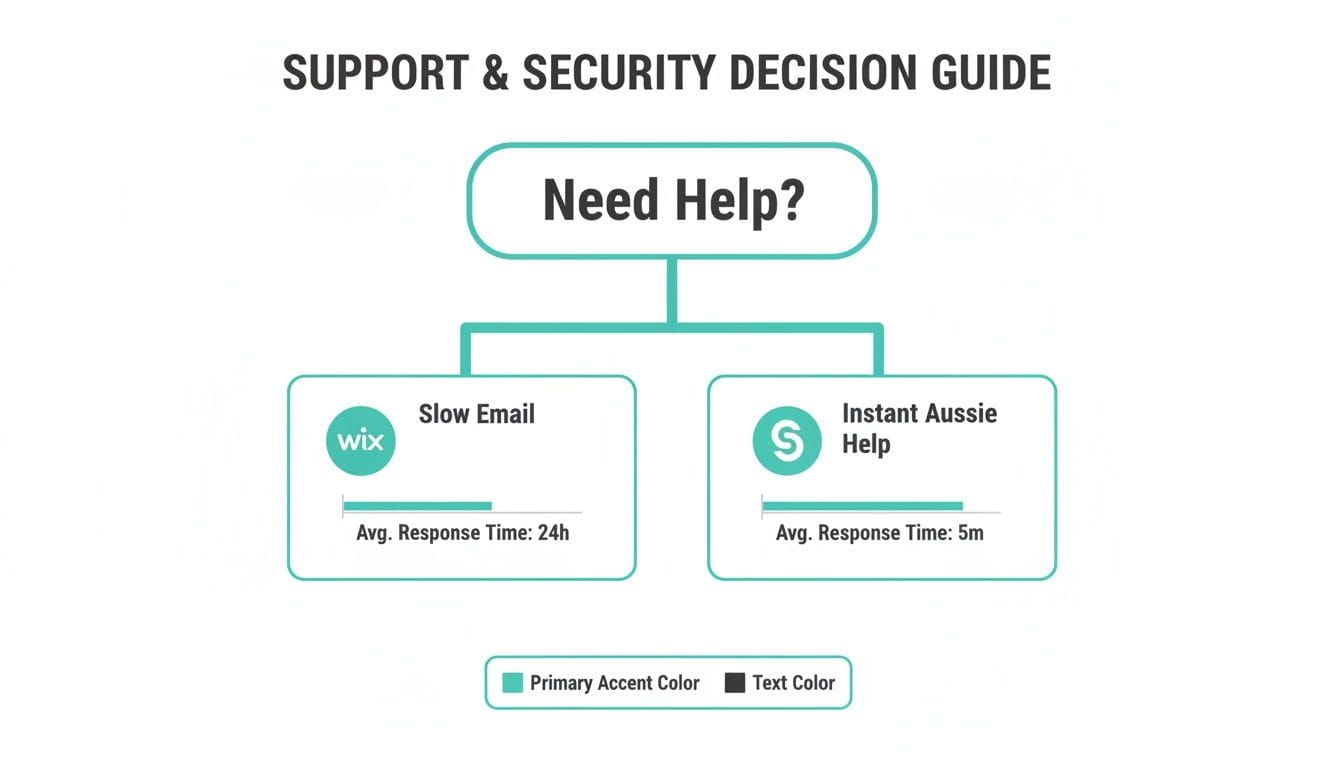
It really boils down to a critical decision for business owners: do you want a slow, impersonal system, or instant, localised help when things go sideways?
A Deeper Dive Into Website Security
Beyond just reactive support, the security that protects your business and customer data should be a top priority. Both platforms take security seriously, but again, their methods are different, especially in what you get as standard.
Wix handles all its security at the platform level. They look after the core infrastructure, so you benefit from their global security blanket. It’s a solid, hands-off approach that covers the basics well enough for most people.
Sitejet, when hosted with UpTime, gives you a much more layered and transparent security setup, with some crucial features bundled right into your plan at no extra cost.
- Free SSL Certificates: Every site gets the padlock icon, which encrypts data and builds trust with your visitors.
- Proactive Malware Scanning: Your site is constantly checked for malicious code, stopping threats before they can cause any real damage.
- DDoS Protection: A strong firewall is in place to defend against attacks designed to take your website offline.
- Nightly Off-Site Backups: This one is a game-changer. Your entire website is automatically backed up every single night to a secure, separate location. If anything ever goes wrong, you can restore a clean version with just a click.
For an Australian business owner, having automatic, off-site nightly backups is the ultimate safety net. It's the peace of mind knowing that no matter what happens—a botched update, a security breach, or just human error—your business data is safe and can be recovered quickly by a local team who’s got your back.
The Value of Local Expertise and Control
When you combine that kind of accessible support with comprehensive, bundled security, you get a powerful sense of control. Knowing you can pick up the phone and chat with an Aussie expert about a technical glitch or a security question is incredibly reassuring. You can get more info on what’s involved with professional web maintenance and support services to see the full value.
For Aussie SMBs, it’s also smart to get a handle on the basics of online security. A practical knowledge base article like "Cybersecurity Starter Guide for SMBs" is a great place to start building your foundational defences. That knowledge, paired with the right platform, puts you in a much stronger position to protect your digital assets.
Ultimately, the choice comes down to what you value most. Wix offers a closed, globally managed system that works well for many. But Sitejet via a local host provides transparent security tools and a direct line to local experts. For a lot of Australian businesses, having that direct line to help and a clear view of their security is simply non-negotiable.
So, Which One is Right For Your Business?
Picking between the Sitejet builder and Wix really boils down to what you need your website to do, how comfortable you are with the tech side of things, and where you see your business heading. This isn't just a simple feature-for-feature comparison; it’s about matching the right tool to your day-to-day operations here in Australia.
Forget the vague "it depends" answer. Let's get straight to some firm, practical advice to help you pick the platform that’s going to be a genuine asset for your business, not a compromise.
Scenarios and Recommendations
To make this super clear, we'll look at two very common Aussie business types. Chances are, your own situation will be pretty close to one of these, making the best choice a lot more obvious.
1. The Solo Operator or Local Tradie
Picture a solo freelance photographer in Adelaide or a plumber in a local suburb who just needs to get a professional-looking site online, fast. Time is money, and they're not a web developer. Their main goal is to have a sharp, simple online presence that shows they’re legit and makes it easy for customers to get in touch.
For this kind of business, Wix is a fantastic, no-nonsense choice.
- Speed to Launch: The drag-and-drop editor is so intuitive you can have a decent-looking site up and running in a single afternoon. Seriously.
- Ease of Use: There’s almost no learning curve. It’s built for people who want to manage their own site without calling for help every five minutes.
For getting a basic but effective online presence sorted with minimum fuss, the simplicity of Wix is hard to beat.
2. The Growing Agency or Performance-Hungry Business
Now, think about a marketing agency in Sydney that's juggling a dozen client websites, or an e-commerce store in Perth where every single millisecond of page speed can make or break a sale. Their priorities are totally different: efficiency, performance, client management, and the ability to scale.
This is where Sitejet, offered through a local provider like UpTime Web Hosting, really shines.
- Professional Workflow: The dashboard is designed to manage multiple sites at once, and the white-label features are perfect for agencies. Our website builder for small business guide goes deeper into building professional sites.
- Superior Performance: Being hosted on UpTime’s Australian servers means lower latency and faster speeds for your Aussie customers. It's a massive advantage.
When it comes to the Sitejet builder vs Wix debate for Aussies, it all hinges on one key difference: Wix is brilliant for getting you started quickly. Sitejet is built to help you grow professionally and scale efficiently.
Figure out which of these sounds more like you, and you'll have a much clearer idea of which platform will support you not just today, but well into the future.
Register your new domain name at competitive market prices including free domain add-ons like privacy, DNS Hosting, Custom Nameservers and Forwarding.
Always the best price and no nasty renewal price hikes.
Register A Domain Name
Frequently Asked Questions
When you're weighing up Sitejet and Wix, a few key questions always pop up, especially for Aussie business owners. Let's tackle the big ones head-on: migration, domain management, and just how hard it is to get started.
Can I Migrate My Existing Website?
This is a huge one, and the answer is night and day between the two. Wix is a walled garden; you can't just import a website. If you're moving to Wix, you’re almost certainly looking at a complete manual rebuild from square one, which can be a serious time-sink.
On the flip side, Sitejet (especially through a partner like UpTime Web Hosting) gives you more options. While there’s no magic one-click import button, the support crew can walk you through rebuilding your site efficiently. For bigger, more complex sites, you can even tap into professional website migration services to get the experts to handle the heavy lifting for you.
How Do I Manage My .au Domain?
For any Australian business, having a .au domain is essential for building that local trust. Both platforms let you use a .au domain, but how you manage it is a different story. With Wix, you can connect a domain you already bought somewhere else, but that just means you’re juggling your domain registrar and your website builder separately.
With Sitejet through UpTime, you can register and manage your .au domain, hosting, and website builder all in one spot. It tidies everything up and means you have a local provider making sure you’re compliant with all the auDA (au Domain Administration) rules. It's a much smoother process. You can dig into the specifics in this guide to .au domain names.
What is the Learning Curve Like?
This is where you'll feel the biggest difference in philosophy. Wix is built for the complete beginner. Its drag-and-drop editor is about as simple as it gets, letting you throw together a basic site in a few hours with zero technical skill.
Sitejet has a slightly steeper learning curve, but it’s still incredibly user-friendly. The key difference is that it’s designed to guide you toward a more professional, well-structured, and properly responsive design from the get-go.
Think of it this way: Wix gives you total simplicity for a fast launch. Sitejet gives you intuitive, powerful tools to build a more polished, professional website with far greater creative control.
Ready to build a high-performance website backed by genuine Australian support? With UpTime Web Hosting, you get the powerful Sitejet builder on our fast, local server network, complete with transparent pricing and 24/7 expert help.
Start building your professional Aussie website today.