So, you’re thinking about starting a business from home? It’s a classic Aussie dream, and honestly, it’s more achievable now than ever before. Forget the confusing government websites and overwhelming checklists for a moment. What you really need is a straightforward, Australia-focused plan that takes you from a brilliant idea scribbled on a napkin to a real, functioning business.
This guide is exactly that. We’ll walk through the practical steps, from making sure your idea has legs to getting all your ducks in a row with an ABN, and then building an online presence that actually brings in customers.
Your Launchpad for a Thriving Home Business

The path from employee to entrepreneur can feel daunting, but it’s a well-trodden one. You’re joining a massive community of go-getters. As of mid-2023, Australia has around 2.6 million actively trading businesses, and an incredible 97.4% of them are small businesses. A huge chunk of these are home-based operations, proving you’re in very good company.
But having a great idea isn't enough. The real challenge is building a solid foundation to support it.
Here’s a hard truth I’ve seen time and again: the most common mistake new business owners make is falling in love with their idea without first checking if anyone will actually pay for it. Don’t skip the validation phase.
From Concept to Your First Customer
This blueprint is designed to get you from that initial spark of an idea to making your first sale, without getting bogged down. Here’s a quick-glance summary of the core phases you'll follow, moving from concept to your first customer.
Key Stages of Launching Your Australian Home Business
| Stage | Key Actions | Primary Goal |
|---|---|---|
| 1. Idea & Validation | Research your market, identify your ideal customer, and test your concept on a small scale. | Confirm there's a real, paying market for your product or service. |
| 2. The Legal Stuff | Choose a business structure (sole trader is common), register for an ABN, and check GST/tax obligations. | Make your business official and compliant from day one. |
| 3. Financials & Setup | Open a separate bank account, create a basic budget, and set up your home office space. | Keep your finances clean and create a productive work environment. |
| 4. Building Your Brand | Secure your .au domain name, set up a professional website, and create a business email. | Establish a credible and professional online identity. |
| 5. Marketing & Sales | Develop a simple marketing plan (SEO, social media), and set up a way to take payments. | Start attracting customers and generating revenue. |
These stages provide a clear path to follow, ensuring you don't miss any critical steps along the way.
We'll cover everything you need to build a professional brand online, from securing your perfect .au domain to getting a fast, reliable website running with a trusted Australian host like us here at UpTime.
Of course, before you spend a cent, it’s smart to map out your potential costs. It's well worth understanding how much it costs to start a business in Australia so you can create a realistic budget from the get-go.
Throughout this guide, we'll focus on:
- Low-cost market research to test your idea without a huge investment.
- Budget-friendly marketing tactics that get you noticed by the right audience.
- Building an online presence that works for you around the clock.
By nailing these fundamentals, you’ll be in a strong position to turn your ambition into a successful reality. If you're keen to dive even deeper into the digital side of things, our guide on starting an online business offers some extra insights.
Ready? Let’s get started.

Performance you can feel, backed by clients who depend on it. Read how our support and uptime create long‑term customer success.Power Your Business with Better Hosting
From Great Idea to Market-Ready Concept
A brilliant idea is just the starting point. The real test for any home business isn't how great the idea sounds, but whether people will actually open their wallets for it. This is the validation step, and it's what turns a passion project into a proper, money-making venture.
Thankfully, you don't need a massive budget for this. It's all about being clever and getting real-world feedback before you sink your savings into the business.
My biggest piece of advice for anyone starting out? Test your idea in the real world as soon as possible. It’s far better to find out your initial concept needs a tweak after a few conversations than after you’ve spent thousands on a website and inventory.
Practical Ways to Test Your Business Idea
Forget about shelling out for expensive market research firms. You can get some incredibly powerful insights using tools you probably use every day. The goal is to get your concept in front of your ideal customer and just listen.
Here are a few real-world examples for Australian home businesses:
- Thinking of making and selling artisan candles in Melbourne? Before buying bulk wax, create an Instagram account. Run polls in your Stories asking followers to vote on scents inspired by Victorian regions (e.g., Yarra Valley Pinot vs. Mornington Peninsula Sea Salt). You get direct feedback on what your future customers actually want.
- Want to be a freelance bookkeeper for tradies in Perth? Find a few local small business owners on LinkedIn and offer a free 30-minute "Tradie's Tidy Up" call to review their current expense tracking. This builds rapport and reveals their biggest financial pain points.
- Starting a pet-sitting service in your Brisbane suburb? Design a simple flyer with your services and an introductory rate. With permission, post it on the community notice boards at local vets, cafes, and dog parks in suburbs like New Farm or Paddington. The number of calls you get is a direct measure of local demand.
These small tests are low-risk but give you a huge amount of information. They’ll tell you pretty quickly if you’re on the right track or if you need to go back to the drawing board. If you're still brainstorming, checking out a list of small business ideas from home can also get the creative juices flowing.
Understanding the Competitive Landscape
Once you’ve got a hunch that people are interested, it’s time to see who’s already out there. Sizing up the competition isn't about copying what they do—it's about finding your own unique spot in the market.
Start by picking out three to five other Australian businesses that offer something similar. They don't have to be exact clones. If you plan to sell handmade ceramic mugs from your Sydney home studio, for example, your competition could be other potters on Etsy Australia, big retail chains, or even local businesses selling corporate gift boxes.
For each one, ask yourself:
- What are they nailing? Have a look at their website, social media, and customer reviews. Do they have beautiful branding, rave reviews about their fast AusPost shipping, or a product feature no one else has?
- Where are the gaps? Maybe their pricing seems a bit steep for the Aussie market, their website looks dated, or their product selection is pretty limited. These are your opportunities.
- What makes them special? What’s their unique selling proposition (USP)? Is it their focus on eco-friendly packaging, their lifetime warranty, or their deep expertise in a particular Australian niche?
This whole exercise helps you figure out your own unique selling proposition. Your USP is the simple, compelling reason a customer should choose you over anyone else. It might be your specialised skill, your friendly and personal service, or your laser focus on a tiny niche market.
Aligning Your Offer with Economic Realities
Finally, you have to get real about the current Australian economic climate and how it affects your pricing and what you’re selling. People spend differently when times are tight, and a business that lasts is one that gets this.
For instance, the latest data shows that while Aussie household spending has seen a small bump, people are also being more cautious. This points to a value-driven mindset. For a new business, that's gold. It tells you that customers are looking for real value, prioritising essentials, and are very receptive to cost-effective solutions. You can find more details in the latest Australian household spending data.
This doesn't mean you need to be the cheapest. Not at all. It means you must be crystal clear about the value you deliver. Whether you're saving a client precious time, solving a problem that's been bugging them for ages, or offering a top-quality product that will last, your marketing needs to answer one question for the customer: "Why is this worth my money right now?"
Get that right, and you'll build a business that can do more than just survive—it can thrive in the Australian market.
Handling Your Australian Business Registration and Finances
You’ve got a killer idea and you know people will pay for it. Now it’s time to make it official. This is the part where many new entrepreneurs get a bit nervous, wading into the world of Australian legal structures, tax, and financials. But don’t worry, it’s not as scary as it sounds.
We'll walk you through the essentials for getting your Australian home business set up correctly. For most people starting out, this means registering as a sole trader. Getting these fundamentals right from day one will save you a mountain of headaches, especially when tax time inevitably rolls around.
Your First Step: The Australian Business Number (ABN)
If you're doing business in Australia, you need an Australian Business Number (ABN). Simple as that. Think of it as your business's unique ID card, essential for everything from sending proper invoices to dealing with other businesses.
For most new home businesses, the sole trader structure is the simplest and fastest way to get started. As a sole trader, you are the business—there’s no complex legal separation. Applying for an ABN as a sole trader is free and you can do it online through the Australian Business Register (ABR).
To get your ABN, you just need to show you’re actually starting a business. This could be as simple as having a basic business plan, setting up a social media page to advertise, or buying some initial equipment. You'll also need that ABN for other key steps, which our guide on why an ABN is needed to register a .AU domain name explains in more detail.
Understanding When to Register for GST
GST—the Goods and Services Tax—is a 10% tax on most things sold in Australia. One of the biggest questions we get is, "Do I need to register for it right away?" The answer is pretty straightforward: it all comes down to your income.
You are only legally required to register for GST once your business has a turnover of $75,000 or more in any 12-month period.
Let's break that down with a couple of real-world scenarios:
- The Etsy Seller: Sarah starts selling her handmade jewellery on Etsy from her home in Adelaide. In her first year, she makes $15,000. Since her turnover is well below the $75,000 threshold, she doesn’t need to register for GST.
- The IT Consultant: Ben quits his job to start a freelance IT consultancy from his home office in Sydney. Business booms, and after eight months, his invoices hit $80,000. Because he's crossed the threshold, he must register for GST within 21 days. From that point on, he has to add 10% GST to his invoices and start lodging Business Activity Statements (BAS) with the ATO.
The key is to keep a close eye on your turnover. The moment you think you're going to cross that $75,000 mark, get registered. Being proactive here will keep you out of trouble with the tax office.
Setting Up Your Financial Foundation
Getting your money management sorted from the get-go is one of the smartest moves you can make. It doesn't have to be complicated, but it does need to be organised. It's all about creating clarity and control.
This whole financial setup comes after you've confirmed your idea is viable, as this flowchart shows. It all starts with making sure people will actually pay for what you're offering.
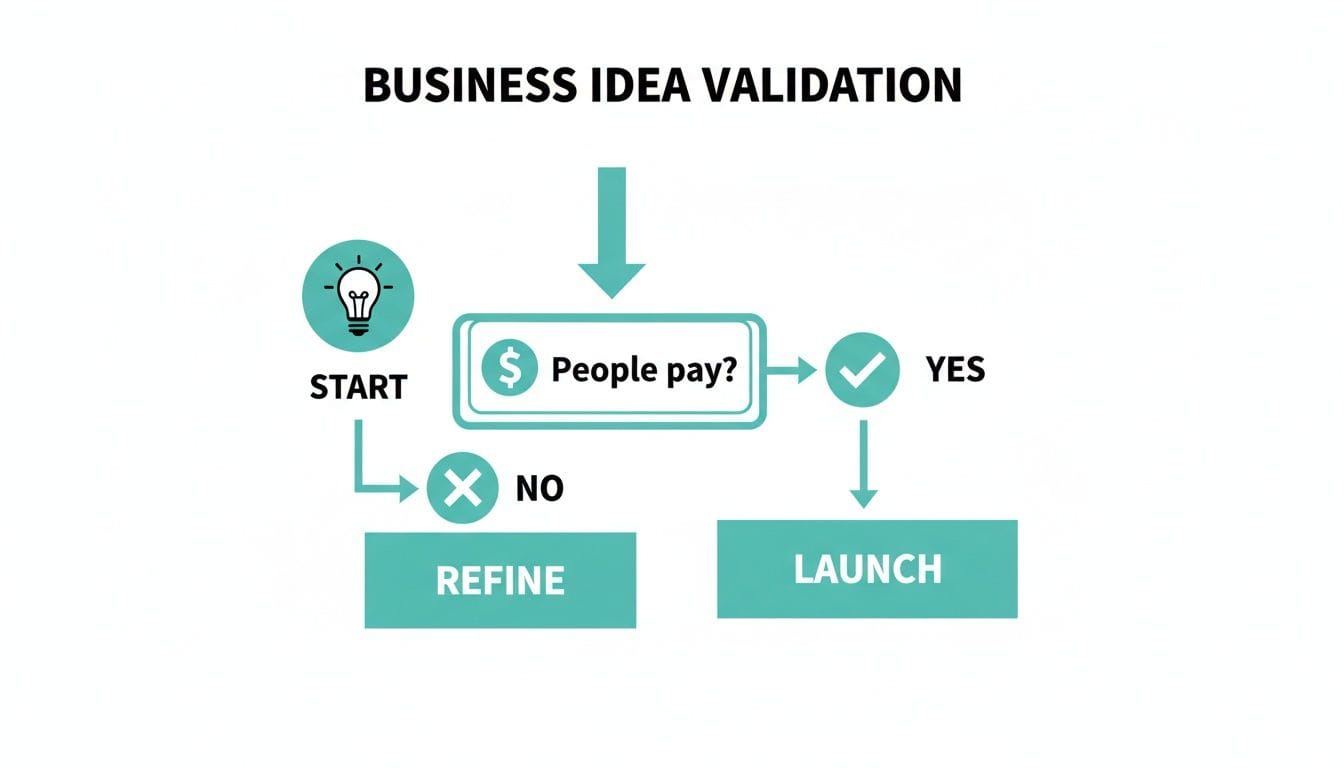
Once you know the money will be coming in, you need a system to handle it. Here are the absolute must-dos:
- Open a Separate Bank Account: This is non-negotiable. Mixing business and personal funds is a recipe for a bookkeeping disaster. Open a dedicated business account to keep every dollar of income and expense separate. It makes tracking your profit and preparing for tax a thousand times easier.
- Create Professional Invoices: Your invoices represent your brand. A compliant Australian tax invoice must include your business name and ABN, the client's details, a unique invoice number, a clear description of the work, the total due, and your payment details.
- Get Simple Accounting Software: You can start with a spreadsheet, but you'll outgrow it fast. Proper accounting software is a game-changer. Tools like Xero, MYOB, or QuickBooks are designed for Aussie small businesses and help you manage invoices, track expenses, and get ready for BAS and tax returns with a clear financial dashboard.
Putting these basic financial structures in place isn't just about ticking compliance boxes. It’s about giving yourself the power to make smarter, data-backed decisions as your home business starts to take off.
Host your website with our 5-star rated, cPanel website hosting plans.
Super fast servers, with security included and hosted in your choice of Australian Data Center.
View cPanel Plans
Building Your Online Presence
Once you’ve handled the paperwork, it’s time to stake your claim on the internet. This isn't just about ticking a box; your online presence is your 24/7 storefront, your lead generation machine, and the first place Australian customers go to decide if they trust you.
Think of it this way: you wouldn't open a shop with a hand-scrawled sign and a dodgy front door. The same rules apply online. A professional, reliable digital footprint is non-negotiable for making a solid first impression and turning curious visitors into paying customers.
Securing Your Australian Digital Identity
Your first move is to lock down two essential assets: a domain name and web hosting. These are your digital address and the block of land your online shop will be built on.
First up, your domain name. This is your web address (like yourbusiness.com.au) and it’s a huge part of your brand. If you’re an Australian home business, getting a .au or .com.au domain is a no-brainer. It instantly tells customers you’re local, which builds trust and can even give you a small boost in local search results.
Next, you'll need web hosting. This is the service that stores all your website files and makes them available to the world. For Aussie businesses, using a local Australian web host like UpTime Web Hosting is a game-changer. Why? Because hosting your site on servers located physically in Australia means it will load much faster for your local customers. That speed is a massive factor in keeping people on your site and helps with your Google ranking.
Choosing the Right Tools to Build Your Website
With your domain and hosting sorted, it’s time for the fun part: building your website. The good news is you no longer need to be a coding whiz or spend a fortune on a developer to get a fantastic-looking site.
Modern tools like the Sitejet Website Builder are made specifically for business owners. They use a simple drag-and-drop editor, giving you a library of professional templates you can tweak to fit your brand perfectly. You can add your own text, images, contact forms, and even set up an online store without touching a single line of code.
It's a lot more intuitive than you might think.
As you can see, you get a clean, visual workspace where your changes happen in real-time. It feels more like designing a brochure than tackling a complex technical project. You can check out this guide on the best website builder for small business in Australia to see how these tools give you complete control.
The best websites aren't just pretty; they're built with a purpose. Before you add a single thing to a page, ask yourself: "What is the number one thing I want a visitor to do here?" Whether it’s booking a call, buying a product, or signing up for your newsletter, make that action ridiculously obvious and easy.
Ultimately, your goal is to build an effective online presence that tells your story and pulls in the right kind of customers.
The Final Touches for Professionalism and Trust
A great-looking website is just the start. To be seen as a credible business, you need to nail the small details that signal you're professional and trustworthy.
Here are the final essentials that turn a basic website into a proper business hub:
Set Up Professional Email: An address like
info@yourbusiness.com.aulooks infinitely more professional than a generic Gmail or Outlook address. It’s a small thing that makes a huge difference. Most hosting plans, including ours at UpTime, include professional email hosting so you can create these branded addresses easily.Integrate Secure Payments: If you plan on selling anything online, you absolutely must have a secure way to accept payments. Integrating trusted gateways like Stripe or PayPal is non-negotiable for the Australian market. They handle all the complicated security and processing, giving your customers the confidence to enter their card details.
Install an SSL Certificate: You know that little padlock icon in the browser address bar? That's an SSL certificate at work, encrypting the data shared between your site and your visitors. It’s essential for protecting information, building trust, and it’s a must-have for SEO. Most quality web hosts, like UpTime, provide a free SSL certificate as standard.
By putting these pieces in place, you’re not just launching a website. You’re building a credible, automated, and effective digital headquarters for your new Australian home business.
Marketing Your New Business Without a Big Budget
Okay, your website is live and your ABN is sorted. Now for the most important part: finding customers. The word "marketing" can conjure up images of massive campaigns with eye-watering price tags, but for a new Aussie home business, the secret is to be clever, targeted, and local.
You really don't need a huge advertising budget to start getting noticed. It's about focusing on a few foundational, low-cost strategies that build momentum over time. The goal is simple: show up where your ideal customers are already looking.
Laying the Groundwork with Local SEO
For most Australian home businesses, your first wave of customers will likely come from your local area. This is where Search Engine Optimisation (SEO) becomes your best mate, and your Google Business Profile (GBP) is the single most important tool in your kit. It's that free business listing that pops up in Google Maps and the local search results.
Setting up your GBP is non-negotiable and you can get it done in under an hour. It's what makes you visible when someone nearby searches for things like "plumber in Ballarat" or "graphic designer in Parramatta."
To turn your profile into a customer-attracting machine, you need to:
- Fill out every single field: Add your services, business hours, photos of your work (or even just your home office setup), and a detailed description packed with the keywords your customers would actually use.
- Chase those reviews: After you finish a job for a happy client, politely ask them to leave you a review on Google. These reviews are absolute gold for building trust and boosting your local ranking.
- Use the Q&A feature: Don't wait for people to ask. Add your own frequently asked questions and answer them yourself. It helps you control the narrative and gives potential customers the info they need right away.
Creating Content That Connects and Converts
Beyond your local profile, your website itself needs to be a magnet for search traffic. The most effective way to do this is by creating content—usually through a business blog—that directly answers the questions your potential Australian customers are asking Google.
Put yourself in your ideal client's shoes. What are their biggest headaches? What problems are they trying to solve? Write blog posts that offer genuine, practical solutions. For some great ideas on how this works in practice, you can check out these high-quality blog post examples to see how different businesses do it.
Just think of the possibilities:
- An accountant in Geelong could write a post titled, "5 Common Tax Deductions Aussie Sole Traders Almost Always Miss."
- A landscaper in Western Sydney might create, "A Simple Guide to Low-Maintenance Native Gardens for Sydney Homes."
- A personal trainer in Adelaide could publish, "How to Set Up a Great Home Gym for Under $500."
This strategy does two incredibly powerful things. First, it establishes you as a helpful expert, building trust before someone even thinks about hiring you. Second, it gives Google more relevant, high-quality content to rank, which can bring a slow but steady stream of free, targeted traffic to your site.
Don’t just sell; solve. Your marketing becomes infinitely more powerful when you shift your focus from "buy my stuff" to "let me help you." This mindset is the real secret to great content marketing.
Choosing Your Social Media Battleground
So many new business owners fall into the trap of thinking they need to be on every single social media platform. That's a one-way ticket to burnout. A much smarter approach is to pick one or two platforms where your ideal Australian customers actually spend their time, and then get really good at using them.
Here's a simple way to think about it:
- For visual products (e.g., crafts, food, design): Instagram and Pinterest are your best bet. They’re built for beautiful imagery and are perfect for showcasing what you create.
- For service-based or B2B businesses (e.g., consulting, bookkeeping): LinkedIn is the professional go-to. It’s the right place to connect with other business owners and build your expert reputation in the Australian market.
- For community-focused or local services (e.g., pet sitting, tutoring): Facebook is still a powerhouse, especially for its local groups and features that help you build a community vibe.
Once you’ve picked your platform, focus on creating content that feels right for that space. Share behind-the-scenes glimpses, offer quick tips, run polls, and actually talk to people in the comments. The goal isn't to just broadcast your message; it's to build a genuine community around your brand, no matter how small it starts.
Common Questions for New Home Business Owners
When you’re finally ready to launch your own business from home, it’s completely normal for a few last-minute, nagging questions to pop up. We’ve been there, and we've helped countless others through it.
Think of this as your quick-fire guide to a few of the most common worries we see new Aussie business owners grapple with. Let's get these sorted so you can get on with the exciting part—building your business.
Can I Run a Business From Home if I Am Renting in Australia?
For the most part, yes. But the first thing you should always do is pull out your tenancy agreement and read it carefully for any clauses about running a business.
If you’re starting something that’s purely digital—like freelance writing, web design, or a small e-commerce shop run from a spare room—it’s usually not an issue. The main test is whether your business will disturb your neighbours' "quiet enjoyment" or breach residential zoning rules. As long as you don't have clients visiting or a constant stream of couriers, you’re generally in the clear.
However, if your business involves clients coming to your home (say, for consulting or beauty treatments), makes noise, or means a lot of delivery traffic, you'll almost certainly need to get written permission from your landlord. It’s always best to be upfront. A quick, honest chat with your landlord or property manager from the get-go can save you a world of headaches later.
What Home Office Expenses Can I Claim on Tax?
As a sole trader in Australia, you can absolutely claim a portion of your home running costs. The Australian Taxation Office (ATO) gives you a couple of ways to do this, depending on how much detail you want to get into with your record-keeping.
Here are the two main ways to tackle it:
- Fixed Rate Method: This is the simple, no-fuss option. From 1 July 2022, the ATO lets you claim a flat rate of 67 cents for every hour you work from home. This is designed to cover your internet, phone, energy, and stationery costs. All you need is a log of your hours. Easy.
- Actual Cost Method: This one takes more work but might lead to a bigger tax deduction. You'll need to calculate the specific business-use percentage of your actual bills—electricity, gas, phone, internet—plus the depreciation on your office gear like your desk, chair, and computer.
No matter which method you pick, great records are your best friend. Keep every receipt and maintain a clear diary or timesheet of your work hours. If the ATO ever asks questions, solid records are your proof.
For more tips on getting your workspace sorted, our knowledge base has a great guide on how to set up your home office for success.
Do I Really Need Business Insurance?
This is a big one. While it might not be a legal requirement for every single business type, operating without insurance in Australia is a massive gamble. A standard home and contents policy will not cover you for business-related incidents or property.
At a minimum, you should look into two key types of cover:
- Public Liability Insurance: This is non-negotiable if clients, suppliers, or even a courier might come to your property. If someone trips on your front path while delivering business supplies and gets injured, they could make a claim against you. This insurance protects you from that.
- Professional Indemnity Insurance: If you're providing advice or a professional service—think consulting, design, or accounting—this is essential. It covers you if a client suffers a financial loss because of your advice or alleged negligence.
Think of insurance not as a cost, but as a crucial investment in protecting your personal assets and the future of your business.
Getting these foundational questions answered is a great start. The next step is building your digital foundation. At UpTime Web Hosting, we specialise in fast, secure, and reliable Australian hosting that makes sure your website is always open for business. From locking in your perfect .au domain to getting a professional site live in minutes, we're here to back you every step of the way.
Explore our hosting plans and start building your online presence today.