
When you're running a business in Australia, your email address does more than just send and receive messages. It's your digital handshake, your first impression, and a constant signal of your professionalism. That's where professional email hosting comes in, giving your business a custom address like info@yourbusiness.com.au that instantly builds credibility with local customers.
What Is Professional Email Hosting and Why Does It Matter?
Think of your email address as your digital business card. When you reach out to a new client, a potential partner, or even a supplier, what kind of impression are you making? An address like your.cafe@gmail.com works, sure, but it feels temporary, almost like a side hustle. It's the equivalent of scribbling your business details on a napkin.
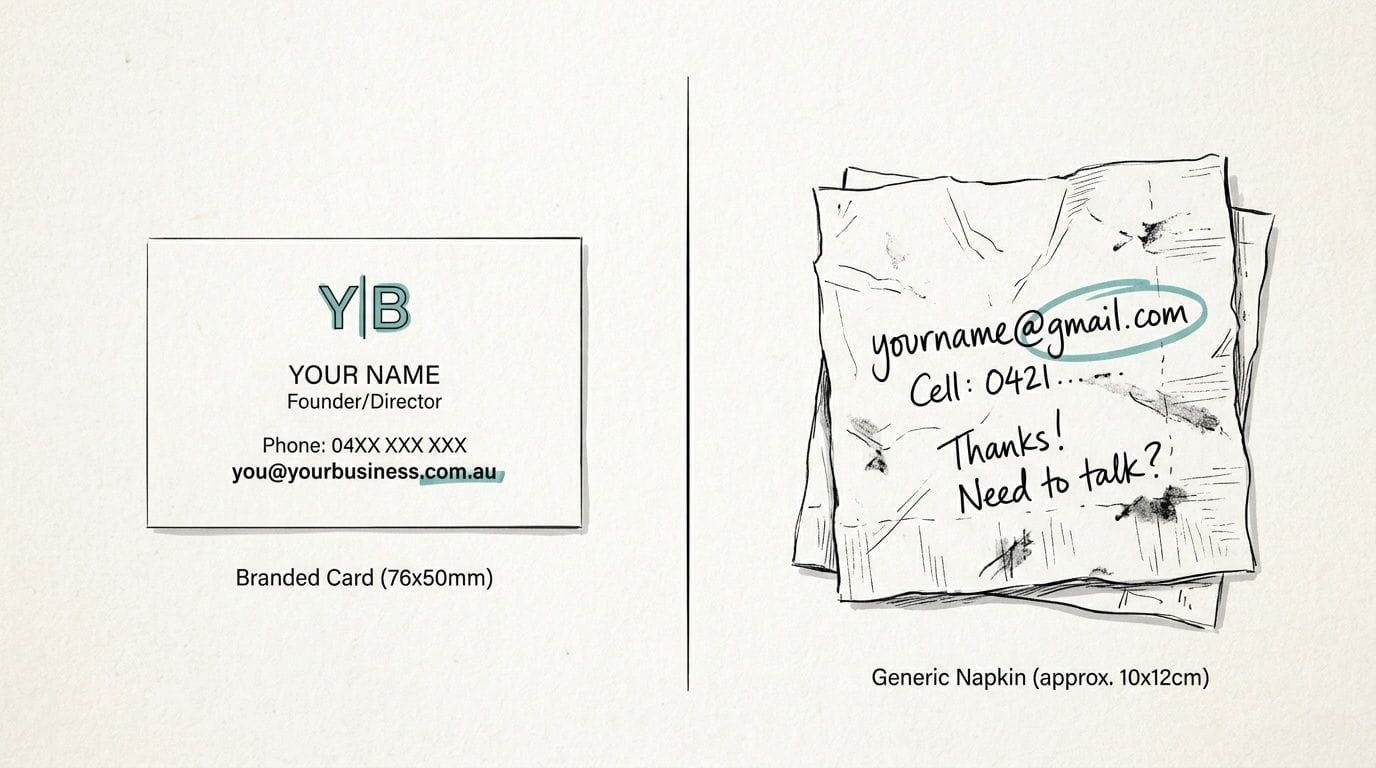
Now, picture an address like orders@yourcafe.com.au. It immediately feels more permanent, professional, and trustworthy. This is exactly what professional email hosting gives you: a dedicated service that manages all your email accounts under your own domain name. It’s built specifically for business and operates completely separately from the big, free email providers.
Before we dive deeper, let's look at a quick side-by-side comparison.
Free vs. Professional Email: A Quick Comparison
It's easy to see the appeal of a free service, but when you're building a brand, the small investment in professional email pays for itself in trust and security.
| Feature | Free Email (e.g., yourbusiness@gmail.com) | Professional Email Hosting (e.g., you@yourbusiness.com.au) |
|---|---|---|
| Branding & Trust | Generic, can look unprofessional or temporary. | Reinforces your brand with every email, builds customer confidence. |
| Security | Basic consumer-grade protection; a common target for scams. | Business-grade security, advanced spam filtering, and spoofing protection. |
| Data Privacy | Your emails may be scanned for advertising purposes. | You own and control your data. Your privacy is protected. |
| Control & Admin | Limited to no central control over multiple accounts. | Full administrative control to add/remove users and manage settings. |
| Support | Community forums or limited, often automated, support. | Dedicated, expert technical support for when you need it. |
As you can see, the differences go far beyond just the name after the "@" symbol.
The Credibility Gap Free Email Creates
Using a free email service for your business can create what I call a "credibility gap." It can make potential customers pause and question how legitimate your operation really is. If a business hasn't invested in its own domain name, are they truly invested in delivering a quality service?
Imagine you get a quote from bazza.plumbing87@hotmail.com. You might hesitate for a second. Is this a real quote? Is it a potential scam? In an online world full of phishing attempts, a branded, professional email address is one of the strongest first signals of authenticity you can send.
A professional email address is more than just a contact point; it's a constant, subtle form of marketing that reinforces your brand's legitimacy and reliability with every single message you send. It tells the world you are serious about what you do.
Beyond Branding: The Security Imperative
While looking professional is a huge plus, the real power of professional email hosting lies in security and control. Free email services are a favourite playground for cybercriminals because they are so widespread and often lack the robust security features that businesses need.
A major reason to make the switch is for the enhanced security. For any new business, getting a handle on digital threats is essential, as detailed in guides on cybersecurity for startups. A proper business email service will typically include:
- Advanced Spam Filtering: This keeps dangerous emails and time-wasting junk from ever reaching your inbox.
- Enhanced Security Protocols: Tools are put in place to prevent others from faking your email address (spoofing) and to protect your sensitive data.
- Greater Control: You own your data. It isn't being scanned by a massive corporation to sell you ads.
Moving to a secure, branded email channel is a fundamental step for any Australian business that wants to build lasting customer trust and grow for the long haul. If you’re ready to build that strong foundation, you can explore the specifics of dedicated email hosting for small business and see how it directly benefits your operations.

Performance you can feel, backed by clients who depend on it. Read how our support and uptime create long‑term customer success.Power Your Business with Better Hosting
Why Australian Hosting Is a Game Changer for Your Email
Picking a provider for your professional email hosting Australia goes way beyond a simple tech choice. It's a strategic move that directly impacts your business's speed, security, and the support you get when things go wrong. Going with Australian-based hosting isn't just about local pride—it's a real competitive advantage.
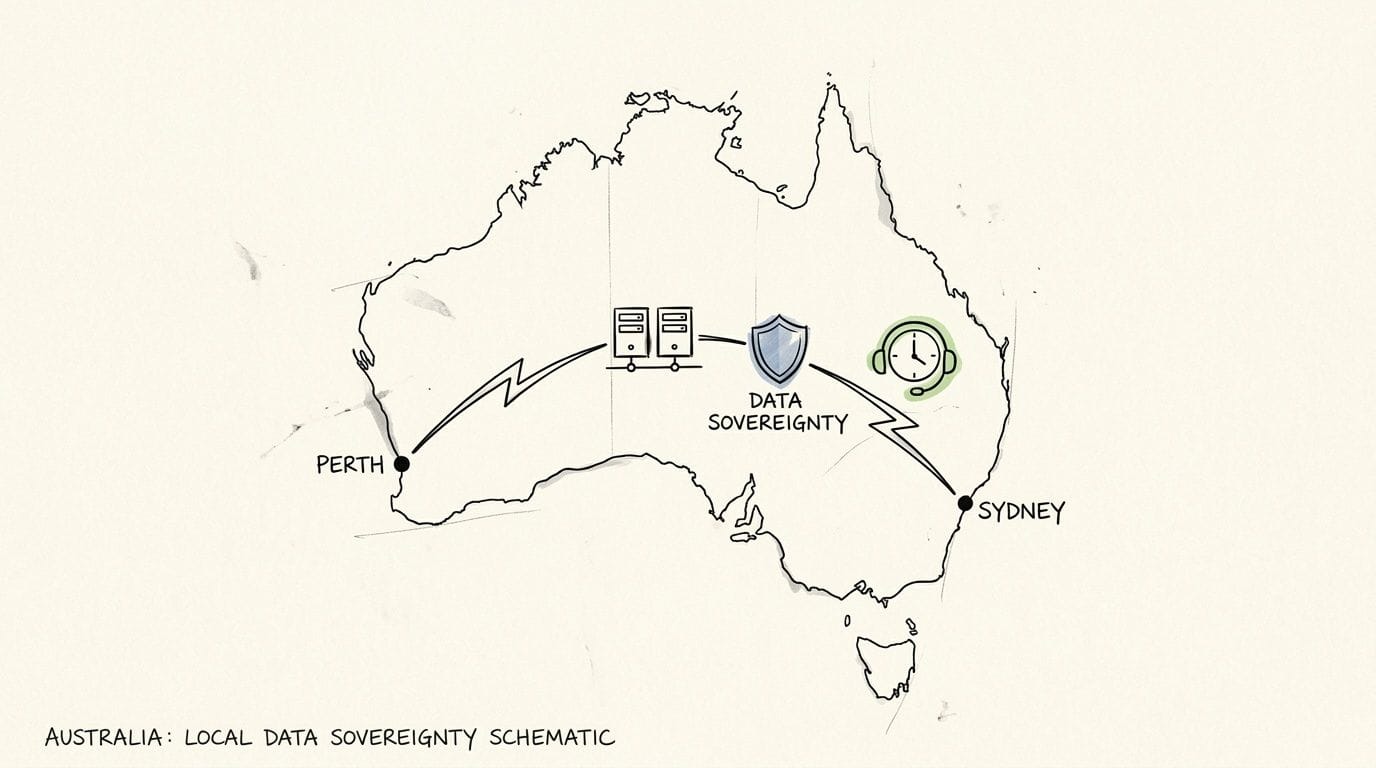
When your email servers are sitting overseas, every single message you send or receive has to take a long-haul international flight. An email from Perth to a client in Sydney might first get routed through servers in Singapore or even Los Angeles before it finally lands in their inbox. This journey adds tiny delays, known as latency, that stack up and make your email feel sluggish.
With Australian hosting, your data stays on home soil. That same Perth-to-Sydney email zips through local networks, which means faster delivery and a much more responsive experience for everyone. It’s the difference between taking a direct freeway and getting stuck on a winding scenic route through another country.
The Power of Onshore Data and Local Law
Beyond just speed, where your data is physically stored has massive legal and privacy implications. We’re talking about data sovereignty, and for any Australian business, it's something you can't afford to ignore.
When your business emails are stored on servers inside Australia, they are protected by Australian law—specifically, the Privacy Act 1988. This is a huge selling point for your clients, especially if you handle any sort of sensitive information.
Storing your data onshore isn't just a best practice; it's a commitment to your clients' privacy. It demonstrates that you take your data security seriously and are compliant with Australian regulations, building a foundation of trust that international hosting simply cannot match.
This local legal framework gives you and your customers clear rights and real protection. It means your confidential business data isn't subject to the laws and potential access requests from foreign governments, giving everyone invaluable peace of mind. Knowing your information is safe under local law is a key reason to work with Australian-owned web hosting companies that get it.
Support That Understands Your Business Hours
Have you ever had a critical email problem at 10 AM on a Tuesday, only to realise the support team you desperately need is on the other side of the world and won’t be awake for another eight hours? It’s a classic, and deeply frustrating, issue with international hosting providers.
Choosing a provider with a local Australian support team completely solves this. When you need a hand, you’re talking to experts who are:
- In Your Time Zone: Get help during your actual business hours, not in the middle of the night.
- Familiar with the Market: They understand the unique challenges and opportunities for Aussie businesses.
- Accessible: No more confusing international phone menus or fighting through language barriers.
That kind of timely, context-aware support can be the difference between a small glitch and a major business headache. This is especially true as Australia's e-commerce market continues to boom, making reliable email for order confirmations and customer service more critical than ever. You can see the full report on this growth from Grand View Research.
At the end of the day, local hosting means faster performance, stronger data security under Australian law, and support that’s actually there when you need it. For any serious business in Australia, that combination is a true game changer.
Essential Features for Your Business Email in 2026
When you're looking for professional email hosting in Australia, it’s easy to get bogged down in a sea of technical jargon. But figuring out the core features isn’t just a job for the IT department; it’s a massive business decision. The right features act as your company's digital immune system, brand ambassador, and communication hub, all rolled into one.
As we move through 2026, the basic expectations have gone up. It's no longer enough just to send and receive emails. Your email service has to be secure, reliable, and flexible enough to keep up with your business as it grows.
Beyond just sending emails, you need a system that supports broader initiatives like powerful business process automation. This means your email should be working for you, not creating more work.
Robust Spam and Malware Filtering
Think of your spam filter as a dedicated security guard for your digital front door. Basic filters might catch the really obvious junk, but modern threats are a lot sneakier. We're seeing a huge rise in sophisticated phishing attacks where criminals impersonate legitimate businesses to steal passwords and data.
A quality professional email hosting Australia provider offers multiple layers of filtering. It analyses incoming mail for dodgy links, malicious attachments, and the tell-tale signs of fraud. This is your first and most important line of defence, protecting your team from scams that could lead to costly data breaches. At UpTime, for instance, our robust scanning quarantines threats before they ever dream of reaching your inbox.
Essential Security Protocols like DMARC
If spam filtering is the security guard, then security protocols like DMARC, DKIM, and SPF are your official, tamper-proof seal of authenticity. These three technologies work together to stop criminals from impersonating your domain and sending emails that look like they came from you—a nasty practice known as "spoofing."
Here's a quick breakdown of how they protect you:
- SPF (Sender Policy Framework): This is a list of approved servers that are authorised to send email for your domain.
- DKIM (DomainKeys Identified Mail): Think of this as a digital signature that verifies an email hasn't been fiddled with on its way to the recipient.
- DMARC (Domain-based Message Authentication, Reporting & Conformance): This policy tells other email servers what to do with emails that fail SPF or DKIM checks—like rejecting them outright.
Setting these up properly sends a clear signal to Google, Microsoft, and other providers that you take security seriously. This boosts your sender reputation and makes sure your emails actually land in the inbox. For a deeper dive into the records that control these settings, check out our guide on what an MX record is.
Automated Off-Site Backups
Just imagine it for a second: years of critical client conversations, contracts, and internal discussions vanishing in an instant. A server failure or a cyberattack could make that a reality. For most businesses, this would be nothing short of catastrophic, which is why automated, off-site backups are completely non-negotiable.
A backup stored in the same physical location as your live data isn't a real backup—it's just a copy. True peace of mind comes from knowing your data is securely duplicated and stored somewhere else entirely.
Professional providers like UpTime run nightly backups that are encrypted and stored in a separate, secure location. This means if the worst should happen, your valuable email data can be restored quickly, getting your business back on track with minimal disruption.
Generous Storage and Multi-Device Sync
The days of being chained to a single office computer are well and truly over. Today, you and your team need to access email from laptops, phones, and tablets—whether you’re in the office, at a client's site, or working from a café across the country.
This demands two key things from your email host:
- Generous Storage: Your mailbox needs enough room to breathe without you constantly having to delete old messages just to make space.
- Seamless Synchronisation: Using protocols like IMAP or Exchange ActiveSync, your email, calendars, and contacts must stay perfectly in sync across all your devices, in real-time.
This seamless experience ensures you never miss an important message and can manage your business communications efficiently, no matter where you are.
Uptime Guarantee and DDoS Protection
Your email has to work when you need it to. "Uptime" is the percentage of time your email server is online and working. When a provider offers a 99.9% uptime guarantee, they are committing to exceptional reliability, usually backed by a formal Service Level Agreement (SLA).
On top of that, Distributed Denial of Service (DDoS) attacks are a constant threat. These attacks flood servers with junk traffic to knock them offline. Your provider must have powerful, automated DDoS protection to make sure these attacks don't stop you from communicating.
Finally, proper email archiving is becoming more and more critical. For Australian SMEs in sectors like finance or healthcare, rules from bodies like APRA and OAIC make secure, long-term archiving essential for compliance. It's a non-negotiable for staying on the right side of the law.
Host your website with our 5-star rated, cPanel website hosting plans.
Super fast servers, with security included and hosted in your choice of Australian Data Center.
View cPanel Plans
Choosing the Right Email Hosting Model for Your Business
Trying to figure out which email hosting is right for your business can feel overwhelming. There are so many options, and it’s not always clear what the real differences are. Do you just need something simple that works, or do you need a more powerful setup for a growing team?
Making the right choice now is about more than just tech; it's a business decision that can save you a lot of hassle down the road. Picking the wrong service can mean paying for features you'll never touch or, even worse, hitting a wall just as your business starts to take off. Let’s break down the most common models for Australian businesses to make the choice a bit clearer.
Standard Email Hosting Bundled with Web Hosting
This is often the first step into professional email for most new businesses. Think of it as the default package. When you sign up for a cPanel web hosting plan, like the ones we offer at UpTime, you get the ability to create email addresses on your own domain name right out of the box.
- Best For: Startups, sole traders, and any small business needing a simple, budget-friendly solution. If you’re just getting your first website online, this model gives you everything you need in one place.
- Practical Example: A local plumber in Brisbane gets their domain
brisbaneplumbingsolutions.com.auand a web hosting plan. Right away, they can log into their control panel and set up professional addresses likequotes@...andjohn@...without needing another subscription. It’s clean, integrated, and perfect for looking professional from day one.
The real advantage here is how simple and cost-effective it is. You manage your website files and your email accounts from the exact same dashboard, which makes life a lot easier. It's a solid foundation for building your brand's credibility.
No matter which model you pick, security has to be your top priority. Getting this wrong can open your business up to all sorts of threats.
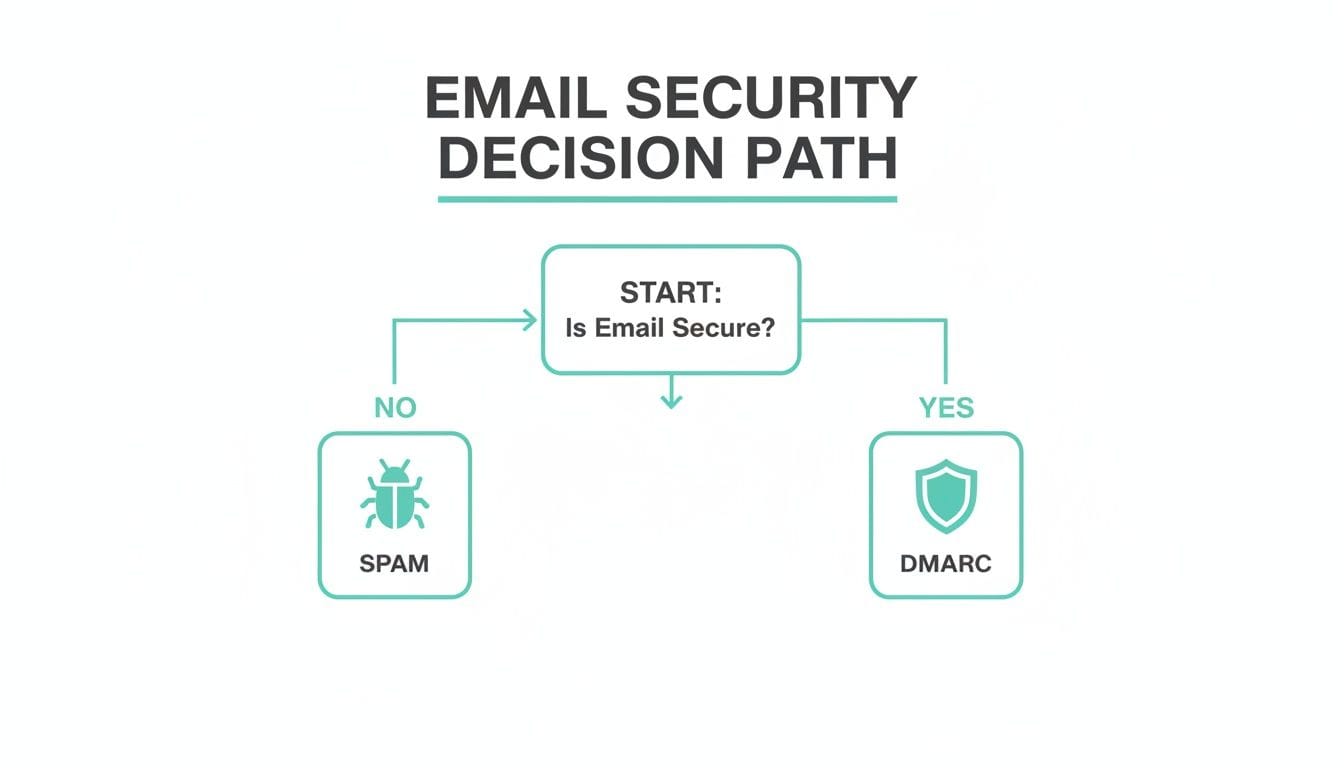
This flowchart shows the basic choice every business has: either proactively secure your email with tools like DMARC or leave yourself exposed to spam and dangerous phishing attacks.
Dedicated Email Solutions
As your business grows, so do your communication needs. This is where dedicated email solutions come in, offering more muscle and features built specifically for collaboration and bigger teams.
A classic example is Hosted Exchange. It's long been the gold standard for corporate email, providing powerful tools like shared calendars, company-wide contact lists, and seamless integration with Microsoft Outlook.
Think of a dedicated solution like Hosted Exchange as upgrading from a small office kitchenette to a fully-stocked commercial kitchen. It’s built for high-volume use and lets your team work together seamlessly, with all the right tools at their fingertips.
- Best For: Medium-sized businesses, law firms, medical centres, and any team where tight coordination and shared schedules are critical.
- Practical Example: An accounting firm with 15 staff members needs to juggle client appointments across multiple calendars. With Hosted Exchange, the receptionist can see everyone's availability in real-time and book meetings directly into their shared calendars, preventing double-bookings and confusion.
While these systems are incredibly powerful, they do come with a higher per-user price tag and can be a bit more complex to manage than a standard cPanel email setup.
Reseller Suites like Microsoft 365
This model gives you the best of both worlds. You get a world-class software suite like Microsoft 365, but you buy it through a local Australian provider. This means you get all the power of the platform, but with the massive advantage of local support and billing.
- Best For: Businesses of any size that are already using Microsoft tools like Teams, OneDrive, and the Office suite alongside their email.
- Practical Example: A marketing agency in Sydney relies on Microsoft Teams for daily chats and SharePoint for sharing client files. By getting their Microsoft 365 subscription through an Australian reseller, they receive a single, consolidated bill in AUD. If an email issue pops up, they can call a local support number in their own time zone instead of waiting for an international helpdesk.
This approach combines top-tier software with the friendly service and accountability you only get from a local partner. If you're weighing these options, you might find our detailed guide on the best email hosting Australia has to offer helpful.
How to Budget for Professional Email Hosting in Australia
Let's talk numbers. When you're trying to budget for professional email hosting in Australia, it can feel a bit like guessing in the dark. But it’s really about understanding what you’re paying for and the real value it delivers. Think of it less as another line item on your expense sheet and more as an investment in your brand's credibility, security, and day-to-day operations.
It’s easy to get drawn in by a low price tag, but that’s often where the trouble starts. A cheap plan might look good on paper, but it can come with a whole host of hidden costs—think poor security, frustrating downtime, or support that’s nowhere to be found when you need it. The damage from just one of those issues can far outweigh the few dollars you saved each month. True value is all about reliability.
Understanding Price Tiers and What You Get
In Australia, email hosting costs are usually priced per user, or per mailbox. This means your budget will naturally scale up or down with your team. Here’s a rough guide to what you can generally expect at different price points for standard email services.
Entry-Level (Approx. $1 - $5 per mailbox/month): This is a great starting point for sole traders and micro-businesses. You'll get your branded email address (
you@yourbusiness.com.au), some basic storage (around 1-5GB), and standard spam filtering. It's a massive leap in professionalism from a free address, without breaking the bank.Mid-Tier (Approx. $5 - $15 per mailbox/month): This is the sweet spot for most small to medium businesses. Here, you should be looking for more generous storage (10GB or more), better security features, sync across all your devices, and shared tools like calendars and contacts. This tier is built for growing teams that need to collaborate.
Premium/Enterprise-Level ($15+ per mailbox/month): Larger businesses, or those with strict compliance requirements, will land in this category. You’ll find features like massive (or even unlimited) storage, email archiving for legal purposes, and advanced security suites like Hosted Exchange.
More and more Australian SMEs are realising the need to move past a basic setup. It's now common for businesses to set aside between $70 and $250 AUD monthly for a solid email solution that can handle their daily communications and marketing efforts. You can dig deeper into these spending trends and the shift towards more dependable platforms in Genix Digital's 2026 cost analysis.
The Return on Investment of Quality Hosting
It's so tempting to just grab the cheapest plan you can find, but this is a classic false economy. We’ve seen it time and time again—understanding the hidden costs of budget web hosts is absolutely critical. A single security breach or a day of email downtime can cost your business thousands in lost sales and, just as importantly, damage your reputation.
Investing in quality email hosting is like buying insurance for your business communications. You're paying for the peace of mind that comes from knowing your emails are secure, always online, and backed by experts who will actually pick up the phone when you need help.
At UpTime Web Hosting, we believe in keeping things simple and transparent. Our pricing is all-inclusive, and GST is included, so the price you see is the price you pay. No nasty surprises on your invoice. With no lock-in contracts, you have the flexibility to scale up as your business grows, giving you access to premium features without the hidden fees. It’s what makes professional email an affordable, powerful, and essential tool for any Australian business.
Your Smooth Migration to Professional Email Hosting
The idea of switching your email provider can feel daunting. But it doesn't have to be a stressful, tech-heavy project that grinds your business to a halt. The whole process can be a smooth, zero-downtime affair if you have a clear plan.
Think of it like moving your office's mailroom. You wouldn't just shut down the old one and hope for the best. You'd set up the new one first, make sure everything is in its right place, and only then redirect the mail. With the right checklist, moving to a professional email hosting Australia service is just that straightforward.
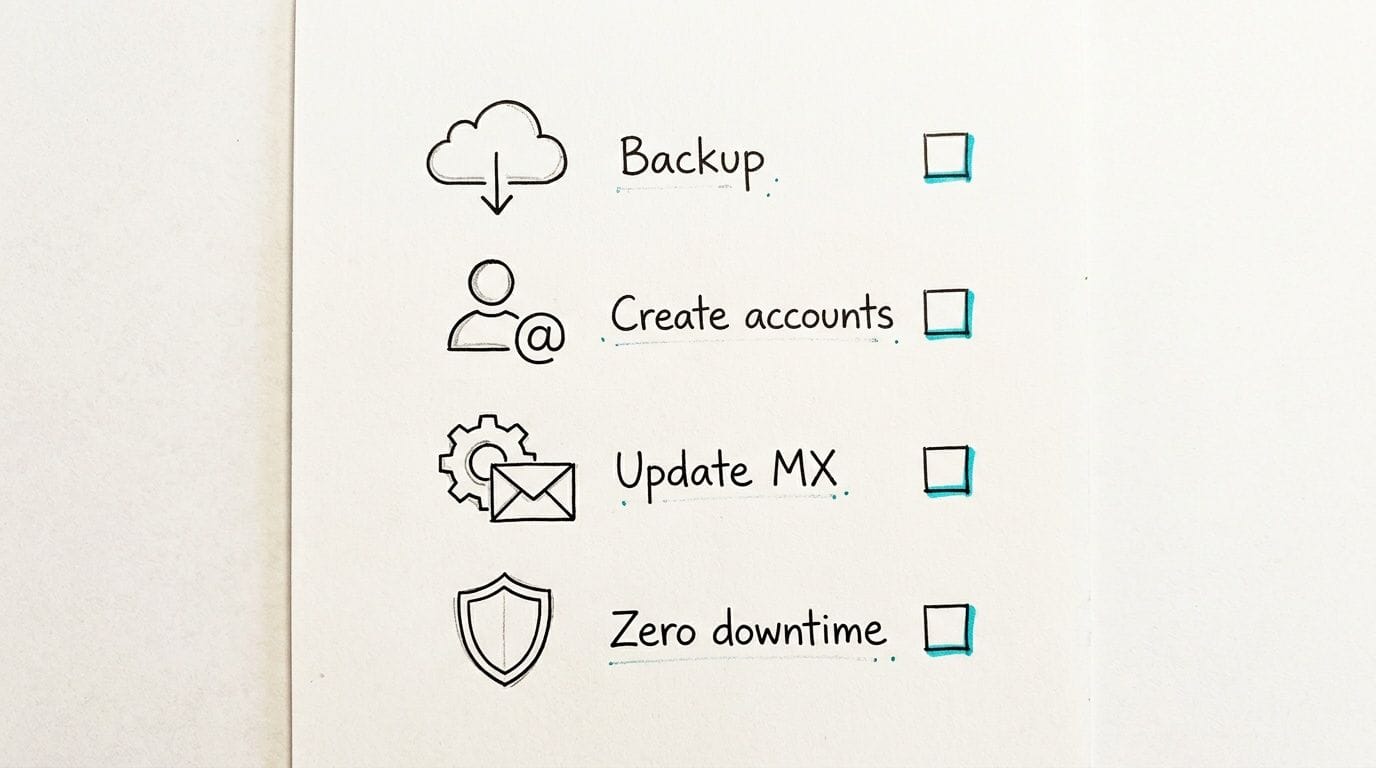
It all comes down to preparation. By getting everything ready before you flick the final switch, you ensure not a single email gets lost and your team keeps working without a hiccup.
Your Pre-Flight Migration Checklist
Before you tell the world to send email to your new address, you need to get the new destination ready. This is the most important part of a seamless switch, giving you complete control over the cutover.
Here’s the step-by-step game plan:
- Back-Up Your Current Emails: This is your safety net. Before you touch anything, make a full copy of all your existing emails. Most email clients like Outlook or Apple Mail have an export function that lets you save entire mailboxes as a local file on your computer.
- Create Your New Mailboxes: Jump into your new provider's control panel and set up all the email accounts your team needs. You’ll create addresses like
info@yourbusiness.com.auandsarah@yourbusiness.com.auso they’re ready and waiting to receive mail the second it arrives. - Configure Your Email Clients: Add the new accounts to your team's email apps (Outlook, Apple Mail, etc.), but don't delete the old account settings yet. This is a crucial step that allows you to see old emails and new ones side-by-side right after the switch. Our UpTime Web Hosting knowledge base has easy guides for this.
A successful email migration is defined by what doesn't happen: no lost data, no interruption to your business, and no frantic calls from your team. Careful planning is what makes the entire process feel uneventful.
Making the Switch: Updating Your MX Records
Once your new mailboxes are set up and ready to go, it's time for the final piece of the puzzle: telling the internet where to deliver your mail from now on. You do this by updating your domain’s MX records.
Think of an MX (Mail Exchanger) record as the digital equivalent of a postal address for your domain. It’s a simple setting in your domain’s DNS that points all incoming email to the right server. When you change this from your old provider to your new one, your mail officially starts flowing to its new home. If you need a hand, you can find a helpful guide on configuring your MX records on our knowledge base.
The best part? This process is designed to be seamless. For a little while after the change, emails might land in either the old or new server. This is exactly why you keep both accounts active in your email client at first. Within a few hours, all new mail will be delivered exclusively to your new, secure Australian-hosted server.
Register your new domain name at competitive market prices including free domain add-ons like privacy, DNS Hosting, Custom Nameservers and Forwarding.
Always the best price and no nasty renewal price hikes.
Register A Domain Name
Your Questions, Answered
Got a few lingering questions about professional email hosting? You're not alone. Here are some straightforward answers to the most common queries we get from Australian business owners, helping you clear up any doubts before you make a move.
Can I Keep My Existing Email Address if I Switch?
Yes, absolutely. As long as you own your domain name (like yourbusiness.com.au), you have complete freedom to move your email hosting to a new provider like UpTime Web Hosting without changing a single email address.
The switch itself is a standard industry process. It involves pointing your domain's MX records to our email servers, a change that's designed to happen with zero downtime. If you're curious about the technical side, you can read our guide on pointing your domain to our servers. Plus, our local Aussie support team is always on hand to walk you through it.
How Much Email Storage Does My Business Really Need?
This really comes down to how you use email day-to-day. For most small businesses, a few gigabytes (GB) per mailbox is more than enough to keep things running smoothly. The key is to pick a provider with flexible options that can scale with your business.
Think of it like this: a real estate agent who’s constantly sending large high-res property photos will need a lot more space than a local café that’s just confirming bookings. Our plans at UpTime start with plenty of storage, and you can upgrade in a couple of clicks if you find yourself needing more.
Is Professional Email Hosting Secure Enough for My Business?
It is, but only if you partner with a provider that takes security seriously. Any service offering professional email hosting in Australia worth its salt will deliver multiple layers of security that you simply don’t get with free email accounts. This isn’t a luxury; it’s essential for protecting your business.
Choosing a quality host means you are actively protecting your business from phishing attacks and data breaches. It's a fundamental step in building a secure and trustworthy brand that clients can rely on.
For example, at UpTime Web Hosting, we bundle in advanced spam filters, TLS encryption to protect emails as they travel across the internet, and robust server-level firewalls. Hosting with us also means your data is kept right here in Australia, protected under our local privacy laws, which is a massive security advantage.
What Is the Difference Between Email and Web Hosting?
It's a great question. While they often come as a package, they are two distinct services. Web hosting is where your website's files live so people can see them online. Email hosting, on the other hand, is a specialised service that handles all the sending, receiving, and storing of your emails.
A simple way to think about it is that web hosting is your digital storefront, while email hosting is your business’s official post office. To make life easier, our cPanel web hosting plans at UpTime Web Hosting include professional email hosting, giving you an all-in-one solution. You can find more setup guides in our email knowledge base articles.
Ready to establish your professional presence with a fast, secure, and Australian-owned email service? Get started with UpTime Web Hosting today and give your business the credibility it deserves. https://uptimewebhosting.com.au