It's Sunday afternoon, and you're at the kitchen table trying to register a domain before another local business takes the name. You've got an ABN, a business name, and a rough website plan, but the checkout screen raises harder questions than expected. Should you choose .com.au or direct .au? Do you need to budget for a policy-driven price change? Will your business details pass the eligibility check?
That's the practical reality of au domain registration. The registration button is the easy part. The decisions around namespace, eligibility, renewal planning and ownership records determine whether your domain becomes a reliable business asset or a recurring administration problem.
Table of Contents
- Why an Australian Domain Matters for Your Business
- Who Can Register a .au Domain and What Counts as Eligibility
- Choosing the Right .au Extension for Your Business
- How to Register a .au Domain Step by Step
- Understanding .au Domain Pricing, GST and Renewal Budgeting
- Transfers, WHOIS Rules and Protecting Your .au Asset
- Quick Checklist and Common Questions Before You Register

Performance you can feel, backed by clients who depend on it. Read how our support and uptime create long‑term customer success.Power Your Business with Better Hosting
Why an Australian Domain Matters for Your Business
A Melbourne electrician registering brightwayelectrical.com.au isn't just choosing a web address. They're choosing how customers recognise the business, how the owner proves its Australian connection, and how the domain will support email, hosting and local marketing. The same applies to a Perth café, a Brisbane accountant or a regional building contractor. A domain that clearly aligns with the business name is easier to say, remember and connect with the company behind it.
The .au namespace signals an Australian connection, which matters when customers are looking for a nearby supplier rather than an anonymous overseas provider. It also gives a local business a domain structure that aligns with Australian search behaviour and country-specific online expectations. That doesn't replace strong pages, accurate business details or useful content. It gives those efforts a more relevant foundation.
Practical rule: Register the name that matches your real business identity, not a clever variation you'll have to explain every time someone hears it.
The direct .au namespace launched in March 2022, opening the option of registering directly under .au rather than relying only on third-level spaces such as .com.au, .net.au, .org.au, .gov.au and .edu.au (auDA's product guide). By May 2026, direct .au had reached 755,572 names under management, making it a substantial part of the Australian domain market (auDA's May 2026 registry statistics).
That change has made defensive registration more common. A business might use .com.au as its public address, hold the matching direct .au, and redirect the extra name to prevent confusion or competitor capture. It's a sensible strategy when the names are available and the renewal costs fit the budget.
For local search planning, pair the domain decision with a useful hosting and location strategy. The local SEO guidance for Australian businesses covers the broader work required after registration, including the information and site signals that help customers find a nearby provider.
Who Can Register a .au Domain and What Counts as Eligibility
Eligibility comes before payment. auDA's rules require an Australian presence for a .au licence, and the applicant must also meet the naming and namespace conditions that apply to the chosen extension (auDA's domain eligibility and allocation rules).
For .com.au and .net.au, the usual pathway is an Australian commercial entity with an active ABN or ACN. An Australian sole trader can generally use their personal ABN for a matching commercial domain, while a registered company can apply using its ACN or ABN. An ARBN or an Australian trade mark can provide an alternative route in qualifying circumstances (auDA's .com.au eligibility guidance).
The trade mark rule catches applicants out. A third party may register a trade mark name under .com.au for two years without holding an ABN, but only where the requested domain is an exact match to the words of the registered trade mark. A loose brand association, shortened phrase or marketing slogan isn't enough.
Direct .au has a different position from the second-level commercial spaces. The supplied auDA allocation policy states that direct .au can be used by foreign businesses without an Australian presence, while .com.au, .net.au, .org.au, .edu.au and .gov.au have namespace-specific local requirements. Organisations applying for .org.au need to fit the relevant charity, club, community or not-for-profit categories. Educational and government domains have much narrower entity requirements.
| Extension | Eligible Registrant | Identifier Required | Common Rejection Reason |
|---|---|---|---|
.com.au | Australian commercial entity or qualifying trade mark holder | ABN, ACN, ARBN or exact-match trade mark | Domain doesn't closely match the applicant's business or trade mark |
.net.au | Australian commercial entity connected to networking, infrastructure or related activity | ABN, ACN or another accepted Australian identifier | Applicant can't show the required commercial connection |
.org.au | Eligible charity, club, community group or not-for-profit | Organisation evidence and relevant registration details | Commercial business applies for a restricted community namespace |
.edu.au | Eligible educational institution | Education-sector evidence | Applicant isn't an approved educational entity |
.gov.au | Eligible Australian government body | Government authority evidence | Applicant lacks government status |
.au | Eligible direct-name applicant, including qualifying foreign businesses under the applicable rules | Required identity or business evidence | Name is unavailable, reserved or deceptively similar |
Mismatched ABN details, inactive or suspended registrations, and incomplete evidence are common reasons applications fail. A rejected application can also create an avoidable delay, including the five-day application freeze associated with some verification issues. Check the domain registration requirements before submitting the order, especially if the trading name differs from the legal entity.
Host your website with our 5-star rated, cPanel website hosting plans.
Super fast servers, with security included and hosted in your choice of Australian Data Center.
View cPanel Plans
Choosing the Right .au Extension for Your Business
For most Australian small and medium businesses, .com.au is the default choice. Customers recognise it, businesses have used it for years, and it immediately frames the website as commercially connected to Australia. If you run a plumbing business, consultancy, retail shop, café or trades service, start there unless your entity or brand strategy gives you a clear reason not to.
.net.au suits businesses whose identity is tied to networks, hosting, telecommunications, internet infrastructure or related technical services. It can still be valid for other commercial applicants where the eligibility connection is clear, but I wouldn't choose it because the .com.au name is inconvenient. Customers generally understand .com.au faster.
.org.au isn't a generic alternative for a business that couldn't secure its preferred commercial name. It's intended for eligible charities, clubs, community groups and not-for-profits. A commercial company shouldn't use it to look community-focused unless it meets the relevant rules.
Direct .au gives you a shorter address. That's useful for spoken referrals, printed material and social profiles, but it doesn't automatically replace .com.au. Some customers still expect a commercial business to use the familiar third-level extension, so a direct name can require more explanation depending on your audience.
| Extension | Best For | Trust Level | Eligibility | Recommendation |
|---|---|---|---|---|
.com.au | Australian commercial businesses | Strong commercial familiarity | Australian commercial connection or exact-match trade mark | Primary choice for most SMEs |
.net.au | Internet, hosting and infrastructure businesses | Clear technical association | Australian eligibility and namespace connection | Choose when the technical identity fits |
.org.au | Charities, clubs and not-for-profits | Strong community association | Restricted organisational eligibility | Use only when the entity qualifies |
.au | Short Australian-facing names and defensive registrations | Growing direct-name recognition | Direct namespace rules apply | Add as a secondary where practical |
The strategy I recommend is simple: register the matching .com.au first, add the direct .au defensively if it's available, and consider .net.au only when the business fits. Redirect secondary domains to the primary website rather than splitting your brand across multiple addresses. The guide to Australia's new direct .au domain provides further context on how the namespace fits into an Australian domain portfolio.
How to Register a .au Domain Step by Step
Start with the auDA eligibility and availability check. Search the exact business name you want, then confirm that the extension fits your entity. An Australian company with a matching company name may have a straightforward .com.au application. A sole trader should check that the ABN details identify the applicant correctly. A trade mark holder must confirm that the requested domain exactly matches the trade mark words where that rule applies.
Choose a registrar that clearly displays the registration period, wholesale component, GST treatment and renewal settings. The cart should show the domain, the applicable fee, the GST line for an Australian customer and any multi-year option before you pay. Don't treat the checkout total as proof that you're eligible. A registrar can submit the application, but auDA's rules still determine whether the licence can be issued.

Enter the registrant details carefully. Use the legal person or organisation entitled to hold the domain, not an employee's name just because they're placing the order. Keep the ABN, ACN, organisation name, contact email and supporting evidence consistent. Those records affect future renewals, transfers and verification requests.
A common mistake is entering a desirable domain that merely resembles the business name. If there's no exact-match entitlement, abbreviation, acronym or substantial and close connection under the relevant rule, the application may be rejected after payment. Check the auDA rules and policies before you rely on a name.
Once the licence is active, connect the domain to your Australian hosting and email service. Add the required A, CNAME and MX records in the DNS manager, then check that the website and email services resolve correctly after propagation. Don't leave the domain parked indefinitely. A domain becomes useful when it points to a site, supports professional email or redirects visitors to your established address.
Understanding .au Domain Pricing, GST and Renewal Budgeting
The major budgeting issue is the planned October 2026 wholesale price rise. auDA says the wholesale annual licence price will increase from AUD$8.64 to AUD$9.50, excluding GST, from 1 October 2026 (auDA's wholesale .au pricing update). The change applies across the relevant .au namespaces, including .com.au, .net.au, .org.au and direct .au.
| Extension | Current wholesale per year | October 2026 wholesale per year | Indicative annual cost including GST |
|---|---|---|---|
.com.au | AUD$8.64 ex GST | AUD$9.50 ex GST | Registrar retail price varies |
.net.au | AUD$8.64 ex GST | AUD$9.50 ex GST | Registrar retail price varies |
.org.au | AUD$8.64 ex GST | AUD$9.50 ex GST | Registrar retail price varies |
.au | AUD$8.64 ex GST | AUD$9.50 ex GST | Registrar retail price varies |
The wholesale figures aren't the final retail invoice. Your registrar may add its service margin, and Australian customers generally see GST added to the taxable retail amount. Overseas registrants can have different tax treatment, so confirm the invoice details for your account rather than assuming every customer receives the same total.
For a practical forecast, list every domain, its renewal date and its registration term. If your SME holds three names on two-year terms, budget for six domain-years at each renewal cycle, then apply the registrar's displayed retail price and GST treatment. Don't multiply the wholesale fee by three and call that the budget. That ignores retail pricing, tax and the timing of the October change.
auDA's June 2026 update also introduced the Quality Pricing Incentive Program, or QPI Program. That policy development reinforces the need to review renewal assumptions rather than copying an old domain guide into your annual budget. The registry base was already 4,367,677 names under management by May 2026, up from 4,267,133 in May 2025, so policy and fee changes affect a large population of Australian registrants (auDA's May 2026 registry data).
Set reminders well before expiry, enable auto-renew where appropriate and review multi-year terms before the price change. If your business needs help separating domain charges from broader tax administration, the guide to registering for GST as a small business is a useful Australian resource. Use domain renewal guidance to build renewals into your normal IT calendar instead of treating them as an emergency task.
Register your new domain name at competitive market prices including free domain add-ons like privacy, DNS Hosting, Custom Nameservers and Forwarding.
Always the best price and no nasty renewal price hikes.
Register A Domain Name
Transfers, WHOIS Rules and Protecting Your .au Asset
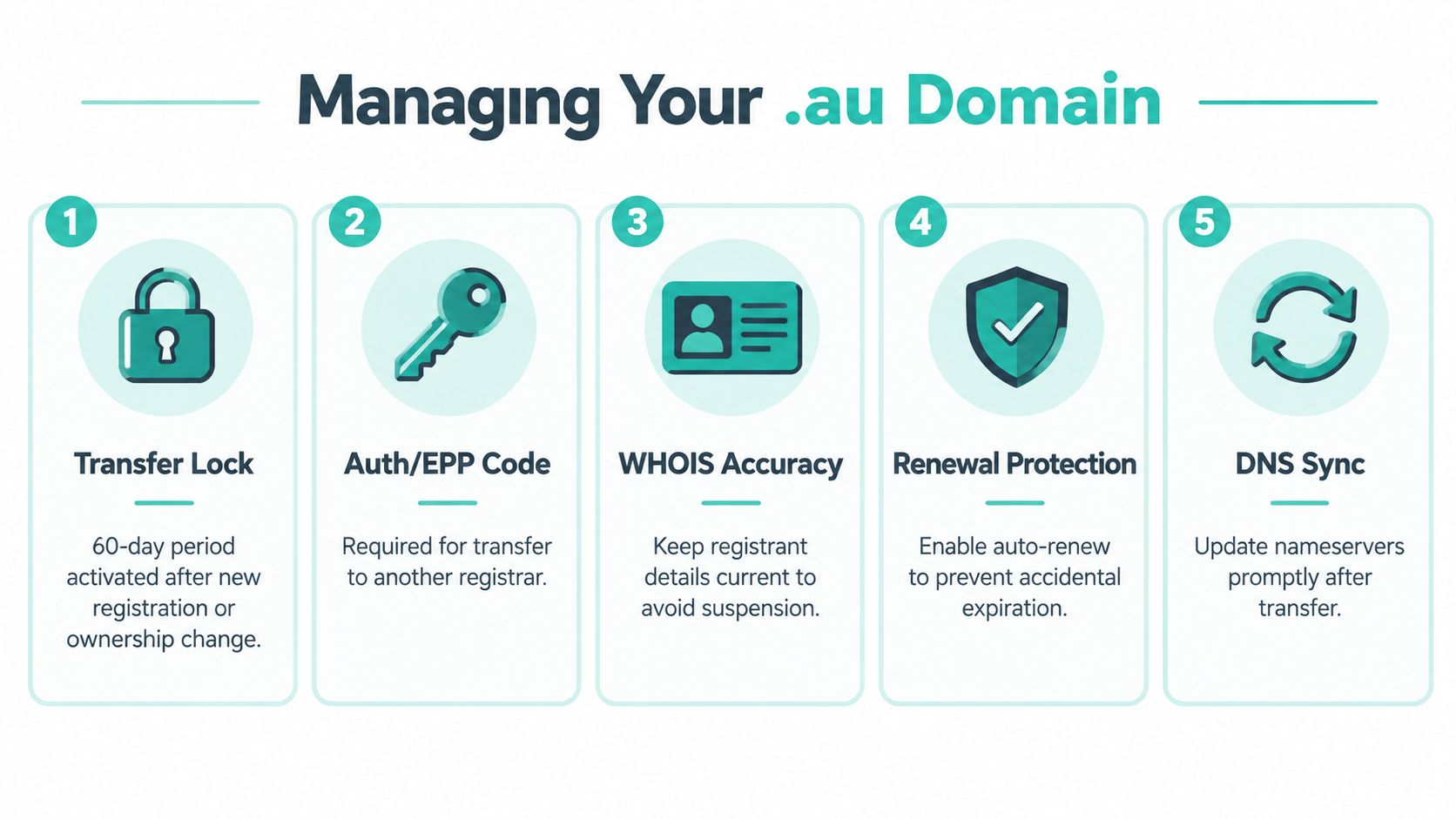
A live domain needs ongoing ownership management. A 60-day transfer lock applies after a new registration or ownership change, so don't promise a transfer to a new registrar immediately after making either change. When a transfer is allowed, the receiving provider will usually need the domain's auth or EPP code. Request it through the current registrar and ensure the registrant email can receive the relevant notices.
Ownership changes deserve extra care. If a sole trader incorporates and wants the company to become the registrant, that isn't just an account-profile edit. Check whether the new entity satisfies the namespace rules, retain the original eligibility evidence and complete the change through the correct transfer or registrant-update process.
Under the 2024 WHOIS policy, the registrant name, organisation and email are visible by default, while phone and address details are redacted. There isn't a commercial privacy proxy for .au, so use a monitored business contact address and understand what information will be published before registration.
Protect the asset, not just the password. Keep the registrant email current, record the legal owner, and store the evidence that supported the original application.
auDA's empirical dispute analysis found an average of 2.5 auDRP proceedings per 100,000 .au registrations over the first 15 years, with 470 determinations during that period (the published auDRP analysis). Those figures show that disputes are uncommon relative to the size of the namespace, but they also justify monitoring confusingly similar names and keeping your brand records organised.
Use registry lock where your registrar offers it, activate auto-renew, restrict account access and check DNS after any transfer. The Australian domain ownership guidance is useful for documenting who controls the domain and what should happen when staff, agencies or business structures change.
Quick Checklist and Common Questions Before You Register
Before you submit your order, confirm:
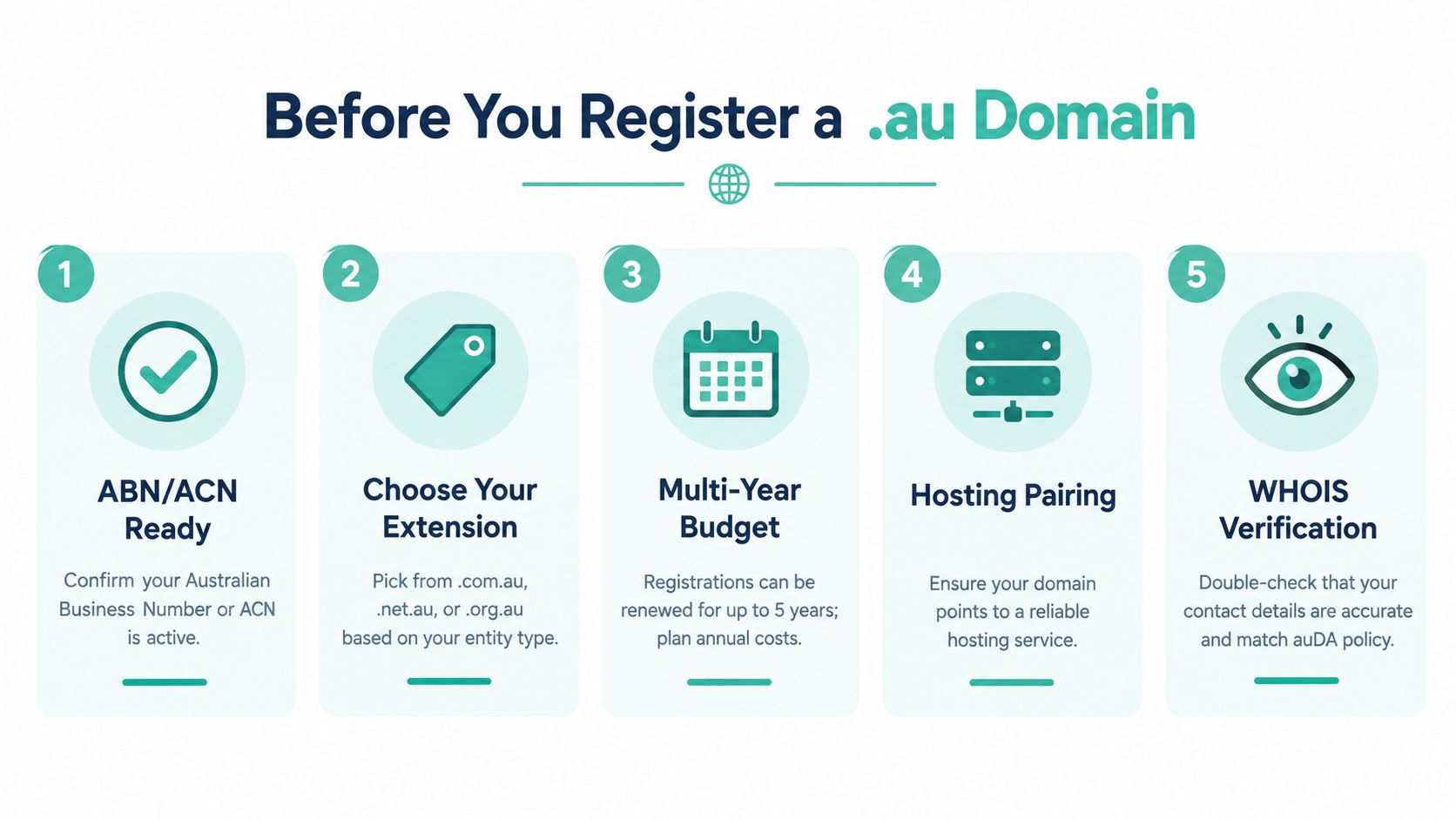
- Eligibility: Your ABN, ACN, trade mark or other evidence matches the registrant.
- Extension: You've chosen
.com.au,.net.au,.org.auor direct.aufor a clear business reason. - Renewals: You've recorded the renewal date, term and expected retail cost.
- Hosting: The domain has a plan for Australian website hosting and business email.
- WHOIS: The registrant name, organisation and email are accurate and monitored.
Do I need an ABN for a personal website? Not every personal project uses the same commercial eligibility pathway. Check the direct .au and relevant namespace rules before assuming .com.au is available.
Can I hold .com.au and direct .au separately? Yes, where you independently satisfy the applicable requirements and both names are available. Many businesses use one as the primary address and redirect the other.
How long does .com.au registration take? A compliant application can proceed once the registrar verifies eligibility and the name is available. Delays usually come from missing, mismatched or suspended evidence.
What if a competitor owns a close match? Don't choose a deceptively similar name. Consider a distinctive business-aligned alternative and check your trade mark position before investing in branding.
Should I bundle registration with Australian hosting? Usually, yes. Keeping the domain, DNS, website and email under a coordinated support arrangement reduces setup errors and makes renewal ownership clearer.
The checklist for registering a .au domain can help you verify the details before payment.
If you're ready to register a compliant .au domain and connect it to Australian hosting, visit UpTime Web Hosting to manage domains, website hosting and business email through a local provider. Their services include .com.au and direct .au registration, cPanel and WordPress hosting, DNS management and Australian support.