
Starting an online business in Australia doesn't have to be complicated. When you boil it down, it's a clear, repeatable process. First, you lock down your big idea. Then you knock over the legal registrations like your ABN. From there, it's all about building your website on a solid local host, sorting out your operations, and then finally—launching and getting in front of customers.
Your Blueprint For An Australian Online Business
Jumping into your own venture is a massive thrill, especially with Australia's digital economy absolutely booming right now. The potential for growth is genuinely huge. To give you an idea, Aussies spent a staggering AU$69 billion on online retail in 2024. That number alone shows the massive market just waiting for new businesses. It's a solid 12% jump from the year before, which tells you that shopping online is now just a normal part of life here.
Of course, a big part of planning is figuring out the costs. Before you get too far down the rabbit hole, getting a handle on How Much Does It Cost To Start A Business In Australia is a crucial step in mapping everything out.
The Foundational Stages Of Launch
Think of this guide as your high-level strategy session. We're going to walk through the entire journey, from that first spark of an idea to a fully functioning business, but without all the confusing jargon. The aim is to help you build your business on a solid, compliant foundation right from day one.
This simple, three-stage flow shows you exactly what that journey looks like.
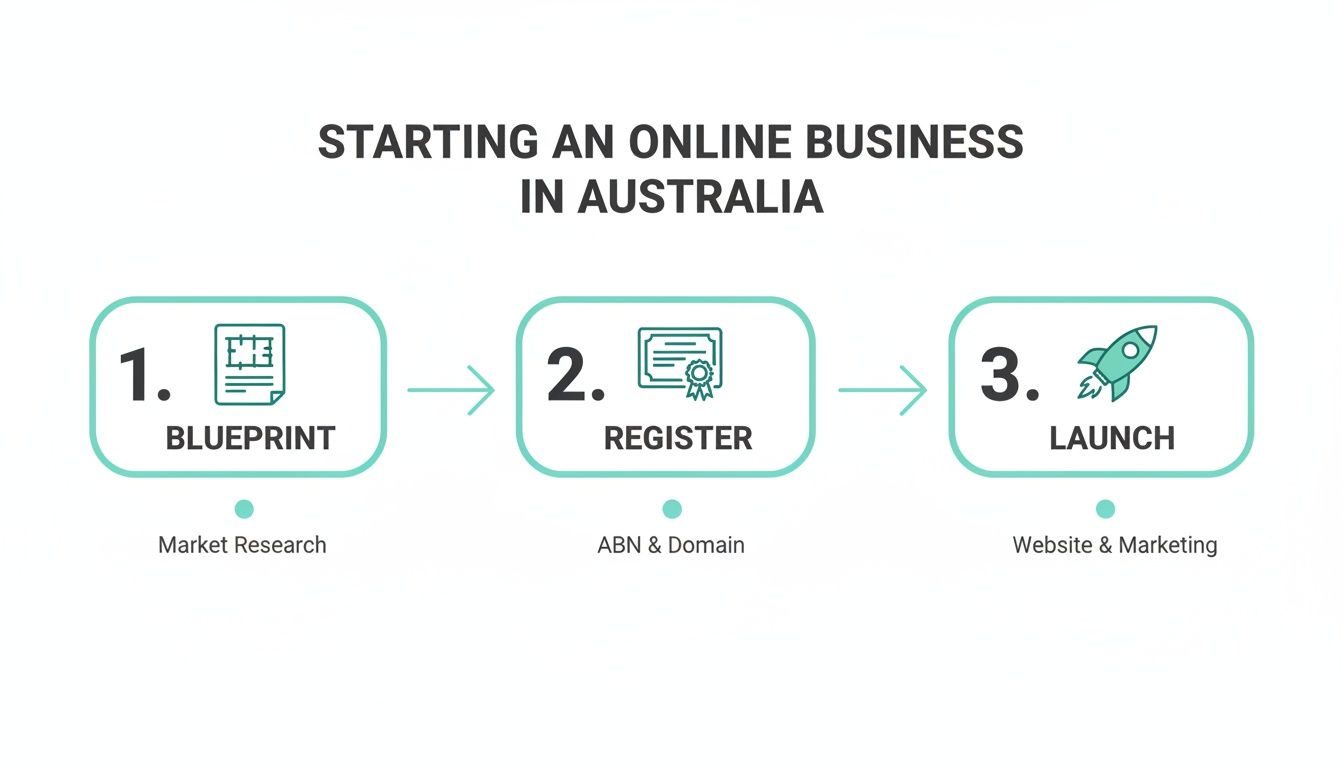
It really highlights that a successful launch comes down to smart planning and getting all your official registrations sorted before you even think about going live.
At the end of the day, your success starts with a great idea. If you're still brainstorming, sometimes seeing what's working for others can be a huge help. You might want to check out our guide on some of the best small business ideas from home to get your creativity flowing. This article will take you through the whole process, step-by-step, so you feel confident and ready to go.
Australian Online Business Launch Checklist
To give you a bird's-eye view, here's a quick checklist summarising the core stages we'll be covering. It’s a handy reference to keep you on track as you move from concept to launch.
| Stage | Key Action | Why It's Important |
|---|---|---|
| Blueprint & Plan | Validate your idea, define your target audience, and map out your finances. | A solid plan is your roadmap. It prevents costly mistakes and sets a clear direction for growth. |
| Register & Legal | Get an ABN, register your business name, and secure your domain. | This makes your business official and compliant, protecting you legally and securing your brand identity. |
| Build & Launch | Set up your website, configure payments, and plan your marketing strategy. | This is where your business comes to life. A smooth launch sets the stage for a great customer experience. |
Having these stages clear in your mind makes the entire process feel much more manageable. Let's dive into the details.

Performance you can feel, backed by clients who depend on it. Read how our support and uptime create long‑term customer success.Power Your Business with Better Hosting
Getting Your Australian Business Set Up: The Legal Bits
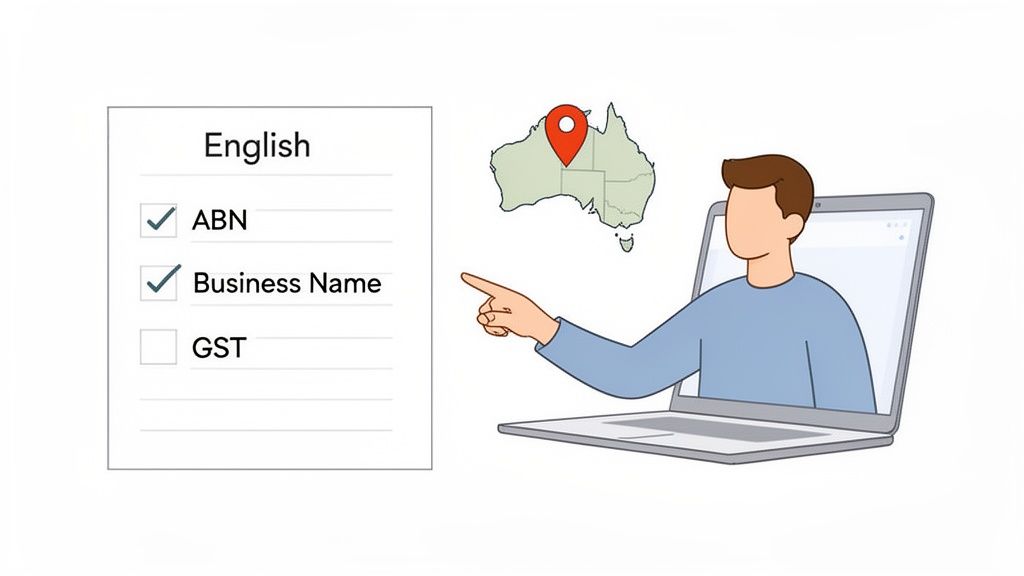
Once you've got a business idea that feels like a winner, it's time to make it official. This is the part where your concept becomes a real, legitimate Australian business by sorting out the necessary legal registrations. It might sound a bit dry, but getting this right from day one is your foundation for success.
Think of it less as bureaucratic red tape and more as building the proper framework for your business to operate safely and grow. Nailing these details now protects you, your brand, and your customers down the track.
Picking Your Business Structure
The first big decision you'll make is choosing your business structure. This choice impacts your tax obligations, personal liability, and how much admin you'll be doing. For most new online businesses in Australia, it comes down to three common options: Sole Trader, Partnership, or Company.
- Sole Trader: This is the simplest and most popular route. You are the business. This means you trade under your own name (or a registered business name), and there’s no legal distinction between your personal and business assets. It's cheap and easy to set up and manage.
- Partnership: This is for two or more people or entities going into business together. You'll share the profits, losses, and management duties based on a partnership agreement. Just like a sole trader, the partners are personally on the hook for any business debts.
- Company (Pty Ltd): A company is a separate legal entity from its owners (the shareholders). This is a game-changer for asset protection because the business’s debts belong to the company, not you personally. It's a bit more complex and costly to run, with stricter reporting rules to follow.
Here’s how that plays out in the real world:
A freelance copywriter just starting out would almost certainly register as a sole trader. It's straightforward, the financial risk is low, and the paperwork is minimal. On the other hand, two mates launching an online apparel brand with big growth plans might choose a company structure to protect their personal assets and look more credible to investors.
Registering Your ABN and Business Name
Once you know your structure, the next step is getting an Australian Business Number (ABN). Your ABN is a unique 11-digit number that's non-negotiable for doing business here. You'll need it for invoicing, claiming GST credits, and dealing with other businesses and government departments.
Getting an ABN is free and you can do it online via the Australian Business Register (ABR). While you're there, you can also register your business name if you're not planning to trade under your own personal name.
Your business name is your brand. It has to be unique and not already taken by someone else in Australia. You can check if your name is available and register it through the Australian Securities and Investments Commission (ASIC). The fees are pretty reasonable, usually starting from $39 for one year.
Getting Your Head Around Tax Obligations
Tax is just a part of running a business. The two big things you need to wrap your head around from the get-go are the Goods and Services Tax (GST) and the Business Activity Statement (BAS).
Goods and Services Tax (GST)
GST is a 10% tax added to most goods and services sold in Australia. You must register for GST if:
- Your business has an annual turnover (or is projected to have one) of $75,000 or more.
- You're in the taxi or rideshare game (like Uber), no matter your turnover.
- You want to claim fuel tax credits for your business.
Even if you don't hit that $75,000 threshold, you can choose to register voluntarily. The main benefit is that you can claim back the GST included in the price of things you buy for your business.
Business Activity Statement (BAS)
After you've registered for GST, you need to report and pay the tax you've collected to the Australian Taxation Office (ATO). You do this by lodging a Business Activity Statement (BAS). This form bundles up your GST, pay-as-you-go withholding tax, and other tax stuff. Most new businesses lodge their BAS quarterly.
With all this financial information flying around, keeping your business data secure is absolutely critical. For a deeper dive, have a look at our guide on cybersecurity and data protection to make sure your new venture is locked down from day one.
Building Your Digital Headquarters with Local Hosting
With the paperwork sorted, it’s time for the exciting part: building your website. This is your 24/7 digital storefront, and its performance and reliability are completely in your hands. This isn't just about picking a pretty design; it's about making smart technical choices that directly affect your site's speed, security, and ultimately, your sales.
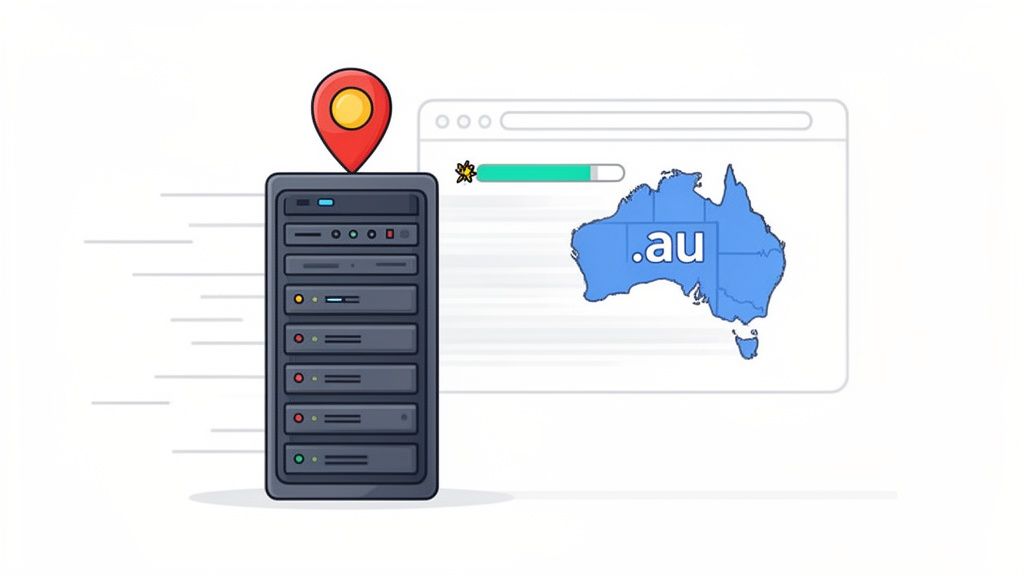
For any new online business in Australia, choosing a local web host is a no-brainer. It's a critical first step. When your site's data is stored on servers right here in Australia—think Sydney or Melbourne—the information has less distance to travel to reach your Aussie customers. This means faster loading times, which is a massive win for keeping visitors on your site and boosting your local SEO rankings.
Securing Your Australian Digital Identity
Your domain name is your online address, and for an Australian business, a .au domain is non-negotiable. Grabbing a .com.au or .au domain name immediately tells your customers you’re a legit local business they can trust. Plus, you need an ABN to register one, which just adds another layer of credibility.
This small detail has a huge impact. Australian shoppers are far more likely to buy from a local business, and Google often gives preference to local domains in search results for people in Australia. It’s a simple way to build trust from the moment someone sees your URL.
Choosing Your Website Platform
Okay, you've got your domain and hosting. Now, how are you actually going to build this thing? There's no single "best" platform—the right choice really comes down to your technical skill, what you're selling, and where you want to go in the future.
Here are three popular options that cater to different needs:
- Sitejet: A fantastic choice if you're just starting out or want a professional-looking site without digging into code. Its drag-and-drop visual editor is incredibly easy to get the hang of. A new online clothing boutique, for instance, could use Sitejet to launch a beautiful, image-heavy store in no time.
- WordPress: Powering a massive chunk of the internet, WordPress is famous for its flexibility. It’s perfect for content-heavy sites, blogs, or businesses needing specific features through its enormous library of plugins. A consultant might use it to build a service website with a client portal and a deep knowledge base.
- ASP.NET: If you need to build custom web applications or integrate with existing Microsoft systems, ASP.NET is a powerful and secure framework. It's definitely a more technical route, often picked by businesses with unique development needs or those running on a Windows-based back end.
The Australian eCommerce scene is absolutely booming, making your website's performance more critical than ever. It's tipped to grow at an annual rate of 10.41%, pushing sales to a staggering AU$64.18 billion by 2027. With mobile purchases already making up over 26% of all eCommerce, a fast, mobile-friendly website isn't just nice to have—it's essential for grabbing your slice of the pie.
Must-Have Features in Your Hosting Plan
Comparing hosting providers can feel like you're drowning in technical jargon. Let's simplify it. Focus on a few core features that deliver security, peace of mind, and real value for money. A solid plan from a quality provider will save you a world of pain down the track.
Make sure these essentials are included:
- Free SSL Certificate: An SSL certificate encrypts the data flowing between your site and your visitors, giving them that little padlock icon in their browser. It's vital for security, customer trust, and even your SEO. Any reputable host should include this for free.
- Automated Nightly Backups: Things go wrong. A simple mistake or a security breach could knock your site offline. Automated, off-site backups mean you can restore a recent version of your site in minutes, minimising downtime and lost sales.
- Generous Resources: Keep an eye on storage and bandwidth. As your business grows, so will your website. Look for plans with plenty of room to move or even uncapped bandwidth, ensuring your site doesn't grind to a halt when you get a surge in traffic.
- Local, Responsive Support: When you need help, you want to speak to someone who gets it—someone available in your time zone who understands the local landscape. Australian-based phone and ticket support is worth its weight in gold.
Choosing the right foundation for your digital headquarters sets the stage for everything that comes next. Investing in reliable, local hosting and the right website platform isn't just a tech expense; it’s a strategic investment in your business's future. To dig deeper into your options, check out our guide on finding the best Australian web hosting for your business.
Host your website with our 5-star rated, cPanel website hosting plans.
Super fast servers, with security included and hosted in your choice of Australian Data Center.
View cPanel Plans
Wiring Up Your Business: Payments, Shipping, and Operations
Your website is built, the virtual paint is dry, and it’s looking sharp. But a pretty storefront is just the beginning. Now it's time to build the engine room—the systems that turn a 'click' into a package arriving on a customer's doorstep.
Getting your payments and shipping sorted isn't just a box-ticking exercise. It's about creating a smooth, trustworthy experience for your customers and an efficient workflow for you. Get this right, and you'll avoid countless headaches down the track.
The first piece of the puzzle is giving people an easy and secure way to hand over their money. For most new Aussie online businesses, this means plugging a reliable payment gateway into your website, whether you're using WooCommerce, Sitejet, or another platform.
Choosing Your Australian Payment Gateway
Here in Australia, you’ll quickly find three names pop up everywhere: Stripe, PayPal, and Square. They all do a great job of letting you take credit card payments online, but they have their own personalities and fee structures.
- Stripe: A favourite among those who like a bit more control. It’s known for its clean integration, meaning you can design a checkout process that keeps customers on your site from start to finish.
- PayPal: The old faithful. It’s a name people instantly recognise and trust, which can genuinely lift your conversion rates. Many shoppers just feel safer using their existing PayPal account.
- Square: The perfect choice if you have any plans for a physical presence, like a market stall or pop-up shop. Square synchronises your online and in-person payments beautifully.
To make sure your setup is rock-solid from day one, it's worth looking into expert payment solutions that integrate perfectly with your chosen platform.
Practical Example: Imagine a small Perth business selling handmade leather goods. They might start with Stripe on their WooCommerce store. It’s a no-brainer—there are no monthly fees, and the simple per-transaction fee (1.75% + A$0.30 for domestic cards) makes it dead simple to manage cash flow when you're just starting out.
Streamlining Your Shipping and Logistics
Next up: getting your products from your workshop to your customer's front door. In Australia, this usually comes down to a choice between the big national carrier and some of the more tech-savvy courier services.
Comparing Australian Shipping Providers
| Provider | Best For | Key Feature |
|---|---|---|
| Australia Post | Nationwide Reach | They have the most extensive network, hands down. If you need to reach every nook and cranny of the country, including PO Boxes, they're your go-to. |
| Sendle | Eco-Conscious Brands | As a certified B Corp offering 100% carbon-neutral shipping, this can be a massive selling point and brand differentiator. |
| CouriersPlease | Metro Deliveries | Often the most competitive option for deliveries within the same city or between major metro areas, with plenty of flexible choices. |
One of the biggest hurdles new store owners face is figuring out what to charge for shipping. You could offer a flat rate, calculate costs based on weight and postcode, or go for the holy grail: free shipping. A common strategy is to offer free shipping over a certain amount (e.g., "Free shipping on orders over $100")—it's a powerful psychological nudge to get people to add just one more item to their cart.
Let's say a Melbourne business selling eco-friendly cleaning products decides to partner with Sendle. It’s a perfect match for their brand values. They could work out their average shipping cost is about $10, build some of that into their product prices, and then offer a very competitive flat-rate fee, or free shipping on bigger orders to seal the deal.
Managing Your Day-to-Day Operations
With payments and shipping humming along, your focus will naturally shift to the daily grind of running the store. This covers everything from keeping an eye on your stock levels to communicating with your customers.
Solid inventory management is crucial for avoiding that dreaded "out of stock" message that sends potential buyers running. Most platforms, like WooCommerce, have simple built-in tools that automatically deduct stock as sales come in, so you don't have to do it manually.
Just as important is how you present yourself. Ditch the generic Gmail address. Setting up a professional business email that uses your own domain (like sales@yourbusiness.com.au) builds instant trust and makes you look like you mean business. It’s a small detail with a huge impact. To get this sorted quickly, check out our simple guide on how to set up a business email address.
Marketing Your Business to an Australian Audience

You've got a fantastic product and a slick website. That's a great start, but without a solid marketing plan, you're pretty much invisible. This is where you actually connect with customers and show them why you're the one they've been searching for. Marketing effectively in Australia means getting into the mindset of Aussies—how they search, which social platforms they live on, and how to speak their language.
Your customers are online. Simple as that. With internet usage in Australia expected to hit 97.1% by 2025 and over 21 million of us scrolling through social media, your online presence isn't just a side project—it's the main event. Smart, targeted marketing is what will get you noticed. You can discover more insights about Australia's digital landscape to really grasp why a sharp online strategy is non-negotiable.
Dominate Local Search with SEO
When an Aussie needs something, the first port of call is almost always Google. Search Engine Optimisation (SEO) is the art of making sure your business pops up right when they’re looking. For any Australian business, that means nailing local SEO.
It's all about using the keywords and phrases that real people are typing into their phones. Forget generic terms. If you sell artisan bread in Brisbane, you're not just trying to rank for "sourdough bread." You want to be the answer for searches like "best sourdough Brisbane," "artisan bakery New Farm," or even "buy fresh bread online QLD."
Tools like Google Keyword Planner or Ahrefs are brilliant for digging up these local gems. Once you've got a list, weave them naturally into your:
- Website pages (especially your homepage and product descriptions)
- Blog posts (think "Our Guide to Pairing Brisbane Cheeses with Sourdough")
- Google Business Profile (an absolute must-have for any local operation)
Build Trust Through Content Marketing
Good content marketing is less about the hard sell and more about being genuinely helpful. By creating useful, interesting, or even entertaining content, you start building a relationship with your ideal customers long before they're ready to buy.
For an online business, a blog or a dedicated resources section is a powerhouse. It positions you as the go-to expert in your niche and gives you a reason to regularly connect with your audience.
Real-World Scenario:
Imagine a new Melbourne-based coffee subscription service. Instead of just running ads that scream "Buy our coffee!", they start a blog. They publish articles like "How to Brew the Perfect Flat White at Home" and "A Tour of Melbourne's Best Independent Roasters." This content doesn't just sell a product; it adds real value, builds trust, and pulls in exactly the right kind of customer through organic search.
Engage Authentically on Social Media
Aussies love their social media, with platforms like Facebook and Instagram being daily habits for millions. The goal isn't to be everywhere at once. It's to be active and engaging on the platforms where your target customers actually hang out.
For businesses selling physical products, visual platforms are king. An online fashion boutique from Sydney could use Instagram Reels to show off new arrivals or team up with local influencers for try-on hauls. If you're a service-based business, like a financial advisor, you might find more traction building authority on LinkedIn or creating helpful video guides for a niche Facebook Group. Tools like FlexClip can help you quickly create polished product videos, promotional reels, or eye-catching ads without requiring advanced editing skills.
Remember, the key to social media is engagement, not just broadcasting. Ask questions, run polls, reply to comments, and share content from your followers. Make them feel like part of a community, not just a number on a spreadsheet.
Nurture Leads with Email Marketing
Don't sleep on email marketing. It's still one of the most powerful ways to turn curious visitors into loyal, repeat customers. It’s your own private channel, free from the whims of social media algorithms, allowing you to build relationships and drive sales directly.
Get started by offering a little something valuable in exchange for an email address. This could be:
- A 10% discount on their first purchase.
- A free, downloadable guide that solves a problem for them.
- Exclusive early access to new products.
Once they're on your list, you can send a welcome series, share handy tips, announce sales, and gently remind them about items left in their cart. Just be sure to play by the rules of Australia's Spam Act 2003—always get permission to email someone and make it dead simple for them to unsubscribe. An email list is a genuine asset you own, giving you a reliable way to generate revenue for your business.
Your Go-Live Checklist and First 90 Days
You've built your site, set up the back end, and you're ready to show the world. Hold on for just a moment. The final hurdle is a methodical, pre-flight check to make sure your launch goes off without a hitch. Skipping this can lead to simple, avoidable issues that frustrate your very first customers.
Before flipping the switch, you need to test every single part of your website. I mean it. Click every link. Make sure every image loads correctly. Most importantly, run a full, end-to-end test transaction. Grab your credit card and buy a low-cost item to be 100% sure your payment gateway is firing on all cylinders.
Crucial Final Check: Pull out your phone and your tablet. Does your website look and function just as well on a mobile device as it does on your desktop? A huge slice of Aussie eCommerce traffic comes from mobile, and a clunky mobile experience is a guaranteed deal-breaker.
Your First 90 Days of Operation
Getting your site live is just the starting line. The next three months are all about gathering real-world data and tweaking your strategy. I find it helpful to break this critical period down into manageable 30-day sprints.
First 30 Days: Your absolute priority is feedback. Don't be shy—actively ask your first customers about their experience. What did they like? What was confusing? At the same time, double-check that your analytics tools, like Google Analytics, are correctly set up and tracking how people are actually using your site.
Next 60 Days: Now you've got some data to play with. Start digging into it. Where is your traffic coming from? Which products or pages are getting the most attention? Use these early insights to start refining where you put your marketing dollars.
Final 90 Days: With some solid data behind you, it's time to optimise. Double down on what's working and don't be afraid to adjust or even cut what isn't. This is also the period where unexpected technical gremlins can pop up, making reliable, on-call support an absolute lifesaver.
Having a dependable partner to help you navigate these early days is invaluable. When you're focused on sales and marketing, the last thing you want is a technical headache. You can learn more about the importance of professional web maintenance and support to keep your new business running smoothly.
Register your new domain name at competitive market prices including free domain add-ons like privacy, DNS Hosting, Custom Nameservers and Forwarding.
Always the best price and no nasty renewal price hikes.
Register A Domain Name
Got Questions? We've Got Answers
Starting an online business in Australia throws up a lot of questions, especially when you're just getting your head around all the local rules. Here are some of the most common queries we see from budding entrepreneurs.
Do I Really Need an ABN for a Small Online Hobby?
The short answer is yes. The moment your "hobby" is set up with the intention of making a profit, the Australian Taxation Office (ATO) sees it as a business. That means you'll need to register for an Australian Business Number (ABN).
Think of your ABN as your business's official ticket to operate. It’s essential for sending out proper invoices, claiming tax credits on your business purchases, and just looking professional to your customers. The good news? You can register for an ABN for free, directly on the Australian Business Register website.
Can I Just Use My Personal Bank Account?
Technically, if you're a sole trader, you can. But you absolutely shouldn't. One of the best pieces of advice I can give anyone starting out is to open a separate business bank account from day one.
Keeping your business and personal finances separate will save you a world of headaches. It makes bookkeeping a thousand times easier, simplifies everything come tax time, and helps you project a much more professional image. If you're setting up as a company, having a separate bank account isn't just a good idea—it's a legal requirement.
How Important Is a .au Domain Name, Really?
If you're targeting an Australian audience, a .com.au or .au domain isn't just important—it's critical. It’s an instant signal to customers that you’re a local, trustworthy business. This can give you a real edge in local Google search rankings, too.
There's also a built-in layer of trust. To register a .com.au domain, you must have a valid ABN, which proves you're a legitimate Australian enterprise. It's a small detail that makes a massive difference in how potential customers see your brand. We dive deeper into this in our guide on choosing Australian web hosting.
Ready to build your digital headquarters? UpTime Web Hosting offers fast, secure, and 100% Australian web hosting to get your online business launched right. https://uptimewebhosting.com.au