
Choosing the best VPS hosting Australia has to offer isn't just about ticking boxes. It's about finding a provider with rock-solid performance, robust security, and dedicated resources—ideally from a 100% Australian-owned company with local data centres in cities like Sydney and Melbourne. This is critical for keeping your load times snappy for Aussie customers and staying on the right side of Australian privacy laws.
Why Australian Businesses Need VPS Hosting
If your business is growing, you've probably felt the squeeze of shared hosting. Performance drops during traffic spikes, and the "noisy neighbours" on the same server can pose a real security risk. It’s no surprise so many Australian businesses are making the jump to a Virtual Private Server (VPS) to get the control, speed, and security they need.
Think of a VPS as your own private, partitioned server. You get dedicated resources, but without the hefty price tag of a full physical machine.
This isn't just a tech upgrade; it's a smart business move. A VPS gives you an isolated environment to protect customer data and keep performance stable—something that's non-negotiable for e-commerce stores, corporate sites, or any business where uptime equals revenue.
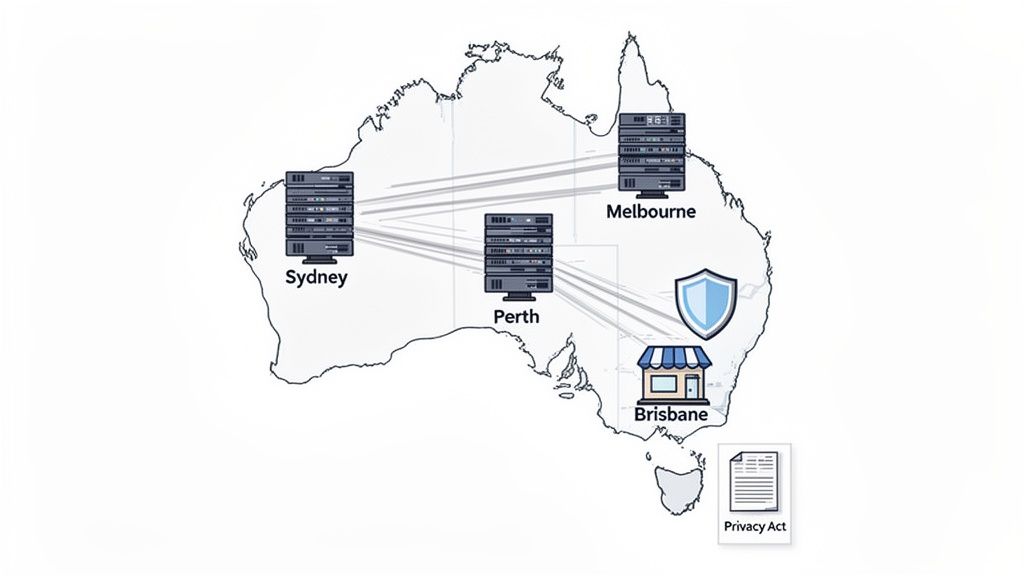
The Advantage of Local Australian Servers
When your server is physically located thousands of kilometres away, every single data request has to make that long journey. This creates noticeable delays, a frustrating little thing called latency. For any business targeting an Australian audience, using a local VPS provider with data centres in Sydney, Melbourne, Brisbane, or Perth is a massive competitive advantage.
Here’s why it matters:
- A Better User Experience: Lower latency means faster page loads. Faster pages keep visitors happy and stop them from hitting the 'back' button.
- Improved SEO Rankings: Search engines like Google love fast websites. Hosting locally can give your site a welcome boost in local search results.
- More Reliable Support: A local provider gets the Australian market and offers support that actually lines up with your business hours. No more waiting for a team in another time zone to wake up.
Data Sovereignty and Security Compliance
For any Australian business that collects customer information, data sovereignty isn't just a buzzword—it's a legal requirement. The Privacy Act 1988 dictates how personal data must be handled, and a key part of that is keeping the data right here in Australia. Hosting with an international provider could land you in hot water.
By choosing a VPS with a 100% Australian-owned and operated provider, you ensure your data remains under Australian jurisdiction. This is non-negotiable for e-commerce sites, healthcare providers, and any business handling sensitive information. You can explore more about why it's important to host your website in Australia in our detailed guide.
This local-first approach is also what's driving growth in the market. The move to VPS in Australia is picking up steam, fuelled by businesses needing more control and needing to meet those strict data sovereignty rules. It just makes sense to go local. Understanding the technology behind it, like Infrastructure as a Service (IaaS), helps make the benefits even clearer.

Performance you can feel, backed by clients who depend on it. Read how our support and uptime create long‑term customer success.Power Your Business with Better Hosting
Evaluating Key Criteria for Your Australian VPS
Picking the right VPS isn't just about finding the cheapest plan. To get the best VPS hosting Australia has on offer, you need to dig a little deeper and understand how the nuts and bolts of a hosting plan impact your website's real-world performance. A smart analysis of the tech specs and service quality is what separates a provider that helps your business grow from one that holds it back.
Think of it like buying a performance car. You wouldn't just look at the paint job; you’d be checking what’s under the bonnet—the engine, the suspension, the works. It’s the same with your VPS. The core components like CPU, RAM, storage, and bandwidth all have to work together to give your visitors a fast, smooth experience.

Core Performance Pillars: CPU, RAM, and Storage
The engine of your VPS is its vCPU (virtual Central Processing Unit). Think of vCPU cores as extra lanes on a highway; more cores mean your server can handle more tasks at once. This is absolutely critical for dynamic sites with a lot of database activity, like a busy community forum or a membership portal.
Working hand-in-hand with the CPU is RAM (Random Access Memory), which acts as your server's short-term memory. It holds all the data that's currently in use so it can be accessed in a flash. Not having enough RAM is one of the most common reasons for a website slowing to a crawl, especially when you get a sudden rush of visitors. A growing WooCommerce store, for instance, needs plenty of RAM to juggle orders, inventory, and customer accounts without a hitch.
Lastly, the type of storage you get makes a massive difference. Standard SSDs are quick, but NVMe SSDs (Non-Volatile Memory Express) are the real game-changer, delivering read/write speeds up to 6x faster. For you, that means lightning-fast database queries, quicker page loads, and a much more responsive website back-end.
Data Centre Location and Bandwidth Policies
For any Australian business, the server's physical location is a deal-breaker. Hosting your VPS in a local data centre—whether it’s in Sydney, Melbourne, Perth, or Brisbane—is the secret to slashing latency. Lower latency means your website loads almost instantly for Aussie visitors, which is a massive win for user experience. This local presence is a huge part of how your hosting service affects website speed, because every millisecond really does count.
Bandwidth is the other piece of the puzzle. It’s the amount of data your server can push out to visitors over a set period. You’ll see a lot of providers advertising "unmetered" bandwidth, but it pays to read the fine print for any "fair use" clauses. A clear, generous bandwidth allowance means your site won't get slowed down or slapped with unexpected fees as your traffic starts to take off.
Key Insight: When you’re comparing VPS plans, don't get fixated on just the numbers. Quality over quantity often wins. A provider offering fewer vCPU cores on newer, high-performance processors will almost always run circles around a plan with more cores on dated, slower hardware.
The Australian VPS scene is also shaped by strict data sovereignty laws, a factor influencing 75% of hosting decisions here. Under Australia's Privacy Act and the Notifiable Data Breaches scheme (which recorded 1,118 breaches in 2023), keeping data on Aussie soil is a must. UpTime Web Hosting meets this head-on with 100% Australian servers across four cities and strong DDoS firewalls—an essential defence when cyber threats cost local businesses an estimated $33 billion AUD each year.
Managed vs. Unmanaged Services
Your level of technical comfort will steer you toward either a managed or unmanaged VPS. There’s a big difference.
- Unmanaged VPS: This is the DIY option. You get full root access and total control over the server. It’s perfect for developers and system admins who are happy to roll up their sleeves and handle security patches, updates, and troubleshooting themselves.
- Managed VPS: This is the go-to for most business owners. With a managed plan, the hosting provider takes care of all the technical heavy lifting. We’re talking server setup, security monitoring, software updates, and performance tuning. It frees you up to actually focus on your business, knowing the tech side is sorted.
Picture this: it’s 3 AM and your e-commerce site goes down. With a managed plan, the support team is already on it, minimising downtime and saving you from lost sales. That kind of peace of mind is what truly defines the best VPS hosting in Australia.
Before you make a final call, it’s a good idea to run through a checklist to make sure you've covered all the bases.
Essential VPS Feature Checklist for Australian Businesses
Use this checklist to evaluate key technical and service specifications when comparing Australian VPS providers, helping you make a well-informed decision for your business.
| Feature/Criteria | What to Look For | Why It Matters for Your Business |
|---|---|---|
| CPU (vCores) | High-performance, modern processors (e.g., AMD EPYC, Intel Xeon Gold). | More powerful cores handle complex tasks and traffic spikes better, ensuring a fast experience. |
| RAM | Sufficient memory for your workload (8GB+ for e-commerce). DDR4 or better. | Prevents slowdowns during peak traffic and allows for more complex applications to run smoothly. |
| Storage | 100% NVMe SSDs for maximum read/write speeds. | Drastically improves page load times, database queries, and overall site responsiveness. |
| Bandwidth | Generous, clearly defined data transfer limits with no hidden fees. | Accommodates traffic growth without performance throttling or surprise costs. |
| Data Centre Location | Servers physically located in Australia (Sydney, Melbourne, etc.). | Reduces latency for local visitors, boosting SEO and user experience. |
| Backups | Automated, daily off-site backups with easy restore options. | Provides a critical safety net against data loss, hacking, or accidental deletions. |
| Security | Included DDoS protection, firewalls, and security monitoring. | Protects your website and customer data from common cyber threats. |
| Managed Services | Proactive server management, updates, and 24/7 expert support. | Saves you time and stress, letting you focus on your business while experts handle the tech. |
| Operating System | Options for both Linux (e.g., AlmaLinux, Ubuntu) and Windows Server. | Ensures compatibility with your specific applications, whether it's WordPress or ASP.NET. |
| Scalability | Easy, seamless options to upgrade CPU, RAM, and storage as you grow. | Your hosting can grow with your business, avoiding the need for a painful migration later. |
Having a clear checklist like this turns a confusing decision into a straightforward process, ensuring the VPS you choose is a perfect fit for where your business is today and where you want it to be tomorrow.
Comparing Top Australian VPS Hosting Providers
Choosing the right VPS in Australia isn't about falling for flashy marketing—it's about digging into what actually delivers results. A provider's true worth shows up when things get busy, when you need help at 2 AM, and when the monthly bill arrives. Let’s cut through the noise and compare some of the top providers based on what genuinely matters to an Australian business.
Forget a generic top-10 list. We're going to look at this through the lens of specific business needs. The right choice for a high-traffic e-commerce store is very different from what a digital agency managing dozens of client sites needs.
Performance and Hardware Quality
The engine of any good VPS is its hardware. You'll find the best providers are investing heavily in modern, high-performance processors like AMD EPYC or Intel Xeon Gold, and they pair them with 100% NVMe SSD storage. This isn't just a nice-to-have; it's a critical combination for the speed and responsiveness your website demands.
But don't get fixated on the number of vCores alone. The quality of those cores is far more important. A provider running the latest-gen CPUs will blow away another offering more cores on older, slower hardware. It’s not even a fair fight.
For instance, a host like UpTime Web Hosting makes a point of standardising on high-frequency processors and pure NVMe SSDs for every single plan. This commitment means even their entry-level VPS packs a punch for database-heavy sites like WordPress and WooCommerce. In contrast, you'll find some competitors are still using older SSDs or, believe it or not, spinning hard drives on their cheaper tiers, creating a performance gap you can really feel.
The Support Experience: Local vs Offshore
When your website goes down, the absolute last thing you want is to be stuck in a support queue, waiting for someone in a completely different time zone to read from a script. This is where a genuinely Australian provider makes all the difference. A local team gets the nuances of the Aussie market and is actually available during your business hours.
Think about the real-world difference here:
- Local Support: You get a 1300 number, live chat, and ticket support staffed by experts who are awake when you are. They can solve problems faster because they're hands-on with the server infrastructure, not just escalating your ticket to another department.
- Offshore Support: Many global giants route their support through overseas call centres. Yes, they’re 24/7, but you often deal with first-level techs who follow a script and have to escalate anything complex, leading to frustrating delays.
Key Differentiator: The real measure of support isn't just being available; it's about expertise and accessibility. A provider offering genuine 24/7 local support from engineers who understand Australian business needs delivers incredible value and peace of mind.
Security Features and Proactive Management
Security should never be an optional extra. The best Australian VPS providers build security into the very core of their service. This is about more than just a basic firewall; it involves layers of protection for your digital assets.
Look for providers that include DDoS protection, regular security patching, and automated malware scanning as standard. Proactive server management is another game-changer. With a managed VPS, the provider takes care of all the tedious server updates and security patches, freeing you up to actually run your business. For a broader look at local options, our guide on Australian web hosting providers has more context.
Specialists like WP Engine and Kinsta are brilliant at WordPress-specific security, offering features like managed Web Application Firewalls (WAF) and proactive threat detection tuned for that platform. But if you need to run more than just WordPress, a local provider offering comprehensive managed services across both Linux and Windows often gives you better all-around value.
Pricing Transparency and Value
Transparent pricing is the hallmark of a provider you can trust. Too many businesses get lured in by a cheap introductory offer, only to be hit with a massive price hike on renewal or stung by hidden fees for things that should be standard, like backups.
When you're comparing prices, always check these things:
- GST Inclusion: Is that price GST-inclusive? Some hosts love to add it on at the final checkout, instantly making the cost 10% higher than you thought.
- Renewal Rates: Get clarity on what you’ll be paying after the first term is up. A host with clear, consistent pricing is playing the long game.
- Included Features: Does the plan come with essentials like SSL certificates, daily backups, and migration help, or are they expensive add-ons?
A provider might dangle a super cheap unmanaged plan, for example. But once you add the cost of a cPanel licence, a proper backup solution, and the hours you'll spend on server admin, a slightly pricier managed plan often delivers far better value and a lower total cost of ownership.
On top of that, some Aussie providers offer unique perks. UpTime Web Hosting, for instance, has a loyalty rewards program that credits a percentage of your invoice back to your account, which genuinely lowers your future hosting costs. It's a tangible benefit that rewards you for sticking around—something you rarely see elsewhere. Finding the best fit is about balancing all these elements.
Host your website with our 5-star rated, cPanel website hosting plans.
Super fast servers, with security included and hosted in your choice of Australian Data Center.
View cPanel Plans
Matching Your VPS Plan to Your Business Needs
Choosing the best VPS hosting Australia offers isn't a one-size-fits-all deal. The right plan for you hinges entirely on your specific business model and what you need it to do. A busy e-commerce store has completely different demands than a digital agency juggling client sites, just as a startup’s priorities are worlds away from a business running specialised Windows applications.
Getting this match right from the start is crucial. It stops you from overspending on horsepower you'll never use, while also making sure you have enough grunt under the hood to deliver a fast, reliable experience for your customers. Let's break down a few common Australian business scenarios to help you find your perfect fit.
This chart really drives home the three pillars that Aussie businesses care about most when picking a VPS: performance, support, and security.
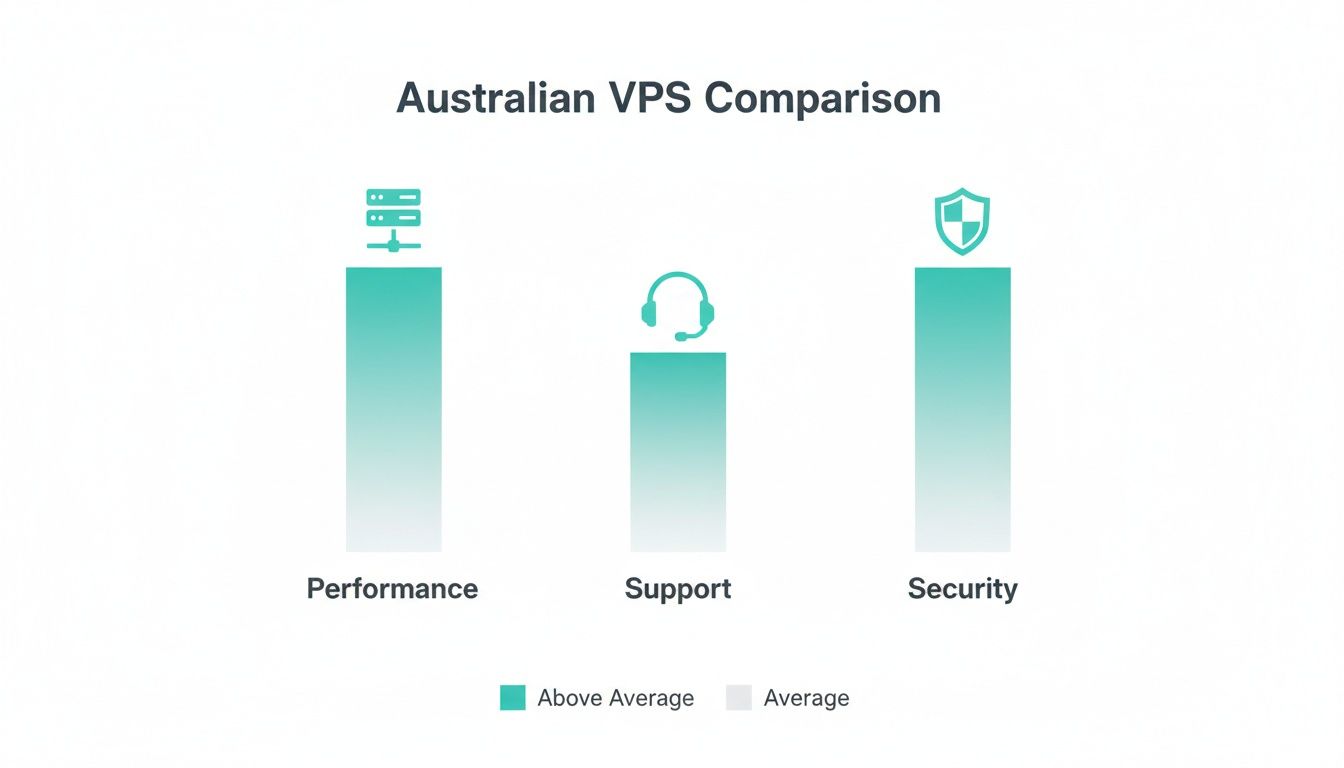
As you can see, it’s all about balance. Each of these elements is critical if you want to succeed in the competitive Australian market.
High-Traffic WordPress and WooCommerce Sites
For a bustling WordPress or WooCommerce site, performance is everything. Every millisecond of delay can mean lost sales and slipping down the search rankings. Your main focus needs to be on a VPS that can handle a relentless barrage of database queries and dynamic content without even breaking a sweat.
- Critical Resources: You should be looking at plans with at least 4GB+ RAM and multiple high-frequency vCPU cores. And forget anything less than 100% NVMe SSD storage—it's absolutely essential for lightning-fast database performance.
- Optimisation Tools: A provider that offers server-level caching like LiteSpeed with AccelerateWP can make a massive difference to your load times. For a deeper dive, check out our guide on how to speed up your WordPress site.
Practical Example: Picture an online store in Melbourne selling handmade goods. They get a massive traffic surge over the Christmas period. A scalable, managed VPS with powerful caching ensures their site stays fast and responsive, preventing abandoned carts and maximising sales when it counts the most.
Digital Agencies and Resellers
If you're an agency managing a portfolio of client websites, your world revolves around efficiency, security, and scalability. The goal is to find a VPS solution that makes your life easier, providing isolated environments for each client so one site's drama doesn't spill over and affect the others.
- Management Tools: A VPS equipped with cPanel/WHM is the undisputed industry standard here. It lets you create and manage separate hosting accounts for each client without any fuss.
- Resource Allocation: You’ll need a plan with plenty of CPU and RAM that you can divvy up between client accounts as needed. The ability to easily scale up resources as you bring on new clients is a must.
- Security: Look for features like CloudLinux OS. It provides account isolation, which is a huge security win, as it stops one misbehaving client from hogging all the resources and slowing everyone else down.
Businesses Running Windows and ASP.NET Applications
If your business is built on Microsoft technologies, a Linux VPS just isn't going to cut it. You absolutely need a Windows Server environment that natively supports your applications and databases.
This is a big market in Australia, especially with e-commerce projected to hit an incredible AUD 82 billion in sales by 2024. A provider like UpTime Web Hosting, offering a specialised ASP.NET Windows VPS, is perfectly positioned to support platforms like nopCommerce, which are popular among the 25% yearly increase of online retailers needing MSSQL. You can get more insights from this detailed industry analysis of the growing private cloud market.
- Compatibility: Double-check that the provider supports the specific versions of the .NET Framework and MSSQL Server your applications rely on.
- Management Panel: A user-friendly control panel like Plesk is a godsend for managing Windows environments, making tasks like setting up databases and deploying apps much simpler.
- Support Expertise: This is a big one. Make sure your provider's support team has real, proven experience in troubleshooting Windows Server and its related software.
Small Businesses and Startups
For small businesses and startups, the best VPS hosting in Australia is all about finding that sweet spot between cost, performance, and support. You want the power of a VPS without the headache or the hefty price tag.
- Managed Services: A fully managed VPS is almost always the smartest move. It means your hosting provider handles all the server maintenance, security updates, and monitoring, freeing you up to actually focus on growing your business.
- Cost vs Value: Look for clear, GST-inclusive pricing with no nasty surprises. A slightly higher monthly fee for a managed plan often delivers far more value in the long run by saving you time and preventing expensive mistakes.
- Scalability: Choose a provider with a clear and easy upgrade path. Your hosting needs to be able to grow alongside your business, letting you add more resources whenever you need them.
A Practical Checklist for Migrating Your Website to a VPS
Moving your website to a new Australian VPS might seem like a huge job, but breaking it down with a solid plan turns a complex task into something much more manageable. With the right prep, you can shift your site to a more powerful server with minimal disruption, keeping your business running smoothly the whole time.
This checklist splits the process into three clear, actionable stages. Get these right, and you're golden.
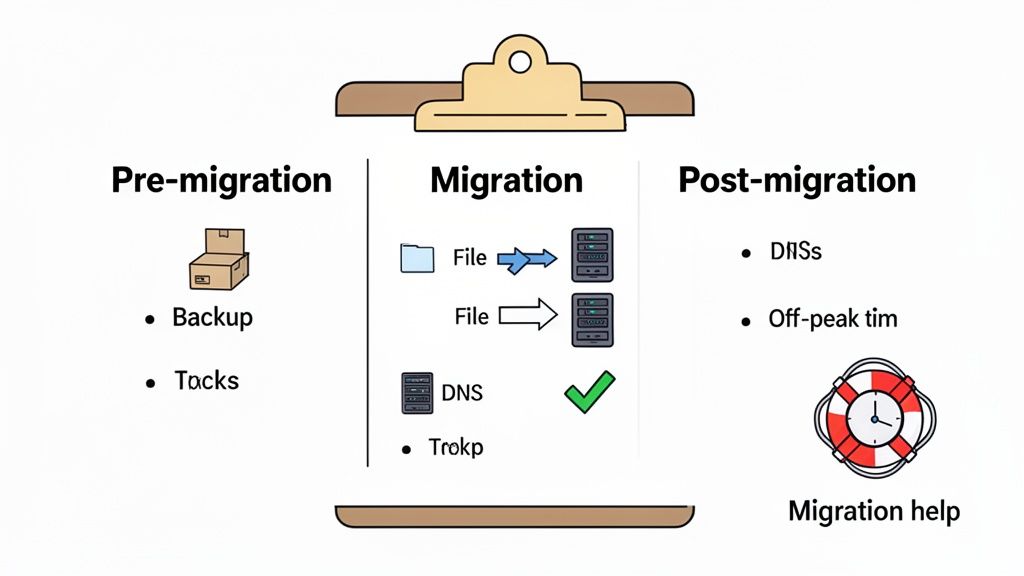
A well-planned migration really comes down to three phases: getting ready, doing the move, and checking your work. Following these steps helps you sidestep common mistakes and ensures a successful switch.
Phase 1: Pre-Migration Preparation
Before you even think about moving a single file, you need to lay the groundwork. This stage is all about auditing your current setup and creating a solid safety net. Don't skip it.
- Audit Your Current Site: Take a full inventory of everything on your current hosting account. I’m talking about all website files, databases, email accounts, and any custom configurations or cron jobs you have running. You'd be surprised what gets forgotten.
- Create a Full Backup: This is your most critical step. Generate a complete, downloadable backup of your entire site—all files and databases. Store this backup in at least two separate, secure locations, like your local computer and a cloud service like Dropbox or Google Drive.
- Choose the Right Provider: This is the perfect time to select a new Australian VPS provider that offers a helping hand. Many providers, including us at UpTime Web Hosting, often include free migration services with their managed plans. This can seriously reduce your workload and the risk of something going wrong.
A common mistake is forgetting all the little things, like email forwarders or specific server settings. A thorough audit prevents these from being left behind and ensures a seamless transition.
Phase 2: The Migration Process
Now for the main event. This is the active phase where you move your data from the old server to your new VPS. The goal here is to keep downtime to an absolute minimum.
- Transfer Website Files: Use FTP (File Transfer Protocol) or the File Manager in your control panel to upload all your website files to the new VPS.
- Migrate Databases: Export your database from your old host (this is usually an SQL file) and import it into the new database you've set up on your shiny new VPS.
- Configure Your Application: You'll need to update any configuration files (like
wp-config.phpfor a WordPress site) with the new database name, username, and password.
For a deeper dive into the common pitfalls, check out our guide on the 13 website migration mistakes you should avoid making to make sure your move is flawless.
When you're preparing the move, a smooth transition is everything. For more detailed guidance on achieving a website migration with zero downtime, this guide is a fantastic resource.
Phase 3: Post-Migration Checks
Once everything has been moved over, the final stage is to test, test, and test again before making the final switch. This is what ensures your visitors have an uninterrupted experience.
- Test Your Website: Before you touch your DNS settings, your new host can give you a temporary URL or another way to preview the site on the new server. Click through everything—check links, submit forms, and test user logins to confirm it's all working as it should.
- Update Your DNS Records: Once you’re confident everything is working perfectly, it's time to update your domain's nameservers or A records to point to your new VPS. Just be aware this change can take a few hours to propagate across the globe.
- Final Verification: After the DNS has fully updated, do one last round of testing on your live domain. This is your final chance to catch any gremlins and ensure everything is absolutely perfect.
Common Questions About Australian VPS Hosting
Even with a solid plan, jumping to a Virtual Private Server can bring up a few last-minute questions. Getting clear, straightforward answers is the key to making a confident decision. This section tackles some of the most common queries we hear from Australian business owners when they're on the hunt for the best VPS hosting Australia has to offer.
Think of it as the final check-in before you commit. We'll clarify some key distinctions and confirm the real-world value you should expect from a top-tier local provider.
What Is the Real Difference Between Managed and Unmanaged VPS?
The choice between managed and unmanaged hosting really boils down to one thing: who’s responsible for the technical heavy lifting?
A managed VPS is like having an expert IT team on call 24/7. Your provider handles the server setup, security patches, performance monitoring, and all the technical support. It's the perfect choice for business owners who would rather focus on running their business, not managing a server.
On the other hand, an unmanaged VPS hands you the keys to the kingdom with full root access. You get complete control, but you’re also on your own for all maintenance, updates, and troubleshooting. It’s a great fit for developers or businesses that already have a dedicated IT team in-house.
How Much Does VPS Hosting Typically Cost in Australia?
The price for a quality Australian VPS really depends on the resources you need—like vCPU cores, RAM, and NVMe storage—and whether you opt for a managed or unmanaged service.
While entry-level unmanaged plans might seem cheaper upfront, the costs can sneak up on you once you add essential extras like control panel licenses or backup solutions. A managed plan might have a higher monthly fee, but it often delivers far greater value in the long run by bundling in expert support, security, and maintenance.
When you're comparing prices, always check that they are GST-inclusive and that there are no hidden fees for essentials like backups or SSL certificates. Honest, transparent pricing is the hallmark of a provider you can trust.
For instance, a managed plan from UpTime Web Hosting includes daily backups, security monitoring, and genuine local support, which stops unexpected costs from popping up and saves you countless hours. You can see our straightforward pricing on our managed VPS plans page.
Is a VPS with an Australian Data Centre Necessary?
For any business with an Australian audience, the answer is a definite yes. Hosting your website in a local data centre slashes latency, which means faster page load times and a much better user experience for your customers.
This isn't just a minor tweak; the benefits are significant:
- Better SEO: Search engines often give preference to locally hosted sites in local search results, giving you an edge over the competition.
- Data Sovereignty: It helps ensure your business complies with Australian data privacy laws, like the Privacy Act 1988.
- Local Support: You get a support team that’s in your time zone, ready to help when you actually need them.
Can I Upgrade My VPS Plan as My Business Grows?
Absolutely. Scalability is one of the biggest advantages of a VPS. As your website traffic grows or your applications demand more power, a good provider will let you upgrade your plan without any fuss.
The process should be simple, allowing you to add more CPU, RAM, or storage with little to no downtime. This flexibility means your hosting can grow alongside your business, saving you from a painful server migration down the track. For more tips on getting started, check out our knowledge base article on how to choose the right VPS plan.
Ready to power your website with the best VPS hosting Australia has to offer? UpTime Web Hosting delivers high-performance, secure, and fully managed VPS solutions from our Australian data centres, backed by genuine local support. Explore our Managed VPS plans and find your perfect fit today.