So, what exactly is web maintenance and support? Think of it as the ongoing care that keeps your website healthy, secure, and performing at its peak long after it goes live. It’s a whole collection of crucial jobs, from software updates and security checks to performance tweaks and technical help, all designed to make sure your digital storefront is in top shape.
Why Your Website Needs Constant Care
It’s tempting to think of your website as a finished product, like a printed brochure. But it’s much more like a high-performance car. Once you drive it off the lot, it needs regular servicing to keep running smoothly and safely. Your website is no different – launching it is just the start.
Ignoring your site’s upkeep is like never changing the oil or checking the brakes on your car. It might seem fine for a bit, but you’re heading for a serious breakdown. This "set it and forget it" attitude is one of the biggest risks a business can take online. Your website is a living asset, constantly interacting with changing technology, new security threats, and evolving customer expectations. Without regular attention, it’s going to slow down, become vulnerable, and stop being effective at winning you business.
The Investment in Uptime and Security
Putting money into professional web maintenance and support isn’t just another business cost; it’s a vital investment in your most important digital asset. It’s the expert mechanic your site needs to stay competitive. This is exactly why the Australian web hosting and maintenance market is growing so quickly. In fact, the market was valued at a whopping AUD 3.67 billion for 2024–25, and it’s expected to grow by around 11% each year through to 2034 as more businesses realise how critical uptime and security are. You can dig into more data on the Australian web hosting market to see the trend for yourself.
Just as you wouldn't leave your physical storefront unlocked and unattended, your website requires continuous vigilance to protect it from digital threats and ensure it's always open for business.
At the end of the day, a well-maintained website protects your reputation, keeps customer data safe, and makes sure visitors have a great experience. Getting a dedicated team to proactively look after your site prevents those costly emergencies – like a hack or a site crash – that can do serious damage to your finances and your brand. For example, our managed web services provide this exact peace of mind, ensuring your site gets the expert, hands-on attention it deserves.

Performance you can feel, backed by clients who depend on it. Read how our support and uptime create long‑term customer success.Power Your Business with Better Hosting
The Essential Tasks in a Maintenance Plan
So, what does web maintenance and support actually involve? It’s much more than a vague promise to keep your site online. A proper plan is a specific, scheduled list of tangible tasks designed to protect, optimise, and refresh your digital presence. Think of it as a comprehensive service for your business's most important digital asset, making sure every part is working exactly as it should—from the code that powers it to the content your visitors see.
At its heart, a solid maintenance plan focuses on three key areas: security, performance, and updates. This visual helps show how these pillars support your website's overall health.
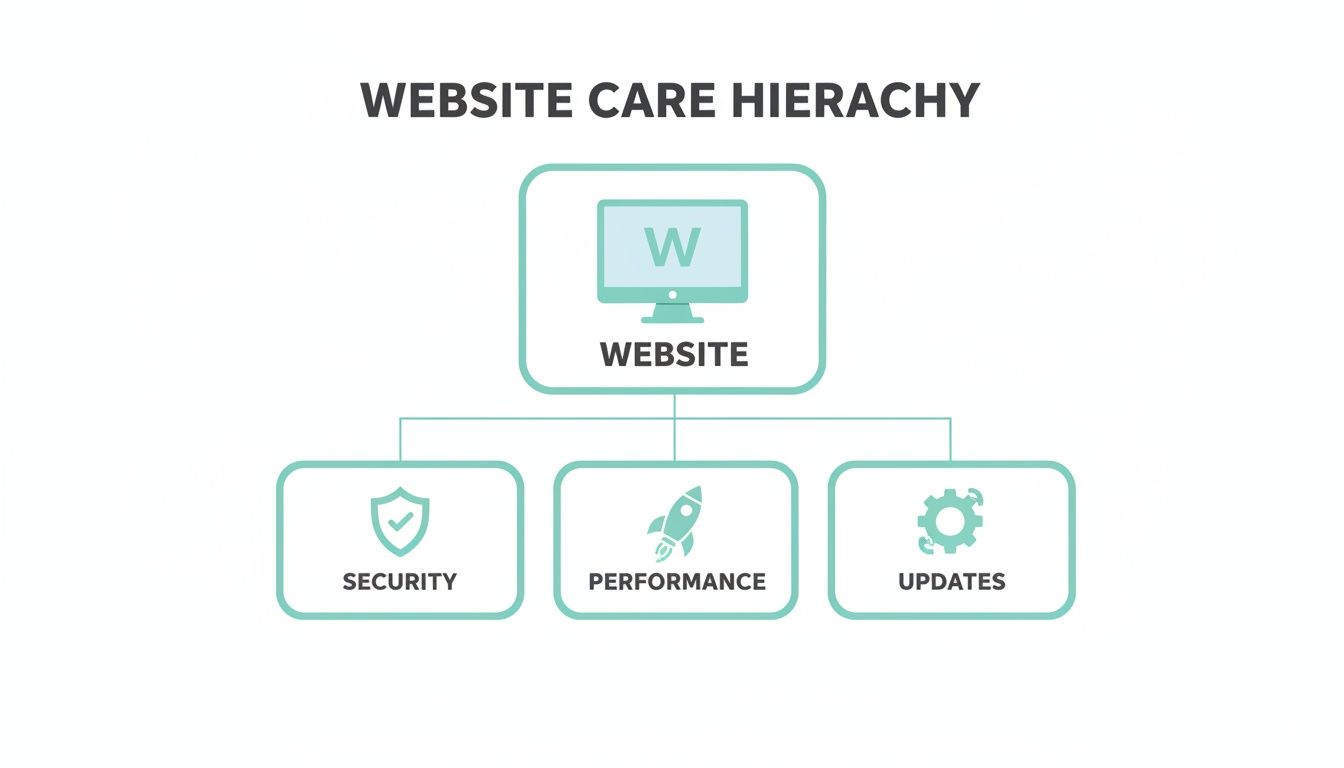
This hierarchy makes it clear: a healthy website is built on a foundation of consistent security, reliable performance, and timely software updates. Without these proactive measures, your site becomes vulnerable and unreliable.
Core Software and Security Updates
The single most critical part of any maintenance routine is keeping your website’s software up to date. This isn't just about the core Content Management System (CMS) like WordPress, but also any themes and plugins you're using. Developers constantly release updates to patch security holes, fix bugs, and sometimes add new features.
A practical example would be a popular e-commerce plugin discovering a flaw that allows hackers to access customer data. Applying the latest patch as soon as it's released closes that security gap immediately, protecting both your business and your clients. This isn’t just a recommendation; it’s a non-negotiable security practice.
Backups and Recovery Planning
Ask yourself this: what would happen if your website was suddenly deleted or corrupted? If you don’t have a recent backup, the answer is probably catastrophic. Regular, automated backups are your ultimate safety net.
A professional maintenance service doesn't just create backups; it verifies they are complete and can be restored quickly. This involves:
- Scheduled Backups: Taking complete copies of your site’s files and database at regular intervals. For an active e-commerce store, this should be daily.
- Off-site Storage: Storing these backups in a separate, secure location so they aren't affected if your server has an issue.
- Verification: Periodically testing the backups to ensure they're not corrupted and can be used to fully restore your site if needed.
A backup you haven’t tested is just a hope. A verified backup is a recovery plan. This one task can be the difference between a minor inconvenience and a business-ending disaster.
Performance and Uptime Monitoring
Your website’s speed has a direct impact on user experience and your search engine rankings. A slow-loading site frustrates visitors and can seriously harm your visibility on Google. Performance optimisation is a continuous process. For example, a maintenance technician might regularly compress images and minify CSS/JavaScript files to reduce load times. Our guide explains in detail how your hosting service affects website speed and the huge role it plays in performance.
On top of that, uptime monitoring ensures your site is always accessible to your customers. This involves automated checks that alert your support team the moment your website goes down, allowing them to start fixing the issue immediately—often before you or your customers even notice.
To see how these moving parts fit together into a regular schedule, we've put together a simple checklist.
Essential Web Maintenance Checklist
Here's a look at the key tasks that should be part of any comprehensive maintenance plan, along with a guide to how often they should be done.
| Maintenance Task | Recommended Frequency | Why It's Critical |
|---|---|---|
| Full Website Backups | Daily or Weekly | Your ultimate safety net against data loss, hacks, or server failure. |
| Software Updates | Weekly | Patches security vulnerabilities and fixes bugs in your CMS, plugins, and themes. |
| Security Scans | Weekly | Proactively detects malware, viruses, and suspicious activity. |
| Performance Checks | Monthly | Monitors page speed and identifies bottlenecks that frustrate users. |
| Database Optimisation | Monthly | Cleans out old data and keeps your site running efficiently. |
| Uptime Monitoring | 24/7 | Ensures you're the first to know if your site goes down, not your customers. |
| Broken Link Checks | Monthly | Fixes dead links to improve user experience and SEO. |
| Spam Comment Cleaning | Weekly | Keeps your site professional and prevents malicious links from appearing. |
Having a clear schedule like this turns website care from a reactive headache into a proactive strategy. If you want a more exhaustive list of tasks, you can also check out this an ultimate website maintenance checklist to see how deep a professional plan can go.
Protecting Your Digital Front Door
Your website is your business's digital front door. Just like you wouldn't leave your shop unlocked overnight, your website needs to be secure. For most Aussie business owners, security is a huge concern, and for good reason. Proactive web maintenance and support is your first and most important line of defence against a constant barrage of digital threats.
Without someone keeping an eye on things, your site is a sitting duck for common risks like malware injections, which can infect your pages with nasty code, or brute-force attacks where bots hammer your login page with thousands of passwords. A solid support plan is all about locking that digital door and making sure it stays locked.
Proactive Security Measures
Good website security isn't a "set and forget" task; it’s a continuous process of staying one step ahead. Several key jobs are absolutely essential for protecting your online presence and, more importantly, your customer's data. Putting robust security measures in place is the foundation of any decent maintenance strategy.
This ongoing protection really boils down to a few critical activities:
- Timely Security Patching: When developers find a weak spot in your website's software (like WordPress or its plugins), they release a "patch" to fix it. A practical example is applying a patch for a WordPress plugin within hours of its release, before hackers can exploit the vulnerability.
- SSL Certificate Management: That little padlock in the browser bar? That’s your SSL certificate, and it encrypts the data between your site and your visitors. A maintenance plan ensures your certificate is automatically renewed before it expires, preventing security warnings that deter customers.
- Regular Malware Scanning: Think of this as a regular security sweep. Automated, frequent scans search through your website's files, looking for any signs of malicious code. For instance, a scan might detect and quarantine a malicious file uploaded via a contact form, stopping an attack before it spreads.
The Real-World Stakes for Australian Businesses
The threat of a security breach isn't just something you see in the movies; it's a growing reality for local businesses right here in Australia. In fact, the need for fast incident response and security-focused support is becoming one of the biggest reasons businesses sign up for maintenance contracts.
The Office of the Australian Information Commissioner reported 1,113 data breaches in a recent 12-month period. This alarming number has pushed Aussie organisations to prioritise maintenance plans that include security audits and active malware monitoring to cut down their risk.
This trend shows exactly why Australian businesses are now looking at security so closely when choosing a provider. It's become a deal-breaker.
Some industry reports even show that "Security & Risk Mitigation" can make up around 20% of a vendor's evaluation score, which tells you how critical this protection has become. Investing in a managed plan is no longer just about convenience—it's about keeping your business safe and sound online.
Host your website with our 5-star rated, cPanel website hosting plans.
Super fast servers, with security included and hosted in your choice of Australian Data Center.
View cPanel Plans
Making Sense of Service Levels and Support
The "support" part of web maintenance and support is what really gives you peace of mind. It’s your lifeline to an expert when something breaks, or even when you just need a hand with something small. This is all laid out in a document called a Service Level Agreement (SLA), which should be a non-negotiable part of any professional plan you're considering.
An SLA isn’t just a page of vague promises; it's a firm contract that clearly outlines what you can expect. It sets the ground rules for things like support availability, how quickly you'll get a response, and what kinds of issues are covered. Without one, you're basically just hoping for the best, which is a risky spot for any business to be in.
Understanding Support Tiers and Response Times
Not all support is created equal, and good providers usually offer different levels to suit different types of businesses. A small blog might just need standard email support during business hours, but an online store that’s making sales around the clock needs access to 24/7 emergency help. The trick is to find a level that matches how critical your website is to your day-to-day operations.
Let’s put this into a real-world context:
- Standard Support: You spot a typo on your "About Us" page. With a basic plan, you'd log a ticket, and the SLA might guarantee a response within 24 hours to let you know they’re on it.
- Premium Support: Your e-commerce checkout suddenly stops processing payments, bringing your sales to a grinding halt. A premium plan could promise a 1-hour response time, meaning an expert is actively digging into that critical issue almost immediately.
This is where it’s important to understand the lingo. A lot of people get hung up on just the initial reply time.
Response time is how long it takes for the support team to acknowledge your request and start looking into it. Resolution time is the total time it takes to actually fix the problem. A solid SLA will give you clear expectations for both.
What Does Support Typically Cover?
Beyond just putting out fires, a good support plan is there to help with the small but important tasks that keep your website ticking over. This is where you get incredible value from your investment, saving yourself countless hours and technical headaches. Most plans will include a set number of small jobs or a block of time each month.
These tasks often include things like:
- Bug Fixes: For example, your online contact form suddenly stops sending you emails. A support task would be to investigate and fix the configuration issue.
- Minor Content Changes: Updating a bit of text, swapping out an image, or adding a new team member to your staff page.
- Plugin Configuration: Helping you tweak the settings on a new plugin you've installed, such as configuring shipping rules for a new courier.
- General Questions: Giving you expert advice on how to get the most out of your website's features.
Taking the time to evaluate these service levels helps you figure out what your business genuinely needs. For those who can't afford any downtime and need the highest level of assurance, exploring options like UpTime's Premium Support offers a clear look at what top-tier, priority service involves. It’s all about matching the support level to your business risk and making sure help is there right when you need it.
How to Choose the Right Maintenance Partner
Picking a provider for your web maintenance and support is a massive decision for any Aussie business. It’s not just about finding the cheapest plan; you’re handing over the keys to your most valuable digital asset. You need a team you can trust to protect and grow it.
To make the right call, you need to go in armed with the right questions. A solid partner will have clear, confident answers that actually make sense for your business goals. Think of it as hiring an extension of your own team—someone who brings real value and lets you sleep at night.

Key Questions for Evaluating Providers
Let's cut through the marketing fluff. To figure out if a provider is the real deal, you need to dig into a few core areas. These questions will reveal their true capabilities, how reliable they are, and whether they're the right fit for you.
First up, let’s talk technical skills.
- What website platforms do you specialise in? You wouldn't hire a plumber to fix your car. If you have a WordPress site, you want a team that lives and breathes WordPress, not a generalist who dabbles in it.
- Can you show me examples of similar sites you manage? This is your chance to see their work in the wild. It proves they've got the experience and gives you a feel for the quality you can expect.
- What is your process for handling a security incident? A prepared team will have a documented incident response plan. They should be able to walk you through how they would identify, contain, and resolve a threat like a malware infection, including steps like restoring from a clean backup and hardening site security.
Support Availability and Local Presence
For any Australian business, having local support is a game-changer. There's nothing worse than having your site go down at 2 PM on a Tuesday, only to find your support team is fast asleep in another time zone.
Here’s what you need to ask about their support structure:
- Is your support team based in Australia? This is non-negotiable. Local support means they're awake when you are and understand the rhythm of your business day.
- What are your standard support hours and what happens in an emergency? Get clear on their availability. Know who you can call for a routine tweak versus a middle-of-the-night catastrophe.
- Who will I be speaking to? Will you get a different person every time, or will you have a consistent point of contact? Building a relationship with a dedicated team makes a huge difference.
Finding a partner who operates on your schedule and understands the local market isn't just a convenience—it's a critical component of effective and responsive website support.
Pricing Transparency and Client Feedback
Finally, let's talk money. The financial side of the partnership needs to be crystal clear. Vague pricing and hidden fees are major red flags.
Costs for web maintenance and support can vary wildly. You might see basic plans starting around AUD 200 per month, while comprehensive managed services can climb past AUD 1,000. It's also worth noting that Sydney-based rates can often be 40–50% higher than in regional areas. To get a better handle on what's fair, it helps to understand the factors that influence website costs in Australia.
To make sure you’re getting what you pay for, ask these questions:
- Can you provide a detailed breakdown of what’s included in your plans? Look for a clear list of what's covered, what's not, and what any extras (like emergency support) will cost you.
- Do you have testimonials or references from other local businesses? Hearing directly from other Aussie clients is gold. It gives you invaluable insight into their reliability and service quality. A strong track record with businesses like yours is the best sign you've found a winner.
Your Web Maintenance Questions Answered
We get it. Even when you know what’s involved, the practical side of professional web maintenance and support can bring up a lot of questions. We hear these all the time from Aussie businesses, so let's tackle the big ones head-on and give you the straightforward answers you need.
Can I Handle Website Maintenance Myself to Save Money?
It’s definitely tempting to roll up your sleeves and try to manage your site’s upkeep yourself, especially when you’re watching every dollar. But honestly, it's a path loaded with hidden risks.
Sure, you can probably handle clicking "update" on a plugin. The real work, though, goes much deeper. For example, a professional will first test updates on a staging server to ensure they don't cause conflicts or break your site. They’re also implementing and monitoring security measures that go way beyond a simple plugin and have a battle-tested recovery plan ready to roll if the worst happens.
The cost of a professional maintenance plan is almost always far less than the cost of lost revenue, reputation damage, and emergency repair bills from a hacked or broken website. It's a strategic investment in business continuity and your own peace of mind.
How Much Should Web Maintenance Cost in Australia?
There’s no single price tag for web maintenance in Australia. The cost really depends on how complex your site is, what it does for your business, and the level of support you need.
For a small business website with basic needs like software updates and regular backups, you’ll likely see plans starting around $100 to $300 per month. For a more involved e-commerce site needing advanced security, constant monitoring, and rapid support for critical issues, plans can easily range from $300 to over $1,000 per month.
When looking at prices, it's crucial to look past the number and focus on the value. Think about the provider's expertise, the guarantees in their Service Level Agreement, and the security measures included. A cheap plan that leaves you hanging when you need it most is no bargain at all.
What Is the Difference Between Web Hosting and Web Maintenance?
This is a fantastic question and a super common point of confusion. Let’s break it down with a simple analogy: building a house.
- Web Hosting is the block of land your website (your house) is built on. It provides the essential space and utilities—like power and water—to keep your house standing and accessible. Without hosting, your website simply has nowhere to "live" online. You can learn more about this in our article on how your hosting service affects website speed.
- Web Maintenance is all the ongoing upkeep of the house itself. It’s locking the doors and windows (security), fixing a leaky tap (bug fixes), cleaning the gutters (performance optimisation), and giving it a fresh coat of paint (content updates).
While some companies bundle the two, they are distinct and equally vital services. Hosting keeps the lights on; maintenance ensures your home is safe, secure, running efficiently, and looking its best for visitors.
My Website Works Fine, So Why Do I Need Maintenance?
This is the classic "if it ain't broke, don't fix it" mindset, and online, it’s a dangerous one. So many of the most serious website issues are completely invisible until it's far too late.
Your site might look fine on the surface, but an outdated plugin could have a critical security vulnerability that hackers are actively searching for. Its performance might be slowly degrading over time, causing a subtle drop in your SEO rankings and frustrating users without you even noticing.
Good web maintenance and support is proactive, not reactive. It’s about preventing catastrophic problems—like getting hacked, crashing after a dodgy update, or losing all your data—instead of scrambling to fix the immense damage after it’s already happened. It’s what ensures your website stays working fine.
Ready to protect your digital asset with expert, local care? At UpTime Web Hosting, we provide fast, secure, and reliable Australian web maintenance and support to keep your site performing at its best. Explore our managed services and get the peace of mind you deserve.