
When you're looking for the best Australian web hosting, the single most important decision is picking a provider with local data centres. Having your website hosted in a city like Sydney or Melbourne isn't just a small technical detail—it's a game-changer. It directly boosts website speed for your Aussie customers and gives your local SEO a serious advantage over competitors using servers halfway across the world.
Why Local Australian Web Hosting Matters
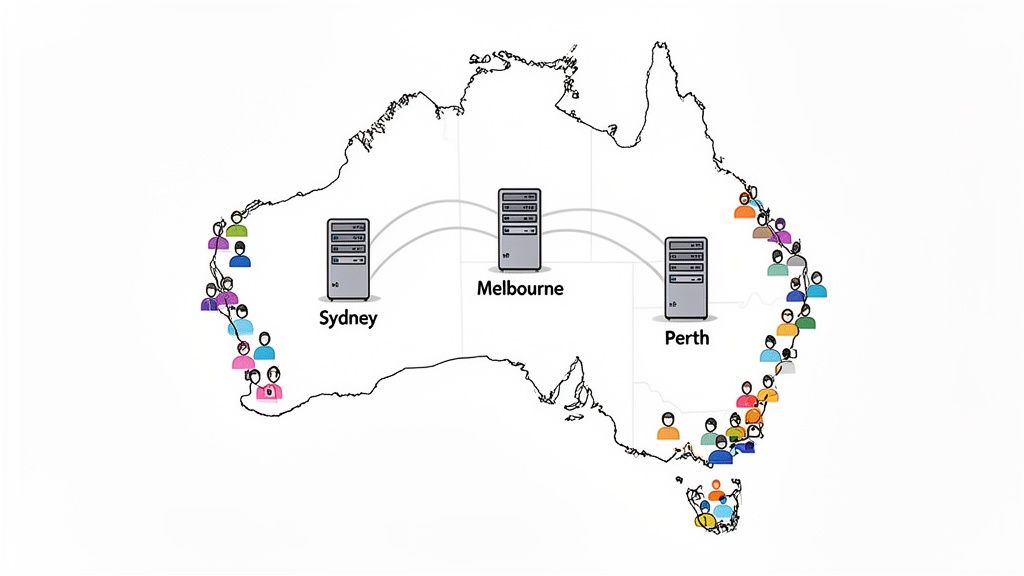
Choosing a web host might feel like just another item on a long to-do list, but for any Australian business, it's a strategic move. Where your website's data lives has a real, tangible impact on user experience, how you rank in search engines, and even your legal compliance. It’s the difference between a sluggish site that frustrates visitors and a snappy, responsive one that keeps them coming back.
The main benefit boils down to one word: latency. This is simply the time it takes for data to get from the server to your visitor's web browser. If your server is in Sydney and your customer is in Melbourne, that trip is incredibly fast. But if your server is in the United States, that data has to travel thousands of kilometres, creating noticeable delays.
The Real-World Impact of Server Location
Think about it like ordering a package. An order from a warehouse in your own city will always get to you faster than one shipped from overseas. Your website works on the exact same principle.
A delay of a few milliseconds might not sound like a big deal, but it's enough to affect everything from bounce rates to online sales. For example, a Perth-based florist whose website is hosted in Perth will load almost instantly for local customers searching for last-minute bouquets, likely securing a sale over a competitor whose US-hosted site takes an extra two seconds to load.
On top of that, search engines like Google prioritise sites that offer a great user experience, and page speed is a massive ranking factor. By choosing a host with Australian infrastructure, you’re sending a clear signal that your business is for an Australian audience, which can give your local SEO a welcome boost.
Data Sovereignty and Security
Beyond pure speed, hosting locally is absolutely critical for data sovereignty. Keeping your business and customer data on Australian soil means it's protected by Australian privacy laws. This is especially important if you handle any sensitive information, as it gives you a clear legal framework and some much-needed peace of mind.
We dive deeper into this in our article about why it’s important to host your website in Australia.
The demand for high-quality, local hosting isn't surprising when you see how Australian businesses have shifted online. The industry revenue for Cloud Hosting and Data Processing Services is on track to hit $3.9 billion in 2025, thanks to an impressive 8.1% compound annual growth rate since 2020. This lines up perfectly with the explosion in online activity, where active Australian domain names jumped by 27.3% to 1.7 million in a single year.
This guide will compare the best Australian web hosting providers by zeroing in on what truly matters: performance, local support, rock-solid security, and transparent pricing. Getting these fundamentals right will empower you to make a choice that genuinely supports your business’s growth.

Performance you can feel, backed by clients who depend on it. Read how our support and uptime create long‑term customer success.Power Your Business with Better Hosting
Key Criteria for Evaluating Australian Hosts
Choosing the right Australian web host is about more than just picking the cheapest plan. To make a smart decision, you need to look past the flashy ads and dig into the technical details that actually impact your website’s performance, security, and day-to-day reliability.
Think of it as a checklist. By breaking it down into five core pillars, you can cut through the marketing fluff and find a provider that truly aligns with your business goals. Let's get into what you should be looking for.
Performance and Infrastructure
Performance isn't just a vague promise of "speed"—it’s a direct result of the technology your host uses. First and foremost, look for providers with Australian data centres in major cities like Sydney or Melbourne. Keeping your data physically closer to your local customers dramatically cuts down latency, which is the delay it takes for your site to start loading.
Beyond location, modern server software is non-negotiable. A host running LiteSpeed Web Server will handle traffic far more efficiently than one using older, clunkier alternatives. When you pair that with tools like AccelerateWP, you get dynamic caching for your WordPress site. Imagine an online store during a massive sale—this combination is what keeps the site snappy and responsive even when thousands of people are browsing at once. For a deeper dive, check out our guide on how your hosting service affects website speed.
Security Features
A great hosting provider is your first line of defence against all sorts of online nasties. Don't just assume they have you covered; you need to check their security measures thoroughly.
Here are the essentials to look for:
- DDoS Protection: A powerful firewall that can filter out malicious attacks designed to knock your website offline.
- Regular Malware Scanning: Automated scans that hunt for and quarantine malicious code before it can cause any real damage.
- Free SSL Certificates: This encrypts the connection between your site and your visitors. It’s a standard feature for any reputable host these days.
- Nightly Backups: Automated, off-site backups are your safety net. They ensure you can restore your website quickly if the worst happens.
A proactive approach to security is what separates the good hosts from the great ones. It’s not enough to just react to threats. The best providers invest in secure, isolated environments using technologies like CloudLinux to prevent problems from happening in the first place.
Australian Support
When something goes wrong, you need quick, effective help from people who actually understand the local landscape. Prioritise hosts that offer genuine Australian support channels, like a local 1300 phone number and a responsive ticket system. For example, if your Melbourne-based business site goes down at 9 AM AEST, you want immediate help, not to be waiting for a support team in another time zone to start their day. When you're looking at different providers, it's worth weighing up the quality of their comprehensive support and hosting services.
Pricing Transparency
Hidden fees can quickly turn an "affordable" plan into a financial headache. The best Australian hosts are completely upfront about their costs. Look for GST-inclusive pricing displayed clearly on their website, with no sneaky charges for features that should be standard. A transparent provider will also have a straightforward refund policy and won’t try to lock you into long, inescapable contracts.
Scalability and Resource Allocation
Your business is going to grow, and your hosting needs to be able to keep up. A good host offers clear upgrade paths, letting you seamlessly add more resources like CPU, RAM, and storage as your traffic climbs. It’s also wise to check for generous or uncapped allocations for things like bandwidth and add-on domains. This gives you the flexibility to expand your online presence without hitting frustrating, and often costly, limits.
A Detailed Comparison of Top Australian Providers
Alright, now that we know what to look for in a web host, let's put that knowledge to work. We're going to dive into how the top Australian hosting providers actually stack up against each other, going beyond the marketing jargon to see what the differences really mean for your business.
Choosing a host isn't about finding the single "best" one on the market. It's about finding the provider whose strengths are the perfect match for what you need to achieve online. So, let's compare some of the common offerings out there and see how small details can make a massive difference to your website's success.
This graphic really nails down the core pillars you should focus on: performance, security, and support.
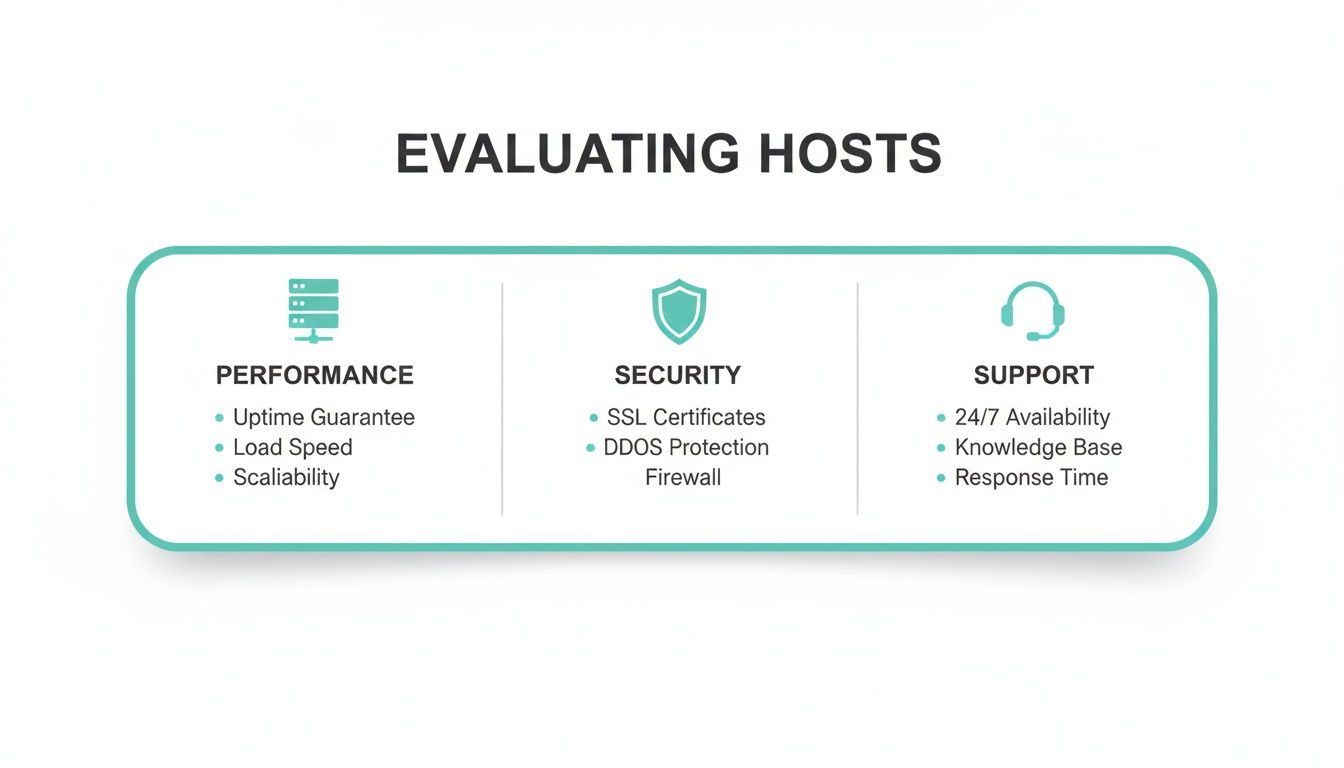
It’s a great reminder that you need a balanced approach. A good host has to deliver on all three fronts to give you a reliable online presence.
Performance: A Tale of Two Servers
On the surface, hosting plans can look identical. They all promise "fast" speeds, right? But the technology running things behind the scenes is what truly matters. Many hosts still use standard Apache servers, which are decent, but they can really start to buckle under pressure from busy sites like WordPress or eCommerce stores.
This is where a modern provider like UpTime Web Hosting pulls ahead by using LiteSpeed Web Server technology on all plans. This isn't just a minor tweak; LiteSpeed is engineered to handle way more traffic while using fewer server resources.
Think of it this way: you run an online store and launch a huge flash sale. With a standard host, that sudden surge of visitors could slow your site to a crawl, causing people to abandon their carts in frustration. With LiteSpeed, your site stays snappy and responsive, making sure every customer has a smooth checkout.
Security: The Backup Differentiator
Almost every host will say they offer backups, but the devil is in the details. The frequency, security, and how you access those backups can vary wildly. It's common to see providers offering weekly backups, which sounds okay until you realise you could lose up to six days of orders, blog posts, or customer sign-ups if disaster strikes.
Here’s where a premium approach really shows its value. While a competitor might offer those basic weekly backups, a provider like UpTime Web Hosting gives you encrypted, off-site nightly backups through services like JetBackup. For any business that handles customer data or updates content regularly, this is a non-negotiable feature.
Key Insight: Nightly, encrypted, and off-site backups aren't a luxury; they are a fundamental part of a smart business continuity plan. It means that even in a worst-case scenario, your data is safe, and a recent version of your site is ready to be restored.
Support: Local Expertise vs. Global Call Centres
When your website goes down, the absolute last thing you want is to be stuck on hold with an overseas call centre. While many of the global giants boast 24/7 support, the quality can be a real coin toss. You might get an agent who doesn’t understand the Australian market or lacks the technical chops to fix your problem quickly.
This is where truly local support shines. Having a 1300 number that connects you to an Australian-based team means you're talking to experts who get the local context and are empowered to sort things out properly. That direct line can turn a major headache into a minor hiccup.
The demand for this level of service is huge. By 2025, Australia's web hosting market is expected to hit €4.47 billion (that's about AUD 7.3 billion), fuelled by businesses wanting better performance. For Aussie small businesses, having local data centres in Sydney or Melbourne can slash latency by up to 50% compared to overseas servers—a game-changer for modern websites.
Pricing and Value: It’s What’s Included That Counts
Transparent pricing isn’t just about showing you the GST-inclusive cost. It’s about the real value you get for your money. Some hosts will reel you in with a super-low introductory price, only to sting you with extra fees for essentials like malware scanning, SSL certificates, or proper caching.
A host that bundles these critical features into their standard plans offers far better long-term value. For instance, UpTime Web Hosting includes LiteSpeed with AccelerateWP, free malware scanning, and CloudLinux for server stability right out of the box. This saves you money and ensures your site is fast and secure from day one, without you needing to become a tech wizard.
If you want to see exactly how different hosts compare feature-for-feature, our detailed host comparison tool can be really helpful.
Feature Comparison of Leading Australian Web Hosts
To lay it all out, let's look at a side-by-side comparison. This table gives you a clear snapshot of how a premium local host like UpTime Web Hosting measures up against the typical competitors you’ll find in the Australian market.
| Feature | UpTime Web Hosting | Competitor A (Budget Host) | Competitor B (Global Giant) |
|---|---|---|---|
| Server Location | Sydney, Melbourne, Perth | Sydney Only | "Global" (Often US/SG) |
| Server Tech | LiteSpeed with AccelerateWP | Apache | Apache or NGINX |
| Backups | Daily, Encrypted, Off-Site | Weekly, On-Server | Daily (Often a Paid Add-on) |
| Support Channels | 1300 Phone, Tickets, Call-Backs | Tickets Only | Phone, Chat (Global Centre) |
| Security Suite | Free SSL, Malware Scan, DDoS | Free SSL Only | Basic Firewall, Upsells |
| Pricing Model | GST-Inclusive, No Hidden Fees | Low Intro Rate, High Renewals | Complex Tiers, Many Add-ons |
This table makes the differences in value pretty obvious. While Competitor A might look cheaper at first glance, the better technology, security, and support from a provider like UpTime Web Hosting deliver a far more reliable and cost-effective solution in the long run. And Competitor B's massive scale doesn't always translate into better service for an Aussie business.
Ultimately, the best Australian web hosting provider is one that invests in local infrastructure, takes security seriously, and offers expert local support. By looking past the headline price and digging into these crucial details, you can find a genuine partner that will help your business grow.
Host your website with our 5-star rated, cPanel website hosting plans.
Super fast servers, with security included and hosted in your choice of Australian Data Center.
View cPanel Plans
Matching a Host to Your Business Needs
Choosing the right Australian web hosting isn't a one-size-fits-all deal. The perfect provider for a simple blog could be a disaster for a high-traffic eCommerce store. To find your ideal match, you have to look past the marketing noise and align a host’s features with your actual business goals.
It’s about moving beyond generic feature lists and into practical, real-world scenarios. By breaking down different business types and their core needs, you can zero in on the features that truly matter and will support you as you grow.
The New eCommerce Store
If you're launching an online store with WordPress and WooCommerce, performance and security are everything. Every extra second your site takes to load costs you sales, and a single security breach can destroy the trust you've built with your customers. Your absolute priority is a host that can handle dynamic content and lock down sensitive transaction data.
A perfect fit here is a provider offering:
- LiteSpeed with AccelerateWP: This combo is built to cache dynamic content—think shopping carts and personalised product pages—keeping your store lightning-fast, even during a Black Friday rush.
- Free Malware Scanning: You need proactive, automated scans that find and eliminate threats before they can touch your customers' payment details. It's non-negotiable.
- Nightly Encrypted Backups: If the worst happens, having a daily backup of your orders and product list is the ultimate safety net.
These features directly tackle the biggest risks and opportunities an eCommerce business faces, setting you up for a smooth, secure, and profitable operation.
The Digital Agency Managing Client Sites
For a digital agency or a developer juggling multiple client projects, the game changes. Your needs shift towards efficiency, control, and scalability. You need a platform that lets you manage dozens of websites without hitting frustrating limits or getting bogged down in admin tasks.
Look for a host that provides:
- Uncapped Add-On Domains: This is a game-changer. It lets you host as many client websites as you need under one powerful plan, without getting dinged with extra fees for each new site.
- Full cPanel Access: A solid control panel like cPanel is essential for quickly spinning up new sites, managing databases, and creating email accounts for your clients. It just makes life easier.
- Generous Resource Allocation: Plenty of CPU, memory, and storage is critical. You can't have one client’s traffic spike slowing down everyone else on your account.
This kind of setup streamlines your entire workflow, letting you focus on building amazing websites instead of fighting with your hosting environment. For more guidance, our article on how to choose the best web hosting service offers some great additional insights.
The Developer with Specific Technical Needs
Not every project fits the standard Linux, Apache, MySQL, and PHP (LAMP) mould. Developers working with Microsoft technologies have a completely different checklist. For them, compatibility isn't just a feature—it's the whole ball game.
A common mistake is trying to shoehorn a Windows application onto a Linux server. The best Australian web hosting providers will offer distinct, specialised hosting plans to avoid compatibility nightmares and ensure your app runs the way it was meant to.
A developer building an application with ASP.NET, for instance, must find a host that explicitly offers:
- Windows Hosting: This is the foundational requirement, providing the Windows Server operating system needed to run .NET applications properly.
- MSSQL Database Support: Microsoft SQL Server is the go-to database for many Windows-based apps, making this a must-have.
- Specific Framework Versions: The ability to select the right version of the .NET Framework is crucial to prevent conflicts and ensure your application runs smoothly.
It's about finding the right tool for the job. Similarly, a trades-based business has its own unique requirements. For example, understanding tailored website solutions for builders helps clarify what features to look for, like rock-solid email hosting for client communication and reliable performance to showcase project portfolios without a hitch.
Why UpTime Web Hosting Is a Top Contender

After weighing up the features that really define the best Australian web hosting, it's pretty clear why UpTime Web Hosting keeps coming out on top. It’s not just about ticking the right boxes. It's about providing a complete package that’s genuinely built for Aussie businesses, blending performance, security, and real local accountability.
The cornerstone of their entire offering is being 100% Australian owned and operated. This isn’t just a tagline; it means their infrastructure, their support team, and the business itself are all based right here. That translates directly into faster, more dependable service and a support team that actually gets the local market.
Transparent Pricing and Genuine Value
One of the most refreshing things you'll notice is their pricing. It’s straightforward and transparent. All costs are shown upfront with GST included, which gets rid of the guesswork and nasty hidden fees you often find with international providers. For any small or medium business trying to manage a budget, that’s a massive win.
UpTime also adds real value with things like its loyalty rewards program, which gives you points that you can credit towards future invoices. It’s a simple gesture, but it shows they're committed to building long-term relationships, not just chasing a quick sale.
For a budget-conscious SMB, clear, GST-inclusive pricing and loyalty rewards aren't just minor perks. They represent a predictable, fair financial partnership that allows for better planning and reduces the total cost of ownership over time.
Premium Features Included as Standard
Where UpTime really pulls ahead of the pack is its decision to include premium features without charging extra. So many hosts will lure you in with a low entry price, only to hit you with extra fees for the tools you actually need to run a fast, secure website.
This is just a fundamentally different approach. Instead of upselling you on the essentials, UpTime builds them into their core service.
- LiteSpeed Servers: Every single plan runs on LiteSpeed technology. It's measurably faster and more efficient than older Apache servers, especially if you're running a dynamic site like WordPress.
- CloudLinux OS: This creates a much more stable and secure hosting environment by isolating each account. If another user’s site on the server gets a huge traffic spike, your website’s performance won’t be affected at all.
- Comprehensive Security: Free SSL certificates, strong DDoS firewalls, and automated malware scanning are all part of the deal, giving you a solid security setup from day one.
These inclusions mean every customer gets a high-performance, secure foundation without having to navigate a confusing list of paid add-ons. You can see their full commitment to reliability with their 99.9% Up-Time Guarantee.
The Australian web hosting market is booming. The Asia-Pacific region is set to grab a 29% global share (worth USD 31.26 billion) by 2025. With active domains jumping 27.3% to 1.7 million in just one year, features like uncapped databases and add-on domains have become absolutely critical. UpTime’s combination of LiteSpeed tech and generous resources gives you a vital performance edge in this competitive space. You can read more about these web hosting service findings to understand the market's growth.
Ultimately, UpTime Web Hosting excels by focusing on what Australian businesses need most: genuine local infrastructure and support, fair pricing, and a powerful set of tools included by default. This makes it a top contender for anyone seeking a reliable, high-value hosting partner.
Common Questions About Australian Web Hosting
Even with all the facts laid out, picking the right Australian web host can still leave you with a few nagging questions. Getting straight answers is the key to making a choice you feel good about—one that will support your business for years to come.
Let's tackle some of the most common queries we hear from Aussie business owners.
Do I Need an Australian Host if My Customers Are Global?
This is a fantastic question, and it all comes down to where the majority of your audience is. If you're running an Australian business and your main customer base is right here at home, then you absolutely need local hosting. The speed boost and local SEO benefits for your Australian visitors are just too big to pass up.
But what if you have a genuinely global audience, with a lot of traffic coming from, say, Europe or North America? This is where a Content Delivery Network (CDN) becomes your best mate. A CDN works by storing copies of your website on servers all over the world, so a visitor from London gets just as fast an experience as someone from Melbourne. A popular and effective choice is the Cloudflare CDN, which is often easy to integrate via your hosting control panel.
For an Australian business with a global footprint, the perfect setup is local hosting for your core Aussie audience, paired with a CDN for your international visitors. It's the best of both worlds, giving you top-notch speed at home and abroad without hurting your local search ranking.
How Do I Migrate My Existing Website to a New Host?
The thought of moving an entire website can be a bit daunting, I get it. But any reputable host will make it a surprisingly painless process. Most top-tier Australian providers, including UpTime Web Hosting, offer a free migration service. Their team of experts handles the whole transfer for you, making sure there’s zero downtime or lost data.
The process usually looks something like this:
- You give your new host the login details for your old hosting account.
- Their team gets to work, copying all your website files and databases over to the new server.
- They run a full suite of tests to make sure everything is working perfectly before you flick the final switch.
This hands-off approach means you can keep focused on running your business while the tech experts handle the heavy lifting. If you're curious about the details, our guide on how to transfer a domain name in Australia is a great read, as this often goes hand-in-hand with moving your hosting.
What Is cPanel and Why Is It Important?
Think of cPanel as the dashboard for your website. It’s the industry-standard control panel for managing your web hosting account, giving you a user-friendly, graphical interface to handle everything without needing a computer science degree.
From your cPanel, you can easily take care of essential tasks like:
- Creating and managing professional email accounts for your domain. For instance, setting up
contact@yourbusiness.com.au. - Installing software like WordPress with just a couple of clicks using tools like Softaculous.
- Managing all your website files and databases.
- Keeping an eye on your resource usage and website traffic stats.
In short, cPanel takes the complexity out of website management. A host that provides cPanel is giving you a powerful and intuitive tool to properly control your online presence. You can learn more about its features in our cPanel hosting knowledge base article.
What Level of Support Can I Expect from a Local Host?
This is where choosing a genuinely Australian host really shines. With a local provider, you’re getting support from a team that actually understands the Australian business landscape and, crucially, works in your time zone. No more waiting until midnight to get on the phone with an overseas call centre.
Proper local support should always include:
- A 1300 phone number so you can speak directly to an Australian-based expert.
- A responsive support ticket system with quick, helpful replies that actually solve your problem.
- The option to request a call-back, so you’re not stuck on hold listening to bad music.
This kind of accountable, expert support is one of the biggest reasons to choose a local provider for the best Australian web hosting experience. It’s the peace of mind that comes from knowing real help is just a quick phone call away when you need it most.
Ready to experience the difference that 100% Australian hosting makes? At UpTime Web Hosting, we combine world-class performance with genuine, local support to give your business the reliable online foundation it deserves. Explore our plans and get started today!