Picture your business phone system working a bit like Netflix. Instead of being tied to old-school copper wires, your calls are streamed straight over the internet. That's the simple idea behind Voice over Internet Protocol (VoIP), and it’s a game-changer for how Australian small businesses communicate.
What Is a VoIP Telephone System?
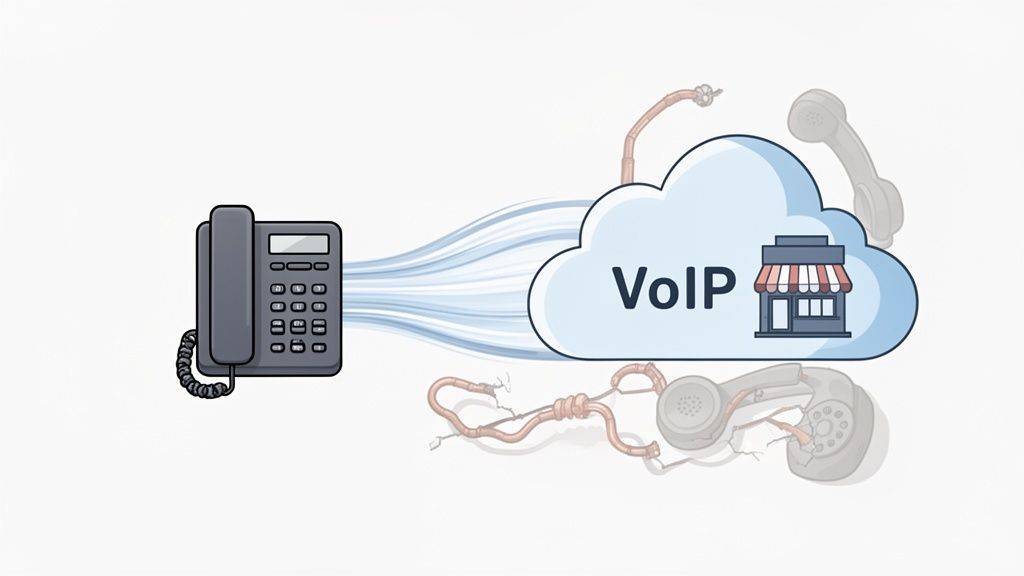
At its core, a VoIP system takes your voice, turns it into a digital signal, and sends it over the internet. This means you can make crystal-clear calls from a computer, a specialised VoIP phone, or even your old desk phone with a simple adapter. It completely cuts the cord from the traditional, often expensive, phone lines from the big telcos, using the internet connection you’re already paying for.
Think about it like this: the old phone network (the PSTN) is like sending a letter through Australia Post. It has to follow a fixed, physical route to get to its destination. VoIP, on the other hand, is like sending an email. It breaks your voice into tiny digital packets, finds the quickest path online, and puts it all back together instantly on the other end.
It's a fundamental shift that opens up a whole new world for Aussie businesses.
More Than Just a Dial Tone
The real magic of VoIP isn't just how it makes calls, but what it lets your business do with them. It puts powerful tools, once only affordable for massive corporations, right into the hands of small business owners.
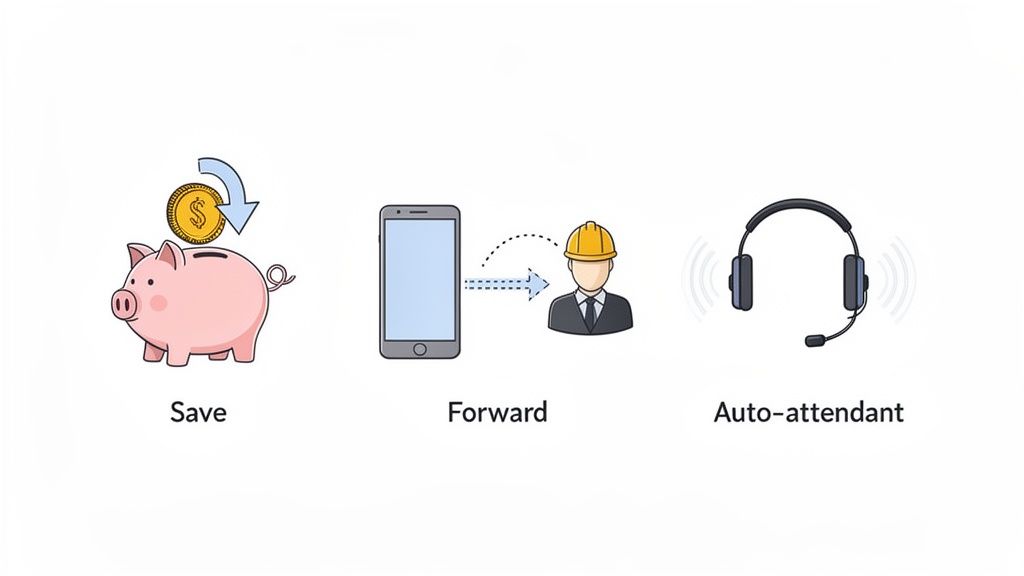
A great example is setting up a professional welcome message and a menu to guide callers to the right person or department—no more missed calls or frantic scrambling. To see how this works in practice, it’s worth understanding the role of an auto attendant VoIP phone system.
Other features that quickly become indispensable include:
- Voicemail-to-Email: Get voicemails sent as audio files directly to your inbox. No more dialling in to check messages. For instance, a busy real estate agent can receive a client's voicemail via email while at a property viewing and listen to it on their phone without dialling into a separate system.
- Call Forwarding: Have calls automatically bounce to your mobile when you're out of the office, so you’re always connected. This is perfect for a tradesperson who can have their main office number ring on their mobile when they are on-site, ensuring they never miss a new job lead.
- Virtual Numbers: Grab a local Sydney or Melbourne number to build a local presence, even if you’re running the show from Perth.
By moving your phone system to the cloud, you're not just changing how you make calls; you're adopting a more flexible, cost-effective, and powerful communication hub that grows with your business.
This tech lets you punch well above your weight, projecting a polished image and operating with slick efficiency, no matter the size of your team. For a deeper dive into the nuts and bolts, you can learn more about VoIP solutions for Australian businesses and how they are put together.

Performance you can feel, backed by clients who depend on it. Read how our support and uptime create long‑term customer success.Power Your Business with Better Hosting
The Tangible Benefits of Switching to VoIP
Technical jargon is one thing, but what does a VoIP system actually do for your business day-to-day? It turns out, the advantages go far beyond just a new way to make calls; they directly hit your bottom line, your team's productivity, and the way customers see you.
For small businesses here in Australia, the most obvious win is a serious drop in operational costs. Because VoIP calls run over the internet connection you're already paying for, you can finally ditch those expensive line rental fees and unpredictable call rates from the old-school telcos.
The savings really stack up if your business deals with people across the country or overseas. Globally, small businesses using VoIP have reported savings of 40% on local calls and a massive 90% on international calls. On top of that, productivity often gets a 20% bump, all thanks to clever features that just make life easier. You can discover more insights about these VoIP statistics and what they mean for your own efficiency.
Boost Your Team's Productivity
A VoIP telephone system for small business isn’t just about saving a few dollars; it’s about working smarter. It gives your team the tools to make sure you never miss a critical call or opportunity, no matter where you are.
Think about these real-world scenarios:
- A plumber in Ballarat: While out on a job, he can have all his office calls sent straight to his mobile. If he can't pick up, the voicemail is instantly converted to text and emailed to him. Now he can see if it's an emergency without even stopping what he's doing.
- A boutique marketing agency in Adelaide: The team uses one shared virtual number for their main support line. When a client calls, every team member's phone rings at once, meaning whoever is free first can jump on it and provide that instant service clients love.
Features like 'find me/follow me' call routing and voicemail-to-email aren't just fancy add-ons. They turn your phone system into an intelligent assistant that keeps your business nimble and responsive.
Project a Polished, Professional Image
First impressions count for everything. VoIP hands even the smallest one-person startup the tools to sound like a major company, building trust from the very first hello.
An auto-attendant that greets callers with, "Welcome to [Your Business]. Press 1 for Sales, Press 2 for Support," instantly makes your operation feel more established. It guides callers to the right person without you needing a dedicated receptionist.
Imagine a consultant based in Perth who wants to attract clients on the east coast. With VoIP, she can easily set up a virtual Sydney (02) or Melbourne (03) phone number. This simple trick gives her an instant local presence, making it far more likely that a potential client in those cities will actually call her.
You can even add custom on-hold music or promotional messages, turning that dead air while someone is waiting into a genuine marketing opportunity. This is how VoIP levels the playing field, helping you stand toe-to-toe with the big players.
Why VoIP Is Now The Standard for Business Communication
For a lot of seasoned Aussie business owners, the term "VoIP" probably brings back some pretty average memories from the early 2000s. Back then, internet calls were a gamble, full of choppy audio and dropped connections, thanks to painfully slow dial-up and first-gen broadband. It felt more like a tech experiment than something you'd ever trust your business with.
But a lot has changed since those early days. The rollout of the National Broadband Network (NBN) has given us the fast, stable internet infrastructure that VoIP was always crying out for. Today’s systems are a world away from their predecessors, delivering crystal-clear HD audio and rock-solid reliability.
This massive shift has turned VoIP from a quirky alternative into the go-to choice for modern business communication. It’s no longer a question of if a business should switch, but when.
The Journey from Niche to Mainstream
The growth of VoIP in Australia tells a powerful story of technology finally coming of age. It wasn't an overnight success; it was a steady evolution, built on better infrastructure and proven results.
Think about this: back in October 2005, a survey found that a tiny 1% of Australian SMBs were actually using VoIP. Fast forward to today, and that number has exploded, with recent data showing that 65% of Australian SMEs are now on board. You can read more about this remarkable growth trajectory to see just how far things have come.
This journey from a fringe tech to the industry standard shows it has a proven track record for business-critical operations. The early scepticism has completely vanished, replaced by widespread adoption because the benefits are just too good to ignore. And if you're managing a vital phone system, you might also be interested in our guide on the importance of IT monitoring to make sure all your systems stay online.
What was once seen as a risky cost-saving measure is now recognised as a strategic investment in flexibility, efficiency, and future-proofing a business's communication framework.
Modern VoIP isn't just about providing a dial tone, either. These systems are the foundation for businesses to seriously improve workplace communication, helping teams collaborate better and work more efficiently. The technology has matured, the network is robust, and Australian businesses have voted with their feet, making VoIP the undisputed standard.
Host your website with our 5-star rated, cPanel website hosting plans.
Super fast servers, with security included and hosted in your choice of Australian Data Center.
View cPanel Plans
Your Essential Checklist for Choosing a VoIP System
Making the switch to a VoIP telephone system for your small business is a big step, but finding the right provider doesn’t have to be a headache. If you know what to look for, you can confidently pick a solution that delivers crystal-clear calls, powerful features, and costs that won’t keep you up at night.
This checklist will walk you through the essential things to consider, helping you make the best choice for your business.
First things first, you need to get a clear picture of what your business actually needs. How many staff members need a phone line? Do you have team members working from home or always on the road? Answering these basic questions helps you figure out the scale of the system you'll need right from the get-go.
Once you’ve got that sorted, you can start digging into what different providers are offering. It’s all about matching their features to the real-world challenges your business tackles every day.
Evaluating Core Features and Functionality
Not all VoIP systems are created equal. While most will handle basic calls, the features that really give a small business an edge are often in the details. You want to look for a provider that offers more than just a dial tone.
Your checklist should include these must-have features:
- Auto-Attendant (IVR): Think of this as a virtual receptionist. It professionally greets callers and directs them to the right person or department, instantly making your small business sound bigger and more established.
- Call Forwarding and 'Find Me/Follow Me': This is non-negotiable for a mobile workforce. It ensures you never miss a critical call by automatically sending it to your mobile or another number when you’re away from your desk.
- Voicemail-to-Email: A massive time-saver. This feature sends voicemail recordings straight to your email inbox, so you can listen and reply much faster without having to dial in to check messages.
- Virtual Numbers: Does your business serve customers in different cities? A provider offering local numbers for various Australian states can help you build a national presence, even if you’re a one-person show in a single location.
These tools are the building blocks of a modern, flexible communication system that adapts to how you actually work.
Reliability and Support You Can Count On
When your phone system is the lifeblood of your business, you simply can’t afford for it to go down. A reputable provider should be upfront about their service reliability, often called uptime. You’ll want to see a guarantee of at least 99.9% uptime, which means the service is almost always available when you need it.
Just as important is the quality of their customer support. What happens when you have a question or run into a glitch? Australian-based support that understands the needs of local businesses can be a lifesaver. Check if they offer help via phone, email, and live chat, and find out what their typical response times are like.
A great VoIP service is more than just technology; it's a partnership. The right provider will offer robust, local support to ensure your communication lines are always open, protecting your revenue and reputation.
Understanding Pricing Models and Security
VoIP pricing is usually based on a per-user, per-month subscription, which makes it pretty easy to budget for. But you need to look closely at what’s actually included in that price. Some providers bundle everything into one neat package, while others have cheaper base rates but sting you with extra charges for things like call recording or additional phone numbers.
Always ask for a clear breakdown of costs so there are no nasty surprises on your bill. As you compare providers, it’s also smart to check that their network is secure. For a deeper dive, you can read our guide on the fundamentals of cybersecurity and data protection.
To help put it all in perspective, here’s a quick comparison showing how old-school phone lines stack up against a modern VoIP solution.
Traditional Phone Lines vs Modern VoIP Systems
This table breaks down the key differences between a clunky, old-school PBX system and a flexible, hosted VoIP service. For most small businesses, the choice becomes pretty clear once you see it laid out like this.
| Feature | Traditional PBX System | Hosted VoIP System |
|---|---|---|
| Initial Cost | High (Requires expensive on-site hardware) | Low (No on-site hardware needed) |
| Scalability | Difficult and costly to add new lines | Easy (Add or remove users online in minutes) |
| Mobility | Tied to a physical office location | Flexible (Use anywhere with an internet connection) |
| Key Features | Basic calling, limited features | Advanced features (Auto-attendant, call recording) |
| Maintenance | Requires specialised IT support | Managed and updated by the provider |
Looking at the comparison, it's easy to see why so many Australian businesses are leaving their traditional phone systems behind. The flexibility, advanced features, and predictable costs of VoIP are simply a better fit for the way we work today.
Setting Up Your VoIP System Step-by-Step
The idea of ripping out your old phone system and starting fresh can feel a bit daunting, but getting a VoIP telephone system for a small business up and running is surprisingly simple. Modern providers have ironed out all the kinks, meaning you definitely don’t need an IT degree to make the switch.
It's a straightforward process designed to help you figure out what you need and find the right fit, fast.
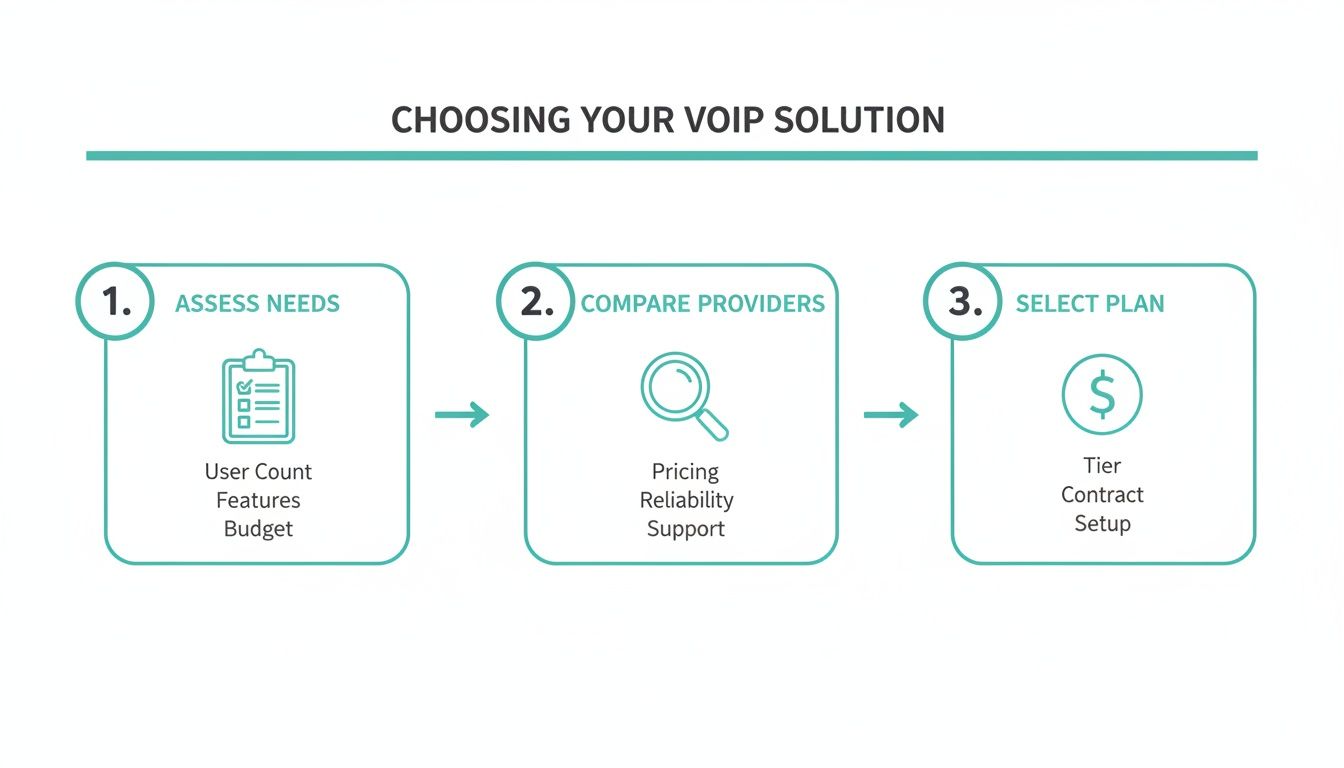
As you can see, choosing a VoIP system is more of a logical progression than a complex technical headache.
Step 1: Check Your Internet Connection
Before you do anything else, you need to make sure your internet connection is up to the task. Because your calls are travelling over the internet, a stable, speedy connection is the foundation of crystal-clear audio. You don't need a top-of-the-line enterprise plan, but it absolutely must be reliable.
As a general rule of thumb, each call you have going at the same time will use about 100 kbps of both your upload and download speed. So, if you think you’ll have five people on the phone at once, you’d want at least 500 kbps (or 0.5 Mbps) of bandwidth free just for your calls.
Pro Tip: Test Before You Commit
Run a free online speed test during your busiest part of the day. This will give you a real-world picture of your internet's performance and confirm you have enough juice to handle high-quality calls without slowing down the rest of your business.
Step 2: Gather Your Hardware
Next up, you'll need the right gear to actually make and receive calls. The real beauty of VoIP is its flexibility, giving you a few different options to suit how your team actually works.
You can pick from a few different setups:
- IP Phones: These look and feel just like the traditional desk phones you're used to, but they plug directly into your internet connection instead of an old-school phone socket. They're perfect for a classic office environment.
- Softphones: This is simply an app you install on a computer or smartphone. It turns the device into a fully-featured business phone, complete with a dial pad and call management features. It’s the ideal choice for remote or mobile team members.
- Analogue Telephone Adapters (ATA): Got some older desk phones you'd rather not throw out? An ATA is a clever little box that connects your traditional handsets to your new VoIP service, bridging the gap between old and new.
Step 3: Port Your Existing Business Number
One of the biggest worries for business owners is losing the phone number their customers already know. Thankfully, you can bring it with you. The process is called number porting, and the good news is your new VoIP provider will handle almost all of the heavy lifting.
All you’ll need to do is provide a copy of a recent bill from your old provider to prove you own the number. The whole porting process can take anywhere from a few days to a couple of weeks, but it's completely seamless. Your old service will keep working right up until the moment the new one is switched on.
This is also a great time to have a quick think about your network setup. While most businesses get by just fine with a dynamic IP address, it might be worth learning the difference between a static vs dynamic IP address to see if a fixed address could benefit your operations.
Once your number is active on the new system, you're ready to start setting up features and making calls.
Common Questions About VoIP for Small Business
Diving into the world of VoIP can definitely bring up a few questions. Let's be honest, changing your business's core communication system is a big deal, so it’s completely natural to want clear answers before you jump in.
We've pulled together some of the most common queries we hear from Australian small business owners, with straightforward answers to help you make your decision with total confidence.
Can I Keep My Existing Phone Number?
Yes, you absolutely can. This is often the first thing people ask, and thankfully, the answer is a simple one. The magic happens through a process called number porting, which lets you bring your trusted, established business number over to your new VoIP service.
Your new provider handles the entire transfer for you. It’s a seamless process that happens in the background, ensuring your old service keeps working right up until the moment your new one is activated. You won't experience any downtime or missed calls.
What Happens if the Internet Goes Down?
This is a crucial question, given that VoIP runs on your internet connection. But modern VoIP telephone systems for small businesses are built with this exact scenario in mind. They come with clever call-forwarding features that act as a safety net.
If your office internet drops out, the system can automatically and instantly reroute all incoming calls to a pre-selected mobile number or another landline. Your customers will never know there was an issue, and you'll never miss an important call. This failover feature ensures your business stays connected, even during an outage.
A common misconception is that an internet outage means your phones go completely dead. With automatic call forwarding, your business remains reachable, providing a level of resilience that many traditional phone lines simply can't match.
Is VoIP Secure Enough for Confidential Calls?
Security is non-negotiable for any business, especially when you're handling sensitive client conversations. Reputable VoIP providers use strong encryption methods, such as Transport Layer Security (TLS) and Secure Real-time Transport Protocol (SRTP), to shield your calls from eavesdroppers.
Think of it as the same level of encryption used for secure online banking. It scrambles your call data, making it unreadable to anyone trying to intercept it. When you're choosing a provider, always confirm they offer robust, end-to-end encryption to keep your business conversations private. And if you ever have network trouble, understanding why your DNS server is not responding can be useful for general troubleshooting, too.
Ready to upgrade to a flexible, cost-effective communication system designed for Australian businesses? UpTime Web Hosting offers reliable, feature-rich VoIP solutions with local support you can count on. Explore our VoIP plans and make the switch today!