
Picture your business phone system working just as flexibly as your email. That's the basic idea behind a VoIP phone system for a small business. It's a modern approach that swaps out costly, rigid landlines for a communication hub that simply runs over your internet connection. This one change can transform your phone from a simple tool into a powerhouse for growth.
Why VoIP Is a Game Changer for Australian Small Businesses
At its core, Voice over Internet Protocol (VoIP) is just a fancy way of saying you can make and receive calls using the internet instead of old-school copper wires. It’s a bit like sending an email or streaming a video; your voice is turned into digital data and zipped across the web. This simple shift unlocks a world of features that, until recently, were only within reach for massive corporations.
For a small business, this means you can finally get your hands on enterprise-level tools without the enterprise-level price tag. A professional phone system adds a layer of credibility, making your two-person operation sound as established as a twenty-person company.
The real magic of VoIP is how it adapts to the way we work now. It untethers you from a physical desk, letting you connect with clients and your team from anywhere, on any device you choose.
The Key Advantages for Your Business
Making the switch to VoIP offers immediate, tangible benefits that can directly fuel your efficiency and growth. Here are the main perks you can expect:
- Significant Cost Savings: By ditching traditional phone line rentals and taking advantage of drastically lower call rates—especially for national and international calls—most businesses see a serious drop in their monthly phone bills. For example, a marketing agency in Melbourne can save hundreds by making unlimited national calls to clients in Sydney and Perth without worrying about per-minute charges.
- Enhanced Professionalism: Features like an auto-attendant (your own virtual receptionist), custom greetings, and smart call routing ensure every caller has a polished, professional experience. This builds trust and confidence in your brand from the first "hello."
- Unmatched Flexibility and Mobility: You can answer your business number from a desk phone in the office, a softphone app on your laptop at a café, or your mobile while you're out visiting a client. This kind of freedom is essential for today's dynamic work environment.
A Look Back at VoIP Adoption in Australia
The landscape for VoIP phone systems for small business in Australia has changed dramatically. If we rewind to October 2005, a survey revealed that a tiny 1% of Australian SMBs used VoIP, with only another 6% even planning to adopt it. That initial hesitation has completely flipped, with businesses now actively seeking out VoIP for its powerful features and undeniable cost-efficiency. You can learn more about the early days of VoIP adoption from the original report.

Performance you can feel, backed by clients who depend on it. Read how our support and uptime create long‑term customer success.Power Your Business with Better Hosting
Must-Have VoIP Features That Power Small Business Growth
Modern VoIP phone systems for small business are loaded with tools that do much more than just make and take calls. These aren't flashy tech for the sake of it; they're practical features designed to solve real-world business problems. They help you look professional, work smarter, and grab every opportunity that comes your way.
Take the Auto Attendant, for instance. Don't think of it as a robotic voice, but as your very own virtual receptionist. For a solo operator or a small team, this is a game-changer. It professionally greets every caller with a menu ("Press 1 for Sales, Press 2 for Support"), making your business instantly feel bigger and more organised. It also guarantees calls get to the right person, every time. A local plumbing business could use this to route emergency call-outs directly to the on-call plumber's mobile, while general enquiries go to the office.
Another brilliant tool is Voicemail-to-Email. Forget dialling into a clunky voicemail box. The system automatically transcribes the audio message and pops it straight into your inbox. This means you can discreetly read a client's message during a meeting or quickly scan for urgent matters on your phone, saving heaps of time and keeping you responsive.
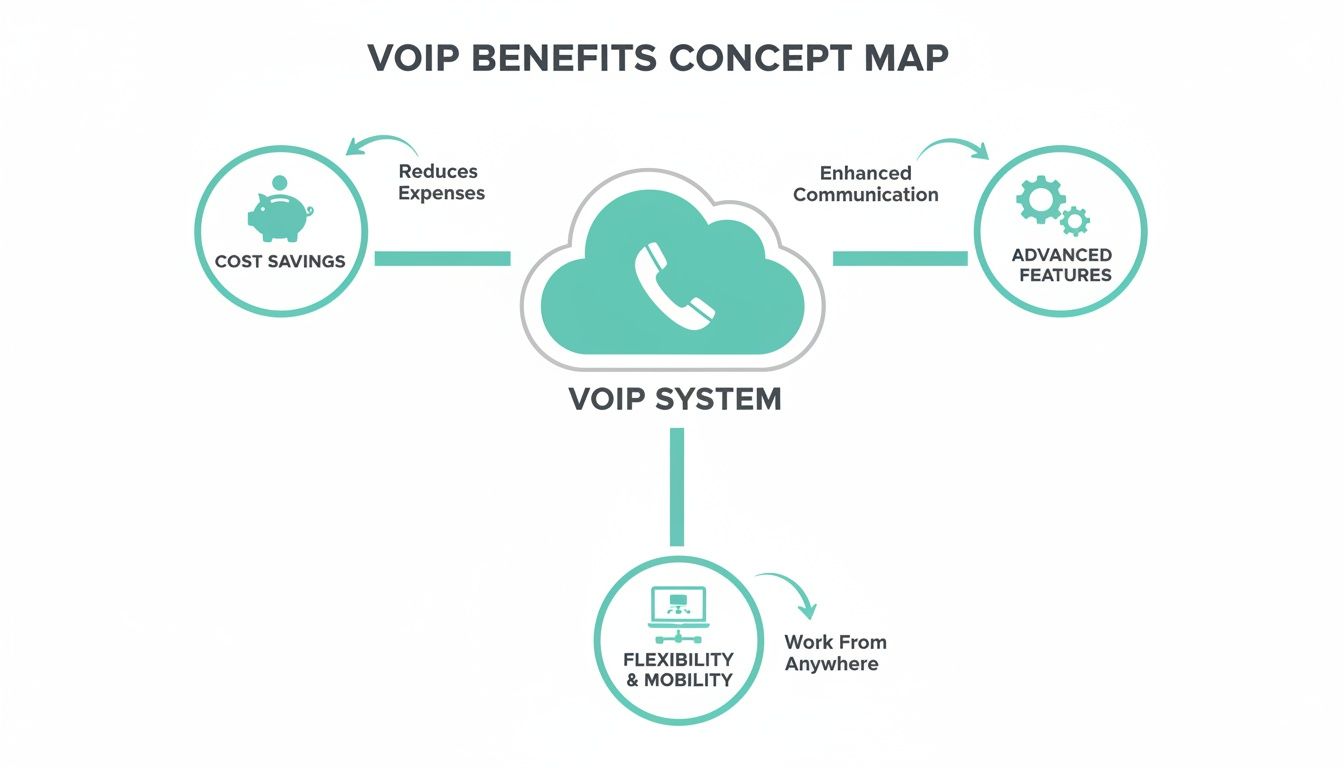
As you can see, the powerful features packed into VoIP are a huge part of what enables businesses to become more flexible and slash their running costs.
Manage Calls On the Go
The freedom to stay connected when you're not at your desk is a massive advantage. Key mobility features make sure you never miss an important call, whether you're visiting a client or working from your home office.
- Call Forwarding: This lets you seamlessly send incoming calls from your business number to your mobile or any other phone you choose. It's a simple function that ensures you're always reachable, turning potential missed calls into captured leads. For a real estate agent out at a property inspection, this feature is essential for catching urgent offers from buyers.
- Softphone Apps: These clever applications turn your laptop, tablet, or smartphone into a complete business phone. You can make and receive calls using your business number, look up contacts, and manage all your settings from anywhere with an internet connection. Check out our guide on how to set up your softphone for maximum productivity.
Collaborate and Project Professionalism
VoIP also brings tools to the table that seriously boost teamwork and polish your company's image. Integrated video conferencing lets you host client meetings or team catch-ups without needing to pay for separate software like Zoom or Google Meet. This not only builds stronger client relationships but also makes internal collaboration a breeze.
To give you a clearer picture, let's compare what you get with a modern VoIP system versus an old-school landline.
Key VoIP Features vs Traditional Landline Capabilities
| Feature | VoIP Phone System | Traditional Landline |
|---|---|---|
| Auto Attendant | Yes, routes calls automatically | No |
| Voicemail-to-Email | Yes, sends transcribed voicemails to your inbox | No |
| Softphone Apps | Yes, use any device as your business phone | No |
| Video Conferencing | Yes, often included | No |
| Call Recording | Yes, great for training and records | Rarely |
| Advanced Call Blocking | Yes, advanced filtering | Basic |
| CRM Integration | Yes, connects with business software | No |
| Scalability | Easy, add or remove lines instantly | Difficult, requires new physical lines |
This table really highlights the jump in functionality. It's not just a phone line; it's a full-blown communication hub for your business.
Beyond these core features, a solid VoIP system can also help your business effectively stop spam calls, letting your team focus on genuine customer conversations. By putting these features to work, you can build a communication system that doesn't just support your business—it actively helps it grow.
How to Choose the Right VoIP System for Your Business
Picking the right VoIP phone system for your small business can feel like a huge task, but it gets a lot easier when you know what to focus on. Let's cut through the noise and look at the things that will actually make a difference to your daily operations and your future plans.
Your first port of call should always be call quality. A VoIP call is only as good as the internet it runs on, so that crystal-clear audio you’re after depends entirely on a stable, high-speed connection. Before you even look at providers, you need to be honest about your current internet setup. For Aussie businesses, choosing a provider with reliable, locally hosted servers is an absolute must to keep lag to a minimum and ensure your calls are top-notch.
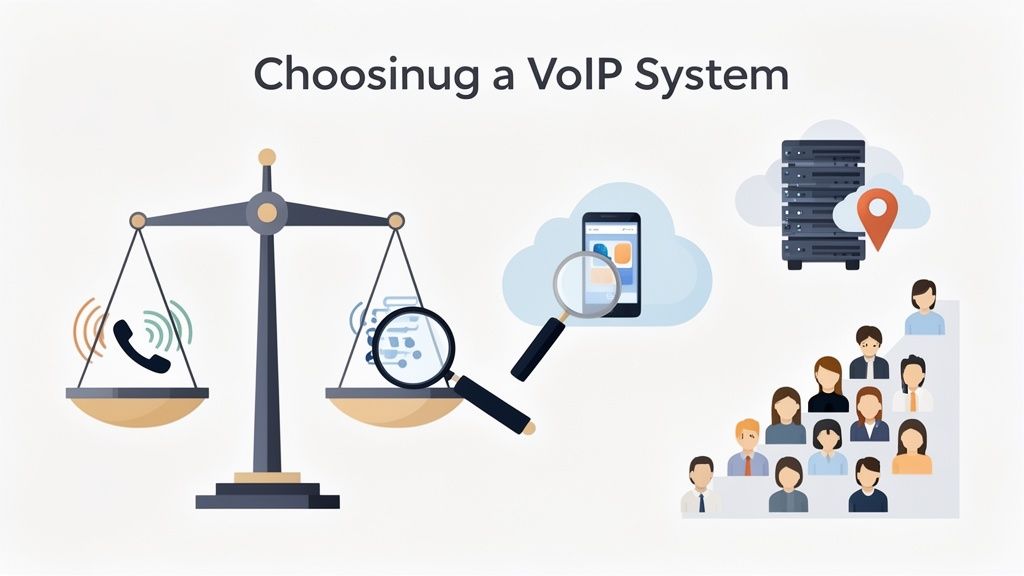
Evaluating Scalability and Pricing
Next up, think about how the system will grow alongside your business. A good VoIP system scales up (and down) without any fuss. Say you start out on your own and then bring on five new team members over the next year. Your phone system should be able to expand just by adding new users through an online portal—no expensive hardware upgrades or technician call-outs needed.
This easy scalability is a game-changer for small businesses. Providers now offer clever, flexible packages that let you upgrade seamlessly as you grow. Considering small businesses are the backbone of the Australian economy, this kind of flexibility isn't just a nice-to-have; it's essential.
Pricing models can be a bit of a maze, but they usually come in two main flavours. You’ll often see a simple per-user, per-month plan, which is great for predictable budgeting. Others might bundle users and minutes into packages. The trick is to always look for the hidden costs—things like fees for bringing your existing number across or charges for extra features can sneak up on you. A detailed breakdown of our plans can be found on our VoIP pricing page.
As of August 2022, small businesses made up a massive 95% of all businesses in Australia, which really drives home the need for communication tools that fit their needs. While the initial setup might be a consideration for a small budget, the ongoing savings compared to old-school phone systems are significant.
Essential Features for Australian Businesses
Once you've nailed the basics, there are a few features that are non-negotiable for any modern Aussie business. Don’t even think about signing a contract without checking for these.
- A High-Quality Mobile App: Your team needs to be able to make and receive calls on their smartphones just as easily as they would at their desk. Before you commit, get a demo and test out the provider’s app. Is it easy to use? Is it reliable?
- CRM Integrations: This is a huge one. Connecting your phone system directly to your Customer Relationship Management (CRM) software is a massive productivity win. Imagine your phone system automatically creating a call log in a customer's HubSpot or Salesforce profile every time you speak. This saves your team a ton of time.
- Support for AU Numbers: The provider absolutely must support porting your existing local numbers. They should also be able to provide Australian 1300 and 1800 numbers if you need them. This is vital for giving your business a professional, nationwide feel.
By zeroing in on these practical points—quality, scalability, clear pricing, and the right features—you can confidently choose one of the best VoIP phone systems for your small business. Uptime Networks offers robust VoIP solutions built specifically for the needs of Australian companies.
Host your website with our 5-star rated, cPanel website hosting plans.
Super fast servers, with security included and hosted in your choice of Australian Data Center.
View cPanel Plans
Navigating VoIP Specifics in the Australian Market
When you're looking at a VoIP phone system for a small business in Australia, it's easy to get lost in international guides that miss the local details. But getting these Aussie-specifics right from the start is the key to a smooth switch and a system that actually works for you and meets our local rules.
One of the first things on your mind is probably keeping your existing phone number. This is called number porting, and it lets you bring the landline or mobile number your customers already know and trust over to your new VoIP service. Any good Aussie provider will handle this for you, but it’s smart to ask about timelines upfront, as they can vary.
Emergency Calls and Local Numbers
A phone system is only as good as its ability to connect you to help when you need it most. Dialling Triple Zero (000) on a VoIP system is a bit different from an old-school landline. Because your calls run over the internet, the service doesn't automatically know your physical location.
It is absolutely vital that you register your physical business address with your VoIP provider. This registered address is what gets passed on to emergency services, ensuring they can find you quickly when it matters most.
This isn’t just a recommendation; it’s a non-negotiable step for setting up your service safely. Beyond the critical stuff, VoIP also makes it incredibly easy to create a professional, national presence.
- Local Landline Numbers: You can grab a local number for any Australian city (like an 02 for Sydney or 03 for Melbourne) to build a local presence, even if your team is halfway across the country. An e-commerce business based in Brisbane, for example, can use a Melbourne number to appear local to Victorian customers.
- 1300/1800 Numbers: Setting up a national toll-free or fixed-rate number is simple. This instantly makes your business feel bigger and more accessible to customers everywhere.
Data Security and Server Location
These days, knowing where your data lives is a huge deal. For any Australian business, picking a VoIP provider that uses Australian-based data centres isn't just a nice-to-have—it’s a massive plus for performance and compliance.
When your data is hosted locally, your voice traffic travels a much shorter distance. The result? Less lag and much clearer, higher-quality calls. It also means you’re automatically aligned with Australia's privacy laws, like the Privacy Act, which dictates how customer data should be handled.
Keeping your data on Aussie soil gives you peace of mind that your sensitive business chats are protected under our own laws. To get a better handle on how this all works, you can learn more about how IP addresses function and why local infrastructure matters in our guide to understanding a static vs dynamic IP address. This local focus is a key part of selecting a dependable VoIP phone system for your small business.
Understanding the True Cost and ROI of VoIP
When you're looking at a VoIP phone system for a small business, it’s easy to focus on the low monthly subscription. But that's just the starting point. To really see how valuable the switch can be, you need to look at the full financial picture—both the total investment and the eventual return.
Beyond the monthly plan, you might have some initial costs. The most common one is buying new IP handsets, but plenty of businesses sidestep this expense completely by using free software-based "softphones" on their computers and mobiles. It’s also a good idea to check for any one-off setup or number porting fees.
Calculating Your Direct Savings
Let's make this real with a quick example. Picture a small office with five staff members still on a traditional phone system. Their monthly bill probably includes hefty line rental fees for multiple lines plus high per-minute call rates. It all adds up, easily costing hundreds of dollars each month.
Now, let's swap that out for a typical VoIP plan. A five-user plan might land somewhere around $25-$35 per user per month, and that usually includes all your local and national calls. That painful line rental fee? Gone. This simple change can slash your monthly phone expenses by 35-40% straight away, which is a pretty big deal for any small business budget.
According to the Australian Bureau of Statistics, a staggering 97.3% of businesses in Australia have fewer than 20 employees. For this huge part of our economy, the financial upside of VoIP is massive. Some data shows global savings for a 30-person team can be around USD $1,200 a month. You can read more on the ROI available to Australian small businesses to see the impact for yourself.
The Untapped Value of 'Soft' ROI
But the true return on your investment goes way beyond just cutting costs. This is where the "soft" ROI kicks in—the powerful boosts in productivity and efficiency that really push your business forward.
- Increased Productivity: Think about features like voicemail-to-email and CRM integrations. They save your team hours of boring admin work every single week.
- Enhanced Flexibility: Letting your team work from anywhere isn't just a nice perk anymore; it's a strategic move that can lower overheads and help you attract better talent.
- Improved Customer Experience: Tools like auto-attendants and smart call routing mean you never miss a potential lead, which has a direct impact on your bottom line.
When you add these benefits to the hard savings, the answer to the big question becomes crystal clear: yes, investing in a modern VoIP phone system for your small business is absolutely worth it. To make sure the rest of your digital setup is just as strong, it's worth looking into an affordable virtual private server to support all your operations.
Your Step-by-Step Checklist for a Smooth Switch to VoIP
Deciding to upgrade to a VoIP phone system for your small business is the easy part. Making the actual switch happen without a single dropped call or frustrated customer? That just takes a solid plan. This checklist breaks the whole process down into simple, manageable steps, guiding you from initial thoughts right through to a successful launch.
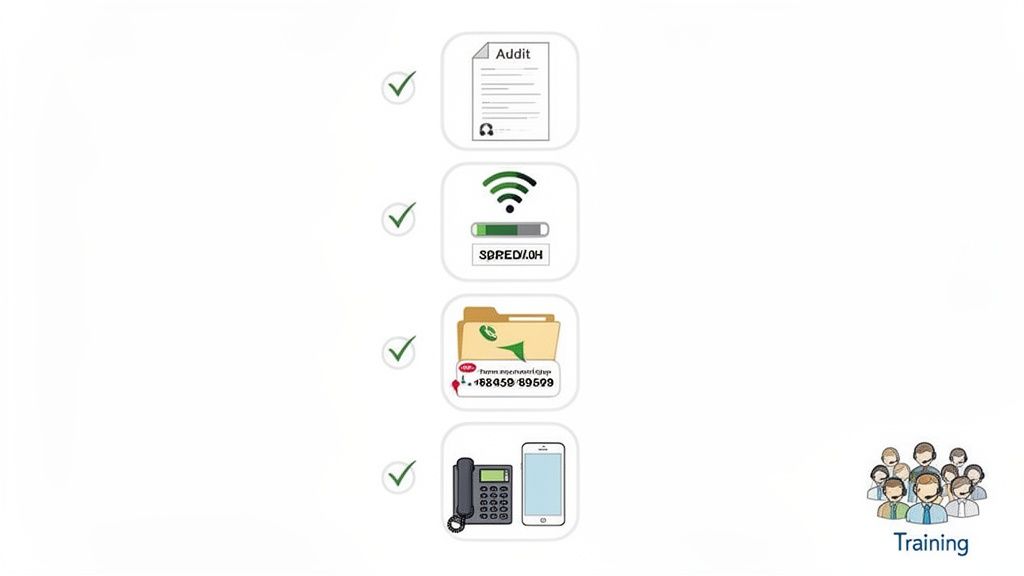
Following a structured approach like this is the secret to avoiding those common migration headaches. It keeps your business communications flowing without missing a beat.
Preparation and Planning
Before you even think about contacting a provider, it’s time to do a little homework. Getting your ducks in a row now will help you pick the perfect service and sidestep any nasty surprises down the track.
Audit Your Current Usage: First things first, grab your last few phone bills. Get a real sense of your call patterns. How many calls are coming in and going out? Are they mostly local chats, or are you calling interstate and overseas? This data is gold—it’ll help you find a plan that fits like a glove, so you’re not paying for bells and whistles you’ll never use.
Test Your Internet Connection: VoIP lives and dies by your internet connection, so you need to know it’s up to the task. Run a few speed and latency tests, especially during your busiest times of the day. A stable, zippy connection is absolutely non-negotiable for crystal-clear calls. If your network is already struggling, you could run into problems like your DNS servers not responding, which will definitely impact call quality.
Shortlist Potential Providers: Now, armed with your usage data and the criteria we’ve covered in this guide, pick out three or four providers. Make sure they tick all your boxes for features, scalability, and—most importantly—proper Australian-based support. Explore our business VoIP packages at Uptime Networks to see if we're the right fit for you.
A smooth transition is all about proactive planning. Taking the time to understand your needs and test your infrastructure before you switch is the single most important factor for success.
Execution and Rollout
Once you’ve settled on a provider, it’s go-time. This is where careful coordination becomes your best friend, ensuring zero downtime for your business.
Plan Your Number Porting: This is a big one. You need to work closely with your new provider to schedule the porting of your existing business number. Any provider worth their salt will manage this process meticulously to make sure there's absolutely no interruption to your service. Your customers should never even know a change has happened. For more details, read our knowledge base article on what to expect during the number porting process.
Decide on Your Hardware: Think about how your team will actually use the system. Are they better off with physical IP desk phones, or will they be using software-based "softphones" on their computers and mobiles? Whatever you decide, get any necessary hardware ordered well ahead of time.
Train Your Team: The final piece of the puzzle is getting your staff comfortable with the new setup. It doesn't have to be a huge affair. Just schedule a quick training session to walk everyone through the basics: making calls, using the mobile app, and accessing handy features like voicemail-to-email. A little guidance goes a long way.
Register your new domain name at competitive market prices including free domain add-ons like privacy, DNS Hosting, Custom Nameservers and Forwarding.
Always the best price and no nasty renewal price hikes.
Register A Domain Name
Frequently Asked Questions About Small Business VoIP
Thinking about switching to a VoIP phone system for your small business? It's completely normal to have a few questions floating around. To help you feel confident you're making the right move, we've put together some straightforward answers to the questions we hear most from business owners.
Can I Keep My Existing Business Phone Number?
Absolutely. You don’t have to give up the number your clients already know and trust.
The process is called 'number porting,' and any reputable VoIP provider will handle the entire transfer for you. They'll make sure it's a seamless switch with no service interruption, so you won’t miss a single call.
Do I Need to Buy Special Hardware?
Not necessarily, which is fantastic news for keeping start-up costs low. You have total flexibility in how you use your new system.
You can opt for physical IP desk phones, use a simple adapter to connect your current analogue phones, or go completely hardware-free with a 'softphone' app on your computer and mobile. A small graphic design studio might choose to use softphones on their Macs to save desk space, while a busy reception desk might prefer a physical handset with multiple line buttons.
This flexibility is one of the biggest perks of modern VoIP. It lets you equip your team without a huge upfront investment in hardware, making professional communication tools accessible for any budget.
What Happens If My Internet Connection Fails?
This is a really common and valid concern. Thankfully, modern VoIP systems are designed with this exact scenario in mind.
If your office internet goes down, calls can be automatically forwarded to a pre-set mobile number. This built-in failsafe ensures your business keeps running, so a temporary outage won't cost you a valuable client call.
Is VoIP Secure Enough for Business Communications?
Yes, it is. Security is a top priority for any serious VoIP provider. They use strong encryption protocols—similar to the ones that protect secure websites—to safeguard your calls and data.
This ensures your business conversations stay private and are protected from anyone trying to listen in. You can find out more by reading our guide on cybersecurity and data protection.
Ready to upgrade your business communications with a reliable, feature-rich solution? UpTime Web Hosting offers powerful and affordable VoIP phone systems designed specifically for Australian small businesses. Explore our VoIP solutions today!