

You’re probably here because the website side of business has started to feel bigger than it should.
Maybe you’ve registered a business name, sorted your logo, opened the socials, and now someone asks, “Have you got your domain and hosting yet?” Then the tabs multiply. Shared hosting. VPS. cPanel. SSL. Australian data centres. Unlimited plans that somehow don’t feel unlimited.
For most Australian small business owners, the primary question isn’t “What’s the most advanced hosting setup?” It’s “How do I get a professional website and email running without wasting money or learning server admin on a Sunday night?”
That’s where shared web hosting services come in. They’re the standard starting point for a reason. In Australia, shared hosting holds about 37.64% of the web hosting market share as of 2024, and typical plans sit around AUD $5 to $15 per month according to Bluehost’s hosting market overview. The fit is obvious in a country where 99.8% of enterprises are SMEs in the same source.
If you’re building a brochure site for a local tradie business, a portfolio for a consultant, a WordPress site for a clinic, or a starter online shop, shared hosting usually gives you the right mix of cost, simplicity, and enough performance to get moving.
Your First Step Online An Introduction to Shared Hosting
A common small business story goes like this. A café owner in Brisbane wants a simple site with menus, a contact form, and a proper email address. A bookkeeper in regional Victoria wants a clean homepage, a service list, and a booking link. A new eCommerce startup in Sydney wants to launch without pouring the whole budget into infrastructure before the first sale lands.
They don’t need a private server room. They need a sensible first step.
That’s why shared web hosting services are usually the most practical place to begin. You pay for a portion of a professionally managed server rather than the whole machine. That keeps costs down and setup simple, which matters when you’d rather focus on customers than server settings.
If you’re still working out the website itself, it can help to start with professional website development services so the build and the hosting decision line up properly from day one. A lot of hosting headaches start when the site, the platform, and the business goals were never matched in the first place.
For Australian businesses, the local angle matters too. You’re not just choosing “a host”. You’re choosing where your website lives, how support works across Australian business hours, whether prices include GST, and whether your visitors are being served from local infrastructure. This short guide on why switching to local Australian hosting can make sense is worth reading if you’ve only looked at big offshore brands so far.
Practical rule: If your site is new, your traffic is modest, and you want email, website files, security basics, and support bundled together, shared hosting is usually the smart starting choice.
Shared hosting isn’t a “cheap and nasty” option. For many Australian businesses, it’s the normal, sensible foundation.

Performance you can feel, backed by clients who depend on it. Read how our support and uptime create long‑term customer success.Power Your Business with Better Hosting
What Is Shared Hosting A Simple Analogy
Shared hosting makes more sense once you compare it to a commercial building with multiple small businesses inside.
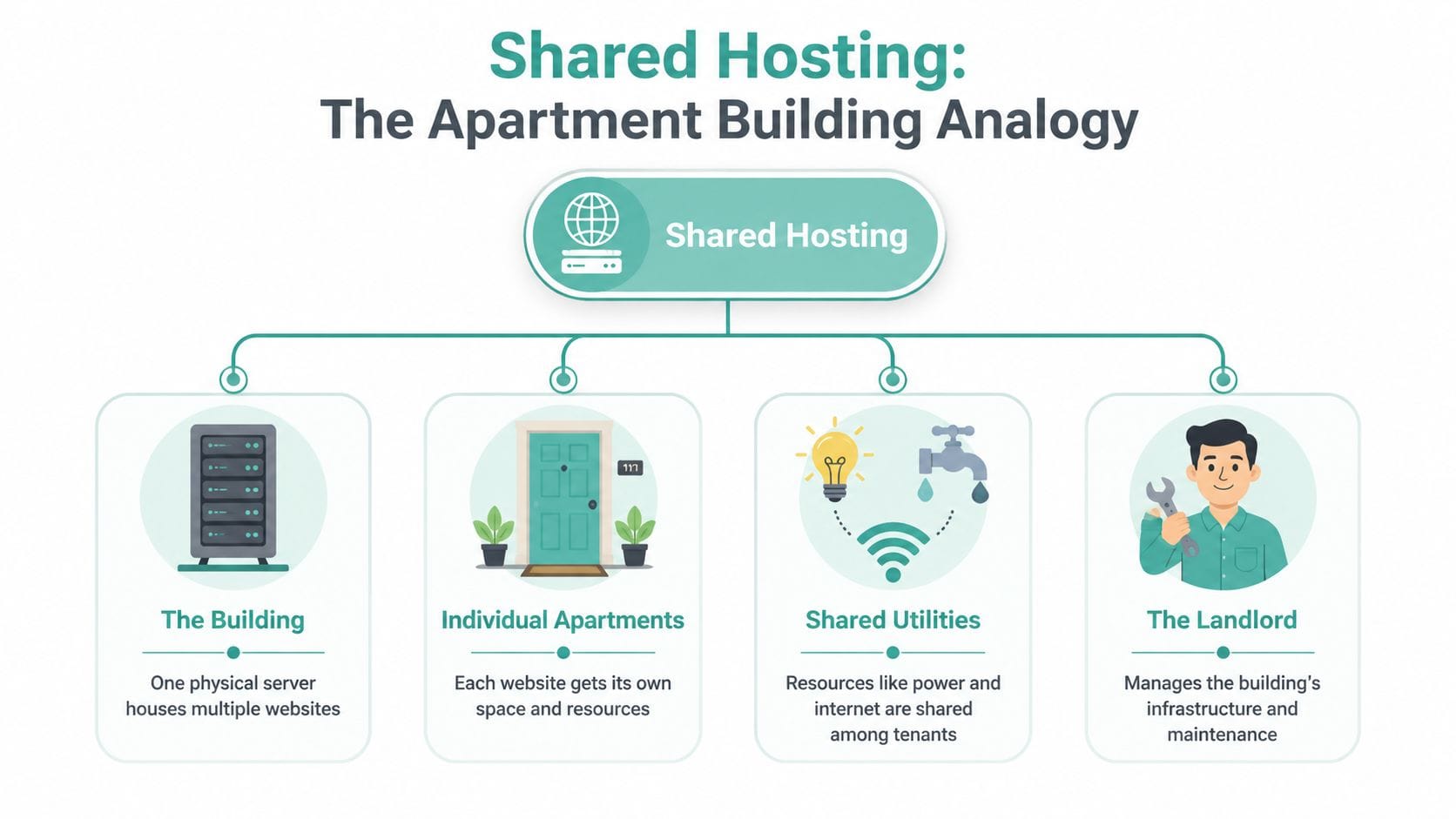
A server is one building with many separate spaces
The server is the building itself. Your hosting account is one leased space inside it.
Everyone in the building uses the big shared systems, such as electricity, lifts, security, and the front entrance. In hosting, those shared systems are processing power, memory, storage, and the internet connection. Your business still gets its own area for website files, email, and databases, even though the larger machine is shared with other customers.
That cost-sharing is the whole reason shared hosting is affordable. Instead of one Australian business paying for the entire server, many businesses split the running costs.
Why this setup suits many Australian small businesses
A lot of small business websites are more like a tidy shopfront than a packed stadium. They need to load properly, send enquiries to the right inbox, and stay online during business hours. They usually do not need an entire server reserved just for them.
That covers plenty of common cases:
- Local trades and service businesses: a plumber, electrician, or accountant with service pages, contact forms, and branded email
- Small retailers: a simple online store or product catalogue
- Professional services: a consultant, broker, or agency with a polished brochure-style site
- Community groups: clubs, associations, and not-for-profits that need updates, events, and committee email accounts
For this sort of workload, shared hosting is often a practical fit.
For Australian operators, the local details still matter. A shared plan in a nearby data centre can feel snappier for Australian visitors. Local support hours are easier to deal with. Billing is usually clearer when GST treatment is obvious, and a business using a .au domain often wants hosting that matches that local presence.
Where the word "shared" confuses people
The word puts some business owners off because it sounds like everything is mixed together.
It is not.
Shared refers to the server and its underlying resources. It does not mean other customers can browse your files or log in to your website. A properly managed shared hosting platform keeps accounts separated and sets limits so one busy site is less likely to affect the others. Tools such as web hosting services with cPanel also make that separation easier to manage from your side, because your files, email, databases, and settings sit inside your own control panel.
A simple way to frame it is this. You share the building services, but you still lock your own front door.
The host is the building manager
Your hosting provider looks after the property itself. They maintain the server, apply system updates, monitor for problems, and manage the underlying environment. You look after the business part, such as your content, passwords, email accounts, and website updates.
That split is what appeals to many non-technical owners. You get the basics handled without needing to become a server administrator.
A well-run shared host feels a bit like renting a clean, well-managed office suite. You focus on serving customers. The provider keeps the lights on, the doors working, and the building in good order.
The Engine Room How Shared Hosting Works Technically
The apartment analogy is useful, but it helps to peek behind the door and see what makes the building run smoothly.
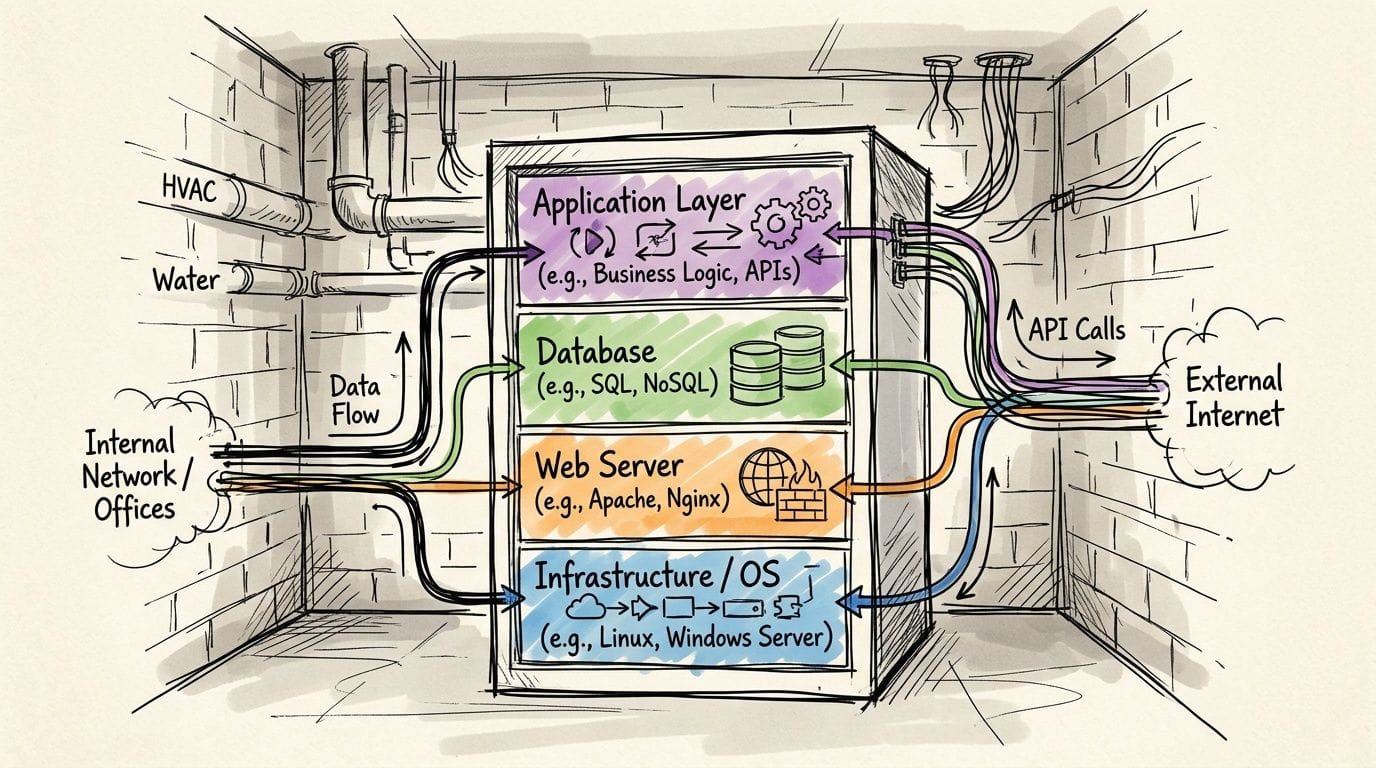
CloudLinux creates the walls between accounts
One of the biggest concerns in shared hosting is the “noisy neighbour” problem. That’s when one website suddenly uses far more server resources than expected and starts affecting the sites around it.
In Australian shared environments, CloudLinux is one of the key tools used to stop that. It puts each account inside a controlled resource space, often called an LVE or Lightweight Virtual Environment, so CPU usage and processes are capped per account. According to this explanation of shared hosting server specs and CloudLinux isolation, benchmarks on Sydney datacentres showed CloudLinux could reduce downtime by 40% during peak loads compared with servers that didn’t use the same isolation approach.
That’s technical language for a very practical result. If another site on the server has a sudden spike, your site is less likely to get dragged down with it.
cPanel is the dashboard most owners actually use
You won’t log into the server the way a systems engineer does. Most business owners use a control panel.
That’s where cPanel comes in. Think of it as the front desk for your hosting account. You use it to manage files, create email addresses, install apps such as WordPress, check backups, handle domains, and review security settings without touching the deeper server layer.
If you’ve never used hosting before, a cPanel web hosting service is often the easiest path because it gives you one familiar dashboard instead of a scattered set of tools.
Common tasks in cPanel include:
- Creating business email accounts so you can use addresses tied to your domain
- Installing WordPress for a brochure site, blog, or online store
- Managing files and databases when a developer needs access
- Setting up SSL so your site uses secure browsing
- Checking usage to see whether your site is still comfortably within plan limits
LiteSpeed and NVMe improve the everyday feel of your site
Business owners usually don’t care what the web server software is called. They care whether the site feels quick.
That’s why performance tools matter. In many shared environments, providers use LiteSpeed web server technology and fast NVMe storage to help pages load faster and handle dynamic websites more smoothly. For a WordPress site, that can mean less waiting when someone clicks from your homepage to a booking page, product page, or enquiry form.
A good way to think about it is this:
| Component | What it does in plain English | Why you care |
|---|---|---|
| CloudLinux | Separates accounts and limits resource abuse | Helps keep neighbours from slowing you down |
| cPanel | Gives you an easy dashboard | Makes common admin tasks manageable |
| LiteSpeed | Serves website pages efficiently | Helps with speed and responsiveness |
| NVMe storage | Reads and writes data quickly | Helps pages and databases feel snappier |
A shared hosting plan can be simple on the outside and still be quite sophisticated underneath.
What happens when someone visits your website
A visitor types in your domain. The hosting server receives the request. It pulls together the files, images, code, and database content that make up the page. Then it sends that page back to the visitor’s browser.
On a modern shared setup, a lot of invisible work supports that simple action. The server software routes the request, the storage system fetches data, account isolation keeps resource usage fair, security tools inspect traffic, and the control panel gives you a way to manage it all.
You don’t need to be a server expert to benefit from that stack. You just need to choose a provider that runs it properly.
Host your website with our 5-star rated, cPanel website hosting plans.
Super fast servers, with security included and hosted in your choice of Australian Data Center.
View cPanel Plans
Benefits and Limitations of Sharing Your Space
Shared hosting works well because it solves a real business problem. You need a website online, but you don’t want to become an infrastructure manager.
That said, it’s worth being honest about the upside and the trade-offs.

Where shared hosting makes life easier
The first benefit is obvious. Cost. Shared hosting lets you get online without paying for resources you’re unlikely to use early on.
The second benefit is simplicity. The hosting company manages the server environment, which means you’re not patching operating systems, replacing hardware, or monitoring the machine yourself. For a small business owner, that’s often the difference between launching this month and delaying the site for another quarter.
The third benefit is convenience. Website files, email, SSL, backups, and a control panel often sit under one roof. That makes the setup easier to understand and easier to hand over to a staff member, freelancer, or agency later.
A few practical wins stand out:
- Lower upfront commitment: You don’t need to overspend before the business case is proven.
- Faster launch path: Most plans are built for quick setup, especially for WordPress and standard business sites.
- Managed environment: The provider handles the deeper server work.
- Easy administration: cPanel and similar dashboards reduce the technical learning curve.
For Australian businesses, there’s another quiet advantage. A local provider usually understands local billing expectations, .au domain relevance, and support timing in a way offshore providers often don’t.
The limits are real, but predictable
Shared hosting isn’t unlimited freedom.
You usually won’t have deep server-level control. If you want to install unusual software, tune advanced server settings, or run heavy custom applications, you may bump into the boundaries of the plan. That isn’t a flaw. It’s part of what keeps the service affordable and manageable.
You’re also working within a shared resource model. Even with protections in place, shared hosting is still designed for smaller to mid-sized workloads, not every possible use case.
Here are the main limitations to keep in mind:
- Less control: You manage your website, not the whole server.
- Resource ceilings: Plans are designed around fair usage and account boundaries.
- Provider quality matters more: A poorly managed shared server can be frustrating.
- Some growth paths require upgrading: If traffic, complexity, or application demands grow, your hosting should grow too.
A sensible way to think about the trade-off
Shared hosting is a bit like leasing a well-serviced office in a business centre. You get the reception, utilities, security, and maintenance included. You don’t get to redesign the electrical system.
That’s usually a very fair trade.
If you’re comparing budget plans, this guide on hidden costs of budget web hosts is useful because the actual issue often isn’t “shared hosting versus something else”. It’s “well-managed shared hosting versus cut-price hosting with poor limits, weak support, and surprise charges”.
Shared hosting is a strong fit when your business values reliability and ease more than deep server customisation.
For many Australian SMEs, that’s exactly the right balance.
Shared Hosting vs Other Options Finding Your Right Fit
Not every website should stay on shared hosting forever. The better question is whether it fits your business right now.
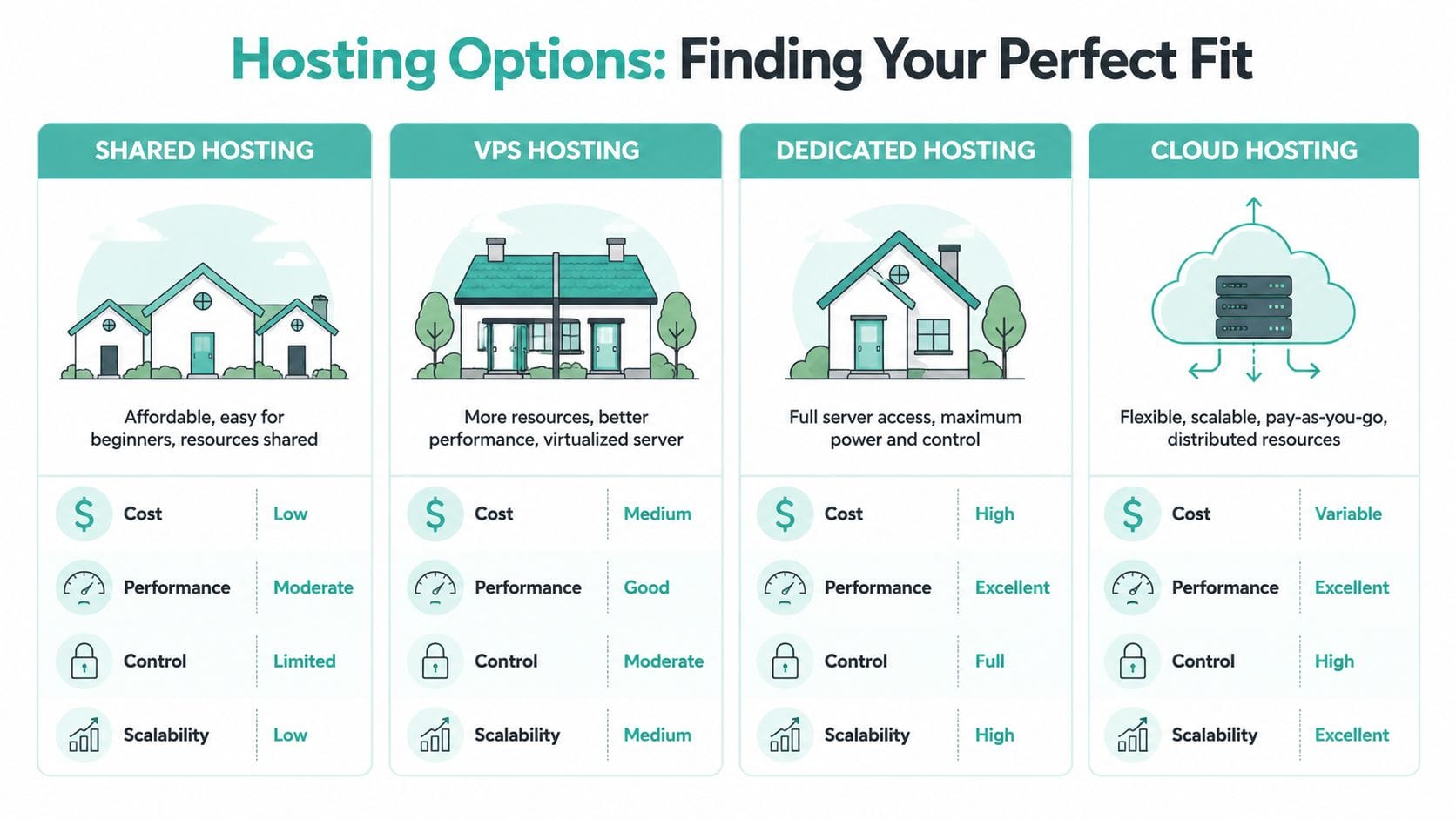
A quick comparison
Here’s a simple side-by-side view.
Hosting Type Comparison Chart
| Feature | Shared Hosting | VPS Hosting | Dedicated Server |
|---|---|---|---|
| Cost | Lower entry cost | Higher than shared | Highest of the three |
| Performance | Good for smaller sites | More consistent resources | Full server resources |
| Control | Limited | More control | Full control |
| Technical skill required | Low to moderate | Moderate | High |
| Best fit | Small business sites, blogs, portfolios | Growing sites, custom apps, agencies | Heavy workloads, specialised needs |
Cloud hosting belongs in the same conversation too, but it behaves a little differently because it relies on distributed infrastructure rather than one traditional server setup. It’s often chosen when flexibility and scaling matter more than keeping things simple.
Shared hosting
Choose shared hosting when you want the easiest path to a reliable site.
It suits local business websites, early-stage eCommerce, portfolios, brochure sites, and standard WordPress builds. If your main goals are launching quickly, keeping costs under control, and avoiding server admin, shared is hard to beat.
This is also the option that makes sense when your website is important but not yet technically demanding.
VPS hosting
A VPS sits in the middle ground.
You still share a physical machine at the hardware level, but you get a more isolated virtual server allocation with more control. That makes VPS useful when your site has grown beyond the comfort zone of standard shared hosting, or when a developer needs more freedom to configure the environment.
A VPS is usually a better fit when:
- Your site has outgrown shared plan limits
- You need more predictable resources
- You run custom software or workflows
- You manage several client sites and want greater separation
If you like the idea of moving up gradually rather than making a huge leap, a provider that offers managed web hosting in Australia can give you that path without forcing you to handle everything yourself.
Dedicated hosting
A dedicated server gives one customer the whole machine.
This is the “own the whole house” option. You get the most control and the most raw server access, but you also take on more cost and complexity. Dedicated setups are usually justified when a business has demanding applications, unusual security requirements, or workloads that need full server resources.
For many small businesses, dedicated hosting is unnecessary at the start. It’s powerful, but often excessive.
Cloud hosting
Cloud hosting is useful when flexibility matters more than simplicity.
Instead of relying on one classic server arrangement, it spreads workloads across broader infrastructure. That can make scaling easier and can suit applications with changing demand, development workflows, or projects that need more elasticity.
The trade-off is that cloud setups can be harder to evaluate for non-technical buyers. Pricing models, architecture choices, and support scope vary a lot.
A plain-English decision guide
If you want the shortest version, use this:
- Choose shared hosting if you’re launching a standard business site and want low fuss.
- Choose VPS if performance needs are rising and you need more control.
- Choose dedicated if your website or application has outgrown shared and virtualised environments.
- Choose cloud if flexibility and scaling are central to the project.
The right hosting plan isn’t the most powerful one. It’s the one that matches your current business stage without creating unnecessary cost or admin.
That’s why shared hosting remains such a common entry point. It leaves room to grow without demanding enterprise decisions too early.
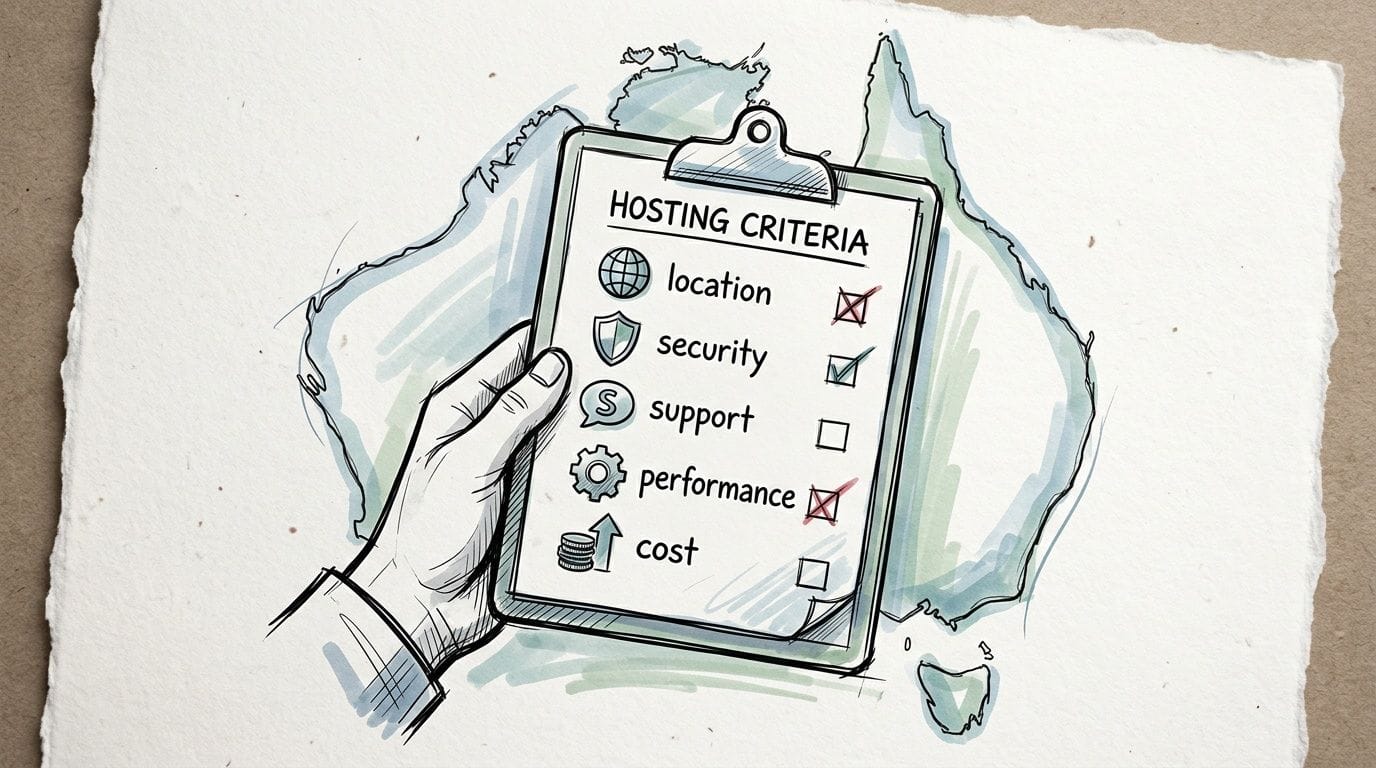
Checklist for Choosing an Australian Shared Hosting Provider
Once you’ve decided shared hosting is the right model, the next step is choosing the provider. Many Australian businesses then accidentally treat every hosting company as interchangeable.
They’re not.
Start with server location
If your customers are in Australia, your hosting should be built around Australian visitors.
According to this overview of shared hosting features and local latency advantages, hosting in Sydney or Brisbane can deliver a 30 to 50ms lower Time to First Byte for Australian visitors compared with US West Coast servers, and for local eCommerce businesses that loading-time improvement can reduce website abandonment by up to 7%.
That doesn’t mean every offshore setup is unusable. It does mean local hosting can have a direct effect on how responsive your site feels to Australian customers.
When you compare providers, check whether they clearly state Australian data centre locations such as Sydney, Melbourne, Brisbane, or Perth.
Look for support that matches your workday
Support quality isn’t just about whether a company has a help desk. It’s about whether the support model fits how Australian businesses operate.
Ask practical questions:
- Can you call during Australian business hours?
- Do they offer tickets or call-backs if you’re busy with customers?
- Will you be dealing with a team that understands local business context?
If your email stops working at the start of the workday, time zone friction matters. So does language clarity. So does being able to sort a problem without going around in circles.
Check the pricing style, not just the headline price
A cheap first invoice can distract from a messy billing structure.
Look for:
- GST-inclusive pricing so you know what you’re really paying
- Clear renewal pricing instead of a teaser discount with vague future costs
- No-contract flexibility if you don’t want to be locked in
- Resource transparency so you can see what the plan includes
This is particularly important for small business budgeting. Predictable monthly costs are easier to plan around than surprise jumps.
Ask what performance tools are included
Two shared hosting plans can look similar on paper and behave very differently in practice.
Check for practical inclusions such as:
- LiteSpeed for faster web serving
- CloudLinux for resource isolation
- AccelerateWP or WordPress optimisation tools if you run WordPress
- NVMe storage for faster data access
- Caching support that doesn’t require heavy manual setup
For example, UpTime Web Hosting offers local hosting with servers in Sydney, Melbourne, Brisbane and Perth, along with cPanel, CloudLinux, LiteSpeed, AccelerateWP, free SSL, malware scanning, DDoS-protected firewalls, and no-contract pricing with GST included. That combination shows the sort of checklist items worth looking for when you compare Australian providers.
Don’t skip the security basics
Security isn’t only for large businesses.
At minimum, look for hosting that includes or clearly supports:
- Free SSL certificates so your site uses secure connections
- Malware scanning to catch common website threats
- DDoS protection to reduce the impact of attack traffic
- Backups that are automated and stored off-site
- Monitoring so server issues are picked up quickly
If a host treats security as an optional extra for a basic business website, keep looking.
Confirm the local business details
A good Australian hosting provider should also make the small things easy.
That includes support for .au domains, business email setup, straightforward invoicing, and a platform that works for common Australian small business needs rather than only enterprise development teams.
A simple checklist before you buy:
| What to check | Why it matters |
|---|---|
| Australian data centre options | Better speed for local visitors |
| Australian support | Easier communication in your time zone |
| GST-inclusive pricing | Fewer billing surprises |
| cPanel or similar dashboard | Easier day-to-day management |
| Security features included | Less risk and less setup burden |
| Upgrade path | Easier growth later |
A provider doesn’t need flashy marketing. It needs to make your website easier to run.
Register your new domain name at competitive market prices including free domain add-ons like privacy, DNS Hosting, Custom Nameservers and Forwarding.
Always the best price and no nasty renewal price hikes.
Register A Domain Name
Pricing Contracts and Avoiding Common Hosting Traps
Hosting prices can look simple until you read the fine print.
This is the part many small business owners learn the hard way. The cheapest-looking shared plan isn’t always the cheapest plan to run over time.
The “unlimited” claim often isn’t unlimited
A lot of shared hosting offers use the word unlimited because it sounds reassuring. Unlimited storage. Unlimited bandwidth. Unlimited websites. Unlimited everything.
In practice, many of those plans rely on fair use rules buried in the terms. According to TechRadar’s review of the hidden limits of unlimited web hosting, 62% of users encountered hidden fees or restrictions in ACCC reporting from 2025, and some hosts cap CPU usage at 25% for more than 90 seconds, which can lead to suspension. The same source notes that renewal costs can rise by up to 300% on some global offers.
That doesn’t mean every plan using broad marketing language is bad. It does mean you should read for actual resource policy, not just the headline.
What to check before you buy
When you compare shared web hosting services, look at these details closely:
- Fair use wording: If the plan says “unlimited”, find out what it really limits.
- Renewal pricing: Check what happens after the introductory period ends.
- Contract terms: See whether you’re locked in or can leave easily.
- Included features: Confirm whether SSL, backups, email, and support are standard or add-ons.
A transparent plan with clear boundaries is usually safer than a vague one with impossible promises.
Why no-contract pricing appeals to SMEs
Small businesses often need flexibility more than flashy discounts.
If you’re testing a new idea, launching a second brand, or rebuilding an older website, a long contract can become dead weight. That’s why many owners prefer affordable web hosting with no contracts over plans that look cheap only because they tie you in and recover margin later.
Clear pricing beats clever pricing.
If the terms are hard to understand, assume the billing experience may be hard to understand too.
A better buying mindset
Instead of asking “What’s the cheapest hosting I can find?”, ask:
- Will I still be comfortable with this plan after the first invoice?
- Are the limits visible and understandable?
- Can I leave without hassle if the service doesn’t suit?
- Does the provider explain pricing like a partner or hide it like a trap?
That mindset usually leads to fewer surprises and a better long-term fit.
Conclusion The Smart Start for Your Australian Business
For most Australian businesses starting or rebuilding a website, shared web hosting services are the right first move.
They’re affordable, easier to manage than more advanced hosting types, and well suited to the everyday needs of SMEs. You get the basics that matter. Website space, email, security features, a control panel, and a setup that doesn’t require deep technical knowledge to keep running.
The local Australian context matters more than many global guides admit. Data centre location affects responsiveness for Australian visitors. Local support affects how quickly problems get solved. GST-inclusive pricing affects budgeting. .au domain support affects how naturally your online presence fits the local market.
Shared hosting’s role in Australia isn’t shrinking into irrelevance. It remains central. According to Verified Market Research’s shared hosting market outlook, projections for 2026 place shared hosting at 32 to 37% market share, alongside over 2.8 million .com.au domain registrations by 2025 and a business environment where 99% of Australian businesses are SMEs. That’s a strong signal that affordable, reliable local hosting still fits the way Australian business operates.
If your site is small to medium, your needs are straightforward, and you want a clean path online, shared hosting isn’t a compromise. It’s a practical business decision.
If you want local servers, Australian support, GST-inclusive pricing, and shared hosting plans built for small business websites, WordPress, email, and .au domains, have a look at UpTime Web Hosting. It’s a straightforward way to get online without overcomplicating the first step.