Your website is live. Your email address is on business cards. Customers know your brand by its domain name. Then one day you realise the domain isn't in your company's name. It was registered by a freelancer, an old employee, or the web developer who set everything up years ago.
That's when “domain ownership” stops being a technical detail and becomes a business risk. If the registrant details are wrong, you can lose control of your website, email, and brand presence at the worst possible time. In Australia, that risk is bigger than many business owners realise because a .au domain isn't the same as owning property. It's a regulated licence with rules, renewals, and eligibility checks.
Australia has 1,922,552 registered domain names, representing 0.22% of the global market across 707 distinct TLDs, with 35,186 signed zones and 100,690 zones (5.24%) listed as upcoming deletes according to Australian domain name statistics. That tells you two things. First, domains are a core part of Australian business infrastructure. Second, names change hands, expire, and drop constantly.
If you're trying to understand domain name ownership Australia rules in plain English, start with this: the name on the registrant record matters more than the person who paid the invoice, built the site, or manages the hosting account.
Table of Contents
- Why Your Domain Name Is Not as Secure as You Think
- The Truth You Are Licensing Not Owning Your Domain
- Who Can Register An Australian Domain Name
- How to Register and Secure Your Australian Domain
- Managing Renewals and Ownership Transfers
- Resolving Common Domain Name Disputes
- Your Australian Domain Ownership Checklist

Performance you can feel, backed by clients who depend on it. Read how our support and uptime create long‑term customer success.Power Your Business with Better Hosting
Why Your Domain Name Is Not as Secure as You Think
A common failure looks like this. A small business hires someone to build a website. The developer registers the domain during setup, adds hosting, connects email, and moves on. The site works, so nobody checks the registrant record.
Months or years later, the business wants to change providers. Then the problem appears. The developer's email address is on the domain. The registrant name is the developer's business, not the client's company. Renewal notices go to the wrong inbox. Ownership approvals go to someone who no longer works with the business.
That's not rare. It's one of the first things to check when a business has lost website or email access. If the wrong legal entity is listed, recovery becomes harder, slower, and more stressful.
The real damage happens off the website
When access breaks, it usually affects more than the homepage.
- Email disruption: Staff can stop receiving enquiries and invoices if the domain can't be renewed or managed.
- Brand confusion: Customers may see an expired site, a parked page, or nothing at all.
- Transfer delays: A business sale, rebrand, or agency handover can stall because the person in control isn't the rightful operator.
Practical rule: If your company trades on the name, your company should be the registrant. Not your developer. Not your marketing agency. Not your cousin who “set it up”.
If the situation has already turned ugly, practical recovery advice from Bridge IT Solutions on recovering a hacked website is useful because domain problems and website access problems often overlap during a business outage.
There's another detail many owners miss. Privacy settings don't change the legal registrant. They only affect what's exposed publicly, and .au names have their own limitations around that. This knowledge base article on domain privacy for AU domain names is worth reading before you assume “private registration” means protected ownership.
A quick self-check
Ask these questions today:
- Who is listed as registrant: Is it your exact legal business entity?
- Who receives approval emails: Is it a monitored business address you control?
- Who can authorise changes: Is that person still part of the business?
- Who has the registrar login: Is access documented and shared securely?
If you can't answer those quickly, your domain is less secure than you think.
The Truth You Are Licensing Not Owning Your Domain
Most Australian business owners talk about domains as if they own them the same way they own equipment, stock, or a vehicle. That isn't how .au works.
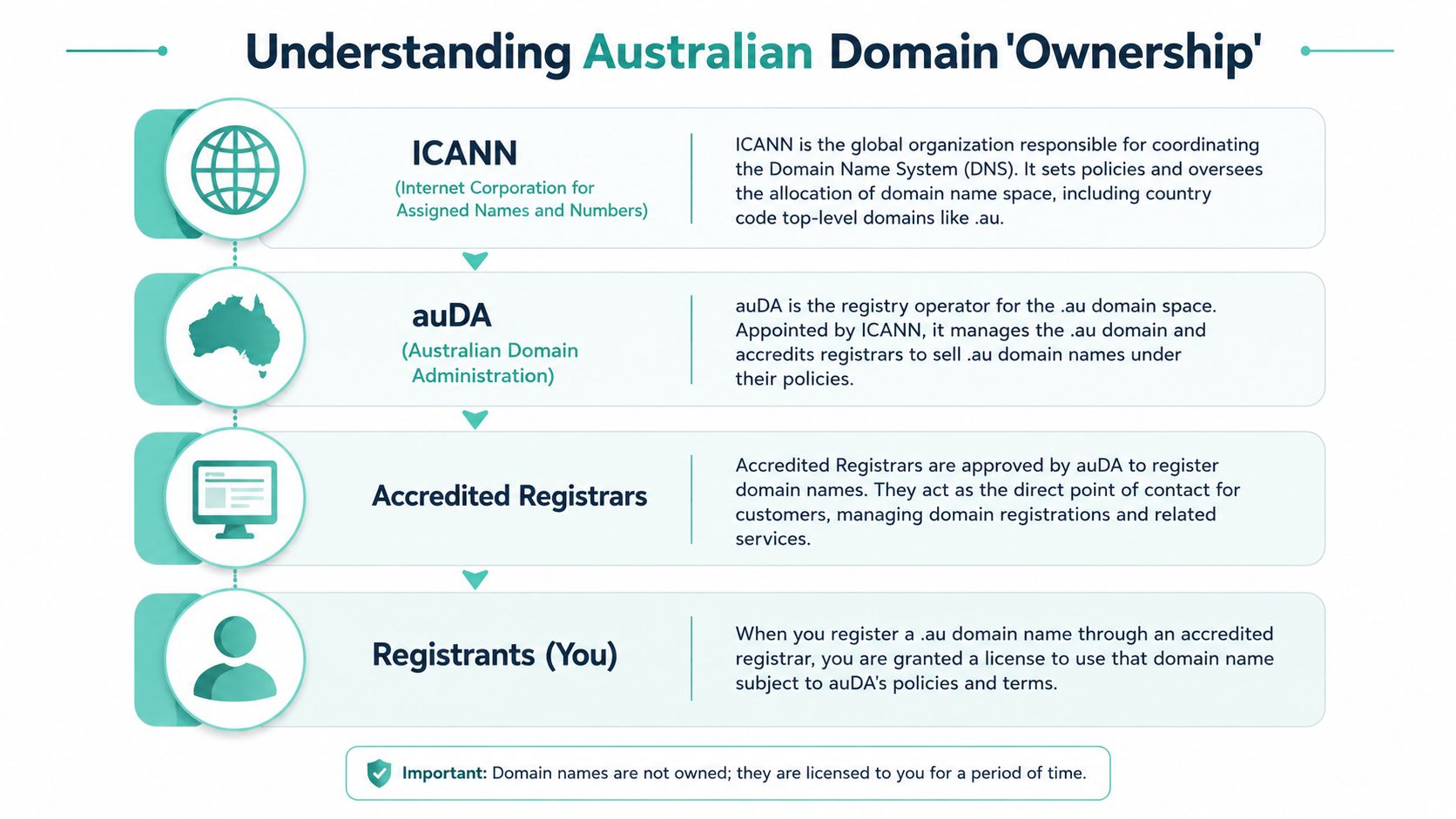
A .au domain is better understood as a renewable licence. You're granted the right to use it, provided you keep meeting the rules. If your eligibility changes, your details are wrong, or renewal is missed, that licence can end.
Think lease not title deed
The easiest analogy is a commercial lease.
If you lease a shop, you can trade from it, fit it out, and build value around the location. But you still have conditions. Miss the rent, breach the terms, or lose eligibility, and the right to occupy the space can disappear. A .com.au domain works in a similar way.
Under .au rules, the registrant is the legal holder of the licence. For commercial names, that generally means the operating entity needs to have the right Australian business connection, usually an ABN or ACN. The broader .au namespace is administered by auDA, which is endorsed by the Australian Government, and registrations are allocated on a first-come, first-served basis through accredited providers as outlined in this overview of .au administration and dispute principles.
That legal distinction is where many businesses slip up. According to auDA's explanation of .com.au domain names, 40% of small business owners in Australia misunderstand the difference between owning a trade mark and licensing a .com.au domain name. The same source explains that .com.au names are licensed assets tied to an active ABN/ACN and can cease upon business closure or eligibility breach.
A domain can feel permanent because you've used it for years. Legally, that feeling doesn't protect it.
Why this matters in practice
This changes how you should manage domain name ownership Australia issues.
- Business restructures matter: Moving from sole trader to company can affect eligibility and registrant details.
- Closures matter: If the business tied to the licence ends, the domain position can change too.
- Renewals matter: Paying on time is part of keeping the licence alive.
If you want a broader lens on digital control beyond domains alone, this piece on who controls your digital life is a useful reminder that online assets often sit in systems other people set up for you.
The practical takeaway is simple. Your domain is an asset, but it's a conditional asset. Treat it like a regulated business licence, not a trophy you bought once and own forever.
Host your website with our 5-star rated, cPanel website hosting plans.
Super fast servers, with security included and hosted in your choice of Australian Data Center.
View cPanel Plans
Who Can Register An Australian Domain Name
Eligibility is where theory turns into paperwork. If you don't qualify for the extension you want, registration won't stand up properly, even if the name looks available.
As of March 2022, direct second-level names such as example.au are available, and the eligibility standard for secondary .au domains requires the name to be an exact match, abbreviation, acronym of the registrant's name, or otherwise closely and substantially connected to the registrant according to OpenSRS guidance on .au domain policies.
Commercial names under .com.au and .net.au
For most businesses, these are the standard commercial options. The registrant needs a genuine Australian presence and a real connection to the name.
In plain terms, that usually means your company or business identity should line up with the domain you're claiming. If your trading name, company name, or brand is unrelated, you're inviting trouble later.
This is where ABN confusion starts. An ABN helps establish eligibility, but it doesn't create exclusive legal rights by itself. If you're unsure why business identifiers are part of the process, this ABN requirement guide for AU domain registration explains the practical reason.
Non-profit and association use under .org.au
If you run an association, club, charity, or other non-commercial organisation, .org.au may be the better fit. The core principle is still the same. The registrant needs to be the organisation with the right to use that name.
The mistake here is letting a committee member or volunteer register the domain personally. That works until the person leaves and nobody else can prove control cleanly.
Register the domain in the organisation's legal name, even if one person handles the admin.
Direct .au registrations
Direct .au names are shorter and cleaner, but the rules still tie the name to the registrant's identity or rights. They aren't a free-for-all.
For trade mark holders, the matching rules are strict. Since 12 April 2021, foreign entities must hold an Australian trade mark, whether registered or pending, that is an exact match to the domain name for .com.au or .net.au eligibility. They can't omit words or numbers from the trade mark sequence, as explained by MinterEllison's summary of the new .au licensing rules.
A practical example helps. If a foreign business holds an Australian trade mark for “Blue River Studio 24”, trying to secure blueriverstudio.com.au by dropping “24” won't satisfy that exact-match requirement.
.au Domain Eligibility Comparison
| Domain Extension | Primary Eligibility Requirement | Common Use Case |
|---|---|---|
| .com.au | Australian commercial presence with a genuine connection to the name | Trading businesses, companies, sole traders |
| .net.au | Australian commercial presence with a genuine connection to the name | Technology, infrastructure, internet-related commercial use |
| .org.au | Appropriate organisation status and connection to the name | Associations, clubs, not-for-profits |
| .au | Exact match, abbreviation, acronym, or close and substantial connection to the registrant | Shorter brand-first Australian identity |
The rule that matters most is simple. Register the extension that matches your legal position and your actual use. Don't try to reverse-engineer eligibility after the fact.
How to Register and Secure Your Australian Domain
Registering a domain correctly isn't complicated. The hard part is resisting shortcuts that create ownership mess later.
Start with the legal entity first, not the search box. Before anyone buys anything, decide which business or organisation should hold the domain licence. That exact entity should appear in the registration details.
What to prepare before you register
Have these details ready before you begin:
- Correct registrant entity: Use the company, incorporated association, sole trader, or other qualifying entity that operates the business.
- Matching eligibility detail: That may be your ABN, ACN, or other qualifying identifier, depending on the extension.
- Business-controlled contact email: Use an address the business keeps long term, not a contractor's inbox.
This is the point where many owners accidentally hand control away. A developer can assist with setup, but they shouldn't become the registrant unless they are the actual legal operator of the business behind the domain.
Here's what the process usually looks like in practice.
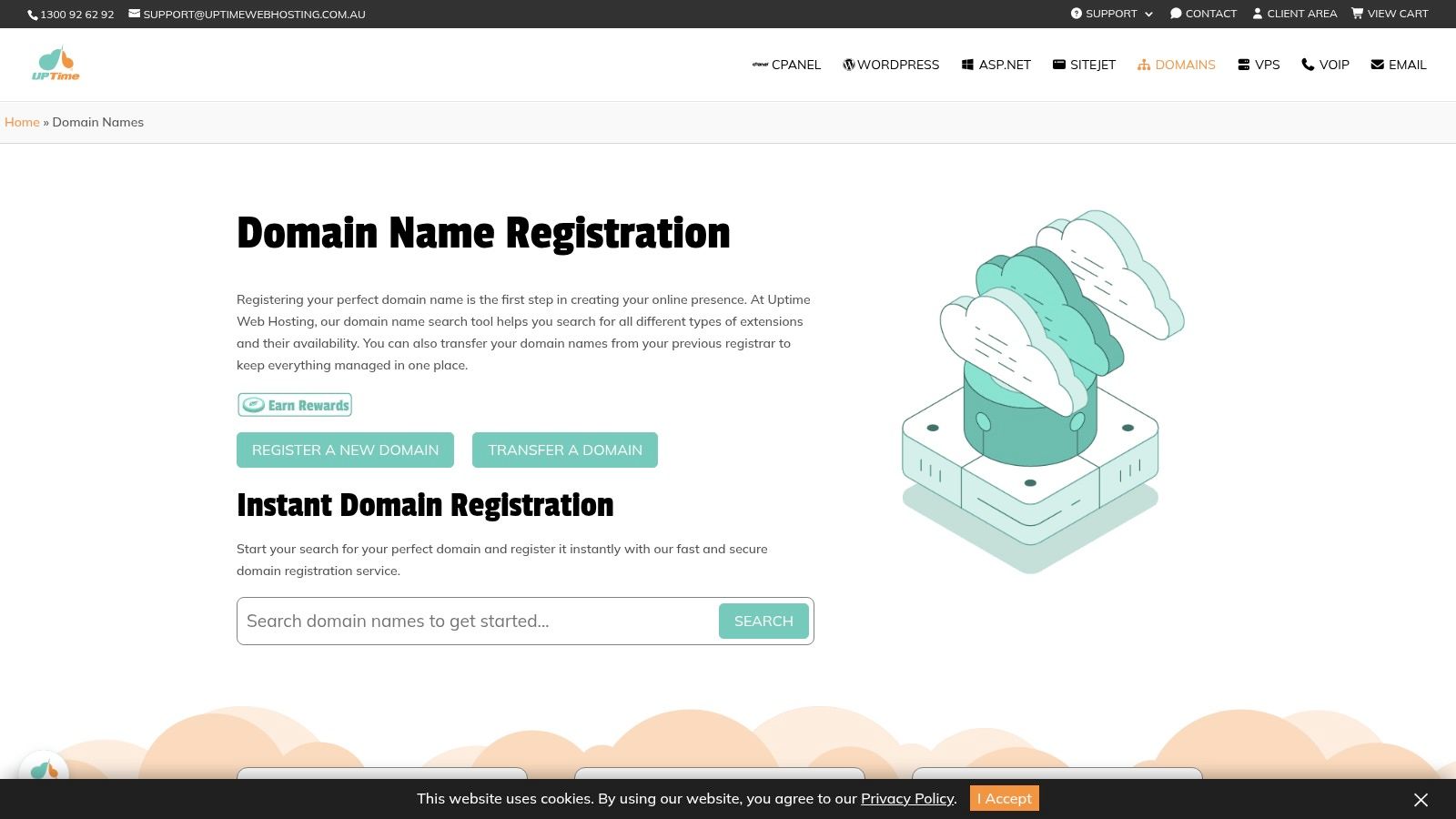
A practical starting point is this guide to registering a domain name in Australia, which walks through the registration flow and what information you'll need.
How to avoid the most common setup mistake
The common mistake isn't choosing the wrong name. It's entering the wrong owner.
A proper registration workflow should look like this:
- Search for the domain you want.
- Confirm the extension suits your business type.
- Enter the legal registrant's details accurately.
- Store login and billing access in business-controlled systems.
- Record renewal responsibility internally.
If you're using a provider that handles domains alongside hosting and email, keep the ownership side separate from the technical admin side. For example, UpTime Web Hosting offers .au registration, DNS hosting, domain forwarding, and related domain management tools, but the registrant details still need to reflect the legal business entity that holds the right to the name.
Security steps people skip
Registration is only half the job. Control also depends on basic account hygiene.
- Use a durable admin contact: Choose a mailbox the business monitors, not a personal address tied to one staff member.
- Turn on account security: Use available sign-in protections and registrar locks where offered.
- Document access: At least two authorised people in the business should know where domain access is stored.
If the only person who can log in is your old developer, you don't control the domain. You're borrowing access to it.
Done properly, the process is boring. That's exactly what you want.
Managing Renewals and Ownership Transfers
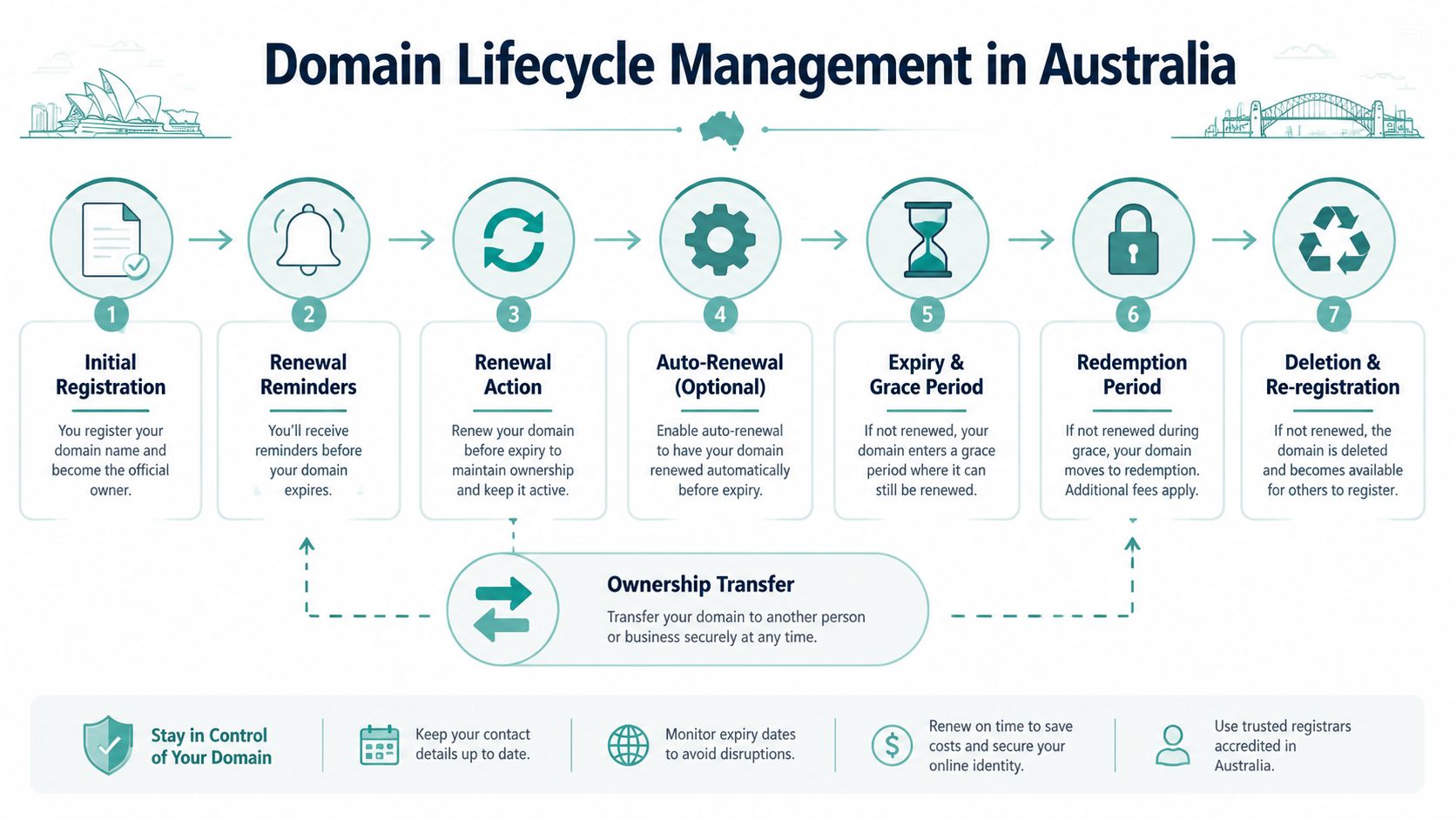
Most domain problems don't start with a court fight. They start with admin drift. Renewal notices go to an inbox nobody watches. The accounts team changes. A business restructures. Years pass, then the business discovers the name is attached to the wrong entity.
Renewals are operational not optional
A .au domain is held for a set period and must be renewed to stay active. If renewal slips, you're not just risking a website issue. You're risking email downtime, service interruption, and a scramble to recover the name before it drops.
Keep the process simple:
- Assign one owner internally: Someone in the business should be responsible for checking domain billing and expiry dates.
- Use reminders and renew early: Don't rely on a single automated notice.
- Review registrant details yearly: Confirm the legal entity and contact email still match reality.
A practical place to handle the recurring side of this is a provider's domain renewal process, especially if you want the billing and management trail centralised.
A registrar transfer is not the same as a change of registrant
These two processes are often confused.
A registrar transfer means moving the domain's management from one provider to another. The underlying registrant usually stays the same.
A Change of Registrant means changing the legal holder of the licence. That's the important one when a business is sold, restructured, or the original registration was placed in the wrong name.
According to Webcentral's explanation of changing ownership of .au domain names, a .au ownership transfer requires a complete re-registration process for a 1-year period and a mandatory administration fee of $119 AUD for each Change of Registrant. The same process isn't complete until both the current registrant and the new registrant complete their confirmation steps, including the required approvals.
That surprises people because it feels like changing the name on a utility bill. It isn't. Australian domain rules treat the licence holder seriously.
When a formal ownership change is needed
A Change of Registrant usually makes sense when:
- The business has been sold: The buyer needs to become the legal registrant.
- The domain is in the wrong person's name: Common after agency or freelancer setup.
- The entity has changed: For example, a sole trader operation is now a company and the name should sit with the company.
If you're about to do one, gather approvals early. Delays usually happen because the old contact email is inactive or the current registrant can't be reached.
Register your new domain name at competitive market prices including free domain add-ons like privacy, DNS Hosting, Custom Nameservers and Forwarding.
Always the best price and no nasty renewal price hikes.
Register A Domain Name
Resolving Common Domain Name Disputes
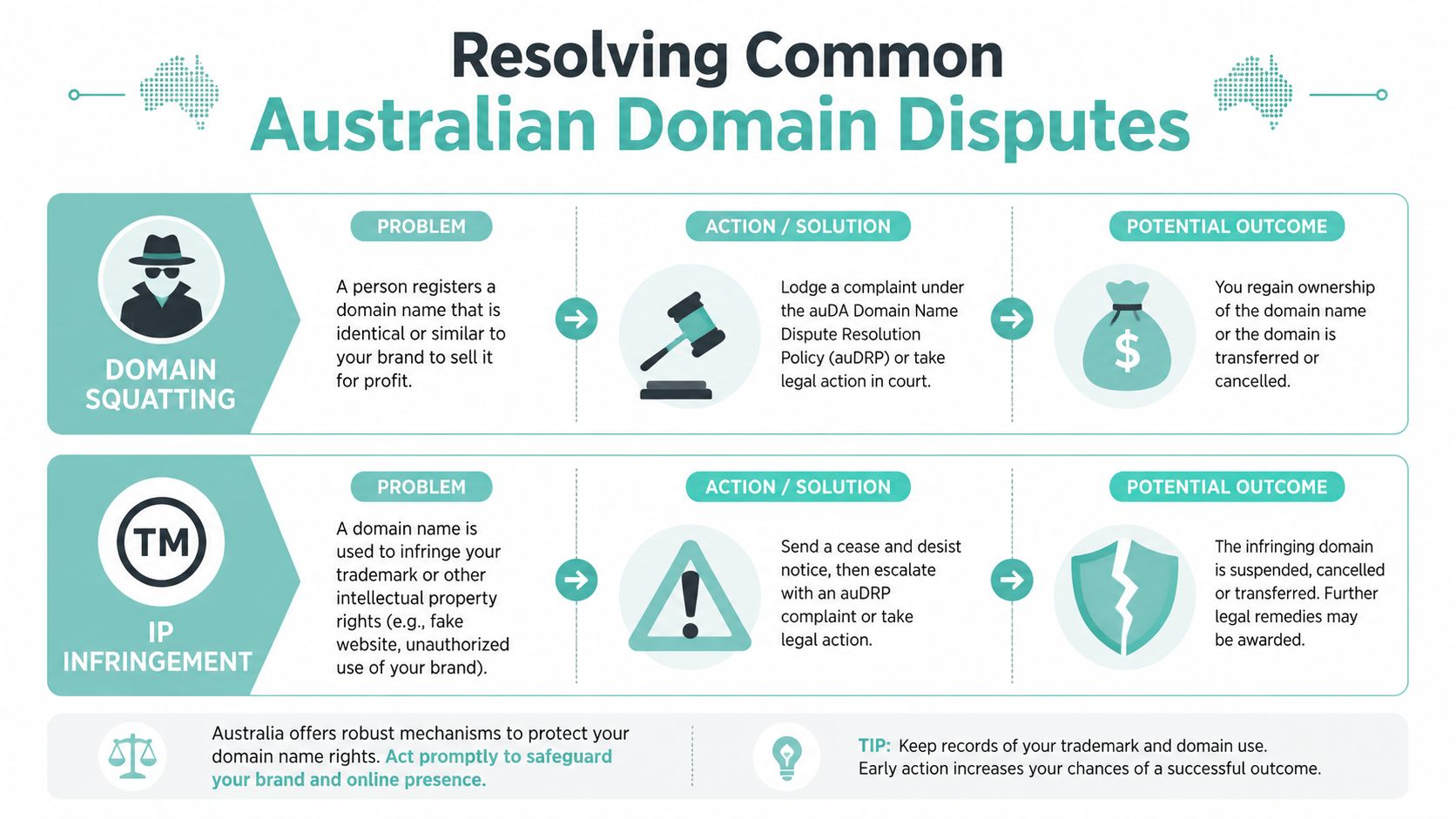
Some domain issues are admin mistakes. Others are strategic problems. The two most common are simple to describe and frustrating to solve. Someone else already registered the name you want, or someone is using a domain that clashes with your brand.
When someone else registered the name you want
A lot of businesses assume this is automatically “domain squatting”. Sometimes it is. Sometimes it isn't.
For .au names, registration is generally first-come, first-served. Registration alone doesn't automatically amount to trade mark infringement under Australian law, and complaints usually need more than “I wanted that name”. What matters is whether the registrant is eligible, whether they have a genuine connection to the name, and whether there's a trade mark or bad-faith issue strong enough to pursue.
The formal option people hear about first is auDRP. It can be appropriate, but it isn't always the fastest move.
According to By George Legal's discussion of domain name options, the auDRP process takes ~7 weeks and costs $2,000+, while a faster eligibility complaint can lead to cancellation in days if the registrant lacks a genuine business connection. The same source states that 35% of disputed .com.au domains were registered by entities with valid ABNs but no actual product or service match.
That's the overlooked tactic. If someone holds a generic .com.au under a valid ABN but has no real business connection to the term, an eligibility complaint may be more practical than heading straight into a larger dispute process.
When trade marks and domain names collide
A trade mark changes the conversation, but it still doesn't mean the domain will magically transfer to you. You need a proper basis for action.
Use this rough decision guide:
- You only want the name: Check whether the registrant qualifies to hold it.
- You have a matching trade mark: Review whether the use creates a stronger dispute position.
- The domain was set up by someone on your behalf: That may be an ownership correction problem, not a squatting case.
This Change of Registrant knowledge base guide for AU domain names is useful when the issue isn't an outside dispute at all, but an internal mistake where the wrong person or entity was listed from the start.
Don't start with the most expensive remedy. Start with the remedy that matches the actual problem.
That approach saves time, money, and a lot of unnecessary legal theatre.
Your Australian Domain Ownership Checklist
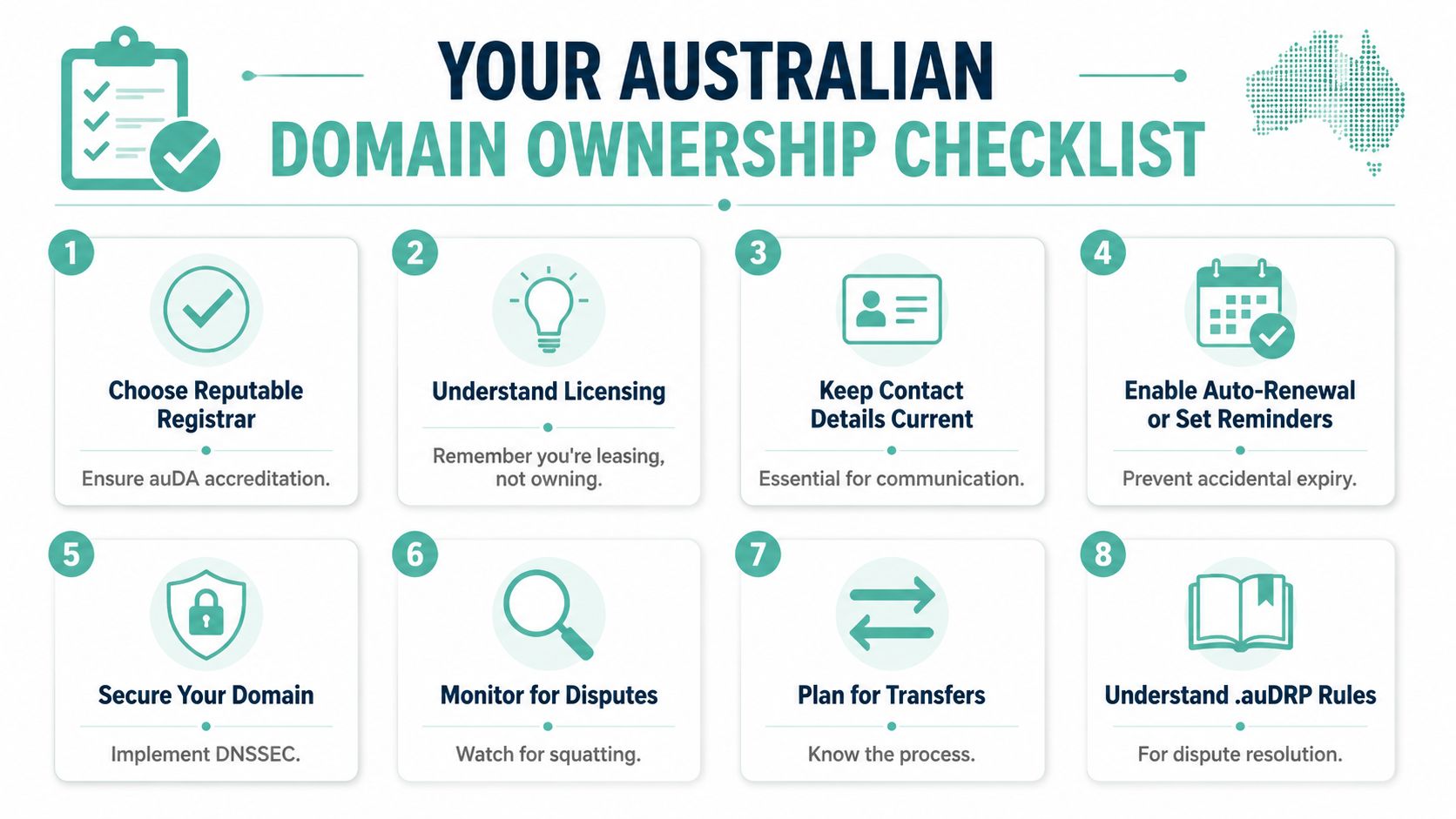
If you want to tighten up domain name ownership Australia issues quickly, use this as a working audit list.
Run this check against every business domain
- Confirm the registrant: Make sure the legal holder is your business or organisation, not a supplier or staff member.
- Check the admin email: It should go to a business-controlled mailbox that still exists.
- Review your renewal setup: Calendar reminders and internal ownership should be clear.
- Secure the registrar account: Enable available protections and restrict access to authorised people.
- Match the entity to the domain: If your structure changed, check whether the registration needs to be updated formally.
- Keep records of access: Billing, registrar login, and approval contacts should be documented.
Protect the brand side properly
There's one point many owners leave too late. An ABN or company registration does not give you exclusive rights to the name.
According to LegalVision's explanation of establishing ownership of .au domain names, registering an ABN or company name is insufficient to establish exclusive ownership of a .au domain name. To secure that position properly, you need a matching trade mark in the relevant class or classes.
That doesn't mean every small business needs a trade mark immediately. It does mean that if the domain is central to your brand, your legal protection strategy should go beyond “we registered the business name”.
A well-managed domain should be boring. The right entity holds it. The right people can access it. Renewals happen on time. If a dispute appears, you know whether it's an eligibility issue, a registrant issue, or a brand issue.
If you need to register a new .au name, review your current setup, or move a domain into the correct business entity, UpTime Web Hosting provides Australian domain registration and management services that can help you handle the practical side cleanly.