
You're setting up a new website, a customer portal, or maybe a software product. You search for name ideas, and suddenly half the available options seem to end in .io. The names look sharp. They feel modern. They also raise a practical question for an Australian business owner: is this just startup styling, or does it make sense for your business?
That's where most advice on .io falls short. It usually stops at “tech companies use it” and leaves out the real decision points. If you run a SaaS product, app, agency, or service business in Australia, you need more than a trendy definition. You need to know how .io works, how customers read it, what it means for search visibility, and whether it's a smarter move than a standard .au address.
I've seen this come up most often when a business has two identities at once. One is local and trust-based. The other is digital and product-led. That's common in software teams, app founders, and even firms branching into web3 solutions for startups and enterprises. In that situation, your domain isn't just a web address. It becomes part of positioning.
If you're still weighing providers and name options, it also helps to compare an Australian domain registrar guide before locking anything in.
Table of Contents
- Introduction Why You Are Seeing .io Everywhere
- What a .io Domain Actually Means
- Technical and SEO Advantages of Using .io
- The Hidden Risks and Controversies of .io Domains
- Comparing .io vs .au for Your Australian Business
- How to Register a .io Domain in Australia
- Final Recommendations Should Your Business Use .io

Performance you can feel, backed by clients who depend on it. Read how our support and uptime create long‑term customer success.Power Your Business with Better Hosting
Introduction Why You Are Seeing .io Everywhere
Australian businesses aren't seeing .io by accident. The extension has become a common choice for software brands, developer tools, apps, and digital products because it looks clean and carries a technical feel. That makes it attractive when your business wants to signal innovation before a visitor even reads the homepage.
For a café in Newcastle or a plumber in Geelong, that signal usually doesn't help much. For a startup building APIs, automation tools, or a SaaS platform, it can fit immediately. The same domain ending can either sharpen your brand or create distance from the people you're trying to win over.
Practical rule: Treat your domain like shop signage. If your customers need to feel “local and established”, .au usually reads better. If they need to feel “digital product and global reach”, .io can work.
The reason .io keeps coming up is simple. It sits in that middle ground between branding and function. It isn't mainstream in Australia the way .au is, but it's recognisable enough in digital industries that many founders shortlist it early.
What a .io Domain Actually Means
The short answer to what is .io is that it has two meanings at once. One is official. The other is cultural.
The official meaning and the practical meaning
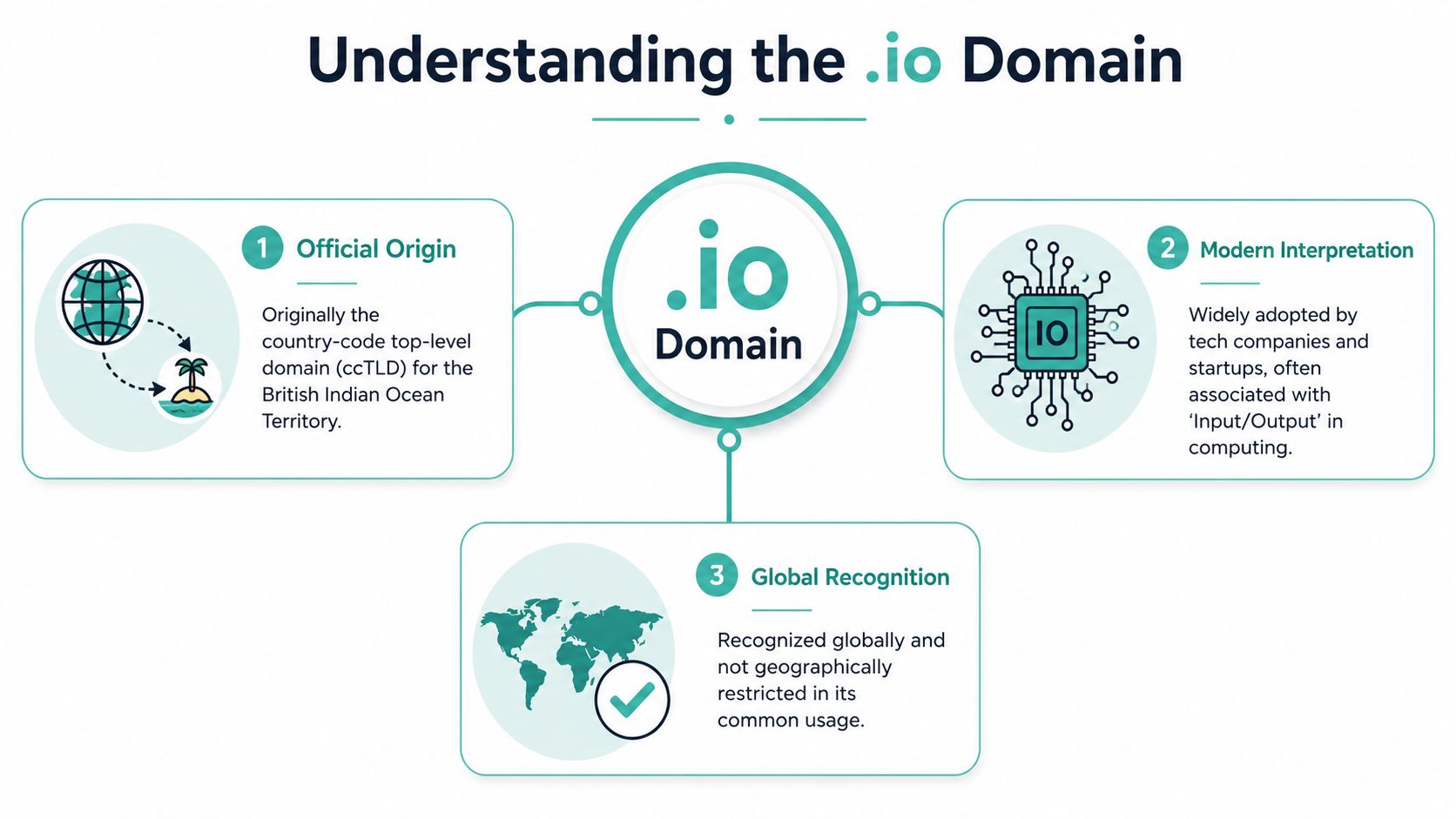
Officially, .io is the country-code top-level domain assigned to the British Indian Ocean Territory. That's its registry origin. But that's not why most businesses buy it today.
In practice, the extension is used globally as a tech-oriented namespace because “I/O” means “input/output” in computing. Registry history shows how far it has moved from a geographic label into a digital brand category: IANA delegated .io in 1997, and the backend registry later moved from Internet Computer Bureau to Afilias in 2017, then to Identity Digital in 2022, which reflects that long shift toward international use over nearly three decades, as outlined by Namecheap's background on the .io domain extension.
A good way to think about it is this. The official meaning is the paperwork. The practical meaning is what people see in the market.
Why the tech world adopted it
Tech founders didn't choose .io because they wanted a territory-linked domain. They chose it because it sounds native to software. A product called something like launchpad.io or metrics.io feels like a software tool. The same name on a different extension can feel broader, more corporate, or less product-focused.
That's why .io often shows up in:
- SaaS products where the company wants a concise, app-style brand
- Developer tools aimed at engineers who already recognise I/O as a computing term
- Product sub-brands where the main company keeps one domain and the software gets another
- Experimental ventures where a founder wants something shorter than what's available on older extensions
Most customers won't know the territorial origin. Many technical buyers will recognise the computing reference immediately.
That split matters. If your audience is technical, .io can communicate relevance very quickly. If your audience is suburban households comparing local providers, that same signal may not land at all.
Host your website with our 5-star rated, cPanel website hosting plans.
Super fast servers, with security included and hosted in your choice of Australian Data Center.
View cPanel Plans
Technical and SEO Advantages of Using .io
The strongest operational argument for .io isn't that it looks modern. It's that it can support a broader digital strategy without boxing you into a local-only perception.

Why search visibility is different from a local ccTLD
A key point for Australian businesses is that Google treats .io as a generic top-level domain for search purposes, even though it began as a ccTLD. That means an Australian site on .io isn't automatically boxed into location-bound search behaviour the way a more strictly geographic country extension might be. Elementor explains that this matters for global SaaS brands, developer tools, and API products that want international discoverability without losing the computing-based brand signal, in its guide to how Google treats .io for search.
For a business owner, the practical takeaway is simple. If your customers could come from Australia, Singapore, the UK, or the US, .io won't immediately make your site feel geographically narrow in search.
That doesn't mean the domain itself does your SEO for you. You still need solid pages, useful content, fast hosting, and clear targeting. If you're working through that side of the plan, a practical read on SEO for Australian business websites helps tie the domain decision back to actual search work.
Why branding can be stronger with the right audience
The second advantage is branding clarity. In crowded naming markets, .io often gives founders access to shorter or cleaner names than they'll find on older, heavily claimed extensions.
That's useful when you're naming:
- A SaaS platform with a short product word
- A client dashboard that needs its own identity
- A tools suite where separate services live under separate brands
- An API product marketed directly to developers
There's also a perception benefit. A .io domain can make a product look purpose-built for software users. That's why it often works well for agencies selling apps, internal tools, AI products, automation workflows, or platform services.
For local lead generation businesses, that same effect is mixed. A Brisbane accounting firm or a Wollongong dental clinic usually gets more trust from a local domain than a startup-style extension. If your goal is local customer acquisition, the domain choice should support the broader plan. This is similar to the thinking behind a digital marketing strategy for Brisbane firms, where audience fit matters more than trend-following.
The Hidden Risks and Controversies of .io Domains
Most articles about .io stay on the safe, easy talking points. They mention startups, branding, and short names. They usually skip the harder question. Is .io a sensible long-term asset for a business that wants stability?
The governance question most buyers miss
Because .io is tied to the British Indian Ocean Territory, there's an underlying governance issue that isn't purely theoretical. Reporting noted that the October 2024 UK decision to transfer the Chagos Islands to Mauritius raised fresh questions about the future of .io, although as of mid-2025 there had been no formal retirement action and the risk was assessed as very low, according to EuroDNS coverage of the .io domain's future.
That doesn't mean Australian businesses should panic. It means they should think like operators rather than trend followers.
A low risk isn't the same as no risk. If a domain sits at the centre of your app, customer email, login system, and docs library, even a small governance uncertainty belongs on your checklist.
For most small businesses, the sensible response isn't to avoid .io at all costs. It's to avoid putting yourself in a position where one extension becomes your only identity.
Business risks that have nothing to do with politics
The second category of risk is more ordinary and more common.
A globally open extension creates practical issues such as:
- Trademark tension: Your business name may feel unique in Australia but clash with another operator overseas using a similar product name.
- Lower local trust: Some Australian buyers still read non-.au domains as less local, especially for service businesses.
- Migration friction: If you ever need to move from .io to a more local or broader primary domain, you'll need a plan for redirects, email continuity, and customer communication.
If you choose .io, treat it as part of a domain portfolio, not as a single bet. Hold the matching local domain if you can. Keep your brand assets consistent. Make sure renewals are watched carefully, because any domain you rely on for product access or email becomes a liability if it lapses. This matters even more if you haven't already set internal reminders around what happens when a domain name expires.
Comparing .io vs .au for Your Australian Business
This is the decision that matters most. Not “is .io cool?” but which extension better matches the way your business earns trust.
Australian buyers are already conditioned toward local domains. auDA reported 3.39 million .au domain names under management as of 30 June 2025, a sign that .au remains the dominant and familiar option for Australian businesses and users, as cited in this discussion of Australian adoption and the .io trade-off.
Where .au wins clearly
For many SMBs, .au still does the heavy lifting.
If you run a business where customers want local reassurance, .au usually helps more than .io. That includes trades, healthcare, legal, accounting, local retail, hospitality, community organisations, and most service businesses operating mainly inside Australia.
Why? Because the extension answers an unspoken question before the customer asks it. Are you local? With .au, the answer is obvious.
If a customer is comparing three businesses and doesn't know any of them, the domain that looks local often feels safer.
That's hard to measure precisely in every case, but easy to observe in buying behaviour. Australian consumers are used to seeing .au in ads, search results, invoices, and email signatures. Familiarity matters.
Where .io makes strategic sense
.io becomes stronger when your business behaves more like a product company than a local operator.
It often fits if you're building:
- A SaaS platform sold beyond Australia
- A developer-facing tool where technical identity matters
- A product lab or spin-off that shouldn't feel tied to one country
- A software feature brand separate from the parent business
- An app with international ambitions from day one
A Melbourne startup selling workflow software to agencies in multiple markets can use .io naturally. A Perth engineering consultancy launching a software dashboard for clients might use .io for the product while keeping .au for the corporate site. That kind of split often works well because each domain does a different job.
A practical side by side view
Here's the simplest way to compare them:
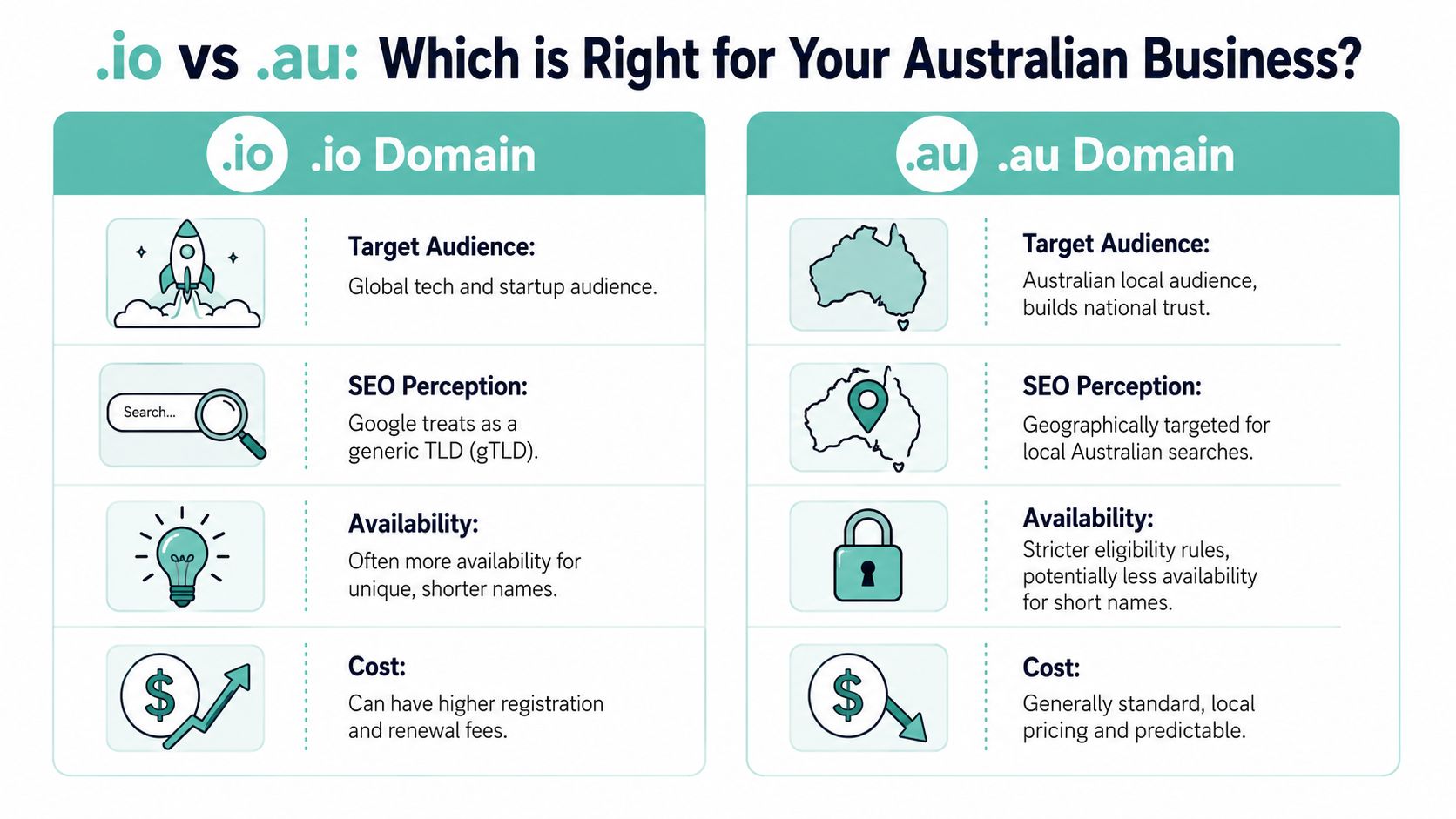
| Factor | .io | .au |
|---|---|---|
| Audience fit | Better for global digital products and technical users | Better for Australian households and local business buyers |
| Brand feel | Modern, software-oriented, startup-leaning | Established, local, familiar |
| Trust signal in Australia | Mixed, depends on audience | Strong for local credibility |
| Search positioning | Useful for broader international brand positioning | Useful when Australia is clearly your home market |
| Use case | SaaS, apps, tools, product brands | Services, local commerce, national business presence |
For many businesses, the best answer isn't either-or.
Use .au as the trust anchor and .io as the product brand if you have both a local company identity and a software offer. If you're planning that path, it helps to understand the mechanics of registering a business domain in Australia before you buy names in the wrong order.
Register your new domain name at competitive market prices including free domain add-ons like privacy, DNS Hosting, Custom Nameservers and Forwarding.
Always the best price and no nasty renewal price hikes.
Register A Domain Name
How to Register a .io Domain in Australia
If you've decided .io fits your brand, the registration process is straightforward from Australia.
What registration looks like in practice
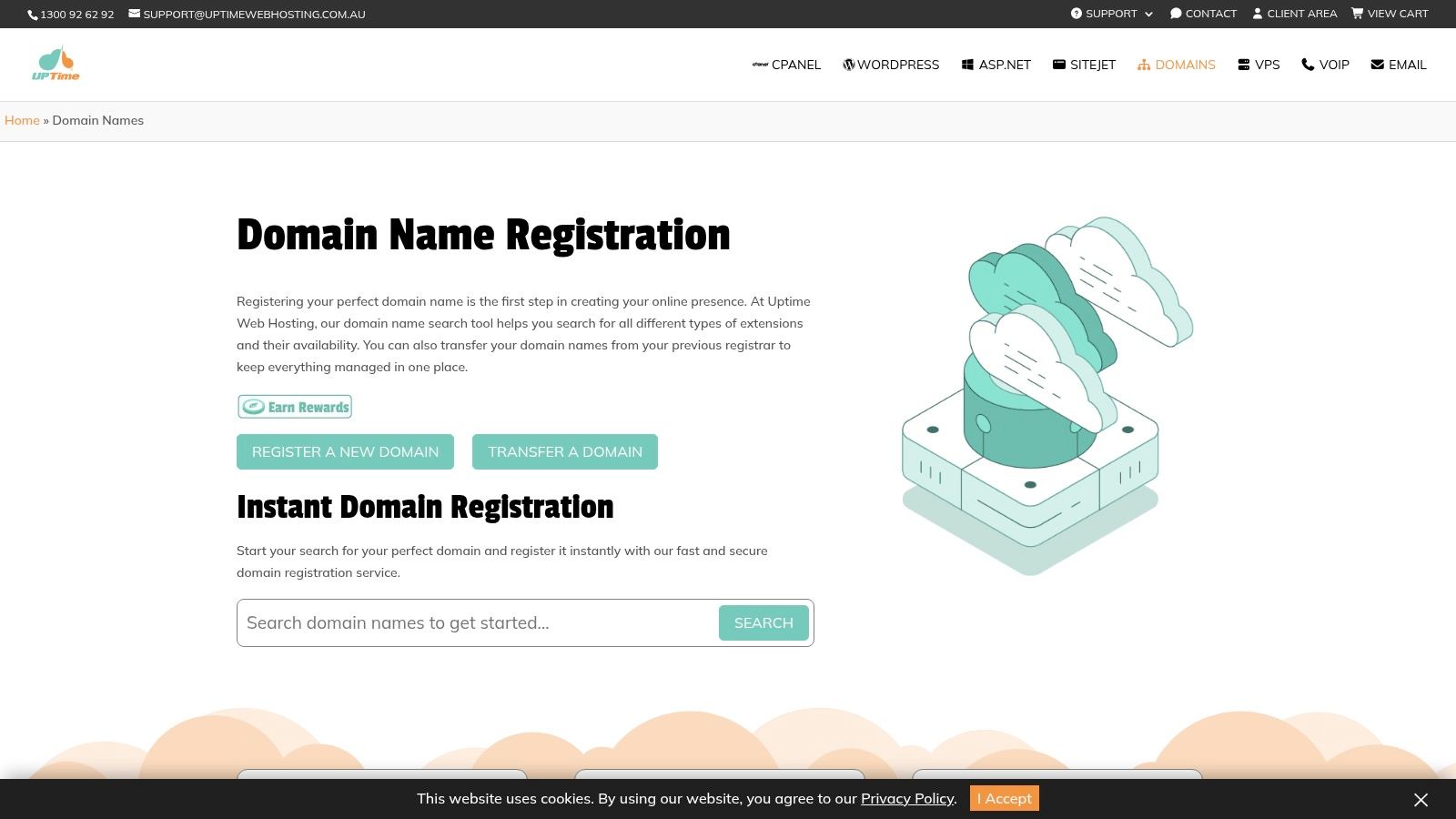
Registrars report that anyone worldwide can register a .io domain without residency requirements, and the extension follows standard DNS-compatible syntax limits of 3 to 63 characters with hyphen rules, which gives Australian businesses room to secure short names for products, stacks, or sub-brands. That same guidance also notes that because .io is globally open rather than Australia-specific, it should be paired with a local domain strategy if local trust matters, as explained in Zoho's overview of .io registration rules.
In plain terms, you don't need to be based in a particular country to buy one. You search for the name, choose an available option, select the registration term offered by your registrar, and complete the purchase like any other domain.
A practical workflow looks like this:
- Shortlist several names. Your first choice may already be taken.
- Check brand conflicts manually. Don't rely only on domain availability.
- Buy the matching .au if it matters to your market. This stops your identity from splitting later.
- Set renewal reminders immediately. Product domains often become critical faster than owners expect.
Rules worth checking before you buy
There are a few details that matter more than people think:
- Length matters: Shorter names are easier to say, type, and remember.
- Pronunciation matters: If you say the name in meetings or sales calls, make sure people can repeat it correctly.
- Email matters: A clever domain can still be awkward when used in staff email addresses.
- Renewal discipline matters: Don't treat domain renewal like admin clutter.
If you want one provider that handles domain registration and management locally, UpTime Web Hosting offers domain services relevant to Australian businesses, including international options alongside local domains. Once your name is secured, it's worth putting a reminder in place for renewing your domain on time.
Final Recommendations Should Your Business Use .io
The best domain choice usually becomes obvious when you stop asking which one looks modern and start asking which one supports the business model.
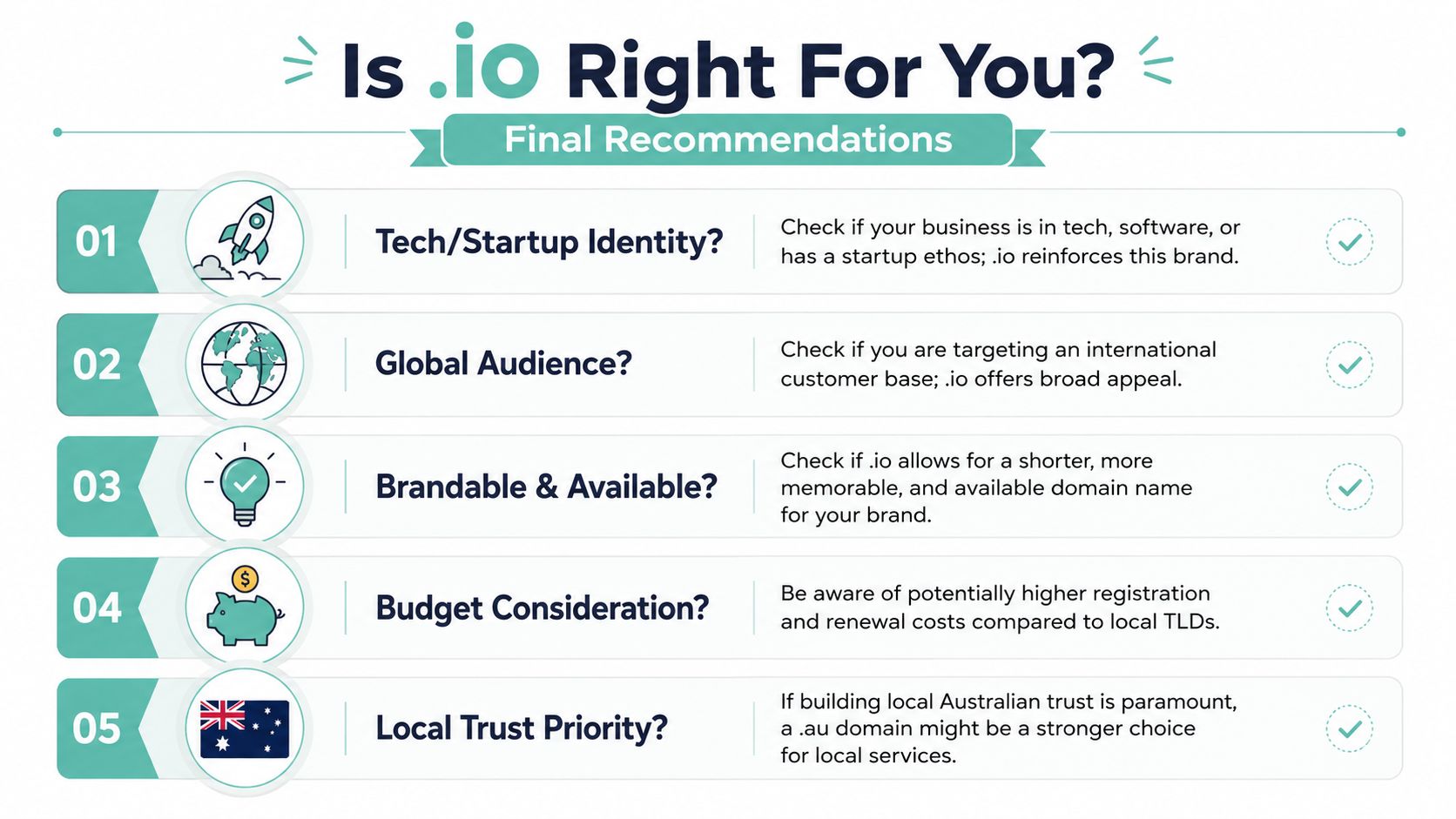
Choose .io if these points sound like your business
.io is a strong option when your business is product-led, software-based, or aimed beyond Australia.
Choose it if:
- You sell software, not just services. A SaaS product, app, platform, or automation tool can wear .io naturally.
- Your audience is technical. Developers, product teams, and startup buyers usually understand the signal.
- You want a shorter, cleaner brand name. Availability is often better for brandable product names.
- Your market isn't mainly local. If the product is designed for multiple countries, .io can fit the positioning.
Decision shortcut: If your homepage talks about features, integrations, dashboards, or APIs before it talks about suburbs and service areas, .io is probably worth considering.
Stick with .au if local trust does most of the work
For many Australian SMBs, .au is still the better default.
Stick with .au if:
- Your customers are mainly in Australia
- You rely on local credibility
- You run a service business people need to trust quickly
- You want the safest and most familiar domain identity for the local market
That includes electricians, accountants, builders, dentists, consultants, training businesses, local eCommerce operators, and most firms where the buying decision is based on reassurance as much as features.
If you're in the middle, use both strategically. Keep .au as the primary business domain. Use .io for a software product, portal, or branded tool if that part of the business needs a different identity. That approach gives you flexibility without forcing all trust and branding work onto one extension.
If you're choosing between .io, .au, or both, UpTime Web Hosting can help you register and manage the domain side cleanly so you can focus on naming, brand fit, and keeping renewals under control.