You've probably been there already. You register a domain, start planning a new website, and then hit a wall of confusing choices: shared hosting, VPS, WordPress hosting, cPanel, cloud hosting, backups, SSL, server location. It all sounds important, but it doesn't sound like plain English.
For most small business owners, web hosting feels like renting a shop in a part of town you've never visited. You know the location matters. You know security matters. You know bad infrastructure can hurt the business. But you shouldn't need to become a systems engineer just to launch a site that loads fast and stays online.
That's why web hosting for small business needs an Australian lens. A local café, tradie, consultant, eCommerce shop, allied health clinic, or professional services firm has practical questions, not abstract ones. Will the site load quickly for local visitors? Will customer data stay in Australia? Will someone answer the phone when email stops working on a Monday morning?
Table of Contents
- Why Your Web Host Is Your Most Important Digital Partner
- Decoding Hosting Jargon Your Guide to Hosting Types
- The Non-Negotiable Features Your Business Website Needs
- Understanding Australian Hosting Prices and Contracts
- Real-World Hosting Setups for Australian Businesses
- Your Hosting Decision Checklist and Migration Plan
- Frequently Asked Questions About Small Business Hosting

Performance you can feel, backed by clients who depend on it. Read how our support and uptime create long‑term customer success.Power Your Business with Better Hosting
Why Your Web Host Is Your Most Important Digital Partner
A small business owner in Brisbane recently described hosting to me as “the bit behind the website that I hope never breaks.” That's a fair starting point, but it misses something important. Your host isn't just the hidden utility behind the site. It's the land, wiring, locks, and after-hours emergency contact all rolled into one.
If your host is slow, your website feels slow. If your host is unreliable, enquiries go missing while you sleep. If your host stores data offshore without clear governance, you create extra compliance questions you didn't need in the first place. The hosting choice sits underneath everything else you build online.
Australia gives business owners plenty of choice, which is helpful and slightly overwhelming at the same time. The Australian Internet Hosting Services industry comprises 1,825 businesses and generated a market size of $1.5 billion in 2026, serving 2.7 million actively trading Australian businesses. That scale creates options, but it also makes filtering providers more important if you care about local speed and data sovereignty, as outlined by IBISWorld's Australian industry profile.
Hosting affects more than your website
A good host supports the business outcomes behind the website:
- Customer trust: A secure, stable site looks professional and feels safe to use.
- Lead generation: Fast pages make it easier for visitors to stay, browse, and contact you.
- Operations: Email, forms, backups, and updates run more smoothly when the foundation is sound.
- Compliance: Australian businesses often prefer local infrastructure because it simplifies internal risk and governance conversations.
Some businesses also need their website provider to think beyond design and into obligations around privacy, governance, and regulated communication. In that context, compliance-focused web solutions can be a useful reference point for firms in advice-led or regulated sectors.
Practical rule: If your customers are in Australia, start by treating Australian server location as a business decision, not a technical extra.
Local hosting matters because physical distance still affects website responsiveness. If you want a plain-English overview of why server location changes performance and support outcomes, this guide on switching to local Australian hosting is a helpful starting point.
Decoding Hosting Jargon Your Guide to Hosting Types
Most hosting jargon becomes easier once you stop thinking about servers and start thinking about property.
Shared hosting is like renting a flat in an apartment building. VPS hosting is closer to a townhouse. Dedicated hosting is your own standalone property. Cloud hosting is a flexible network of spaces you can draw from as needed. The words sound technical, but the business trade-offs are familiar: cost, privacy, control, and how much room you need.
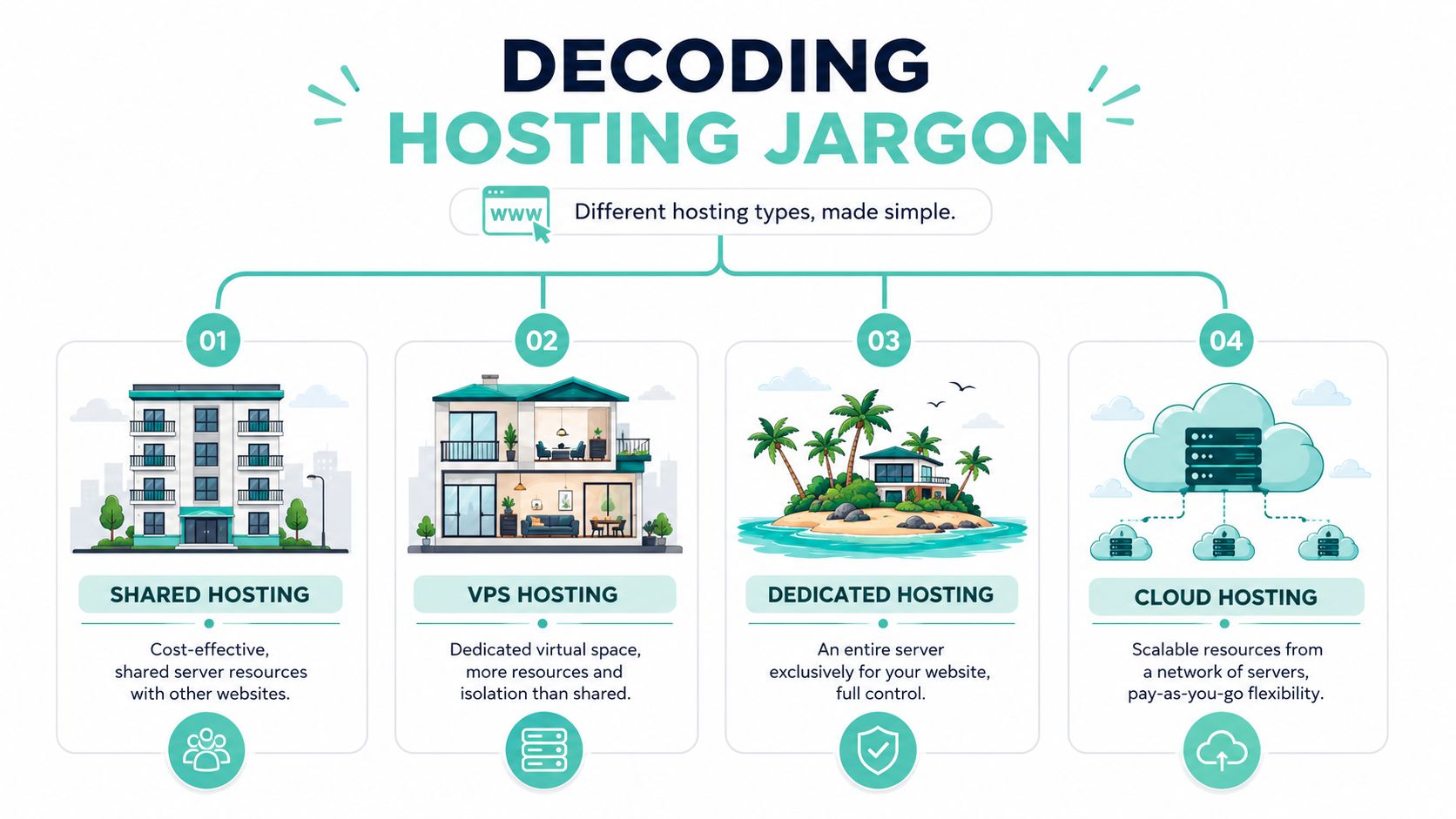
Australian small businesses usually start with two practical budget bands. Entry-level shared hosting can sit under $30 AUD per month, while business-grade managed cloud hosting typically starts around $100 AUD per month for SMEs, according to Bridge IT's Australian business hosting overview. That doesn't mean everyone should buy the cheapest plan or jump straight to cloud. It means you can usually match the hosting type to the stage of the business.
Shared hosting for simple business sites
Shared hosting works well when you're launching a straightforward site and want low cost with low fuss.
Think of a local accountant, photographer, consultant, or family law firm with a brochure-style website. They need pages, contact forms, business email, maybe a blog, and reliable basics. They usually don't need custom server configuration or heavy processing power.
Shared hosting is a sensible fit when you want:
- A simple launch: You can get online without managing server settings.
- Predictable costs: It's often the easiest entry point for a new business site.
- Standard features: SSL, email, databases, and a control panel are commonly included.
- An upgrade path: You can move later if traffic, bookings, or online sales grow.
If that sounds like your current stage, a local shared hosting plan for Australian businesses is the kind of option to compare against others.
VPS hosting when your site needs room to grow
A VPS, or Virtual Private Server, is more like a townhouse. You're still inside a bigger property arrangement, but you get your own defined space and more control over how it's used.
This suits businesses that have outgrown basic hosting. A growing online store, a custom web application, a busy agency site, or a company running multiple business systems from one environment often fits here. The key difference isn't just traffic. It's complexity.
Here's a quick comparison:
| Hosting type | Simple analogy | Best fit | Main trade-off |
|---|---|---|---|
| Shared | Apartment building | New brochure sites, smaller service businesses | Less control |
| VPS | Townhouse | Growing stores, custom apps, multi-site setups | Higher cost and more technical decisions |
| Dedicated | Standalone property | Very specialised workloads | More management responsibility |
| Cloud | Flexible network | Businesses needing scalable infrastructure | Can be harder to compare on price |
If your website directly supports sales, bookings, member access, or operational workflows, the question changes from “What's cheapest?” to “What breaks first if this is underpowered?”
Managed WordPress and specialist hosting
Managed WordPress hosting is like a serviced apartment. The place is set up for one purpose, and many of the maintenance jobs happen for you. That matters if your business website runs on WordPress and you don't want to spend your own time on plugin updates, security hardening, caching, and performance tuning.
This option often suits:
- Content-heavy sites: Blogs, publishers, and firms publishing regular updates.
- Lead generation websites: Sites where enquiry forms and speed matter.
- WooCommerce stores: Especially when revenue depends on smooth front-end performance.
- Owners who don't want server admin work: You'd rather focus on running the business.
Then there's specialist hosting, including Windows or ASP.NET hosting. That's relevant when your business relies on Microsoft-based applications or needs compatibility with tools such as MSSQL. It's not common for every small business, but when you need it, you really need it. In such cases, generic one-size-fits-all plans can become frustrating.
The simplest way to choose is to ask one question: what job does the website perform for the business today?
If it's mainly an online brochure, shared hosting is often enough. If it's a revenue engine or runs something custom, look at VPS, cloud, or managed environments. If it's built on WordPress and you want the maintenance burden reduced, managed WordPress often feels worth it very quickly.
Host your website with our 5-star rated, cPanel website hosting plans.
Super fast servers, with security included and hosted in your choice of Australian Data Center.
View cPanel Plans
The Non-Negotiable Features Your Business Website Needs
A hosting plan can look fine on paper and still be a bad business decision. The giveaway is usually a plan that lists storage and bandwidth loudly but hides the features vital for daily site protection.
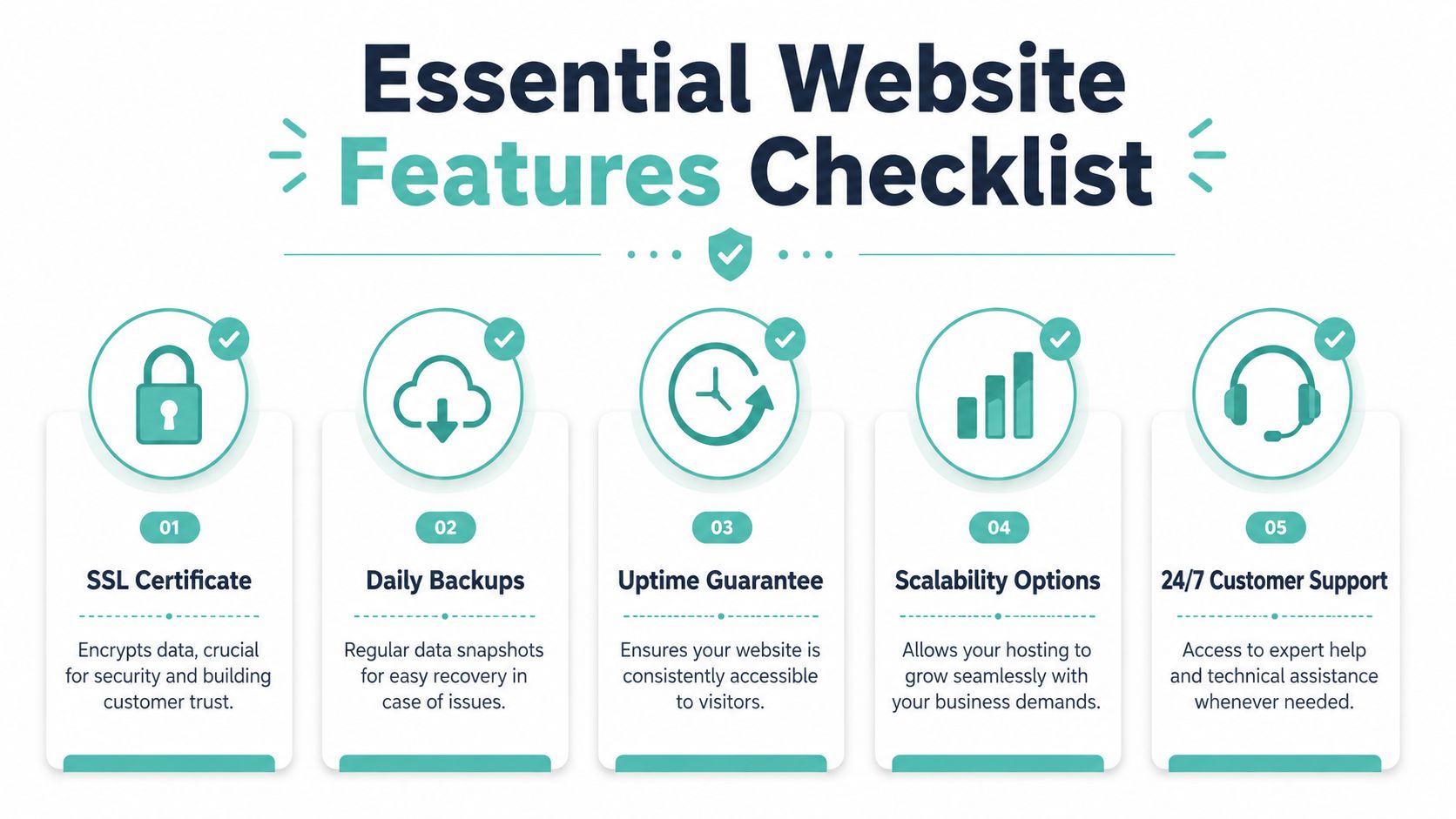
For a small business, hosting features aren't technical decorations. They're business insurance. They decide whether your site loads quickly for local visitors, whether customer data is protected in transit, whether you can recover from mistakes, and whether help is available when something goes wrong outside office hours.
Speed starts with local infrastructure
If your customers are in Australia, server location isn't a minor detail. It changes how quickly your site responds to people who are trying to browse, book, or buy.
For Australian websites, hosting in Sydney or Melbourne can significantly reduce latency for domestic visitors and help targets such as TTFB under 300ms and LCP below 2.5 seconds, according to this Australian-focused hosting performance benchmark. Those are technical labels, but its practical translation is simple: pages feel more immediate, especially on mobile connections.
Look for performance features that support local delivery and efficient site handling, including:
- Australian data centres: Sydney and Melbourne are especially relevant for east coast audiences.
- Fast web server software: Tools such as LiteSpeed can improve the feel of WordPress and dynamic sites.
- Caching layers: These reduce repeat work so pages can load more efficiently.
- Resource isolation: This helps stop one noisy account from affecting others.
If you want a practical benchmark for the security and performance side together, this website security checklist for hosting decisions is worth keeping beside you while comparing providers.
Security and backups are business protection
No SSL certificate means browsers may warn visitors before they even reach your site properly. That's not just awkward. It can cost trust at the exact moment a potential customer is deciding whether to stay.
Backups matter for a different reason. People often assume backups are only relevant if they get hacked. In reality, many restores happen after a plugin update, a theme conflict, a user error, or a failed change made in a hurry.
A solid small business hosting setup should include these basics:
- SSL certificate: This gives you the padlock in the browser and encrypts data moving between the visitor and your site.
- Malware scanning: Think of this as regular security patrols for suspicious files and behaviour.
- Off-site backups: These give you a recovery point if the live site breaks.
- Firewall protection: This helps filter unwanted traffic before it becomes a bigger issue.
A backup you can't access quickly is a comfort blanket, not a recovery plan.
Support and email matter more than most owners expect
Many business owners only discover the value of support after the first real problem. The site might be down. Email might stop sending. A plugin update might knock out the homepage. At that point, local support with Australian business hours, clear communication, and real troubleshooting ability matters far more than a flashy sales page.
Email also sits inside the hosting decision more often than people realise. A small business might want one provider to handle the website, domain-related services, and business email because it keeps administration simpler. That can work well, provided the host treats email as a proper service rather than an afterthought.
Use this checklist when reviewing any hosting provider:
| Feature | Why it matters to the business |
|---|---|
| SSL | Protects trust and basic data security |
| Backups | Gives you a practical recovery option |
| Malware scanning | Reduces the chance of hidden compromise |
| Local server location | Improves speed for Australian visitors |
| Responsive support | Shortens downtime and confusion |
| Business email tools | Helps keep branding and daily communication organised |
The hosting plan itself should disappear into the background most of the time. That's the point. When it's working properly, you spend your time on customers and staff, not on browser warnings, restore requests, and support tickets that drift for days.
Understanding Australian Hosting Prices and Contracts
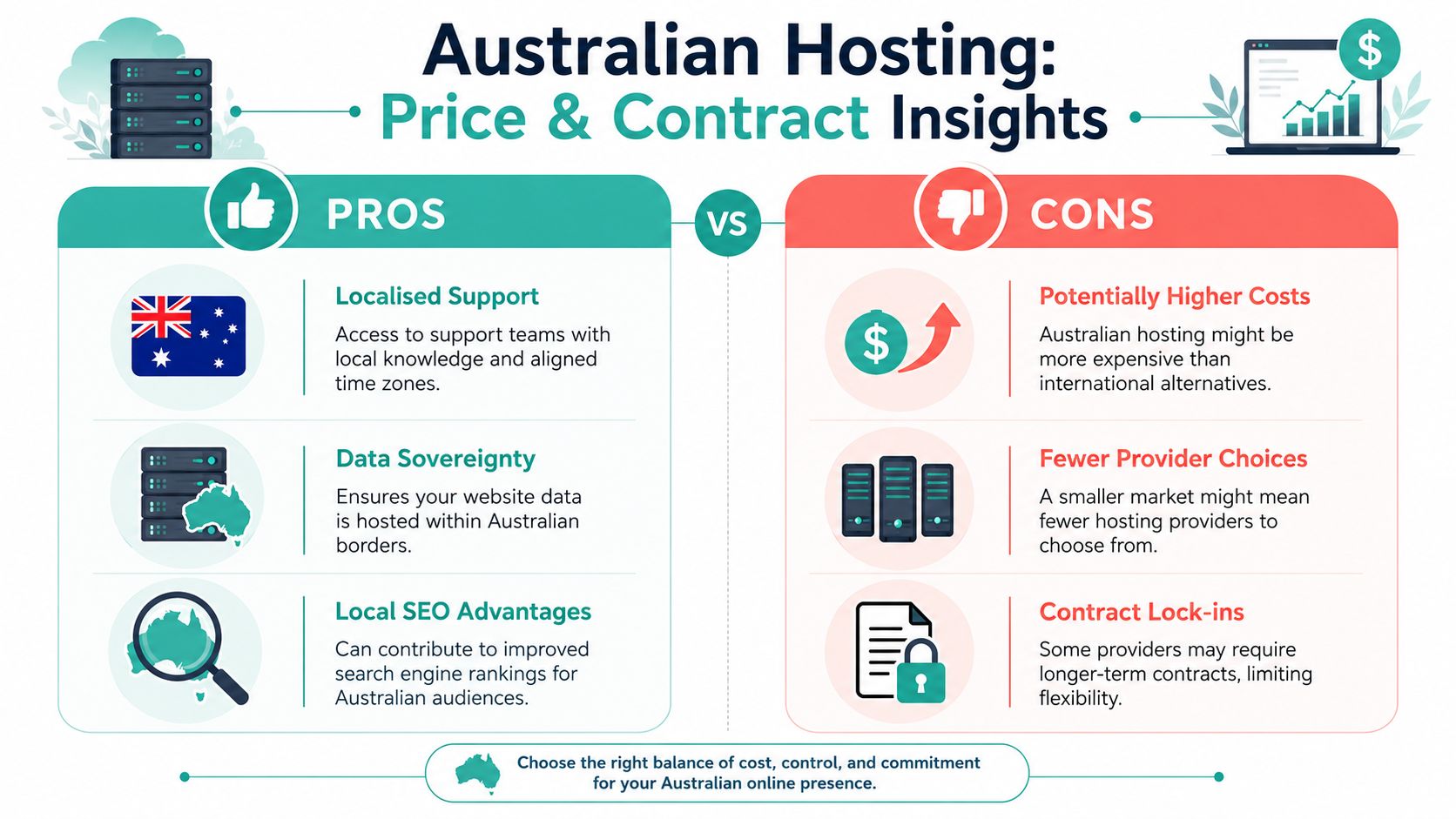
Price is where many small businesses get trapped. Not because they're careless, but because hosting offers are often designed to look simple at first glance and become more expensive later.
A low introductory rate can be perfectly fine if the provider is transparent about what happens next. The problem starts when the first invoice looks cheap, the renewal price is buried, and the business owner only realises the actual cost after the site is established and harder to move.
The cheap first year trap
One of the most misunderstood parts of Australian hosting is what some guides call hidden renewal economics. Introductory discounts can mask a 60 to 100 per cent price jump at renewal, which is why small businesses should review the 24 to 36 month total cost of ownership, as explained in PickaHost's Australian hosting pricing guide.
That sounds abstract until you picture the scenario. A business signs up because the first term feels inexpensive. A year later, the invoice arrives at a much higher figure. By then, the site is live, email is attached, and moving feels inconvenient, so the business absorbs the cost.
Contract terms also matter. Some providers push long commitments to obtain the advertised price. Others make cancellation and migration awkward enough that inertia does the selling for them.
How to compare plans properly
A better way to assess hosting is to ignore the first headline price for a moment and compare the whole package.
Ask for these details in plain language:
- Renewal pricing: What will the plan cost after the introductory period?
- GST treatment: Is pricing shown with GST included so budgeting is clear?
- Inclusions: Are backups, SSL, security tools, and support bundled in or sold separately?
- Contract length: Can you pay without a long lock-in?
- Migration help: If you need to move later, what assistance exists?
This article on hidden costs of budget web hosts is useful because it frames the buying decision around total ownership rather than sticker price.
The cheapest hosting plan is often the one that costs the least to live with over time, not the one with the smallest number on page one.
Transparent hosting is easier to manage because it aligns with how small businesses budget. You don't want surprises in year two, and you don't want to discover that an essential feature was treated as an optional extra all along.
Real-World Hosting Setups for Australian Businesses
Abstract advice only gets you so far. Most owners make a decision once they can see themselves in a practical scenario.
The three examples below are common Australian business setups. None of them needs the same hosting arrangement, because each website plays a different role in the business. That's the core idea behind sensible web hosting for small business. Match the plan to the job.
A solid small business hosting plan in Australia should deliver 99.9% uptime and include essentials such as SSL, malware protection, backups, and 24/7 support, with typical small business pricing often sitting between $5 and $20 per month, based on this Australian small business hosting benchmark.
Sarah the celebrant
Sarah is a marriage celebrant in regional Victoria. She needs a polished site with service pages, a contact form, testimonials, and an image gallery. Most of her traffic comes from mobile users who find her through local search and social media.
Her main priorities are simplicity, professional email, and a website she can update without calling a developer for every text change. She doesn't need custom infrastructure. She needs reliability and ease.
A setup that makes sense for Sarah:
- Website type: Brochure site with enquiry forms
- Hosting fit: Shared hosting or a hosted website builder such as Sitejet
- Reasoning: Low complexity, low admin burden, professional presentation
For this kind of business, the ideal host stays out of the way. The site should load cleanly, forms should arrive reliably, and updates should be easy enough to do between client meetings.
Daves Drones
Dave runs a drone services business in Sydney and has started selling accessories and training packages online. His website now includes product pages, bookings, image-heavy content, and occasional spikes when he runs promotions.
Basic hosting can start to feel cramped. An eCommerce site needs better handling of dynamic pages, checkout flows, and plugin interactions. Dave may not need a full dedicated server, but he does need more breathing room than a simple brochure site.
A sensible setup for Dave could include:
| Need | Suitable approach |
|---|---|
| WordPress store with growing activity | Managed WordPress |
| More control and isolated resources | Managed VPS |
| Seasonal promotions and heavier workloads | Cloud-oriented environment |
One relevant option in this category is managed VPS hosting in Australia, which gives businesses more dedicated resources and control when shared plans stop fitting the workload.
BuildRight Constructions
BuildRight is a small construction firm with office staff, site supervisors, and directors who all use business email daily. Their website is less about constant traffic and more about credibility. It needs to showcase projects, list services, support contact enquiries, and reinforce trust for those checking the company name after a referral.
Their hosting decision is less about flashy front-end features and more about operational reliability. Email matters. Security matters. The website needs to stay online and represent the business properly when tenders and referrals are in play.
This business may choose a broader business hosting package that includes:
- Portfolio-friendly hosting: Space for project imagery and service pages
- Email integration: Consistent business addresses for the team
- Security basics included: SSL, scanning, and backups as standard
- Room to grow: The ability to move into a stronger environment later if needed
In all three cases, the right answer isn't “buy the most powerful plan.” It's “buy the plan that suits the business you're running.” That keeps cost sensible and avoids the frustration of paying for technical capacity you'll never use.
Register your new domain name at competitive market prices including free domain add-ons like privacy, DNS Hosting, Custom Nameservers and Forwarding.
Always the best price and no nasty renewal price hikes.
Register A Domain Name
Your Hosting Decision Checklist and Migration Plan
Choosing hosting gets easier when you stop comparing brands and start asking better questions. Most business owners don't need to inspect every technical detail. They do need a shortlist that exposes weak providers quickly.

The shortlist questions to ask before you buy
When you speak with a hosting provider, look for clear answers rather than polished marketing language.
Use this checklist:
Where are your servers located for Australian customers?
You want an answer that is specific and relevant to your audience, not vague.What's included in the plan by default?
Ask about SSL, malware scanning, backups, support channels, and email.What is the renewal price?
Don't settle for the introductory number alone.Are there lock-in contracts?
Flexibility matters if your business changes direction.How do upgrades work?
A good provider should explain the path from simple hosting to a stronger setup without making it sound risky or mysterious.How is support handled when something breaks?
Find out whether real technicians are involved and how quickly issues are triaged.
Ask sales the same practical question you'd ask support on a bad day. Their answer tells you a lot about the provider you're dealing with.
You should also review the host's knowledge base. Good support articles are a strong sign because they show the business expects customers to need clear operational help, not just sales copy.
A simple migration plan that keeps risk low
If you already have a website, moving hosts feels bigger than it usually is. Most migrations follow a manageable sequence when handled carefully.
A straightforward migration plan looks like this:
- Backup first: Take a current copy of the website files, database, and any related assets.
- Prepare the new hosting account: Set up the destination environment and confirm the required software is available.
- Move the site: Import files and data, then configure the website within the new account.
- Test before going live: Check forms, page layouts, email behaviour, login areas, and mobile display.
- Switch over carefully: Go live only after the new environment is behaving properly.
- Monitor immediately after launch: Watch for missing images, broken forms, or email issues.
The main thing to avoid is rushing. Business owners often create risk by moving late at night, skipping the test phase, or assuming email will take care of itself. A provider that offers migration help can remove a lot of that pressure, especially if your current setup is old, undocumented, or tied to multiple services.
A good migration feels uneventful. That's exactly what you want.
Frequently Asked Questions About Small Business Hosting
Can I host my website and email with the same provider?
Yes, many small businesses do. It can simplify billing, support, and administration because fewer moving parts are spread across different suppliers. The key is making sure the provider treats email as a serious business service and not as a minor add-on.
What's the difference between shared hosting and VPS in plain English?
Shared hosting is like leasing a unit in a larger building. It's economical and usually fine for simpler sites. VPS gives you a more private slice of infrastructure with more control and breathing room, which suits growing stores, custom applications, or businesses running multiple sites.
Do I need Australian hosting if my customers are mostly in Australia?
In most cases, yes. Local hosting helps with speed for Australian visitors and can make data location easier to understand from a governance point of view. It's a practical choice, not just a patriotic one.
What is a .au domain and does it matter?
A .au domain tells customers you're operating in the Australian market. For many small businesses, it reinforces local identity and trust. It can also make your brand look more relevant to domestic customers who expect to deal with an Australian business.
How much bandwidth do I need?
Most small business owners focus on bandwidth because it's easy to spot on a plan page. In practice, overall site performance, server resources, and the quality of the hosting environment matter more. A modest site with sensible optimisation often performs well without needing the largest-looking resource list.
Should I choose managed WordPress hosting?
If your site runs on WordPress and you don't want to handle updates, caching, security tuning, and maintenance tasks yourself, managed WordPress can be a sensible choice. If your site is simple and stable, regular shared hosting may still be enough.
Is changing hosts difficult?
Usually not, provided there's a plan. The smoothest moves happen when the new host helps with the transfer, testing, and timing. Problems tend to come from poor preparation, not from the move itself.
Web hosting becomes much less confusing once you tie it back to business reality. You're not buying “server resources” in the abstract. You're choosing the platform your website, email, reputation, and customer experience depend on.
If you want an Australian option for web hosting, email, domains, WordPress, Sitejet, Windows hosting, or managed VPS, UpTime Web Hosting is one provider to review. Its service range is built around local infrastructure, transparent pricing, and support for small and medium Australian businesses that want practical hosting without unnecessary complexity.