WordPress hosting means a hosting setup that's pre-tuned for WordPress, with the host configuring the server layer to run it more smoothly than generic hosting. That matters for Australian businesses because WordPress powers 43.4% of all websites globally and 61.3% of CMS-based websites (WordPress market share data), so the choice you make affects how fast your site loads, how much admin you carry, and how easily you can get help when something breaks.
If you've ever looked at a hosting plan and wondered why one option says “WordPress hosting” while another just says “web hosting”, you're not alone. Most small business owners just want a site that stays online, loads quickly for local customers, and doesn't eat their day with updates, errors, and support tickets.
Table of Contents
- What WordPress Hosting Actually Means in 2026
- The Main Types of WordPress Hosting Explained
- Core Features That Make a Host Truly WordPress Ready
- Real World Examples for Australian WordPress Site Owners
- Common WordPress Hosting Myths Australian Buyers Should Ignore
- How to Choose an Australian WordPress Hosting Provider
- WordPress Hosting Questions Australian Buyers Ask Most

Performance you can feel, backed by clients who depend on it. Read how our support and uptime create long‑term customer success.Power Your Business with Better Hosting
What WordPress Hosting Actually Means in 2026
A café owner in Melbourne might hear “WordPress hosting” on a provider's site and assume it just means “hosting with WordPress installed”. That's too narrow. In practice, WordPress hosting is a web hosting environment configured and optimised specifically to run WordPress sites, not just a place to park files on a server (technical definition).
The simple way to think about it
The easiest mental model is this. Regular hosting gives you storage and server space. WordPress hosting adds a layer on top, where the host preconfigures the stack so WordPress can handle page delivery, caching, PHP execution, and update handling more predictably than on generic hosting (how the hosting layer affects performance).
That difference matters for local businesses because the site isn't just “there”. It has to respond quickly when a customer opens your menu, books a table, or checks your contact form. Purpose-built WordPress hosting is designed to reduce admin overhead and keep performance steadier under load (performance and maintenance focus).
Practical rule: if the host has to ask you to configure caching, security, and update handling yourself, it's probably not much more than generic hosting with a WordPress label.
The phrase also carries a management meaning. A WordPress-specific host will often include pre-installed WordPress, automatic updates, and caching controls so the site runs fast and stays safer with less manual server work (operational definition). That's the value for many Australian SMEs. You're not buying “WordPress” as software, you're buying a hosting environment that saves time and avoids avoidable mistakes.
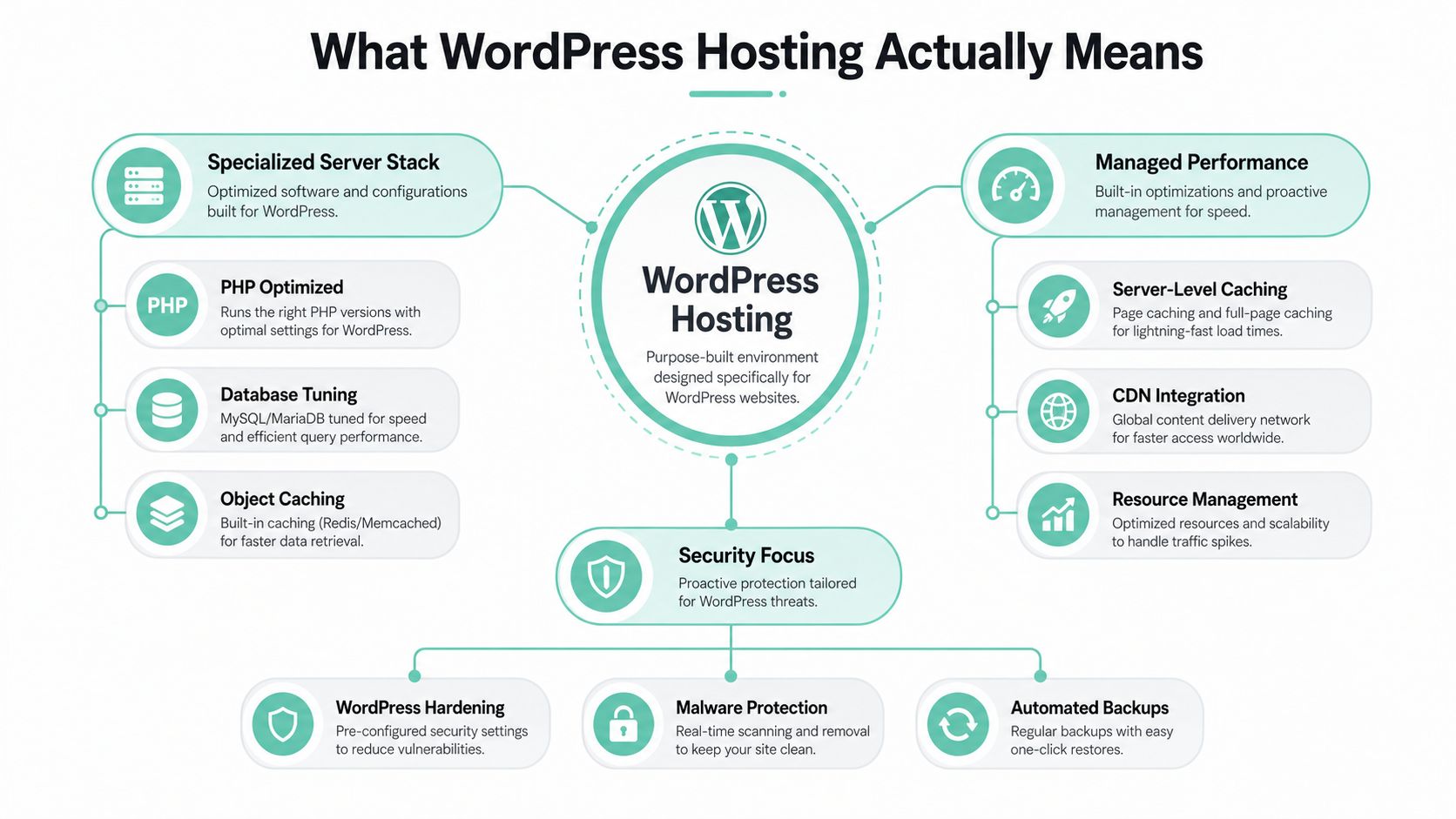
For a local owner, that usually translates into fewer late-night admin jobs and more predictable site behaviour when traffic spikes after a social post or a weekend promotion. If you want a host-level example of how this is presented in the market, the WordPress-specific service page at UpTime Web Hosting's WordPress server overview shows how the service is framed as a tuned environment rather than plain disk space.
The Main Types of WordPress Hosting Explained
A WordPress site for a local café does not need the same setup as an agency juggling client sites or an online store that gets bursts of traffic after a promotion. The label “WordPress hosting” covers more than one service tier because different sites need different amounts of control, resources and day-to-day support.
Shared, managed, VPS and dedicated
Shared WordPress hosting is the entry-level choice. It suits smaller sites, simple business pages and owners who want an easy way to get online without a large upfront commitment. You share the underlying server with other sites, so the price is usually lower, but you also have less headroom for traffic spikes and less room for custom tuning. If you are comparing basic entry options, shared web hosting from UpTime Web Hosting shows the sort of service many Australian businesses start with before they need more WordPress-specific handling.
Managed WordPress hosting is the version many buyers mean when they ask for “true WordPress hosting”. The host handles updates, backups, security and performance tuning, which suits owners who would rather spend time on sales, bookings and content than on server tasks. For a lot of Australian small businesses, this sits in the sweet spot because it reduces admin without asking you to become a server specialist.
VPS WordPress hosting gives you a private slice of server resources. It suits agencies, ecommerce stores and sites that need more consistent performance across the day. You usually get more control, but also more responsibility, especially if you want to adjust PHP settings, caching behaviour or database limits.
Dedicated WordPress hosting is for heavier, high-traffic environments. You get the whole server rather than a shared slice, which can help when the workload is large or the setup is unusually specific. The trade-off is cost and complexity, so it only makes sense when your site has outgrown simpler arrangements.
| Hosting type | Best suited to | Typical AU price band |
|---|---|---|
| Shared WordPress hosting | New sites, blogs, basic business pages | Around $3 to $25 per month for WordPress hosting, with broader shared hosting commonly around $2 to $10 per month (WordPress.com hosting price benchmarks) |
| Managed WordPress hosting | SMEs wanting updates, backups and tuning handled | Around $3 to $25 per month for WordPress hosting, as shown in the same market benchmarks |
| VPS WordPress hosting | Agencies, stores, larger or more dynamic sites | Around $10 to $100 per month for VPS hosting broadly, based on the same market benchmarks |
| Dedicated WordPress hosting | High-resource or high-traffic sites | Usually above shared and VPS tiers, depending on the build |
These pricing bands matter because they show what each tier usually includes in the market, not just the label on the sales page. They also help Australian buyers compare GST-inclusive pricing, local data centre options and support hours that suit AEST or AEDT rather than assuming every host serves the same way. Some providers keep the offer simple, while others bundle more optimisation and support into the plan, so the key question is how much site management you want the host to take on.
The right tier is the one that matches your traffic, your control needs and how much admin you are prepared to handle. A WordPress host should fit the way your business runs, not force your site into a setup that only looks good on a pricing table.
Host your website with our 5-star rated, cPanel website hosting plans.
Super fast servers, with security included and hosted in your choice of Australian Data Center.
View cPanel Plans
Core Features That Make a Host Truly WordPress Ready
A lot of providers say they offer WordPress hosting, but the label only means something if the service includes the right feature layer. Without that, you've just got ordinary hosting with a WordPress installer bolted on. The real test is whether the host reduces manual work while improving speed, safety and recoverability.
Setup, updates and caching
The first signs of a WordPress-ready host are basic but important. Look for pre-installed WordPress, one-click setup, and automatic core and plugin updates. These features reduce the amount of manual work you need to do and make it easier to keep a site current without having to log into server tools every week (feature set and management logic).
Caching is just as important. A host that offers server-level caching and CDN support can make static pages easier to serve, which helps keep load times more consistent for Australian visitors. If the host also supports a stack such as LiteSpeed or an equivalent performance layer, that usually signals a stronger WordPress fit than a generic environment.
Security and recovery
Security features separate a basic host from a serious one. Free SSL certificates, malware scanning, DDoS protection, and daily off-site backups all reduce risk in ways a business owner can understand immediately. SSL matters for checkout and forms. Backups matter when a plugin update breaks the layout. Malware scanning matters when an account gets compromised.
A staging environment is another useful feature because it lets you test changes before they go live. That's especially handy for ecommerce sites, where a broken checkout or plugin conflict can affect sales and trust.
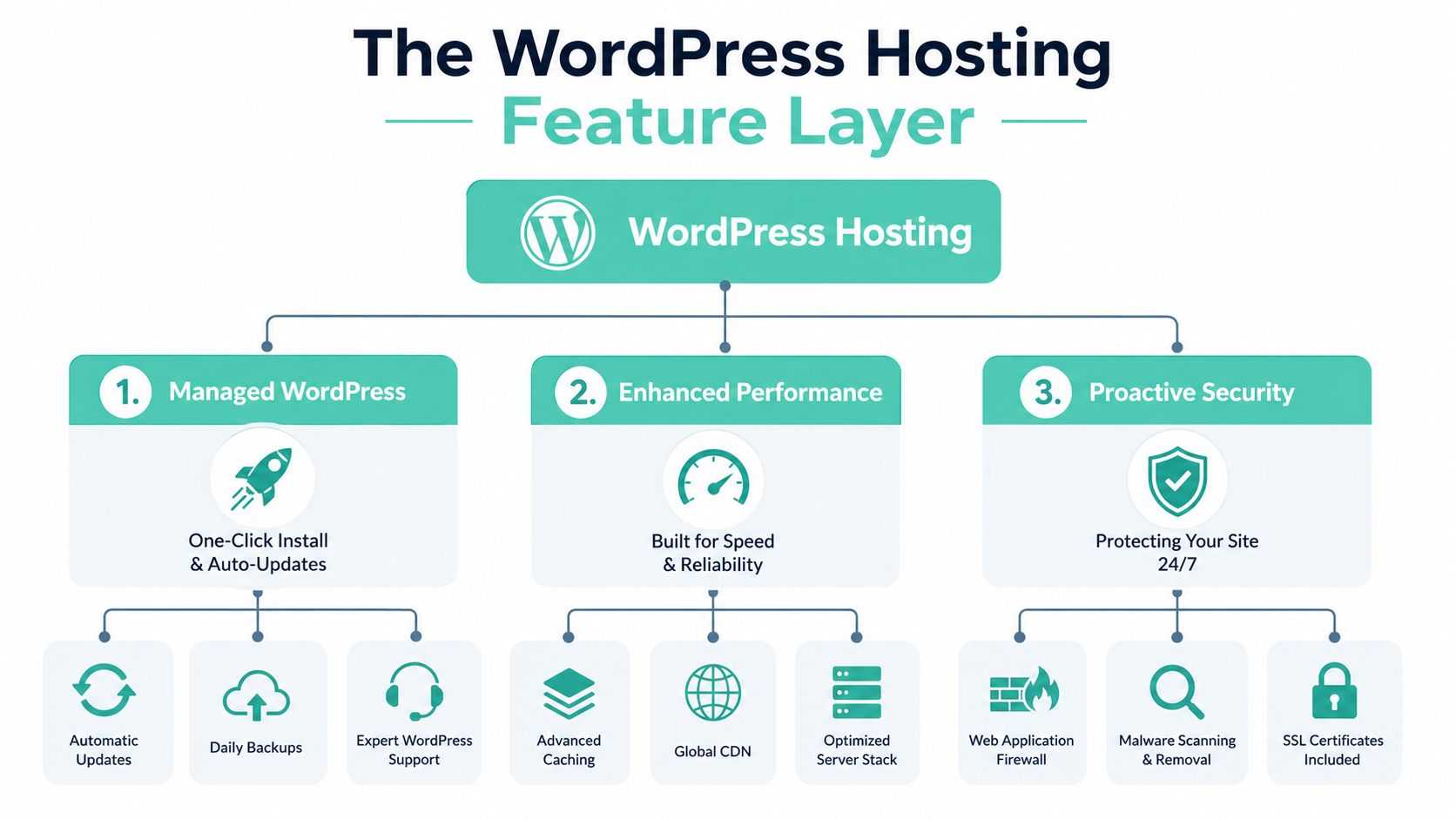
If a host advertises WordPress-specific management, these are the practical services you should expect to see behind the marketing. UpTime Web Hosting's WordPress hosting features page is an example of how those capabilities are packaged for buyers who want the WordPress layer handled rather than assembled manually.
Useful test: ask the provider whether updates, caching and backups are configured at the hosting level or left to you inside WordPress. That answer usually tells you whether the service is really WordPress-ready.
Real World Examples for Australian WordPress Site Owners
A small Melbourne café and a Brisbane travel blogger can both use WordPress, but they need different kinds of hosting. The platform is the same. The hosting choice isn't. That's where the meaning of WordPress hosting gets practical, because it has to match the way the site is used every day.
A café that needs speed and simplicity
A Melbourne café usually wants a site that opens quickly for local customers, shows the menu clearly, and handles bookings without fuss. That business doesn't want to spend time tweaking a server or reading logs. Managed WordPress hosting with Australian data centres makes sense here because the hosting layer is tuned for performance and the owner can focus on opening hours, not caching rules.
In this scenario, the local support side matters just as much as speed. If the owner rings for help during AEST business hours, they want someone who understands Australian billing, Australian time zones and the difference between a quick fix and a long support loop. That's where a locally based provider can feel more practical than an offshore one.
Practical insight: for service businesses, a host that handles updates and backups is often more valuable than a cheaper plan that leaves everything to the owner.
A blogger who needs room to grow
A Brisbane travel blogger is a different case. The site might start as a hobby, then pick up ad traffic, affiliate links and more image-heavy content. A lightweight managed WordPress plan can suit that stage well, especially if the host offers performance tuning and enough storage headroom for media files.
That blogger may not need a full VPS yet, but they should watch for signs of growth. If the admin area starts feeling sluggish, or if the site needs more flexibility around plugins and caching, they'll likely outgrow a simpler shared plan. That's the moment to reconsider the tier rather than trying to force a small plan to behave like a bigger one.
For a local comparison point, the page on best Australian WordPress hosting is useful because it frames the choice around Australian service expectations rather than generic global advice.
The main lesson is straightforward. A café owner values reliability and low admin. A blogger values speed, image handling and room to expand. WordPress hosting only makes sense when the host is matched to that real-world use.
Common WordPress Hosting Myths Australian Buyers Should Ignore
The phrase “WordPress hosting” causes confusion because it sounds technical, and many buyers fill the gaps with assumptions. Some of those assumptions lead to the wrong plan, the wrong provider, or a bigger bill than necessary. A better approach is to test the claim behind the marketing copy.
Myth and reality in plain English
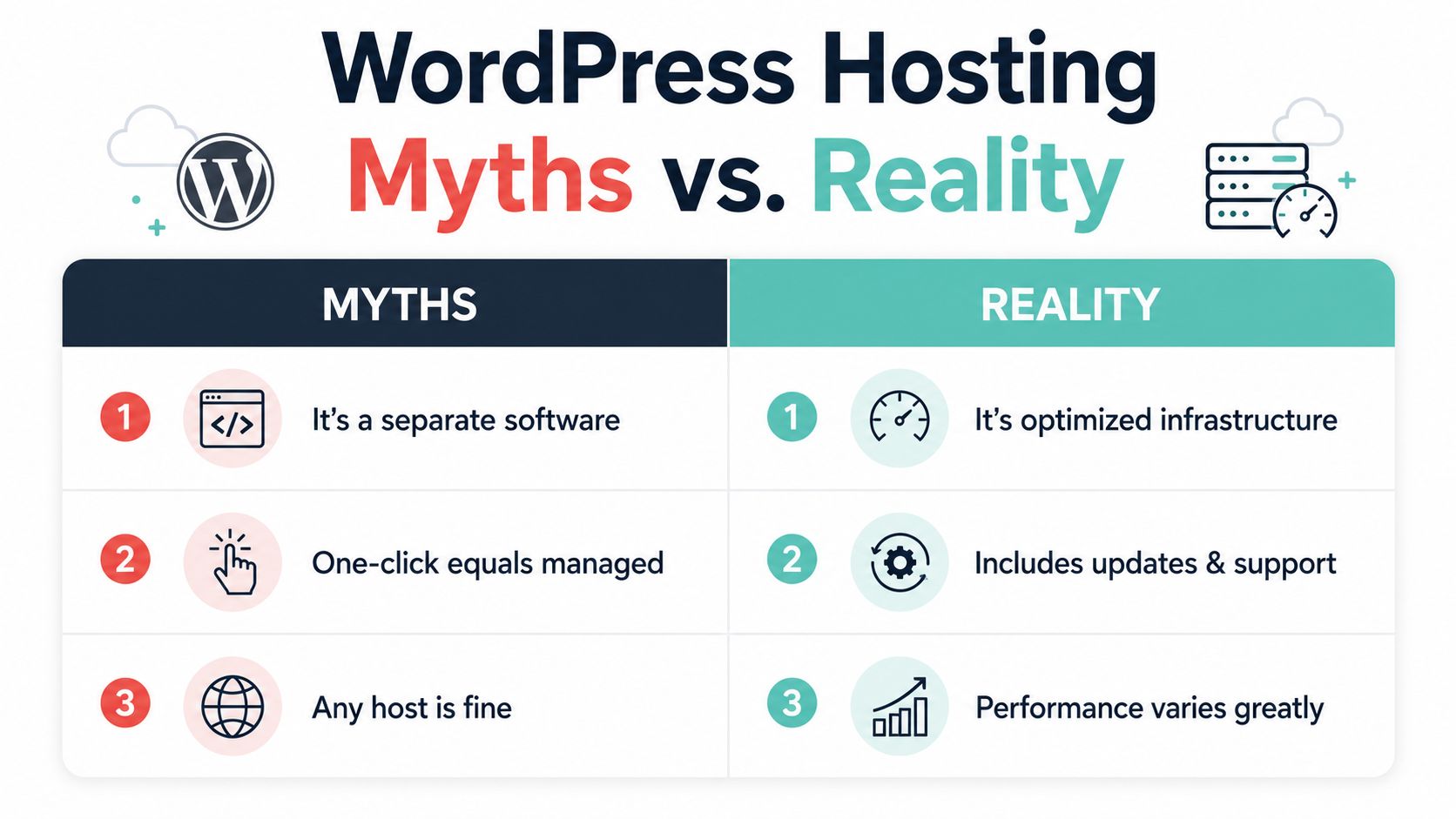
One common myth is that WordPress hosting is a separate software product. It isn't. It's an optimised hosting environment for WordPress, which means the difference lives in the server setup, not in some new application layer.
Another myth is that one-click install means the host is optimised for WordPress. One-click install only proves that WordPress can be added quickly. It doesn't tell you whether the server uses caching, automatic updates, or other WordPress-specific management features.
A third myth is that the most expensive plan is always the fastest. That's not a safe assumption. Cost and fit aren't the same thing, and a host can be pricey without being tuned for the way your site works.
| Myth | Reality |
|---|---|
| It's a separate software | It's optimised infrastructure |
| One-click equals managed | It includes updates and support only if the host says so |
| Any host is fine | Performance varies greatly depending on the stack |
The last myth is that managed WordPress hosting means you lose control. For many business owners, the opposite is true. It removes low-value tasks like routine maintenance while still giving you access to the site itself. You can still edit pages, publish posts and run the business.
If you want to test a provider's claims, ask for three things, server-level caching, automatic minor updates, and Australian-based support. If the answers are vague, the plan is probably more generic than it sounds. The same caution applies to price pages that hide support conditions or add-ons, which is why checking hidden costs on budget web hosts is worth the time before you sign up.
Register your new domain name at competitive market prices including free domain add-ons like privacy, DNS Hosting, Custom Nameservers and Forwarding.
Always the best price and no nasty renewal price hikes.
Register A Domain Name
How to Choose an Australian WordPress Hosting Provider
The best WordPress host for an Australian site usually looks good on paper and in practice. That means local data, clear pricing, and support that answers when you need it. It also means looking past buzzwords and checking the parts that affect your daily workload.
What to check before you buy
Start with the data centre. If your audience is mostly in Australia, a provider with infrastructure in Sydney, Melbourne, Brisbane or Perth can be a better fit because the service is built around local delivery rather than a distant default. Then check the support window. If your team works during AEST or AEDT, support should be available when your business is open.
Pricing needs the same scrutiny. Look for GST-inclusive pricing, no hidden fees, and no surprises when you get to checkout. Then look at the resource allocation. Generous storage, CPU and memory matter more than glossy slogans, especially if you plan to run media-heavy pages or a growing plugin stack.
A solid Australian plan should also spell out uncapped bandwidth and databases where those are included, along with free SSL, malware scanning, DDoS protection and nightly off-site backups. Those aren't luxury extras for a business site, they're basic operational safeguards.
Migration and handover
Moving an existing WordPress site shouldn't feel like a rebuild. A typical Australian provider will help move files, databases and site settings with minimal downtime, then check that the site opens properly on the new host. Before you switch, back up the current site, confirm the domain details, and keep a copy of anything custom such as forms, plugin licences or email settings.
If you want a locally owned option that focuses on accountability and personal service, UpTime Web Hosting is one Australian provider that packages WordPress hosting, VPS and support from a local team. The point isn't the brand name alone. It's whether the service line matches the operational needs of an Australian site owner.
Choose the provider that answers clearly on location, support hours, backups and pricing. If those details are hard to find, the plan will probably be hard to live with.
WordPress Hosting Questions Australian Buyers Ask Most
Is WordPress hosting really different from regular hosting? Yes. Regular hosting stores websites. WordPress hosting is configured to run WordPress with more relevant server settings, better management features and less manual maintenance (host configuration and management focus).
What should an Australian small business expect to pay each month? Market benchmarks place WordPress hosting around $3 to $25 per month, with broader shared hosting around $2 to $10 per month and VPS hosting around $10 to $100 per month (price benchmarks). The exact bill depends on support, resources and whether GST is included.
Is managed WordPress hosting worth it over a cheap shared plan? If you want fewer maintenance tasks, safer updates and steadier performance, usually yes. If the site is tiny and traffic is light, a simpler plan can work for a while, but you'll do more yourself.
How hard is it to move an existing WordPress site to a new Australian provider? It's usually straightforward if the host helps with migration. The usual steps are to back up the existing site, move the files and database, test the new host, and switch over only after the site is working properly.
If you want a local team that handles WordPress hosting, VPS and support with Australian service expectations, visit UpTime Web Hosting and compare the WordPress, shared hosting and managed VPS options against the checklist above. The right host should make your site easier to run, not harder.