
46% of Google searches have local intent in Australia, and that changes the whole game for small businesses. If your café, clinic, tradie service, or local retail shop isn't set up to show up in those moments, you're relying on generic search traffic while nearby customers are choosing whoever appears first on Maps, in the AI-style answer box, or on a location page that matches what they need. Local SEO statistics for Australian search behaviour make one thing clear, local SEO for business isn't a side task anymore, it's the front door.
That shift matters because local search is action-heavy. People search, compare, call, visit, and buy quickly, especially on mobile. In practice, that means a Brunswick café with a complete profile, a Brisbane plumber with clean suburb coverage, and a regional clinic with accurate location pages all have a better shot at turning search into a real-world booking than a competitor that only “does SEO” in the generic sense.
Table of Contents
- Why Local SEO Matters for Australian Businesses Right Now
- Claiming and Optimising Your Google Business Profile
- On-Page and Local Keyword Targeting That Actually Works
- NAP Consistency and Citations Across the Australian Web
- Reviews, Reputation and LocalBusiness Schema
- Local Content, Links and the Technical Foundation Underneath
- Your 30-60-90 Day Local SEO Plan and Common Questions

Performance you can feel, backed by clients who depend on it. Read how our support and uptime create long‑term customer success.Power Your Business with Better Hosting
Why Local SEO Matters for Australian Businesses Right Now
For Australian businesses, local search is where intent turns into action. Searches on mobile for a café near the station, a plumber who can come to their suburb, or a clinic that can take a booking soon reflect this behaviour. That behaviour shows up in The local intent benchmark and AI-style local answers, and it explains why local visibility often matters more than broad organic traffic for small operators.
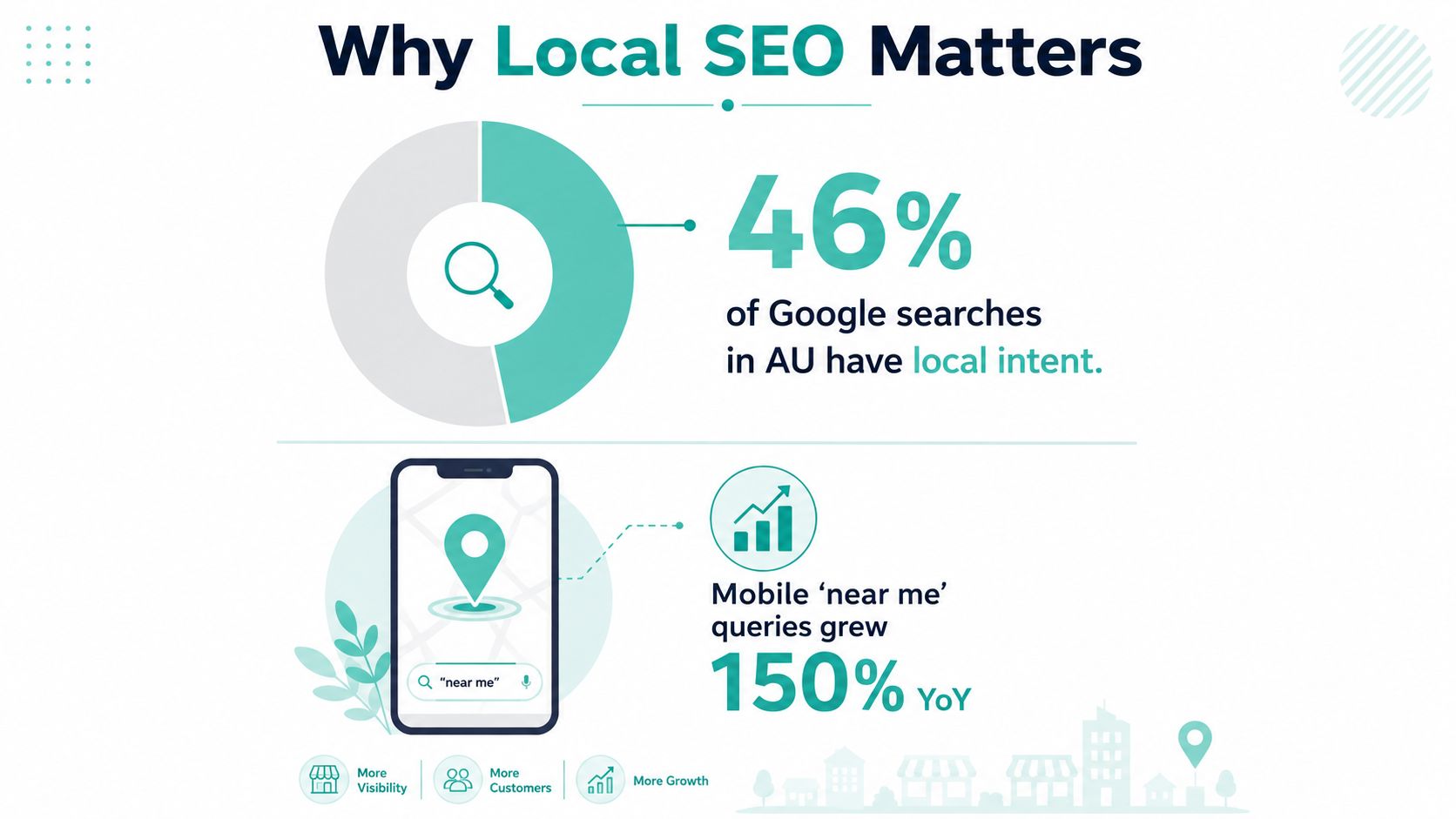
The Map Pack still gets attention before a user scrolls to standard organic results. For many local businesses, that is the part of Google that drives calls, directions, and bookings. Semrush's local SEO benchmark shows how much activity sits in those top local results, which is why a tradie in Perth, a dentist in Geelong, or a retailer in Newcastle cannot treat local search as a side project.
Who this matters for
This matters for café owners, tradies, clinics, regional service-area businesses, and small eCommerce shops with a physical footprint. It also suits operators who already have a website but have not turned it into a source of local enquiries.
Practical rule: if the customer can visit, call, book, or collect, local SEO belongs in the revenue path.
A lot of local businesses still ignore the basics, which creates room for anyone willing to do the work properly. When businesses leave local search untouched, the ones that do the simple things well usually win more visibility, especially in smaller Australian markets where suburb-level competition is easier to spot and easier to beat. That is where this website and SEO guide is useful, because the site structure, page content, and technical setup all feed the local result.
Claiming and Optimising Your Google Business Profile
A Google Business Profile is where many Australian customers decide whether you exist, whether you're open, and whether they should bother calling. For a Brunswick café, that means making the profile feel like the actual venue, not a listing skeleton. For a Brisbane plumber, it means making the service area clear enough that a customer in the right suburb knows you'll show up.
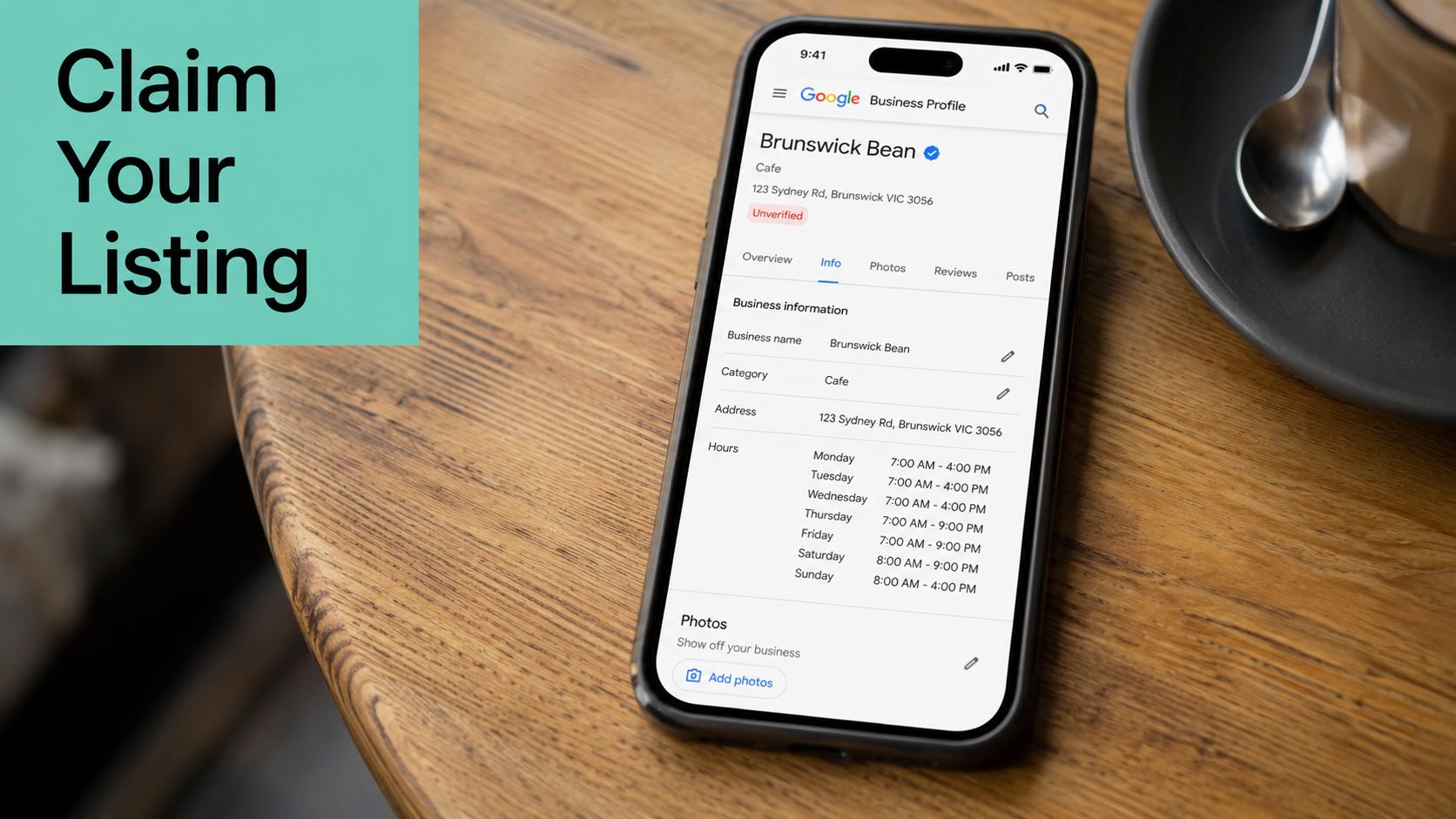
Google only allows a Business Profile for businesses that make in-person contact with customers during stated hours. That matters for online-only brands, because they do not qualify for the same local listing setup. Google also expects the business name, address, phone number, and hours to be accurate and consistent across the website and third-party listings, so this is an operational task, not a cosmetic one. Google's own Business Profile help pages spell that out, and this guide on adding a Google local business listing is useful if you are setting it up for the first time.
What to fill in first
Start with the basics, then complete the fields that many businesses skip. Choose the most specific primary category that matches what you do, not the broadest one you think sounds impressive. A café should not pretend to be a restaurant if café is the proper fit, and a plumber should not hide under a generic trade label if a tighter category matches the work.
Use the business profile to show how you operate.
- Address or service area: storefront businesses should show the exact location, service-area businesses should define realistic coverage.
- Hours and appointment links: keep them aligned with actual opening times and booking windows.
- Photos: exterior, interior, team, work samples, and a few natural, unfiltered shots usually help more than polished filler.
- Services and products: spell out the specific jobs, menus, treatments, or retail categories.
- Accessibility and opening date: these details help customers compare businesses more confidently.
How I'd set it up for a real business
For a café, I'd add photos of the front entrance, counter, seating, menu highlights, and a couple of honest images of the space at different times of day. For a plumber, I'd focus on service trucks, branded gear, completed jobs, and team images that make the operation look established, not stock-photo generic. For a clinic, the profile should feel calm, professional, and exact, with practitioners, parking notes, and appointment pathways made obvious.
A profile that's only “claimed” is still incomplete. The businesses that win local attention usually look more useful, more current, and less ambiguous than the rest.
If you manage multiple locations, each branch needs its own profile, own details, and its own local proof. Do not collapse everything into one generic brand listing, because that usually weakens relevance and confuses users who want the closest branch or the right suburb.
Host your website with our 5-star rated, cPanel website hosting plans.
Super fast servers, with security included and hosted in your choice of Australian Data Center.
View cPanel Plans
On-Page and Local Keyword Targeting That Actually Works
Local keywords work when they match how Australians search, not when they're stuffed into every heading. Think suburb plus service, city plus service, and plain-language variants that sound normal on mobile. A Sydney dental clinic might target “dentist Surry Hills”, “emergency dentist Sydney”, and “teeth whitening near me”, while still writing in clear Australian English rather than awkward phrase-matching copy.
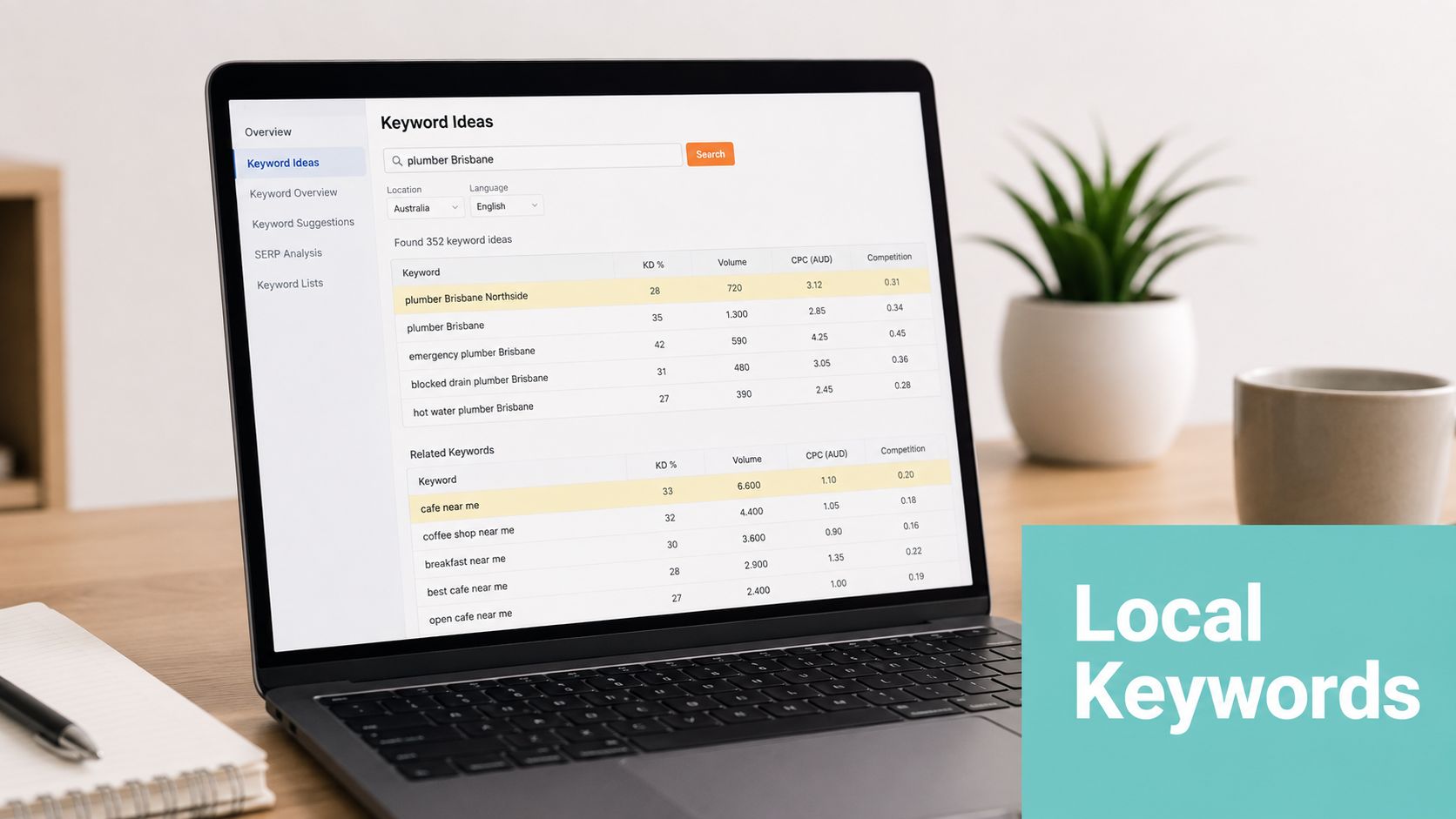
The right page structure is simple. One strong location page should carry the main keyword theme, the address or service area, service-specific detail, proof, and a clear next step. If you're creating a page for a Sydney clinic, write it like a real practice page, not like a suburb template with one place name swapped out. For a broader content approach, these blog post examples can help shape supporting pages without turning them into generic filler.
A useful location page structure
Use headings and blocks that help both humans and search engines understand what the page is about:
- H2 for the main service and place: “Dentist in Surry Hills” works better than a vague brand-led heading.
- Short NAP block: name, address, phone, hours, and booking details in one place.
- Embedded map: useful for storefronts, and a strong signal when paired with the rest of the page.
- Service detail: treatment types, practitioner credentials, or job examples.
- Local proof: suburb-specific testimonials, nearby landmarks, or community references that are real.
Don't build duplicate city pages with only the suburb name changed. That's the doorway-page problem in local SEO, and it's one of the fastest ways to create a site that looks busy but feels thin. A better model is one strong service page, then separate location pages only where the business has genuine service differences, local proof, or distinct operational coverage.
What belongs on a page, and what doesn't
City pages work best when they answer a local buying decision. Service pages work best when they explain the actual offer. Blog content should support both, with practical local topics like “how to choose a plumber in Geelong” or “what to check before booking a family dentist in Parramatta”.
Useful test: if you could change the suburb name and the page would still read the same, it's not local enough.
NAP Consistency and Citations Across the Australian Web
NAP means Name, Address, Phone. Keep it as an operational record, not a loose marketing preference. If your website says one thing, your Google Business Profile says another, and a directory still lists an old phone number, you create avoidable confusion for search engines and customers alike.
Start with a spreadsheet and audit the entries that matter most. Track the business name used, the exact address format, the phone number, login ownership, and the last update date. That gives you a live map of what is correct, what is stale, and what needs attention first.
Priority Australian citation sources
| Source | Type | Priority | Cost |
|---|---|---|---|
| Yellow Pages | Directory | High | Usually free, some paid options exist |
| TrueLocal | Directory | High | Usually free, some paid options exist |
| Word of Mouth | Directory and review platform | High | Usually free, some paid options exist |
| StartLocal | Directory | Medium | Usually free, some paid options exist |
| Hotfrog | Directory | Medium | Usually free, some paid options exist |
| Yelp AU | Review and directory | Medium | Usually free, some paid options exist |
| Apple Maps | Map platform | High | Free |
| Bing Places | Map platform | High | Free |
| Social profiles | Brand profiles | High | Free |
| Industry directories | Trade or sector listings | High | Usually free, some paid options exist |
Fix the obvious inconsistency first. That includes abbreviations like Street vs St, state formatting like NSW vs New South Wales, and old addresses that never got cleaned up after a move. Duplicates matter too, because a business can end up with two listings that split attention and trust if nobody managed the old one properly.
A café in Fitzroy with one address on its website and another in Apple Maps will lose bookings it should have won. The same issue hurts a tradie in Penrith who works from a service area, or a clinic in Hobart that relies on patients finding the right entry, phone number, and opening hours on mobile.
What to correct this week
- Check the website footer and contact page: make sure the live NAP matches the profile exactly.
- Audit the top directory listings: prioritise the sources above before chasing obscure niche sites.
- Remove or merge duplicates: old branches and old phone numbers should not linger online.
- Keep ownership clear: every major listing should have a known login holder, not a forgotten agency account.
Google's local guidance expects consistent business details across your web presence, and that is the practical reason this audit matters. The same principle is reinforced in broader local search guidance from Google's local business profile guidance, which treats consistency as a trust signal, not just admin work.
Reviews, Reputation and LocalBusiness Schema
Reviews and schema work together because one speaks to humans and the other helps machines read the business correctly. For a clinic, review language about care, punctuality, and clarity often matters more than generic praise. For a tradie, customers tend to mention responsiveness, reliability, and whether the job was finished properly. For a café, atmosphere, service, and consistency usually shape the conversation.
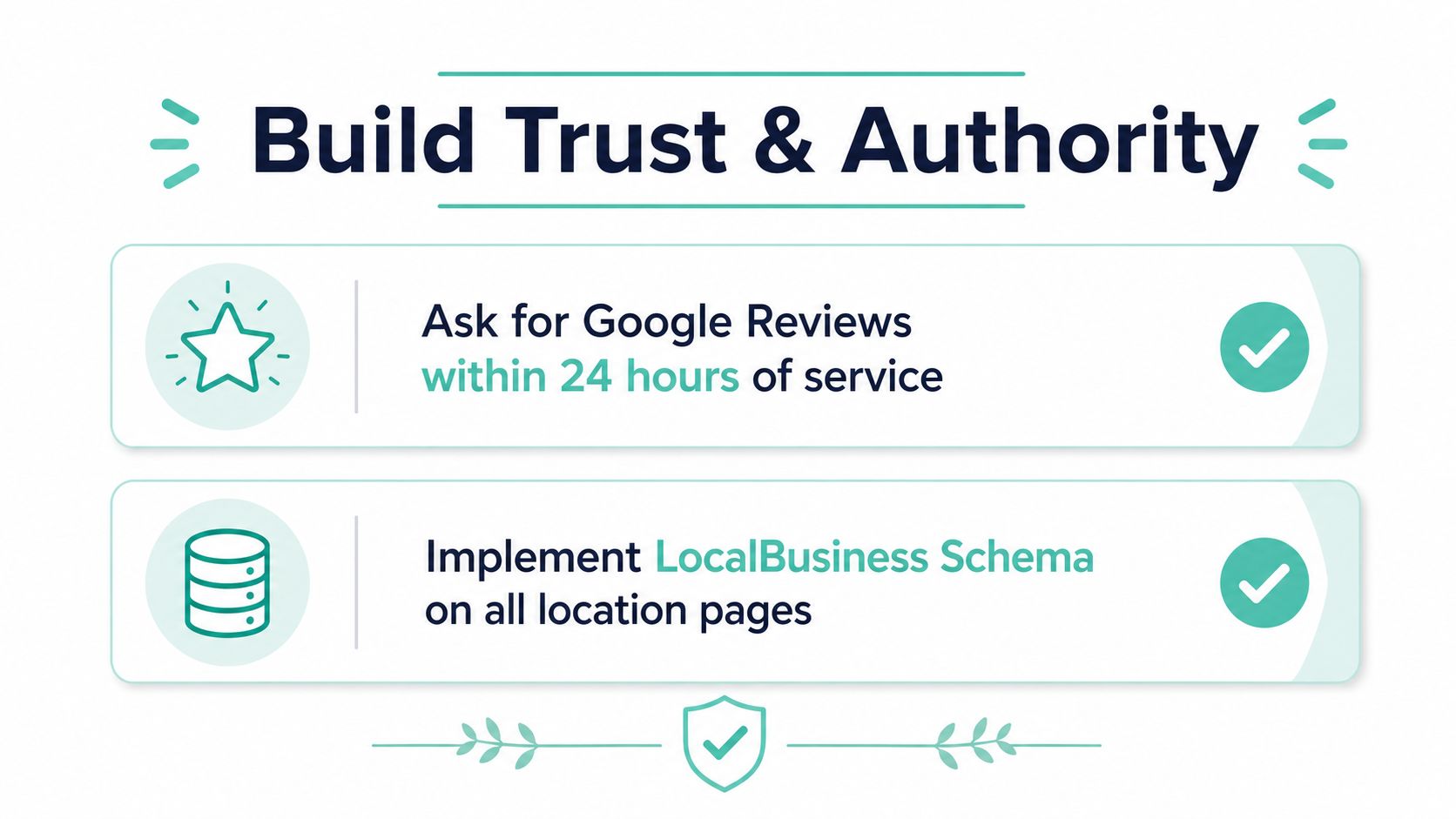
Ask for reviews when the job is fresh and the customer is happiest. A completed bathroom repair, a first appointment that went smoothly, or a lunch rush that ended well are all better moments than a cold follow-up weeks later. Keep the request direct, and send customers to Google first unless there's a stronger product-specific platform for your category.
A calm response template for negative feedback
A good reply doesn't fight the customer. It acknowledges the issue, offers a path forward, and keeps the tone steady.
Response template: “Thanks for the feedback. We're sorry your experience didn't meet expectations. Please contact us directly so we can look at what happened and sort this properly.”
That kind of reply signals to future customers that you're paying attention. It also keeps the business from turning a public complaint into a bigger public argument.
Schema makes the page easier to interpret. Add LocalBusiness JSON-LD to your location pages with the core fields that matter, including business name, address, phone, opening hours, geo coordinates, price range, and aggregate rating where it's legitimate to show. Don't stuff schema with claims the page can't support, and don't fake ratings or invent hours.
A sensible workflow is simple:
- Use one schema block per location page: keep it aligned to the visible content.
- Match the details exactly: hours, address, and contact information should mirror the page and profile.
- Update it when the business changes: holidays, relocations, and new service hours should all be reflected.
AI search surfaces increasingly rely on trust signals that are easy to parse, so reviews and structured data are no longer separate jobs. They're part of the same credibility layer.
Register your new domain name at competitive market prices including free domain add-ons like privacy, DNS Hosting, Custom Nameservers and Forwarding.
Always the best price and no nasty renewal price hikes.
Register A Domain Name
Local Content, Links and the Technical Foundation Underneath
Local SEO gets stronger when the site behaves like a real local business, not just a listing endpoint. Suburb guides, neighbourhood pages, community sponsorships, and partnerships with nearby businesses can all create relevance if they're grounded in actual operations. A café might publish a guide to nearby parking and lunch spots. A tradie might sponsor a local footy club and earn a mention on the club site. A regional clinic might partner with nearby allied health providers and build referral content that makes sense to users.
Local links still matter because they come from places that already know the area. Chamber of commerce listings, local press mentions, trade associations, .au directories, and community pages can all support the business when they're real and relevant. The point isn't volume, it's local credibility.
Technical basics that protect the local work
The website has to keep up with that visibility. Australian visitors expect a site to load cleanly, stay secure, and behave well on mobile, especially if they've clicked from Maps and want a quick answer. One practical option is Australian website speed optimisation support, because hosting, caching, and image delivery can all affect whether a local landing page feels fast enough to convert.
For businesses that care about local performance, the technical layer should include:
- Fast mobile pages: especially on service and location pages.
- Free SSL: trust matters when a user is about to call, book, or pay.
- DDoS protection and malware scanning: downtime breaks both trust and discovery.
- Reliable Australian hosting: lower latency helps local users reach the site faster.
- Regular backups and monitoring: local visibility is wasted if the page keeps failing.
UpTime Web Hosting is one Australian provider that offers those basics, including local hosting in Sydney, Melbourne, Brisbane and Perth, plus free SSL, malware scanning, DDoS-protected firewalls, LiteSpeed, and AccelerateWP. That kind of setup fits local SEO because a site that loads quickly and stays online is easier for customers to use and easier for search engines to trust.
Service-area businesses without a storefront
The underserved part of local SEO is the business without a shopfront. A mobile mechanic, a plasterer, a regional IT service, or a clinic that only serves by appointment still needs locality, but it has to prove coverage fairly. Set realistic service areas, hide the address when appropriate, and build city pages that are different, with local testimonials, service detail, landmarks, and real coverage notes.
If the page changes only because the suburb name changed, it's not useful. If it helps a user in that suburb understand whether you'll serve them, it's doing the job.
Your 30-60-90 Day Local SEO Plan and Common Questions
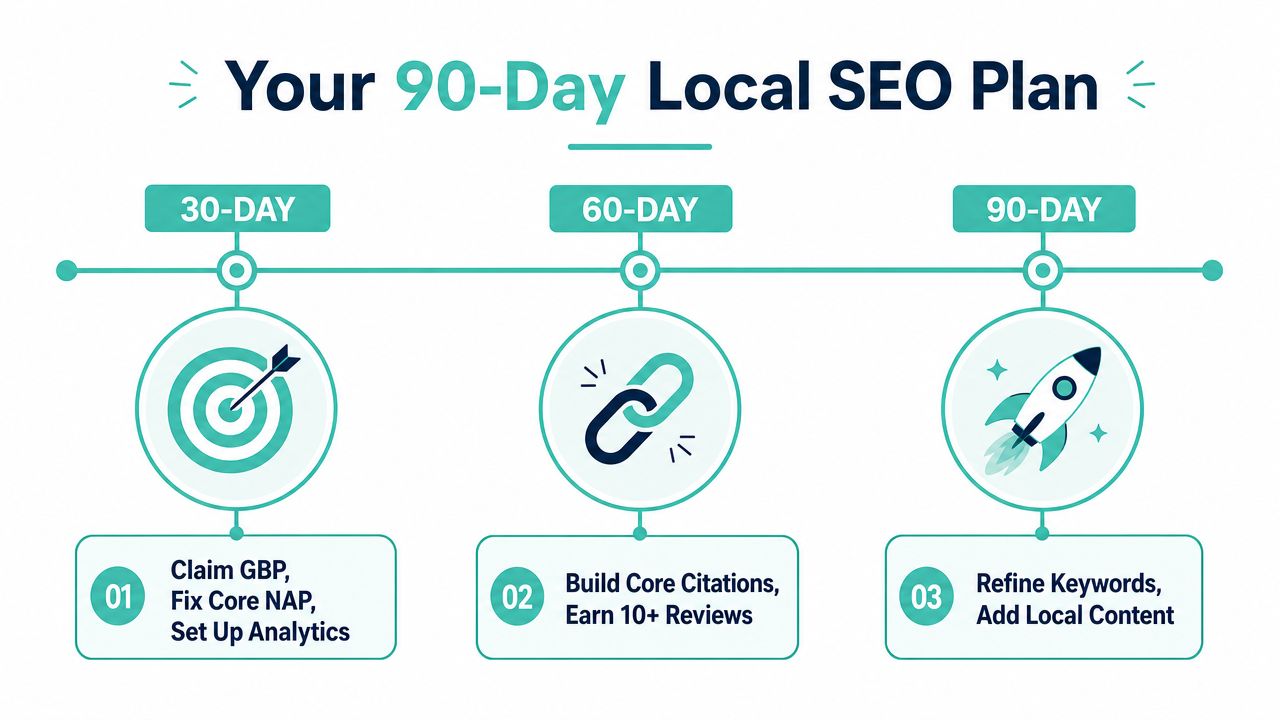
The first 30 days should be about control, not polish. Claim and complete the Google Business Profile, fix the core NAP on the website, and make the main location or service page strong enough to answer a local buyer's question. If the business is missing from the right places, nothing else compounds properly.
By day 60, clean up citations, start a review system, add LocalBusiness schema, and earn the first few meaningful local links. By day 90, expand into suburb pages only where they're justified, build a couple of useful local content pieces, and check whether hosting or speed is holding the site back. Website maintenance and support becomes relevant here, because local SEO falls apart fast when pages, plugins, and details drift out of date.
Common questions Aussie business owners ask
How do I measure local SEO success? Track calls, direction requests, bookings, profile views, and suburb page visits alongside rankings. The ranking alone doesn't pay the bills.
Do paid ads replace local SEO? No. Ads can fill gaps, but they stop the moment you stop paying. Local SEO keeps working when the basics are in place.
What changes for multi-location businesses? Each location needs its own profile, page, and local signals. One generic brand page won't do the same job.
What happens as AI summaries show up more often? The business needs clearer service descriptions, stronger proof, cleaner data, and more useful local pages. AI doesn't remove the need for local authority, it raises the bar for clarity.
If you want the local side of your site to support leads, bookings, and calls, treat the website as part of the operating system. UpTime Web Hosting gives Australian businesses hosting, security, and support that keep local pages fast, stable, and easy to maintain, and you can review the options at UpTime Web Hosting.