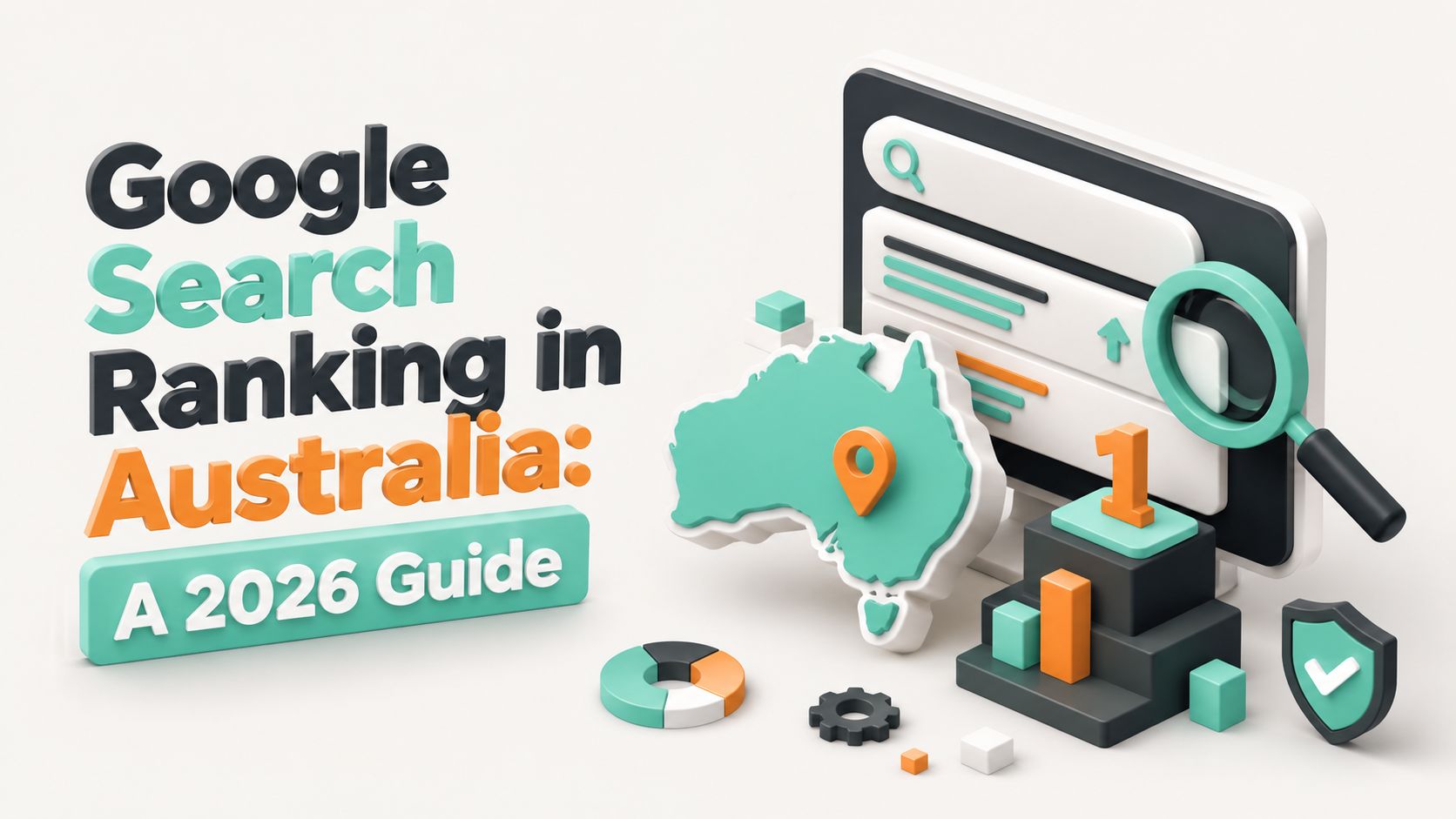
In Australia, Google remains the clear leader in search, so the difference between being seen and being skipped starts there, not in a side channel. That matters because the click gap is brutal, the #1 organic result averages 39.8% CTR while the #10 result averages 1.6% CTR according to the datasets cited by FourSets' Google search statistics round-up. For an Australian small business, moving up the page isn't a vanity win, it's often the difference between steady enquiries and silence.
Google search ranking also isn't one thing. Google's systems first crawl a page, then index it, then rank it, and those stages can fail separately. If you've ever wondered why a page exists on your site but still doesn't bring in traffic, that pipeline is usually where the answer lives.
Table of Contents
- Why Google Search Ranking Matters More in Australia
- How Google Crawls, Indexes, and Ranks Your Pages
- The Eight Primary Ranking Factors That Move the Needle
- Organic Rankings vs Local Maps Visibility in Australia
- A Practical Example Climbing From Page Three to Top Three
- Measuring Performance and Troubleshooting Ranking Drops
- Hosting Choices That Directly Support Your Rankings
- Putting It Together and Common Misconceptions to Avoid

Performance you can feel, backed by clients who depend on it. Read how our support and uptime create long‑term customer success.Power Your Business with Better Hosting
Why Google Search Ranking Matters More in Australia
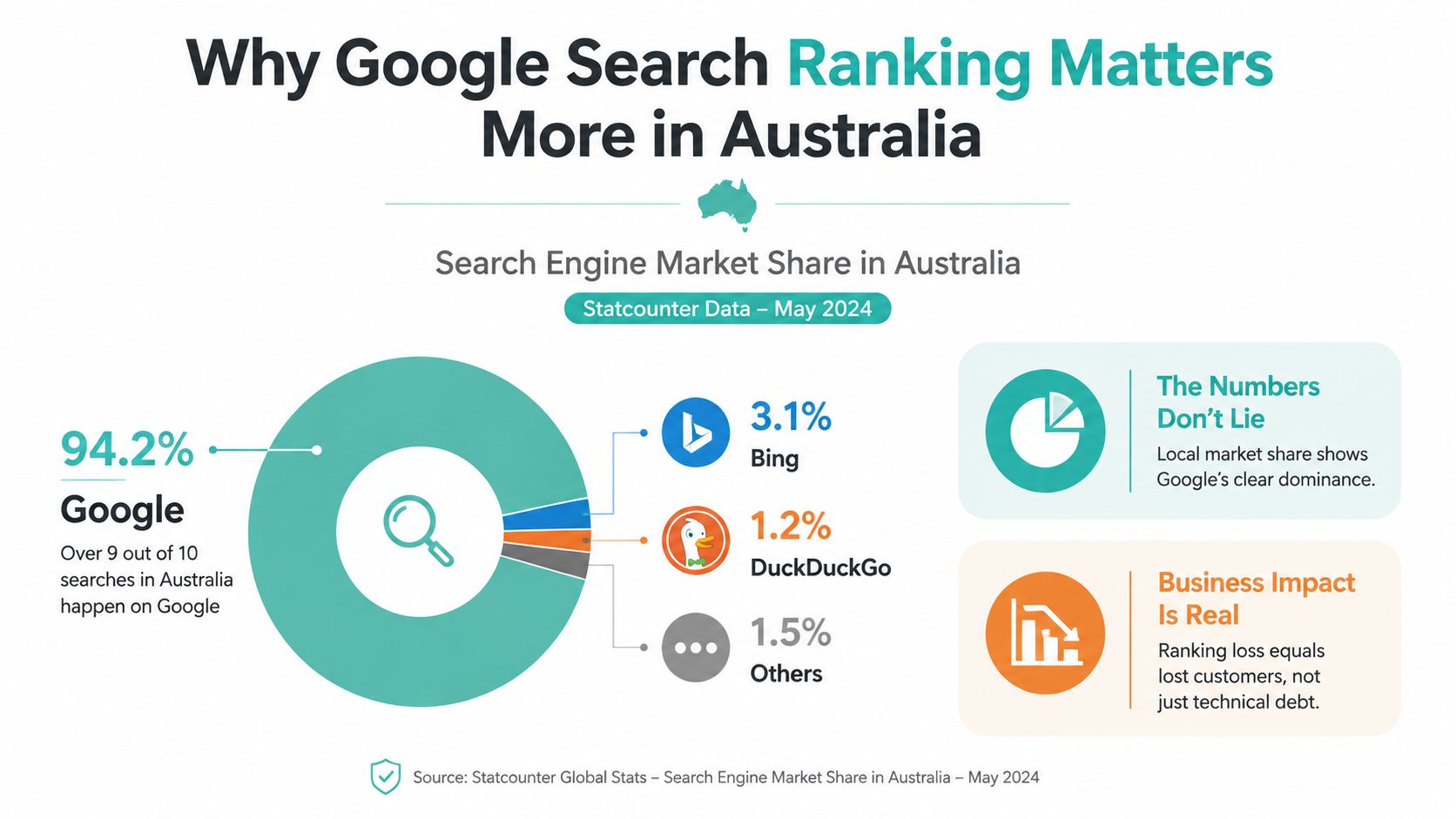
Australia is a Google-first market, and that changes how search visibility affects revenue. For an Australian SME, being easy to find on Google is often the difference between a steady flow of enquiries and a page that sits out of sight. The local market-share data, shown in the visual above, points to Google's clear dominance here, so organic visibility on Google remains the main path to discovery for most Australian sites.
That dominance makes ranking a commercial issue, not a technical badge. Click behaviour shows why. The first organic result attracts far more attention than listings lower down, while the tenth result gets only a small share of clicks, so a page that moves up the page can capture more demand without changing the offer at all. The searcher stays the same, the market stays the same, only your position changes.
Ranking is not a vanity metric for Australian SMEs. It's the main route customers use to find you.
Google does not move pages through a single score. Its systems assess relevance, quality, usability, and context, then decide which pages deserve the better positions. The path is simple to describe, even if the machinery behind it is not. Crawl, index, rank.
What to expect from the rest of the ranking journey
The ranking journey falls into a few practical stages. Google has to find your page, understand it, and then prefer it over other pages that answer the same query. A site can lose ground at the discovery stage, the content stage, or the authority stage, and each one needs a different fix.
A page that never gets crawled cannot rank. A page that gets indexed but does not match intent still will not win.
For Australian businesses, that gap is often the whole game. A local service site might have strong products, decent branding, and a tidy homepage, yet still lag because the page structure, hosting, and local signals do not line up with how Google interprets the query. A page can be technically live and still be hard for Google to trust. That is why the article keeps coming back to one question, what exactly is blocking discovery, understanding, or trust?
For businesses that want faster local delivery and cleaner Australian hosting signals, why switch to local Australian hosting is worth a close look.
How Google Crawls, Indexes, and Ranks Your Pages
Think of your website like a warehouse in Melbourne. Crawling is the delivery truck finding the building. Indexing is the stock being catalogued on shelves. Ranking is the warehouse manager deciding which box gets handed to the customer standing at the counter.
That simple model helps because each stage can break in a different way. If a page is blocked by robots controls, Google may never discover it properly. If a page is thin, duplicated, or confusing, Google may store it but still choose something else for the query. If a page is slow or awkward on mobile, Google can still crawl it, but the experience can weaken how often it gets revisited and how often it earns good positions.
Crawl first, then index, then compete
A Melbourne café's contact page gives a clean example. Google finds the page through links or a sitemap, then stores the page in its index, then compares it against pages trying to rank for something like “best coffee South Yarra”. If the content is vague, it won't feel specific enough. If it's clear, locally grounded, and easy to read on a phone, it has a much better chance of being selected.
Many site owners get tripped up here. They assume “published” means “eligible to rank”, but publication is only the start. A page can exist on your site and still be invisible to search because the crawl or index stage failed.
The practical test is simple. Ask yourself which stage is weakest. If your pages aren't being discovered, your crawl paths need work. If they're being discovered but not stored correctly, your structure or duplicate content may be the issue. If they're stored but still not winning, the page probably isn't matching intent strongly enough.
Host your website with our 5-star rated, cPanel website hosting plans.
Super fast servers, with security included and hosted in your choice of Australian Data Center.
View cPanel Plans
The Eight Primary Ranking Factors That Move the Needle
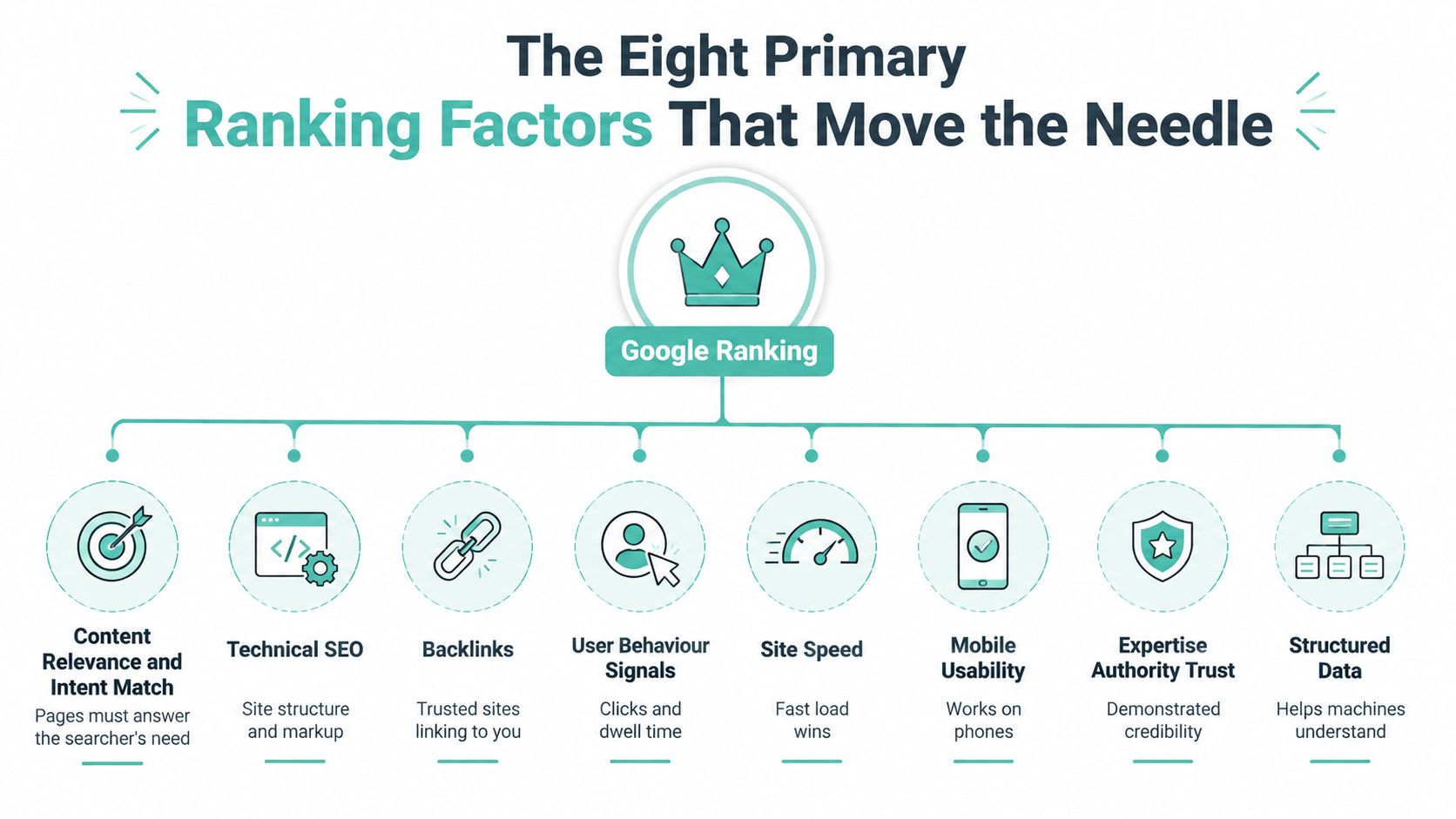
Google's ranking systems weigh many signals, but for Australian SMEs the practical work usually comes back to eight areas. The strongest way to think about them is as a stack, with foundation first, then content, then authority and locality. If the base is weak, the whole thing wobbles.
Start with the foundation
Technical SEO asks whether Google can understand the site cleanly. That includes internal linking, architecture, crawl paths, and markup. If a homepage has no clear route to service pages, or your important pages are buried three clicks deep, the site wastes authority.
Site speed matters because Google's page experience systems use Largest Contentful Paint, Interaction to Next Paint, and Cumulative Layout Shift as proxies for speed, responsiveness, and visual stability, as described in Google's ranking-systems guidance and SEO factor summaries such as Google ranking factors coverage from Semrush. The blunt question is, does the page load fast enough on a phone that a customer stays?
Security and trust are about more than the padlock icon. HTTPS, clean infrastructure, and a stable technical setup all reduce friction for users and help Google see the site as dependable.
Then answer the search properly
Content relevance and intent match is the heart of ranking. Does the page answer the exact question the person typed, in the language they're using? A florist page titled “same-day flower delivery Sydney CBD” should answer that service directly, not wander through a brand story for half the page.
User behaviour signals are trickier to observe, but the practical version is easy. If people click, stay, and keep exploring, that usually means the page met the need better than nearby results.
Structured data helps machines understand what the page is about. It doesn't replace content, it clarifies it, which is especially useful for products, services, and local pages.
Then build authority and local confidence
Backlinks still matter because trusted sites linking to you act like external validation. The best links are the ones that make sense in context, not random placements with no audience fit.
Local signals matter when the search has a place attached to it. Google's own local guidance says local ranking is driven mainly by relevance, distance, and prominence. For many Australian service businesses, that means Maps visibility can move the needle faster than broad blue-link rankings.
Practical rule: improve the foundation first, then the page, then the signals around it. Don't try to out-link a page that's technically broken.
Organic Rankings vs Local Maps Visibility in Australia
A florist in Sydney can rank well in organic search and still be invisible in Maps. That split is common in Australia, and it explains why a blue-link result and a local pack result should never be treated as the same outcome.
Organic ranking is about whether a page answers the query clearly enough to earn a standard search position. Local Maps visibility is about whether Google sees the business as relevant to the search, close enough to matter, and prominent enough to place in the local pack. For Australian SMEs, that difference shapes the whole ranking journey, because a clean website can still miss local visibility if the Google Business Profile is thin or the location signals are weak. The website and the map listing can point Google in different directions.
Organic vs Local Ranking: Key Drivers
| Signal | Organic ranking | Local Maps ranking |
|---|---|---|
| Query match | Strong page intent match and content depth | Business category and service relevance |
| Location | Helpful, but not always decisive | Central to visibility |
| Trust | Links, content quality, technical health | Reviews, prominence, profile completeness |
| Page experience | Important for site users | Indirect support, not the main local driver |
| Business data | Supports understanding | Core input through Google Business Profile |
| Best use case | Informational and service pages | Near-me searches and store or service-area discovery |
This table explains why broad keyword chasing can miss the point. Search behaviour in Australia often moves across both surfaces, and Google's own Australian consumer data shows 88% of Australian consumers used Google Search before buying, while 63% used Google Maps before buying. A person can start on the web, check the map, compare a few businesses, then return to the website to confirm details.
The practical lesson is simple. A café, tradie service, dental clinic, or retail showroom needs its Google Business Profile treated with the same care as its homepage. Categories, reviews, photos, hours, and consistent location details can carry more weight than another generic blog post. If the local side is weak, the blue-link side has to do extra work just to keep up.
For Australian businesses that want both signals working together, local SEO setup for Australian websites starts with the basics, then joins the website, the business profile, and the location data into one clear message for Google.
A Practical Example Climbing From Page Three to Top Three
Petals & Stems, a hypothetical Sydney florist, launched a neat WordPress site and still sat on page three for “flower delivery Sydney CBD”. The site looked fine at a glance, but it wasn't helping Google decide that this page was the obvious answer. The fix came from six changes, each tied to a ranking factor rather than guesswork.
The sequence that changed the result
First, the team tightened the intent match on the category page. The page stopped trying to sell every floral occasion at once and focused on same-day Sydney CBD delivery, opening hours, and ordering details.
Then they added schema markup for products and the local business. That gave search engines cleaner signals about what the page sold and where the business operated.
Next, they moved hosting to an Australian setup with LiteSpeed and AccelerateWP. The site loaded faster on mobile, which gave the content a fairer shot during mobile searches.
After that, they earned their first five genuine Google Business Profile reviews. That didn't rewrite the website, but it improved trust and local prominence around the business name.
Two local backlinks followed, one from a Sydney wedding directory and one from a neighbourhood blog. Those links were useful because they made sense in the actual world, not because they were gaming the system.
Finally, they tightened internal linking from blog posts to the transactional pages. That helped Google understand which pages should receive more attention and authority.
A ranking lift is often a chain of small fixes, not one big breakthrough.
The result wasn't magic. The site became easier to understand, easier to trust, and easier to use on mobile. Traffic improved, and enquiry volume rose because the search result finally matched the business people were looking for.
Register your new domain name at competitive market prices including free domain add-ons like privacy, DNS Hosting, Custom Nameservers and Forwarding.
Always the best price and no nasty renewal price hikes.
Register A Domain Name
Measuring Performance and Troubleshooting Ranking Drops
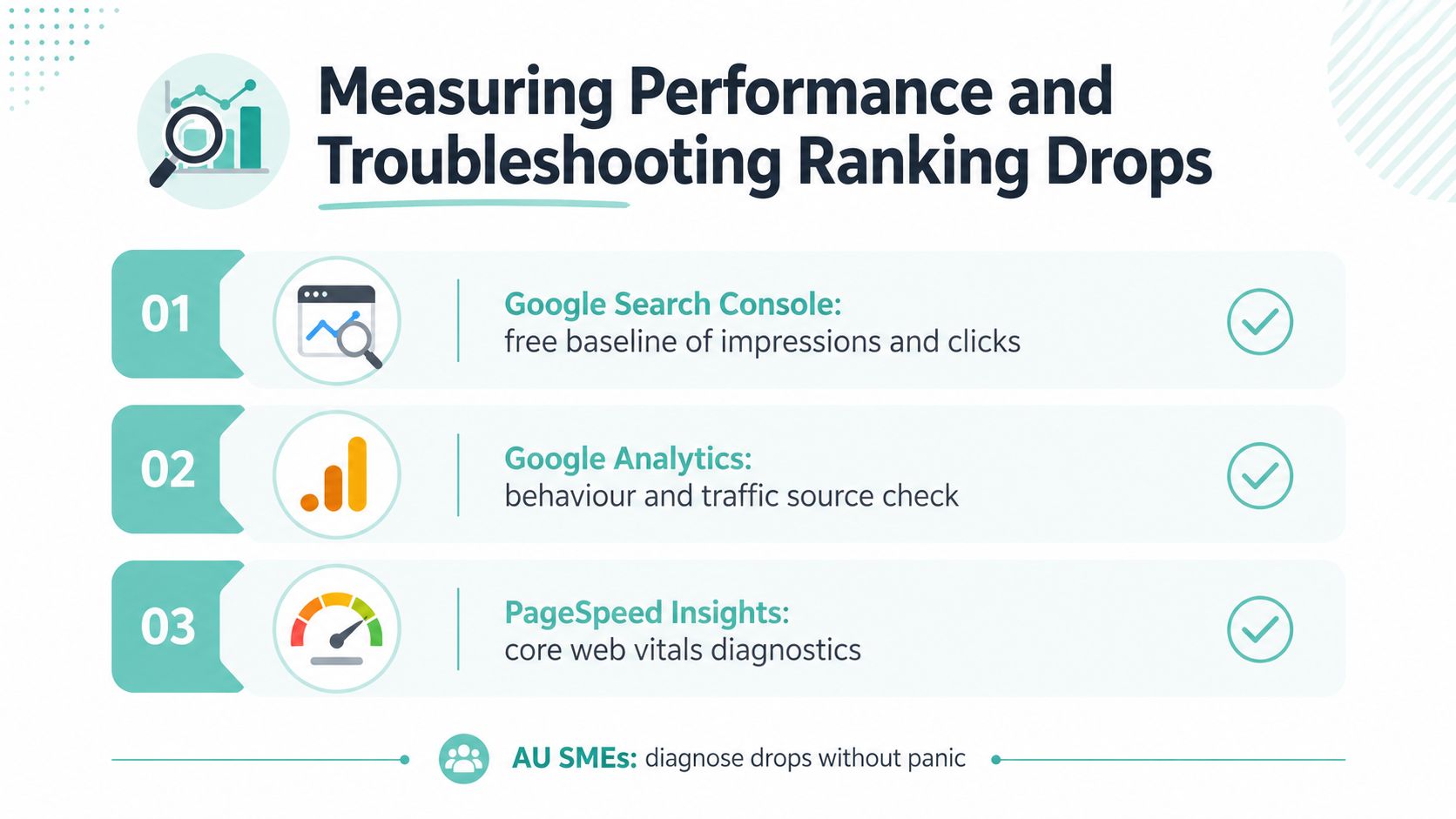
A ranking drop isn't always a crisis. Sometimes Google shifts snippets, sometimes demand changes with seasonality, and sometimes the site just stops earning clicks because the listing looks less relevant than before. The trick is to separate a real problem from normal movement.
The three free tools that tell the story
Google Search Console shows impressions, clicks, queries, and page-level performance. It's the first place to check when a page stops appearing the way it used to.
Google Analytics 4 helps you see whether people are staying, engaging, or bouncing once they land. That matters because a ranking issue and a user-experience issue can look similar from the outside.
PageSpeed Insights is useful when the problem feels technical. It surfaces Core Web Vitals signals so you can tell whether the page is slow, unstable, or lagging on mobile.
A simple decision tree for AU SMEs
If traffic is stable but rankings look weaker, the problem may be a snippet reshuffle or ordinary movement around the result page. Check the query and the page title first.
If both traffic and rankings are down, look for a technical issue, a crawl problem, or an algorithmic change. Start with Search Console coverage and the affected page group.
If traffic is down but rankings look flat, the likely issue is click-through, branding, or search-result presentation. Your title tag, meta description, and brand trust may be underperforming even though the position hasn't moved much.
Practical rule: always check Search Console before changing content. Guessing from a dip in enquiries usually leads to the wrong fix.
Bring in a specialist when the problem spans several page types, when crawl errors persist, or when the site has already had one round of basic fixes and the numbers still point down. That keeps the response focused instead of reactive.
Hosting Choices That Directly Support Your Rankings
Your host doesn't write the content, but it shapes how far that content can go. For Australian SMEs, the hosting checklist should line up with the ranking factors that matter most, speed, security, stability, and clean support for WordPress or Windows-based sites.
The cleanest mapping starts with location and speed. Australian servers in Sydney, Melbourne, Brisbane, and Perth help reduce latency for local visitors, and hosting stacks that use LiteSpeed and AccelerateWP can improve how quickly WordPress pages respond under load. If your pages feel sluggish on mobile, the host is part of the conversation.
Security and trust belong on the checklist too. Free SSL, DDoS-protected firewalls, malware scanning, CloudLinux isolation, encrypted off-site nightly backups, and 24×7 monitoring all help keep a site reliable and easier to trust. When a service business site has to stay available, uptime and recovery matter as much as design polish.
A hosting checklist tied to ranking work
- Speed and Core Web Vitals: check whether the host offers caching, resource allocation, and fast response times for Australian users. What is server response time is a useful place to start if you're comparing hosts.
- WordPress support: look for one-click installs, managed updates, and performance tuning that reduces admin drag.
- Windows or ASP.NET sites: make sure the host supports the application stack without forcing awkward workarounds.
- Reliability and recovery: verify backups, monitoring, and isolation controls before you need them.
- Local relevance: if your customers are mostly in Australia, a local infrastructure fit makes more sense than chasing generic global hosting.
One option in this space is UpTime Web Hosting, which provides Australian hosting with WordPress and ASP.NET support, plus the infrastructure features above. The point isn't the brand name, it's the fact that hosting choices can either support ranking work or slow it down.
Experience Microsoft 365 Business Standard for free for 30 days.
Up to 25 users with full access to email, OneDrive and Teams. Includes full versions of desktop apps of Outlook, Word, Excel, PowerPoint and more.
Try Microsoft 365
Putting It Together and Common Misconceptions to Avoid
A sensible ranking plan doesn't need drama. It needs sequence.
A practical 90-day order
In week one, audit Search Console and Core Web Vitals so you know what Google can see and how the site behaves. In weeks two to four, fix technical foundations, including hosting, crawl errors, and security gaps. In weeks five to eight, improve content intent match and add schema where it clarifies the page. In weeks nine to twelve, build local signals and earn genuine reviews.
The biggest misconceptions still trip up a lot of Australian SMEs. Keyword stuffing doesn't rescue weak pages. Buying backlinks creates risk, not durable authority. Ranking alone doesn't equal revenue, because a page still has to convert once the click arrives. And ignoring Google Business Profile is a poor choice for service-area businesses, because local visibility can be where the customer decides.
Original, useful content still wins more often than recycled SEO noise.
Google's ranking systems continue to reward pages that answer the query well, look trustworthy, and work properly on the device people are using. That's why the durable strategy in 2026 is still straightforward, helpful content, strong technical delivery, and local relevance on a fast, secure Australian host.
If you want a hosting setup that supports WordPress performance, local Australian servers, free SSL, backups, and security features without forcing you into a complicated stack, visit UpTime Web Hosting and compare the available plans against your current site. A stronger hosting base won't replace good SEO, but it can remove the friction that stops your pages from ranking, loading, and converting the way they should.