
You can do everything “right” and still watch traffic sit flat. The site is live, the pages look fine, a few blog posts are ranking, and yet the enquiries haven't moved. In Australia, that usually isn't because the business has no demand, it's because the traffic engine is missing one or two high-impact parts, often the ones nobody wants to look at first, like hosting, page speed, internal links, and whether the content matches what people typed into Google.
Table of Contents
- Why Most Australian SMBs Get Stuck Around the Same Traffic Plateau
- Run a Traffic Audit Before You Touch Anything Else
- Fix the Infrastructure Layer That Most Guides Ignore
- Match Every Page to Real Search Intent
- Build a Content Engine That Compounds, Not a One-Off Blog
- Diversify Beyond Google With Local and Owned Channels
- Measure, Refresh and Compound the Wins

Performance you can feel, backed by clients who depend on it. Read how our support and uptime create long‑term customer success.Power Your Business with Better Hosting
Why Most Australian SMBs Get Stuck Around the Same Traffic Plateau
A Sydney tradie gets the site built, the logo looks sharp, the service pages are all there, and the first month brings a nice little lift. Then the phone goes quiet again, visits flatten, and every new post seems to vanish into the same shallow pool of traffic. I've seen that pattern across Melbourne cafes, Brisbane service firms, and regional operators who thought “launching the site” was the hard part.
The problem is usually not effort. It's that the business treated traffic like a publishing problem when it was a systems problem, a search problem, and sometimes a hosting problem.
What a plateau usually means
A plateau often means the site has enough pages to exist, but not enough structure to earn stable visibility. On the Australian side, that matters more because Google still dominates search, with StatCounter's Australian market share data showing Google at roughly 93% of all searches in 2024. That makes every improvement in Google visibility disproportionately valuable for local businesses, especially when most discoverability still flows through one engine. The practical levers are the ones that improve Google visibility, like search-intent content, long-tail keywords, internal links, and reputable backlinks.
Practical rule: if your traffic stopped growing, don't publish blindly. Check whether the site is actually built to be found, clicked, and loaded quickly on mobile first.
There's also a broader Australian access reality behind the plateau. The ABS reported that 97% of households had internet access in 2022–23, and mobile internet access was nearly universal among connected households. That means “having a website” isn't enough. The site has to load fast, work well on phones, and make the right page obvious.
What I want a business owner to do here is simple. Stop guessing which content idea might save the month, and start looking at the machinery underneath the pages. By the end of this piece, you'll be able to run your own audit, fix the bottlenecks that matter, and build a content and promotion rhythm that compounds instead of resetting every time you hit publish.
Run a Traffic Audit Before You Touch Anything Else
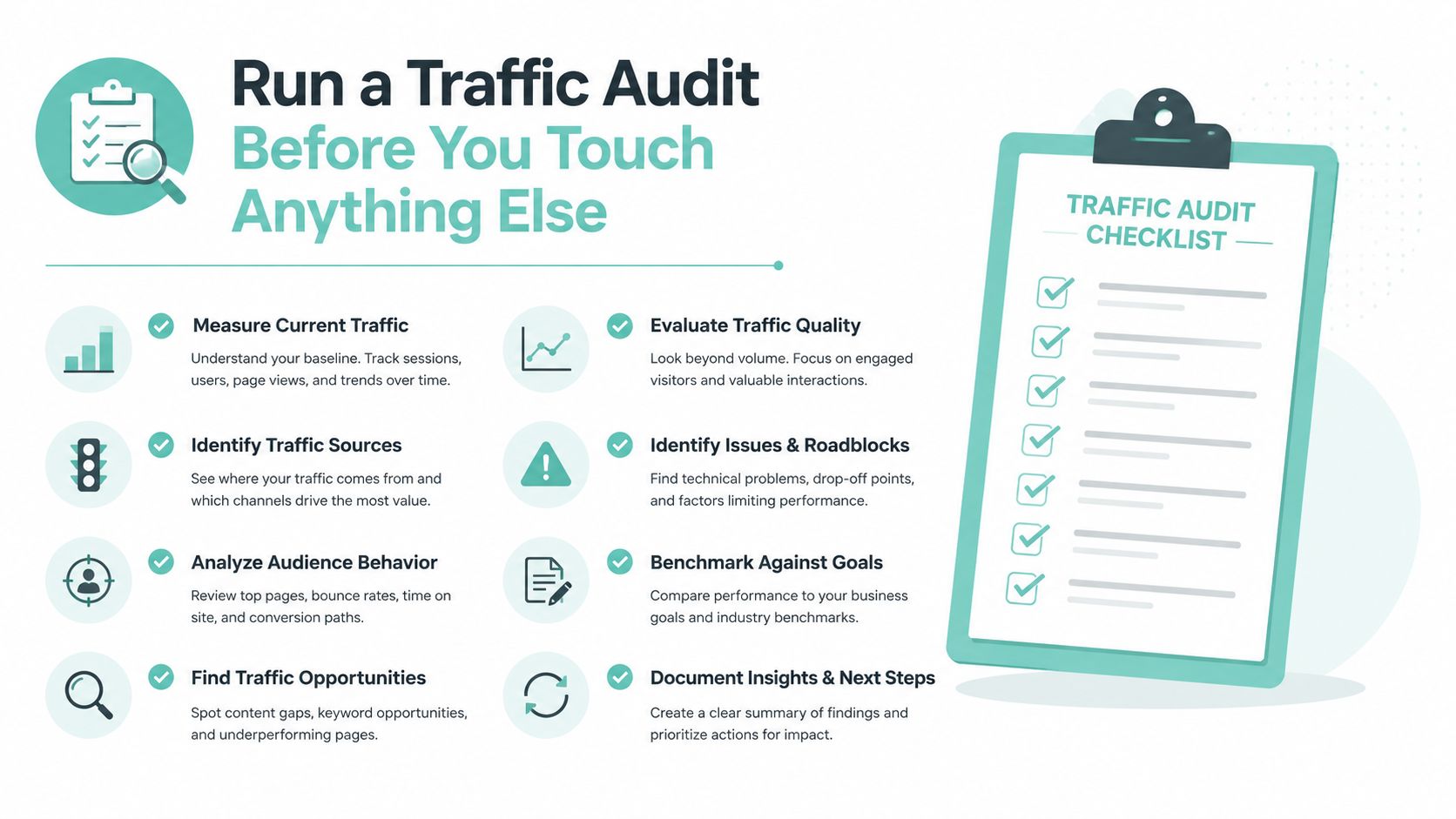
A useful audit doesn't need a full agency workshop. It needs one afternoon, a browser, and enough discipline to write down what you find rather than what you hope is wrong. I'd start with the pages and queries that already have some traction, because that's where the easiest gains usually hide.
What to check first
Open Google Analytics 4 and look at traffic sources, landing pages, and exits. You're searching for pages that attract visits but lose people quickly, because that usually tells you the page promise and the page content don't line up. Then open Google Search Console and scan for queries sitting on page two, because those often need better metadata, tighter intent matching, or stronger internal links rather than brand-new content.
A simple reading of those patterns goes a long way. A high-impression, low-click query usually points to a metadata issue. A page with a slow Largest Contentful Paint often points to hosting, image weight, or both. A page that performs well but has no internal links pointing to it is usually a crawl priority problem, not a content problem.
Then use a tool like PageSpeed Insights to test a few real templates, not just the homepage. If your core service page is dragging while the blog looks fine, the bottleneck is probably structural, not editorial. That's the kind of finding that saves a business from writing ten more posts to fix a page that was never the issue.
You can also inspect the top three pages a real visitor sees, not the top three pages you wish they saw. That often exposes awkward navigation, orphaned service pages, or content that sits too deep in the site architecture.
A traffic audit should end with a written diagnosis, not a vague feeling. If you can't point to the bottleneck, you're not ready to scale content.
For a practical framework on content structure after the audit, the guide at this SEO content strategy resource is useful because it keeps the focus on search intent, internal linking, and the pages that should carry the most weight.
Write your summary in this format:
- Traffic sources: where visitors come from.
- Top landing pages: which pages do the work.
- Main leak: where people drop off.
- Search gap: what queries show impressions but weak clicks.
- Technical blocker: speed, mobile, or crawlability issue.
- Next action: one fix, not ten.
That turns a messy dashboard into a decision list.
Host your website with our 5-star rated, cPanel website hosting plans.
Super fast servers, with security included and hosted in your choice of Australian Data Center.
View cPanel Plans
Fix the Infrastructure Layer That Most Guides Ignore

A lot of traffic advice starts with content and assumes the site can already serve that content properly. For many Australian SMB sites, that assumption is where growth stalls. Google's Core Web Vitals guidance still matters because page experience affects how people feel about a site, and businesses that load cleanly on mobile tend to hold attention longer than sites that stutter under normal use.
Why location and stack choices matter
For Australian audiences, hosting location affects latency, which changes how quickly a visitor sees the page and how efficiently search engines can crawl it. If your customers are in Sydney, Melbourne, Brisbane, or Perth, hosting closer to them usually removes friction that shows up on every visit. The effect is even sharper on mobile and on sites that need to serve multiple suburbs or cities.
The stack matters too. For WordPress, Joomla, and Drupal sites, LiteSpeed and CloudLinux are practical performance choices because they are built for efficient PHP handling and resource isolation. For ASP.NET sites, the hosting platform has to suit the application properly, otherwise the benefit of strong content gets swallowed by slow response times and unstable delivery. A site can look polished and still lose visitors if the backend is heavy or the server response is slow.
For owners who want a closer look at that delay, the article on what server response time means for hosting explains why backend latency is not a theoretical metric. It is the gap between a click and a page that feels ready.
A five-minute infrastructure check
Use this quick checklist against your current provider:
- Server location: is the site hosted close to your Australian audience?
- Stack fit: does your CMS run on a platform designed for it?
- SSL: is free SSL enabled and active everywhere?
- Firewall: is there a DDoS-protected firewall in place?
- Backups: are nightly off-site backups running automatically?
- Monitoring: do you have 24×7 uptime monitoring?
- Mobile delivery: do the pages feel quick on a phone, not just on desktop?
If you are comparing providers, one practical benchmark is Australian hosting with local infrastructure, LiteSpeed, CloudLinux, SSL, firewall protection, and off-site backups. The aim is clear, remove the delays and outages that cap traffic growth before content gets a fair shot.
Victoria OHare's Victoria OHare SEO guide is also worth a look if you want a broader view of how technical setup, content, and search visibility fit together in practice. The useful part is the reminder that traffic work stops being effective once infrastructure gets in the way.
Match Every Page to Real Search Intent
A page can be well written and still miss because it answers the wrong version of the question. That's why intent beats topic. If someone in Brisbane types a phrase about a hot water system, they don't want a generic industry explainer, they want local context, likely pricing guidance, and a fast route to the next step.
Build from the query, not the brochure
The fastest way I've seen to improve page relevance is to mine People also ask and Related searches in Google, then map five to ten long-tail variations around one commercial or informational intent. Write the page so it answers the exact query first, then supports it with headings, examples, and enough detail that the reader doesn't need to bounce back to the results page.
Use the query in the title, meta description, and H1. Keep the URL descriptive. Link the page from related service and blog posts with anchor text that says what the page is about, not “read more”. If structured data fits the page type, add it where appropriate so search engines can read the page cleanly.
Useful habit: every important page should have a job, a query, and at least one nearby page sending it authority.
The Australian search market makes this even more important. With Google handling roughly 93% of searches in Australia in 2024 according to StatCounter's Australian market share data, getting the intent match right on Google pays off more than spreading effort too thin across channels that don't move the same volume.
For a local example, a Brisbane plumber could turn a query like “how much does a hot water system cost” into a service page that explains the decision factors, names suburbs served, and gives transparent pricing ranges or estimate drivers without sounding evasive. That page should be linked from the plumbing service hub, a hot water installation article, and any suburb page that mentions related work.
One practical internal reference for this kind of work is the search engine optimisation page, because the mechanics only work when keywords, internal links, and page structure are aligned.
The biggest mistake is still broad promotional copy. If the page reads like a sales brochure, it usually underperforms because it doesn't satisfy the informational layer behind the purchase intent. Educational first, commercial second, tends to rank and convert better than the reverse.
Build a Content Engine That Compounds, Not a One-Off Blog
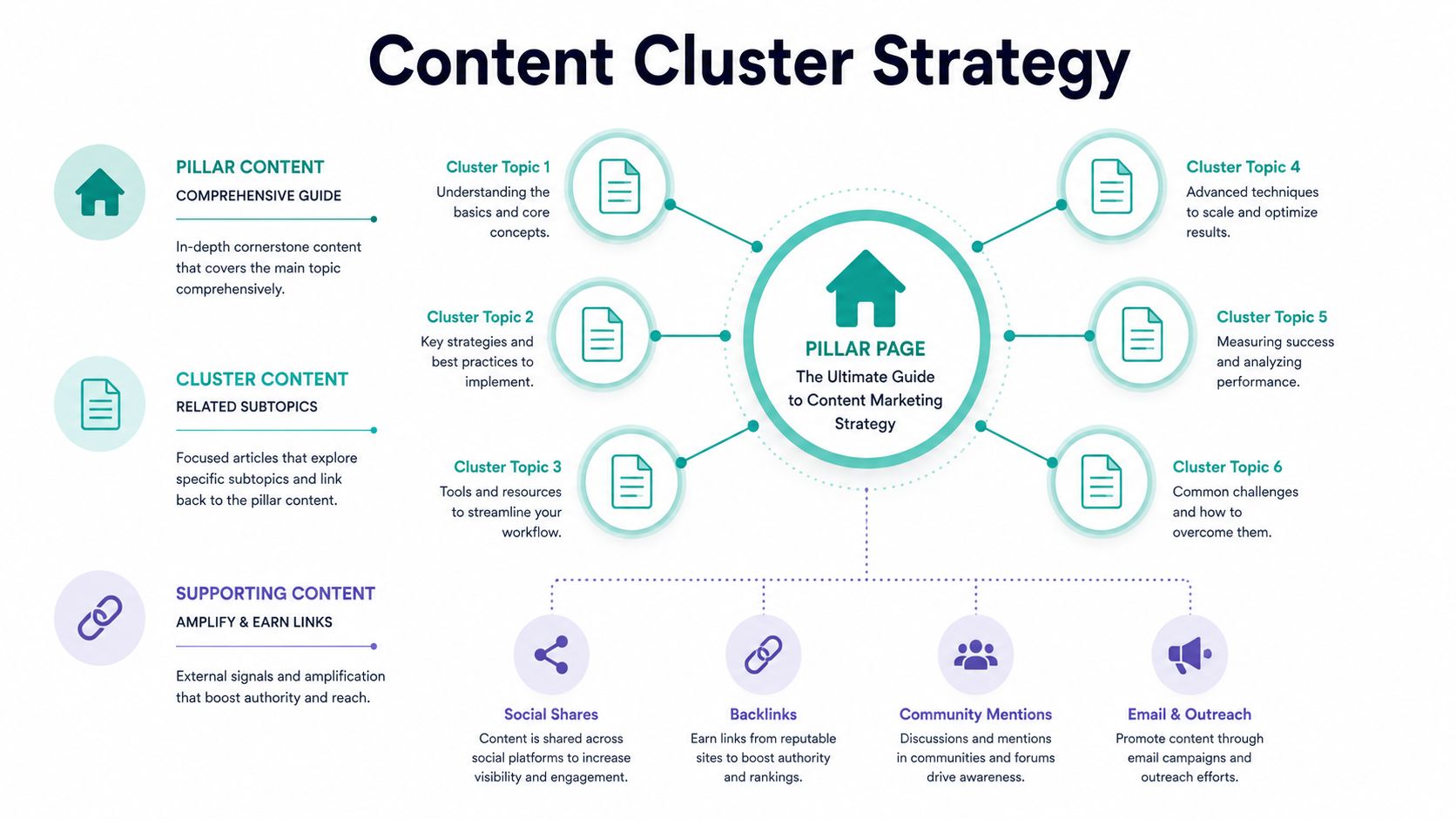
One article can win a few visits. A connected cluster can keep winning because each page reinforces the others. That's the difference between “we published something” and “we built an asset”.
Make one topic do more work
A pillar page covers the broad subject. The surrounding articles answer narrower questions, each aimed at a long-tail variation. Internal links then push authority back towards the pillar and distribute relevance across the cluster.
A Perth accounting firm is a clean example. One pillar page could sit on small business tax deductions, with supporting posts on vehicle logs, home-office expenses, and super contributions. Each article should stand alone, but none should be isolated. That's how the whole group becomes easier to find than a pile of unrelated posts.
This approach also keeps content production realistic. Instead of chasing random ideas, the business builds a subject area properly and keeps expanding where it already has traction. That's usually where Australian SMEs get the best return from a smaller publishing budget.
Turn publishing into distribution
Publishing is only half the job. The other half is getting the page back in front of people who can use it.
Here's a practical repurposing loop:
- LinkedIn carousel: break the key points into slides for B2B visibility.
- Email newsletter: send the article to your subscriber list with a single clear reason to click.
- Client update: add a short summary to your customer email or account update.
- Community comment: contribute a useful reply in a local forum or industry group where the issue already comes up.
For concrete content formats, these blog post examples are useful if you're trying to move from “idea” to publishable page without overcomplicating the structure.
The point is not to blast the same link everywhere. The point is to create several entry points into one good piece of content, so the page gets multiple chances to attract qualified traffic. Smaller Australian sites can't rely on domain authority alone, so distribution has to do some of the heavy lifting.
Register your new domain name at competitive market prices including free domain add-ons like privacy, DNS Hosting, Custom Nameservers and Forwarding.
Always the best price and no nasty renewal price hikes.
Register A Domain Name
Diversify Beyond Google With Local and Owned Channels
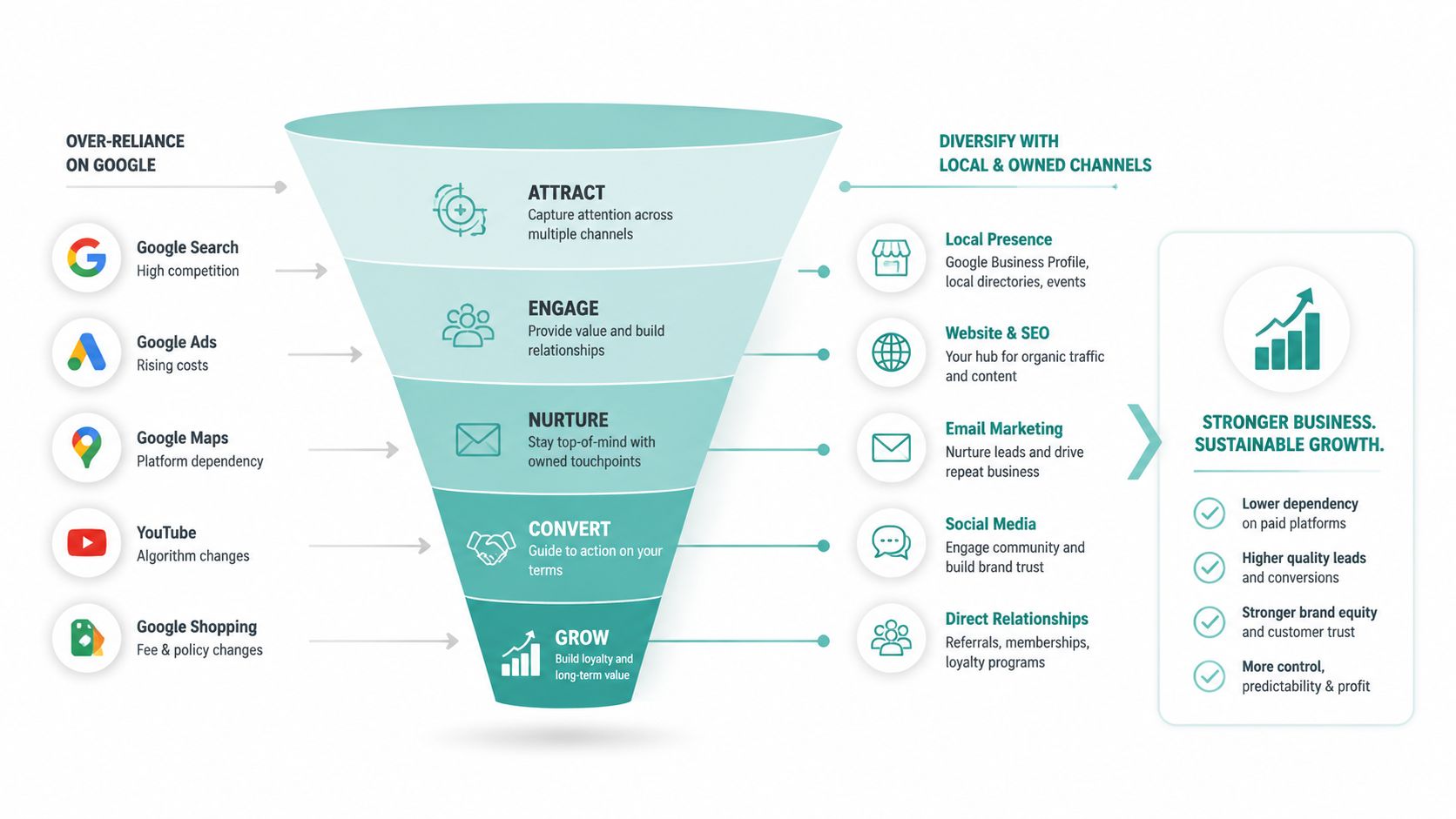
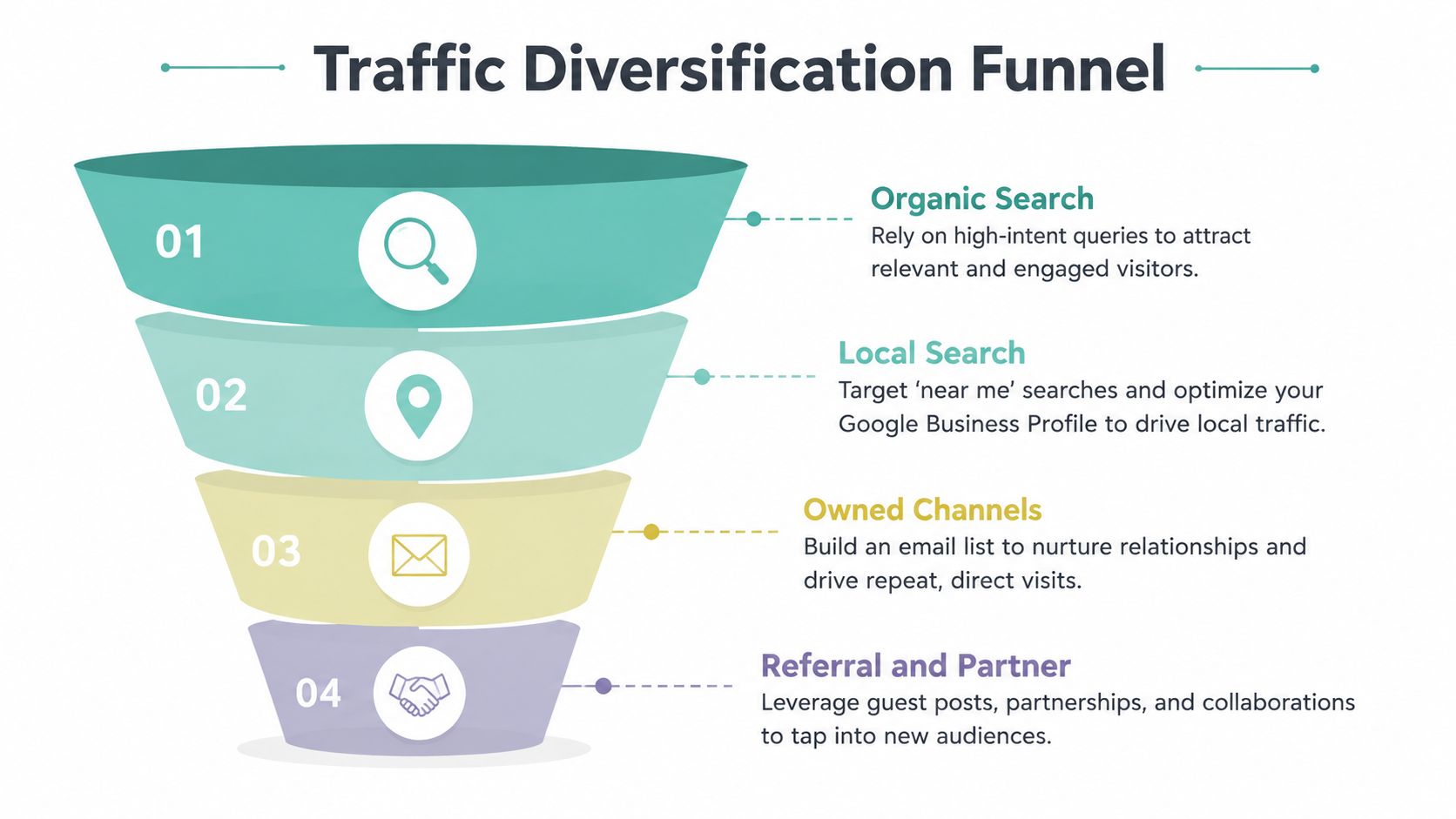
Traffic resilience matters more than raw traffic volume right now. Search results are busier, answer boxes absorb clicks, and AI-driven discovery is changing how people get to answers. That doesn't mean SEO is dead, it means relying on one doorway is a fragile way to grow.
Build three buffers
The first buffer is Google Business Profile. Google's own help documentation says businesses can improve discovery by completing the profile, adding accurate opening hours, photos, service areas, and encouraging reviews. For an Australian business serving a city or suburb, that's one of the most direct ways to show up for local intent, especially when someone is ready to contact rather than browse.
The second buffer is email. A newsletter gives you a way to bring people back without waiting for a new search click. Publish one useful local guide, then send it to existing customers and site visitors who already know your name. That creates repeat visits from people who are more likely to care about the next offer or article.
The third buffer is a channel where your actual customers already spend time. For B2B services, that might be LinkedIn. For local retail, it might be Facebook groups. For hospitality, it might be Instagram. The rule is simple. Pick one or two and stay present, instead of scattering effort across every platform.
A practical local SEO reference is this guide on local SEO for business, because the mechanics only work when local listings, pages, and on-site relevance line up.
Google can still be the biggest source of traffic. It just shouldn't be the only source you trust.
Traffic quality matters as much as volume. A smaller but intent-rich local visit can be worth more than a broad informational click that never converts. Australian SMBs usually win by tightening the path to enquiry, then using local search, email, and community presence to keep the pipeline from relying on a single algorithm.
Measure, Refresh and Compound the Wins
Traffic growth becomes durable when the review process is boring and consistent. Most sites don't fail because they never publish again. They fail because nobody checks whether the last round of work changed anything.
Weekly, monthly and quarterly rhythms
On a weekly basis, check top queries, top pages, and any sudden drops in clicks or impressions. You're looking for movement, not perfection. If a page that used to get steady attention starts slipping, inspect it before you add new content.
On a monthly basis, review which clusters are growing, which are flat, and which pages need a refresh. That's where the easiest gains often sit, because older pages already have some history and just need better alignment, cleaner structure, or updated internal links. A page that has drifted away from current search intent can often recover with less effort than a brand-new article.
On a quarterly basis, do the deeper work. Check competitor movement, look for new keyword opportunities, and review infrastructure, including SSL renewal, backup integrity, and Core Web Vitals. That keeps the site healthy enough for new content to perform.
A Melbourne florist is a good example of why refreshes matter. A two-year-old Valentine's Day guide can regain relevance when the owner updates pricing, adds new photos, links it to the wedding flowers cluster, and rewrites the meta description. The page doesn't need to be reinvented, it needs to be brought back in line with what people now expect.
The warning signs that point to infrastructure rather than content are usually obvious once you know them:
- Pages feel slow on mobile even when the copy is strong.
- Traffic drops after changes that should have helped.
- Search Console shows impressions but clicks stay weak across multiple pages.
- Visitors land, then leave quickly on otherwise relevant pages.
- The site goes down or stutters when you're actively promoting it.
When those signs show up, writing more posts isn't the answer. A hosting review usually is. Fixing the underlying delivery layer protects the work you've already done and gives the next round of content a fair chance to perform.
If your site is ready for faster pages, stronger uptime, and an Australian hosting setup that supports the traffic work instead of slowing it down, take a look at UpTime Web Hosting. It's worth matching the hosting layer to the growth plan before you publish the next round of content.