
The café owner thought the website bill would be simple. A cheap shared plan, a domain, maybe an SSL certificate, then done. The first invoice looked harmless, then renewal pricing, GST, backups, email, and support turned a small monthly number into a much bigger yearly commitment.
That story is common because hosting is rarely just hosting. For Australian SMEs, the annual web hosting cost sits inside a broader digital running cost, and the bill keeps coming long after launch. The Australian Bureau of Statistics found that 65% of businesses with a website had been online for more than five years, 42% had fewer than 10 employees, and 86% used their website to provide information about products or services, which shows why hosting is a recurring business expense, not a one-off setup fee Australian web hosting market data.
Table of Contents
- Introduction to Annual Hosting Cost in Australia
- Understanding Cost Components for Annual Hosting
- Renewal Pricing Discounts and GST Implications
- Annual Cost Ranges by Hosting Type
- Sample Annual Budgets for Common Scenarios
- Strategies to Reduce Your Annual Hosting Spend
- Conclusion and Host Selection Checklist

Performance you can feel, backed by clients who depend on it. Read how our support and uptime create long‑term customer success.Power Your Business with Better Hosting
Introduction to Annual Hosting Cost in Australia
A local café owner usually doesn't start with a spreadsheet. They start with a launch deadline, a logo, and a promise from a developer that the site will only cost a few dollars a month. Then the renewal notice arrives, the domain is due again, and the owner realises the website is part of the monthly cash flow, not a one-time project.
That's why the annual web hosting cost matters more than the headline monthly rate. A site is often a working business asset, not a decoration, and it keeps generating storage, security, and support needs every year. The ABS data above helps explain the pattern, because businesses don't treat websites like disposable brochures, they keep them live, updated, and useful for years Australian web hosting market data.
For a small Australian business, the confusion usually starts with one question, “Why did the bill jump?” The answer is usually a mix of renewal pricing, GST, and add-ons that weren't obvious at sign-up. That's where owners need to stop comparing only the first invoice and start comparing the full yearly outlay.
Practical rule: if a quote only shows the launch discount, it's not a budget, it's a teaser.
The cleanest way to think about it is like running a shop. The rent matters, but so do power, cleaning, security, and the extra charges the landlord never mentioned in the first conversation. Hosting works the same way, and the annual total is what decides whether the site stays comfortably funded or becomes a surprise expense.
Understanding Cost Components for Annual Hosting
The easiest mistake is treating hosting like a single line item. In practice, the invoice is usually a bundle of smaller charges, and each one reflects a different part of the service. If you break them apart early, the quote starts making sense.
Storage, bandwidth, and performance needs
Storage is the obvious part. It's the space for pages, images, backups, and files, but the bill can rise if a site needs more room than the basic plan includes. Bandwidth matters too, because it's the amount of data the host has to move when visitors load pages, view images, or complete forms.
CPU and memory are less visible, but they shape how smoothly a site behaves under load. A brochure site can often live happily on a simple plan, while a store or booking system may need more isolation and more resources. That's why yearly hosting spend tends to rise when a business moves from shared hosting to VPS or dedicated infrastructure, rather than because of storage alone hosting resource cost guide.
Security, support, and business add-ons
Backups are another line item that often gets missed. Encrypted off-site backups cost more than basic storage, but they also give the owner a recovery path if an update breaks the site or a plugin misbehaves. The same goes for malware scanning, monitoring, and DDoS protection, which are easy to ignore until there's a problem.
Domain registration and renewals are separate from hosting on many plans, so the bill can keep climbing even if the website itself doesn't change. Business email hosting is another common add-on, and support response times can affect price too. A provider with local support and managed services is usually charging for more than disk space, it's charging for someone to watch the site, patch it, and help when something goes wrong.
For a plain-language breakdown of hidden extras, UpTime Web Hosting has a useful guide on hidden costs of budget web hosts, which is a good reference point when you're reading plan inclusions line by line.
A good budget question is this: if the site went offline tomorrow, what's already covered and what would you have to pay separately?
The business owner's job isn't to memorise technical jargon. It's to understand which pieces are part of the annual running cost and which pieces are optional extras that only look cheap at sign-up.
Host your website with our 5-star rated, cPanel website hosting plans.
Super fast servers, with security included and hosted in your choice of Australian Data Center.
View cPanel Plans
Renewal Pricing Discounts and GST Implications
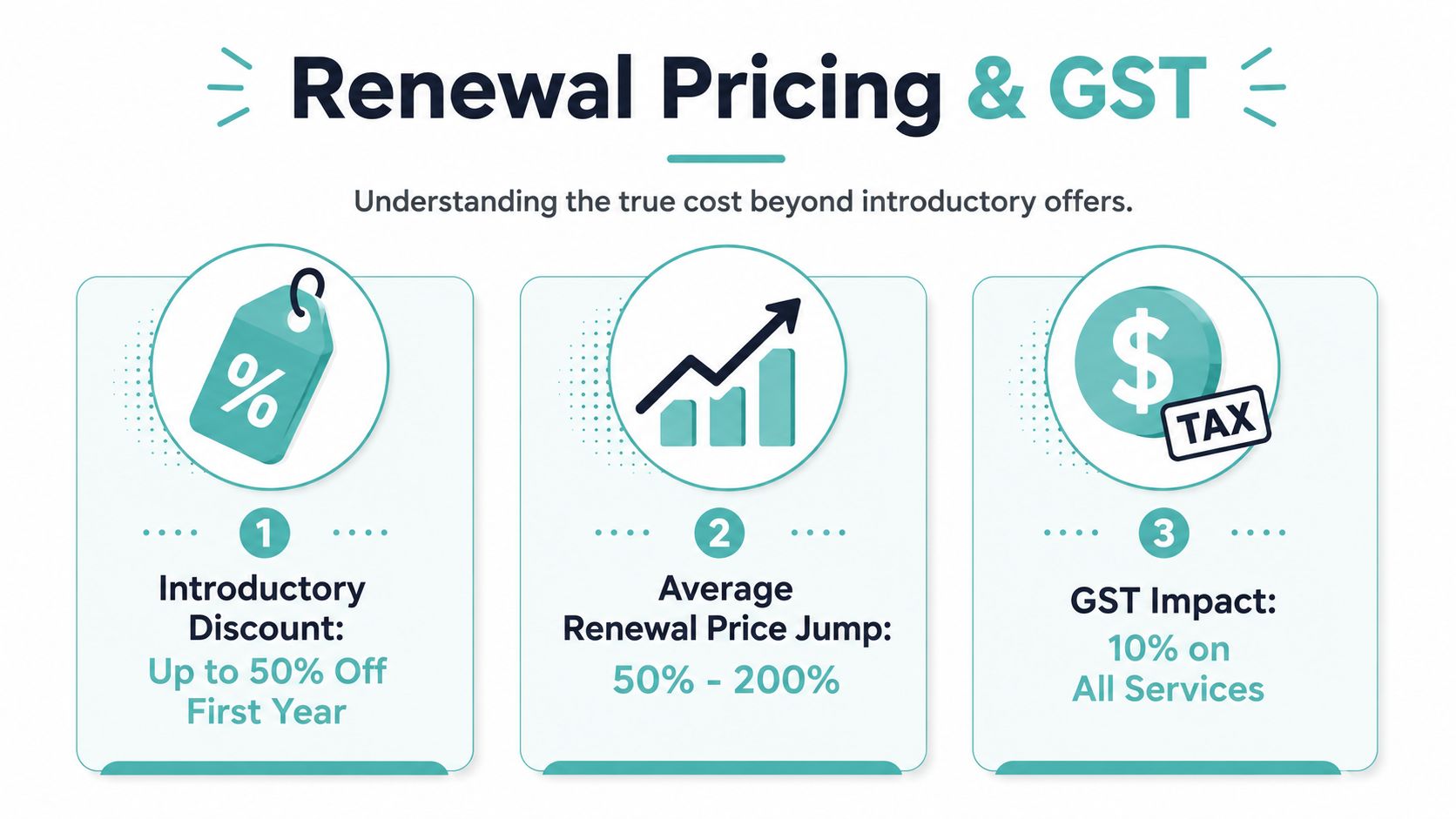
Promotional pricing is designed to get you in the door. Renewal pricing is designed to recover the margin. That gap is the reason so many Australian buyers feel blindsided when the first bill and the second bill look like different products.
A practical benchmark from independent pricing guides shows shared hosting commonly starting around $2 to $6 per month but renewing at roughly $10 to $20 per month, which means a basic site can move from about $24 to $72 in year one to about $120 to $240 after the promo period ends Forbes Advisor web hosting cost guide. That's why the renewal rate is the number that matters most when you're building an annual web hosting cost estimate.
GST adds another layer. Australian businesses need to budget for the tax on hosting and on most add-ons, so comparing a pre-tax launch rate with an all-in local bill can be misleading. A plan that looks tiny on the pricing page can feel very different once tax is applied and extras are added.
Reading the pricing table correctly
The smartest habit is to compare the renewal column, not just the introductory column. If a provider offers a steep first-term discount, ask what the plan costs after the contract rolls over, what's included at renewal, and whether support, backups, and email are still covered.
There's also a budgeting angle that often gets ignored, loyalty rewards. Some providers credit points or future discounts to ongoing customers, which can reduce the effective annual spend over time. That doesn't erase renewal shock, but it can soften it if the host's pricing is transparent and the rewards are easy to use.
UpTime Web Hosting's AUD pricing versus USD hosting guide is relevant here because currency conversion and tax treatment can both change the number on the invoice.
Compare like with like, first year to first year, renewal to renewal, and tax included to tax included.
The goal isn't to avoid discounts. The goal is to understand what happens after the discount ends so you can budget for the yearly bill instead of the headline one.
Annual Cost Ranges by Hosting Type
Not every website belongs on the same kind of server. A simple brochure site, a managed WordPress site, a growing online store, and a heavy corporate app all place different demands on the infrastructure. The annual cost climbs because the resource class changes, not because the host changed the font on the pricing page.
For Australian SMBs, a practical budget rule is to expect roughly A$36 to A$360 per year for most simple hosting needs if billed upfront, with shared hosting commonly around A$36 to A$96 per year and managed WordPress hosting typically A$120 to A$360 per year Australian hosting cost breakdown. That's the low-friction zone for many small sites.
Comparing the main hosting classes
| Hosting Type | Entry Annual Cost (A$) | Renewal Annual Cost (A$) |
|---|---|---|
| Shared Hosting | A$36 to A$96 | Higher after promo renewal |
| Managed WordPress Hosting | A$120 to A$360 | Higher after promo renewal |
| VPS Hosting | A$120 to A$1,200+ | Higher after promo renewal |
| Dedicated Hosting | A$960 to A$6,000+ | Higher after promo renewal |
The ranges above reflect the general pricing bands for each hosting class, with VPS commonly more expensive than shared and dedicated sitting at the top end hosting pricing comparison. The point isn't that every site needs a bigger plan. The point is that performance, isolation, and support are priced into the annual bill when a website needs more than a basic shared environment.
Matching the tier to the business need
A small brochure site or local service page usually doesn't need much more than shared hosting, especially if traffic is steady and the content is simple. A WooCommerce store, a membership portal, or a business with heavier traffic can justify VPS or cloud-style resource allocation because downtime, slow checkout, and congestion have a direct cost.
For Australian buyers looking at a more practical small-business lens, UpTime Web Hosting's web hosting for small business page is a useful example of how plan types can be presented for real business use rather than abstract specs. Keep the question simple, what does the site do, and how much isolation does it need to do it reliably?
If the site only needs to display information, don't pay for a race car.
If it processes orders, holds logins, or supports heavy content, the annual bill usually needs a stronger engine underneath.
The right plan is the one that fits the workload without forcing you into overspending for capacity you won't use.
Sample Annual Budgets for Common Scenarios

A yearly budget becomes much clearer when it has a business attached to it. The numbers below are deliberately realistic for Australian SMB use cases, with the goal of showing how hosting, domain, SSL, backups, and support can stack together.
Local café brochure site
A café site usually needs a simple plan, a domain, SSL, and maybe basic backups. It's a business card with opening hours, menus, and a contact page, so the main aim is reliability rather than scale.
| Item | Typical annual cost impact |
|---|---|
| Shared hosting | Low to modest |
| Domain renewal | Separate annual cost |
| SSL | Often included, otherwise extra |
| Backups and monitoring | Optional, but sensible |
This kind of site usually sits in the lower annual range because it's light on traffic and doesn't need much compute. The biggest budget mistake is assuming the basic plan includes every add-on. It often doesn't.
Solopreneur WordPress blog
A blog needs more than a brochure site because updates, plugins, and media uploads increase maintenance pressure. A managed WordPress setup can make the annual cost more predictable, especially if the owner wants less time spent on technical upkeep.
| Item | Typical annual cost impact |
|---|---|
| Managed WordPress hosting | Modest to moderate |
| Domain and renewal | Separate annual cost |
| Backup service | Helpful for plugin updates |
| Premium support | Worth considering if the site is revenue-bearing |
Annual budgeting starts to matter more than launch pricing. The owner may think in terms of “cheap hosting”, but the question is whether the plan covers the work the blog generates.
WooCommerce store
A small online shop carries more risk because checkout, product images, and customer data all depend on the host. That's why the hosting tier, backup frequency, and support response time usually deserve a higher budget than a standard content site.
UpTime Web Hosting's website creation cost page is a useful companion when a business is separating build costs from recurring hosting costs. A store owner should always split those two numbers before planning the yearly bill.
| Item | Typical annual cost impact |
|---|---|
| VPS or stronger shared plan | Moderate to higher |
| Domain renewal | Separate annual cost |
| SSL | Essential |
| Backups, security, support | Strongly recommended |
The mistake here is buying for launch only. A store needs enough headroom to handle seasonal surges, plugin updates, and recovery if something breaks.
Corporate portal or higher-demand site
A portal that handles logins, internal resources, or frequent content updates usually needs stronger infrastructure and more support discipline. The annual spend rises because uptime, isolation, and resilience become part of the operating requirement.
| Item | Typical annual cost impact |
|---|---|
| VPS, cloud, or dedicated hosting | Higher |
| Security monitoring | Important |
| Backups and restoration | Important |
| Support SLA | Often worth paying for |
That budget is less about saving money and more about avoiding avoidable downtime. For a site that carries business operations, the cheapest plan can become the most expensive if it fails when staff or customers need it.
Register your new domain name at competitive market prices including free domain add-ons like privacy, DNS Hosting, Custom Nameservers and Forwarding.
Always the best price and no nasty renewal price hikes.
Register A Domain Name
Strategies to Reduce Your Annual Hosting Spend
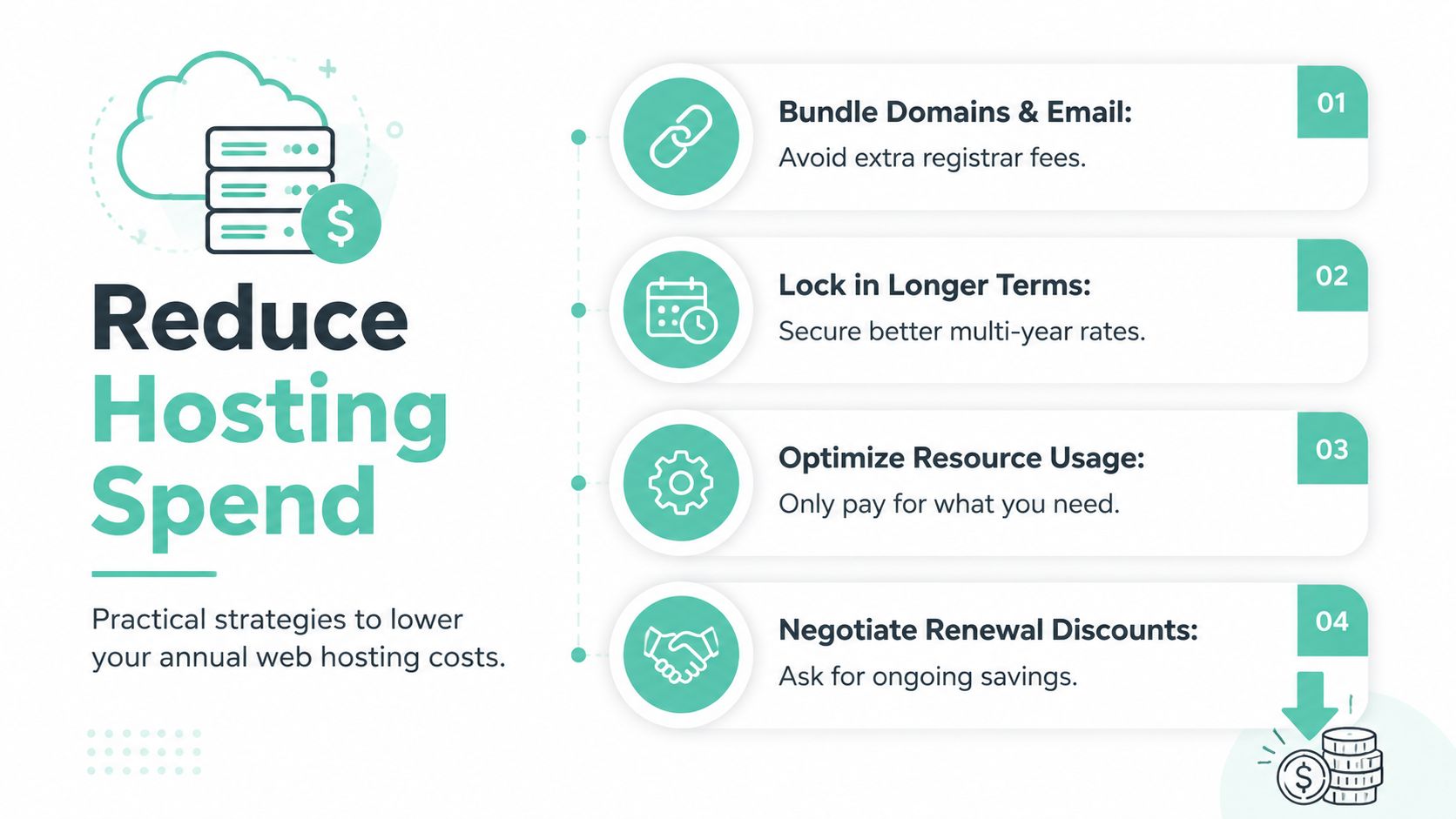
Practical strategies to lower your annual web hosting costs.
Bundle the parts you already need
If your host can provide the domain, email, SSL, and hosting in one billing relationship, you can cut down on separate renewals and reduce admin overhead. That doesn't always make it cheaper on paper, but it often makes the all-in yearly bill easier to track. It also helps when you're comparing invoices, because the full cost sits in one place instead of three.
Pay for the capacity you'll actually use
A lot of businesses overspend by buying more server than their site needs. If the site is mostly informational, shared hosting is often enough. If it grows, upgrade gradually rather than jumping straight to a larger tier because a sales page made it sound urgent.
Use add-ons with intent
Backups, security suites, and premium support are worth paying for when the site would hurt the business if it failed. If the site is low-risk, you can sometimes handle some tasks in-house and keep the bill tighter. The trick is not to strip out protection that you'll regret the first time a plugin update goes sideways.
Negotiate and review renewals early
Renewal conversations matter more than sign-up conversations. Ask what happens at the end of the promo period, whether a better rate exists for a longer commitment, and whether loyalty credits can be applied before the invoice is charged. Many hosts won't volunteer that information unless you ask.
The reason this matters in Australia is that website risk isn't just technical anymore. The ACSC reported 87,400 cybercrime reports in FY2023–24, up 7% year on year, which makes managed protections, backups, and local support more economically relevant than bare-bones hosting ACSC cybercrime reporting context.
UpTime Web Hosting's affordable web hosting with no contracts page is a useful example of how an Australian buyer can keep renewal flexibility while still paying for the parts that matter.
Pay for resilience where failure would cost money.
Save on the parts that don't affect revenue, recovery, or customer trust.
The best savings strategy is not cutting everything. It's cutting the things that don't change the site's reliability.
Conclusion and Host Selection Checklist
Key factors to consider before choosing your web host.
The true annual web hosting cost is the number after renewal, tax, and add-ons are included. If you compare only the headline launch rate, you'll under-budget. If you compare the full year, you can choose a plan that fits the business instead of surprising it.
Use this checklist before you sign:
- Evaluate base plan fees, because the first invoice doesn't tell the whole story.
- Assess resource needs, so you don't overbuy server capacity.
- Check renewal rates, because that's where the annual bill usually shows up.
- Understand GST impact, so your budget matches the Australian invoice.
- Account for add-ons, especially backups, security, email, and support.
The simplest test is this, can the site stay secure, available, and supported for a full year without straining cash flow? If the answer is yes, the plan is probably in the right zone. If the answer is no, the quote needs another look.
If you want an Australian host that keeps pricing visible from the start, UpTime Web Hosting offers local hosting, domains, email, SSL, backups, and managed VPS with GST included and no contracts. Visit UpTime Web Hosting to compare plans and work out what your own annual bill would look like before the renewal invoice arrives.