In short
Domains with dashes are valid, but most businesses should use an unhyphenated name as their primary address when a clear alternative is available. A hyphen can rescue readability or secure a useful phrase, yet it also adds a character people must hear, remember, type and include in every email address.
Key takeaways
- Under auDA's rules current in September 2026, a .au name may contain hyphens, but it cannot begin or end with one or place hyphens in both the third and fourth positions. (auda.org.au)
- Google's 2025 SEO Starter Guide says keywords in a domain name or URL path alone have hardly any ranking effect, so a hyphen should not be treated as an SEO shortcut. (developers.google.com)
- auDA recommends saying a proposed domain to five people and asking them to write it down, because hyphens can be forgotten or misinterpreted when heard. (auda.org.au)
- An active no-dash version in the same market is a strong reason to choose a different name rather than accepting ongoing confusion.
- If both versions are registered, one should be the primary address and the other should use a permanent 301 redirect. (developers.google.com)
Table of contents
- Should a business register a domain name with a dash?
- Are dashes allowed in domain names?
- Do hyphens hurt SEO?
- What goes wrong when people say or email the domain?
- When can a dash make the name better?
- What if the no-dash version is taken or expensive?
- Should both versions be registered?
- How can you test a hyphenated domain before buying it?
- Frequently asked questions
- What should you do next?
The practical question is not simply whether a dash in a domain name is valid. It is whether a website with a hyphen will remain clear when it is spoken, typed into a phone, printed on a vehicle and used after the @ in every business email address.
Should a business register a domain name with a dash?
Most businesses should choose an unhyphenated primary domain when a clear, affordable and legally safe option is available. A hyphenated domain is worth considering only when the dash makes the name easier to read and the added typing and speaking friction is acceptably low.
A useful decision is not simply whether hyphens are good or bad. The better question is which failure is more likely: people misreading the joined words, or people forgetting the dash.
Check three forms of ambiguity:
- Visual ambiguity: Do the joined words create an unwanted word or a misleading phrase?
- Spoken ambiguity: Can somebody hear the domain once and write it correctly without asking where the dash goes?
- Destination ambiguity: Does the no-dash version belong to an active organisation that customers could mistake for the intended business?
Availability by itself does not make a name suitable. A free domain that needs to be corrected in every phone call, advertisement and email signature can be more expensive to live with than a different name that works naturally.
A hyphenated domain should win on clarity without losing on recall.

Performance you can feel, backed by clients who depend on it. Read how our support and uptime create long‑term customer success.Power Your Business with Better Hosting
Are dashes allowed in domain names?
Yes, dashes are allowed inside many domain names. The dash used in a domain is the ASCII hyphen-minus -, and it belongs between letters or numbers rather than at the edge of the name.
The IETF's RFC 1035 from 1987 describes the preferred host-label syntax as letters, digits and internal hyphens, with a maximum of 63 characters per label. (rfc-editor.org)
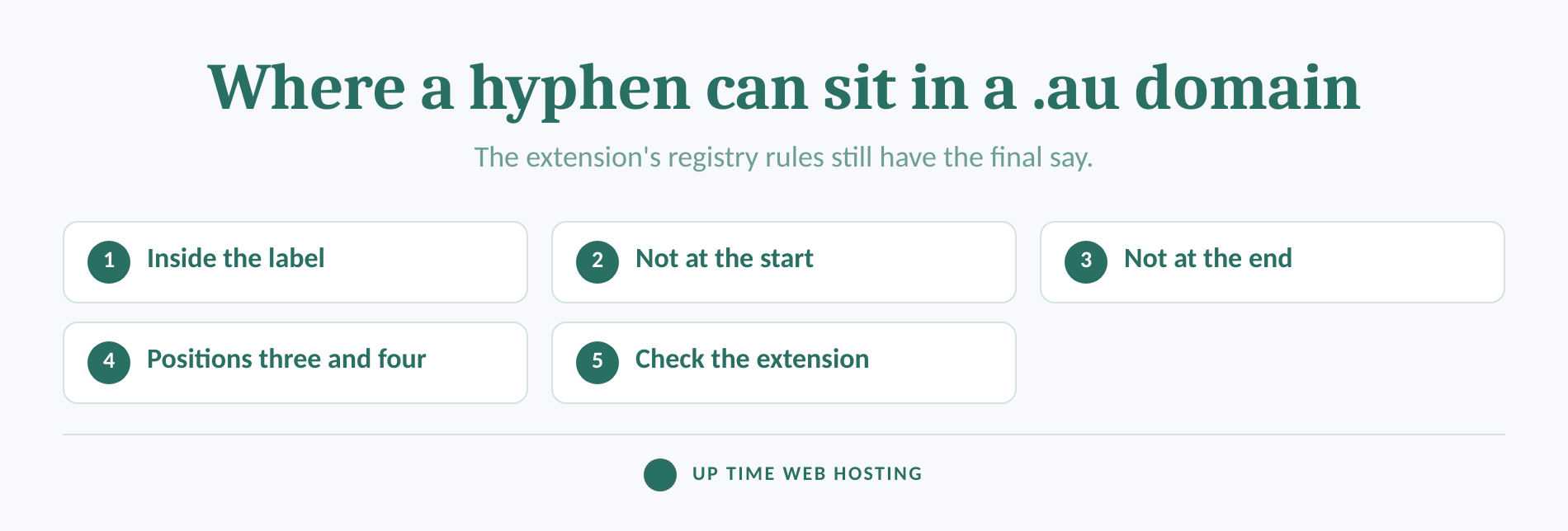
For Australian addresses, the current auDA licensing rules are more specific. As of September 2026, a .au name must be at least two characters, may contain letters, numbers and hyphens, cannot start or end with a hyphen, and cannot have hyphens in both the third and fourth positions. (auda.org.au)
A hyphen separates characters inside one label, while a full stop separates labels. In the hypothetical address bright-leaf.example, the hyphen sits inside the bright-leaf label. Names such as -brightleaf.example and brightleaf-.example put the hyphen at an edge and should not be treated as valid host names.
The registry for the chosen extension has the final say. A name that looks technically reasonable can still fail because of extension-specific syntax, eligibility or reserved-name rules.
A valid hyphen must sit in an allowed position and satisfy the rules of the chosen extension.
Do hyphens hurt SEO?
A hyphen in a domain name does not create an automatic search ranking penalty. It also does not provide a meaningful ranking advantage simply because it separates keywords.
Google's 2025 SEO Starter Guide says keywords in domain names and URL paths alone have hardly any effect on rankings beyond their appearance in breadcrumbs. Google's advice is to choose a site name that works for the business and its users. (developers.google.com)
A registered domain and a page path are different decisions. Google's 2025 URL structure guidance recommends hyphens instead of underscores when separating words in paths, such as /small-business-hosting/, because the separated concepts are easier to identify. That guidance is not a promise that an exact-match hyphenated domain will outrank a clearer brand. (developers.google.com)
The domain also does not determine whether the site should use subdirectories or separate sections on subdomains. Those architecture decisions have different operational consequences, covered in the guide to subdomains for SEO.
Choose the domain for people first, because the hyphen itself is neither an SEO penalty nor a ranking strategy.
Host your website with our 5-star rated, cPanel website hosting plans.
Super fast servers, with security included and hosted in your choice of Australian Data Center.
View cPanel Plans
What goes wrong when people say or email the domain?
A hyphen adds a spoken instruction to an address that would otherwise be a continuous string. Every speaker must mention the dash, and every listener must remember its exact position.
auDA's domain-name guidance recommends short, simple names and suggests aiming for 15 characters or fewer as a guide. It advises avoiding hyphens and numbers because they can be difficult to remember or misinterpreted verbally, then recommends a radio test with five listeners. (auda.org.au)
Run the proposed name through four real channels:
- Seen: Display the domain in lowercase with no logo or colour treatment. Check whether the word break is clear.
- Heard: Say the domain once without spelling it. Ask the listener to write what was heard.
- Emailed: Dictate an address such as
sales@bright-leaf.exampleand check whether the hyphen survives. - Recalled: Wait several minutes, then ask the listener to type the domain without seeing it again.
Email deserves its own test. sales@bright-leaf.example and sales@brightleaf.example address different domains. If a customer omits the dash, the message is not addressed to the intended domain unless the business also controls and configures the no-dash version.
This risk grows when staff regularly give the address over the phone, customers type it from printed material, or referrals arrive through conversation rather than clickable links.
A domain that works on screen can still fail when it has to be heard, remembered and used in an email address.
When can a dash make the name better?
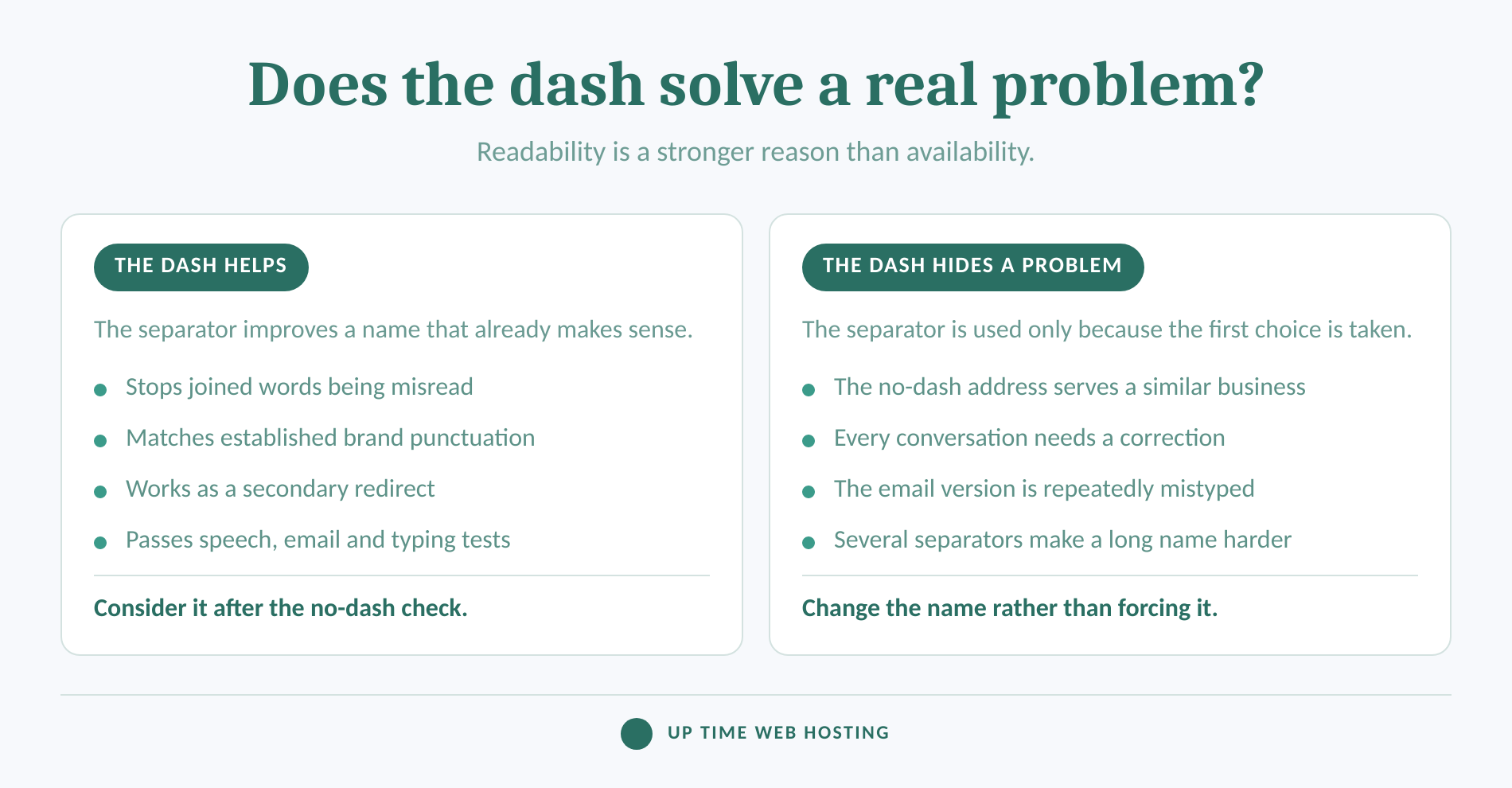
A dash can help when two joined words are genuinely hard to parse or produce an unintended reading. The dash should solve a clear communication problem rather than merely make an unavailable phrase registrable.
A hyphen has a defensible role in three situations:
- It removes a real misreading. The joined form creates an unwanted word boundary, while the hyphen makes the intended terms obvious.
- It matches an established identity. The organisation already uses the punctuation consistently in its public name, subject to a trade mark and registration check.
- It is a secondary address. The hyphenated version protects a common variation or sends visitors to one established primary domain.
Availability alone is the weakest reason. A long descriptive phrase with several separators may look understandable on a screen, but each dash becomes another instruction in speech and another possible omission in email.
One dash that removes ambiguity can help; punctuation added only to obtain a taken phrase usually cannot.
What if the no-dash version is taken or expensive?
A taken or expensive no-dash domain is a signal to investigate the name, not an instruction to add punctuation immediately. The owner and use of the no-dash version matter more than the fact that the hyphenated version is available.
Ask these questions before registering:
- Does the no-dash domain lead to an active business in the same or a related market?
- Is the no-dash name parked, listed for sale or unused?
- Could one word be shortened, replaced or reordered without weakening the brand?
- Is another suitable extension available, and does the business meet its registration rules?
If the no-dash name is listed at a premium, why are some domains so expensive explains what can drive the asking price. Compare that price with the long-term cost of explaining the dash, losing direct visits or changing the brand later.
A name change may be the cleaner option when the no-dash owner could attract the same customers. The guide to choosing a domain name can help test shorter wording instead of forcing punctuation into the first choice.
Treat an unavailable no-dash version as information about the market and the brand, not just a registration obstacle.
Register your new domain name at competitive market prices including free domain add-ons like privacy, DNS Hosting, Custom Nameservers and Forwarding.
Always the best price and no nasty renewal price hikes.
Register A Domain Name
Should both versions be registered?
Registering both versions can be sensible when both are available and the name is important to the business. One version should still be chosen as the primary domain and used consistently across the website, email, advertising and documents.
Google's 2025 crawling and indexing FAQ recommends a permanent 301 redirect when the same site could be reached through an alternative domain. The redirect sends visitors and search engines to one preferred location rather than leaving two independent copies of the site. (developers.google.com)
The defensive version should not become a second public identity without an operational reason. Alternating between two website addresses or two email domains asks customers to remember which version applies in each situation.
Defensive registration also has legal limits. IP Australia's name and trade mark guidance says registering a domain name does not create ownership or legal rights over the words in that name. A trade mark search remains a separate step. (ipfirstresponse.ipaustralia.gov.au)
Registering both versions reduces one predictable source of confusion, but it does not replace a clear primary address or a trade mark check.
How can you test a hyphenated domain before buying it?
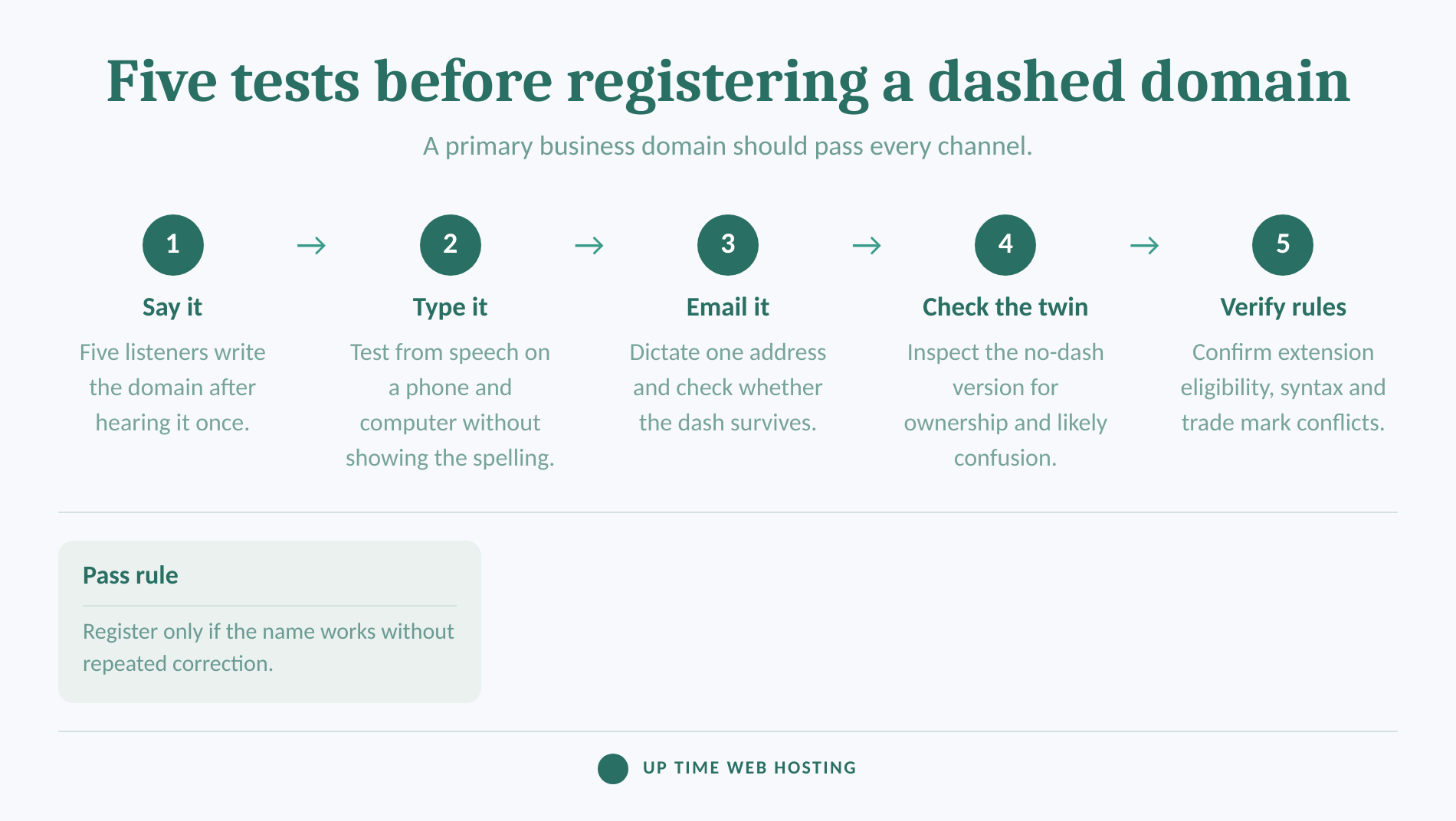
A useful test checks speech, typing, email, the no-dash version and registration rules before money is spent. The name should pass all five because a weakness in one channel can follow the business into every advertisement and customer conversation.
Use this process:
- Say it. Tell five people the domain once and ask each person to write it down without seeing the spelling.
- Type it. Ask somebody to enter the spoken domain on both a phone and a computer.
- Email it. Dictate a complete business email address and check whether the dash is included in the correct position.
- Check the twin. Inspect the no-dash version and decide whether its ownership or content could cause confusion.
- Verify the rules. Check the extension's syntax and eligibility, then search for conflicting business names and trade marks.
Set the pass rule before becoming attached to the name. If several people omit the dash, staff explain it differently, or the no-dash address belongs to a similar organisation, reject the name and test another option.
Australian businesses should also confirm the correct registrant type, connection to Australia and extension-specific evidence. The guide to domain registration requirements covers the information to prepare before submitting a registration.
A domain is ready to register only after it works in speech, typing, email, ownership checks and registry rules.
Experience Microsoft 365 Business Standard for free for 30 days.
Up to 25 users with full access to email, OneDrive and Teams. Includes full versions of desktop apps of Outlook, Word, Excel, PowerPoint and more.
Try Microsoft 365
What else do businesses ask about domains with dashes?
The short answers below separate what is technically valid from what is usually a sound business choice. Each answer assumes the domain is being considered as the main public website and email address.
Are dashes allowed in domain names?
Yes. A hyphen can appear inside a domain label, subject to the rules of the chosen extension. For .au names, auDA's rules current in September 2026 allow letters, numbers and hyphens, but the name cannot start or end with a hyphen or place hyphens in both positions three and four. (auda.org.au)
Are domain names with hyphens bad?
Hyphenated domain names are not technically bad, and a dash does not make a site unsafe or unindexable. The business risk is human: people may forget the dash, mistype an email address or visit the no-dash version. A name that passes spoken, typing and ownership checks can still be suitable. (auda.org.au)
Do hyphens affect SEO?
A hyphen does not create an automatic Google ranking penalty, but it is not a useful ranking shortcut either. Google's 2025 SEO Starter Guide says keywords in domain names and URL paths alone have hardly any ranking effect. Choose the domain for clarity and brand recall, then earn visibility through the site itself. (developers.google.com)
Should both hyphenated and non-hyphenated domains be registered?
Register both when the name is important, both versions are available and the extra registration cost is justified by reduced confusion. Pick one primary domain, use it everywhere, and send the defensive version to it with a permanent 301 redirect. Registration does not create trade mark rights over the words. (developers.google.com)
A hyphen is technically ordinary but operationally significant.
What should you do next?
Choose the unhyphenated version when it is clear and realistically available. Choose the hyphenated version only if it improves readability, survives the five tests and does not send customers towards the no-dash domain.
After the name passes those checks, search available domain names and register the preferred address together with any defensive version that has a clear purpose.
Choose the domain people can repeat correctly after hearing it once.