
A Melbourne retailer launches a Father's Day promotion, watches orders climb, then sees the checkout slow to a crawl. The site sits on shared web hosting, so the owner has two urgent choices: pay for a larger VPS or move the store to a cloud platform in an Australian region. The decision isn't about buying more CPU. It's about customer latency, billing control, security responsibilities, data location, recovery planning and how much infrastructure the team can operate without help.
For Australian small and medium businesses, web hosting vs cloud hosting has become a practical commercial decision. Australia's cloud hosting and data processing services industry was worth $3.2 billion in 2024, grew 9.1% in that year, and is projected by IBISWorld to reach $3.5 billion in 2025 and $4.1 billion by 2026. The industry is also projected to grow at an annualised 7.6% through 2026-27, with 2,210 businesses operating in 2026. IBISWorld's Australian market benchmark shows that cloud infrastructure is no longer a niche option.
That growth doesn't make cloud hosting the automatic winner. A stable WordPress site may be better served by local managed hosting, while a campaign-driven ecommerce store may need elastic capacity and stronger failover. The right answer starts with the workload, then tests the provider's Australian location, operating model and exit path.
Table of Contents
- Why Australian SMBs Are Rethinking Their Hosting in 2026
- What Web Hosting and Cloud Hosting Actually Mean
- Head-to-Head Comparison Across the Criteria That Matter
- The Case for Cloud Hosting in Australia
- The Case for Traditional Web Hosting in Australia
- Real-World Use Cases From the Australian Market
- Which Option Fits Your Business
- Compliance, Data Residency and a Safe Migration Path

Performance you can feel, backed by clients who depend on it. Read how our support and uptime create long‑term customer success.Power Your Business with Better Hosting
Why Australian SMBs Are Rethinking Their Hosting in 2026
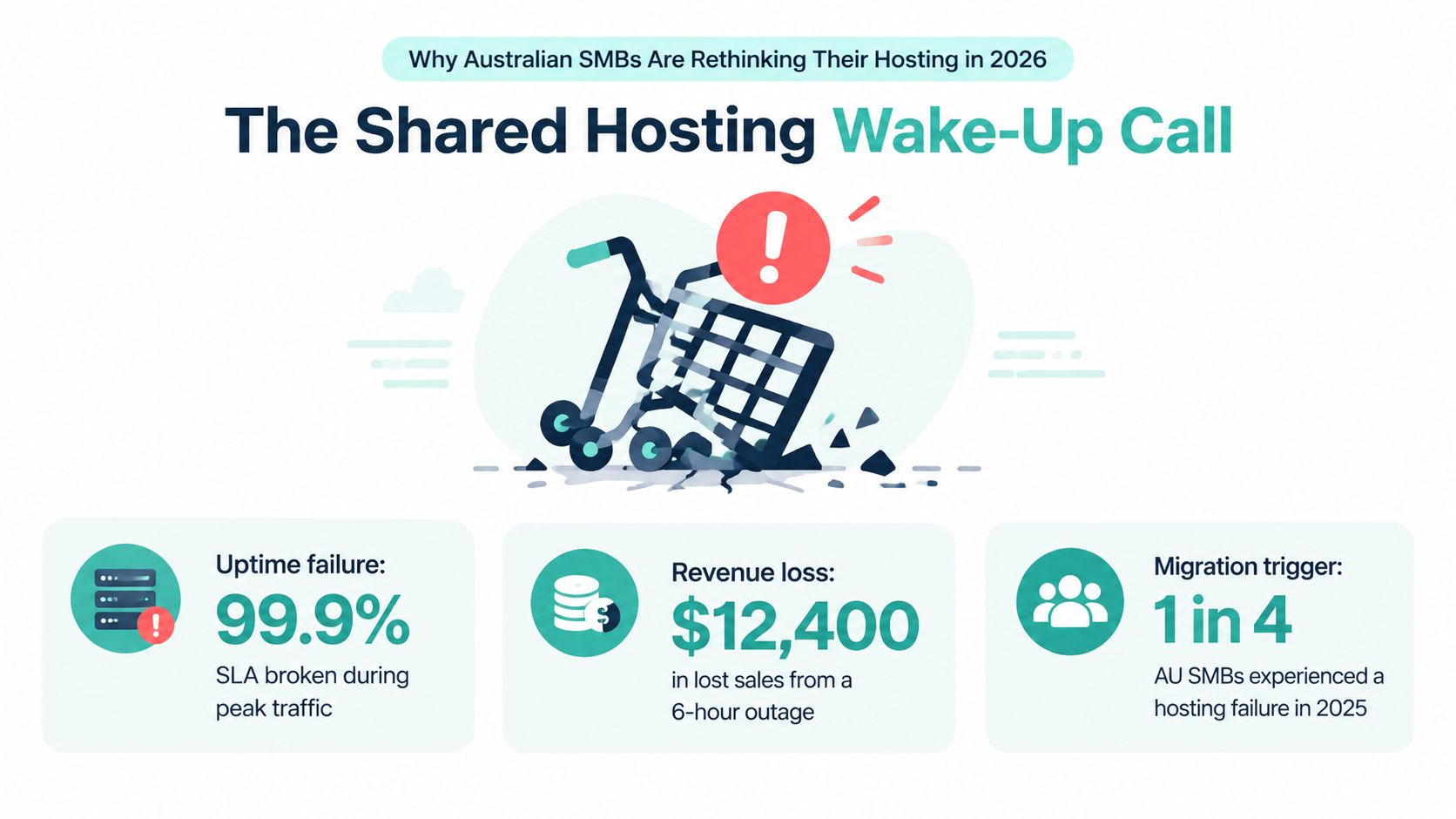
A Melbourne retailer can lose sales before anyone opens a support ticket. During a promotion, the practical questions are whether the platform absorbs changing demand, whether customers reach an Australian origin quickly, and whether the team can restore service without rebuilding a server by hand.
Australian businesses have increased their use of paid computing services. ABS-based reporting recorded adoption at 19.4% in 2013-14, 31% in 2015-16 and 55.4% in 2019-20, taking usage from under one-fifth of businesses to more than half during that period. ABS cloud-use reporting covered by iTnews also found a business-size gap in 2015-16, with paid cloud services used by 25% of businesses with 0-4 employees and 60% of businesses with 200 or more employees.
That change matters because smaller firms now run online shops, booking systems, customer portals, accounting integrations and campaign landing pages. Demand can shift quickly. A fixed hosting plan may still suit the site, provided the owner knows its resource ceiling, Australian latency and recovery procedure before a promotion tests them.
Practical rule: Choose the platform you can operate during a bad day, not the one that looks impressive in a sales demo.
Government policy gives businesses another reason to review their operating model. The Australian Government's whole-of-government cloud computing policy requirements require cloud adoption for new digital and ICT initiatives and upgrades unless an alternative is justified. The policy also calls for exit strategies, migration plans, continuous monitoring, and performance or reliability measures. Suppliers and contractors serving government must account for those requirements, while private businesses can apply the same discipline to reduce provider lock-in and clarify who owns migration, backups and recovery.
Australian customers notice slow pages and failed checkouts quickly. Our guide to Australian cloud computing trends places the commercial issue in context: infrastructure affects customer experience, not only the developer's toolkit. For an SMB, the decision should balance Australian delivery, predictable support, compliance obligations and an exit path that does not depend on one person remembering the old server configuration.
What Web Hosting and Cloud Hosting Actually Mean
Start with the physical idea. Traditional web hosting places website files, databases and applications on a server managed by a hosting provider. You rent a defined service, usually through a control panel, and the provider handles much of the underlying hardware and platform maintenance.
Traditional hosting comes in several forms:
- Shared hosting: Multiple websites use the same server environment. It suits smaller sites that need low administration overhead.
- VPS hosting: A virtual private server gives a business more isolated resources and configuration control than shared hosting.
- Dedicated hosting: One customer uses a physical server, which provides greater control but also demands more technical management.
- Managed WordPress hosting: The provider focuses the platform around WordPress, with maintenance, security and backups commonly included according to the plan.
A useful explanation of these categories appears in this guide to common web hosting types. The important distinction is that these services generally feel like renting a defined environment. You select a tier, receive an allocation and upgrade when the workload outgrows it.
Cloud hosting takes a different approach. Infrastructure as a Service, or IaaS, gives you virtual machines, storage and networking that you configure on platforms such as AWS, Microsoft Azure or Google Cloud. Platform as a Service, or PaaS, moves further up the stack, offering managed application runtimes, deployment tools and services such as databases.
Some Australian organisations also consider sovereign or locally controlled cloud environments, especially when contracts or data-handling requirements make offshore storage unacceptable. Cloud doesn't automatically mean Australian data residency, so the region, backup destination, support access and service terms all matter.
| Model Type | What You Get | How You Pay | Typical AU Providers |
|---|---|---|---|
| Shared hosting | Shared server resources and a control panel | Flat plan fee | Australian web hosts |
| VPS hosting | Isolated virtual server resources and greater control | Flat or tiered monthly fee | Australian managed hosting providers |
| Dedicated hosting | A physical server allocated to one customer | Flat or contracted fee | Australian datacentre providers |
| IaaS cloud | Virtual machines, storage and networking | Usage-based compute, storage and transfer | AWS, Azure and Google Cloud |
| PaaS cloud | Managed application platform and deployment services | Usage-based platform and service charges | Managed cloud platforms |
The pricing mental shift is substantial. Traditional hosting normally gives you a predictable monthly invoice for a plan tier. Cloud hosting can charge separately for compute time, storage, managed databases, network transfer and other services. That flexibility is powerful, but it means the business must monitor consumption rather than assuming the monthly bill will remain fixed.
Host your website with our 5-star rated, cPanel website hosting plans.
Super fast servers, with security included and hosted in your choice of Australian Data Center.
View cPanel Plans
Head-to-Head Comparison Across the Criteria That Matter
The useful comparison isn't “old technology versus new technology”. It's fixed simplicity versus operational flexibility. Australian SMBs should assess performance, scaling, reliability, price control and administration together.
| Criterion | Traditional Web Hosting | Cloud Hosting | Winner for AU SMBs |
|---|---|---|---|
| Performance | Strong when the site is well-optimised and hosted near customers | Strong potential, but depends on region, architecture and configuration | Local platform for simple sites, cloud for engineered workloads |
| Scalability | Usually requires a plan change or server migration | Can add resources or instances through automation | Cloud for unpredictable demand |
| Reliability | May depend heavily on one server or platform cluster | Can distribute workloads across infrastructure, if configured correctly | Cloud for teams able to design redundancy |
| Pricing predictability | Usually easier to forecast | Usage, storage and transfer charges can vary | Traditional hosting for stable budgets |
| Administration | Control panels and managed support reduce technical work | APIs, infrastructure automation and deployment pipelines provide deeper control | Traditional for non-technical owners, cloud for technical teams |
Latency deserves special attention in Australia because domestic geography and international network paths can materially affect the first response from a server. In Sydney-based tests using median Time to First Byte, one Australian comparison recorded 85 ms for Kinsta, 95 ms for Cloudways, 105 ms for SiteGround, 118 ms for VentraIP, 134 ms for Digital Pacific, 148 ms for Bluehost AU and 180 ms for Hostinger. The Sydney hosting benchmark indicates that locality and platform architecture can produce roughly a twofold difference in first-byte latency for the same Australian audience.
That result carries a clear warning: cloud hosting isn't automatically faster. A poorly placed cloud origin can perform worse than a well-run Australian web host. Sydney or Melbourne placement, network quality, caching and application design matter more than the word “cloud” in the plan name.
For AU-facing sites, select the region first, then compare the hosting model.
Traditional hosting wins on budget discipline and support simplicity. A business owner can often manage websites, email and backups through a familiar panel, while cloud environments reward teams that can use APIs, infrastructure as code and automated deployments. Cloud also gives you more options for horizontal scaling and redundancy, but those benefits don't arrive by default. Someone must design, test and monitor them.
For a practical selection checklist covering location, support, security, backups and resource limits, use these factors for choosing web hosting services. The winning model is the one that matches the team's capability as closely as it matches the website's traffic pattern.
The Case for Cloud Hosting in Australia
An ecommerce campaign can produce a sharp demand spike, while a software company may add customers across several markets. A single website directory cannot always support the web tier, database, queue, object storage and deployment process those workloads require. Cloud hosting earns its place when the workload changes faster than a conventional plan can respond.
Australian businesses have moved strongly in this direction. Paid computing service usage was 55.4% of Australian businesses in 2019-20, compared with 19.4% in 2013-14, as noted in the earlier ABS-based analysis. That shift does not mean every SMB needs IaaS. It does show why cloud skills and cloud procurement now form part of ordinary business operations.
Cloud's practical advantages include:
- Elastic capacity: Auto-scaling can add application resources during demand spikes, provided the application and database support it.
- Managed services: Small teams can use managed databases, monitoring, backups and deployment tools instead of maintaining every component.
- Regional options: Australian cloud regions can reduce network distance for local users, while additional regions can support wider delivery and recovery plans.
- Automation: APIs and infrastructure-as-code tools create repeatable environments and reduce manual server changes.
Government cloud guidance also points to the work required behind the platform. It calls for monitoring, reliability measures, migration planning and an exit strategy. Cloud is a governed service, not a place to upload a website. Assign an owner, measure performance and document how the business would move its data and applications elsewhere.
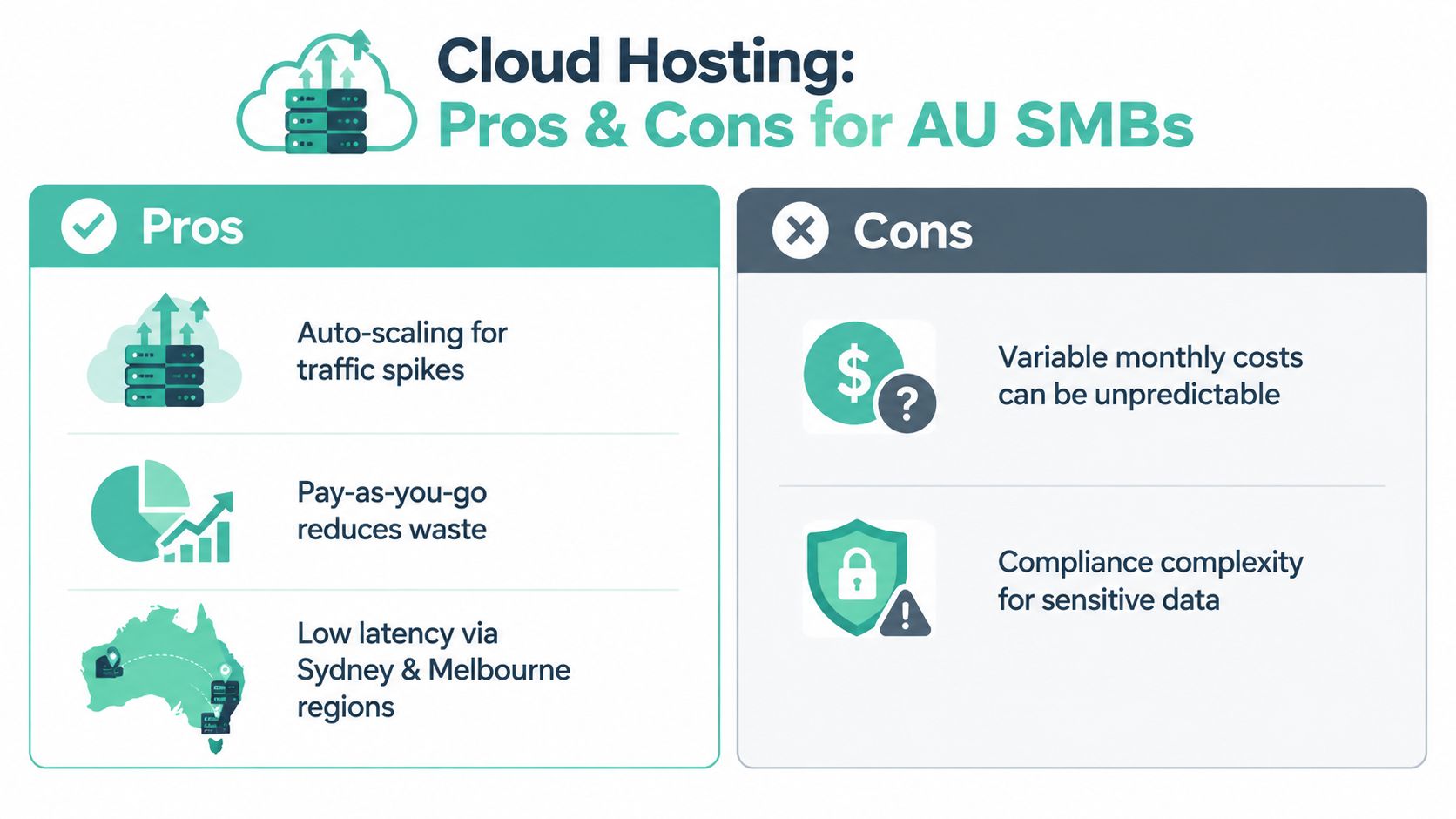
The trade-offs are real. Usage-based billing can rise through compute, storage and data transfer. The Australian cloud comparison published by ZDNET gives examples including CloudCentral's Sydney and Canberra locations, no minimum term, and transfer charges of AU$0.25 inbound per GB and AU$0.50 outbound per GB. CSC Australia listed Melbourne and Sydney locations with contract terms from three months to twelve months, alongside separately priced compute and storage. These examples show how cloud pricing works, not universal rates.
Cloud also demands operational discipline. Someone must monitor consumption, restrict permissions, test backups and review public exposure. Choose cloud for growth, variable demand or integration complexity. If the team cannot operate the platform confidently, use managed services and set billing controls before migration. This overview of cloud hosting benefits provides a useful starting point, but the final plan must also specify how the business can leave the platform without losing control of its data.
The Case for Traditional Web Hosting in Australia
Traditional hosting remains the sensible choice for many Australian SMBs. A local tradesperson's brochure site, a suburban professional practice, a WordPress blog or a small catalogue store often needs reliable delivery, backups, security updates and responsive support. It doesn't need a distributed application architecture merely because one exists.
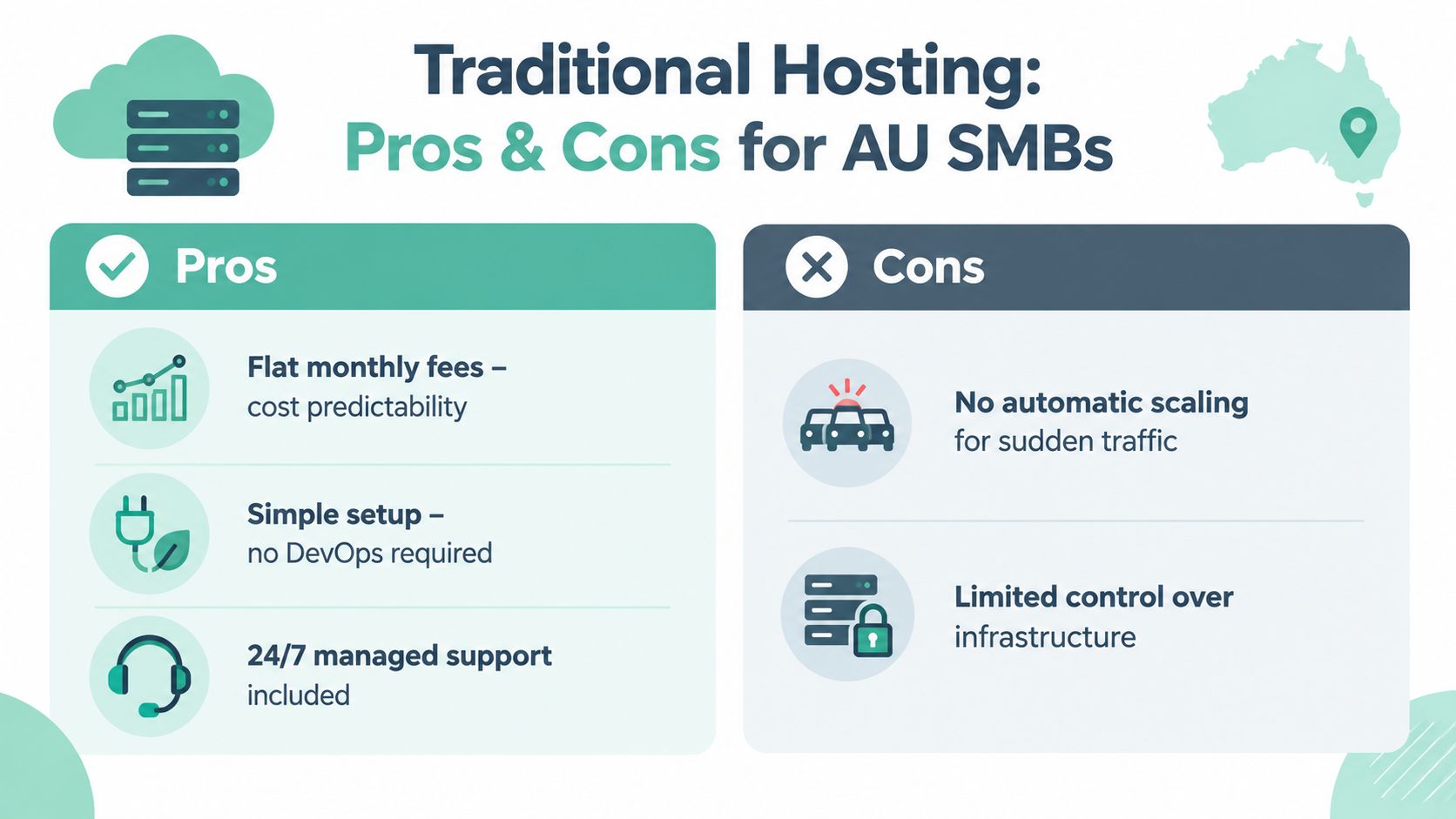
The financial model is easier to manage. A flat monthly plan gives the owner a stable operating cost, while shared, managed WordPress, VPS and dedicated options provide a clear progression as requirements change. A control panel such as cPanel or Plesk also keeps routine work accessible, including creating mailboxes, managing websites and reviewing backups, without requiring a DevOps workflow.
Local infrastructure can simplify data handling, but don't treat “Australian hosted” as a complete compliance answer. The business still needs to understand who can access the data, where backups and logs are stored, how incidents are handled and which Australian Privacy Act obligations apply. Local-only hosting can reduce the number of jurisdictions involved, which is valuable for sensitive workloads, but it doesn't remove the need for access controls and documented procedures.
Traditional platforms also have hard limits. A shared plan may slow under a sudden demand spike, a VPS may need a manual resource increase and a single-server design can create a larger failure domain. Disaster recovery may also take more planning than with a deliberately distributed cloud architecture.
Choose traditional hosting when stability and simplicity matter more than elastic capacity.
For a site with predictable demand, local support and a single invoice may be more valuable than orchestration. The owner can spend time improving content, sales and customer service instead of learning cloud billing, identity policies and deployment pipelines. Upgrade when the workload proves it needs more, not because cloud hosting sounds more modern.
Register your new domain name at competitive market prices including free domain add-ons like privacy, DNS Hosting, Custom Nameservers and Forwarding.
Always the best price and no nasty renewal price hikes.
Register A Domain Name
Real-World Use Cases From the Australian Market
The Australian Maritime Safety Authority provides a documented example of cloud solving a distribution problem. In 2009, AMSA needed to extend an Excel-based ship-compliance application across 14 geographically separated ports. The cloud solution was described as significantly cheaper and faster to deploy than the alternative in the Australian Government's National Cloud Computing Strategy material. The lesson is practical: cloud is valuable when people in different locations need coordinated access to an application without waiting for separate local deployments.
A modern Melbourne software startup presents a different pattern. If its customer base grows unpredictably, its application depends on managed databases and automated deployments, and its developers need separate test environments, managed cloud can remove infrastructure bottlenecks. The team still has to control permissions, monitor consumption and choose an Australian region where local data handling matters.
A Brisbane retailer facing a major promotional event also benefits from cloud architecture when the site can scale across application instances and protect the database from overload. Auto-scaling alone won't rescue a poorly designed checkout, but it gives the retailer more room to handle demand than a fixed shared plan.
Traditional hosting fits different businesses:
- A Sydney accounting firm with a stable client portal may prefer managed VPS hosting, local support and a predictable invoice.
- A Perth tradie with a WordPress site and contact form probably doesn't need a multi-service cloud architecture.
- A regional council with an internal portal may choose dedicated Australian infrastructure where local control and straightforward administration carry more weight than elastic scaling.
The recurring pattern is clear. Cloud wins when traffic is unpredictable, access is distributed or the application depends on multiple integrated services. Traditional hosting wins when the workload is steady, the site is conventional and the owner values a managed environment over infrastructure orchestration.
Australian Government guidance makes the migration timing principle similarly practical. Its cloud migration guidance for public-facing websites says agencies should consider cloud hosting at natural ICT refresh points when the service is fit for purpose and offers value for money. SMBs can use the same rule. Don't migrate during the busiest sales week. Migrate when you're already replacing the site, redesigning the application or reaching the existing platform's operational limit.
Which Option Fits Your Business
Start with the business process, not the hosting label. Ask what happens when demand rises, who responds to an outage, what information the site stores and whether the team can review cloud bills and permissions every month.
A tradie, café or single-location retailer should generally stay with shared or managed WordPress hosting. Choose a local provider, confirm backups and support arrangements, and make sure the plan has a clear upgrade path. A growing ecommerce business may need a VPS first, especially if it wants more predictable resources without taking on a full cloud operating model.
A SaaS company, marketplace or integration-heavy retailer should consider managed cloud once its application needs automated deployments, separate services or elastic capacity. Regulated businesses and organisations serving multiple regions need a more deliberate IaaS design, with documented data locations, identity controls, monitoring and recovery tests.
| Business profile | Traffic pattern | Recommended hosting | When to upgrade |
|---|---|---|---|
| Tradie, café or local professional | Stable and modest | Shared or managed WordPress hosting | When resource limits or business-critical downtime become recurring concerns |
| Small online retailer | Stable with occasional campaigns | Managed VPS or higher-tier web hosting | Before promotions outgrow the server or checkout performance becomes unreliable |
| Growing ecommerce business | Seasonal or unpredictable | Managed cloud with scalable application services | When traffic, integrations or recovery requirements exceed the managed platform |
| SaaS startup | Variable and deployment-heavy | Managed PaaS or carefully managed IaaS | When service isolation, regional delivery or custom controls become necessary |
| Regulated or multi-region operator | Complex and risk-sensitive | IaaS with documented governance and Australian region choices | After formal architecture, compliance and exit reviews |
Technical maturity changes the recommendation. A business with no infrastructure specialist shouldn't select raw cloud VMs and assume the provider will design the platform. Managed cloud may be worth the premium when it buys deployment automation, monitoring, backups and human support that the internal team can't provide.
For website rebuilds, performance work or a broader digital review, Leaping Lemur Media services can provide useful implementation context before you choose infrastructure. The hosting decision should be made alongside the website's application requirements, not after development has locked the business into a difficult deployment model.
My default advice is conservative. Start with managed traditional hosting when the site is simple and stable. Move to managed cloud when growth or complexity creates a measurable operational need. Choose raw IaaS only when the team can own the architecture, security, monitoring and exit process.
Experience Microsoft 365 Business Standard for free for 30 days.
Up to 25 users with full access to email, OneDrive and Teams. Includes full versions of desktop apps of Outlook, Word, Excel, PowerPoint and more.
Try Microsoft 365
Compliance, Data Residency and a Safe Migration Path
Australian businesses must review the Notifiable Data Breaches scheme, contractual privacy duties and sector-specific obligations before moving customer or operational data. Financial services firms should assess APRA CPS 234. Government-adjacent suppliers may need to consider IRAP expectations and the Hosting Certification Framework. A Sydney region alone does not prove compliance.
Confirm where production data, backups, logs, support records and disaster-recovery copies are stored. Document identity ownership, retention rules, incident responsibilities and the export process. For businesses requiring local control, review Australian data sovereignty hosting. Containers, documented infrastructure as code and exportable backups also make an exit from a provider less painful. Test an export before migration, not after a lock-in problem appears.
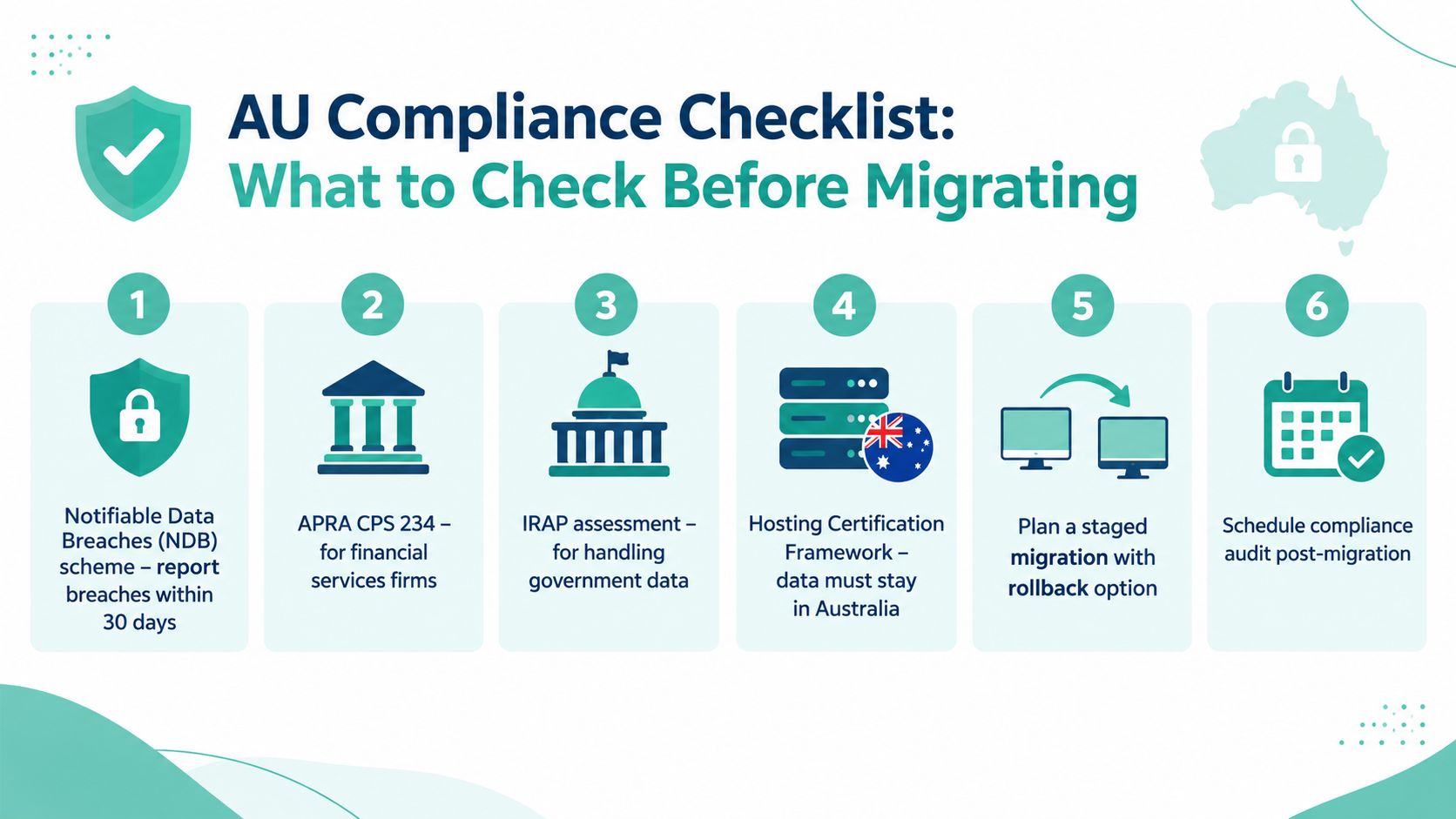
The Australian Cyber Security Centre's small-business cloud security guides cover practical risks including misconfiguration, identity control and data handling. Use them before migration, then keep the controls under review.
FAQ
Can cloud bills surprise us? Yes. Set budgets, alerts and clear ownership for compute, storage and transfer before launch.
When should we migrate? Use a planned refresh, redesign or capacity limit as the trigger. Stage the move and retain a tested rollback path.
Is managed cloud worth paying for? Yes, when provider support costs less than hiring, training and covering operational gaps internally.
For Australian businesses wanting local infrastructure without raw cloud administration, UpTime Web Hosting offers cPanel, WordPress, ASP.NET Windows hosting and managed VPS with Australian server locations, encrypted off-site nightly backups, malware scanning, DDoS-protected firewalls and 24×7 monitoring. Review the options at UpTime Web Hosting, then request advice based on site requirements, data location and expected growth.