
You've got an Australian online shop, a payment gateway, a WordPress or application stack, and a hosting account that keeps the business running. Then a provider, bank, or assessor asks a simple question: where does cardholder data travel, and who is responsible for protecting it?
That's where many small businesses discover that secure infrastructure and PCI compliance aren't the same thing. The host can provide hardened systems, monitoring, backups, firewalls and access controls, but the merchant still needs to choose a safe payment design, control staff access, manage applications and retain evidence that the controls work.
Table of Contents
- Why Secure Hosting Matters for Australian Businesses
- Understanding PCI DSS Scope and Responsibility
- Essential Technical and Organisational Controls
- Payment Integration Patterns and Your Risk
- Managing Hosting Providers and Contracts
- Practical Checklist for SMB Validation
- Common Misconceptions About Compliant Hosting

Performance you can feel, backed by clients who depend on it. Read how our support and uptime create long‑term customer success.Power Your Business with Better Hosting
Why Secure Hosting Matters for Australian Businesses
An Australian retailer may notice the problem first as an unusual administrator login, a payment plugin behaving strangely or customers reporting suspicious transactions. By the time the issue is visible, malicious code may already have reached the checkout or captured card details from the browser.
Australian card fraud reached A$495 million in 2021, a 5.7% increase from the prior year, while card-not-present fraud represented 92% of fraud committed within Australia, according to AusPayNet's Australian card-fraud analysis. For an online retailer, that exposure is directly relevant because card-not-present payments rely on websites, hosted checkout pages, plugins, APIs and administrative accounts.
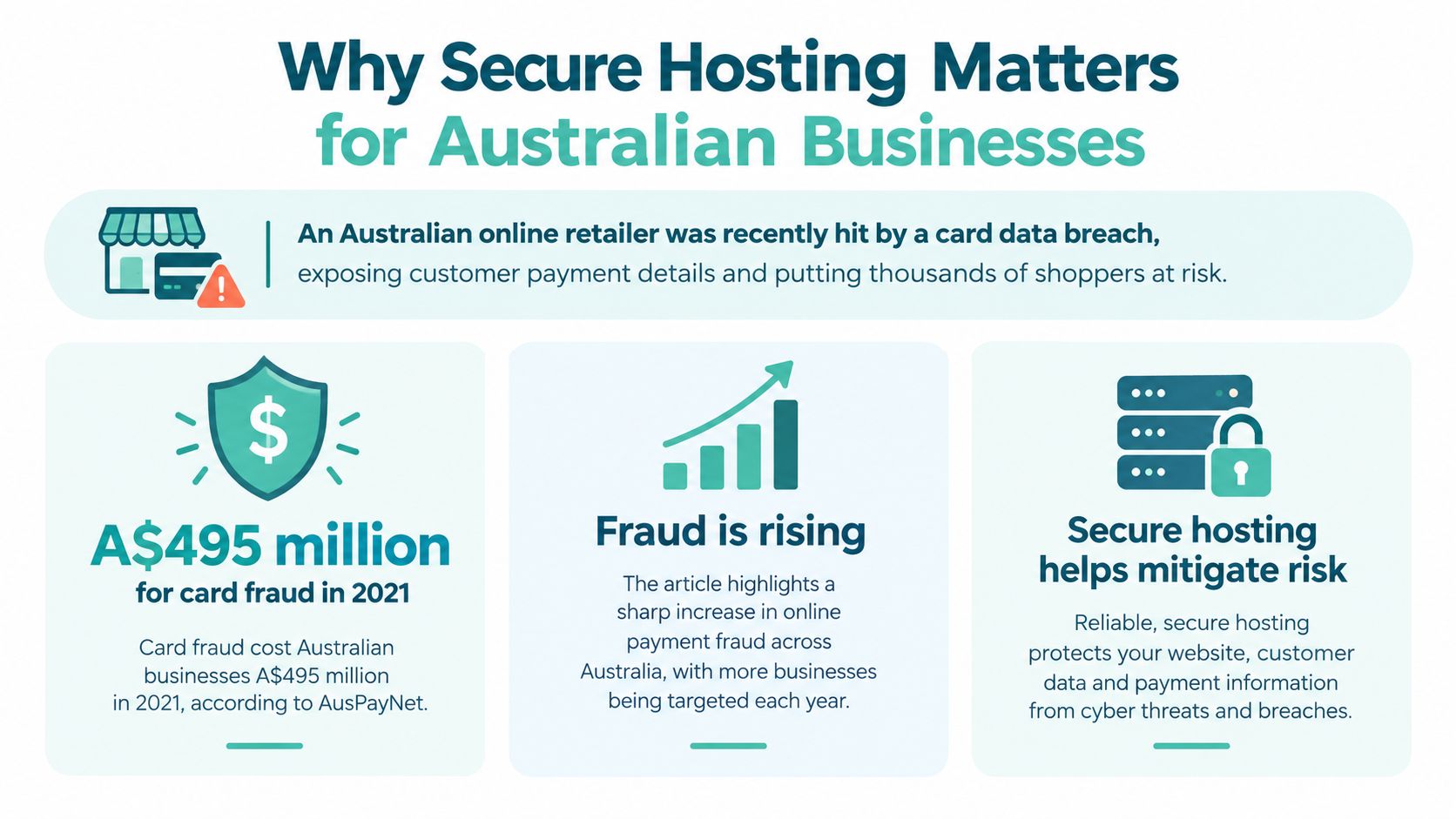
Secure hosting can't stop every fraudulent transaction. It can, however, reduce the opportunity for an attacker to compromise the web server, alter payment code, steal credentials or use an infected backup to restore the same weakness. Controls such as secure configuration, malware protection, access restrictions, vulnerability management, logging and carefully designed payment integrations reduce the amount of sensitive data exposed if something goes wrong.
Hosting is part of the risk decision
PCI DSS is a risk-management framework, not a badge that a business earns by selecting a particular data centre. It applies to the systems, people and processes involved in storing, processing or transmitting cardholder data, as well as systems that can affect that environment.
For a small business, the hosting decision influences:
- The attack surface: An outdated CMS, unnecessary service or weak control-panel credential gives attackers more ways into the environment.
- The amount of sensitive data handled: A hosted payment page can keep card details away from the merchant's web server, while a custom form may bring the entire application into scope.
- The evidence available: A provider's security features matter more when the business can obtain useful records about access, changes, vulnerabilities, backups and incidents.
- The recovery outcome: A clean, tested backup can restore a website. An unverified backup can also restore malicious code or an exposed payment component.
Practical rule: Choose the payment architecture first, then select hosting and controls around the resulting data flow.
Business owners also need to consider the wider consequences of a breach, including customer notification, investigation, downtime, legal advice and insurance questions. Independent business cyber risk advice can help clarify where cyber insurance may fit, but insurance doesn't replace secure design or PCI evidence.
For a website that needs a stronger infrastructure baseline, review secure web hosting for Australian websites. The useful question isn't whether a host uses impressive server specifications. It's whether the environment helps the merchant limit exposure and prove that agreed controls are operating.
Understanding PCI DSS Scope and Responsibility
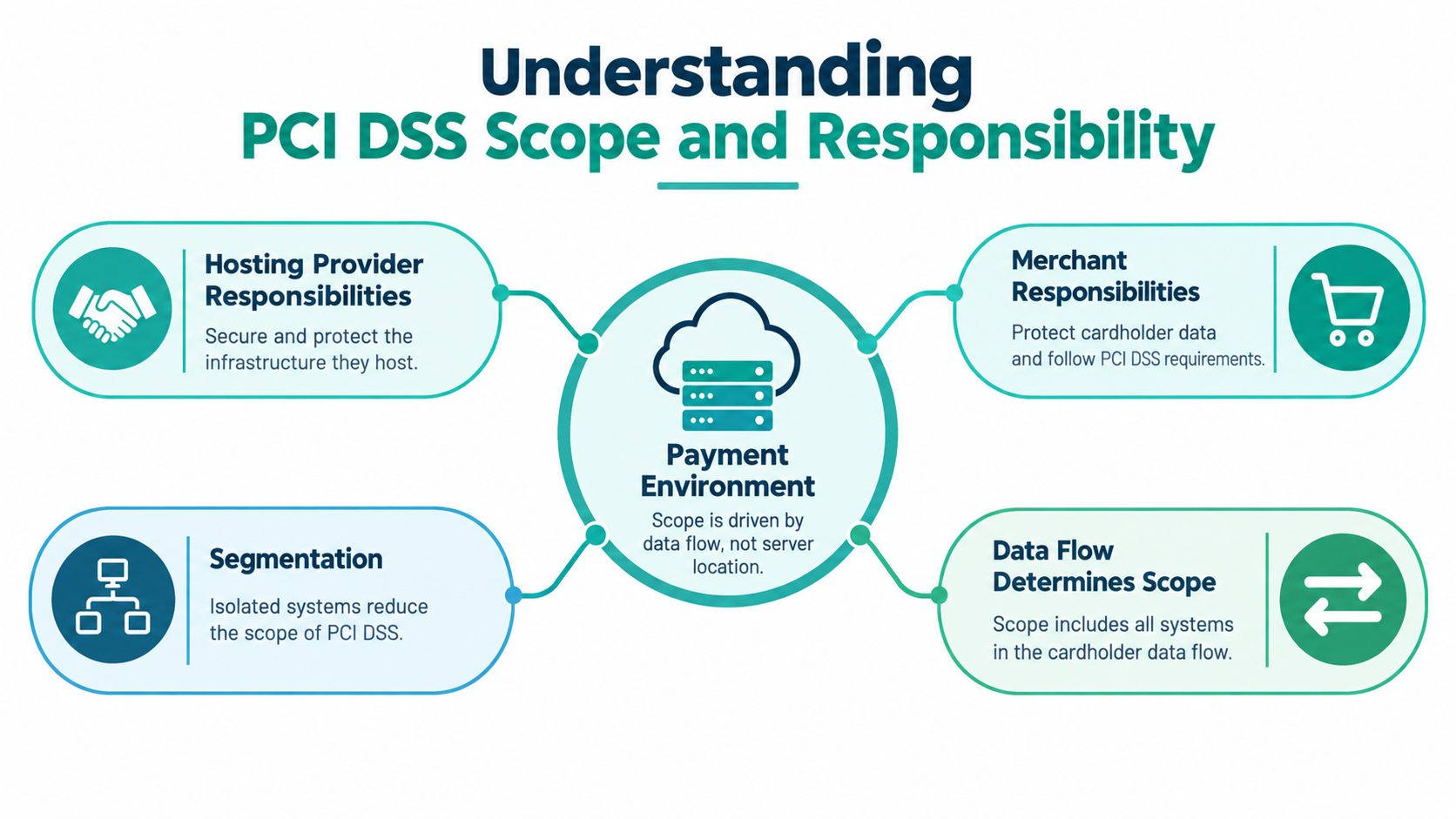
PCI DSS scope follows the data, not the server's postcode. Hosting a website in Australia may support data residency preferences and operational control, but local hosting alone doesn't make a merchant compliant. The decisive questions are whether the environment stores, processes or transmits cardholder data, and whether another system or account could affect its security.
Consider two checkout designs. In the first, the customer is sent to a payment provider's hosted page, and the merchant receives a confirmation or non-sensitive token. In the second, the merchant's application collects card details, sends them to a gateway and records payment information in its own database or email system. The second design normally creates a broader set of systems, workflows and people for the merchant to assess.
What the host provides
A hosting provider may operate the underlying server, network, facility, backup platform and monitoring service. Depending on the agreement, it may also manage the operating system, control panel, firewall, malware scanning and parts of the patching process.
That responsibility is limited. The host generally can't decide whether a merchant's WordPress plugin is necessary, whether employees share administrator credentials, whether payment details are copied into email or whether a developer has left a test database publicly accessible. Those decisions remain with the merchant or its appointed technology partners.
What the merchant must prove
The merchant owns the payment flow and the business process around it. That includes:
- Data mapping: Document where payment information enters, where it goes and whether it reaches the website, database, email, logs or backups.
- Access governance: Identify who can administer the website, hosting panel, payment account and backup system.
- Application security: Remove unused plugins, apply updates, review changes and restrict administrative functions.
- Provider oversight: Confirm what the host manages, what evidence it supplies and which controls the merchant must perform.
- Incident readiness: Keep records that support investigation, containment, recovery and required notifications.
Segmentation can narrow the cardholder-data environment. If a payment gateway handles card details and returns only a token, the merchant website may have a smaller role in the payment process. That reduction only holds when the integration, logs, backups, support access and administrative paths match the documented design.
The OAIC recorded 1,113 Notifiable Data Breach notifications during 2024, including 595 in July to December alone, as reported in its Notifiable Data Breaches report for July to December 2024. The figure reinforces why a clear responsibility matrix matters. An Australian business considering local infrastructure can also examine Australian data sovereignty hosting, while remembering that sovereignty and PCI scope solve different problems.
Host your website with our 5-star rated, cPanel website hosting plans.
Super fast servers, with security included and hosted in your choice of Australian Data Center.
View cPanel Plans
Essential Technical and Organisational Controls
A compliant-looking hosting package can still fail in daily operation. PCI-oriented hosting works when the merchant can show that security controls are configured, assigned to an owner, reviewed and supported by evidence.
OAIC reporting for January to June 2024 recorded 49 breach notifications involving ransomware and 16 involving brute-force attacks using compromised credentials, according to the OAIC breach report for January to June 2024. Those incidents point to practical weaknesses that a small business can address directly.
Start with patching and configuration
Set a written patching process for the operating system, hosting panel, CMS, plugins, themes, database and application dependencies. The process should identify who receives update alerts, who tests important changes, who approves production deployment and what happens when a critical vulnerability appears.
A patch policy is stronger when it produces records. Keep change tickets, update reports, vulnerability scan results and exceptions with an explanation and an expiry date. Remove unused services and plugins rather than leaving them installed because they might be useful later.
Treat credentials as a payment control
Use separate named accounts for administrators, developers, support staff and routine content editors. Shared logins make it difficult to identify activity and make access removal unreliable when someone leaves the business.
Require MFA for hosting panels, SSH or remote administration, domain management, email administration, payment platforms and backup consoles. Restrict privileged access by IP address or VPN where practical, and review administrator access regularly.
Make monitoring useful
A host's 24×7 monitoring is valuable, but the merchant should know what it detects, who receives alerts and how incidents are escalated. Useful evidence may include login activity, privilege changes, malware events, firewall alerts, file changes and support access records.
Centralise logs where possible and protect them from unauthorised alteration. Retain enough context to answer who accessed a system, what changed, when it happened and what action followed. A web application firewall guide can help explain how filtering supports, but doesn't replace, secure application development and access control.
Prove that recovery works
Backups should be encrypted, access-controlled and stored separately from production. A backup plan needs an owner, retention rules and a restoration test. If a restored website includes card-related data or payment code, the restored copy must receive the same protection as the production environment.
A backup that has never been restored is an assumption, not evidence.
For a WordPress retailer, a practical test might restore the site into an isolated environment, confirm that the database and files are intact, verify that administrator access is controlled and record the result. The merchant should also check that a compromised backup can't reintroduce the original malicious code without detection.
Security teams often explain these controls through principles such as how participant data is protected. The same principle applies here: responsibility must be visible in configuration, process ownership and records, not just in a list of product features.
Payment Integration Patterns and Your Risk
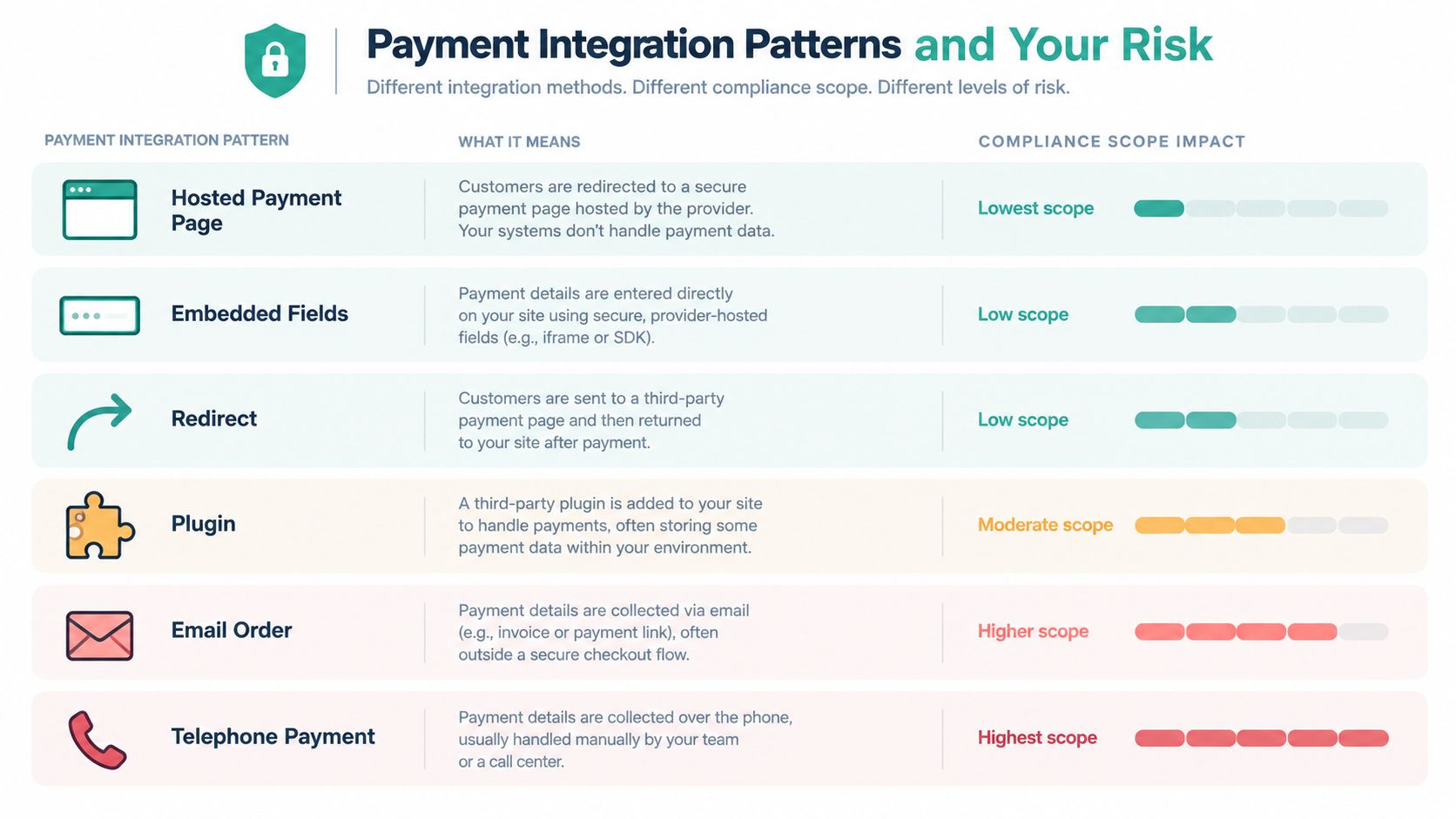
The payment method often determines PCI workload more than the hosting plan. A merchant should compare each pattern by asking what data the website receives, what the host stores, who can access it and whether the payment provider supplies suitable compliance documentation.
AusPayNet data cited in this Australian PCI DSS small-business analysis puts Australian card fraud at 78.8 cents per A$1,000 spent in 2024, a 12% year-on-year increase and the highest rate recorded by AusPayNet. That makes a low-data, well-documented checkout design a sensible risk decision, not merely an audit preference.
| Payment pattern | Typical scope effect | Practical concern |
|---|---|---|
| Hosted payment page | Lowest scope | Confirm that the customer enters card details on the provider's page and that the merchant receives only confirmation or a token. |
| Embedded payment fields | Low scope | Check how the fields are delivered, whether the merchant page can alter them and what security controls the integration requires. |
| Redirect to a gateway | Low scope | Review return URLs, payment-status validation and protection against tampered confirmations. |
| Payment plugin | Moderate scope | Keep the CMS, plugin, API credentials and administrative accounts patched and restricted. |
| Email order workflow | Higher scope | Never ask customers to send card details by email. Payment instructions and invoice changes also need strong verification. |
| Telephone payment | Highest scope | Define who can handle card details, where notes are recorded, how information is deleted and how calls are supervised. |
The labels above describe likely operational exposure, not an automatic compliance classification. A hosted page can be implemented poorly, while a well-controlled embedded integration may be appropriately managed. The merchant still needs confirmation from its acquirer, payment provider or qualified assessor.
For an Australian store choosing between a hosted platform and a self-managed stack, compare WooCommerce and Shopify hosting considerations. The better option is the one that keeps sensitive data out of unnecessary systems and gives the team enough control to maintain updates, access restrictions and evidence.
Managing Hosting Providers and Contracts
A hosting provider doesn't inherit the merchant's entire PCI obligation. The provider may secure the platform it operates, while the merchant remains accountable for its website, payment configuration, staff, contractors, customer records and business processes.
The OAIC states that entities remain responsible for taking reasonable steps to protect personal information under Australian Privacy Principle 11.1, as explained in its guide to securing personal information. That principle matters when a retailer stores customer contact details, order records or payment-related information with a hosting provider.
Put the shared boundary in writing
A useful hosting agreement or security schedule should identify:
- Platform ownership: Which party manages the facility, hardware, network, hypervisor, operating system, control panel and backups?
- Merchant duties: Who patches the CMS, reviews plugins, manages payment integrations and approves administrator access?
- Support access: Can provider staff access the environment, under what conditions, with what authentication and what logging?
- Incident reporting: What events trigger notification, who is contacted and what information will be supplied to support investigation?
- Evidence access: Can the merchant obtain relevant logs, vulnerability information, backup records and service documentation?
- Third-party dependencies: Which payment gateways, email services, developers and managed security providers can affect the environment?
- Exit and deletion: How will data, backups and credentials be returned or securely removed when the service ends?
A retailer shouldn't accept “PCI-ready” as a sufficient answer. Ask for the exact service-provider evidence that applies, then map that evidence to the merchant's own obligations. A provider's certification or audit report may support the assessment, but it won't validate an insecure plugin, an email workflow that receives card details or an undocumented support account.
The strongest arrangement creates a responsibility matrix that names the control, owner, evidence and review frequency. That document gives the business a practical way to challenge gaps before an incident or assessment exposes them.
Register your new domain name at competitive market prices including free domain add-ons like privacy, DNS Hosting, Custom Nameservers and Forwarding.
Always the best price and no nasty renewal price hikes.
Register A Domain Name
Practical Checklist for SMB Validation
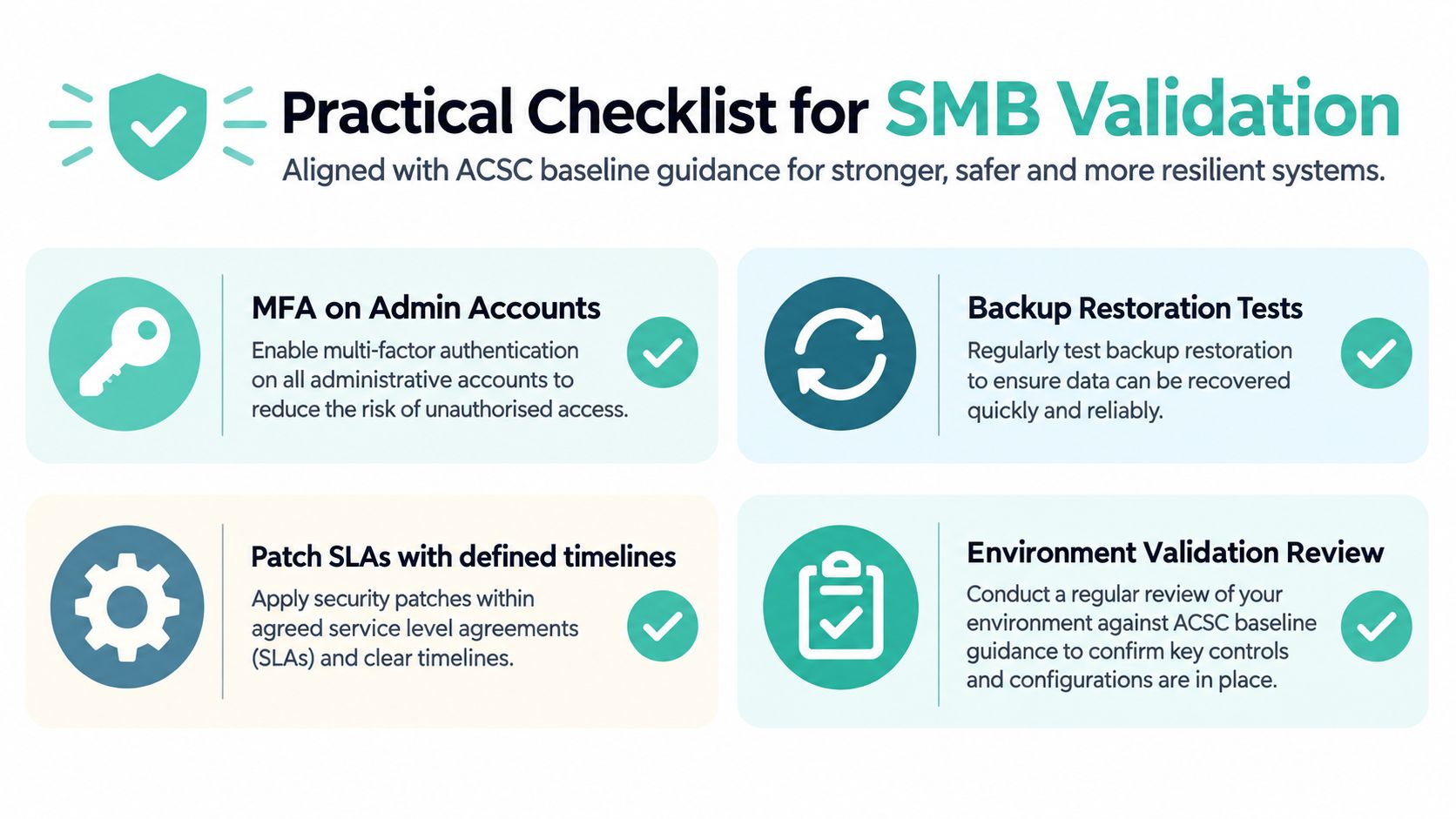
Run this review with the business owner, developer and hosting provider. Store the answers, screenshots and supporting records in one controlled location so they can be checked during an assessment or after a security event.
Map the payment journey. Follow a test transaction from checkout to confirmation. Record whether card details reach the website, browser scripts, database, email, logs, support desk or backups. This shows which systems may enter PCI DSS scope.
List every privileged account. Include hosting, CMS, domain, email, payment gateway, developer and backup accounts. Remove former users, replace shared credentials and assign a named owner to each account.
Turn on MFA. The Australian Cyber Security Centre recommends MFA for important accounts, prioritising financial and email accounts. Apply that control to hosting, CMS, payment and backup administration where available.
Confirm the patch process. Ask who patches each layer, how urgent updates are handled and where completion is recorded. Cover the CMS, plugins, themes, database, control panel and operating system.
Test a restoration. Document what is backed up, where it is stored, who can access it, how long it is retained and how restoration is tested. Restore into an isolated environment and record the result. A backup that has never been restored remains an assumption.
Inspect monitoring and logs. Confirm that administrator access, authentication failures, file changes, malware events and security alerts are recorded. Assign responsibility for reviewing alerts and escalating incidents.
Check the contract. Match provider claims to written responsibilities, incident notification terms, support access controls, audit assistance and data deletion procedures. Work through a broader website security checklist to confirm that controls outside the payment path are not missed.
Review after every material change. A new payment plugin, developer, domain account, backup service or checkout flow can alter scope. Update the data-flow diagram and responsibility matrix instead of relying on an old assessment.
This review does not replace advice from a qualified PCI professional. It gives an Australian SMB clearer evidence for discussions with its acquirer, assessor and hosting provider, while showing where the host's responsibility ends and the merchant's begins.
Common Misconceptions About Compliant Hosting
The most expensive misunderstanding is believing that PCI-compliant hosting makes the merchant compliant. A host can provide secure facilities, hardened systems, malware scanning, firewalls, monitoring and encrypted backups. It can't decide how the merchant collects card details, whether a developer uses a shared login or whether an employee forwards payment information to a personal inbox.
Email deserves special attention. The Australian Signals Directorate reported that business email compromise involving financial loss appeared in 15% of business cybercrime reports in 2024 to 2025, according to its Annual Cyber Threat Report. Payment redirection, invoice changes, password resets and requests for card details can all exploit business email without attacking the web server directly.

Security features aren't proof by themselves
An encrypted backup protects confidentiality during storage, but it doesn't prove that access is restricted, retention is controlled or restoration has been tested. A firewall blocks unwanted traffic, but it doesn't show that the checkout code is safe or that administrative access is reviewed.
Likewise, a malware scanner can identify known threats without proving that the merchant has a complete inventory, an incident-response process or a reliable method for investigating suspicious changes. The business needs to retain evidence that controls operate over time.
Scope can return through overlooked workflows
A retailer may remove card data from its production database but leave it in:
- Email inboxes: Staff ask customers to reply with payment details or forward transaction information.
- Support tickets: A customer pastes sensitive information into a helpdesk conversation.
- Backups: Old databases and file archives retain information that production no longer uses.
- Logs: Debugging records capture request bodies, payment responses or authentication details.
- Test systems: Developers copy production data into staging without applying equivalent controls.
- Telephone notes: Staff record card details on paper or in an unapproved application.
A smaller cardholder-data environment is easier to protect, but only if the business checks every path where data can be copied.
The practical standard is evidence-ready operation. Keep the data-flow diagram current, document provider responsibilities, retain access reviews, record patch and change activity, test backups and investigate alerts. If a host advertises PCI support, ask what the service covers and what remains with the merchant.
UpTime Web Hosting provides Australian hosting with local infrastructure, security tooling, encrypted off-site backups and 24×7 monitoring to support businesses building a defensible web environment. Review the available services at UpTime Web Hosting, then ask the team which hosting controls and evidence options fit your payment architecture.