You're comparing Shopify's monthly price with WooCommerce's “free” plugin, probably late at night and probably using figures that don't reflect what an Australian store costs to run. The important question isn't which platform has the longer feature list. It's which one gives your business the right balance of total cost, GST handling, payment flexibility, technical control and day-to-day support.
For Australian merchants, Shopify and WooCommerce remain major platforms, but recent independent tracking puts Shopify ahead by installed store count. One dataset recorded around 153,140 live Shopify stores and about 82,481 WooCommerce stores in Australia, while another reported Shopify at 51.7% and WooCommerce at 27.7% of tracked stores. The Australian Shopify landscape analysis describes this as a meaningful shift towards hosted ecommerce for merchants who prioritise simpler operations and faster launches.
| Decision area | Shopify | WooCommerce |
|---|---|---|
| Hosting | Included and managed | Purchased and managed separately |
| Starting position in Australia | Basic at AU$56 monthly, or AU$42 monthly when billed annually | Core plugin is free |
| Practical cost driver | Subscription, apps and payment fees | Hosting, extensions, maintenance and support |
| GST handling | Built-in GST support and automatic tax calculation | Usually requires WooCommerce Tax or accounting integration |
| Payment flexibility | Shopify Payments plus supported third-party gateways | Broad gateway choice, including local providers |
| Best fit | Owners who want a managed store | Owners who need control and have technical resources |
Table of Contents
- What Australian Store Owners Actually Need to Decide
- What WooCommerce and Shopify Are in Australia
- True Cost of Running Each Platform in Australia
- Performance, Checkout Speed and Australian Conversion
- Payments, GST and Local Integrations
- Honest Pros and Cons for Australian SMBs
- Which Platform Fits Your Business Scenario
- How to Make the Right Call for Your Store

Performance you can feel, backed by clients who depend on it. Read how our support and uptime create long‑term customer success.Power Your Business with Better Hosting
What Australian Store Owners Actually Need to Decide
At 11pm in Melbourne, a fashion brand owner is comparing two pricing pages. Shopify looks straightforward, while WooCommerce is labelled free. Her actual questions are harder: will GST calculate correctly, should the store use Australian hosting, can customers pay with Stripe or Afterpay, and who handles security when WordPress needs updating?
The headline comparison hides the operating work. A hosted subscription can cost more than a free plugin while removing hosting choices, server maintenance and much of the security workload. WooCommerce provides more control, but that control has a cost when someone must configure, monitor and maintain the store.
The practical question: Which platform gives your business the lower total operating burden, rather than the lower software price?
Four decisions deserve priority:
- Total cost in Australian dollars: Count hosting, apps, extensions, payment processing and technical labour.
- Local compliance: GST calculations and reporting must match the way your business operates.
- Technical capability: Decide whether you or your team can manage WordPress, plugins, backups and security.
- Growth headroom: Allow for a bespoke catalogue, wholesale pricing, custom content or a managed launch.
WooCommerce is often not the cheaper option once hosting, paid extensions, maintenance and technical support are included. Shopify can carry a higher recurring subscription, yet reduce the number of operational tasks your business owns.
Use this ecommerce platform showdown for broader comparison, then test its recommendations against Australian GST rules, payment gateways and hosting needs. The Australian guide to hosting for online selling helps clarify the hosting work that sits outside a platform subscription.
Choose Shopify when predictable operations and a managed environment matter more than deep technical control. Choose WooCommerce when customisation justifies the added responsibility and you have reliable technical support.
What WooCommerce and Shopify Are in Australia
An Australian store owner choosing between these platforms is choosing where operational responsibility sits.
Shopify is a hosted software service. You pay for the ecommerce software and infrastructure, while Shopify manages the hosting environment, core platform updates and much of the security layer. You handle products, collections, content, design settings, apps, orders and customer service through the Shopify admin.
For a business without an in-house developer, that managed setup removes several early decisions. You do not need to select a VPS, configure WordPress, patch the core platform or assemble the basic hosting stack before selling. The trade-off is working within Shopify's platform rules, theme system and app ecosystem.
With WooCommerce, you install a free plugin on hosting you choose and assemble the store yourself. Hosting might be an Australian shared plan, a managed WordPress environment or a virtual private server. You then add WordPress themes, WooCommerce extensions, payment plugins, shipping tools and tax settings.
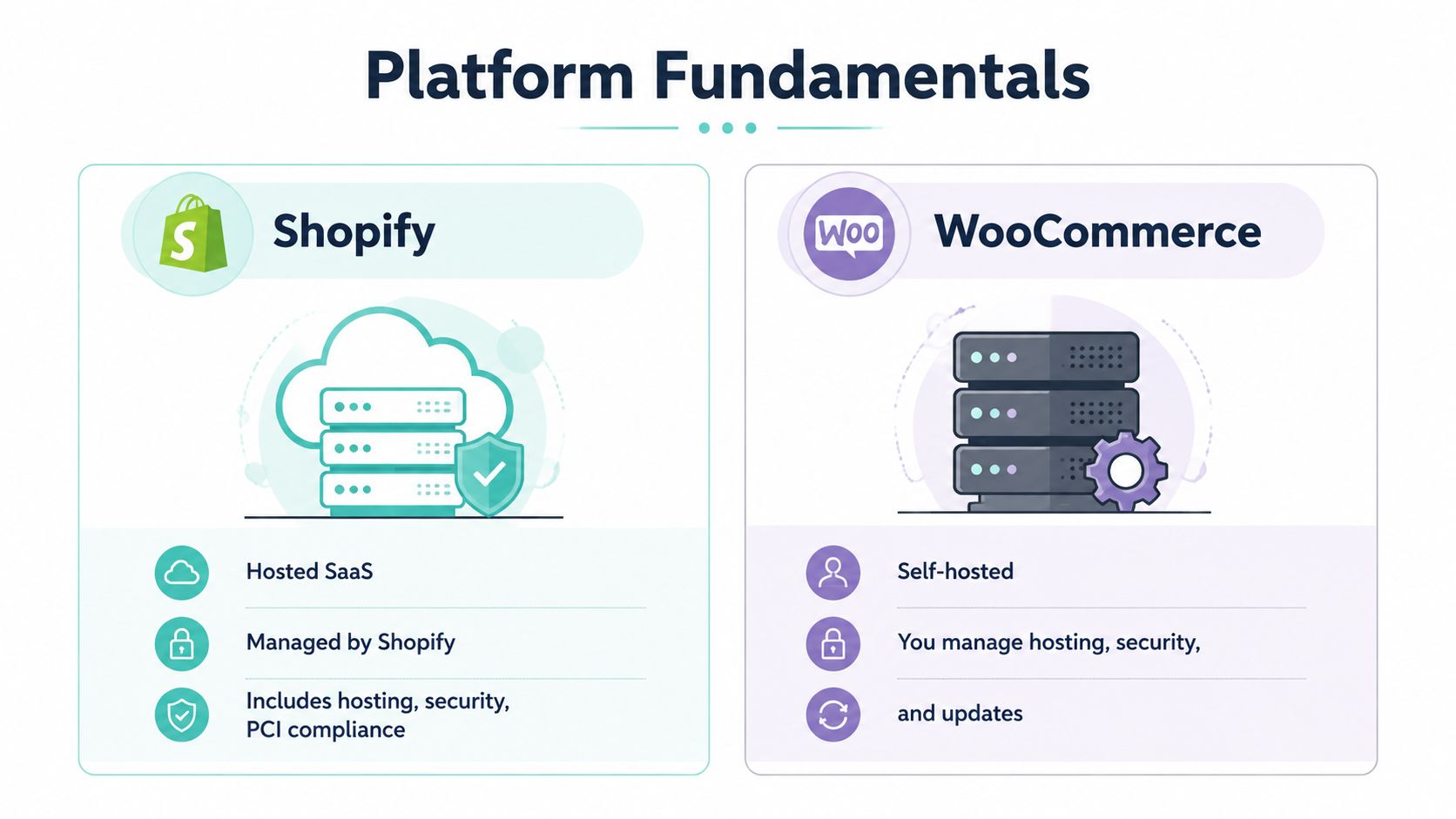
The main difference is responsibility. Shopify controls the underlying infrastructure. With WooCommerce, the merchant or web partner coordinates hosting, updates, backups, plugin compatibility, security and uptime. This explanation of what WooCommerce is provides useful context for its self-hosted model.
Control versus simplicity
WooCommerce gives you greater access to WordPress code, the database, templates and content structure. That suits brands with unusual product logic, advanced content marketing or integrations that standard ecommerce apps cannot handle cleanly.
Shopify limits technical decisions. That is often the better fit for a founder who needs to launch, manage products and process orders without becoming the store's systems administrator.
Shopify trades some control for operational simplicity. WooCommerce trades simplicity for control. Calling WooCommerce free misses the hosting, maintenance and technical work required to run it reliably. In Australia, that responsibility can make it more expensive overall.
Host your website with our 5-star rated, cPanel website hosting plans.
Super fast servers, with security included and hosted in your choice of Australian Data Center.
View cPanel Plans
True Cost of Running Each Platform in Australia
WooCommerce's free core plugin is only the starting point. Australian merchants still pay for hosting, themes, extensions, backups, security and technical support. They also carry the risk of conflicts when a WordPress update affects checkout or another store function.
Shopify gives owners a more predictable baseline. Its Australian Basic plan costs AU$56 per month on monthly billing or AU$42 per month when billed annually, according to The Australian Shopify and WooCommerce cost comparison. WooCommerce hosting is separate, with Australian estimates ranging from roughly AU$25 to AU$350 per month, depending on traffic and performance requirements.
The budget question is the total operating cost, not the licence fee.
A realistic budgeting framework
Use the following framework before comparing quotes. It separates fixed platform costs from expenses that grow with orders, integrations and technical complexity.
| Budget area | Shopify | WooCommerce |
|---|---|---|
| Hosting and infrastructure | Included in the platform service | Purchased and managed separately |
| Software extensions | Apps can create recurring costs | Premium plugins and extensions add to the budget |
| Security and maintenance | Managed within the platform service | Handled by the merchant or a contractor |
| GST and tax setup | Built-in GST support is available | WooCommerce Tax or accounting integration may be required |
| Technical support | More predictable operating responsibility | Costs vary with the host, developer and store complexity |
| Total-cost risk | Easier to forecast | Lower entry price, less predictable total |
One Australian analysis estimates that a production WooCommerce store can cost roughly A$1,800 to A$15,000 per year once hosting and premium extensions are included. The Australian total-cost analysis highlights the expense comparisons often miss: WooCommerce is not automatically cheaper once a working business needs shipping, reviews, bookings, automation and ongoing support.
Payment fees must sit in a separate line of the budget. Shopify's published Australian comparison material gives a checkout processing example of 1.75% plus 30 cents, while WooCommerce usually passes the merchant to the selected gateway's pricing. GST also affects invoices, subscriptions and accounting treatment. Have your bookkeeper confirm the setup before treating the advertised base price as the final business cost.
WordPress owners who describe the software as free should separate open-source licensing from commercial operating costs. This explanation of whether WordPress is free covers the distinction between the software itself and hosting, maintenance and website operation.
Performance, Checkout Speed and Australian Conversion
Performance is less about the platform logo and more about the environment behind the store. Shopify gives merchants a managed infrastructure model, while WooCommerce performance depends on the host, theme, plugin load, caching, database configuration and the quality of the implementation.
For an Australian shopper, server geography can influence responsiveness. A WooCommerce site hosted in Sydney or Melbourne may offer a different experience from one routed through an overseas region, but location alone won't rescue a poorly configured store. A heavy theme, oversized images, unnecessary plugins and inefficient cart behaviour can slow a store regardless of its platform.
Shopify claims that its checkout outperforms WooCommerce's checkout by 17% globally. That figure comes from Shopify's Australian comparison page, so treat it as a Shopify-published benchmark rather than an independent Australian test.
Where WooCommerce performance varies
A WooCommerce store on shared cPanel hosting has less room for error than one on a properly managed Australian host or a tuned Sydney VPS. Plugin conflicts, PHP compatibility issues, database bloat and cart fragment requests can all create problems during traffic spikes.
| Metric | Shopify, AU shopper | WooCommerce on shared AU host | WooCommerce on managed AU host | WooCommerce on self-managed Sydney VPS |
|---|---|---|---|---|
| Hosting responsibility | Shopify manages it | Merchant and host share responsibility | Host manages more of the stack | Merchant or developer manages the stack |
| Performance consistency | Generally consistent | Can vary with neighbouring accounts and configuration | More controlled | Depends heavily on tuning |
| Checkout risk | Lower technical maintenance burden | Plugin and theme conflicts remain possible | Requires ongoing compatibility checks | Requires active technical oversight |
| Traffic spikes | Infrastructure is managed | May require plan or configuration changes | Better prepared when correctly sized | Owner must monitor and scale |
| Best operator | Non-technical merchant | Cost-conscious owner with support | Business with a hosting partner | Technical team or experienced developer |
A practical optimisation review should cover image sizes, caching, database queries, plugin necessity, checkout scripts and mobile rendering. This ecommerce site optimisation guide is a useful checklist for Australian store owners who want to improve the environment before changing platforms.
At modest traffic, both platforms can perform well when configured correctly. As visitor demand rises, Shopify removes more infrastructure decisions, while WooCommerce gives a capable technical team more levers to pull. The choice is therefore operational: do you want to tune the system yourself, or pay for a managed environment that limits the tuning you need to do?
Payments, GST and Local Integrations
Australian merchants need more than card payments. A workable stack may include Stripe, Afterpay, Zip, PayPal, Apple Pay, Google Pay, bank merchant facilities, Australia Post, Sendle, Xero or MYOB. The platform needs to connect these services without creating a fragile chain of plugins and manual reconciliation.
WooCommerce offers broad gateway choice. An Australian comparison lists integrations including Stripe, eWAY, Tyro, Afterpay, Zip, Apple Pay, Google Pay, PayPal, and direct gateway connections through NAB, CBA, Westpac and ANZ merchant facilities. The Australian WooCommerce payments overview shows why this flexibility matters to retailers that don't want to depend on one provider.
Shopify supports Shopify Payments as well as third-party gateways. Shopify's managed checkout is simpler to deploy, but merchants should still compare gateway rates, settlement timing, refunds and accounting workflows before choosing the payment route.
| Capability | Shopify | WooCommerce |
|---|---|---|
| Card processing | Shopify Payments and third-party gateways | Stripe and other gateway extensions |
| Australian payment options | Supports local payment methods through Shopify Payments, apps and gateways | Strong choice of local gateway plugins and bank integrations |
| GST | Built-in GST support and automatic tax calculation | Usually configured through WooCommerce Tax or accounting integration |
| Shipping | Shopify tools and app integrations | Extensions for Australia Post, Sendle and other carriers |
| Accounting | Apps and integrations for platforms such as Xero and MYOB | Deep WordPress integration options, often through extensions |
| Operational model | Fewer infrastructure decisions | More choice, more configuration responsibility |
GST is a major dividing line for small businesses. An Australian comparison states that Shopify includes built-in GST support with automatic tax calculation, while WooCommerce generally needs WooCommerce Tax or integration with Xero or MYOB to achieve comparable handling. The local GST comparison explains why tax settings need to be tested before launch rather than assumed to be correct.
Don't treat the payment stack as an afterthought. A Sydney retailer accepting cards, Afterpay and local delivery may prefer Shopify's simpler assembly. A merchant with a specific Tyro, eWAY or bank facility may accept WooCommerce's extra configuration in exchange for gateway control. This guide to selling products online provides further practical context for assembling the Australian side of the store.
Register your new domain name at competitive market prices including free domain add-ons like privacy, DNS Hosting, Custom Nameservers and Forwarding.
Always the best price and no nasty renewal price hikes.
Register A Domain Name
Honest Pros and Cons for Australian SMBs
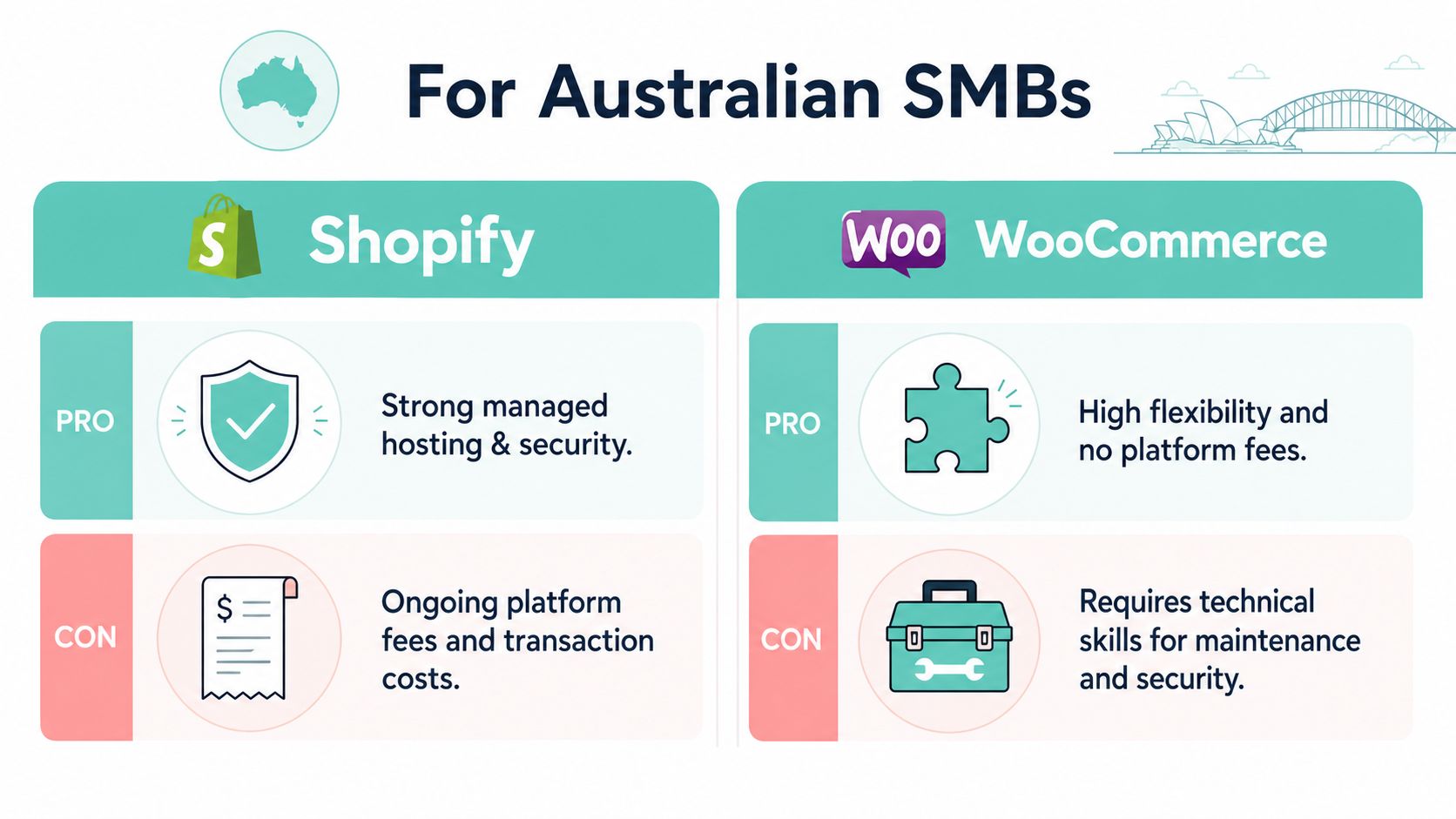
Shopify's strongest advantage is operational clarity. The merchant pays for a hosted service, works through a relatively approachable admin and can use a large app ecosystem without managing the server underneath it. Shopify also suits retailers that want online and in-person selling through its POS hardware range, while its paid plans include round-the-clock support.
Those benefits come with constraints. The subscription continues whether sales are strong or weak, apps can create recurring costs, and payment economics may change if the merchant avoids Shopify Payments. Shopify's Liquid theme language allows meaningful design work, but it doesn't offer the same underlying access as WordPress. Its content tools are also less flexible for brands that treat publishing and organic search as central growth channels.
The Shopify case
- Managed infrastructure: Shopify handles the hosting environment, core updates and much of the security workload.
- Fast administration: A small team can learn product, order and promotion workflows without managing WordPress.
- Integrated ecosystem: Apps can extend shipping, reviews, marketing, subscriptions and reporting.
- Retail compatibility: Shopify's POS offering can suit businesses selling through a physical shop and online.
- Exit cost: Moving away later may require rebuilding the storefront and carefully transferring catalogue, customer and order data.
WooCommerce offers the opposite set of strengths. You own the WordPress installation, site files and database, and you can use custom fields, bespoke templates and WordPress publishing tools without waiting for a platform feature. You can also select Australian hosting that matches your performance or data-location preferences.
The price of that freedom is responsibility. You own updates, backups, plugin compatibility, PHP version compatibility, security hardening and the practical work involved in keeping checkout available. A store can be flexible and powerful, but it needs a capable operator.
Operational test: If nobody on your team can maintain WordPress or manage a reliable developer relationship, WooCommerce's control may become a liability rather than an advantage.
WooCommerce is often more expensive in the first year for a non-technical founder once hosting, premium plugins, a paid theme and development time enter the budget. Shopify is more restrictive, but that restriction can be a sensible trade when the owner's priority is selling rather than maintaining infrastructure.
Which Platform Fits Your Business Scenario
The right platform becomes easier to identify when you attach it to a real Australian operating model. A solo seller in Brisbane doesn't face the same problem as a wholesale business in Sydney, even if both sell physical products online.
| Scenario | Recommended platform | Monthly AUD cost | Key trade-off |
|---|---|---|---|
| Solo Brisbane craft seller shipping handmade candles | Shopify | AU$56 monthly, or AU$42 monthly when billed annually | Less technical control in exchange for simpler operations |
| Melbourne fashion brand with complex design requirements | WooCommerce | Depends on hosting, extensions and support | Requires a managed technical environment |
| Sydney B2B wholesaler with tiered pricing and Xero workflows | WooCommerce | Depends on hosting, plugins and maintenance | More setup and ongoing maintenance responsibility |
The solo craft seller
A Brisbane maker shipping handmade candles through Australia usually needs reliable product pages, stock tracking, delivery options and a checkout that doesn't become a weekend technical project. Shopify is the sensible recommendation because a managed platform lets the owner focus on production, customer service and fulfilment.
The trade-off is recurring platform cost and less freedom to alter the underlying checkout. That's acceptable when simplicity has more value than code-level control.
The growing fashion brand
A Melbourne fashion company with a large catalogue, strong editorial ambitions and a designer who wants close control over layout may prefer WooCommerce on managed Australian hosting. WordPress gives the team broader control over content structures, templates and custom product data.
This choice only works if the business funds maintenance. The owner shouldn't put a complex WooCommerce build on inexpensive hosting and hope the developer will fix problems after every update.
The B2B wholesaler
A Sydney wholesaler dealing with account logins, customer-specific pricing and accounting synchronisation may find WooCommerce more direct. A developer can shape the catalogue and purchasing workflow around the company's existing processes rather than forcing those processes into a simpler retail model.
The trade-off is ongoing ownership of the technical stack. The business needs a clear person or provider responsible for updates, backups, security and integration monitoring.
Experience Microsoft 365 Business Standard for free for 30 days.
Up to 25 users with full access to email, OneDrive and Teams. Includes full versions of desktop apps of Outlook, Word, Excel, PowerPoint and more.
Try Microsoft 365
How to Make the Right Call for Your Store
Australian store owners should make this decision from total cost of ownership, not the advertised entry fee. Compare hosting, apps, extensions, payment fees, GST tools, backups, maintenance and developer time. Shopify is easier to forecast because the core service, hosting and much of the operational infrastructure sit in one subscription. WooCommerce gives you more control, but each extra requirement can add a separate cost.
Use the earlier cost discussion as a warning, not a reason to repeat the figures. A free core plugin does not make WooCommerce the cheaper choice once Australian hosting, paid extensions and technical support enter the budget.
Define the control your store needs. Shopify is the stronger operational choice when standard products, checkout and shipping workflows fit the business. Choose WooCommerce when you require unusual pricing rules, custom fields, a content-heavy WordPress site or a wholesale process built around your existing systems. Pay for that flexibility only when the requirement is real.
Match the platform to your operating capability. A non-technical owner who wants a quick launch, local payment setup and predictable administration should choose Shopify. A business with reliable development support and a genuine need for bespoke functionality or deep Xero integration can justify WooCommerce. Your team must be able to manage updates, backups, security and integration failures.
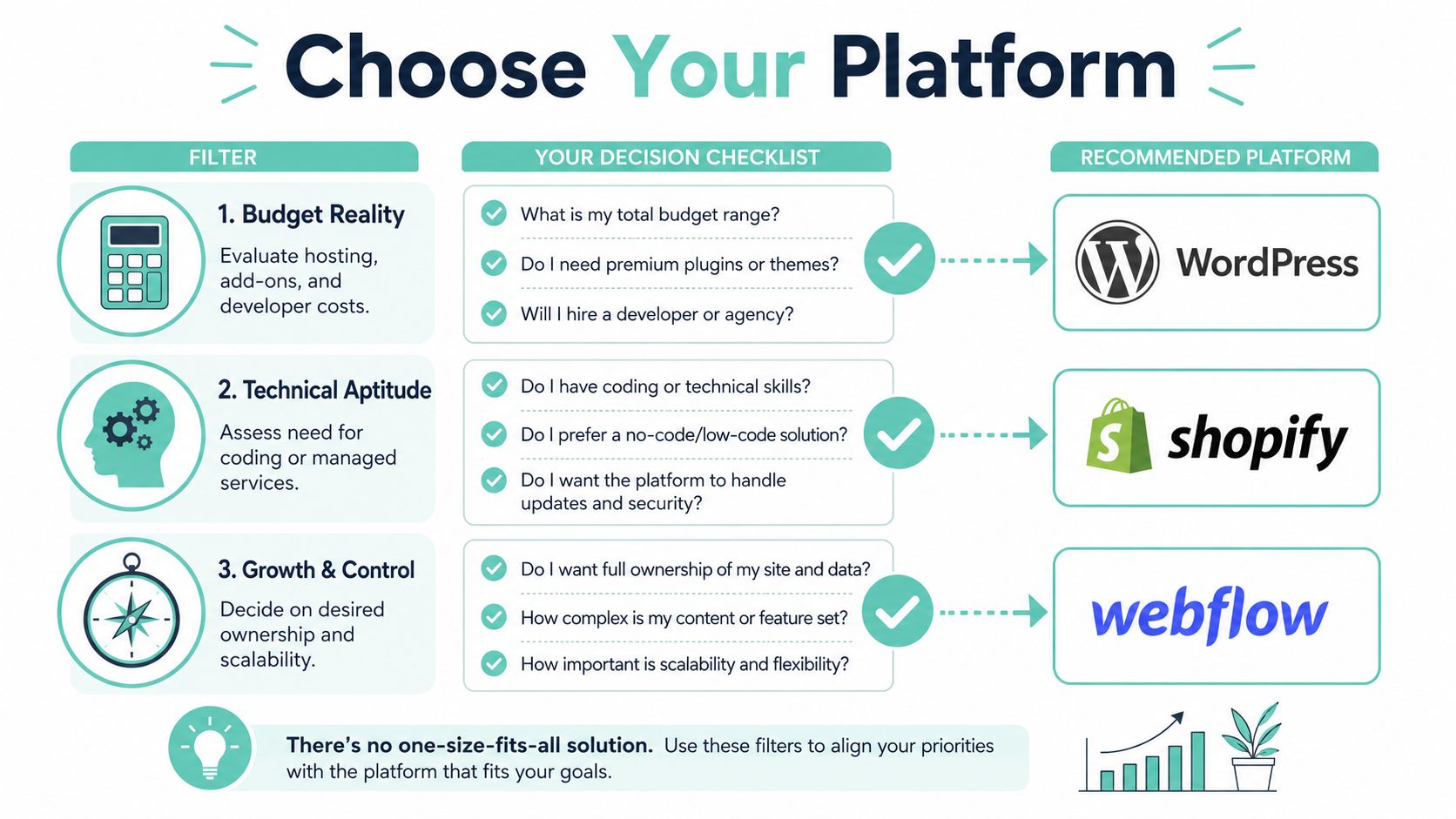
My recommendation is direct. Choose Shopify if speed, support and predictable administration matter most. Choose WooCommerce if your business can fund technical ownership and needs control Shopify will not provide. Do not select WooCommerce solely because its core plugin is free.
Before committing, ask each provider to confirm GST handling, Australian payment gateway compatibility, shipping rules, hosting location and who owns maintenance. UpTime Web Hosting provides Australian cPanel, WordPress and managed VPS hosting, with local infrastructure, SSL, malware scanning, backups and 24×7 monitoring for WooCommerce stores. Review UpTime Web Hosting against the maintenance your store can realistically support.