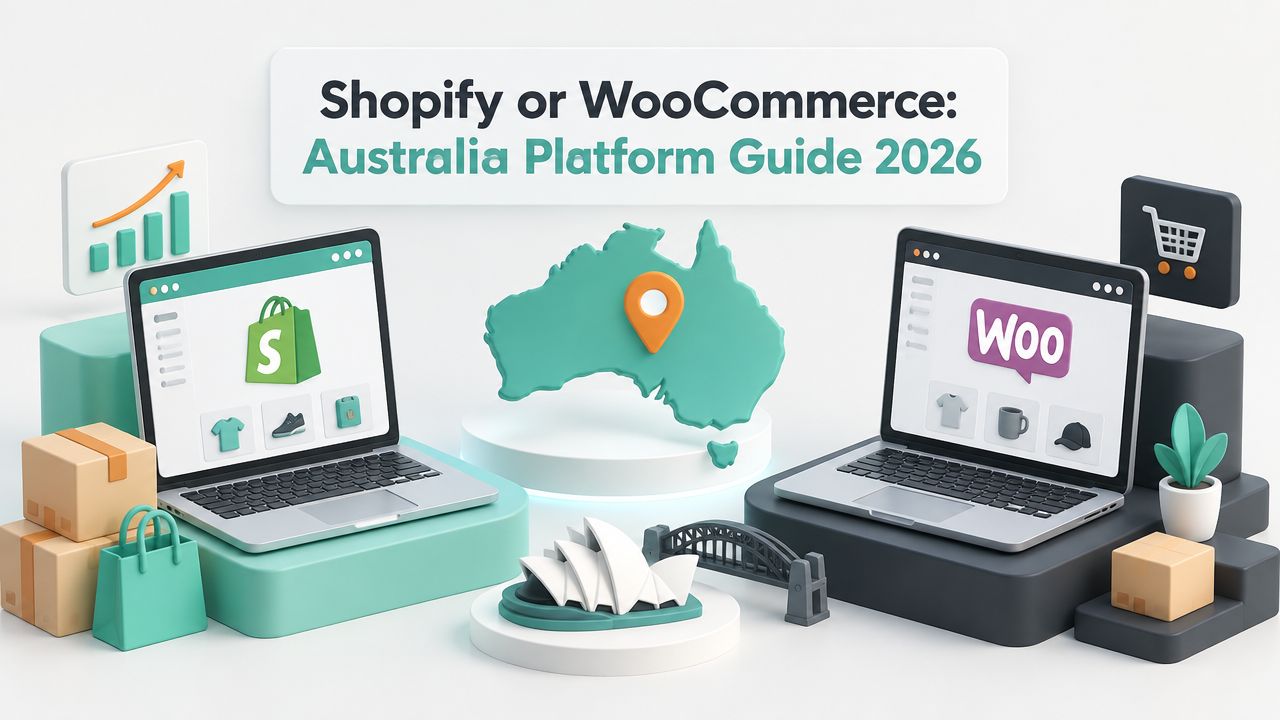
An Australian founder usually doesn't start by comparing platforms in the abstract. They're trying to launch a side hustle from a Melbourne kitchen, move a Sydney fashion label through a busy trading week, or turn a Brisbane service business into an online operation. Then the practical questions arrive: what will this cost in Australian dollars, who controls the data, how will GST and local payments work, and who fixes checkout when it fails outside business hours?
My direct view is simple. Shopify is the safer default for most first-time Australian store owners. WooCommerce is the better choice when WordPress, custom business logic, content ownership, or self-managed infrastructure already matter. The right decision depends less on which platform has more features and more on which operating model your business can support every week.
Table of Contents
- Choosing Between Shopify and WooCommerce in Australia
- What Each Platform Actually Is and How It Fits the Australian Market
- Total Cost of Ownership for Australian Merchants
- Hosting, Performance and Uptime Compared
- Payments, GST and Australian Checkout Workflows
- Security, Maintenance and Long-Term Operations
- Matching the Right Platform to Common Australian Business Scenarios
- A Clear Recommendation and Next Steps for AU Founders

Performance you can feel, backed by clients who depend on it. Read how our support and uptime create long‑term customer success.Power Your Business with Better Hosting
Choosing Between Shopify and WooCommerce in Australia
A founder often notices the difference between Shopify and WooCommerce only after the first real operational problem. A payment method needs changing, a shipping rule behaves unexpectedly, or a plugin update breaks a product page. At that point, the platform decision is no longer a design preference. It affects sales, staff time, marketing work and the quality of customer service.
Consider a Melbourne maker selling homewares alongside a WordPress blog. WooCommerce may fit naturally because the content site, search strategy and shop can live in one system. A Sydney fashion label planning serious growth may prefer Shopify because the team wants a predictable managed environment rather than another technical responsibility. A Brisbane trade business selling booked services and physical products may choose WooCommerce if its agency needs highly specific pricing and account workflows.
The questions worth answering are practical:
- Monthly cost: What subscriptions, hosting, apps, extensions and maintenance will continue after launch?
- Australian checkout: Which payment methods, shipping services and tax settings are native, and which need add-ons?
- Ownership: Do you need direct control over code, hosting and databases?
- Support: Can someone in your team or agency diagnose problems quickly?
- Content and SEO: Is the shop the whole business, or is it an extension of a substantial publishing site?
If you're selling downloads, memberships or other non-physical products, Tagada's guide to the best platforms for selling digital goods is a useful companion because digital fulfilment can change the platform requirements.
This guide takes an Australian consultant's position rather than presenting a feature checklist. Shopify generally wins on launch speed, managed operations and predictable performance. WooCommerce earns the recommendation when flexibility and ownership justify the extra work.
What Each Platform Actually Is and How It Fits the Australian Market
Australian businesses choose between two different operating models, not two storefront builders.
Shopify is a managed software-as-a-service platform. You subscribe, build the storefront within Shopify's system and rely on Shopify for core hosting and infrastructure. That removes server selection and much of the routine platform administration, which suits agencies and founders who want to launch quickly. Shopify Payments is available in Australia and supports multiple checkout payment methods, as documented in Shopify's Australian Payments knowledge base.
WooCommerce is an open-source ecommerce plugin for WordPress. The plugin does not supply the full hosting environment. You choose Australian hosting, configure WordPress, select the theme and extensions, and take responsibility for updates, backups, security and checkout performance. A WooCommerce knowledge-base guide explains this underlying model.
That difference matters in daily operations. A WooCommerce store paired with capable local infrastructure can deliver strong performance for Australian shoppers, but poor hosting or an overloaded WordPress installation can make speed and maintenance the owner's problem. Shopify removes more infrastructure decisions, while WooCommerce gives an agency or in-house developer greater control over the stack.
Australian adoption reflects Shopify's local strength. A May 2026 snapshot reported 152,323 active Australian Shopify stores, including 3,653 Shopify Plus stores, compared with 83,784 WooCommerce stores, with Shopify ahead by 1.82 to 1 (Eightx Australian Shopify data for 2026). A June 2026 dataset recorded 153,214 Shopify stores, representing 51.7% of tracked Australian online stores, versus 82,028 WooCommerce stores, or 27.7% (TechnologyChecker platform data).
Those figures show adoption, not quality. Shopify suits direct-to-consumer brands, retailers needing a quick launch and agencies standardising delivery across clients. WooCommerce remains a strong fit for WordPress agencies, publishing-led businesses and owners who require direct control over site architecture, data and custom workflows.
| Dimension | Shopify | WooCommerce |
|---|---|---|
| Operating model | Managed SaaS platform | WordPress plugin you host and manage |
| Hosting | Included in the platform | Chosen and paid for separately |
| Code and database control | Restricted compared with self-hosting | Broad control through WordPress and server access |
| Australian payments | Shopify Payments and supported payment methods | Gateways added through extensions |
| Best fit | Fast launch and lower technical overhead | Existing WordPress, custom workflows and ownership |
| Main trade-off | Less infrastructure control | More maintenance and configuration responsibility |
For founders preparing for Shopify setup, the managed model cuts decisions before launch. WooCommerce offers more architectural freedom, but each choice needs an owner.
Host your website with our 5-star rated, cPanel website hosting plans.
Super fast servers, with security included and hosted in your choice of Australian Data Center.
View cPanel Plans
Total Cost of Ownership for Australian Merchants
A Shopify store can look cheaper at launch because hosting and core infrastructure sit inside the subscription. A WooCommerce store starts without a native platform fee, yet Australian merchants still pay for hosting, domains, SSL where it is not included, extensions, backups, security and technical labour. Compare the full operating stack, not the headline licence cost.
Shopify's Australia-facing plan comparison lists Basic at $39 USD per month, Shopify at $105 USD per month, and Advanced at $399 USD per month (Shopify Australia comparison). Those charges are in US dollars, so the Australian amount changes with the exchange rate. Convert the live charge when budgeting rather than treating an old AUD estimate as fixed.
WooCommerce gives you more control over the stack, but that control creates recurring work. You choose Australian hosting, configure caching, maintain WordPress and plugins, manage backups, and pay for tools covering subscriptions, tax, reviews, shipping or local payment gateways. Hosting requirements rise with traffic, catalogue size and support expectations. A small brochure-style shop and a busy store should not share the same hosting budget.
| Cost line | Shopify (AUD/year) | WooCommerce (AUD/year) |
|---|---|---|
| Core platform or plugin | Subscription, based on selected Shopify plan | WooCommerce plugin has no native platform fee |
| Hosting and SSL | Core hosting and SSL bundled into Shopify | Separate hosting, SSL may be included by host |
| Domain | Separate domain registration | Separate domain registration |
| Theme | Free or paid commercial theme | Free or paid commercial theme |
| Apps and extensions | Store-specific app subscriptions | Store-specific plugin and extension subscriptions |
| Payments | Shopify Payments or external gateway charges | Chosen gateway and its processing charges |
| Maintenance | Lower infrastructure burden | Updates, testing, security and developer time |
| Total | Predictable starting structure, variable app and payment costs | Flexible starting structure, variable technical costs |
Use this guide to annual web hosting cost when pricing a WooCommerce setup with Australian infrastructure. Then add developer time, testing and the cost of fixing failures during trading hours. That calculation is more useful than claiming one platform always costs less.
Where the budget changes
Shopify becomes expensive as the app stack grows. Reviews, advanced shipping, subscriptions, invoicing, reporting and customer support can each add a recurring charge. A serious store's app stack can exceed $200 AUD per month, so review every app by the job it performs and the revenue or time it protects. External gateways may also create extra Shopify transaction charges. WooCommerce generally avoids a platform fee for selecting a third-party provider, as described in the Australian Shopify and WooCommerce cost comparison.
WooCommerce's less visible cost is technical labour. A plugin conflict, failed update or badly configured cache can cost more than a monthly subscription, especially when a developer is needed during a sales period. Local hosting can improve response times, but it does not remove the need to test the whole WordPress stack.
For larger Shopify operations, Carti's Shopify Plus monthly cost analysis 8 provides useful pricing context. Choose that tier only when checkout, integrations and operating requirements justify it, not because the store has grown.
Hosting, Performance and Uptime Compared
A store can lose sales during a campaign because its hosting, theme, checkout scripts or plugins cannot handle the load. Shopify removes much of that operational work. Its managed infrastructure handles platform-level scaling, security and availability, while you control the theme, images, tracking scripts and app selection. You do not need to choose a PHP environment or tune a database server.
WooCommerce gives you more control and more responsibility. Performance depends on the host, theme, image sizes, plugin quality, caching strategy and database health. Two WooCommerce stores can perform very differently because the platform is only one part of the stack.
Shopify-published benchmarks report faster checkout and storefront performance than WooCommerce, including a 17% checkout advantage, 93% of Shopify stores rated fast compared with 15% of WooCommerce stores, and Shopify stores rendering 2.4 times faster on average. Treat those figures as Shopify-provided benchmarks, not a guarantee for every Australian store. A heavily customised Shopify theme can still be slow. A disciplined WooCommerce build, hosted close to Australian customers and tested properly, can be quick.
Practical rule: Do not ask whether WooCommerce is fast. Check whether the specific host, theme and plugin stack has been tested under your busiest realistic conditions.
What an Australian WooCommerce host should provide
Prioritise Australian data-centre options, managed WordPress experience, staging, daily backups, server-level caching and support for Redis or object caching. PHP 8.x support, CDN compatibility and a clear uptime commitment should be confirmed before launch.
Australian businesses can compare providers such as UpTime, Kinsta, WP Engine, SiteGround and VentraIP, but the brand matters less than the plan and support process. Ask whether staging is included, whether backups are encrypted and stored off-site, and how quickly support responds when checkout fails. Local infrastructure can reduce latency for Australian shoppers, but it will not fix a poorly configured database or oversized images.
| Factor | Shopify | WooCommerce, self-hosted |
|---|---|---|
| Server management | Shopify manages the platform environment | Merchant or agency manages the host |
| Scaling | Infrastructure is managed by Shopify | Requires suitable hosting and configuration |
| Caching | Platform-level services are included | Host, plugin and server configuration vary |
| Plugin impact | Apps and scripts can affect storefront speed | Plugins can affect TTFB, database load and Core Web Vitals |
| Australian latency | Managed global infrastructure | Depends on data centre, CDN and network path |
| Troubleshooting | Platform support plus agency support | Host, developer and plugin vendors may all be involved |
Review what WooCommerce hosting involves before accepting a hosting proposal. The minimum standard is a staging copy, tested backups, monitoring and a named person responsible for performance after launch. Shopify suits operators who want hosting decisions removed. WooCommerce suits businesses prepared to manage, fund and test the infrastructure behind the store.
Payments, GST and Australian Checkout Workflows
Australian shoppers expect familiar payment methods, GST-inclusive prices, sensible delivery choices and invoices that suit local accounting. The PayPal Australia eCommerce Index identifies safety and security as the top priority for 58% of Australian SMB respondents, followed by improving customer experience at 49% and attracting new visitors at 40%. A checkout that creates uncertainty at payment or delivery will cost sales, regardless of the platform behind it.
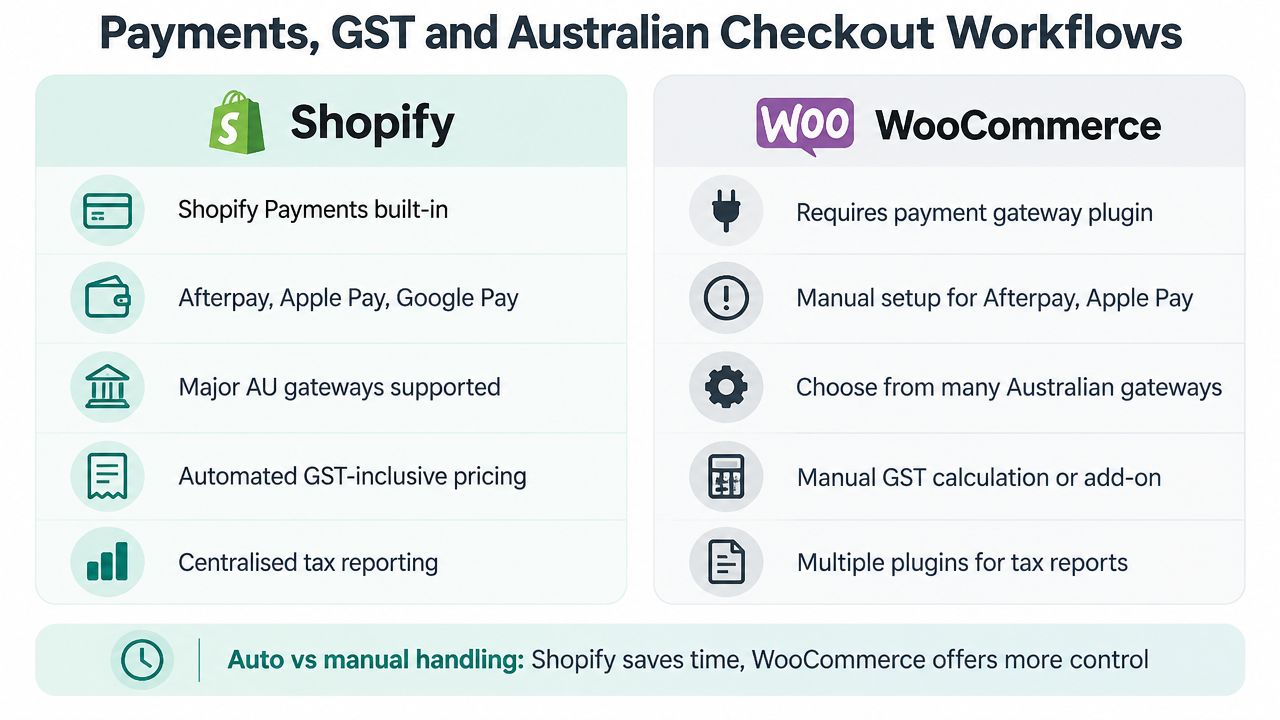
Shopify gets a standard Australian checkout live faster for a non-technical founder. Shopify Payments sits inside the admin and works with familiar local payment options, while apps can extend the setup. WooCommerce supports Stripe, PayPal, Afterpay, Zip, Square, eWAY and local bank integrations, but each gateway generally requires an extension, account connection, testing and compatibility checks. The trade-off is clear: Shopify reduces configuration work, while WooCommerce gives the merchant more control over the payment stack.
GST needs deliberate testing
Shopify handles GST-inclusive price display and Australian tax settings within its managed workflow. WooCommerce offers finer control, but the merchant must configure tax tables, price rules, invoice templates and reporting accurately. Many Australian businesses connect WooCommerce with Xero or MYOB so order data, tax treatment and reconciliation follow the accounting process.
Shipping deserves the same testing. Australia Post, Sendle and ShipStation work with either platform through apps, plugins or external automation. Test postcode rules, regional charges, pickup options, split orders and returns before launch. Local infrastructure may improve response times, but it does not correct a broken tax rule or a checkout extension that fails on a regional order.
Shopify is the practical choice for standard products and straightforward delivery. Choose WooCommerce when the business needs unusual tax rules, account-specific pricing, a specialised gateway or a custom order process that Shopify cannot accommodate cleanly.
Register your new domain name at competitive market prices including free domain add-ons like privacy, DNS Hosting, Custom Nameservers and Forwarding.
Always the best price and no nasty renewal price hikes.
Register A Domain Name
Security, Maintenance and Long-Term Operations
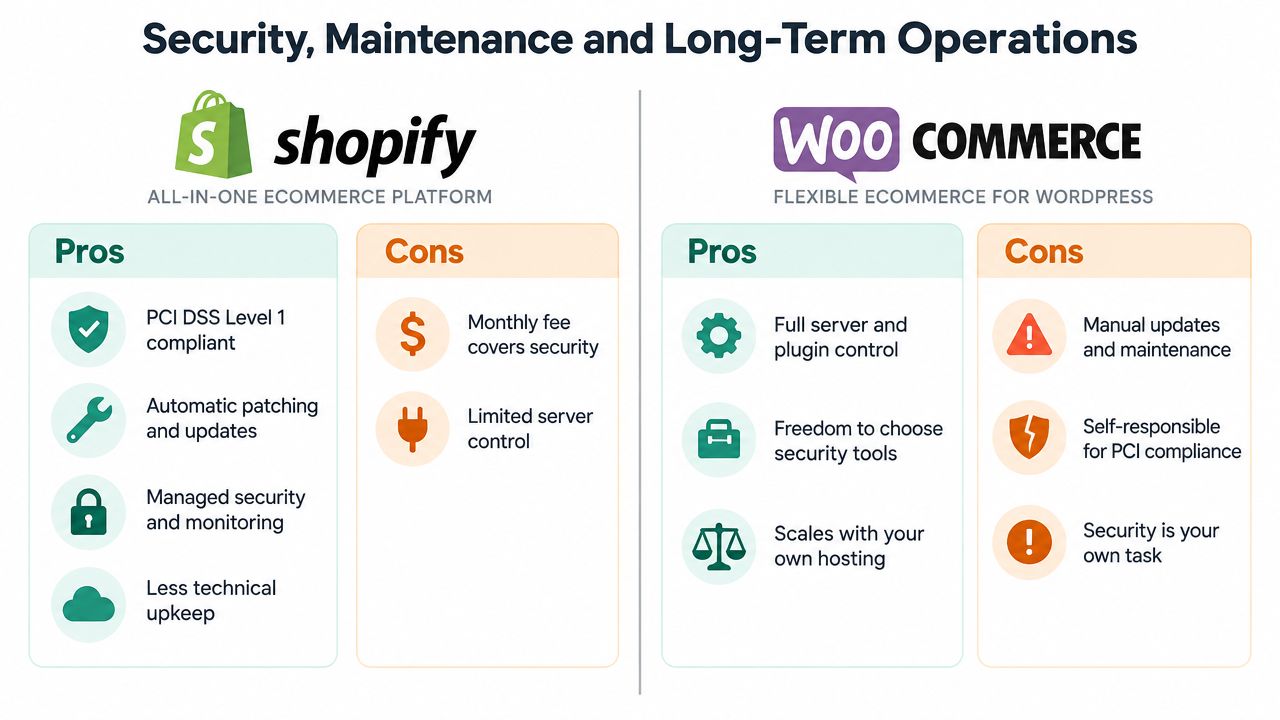
Shopify carries much of the platform security workload. It provides built-in SSL, managed infrastructure and PCI DSS Level 1 compliance, while platform-level patching and monitoring sit with Shopify. That doesn't make the merchant's account, staff access or third-party apps automatically safe, but it removes a substantial amount of server administration.
WooCommerce requires a defined maintenance owner. WordPress core, WooCommerce, themes and extensions all need updates, and each update should be tested for compatibility. The store also needs SSL renewal, firewall configuration, malware scanning, backups and a payment setup that meets the chosen gateway's compliance requirements.
Decide who owns the maintenance queue
A WooCommerce owner can self-manage if they understand WordPress updates, staging, backups and incident recovery. Otherwise, the business should appoint a developer or agency and include maintenance in the operating budget. This WordPress security resource provides a useful foundation for the controls that need regular attention.
The risks are familiar: an abandoned plugin, an outdated PHP version, an expired hosting renewal or a backup that has never been restored. Shopify reduces those platform-level risks, while WooCommerce lets a capable team choose its own tools and processes.
Operational test: If nobody has a named responsibility for updates, backups and checkout testing, self-hosted WooCommerce isn't ready for production.
Shopify's monthly fee buys reduced technical upkeep and less server control. WooCommerce's open architecture buys control, portability and the ability to select your own hosting and security tools. Choose the model your team will maintain, not the one that looks cheapest in a spreadsheet.
Matching the Right Platform to Common Australian Business Scenarios
Platform selection becomes clearer when it's tied to the business you're running. The same feature can be valuable to one Australian operator and irrelevant to another.
| Scenario | Best fit | Why | Watch out for |
|---|---|---|---|
| Creative side project adding a shop to an existing WordPress blog | WooCommerce | Keeps publishing and commerce in one WordPress environment | Plugin, theme and hosting maintenance |
| Melbourne fashion label expecting more than 500 orders a week | Shopify | Managed operations reduce infrastructure work during growth | App costs and external gateway charges |
| Brisbane B2B wholesaler needing custom pricing and tax-exempt accounts | WooCommerce | Code and account logic can be shaped around complex rules | Requires a capable WooCommerce developer |
| Regional retailer moving from an offline POS | Shopify | Faster setup for catalogue, payments and basic retail workflows | Confirm the POS and payment workflow before committing |
| Sydney agency building stores for multiple clients | Shopify | Standardised delivery and managed hosting simplify client handover | Complex clients may need custom Shopify development |
| Established brand migrating from Magento | Depends on the current architecture | Shopify can simplify operations, while WooCommerce can preserve WordPress-led control | Migration planning, redirects, integrations and data quality |
The WordPress blogger should usually stay with WooCommerce unless the shop has become a separate operation and the owner wants a clean managed storefront. Moving because Shopify is more popular in Australia can create unnecessary migration work and disrupt content workflows. The local platform counts show Shopify's scale, but they don't override a functioning WordPress architecture (Creative Ground's Australian comparison).
The fashion label has a different problem. Once a store becomes central to revenue, predictable operations often matter more than server control. Shopify is the practical recommendation if the product catalogue, checkout and integrations fit its framework.
For B2B, WooCommerce often wins because customer roles, account pricing, tax treatment and custom approvals may need deeper control. Shopify can work when its B2B capabilities and apps cover the requirements, but don't assume a consumer storefront will translate neatly into wholesale operations.
A regional retailer should test inventory, pickup, returns and POS synchronisation with real products. An agency should choose a standard build process, but retain WooCommerce for clients whose WordPress content or custom integrations are the business rather than a side feature. For broader local market context, Australia Post's Australian eCommerce Report is a useful knowledge-base reference for merchants planning around local online retail conditions.
You can also compare the broader platform trade-offs in this Shopify, WooCommerce and Wix hosting guide, although the decision here remains between Shopify and WooCommerce.
Experience Microsoft 365 Business Standard for free for 30 days.
Up to 25 users with full access to email, OneDrive and Teams. Includes full versions of desktop apps of Outlook, Word, Excel, PowerPoint and more.
Try Microsoft 365
A Clear Recommendation and Next Steps for AU Founders
Choose Shopify if you're launching your first serious Australian store, want predictable managed operations, or don't have a technical person responsible for hosting and maintenance. It's the better default for a founder who wants to sell, market and fulfil orders rather than manage infrastructure.
Choose WooCommerce if you already run WordPress, rely heavily on editorial SEO, need complex B2B rules, or require ownership of the hosting and code. Its flexibility is real, but so is the responsibility. You'll need a host, a testing process, backup discipline and someone who can resolve plugin and performance issues.
Use this decision checklist
- Existing site: Is WordPress already generating important content and search traffic?
- Technical capacity: Who will maintain hosting, updates, backups and security?
- Checkout: Do you need standard Australian payments, or a specialised gateway and workflow?
- Customisation: Will customer accounts, pricing or tax rules require custom development?
- Budget model: Do you prefer a recurring managed subscription or variable hosting and development costs?
- Growth plan: Will operational simplicity matter more than server-level control?
Build a small test store before committing to a full migration. Add representative products, configure GST-inclusive pricing, connect your preferred payment methods, test Australia Post or Sendle shipping rules, and place test orders on mobile. For WooCommerce, test the same workflow on staging and restore a backup before launch. For Shopify, install only the apps required for the first release and measure whether each one earns its place.
My recommendation is Shopify for most first-time Australian founders, and WooCommerce for established WordPress businesses and technically demanding operators. Make that choice based on the work your team can sustain after launch, not on the free-plugin headline or a feature list.
UpTime Web Hosting provides WooCommerce-ready Australian hosting with WordPress tools, free SSL, malware scanning, DDoS-protected firewalls, LiteSpeed and encrypted off-site nightly backups. Visit UpTime Web Hosting to compare local hosting options before you commit to a self-managed WooCommerce store.