You've settled on a business name, ordered the signage, and you're typing that name into a domain search box for the first time. The .com.au comes back available, so you assume the rest is paperwork. Then checkout asks for an ABN, the exact legal entity name and proof the name belongs to your business, and the order stalls on a detail nobody warned you about.
Registration itself is mainstream business infrastructure in Australia. auDA's Q3 2024–25 quarterly report recorded 4,260,259 .au domain names under management in March 2025, with 152,229 new names created during the quarter, a 5.6% increase on the same quarter a year earlier.
Volume hides the part that catches people out. Availability is a search result. Eligibility is a decision, made by rules that have nothing to do with whether a name is free. Getting the order right is most of what how to register a web domain name involves.
Table of Contents
- Choose the Right .au Namespace Before You Search
- How to Register a .au Domain Step by Step
- Spot Registration Scams Before They Cost You
- Fix the Most Common Registration Problems
- Set Up DNS and Confirm You Are Ready to Launch

Performance you can feel, backed by clients who depend on it. Read how our support and uptime create long‑term customer success.Power Your Business with Better Hosting
Choose the Right .au Namespace Before You Search
Say you run a two-person landscaping business and want the shortest version of your trading name. Three searches will tell you it's available. None of them will tell you whether you can keep it, because the namespace decides the evidence you must produce and the evidence decides whether the registration survives an audit.
Four namespaces cover almost every small business decision. The shares below come from auDA's December 2024 registry data, which showed roughly 4.2 million .au names under management (auDA .au product guide 2025).
| Namespace | Who Can Register | Evidence Usually Needed | Share of .au Names |
|---|---|---|---|
| .au direct | Anyone with a validated Australian connection, such as an Australian citizen, permanent resident or Australian-registered organisation | Driver's licence, passport number, ABN or Australian trade mark number | 17.9% |
| .com.au | Commercial entities such as companies, registered businesses, partnerships and sole traders | ABN or ACN, with a name derived from a legal name, business name, trade mark, or a good or service provided | 74.9% |
| .net.au | Commercial entities with an eligible connection, following the same allocation criteria as .com.au | ABN or ACN, with proof the name relates to the business | 4.6% |
| .org.au | Organisations meeting the organisation eligibility rules | Proof the organisation meets the .org.au eligibility rules, plus Australian presence evidence | 1.6% |
Eligibility comes before availability
Every .au registrant has to show an Australian presence, but the evidence differs by namespace. For .au direct, an Australian citizen, permanent resident, Australian-registered organisation or Australian trade mark holder can qualify, and the proof is usually a driver's licence, passport number, ABN or trade mark number (auDA on the Australian presence requirement).
.com.au and .net.au add a second test. The registrant must be a commercial entity, and the name must derive from a legal name, registered business name, trade mark, or a good, service, event, activity or premises the business provides (auDA domain administration rules).
A company called Harbour View Plumbing Pty Ltd can generally register a name based on Harbour View Plumbing, its registered business name, or a service it offers. It can't register an unrelated available name just because that name is free.
.au direct explains why this decision matters more than it once did. auDA counted 768,045 .au direct names, one in five .au registrations used .au direct, and those names ran an average of 26% shorter than .com.au names. Shorter is the appeal, and there's a real cost: a .au direct name doesn't signal a commercial entity the way .com.au does, since 74.9% of the registry sits in .com.au.
Trust runs the other way too. auDA research found three in five Australian consumers choose .au websites when shopping online to support local businesses, and half said they'd buy online only from a business with an Australian site ending in .au. Branding choices sit on top of that; the guide to choosing a domain name for business handles the naming side once eligibility is settled.
Settle the namespace first. It sets your evidence, your naming flexibility and your renewal cost. Run the availability search only after that.
How to Register a .au Domain Step by Step
Registration runs through an auDA-accredited registrar or reseller, and the order of operations decides whether you spend minutes or days on it. A rejected application isn't a quick retry: the evidence has to be redone.
The short version of the workflow:
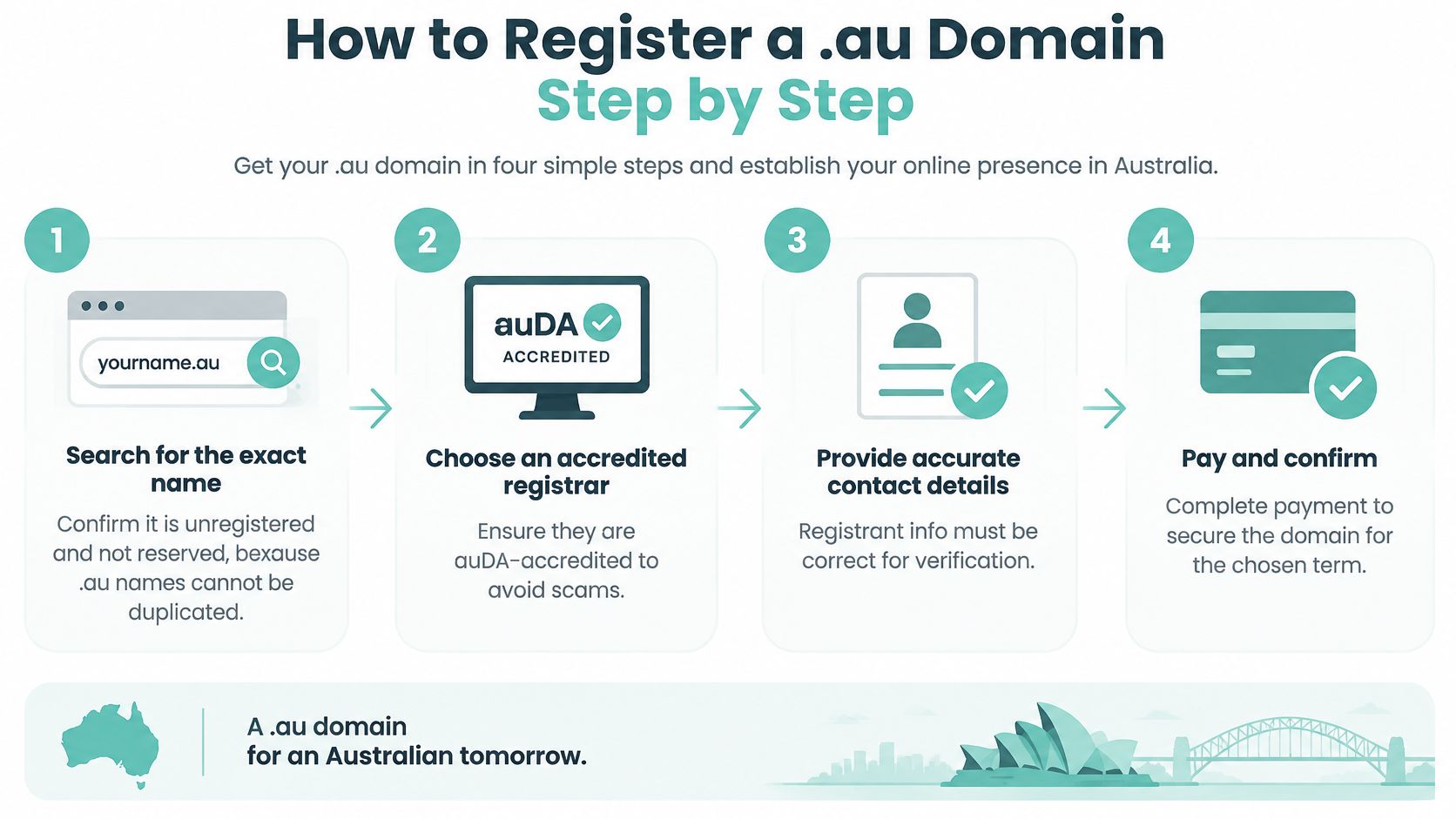
- Search the exact name. Confirm it's unregistered and not reserved, because .au names can't be pre-registered or held, and availability can change between your search and your checkout (auDA product guide 2026).
- Match the name to your namespace and check it's valid. Letters, numbers and hyphens only, no spaces, and not deceptively similar to an existing .au name.
- Choose an accredited registrar or reseller and enter registrant details exactly as they appear on your ABN, ACN or identity documents. Trading names cause validation failures; the checks a registrar must run are listed in domain registration requirements.
- Supply evidence of Australian presence. That's usually a driver's licence, passport number or ABN for .au direct, and an ABN or ACN for .com.au.
- For .com.au, confirm the allocation connection. The name must tie to your legal name, registered business name, trade mark, or a product or service you provide, and auDA audits registrations after the fact, so the legal entity name and current ABN or ACN matter more than the trading name on your sign (auDA guide to registering a .au domain name).
- Pick your term and pay. Each registrar sets its own licence fee, so compare the total across the whole term and check the renewal price against the first-year price before you commit.
- Complete validation and save everything. Keep the confirmation email, the registrar login and the renewal date somewhere you'll find them in two years.
A worked example
Harbour View Plumbing Pty Ltd wants the .com.au matching its business name. The owner searches, finds it free, selects .com.au, enters the legal entity name and ABN exactly as recorded, and confirms the name derives from the registered business name. Validation clears, he pays for a multi-year term, and the domain shows as active with a renewal date.
That last detail is how you confirm success: active status in the registrar account, the registrant being the entity that owns the business, and a renewal date recorded outside the dashboard. Checkout completion isn't ownership, and it isn't permanent. Eligibility has to hold for the whole licence period, or the registrar or auDA can suspend or cancel the name.
Fees belong to the registrar, not to auDA. A cheap first year with an expensive renewal is a longer, more costly registration than a plain one.
Host your website with our 5-star rated, cPanel website hosting plans.
Super fast servers, with security included and hosted in your choice of Australian Data Center.
View cPanel Plans
Spot Registration Scams Before They Cost You
A café owner gets an email with a logo, a reference number and a warning that the business's .com.au licence will be cancelled within 24 hours unless the registrant verifies their details. The page behind the link asks for a driver's licence and a login. Nothing about it is real, but the deadline does its job.
auDA warns that criminals impersonate auDA employees in phishing campaigns, asking recipients to click a verification link, hand over information, retain a licence or avoid service disruption (auDA scams awareness). The tell is always the same: urgency plus a link you didn't ask for.
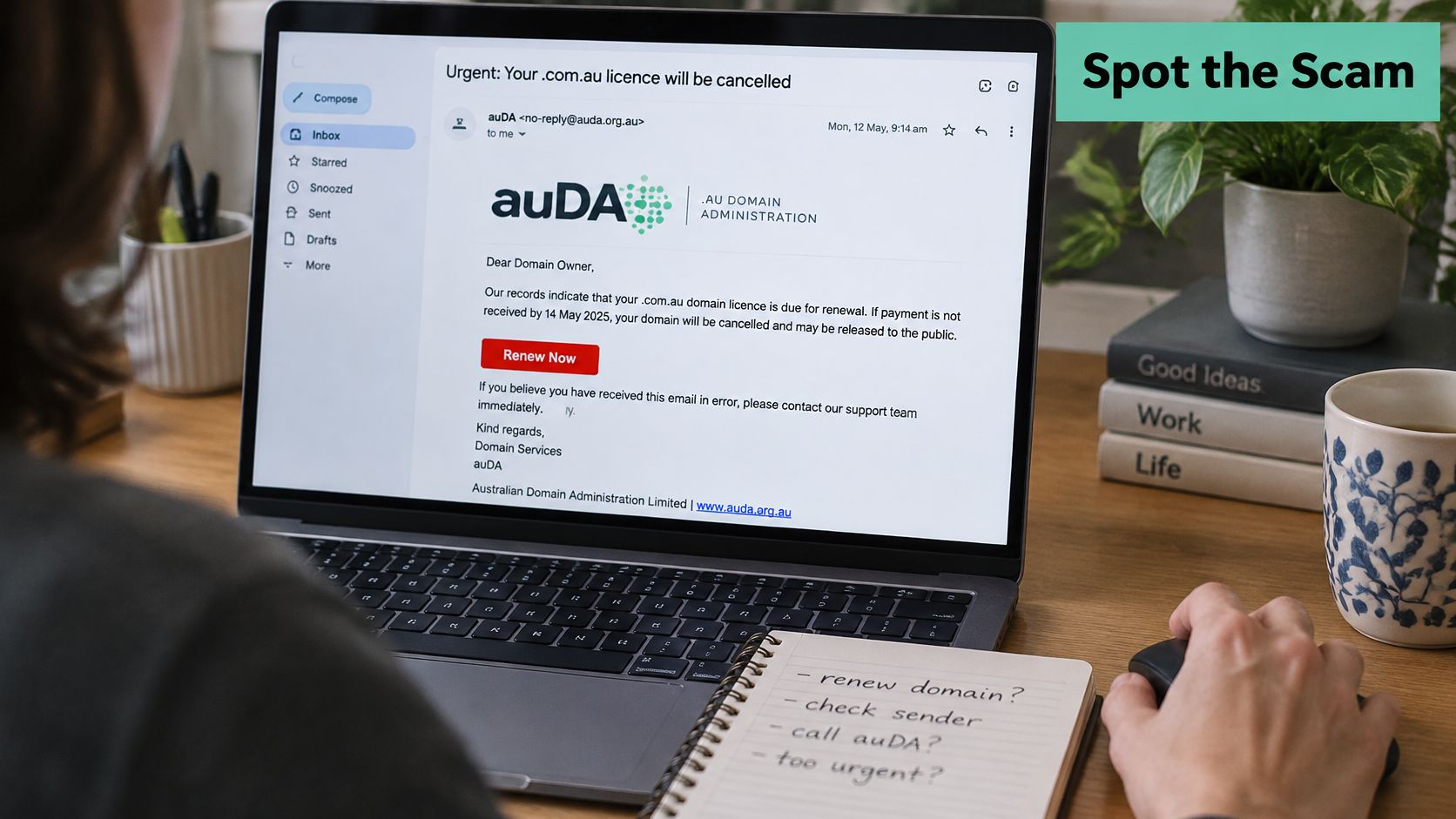
Under pressure, work through it in this order:
- Don't use the link. Not to check, not to "see what they want".
- Verify through official channels. Contact auDA through its enquiry channels or on 1300 732 929 and ask whether the message is genuine.
- Reach your registrar directly. Type the known address or open a saved bookmark instead of following an unsolicited route.
- Report it. Send suspected scams to the ACCC's Scamwatch.
- If you disclosed anything, contact state or territory police and the Australian Cyber Security Centre.
Small businesses carry the most risk here because domain credentials and personal documents provide access to the account. With both, someone can take over the registrar login or push a fraudulent transfer, and the website and email go offline together. Choosing a registrar with a track record helps; the comparison of domain name registrar options in Australia covers what to check before you upload documents.
An unsolicited deadline is a reason to check the message, never a reason to click the link inside it.
Fix the Most Common Registration Problems
Most registration problems aren't mysterious. They fall into five patterns, and each has a first move you can make without calling anyone.
| Symptom | Likely Cause | Fix |
|---|---|---|
| Name shows as unavailable | Already registered or reserved | Try a variant tied to your legal name, trade mark or service, or consider .au direct |
| Application rejected on eligibility | Entity name, ABN or ACN does not match the registrant | Use the exact legal entity name and current ABN or ACN details |
| .com.au name rejected | Name has no connection to the business | Choose a name based on your legal name, business name, trade mark, service or product |
| Domain suspended or cancelled | Eligibility lapsed after registration | Update registrant details and evidence with the registrar before the deadline |
| Site offline after registration | Nameservers not pointed to the host or change not yet spread | Confirm nameservers at the registrar and check propagation from an independent network |
How long each problem takes to clear
Timing is what separates a mild annoyance from a launch delay. A name clash resolves in minutes: run four or five variants and you'll normally find one that's free and defensible. Eligibility problems are the slow ones, because you're assembling documents that match a legal entity, and that can take days if the ABN details were updated after the business changed structure.
DNS is the middle case. A nameserver change made in the morning may not be visible to a customer in another state until the following day, so don't schedule a launch announcement for the same afternoon.
One question comes up constantly with sole traders and new companies. If you don't have an ABN yet, .au direct doesn't require one, and the answer on whether you need an ABN to register a .au domain name sets out which evidence works instead. Fix eligibility before launch and you avoid the expensive version of this problem, which is a working website whose domain gets suspended months later.
Set Up DNS and Confirm You Are Ready to Launch
A registered domain is an address with nothing behind it. Until DNS points somewhere, visitors get an error page and email bounces, and the fastest way to understand that is to see the three records in plain terms.
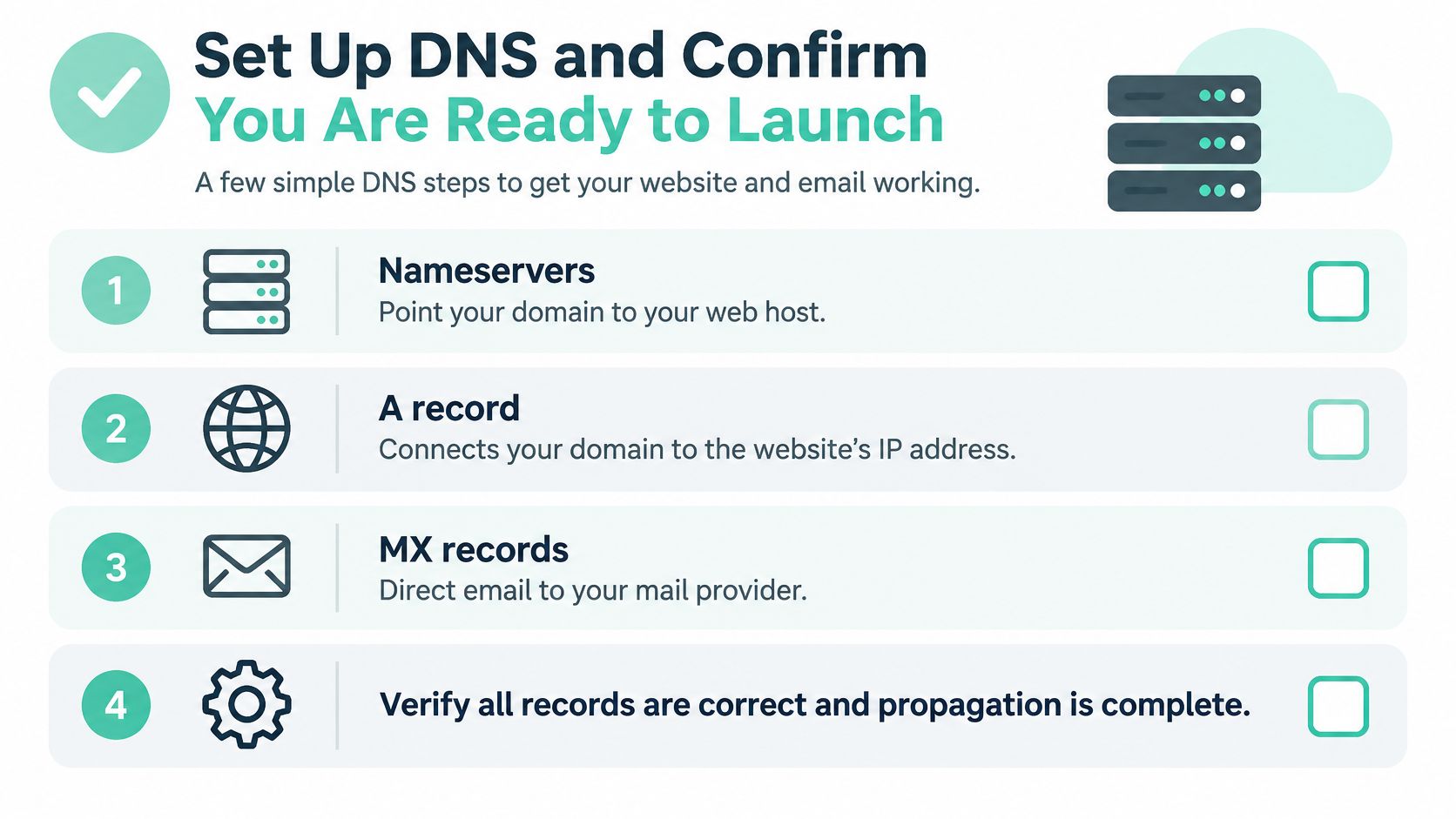
- Nameservers are the delegation record. They tell the internet which company holds your zone file and answers queries for your domain, which is why pointing them at your host is the first move.
- An A record connects the domain to the server that holds your website files. If the site loads for nobody, this is usually where the mismatch sits.
- MX records direct email to your mail provider. Get these wrong after switching on business email and messages fail.
Verify nameserver changes from an independent network rather than trusting the registrar dashboard, and read up on why a change made at 9am may not be visible to a customer interstate until tomorrow, which is what DNS propagation explains.
Protect the account as carefully as the name
Publish SPF, DKIM and DMARC records before activating business email, so your new domain doesn't start its life as a spoofable address. Turn on multi-factor authentication where the registrar offers it, use unique credentials, and lock the domain against unauthorised transfers. Consider DNSSEC where your registrar and DNS provider support it, since auDA identifies it as a mechanism for protecting DNS integrity and authenticity (auDA on keeping .au secure).
The scale behind those controls is real. auDA reported more than four million .au domains under management and about 2.6 billion daily .au DNS queries in 2021–22, with a DNS-abuse rate of 0.03%, below the global average.
The launch checklist
- Registrant name matches the ABN or ACN record exactly, not the trading name.
- Namespace and renewal date are the ones you chose, not a default at checkout.
- Auto-renewal is on with a calendar reminder as the backup, because a lapsed renewal or a lost registrant email can take the website, email, SSL validation and password recovery offline at once.
- Nameservers resolve from a network that isn't yours.
- Business email sends and receives before you print the address anywhere.
- Recovery contacts are saved alongside the registrar account, DNS provider and renewal date, ready for handover to a developer.
Once the site resolves, getting it found is the next job, and a walkthrough on how to pick relevant directories saves you from submitting to lists nobody reads. UpTime Web Hosting lets customers register and secure a domain instantly, and Hosting Configuration support covers email tasks, domain and DNS changes, SSL installation and renewal, PHP configuration, database administration and storage clean up if you'd rather hand the technical side over. The team is on 1300 92 62 92 or support@uptimewebhosting.com.au.
UpTime Web Hosting handles the part that comes after the paperwork, with instant .au domain registration, local DNS and email, free Let's Encrypt SSL and Australian-based support you can reach on 1300 92 62 92. If you'd rather have your eligibility evidence checked before anything is submitted, our team can walk through the ABN, entity name and namespace with you first. Register the name you've settled on at UpTime Web Hosting and get it pointing at a site the same day.