You've got a business name on a notepad, a quote for vehicle signage and a browser full of domain searches. Your favourite address is taken, but a longer version with a dash is available. It's tempting to buy it and move on.
That's how owners end up spelling their web address on every phone call. Choosing a business domain means balancing brand fit, Australian eligibility and the risk of customers confusing your address with someone else's. Availability matters, but it shouldn't make the decision for you.
Table of Contents
- Eight Steps to Pick a Business Domain Name
- Brainstorm, Test and Shorten Your Name
- Choosing Between .com.au, .au Direct and Other Extensions
- Trademark, Business Name and Lookalike Checks
- Check Availability and Register Without Costly Mistakes
- Lock In Your Domain and Plan Any Move

Performance you can feel, backed by clients who depend on it. Read how our support and uptime create long‑term customer success.Power Your Business with Better Hosting
Eight Steps to Pick a Business Domain Name
The costly mistake is checking availability before settling the brand. You find a free address, adjust the business name to match it, then discover it doesn't suit the customers or services you want.
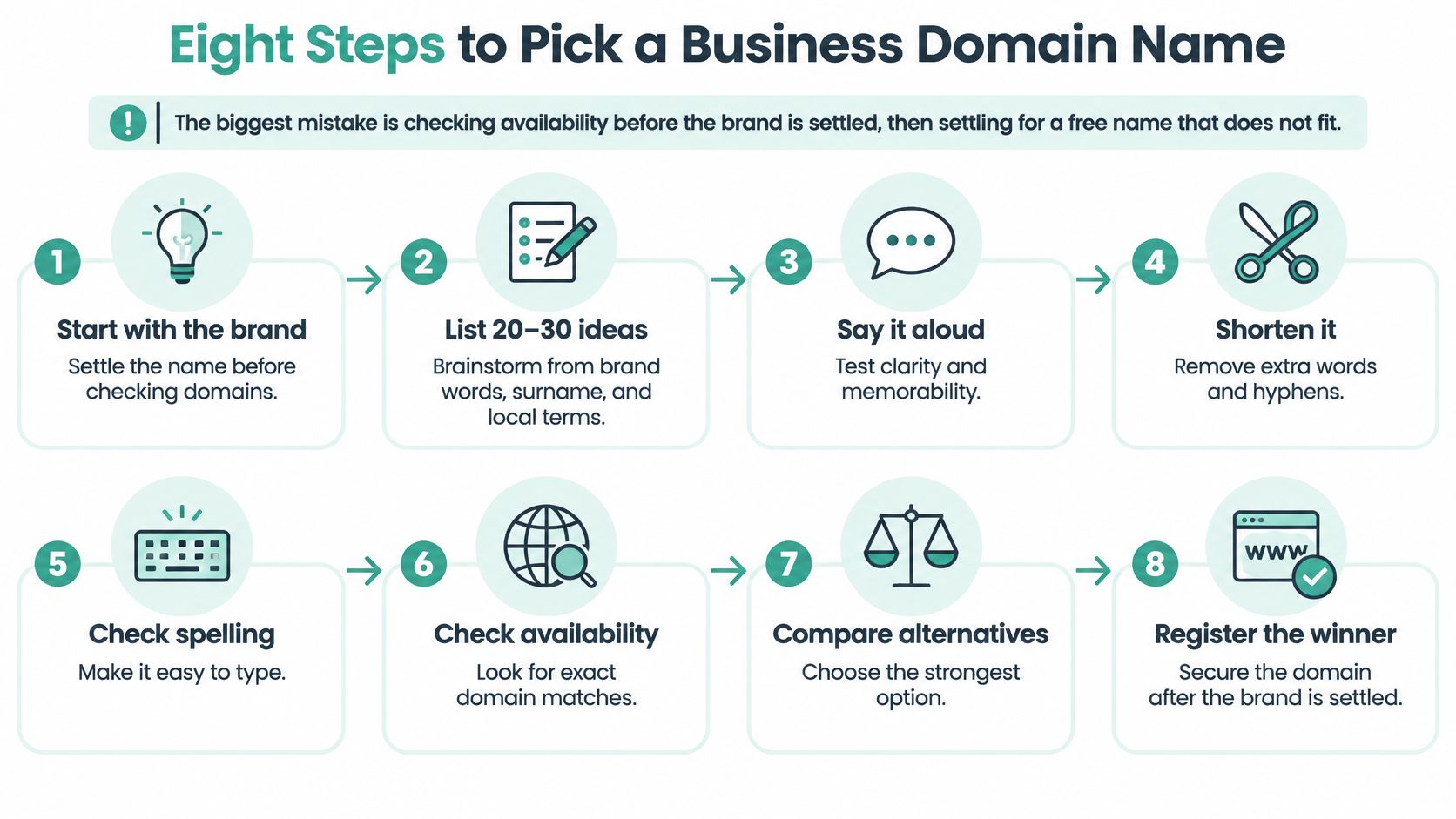
Start with a decision process
- Write down the business basics. Put the business name, core services and main customer area on one page. Your output is a naming brief, not a domain search result.
- Build a broad candidate list. As a brainstorming exercise, list 20 to 30 possibilities using brand words, your surname, a service word or a relevant place name. Don't edit while generating ideas.
- Test a shortlist. Narrow the list to five to 10 variants, then say and spell each aloud. Keep the ones another person can understand without coaching.
- Choose an extension. Start with .com.au for most Australian commercial businesses. Record an alternative only when it makes sense for your audience.
- Check potential conflicts. Investigate business names and trade marks before approving signs, uniforms or vehicle wraps. Mark unresolved candidates as pending.
- Verify availability and eligibility. Search through auDA's official resources, then use an accredited registrar or reseller with the correct ABN or ACN details. Keep a record of the result.
- Secure the selected name. Register before the website is ready, then arrange renewal controls and account security immediately. The output is a domain the business controls.
- Prepare any replacement carefully. If you're changing an existing address, map old pages to their replacements before switching. Keep the migration plan separate from the naming decision.
Decision record: Finish with a dated shortlist of three names, each showing its extension and clearance result. Don't choose a weaker brand simply because its address is free today.
Brainstorm, Test and Shorten Your Name
Say you're starting Harbour Green Gardens in Sydney. harbourgreen.com.au is compact and flexible, but someone seeing it without context could assume it belongs to a café or apartment development. harbourgreengardens.com.au takes longer to type but tells a prospective customer exactly what you do.
Neither wins automatically. The shorter version suits an established brand that people already recognise; the descriptive version can work harder for a new business appearing on a ute, quote or local directory.

Generate first, judge second
Build ideas from combinations of brand words, your surname plus a service, or a local term with a genuine connection to the business. Use a place name only if you're comfortable carrying it into your future plans.
If the page stays blank, IndieTool's a naming framework for indie founders offers another way to structure the exercise. Use it for prompts, then judge the results against Australian customers and your actual services.
The Australian Government's starting-a-business guide recommends a domain that's short, memorable, easy to pronounce and spell, unique, and unlikely to be confused with another business. Apply that as a filter rather than trying to make every candidate clever.
Put candidates through practical tests
- Say it without showing it. Ask someone unfamiliar with the name to write what they hear. If they need hints, customers probably will too.
- Spell it over the phone. Try the exercise with ordinary background noise. Repeated corrections are a warning, particularly if most enquiries arrive by phone.
- Read it as an unbroken string. Look for accidental words and letters that blur together. Test it in a small email signature, not just a large logo.
- Remove unnecessary complications. Drop hyphens, decorative numbers and awkward doubled letters unless they're essential to the brand. The guide to domains with dashes explains the practical trade-off.
- Test future fit. A Sydney-specific name becomes awkward if you open in Perth. A narrow service name can also become misleading when you expand the offering.
Keywords provide context, not a shortcut to search rankings. cheap-plumbers-sydney.com.au piles up terms and relies on hyphens, while coastalplumbing.com.au includes a service word and still reads as a business.
I'd aim for under about 15 characters before the extension as an editing target, not a technical rule. Harbour Green is a reasonable exception if the extra length prevents confusion; clarity matters more than hitting an arbitrary count.
Try the address after hello@ and accounts@, then search the candidate name online. If unrelated established brands dominate the results, you'll spend more effort distinguishing yourself. Keep five to 10 names that pass the tests, with a short note explaining each name's strongest feature and remaining concern.
Host your website with our 5-star rated, cPanel website hosting plans.
Super fast servers, with security included and hosted in your choice of Australian Data Center.
View cPanel Plans
Choosing Between .com.au, .au Direct and Other Extensions
Australian customers recognise local extensions. auDA's consumer-trust findings published in 2025 found that three in four Australians were more likely to trust an Australian business when its website ended in .au; its December 2024 namespace figures put .com.au at 74.9% of .au domains and .au direct at 17.9%.
That makes .com.au a sensible starting point, not an automatic winner. An extension can communicate local relevance, but it won't rescue an awkward name or prevent customers confusing similarly named businesses.
Compare the practical options
| Extension | Eligibility to investigate | Practical role |
|---|---|---|
| .com.au | Commercial entity, generally with an ABN or ACN, meeting the namespace rules | Default choice for most Australian commercial businesses |
| .au direct | Person or entity with an Australian connection | Shorter primary address or useful brand protection |
| .net.au | Commercial entity, generally with an ABN or ACN, meeting the namespace rules | Secondary protective name rather than the first choice here |
| .org.au | Registered Australian not-for-profit organisation | Appropriate namespace for an eligible not-for-profit |
| .com | Check the registrar's applicable requirements | Worth considering for an Australian business selling mainly overseas |
Treat the eligibility column as a starting screen. Having an ABN doesn't mean every possible .com.au name is suitable for your business, and .au direct still has licensing conditions despite its broader audience.
Choose for the customer, not the trend
Check .com.au first because it's familiar in Australian commerce. If the matching name belongs to an unrelated firm, investigate .au direct only after considering whether customers could confuse the businesses.
For example, a Brisbane bakery might find that its preferred .com.au belongs to a Gold Coast business. It could test brandname.au before settling for brandname.com, but a nearby bakery using the same brand would be a reason to reconsider the name itself.
I'd consider .net.au mainly as a secondary address to protect an established name. Choosing it as your main address can mean repeatedly correcting people who assume you said .com.au.
For an Australian software business weighing a fashionable extension, the explanation of what .io means provides useful context. Don't adopt it just because other technology businesses do; judge whether your customers will remember and trust the address.
A shorter extension is useful only if customers still reach the right business. Avoid saving a few characters at the cost of constant clarification.
Record your preferred extension beside each finalist. That gives you specific addresses to investigate, rather than an open-ended hunt across every available ending.
Trademark, Business Name and Lookalike Checks
A free domain isn't a cleared brand. A registered business name, a trade mark and a domain licence serve different purposes, so completing one check doesn't settle the others.
IP Australia's guide to choosing the right IP tool explains that business-name registration doesn't stop another party using the same name, while a qualifying trade mark can offer stronger protection under the Trade Marks Act 1995; it also explains that a trade mark doesn't automatically entitle its owner to a matching .au domain.

Separate clearance from availability
Say a Queensland consultancy wants clearpath.com.au. Before buying signage or publishing email addresses, its owner should check the ASIC business-name position, search IP Australia's trade mark tools and verify domain availability separately.
Search similar spellings and related services, not just the exact phrase. If a close result appears, get advice from an Australian trade marks professional before committing to the brand.
The domain registration requirements guide is useful for checking the registration side of the decision. It isn't a substitute for assessing potential brand conflicts.
Rank lookalikes by likely harm
A scammer doesn't need access to your website to impersonate your business. A similar address can be enough to send a fake payment request or redirect someone seeking support.
The ACCC's small-business scam guidance warns about similar website addresses and unsolicited domain offers, and notes that scammers can use stolen branding, ABNs and even .com.au domains. A familiar extension isn't proof that a message is genuine.
Domain priority tiers for a new business
| Priority tier | Example for Harbour Green Landscapes | Action |
|---|---|---|
| Tier 1: primary name | harbourgreenlandscapes.com.au | Register first and renew for multiple years |
| Tier 2: likely variants | harbourgreen.com.au, harbourgreenlandscape.com.au | Register if inexpensive and likely to be typed |
| Tier 3: high-risk lookalikes | harbourgreenaccounts.com.au, harbourgreenpay.com.au | Register or monitor, because scams target payment and support |
These are candidate examples, not claims that the addresses are available. Defensive registration also needs to meet the applicable eligibility rules.
Don't buy every imaginable variation. Prioritise names customers are likely to mistype and lookalikes that could make a payment request convincing, then monitor the rest. Run trade mark searches on your top three candidates and record the results before approving a winner.
Check Availability and Register Without Costly Mistakes
Registration should leave your business in control of the domain, the account and the renewal notices. A low introductory price is poor value if you can't recover the login or identify who holds the licence.
The auDA registration and namespace guide explains that .au registration is first-come, first-served where the applicant meets the licensing criteria, the name isn't registered or reserved, and the name meets syntax and deceptive-similarity rules.
Follow the registration sequence
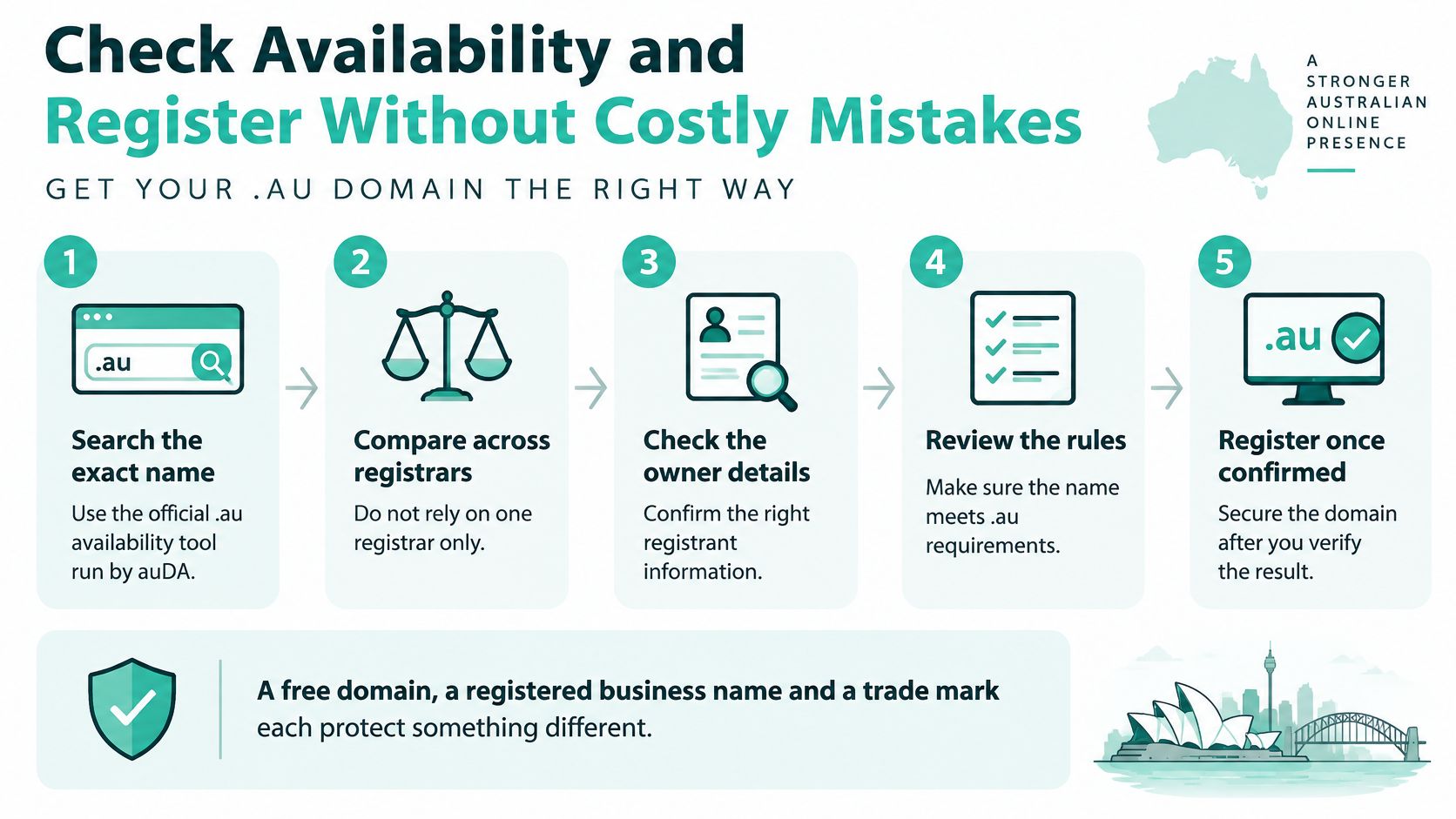
- Search the exact address. Use auDA's official availability resources. Check the complete name and extension rather than assuming a search for the brand covers every variant.
- Compare registrar offers. Confirm the result across accredited registrars or their resellers. Compare renewal pricing, account recovery and support, using this Australian registrar comparison guide as a checklist.
- Enter the correct registrant. Use the business's legal details and applicable ABN or ACN, not the developer's details. Check the spelling before paying.
- Choose the term deliberately. Favour a multi-year term where the budget allows, while checking the ongoing renewal cost. A longer term doesn't remove the need for reminders.
- Secure the account. Enable auto-renewal and two-step login where available. Use a recovery address you can access if the domain's own email stops working.
- Document responsibility. Store the registrar, exact domain, renewal date and named account owner in the business's password manager or asset register.
Keep access with the business
Suppose a developer registers Harbour Green's domain through a personal account, then leaves the industry. The owner may have a working website but no practical way to approve changes or resolve a missed payment.
Instead, register harbourgreen.com.au under the company's correct details and give the developer delegated access where supported. Store recovery information in the business's shared password manager, with access restricted to authorised staff.
One option is UpTime Web Hosting's domain services, which can sit alongside hosting and business email in the same customer account. Consolidation can shorten setup and centralise renewal management, but don't assume different services automatically share a renewal date.
For registration and account-setup help, consult the provider's knowledge base through its website. Keep the Australian Government's domain-registration checklist beside the application so you can check the business details before submitting it.
Register your new domain name at competitive market prices including free domain add-ons like privacy, DNS Hosting, Custom Nameservers and Forwarding.
Always the best price and no nasty renewal price hikes.
Register A Domain Name
Lock In Your Domain and Plan Any Move
Once registration is complete, check that the website opens correctly and business email can send and receive. Set calendar reminders for each renewal date, even when auto-renewal is enabled, because cards expire and billing contacts change.
Keep control separate from convenience. The guide to domain name ownership in Australia helps clarify why the business should retain its own records and access rather than relying entirely on a contractor.
Move an existing website with a page map
Changing the address affects more than the homepage. If you're also reconsidering the site platform, Operosus's comparison of a website builder versus a custom build can help you decide what to rebuild before scheduling the move.
Use this migration checklist:
- Inventory valuable old pages. List URLs with search traffic or inbound links, using Google Search Console, analytics and your existing sitemap.
- Choose a matching destination. Map each old page to its closest replacement. Don't send every visitor to the new homepage.
- Apply permanent 301 redirects. Ask your developer or host to implement and test the page map before launch.
- Update public details. Change Google Business Profile, email signatures, invoice templates, vehicle signage and directory listings.
- Retain the old domain. I'd keep it registered for at least a year, and longer if customers still use its email addresses or printed materials.
- Monitor missed pages. Check for 404 errors for about three months after launch and repair missing mappings promptly.
Use the hosting provider's knowledge base, accessible through its website, for migration and redirect guidance appropriate to your platform. Test important enquiry and checkout journeys yourself rather than accepting a successful homepage load as proof that everything works.
Verify renewal requests before paying
The ACCC's business-scam protection guide warns that unsolicited invoices can concern a domain resembling one you already hold, rather than a genuine renewal. Check the actual domain and registrar independently before approving payment.
For example, an owner of coastalplumbing.com.au receiving an invoice for coastalplumbing.net.au should compare it with the registrar account. Identify the genuine registrar and verify the sender without using contact details supplied in the unexpected notice.
Payment control: Staff should check domain invoices against the asset register, not approve them because the logo or business name looks familiar.
Keep the exact domain, registrar, renewal date and login owner together. Confirm your three shortlisted names, resolve any outstanding clearance concerns and aim to register the strongest candidate within the week.
UpTime Web Hosting offers domain registration, website hosting and business email for Australian businesses. Visit UpTime Web Hosting to check your shortlisted address and arrange the services you need to put it to work.