

Your board is trying to keep the website reliable, keep donor details safe, and keep a volunteer who “knows the website” from becoming a single point of failure. That's the core web hosting problem for Australian nonprofits. Cheap hosting looks tidy on paper, but the moment a donation appeal goes live, a volunteer leaves, or a login gets compromised, the difference between basic and serious hosting becomes obvious.
Australian nonprofits don't run websites as decoration. They run them for service delivery, volunteer recruitment, event registrations, fundraising, and donor communication. The sector is large enough that hosting choices have operational significance, with the Australian Bureau of Statistics reporting 59,502 nonprofit institutions in 2020–21, employing 1.38 million people and contributing $168 billion to the economy in the cited sector summary (Australian nonprofit sector scale). If your organisation depends on its website, then hosting is infrastructure, not an expense line to minimise blindly.
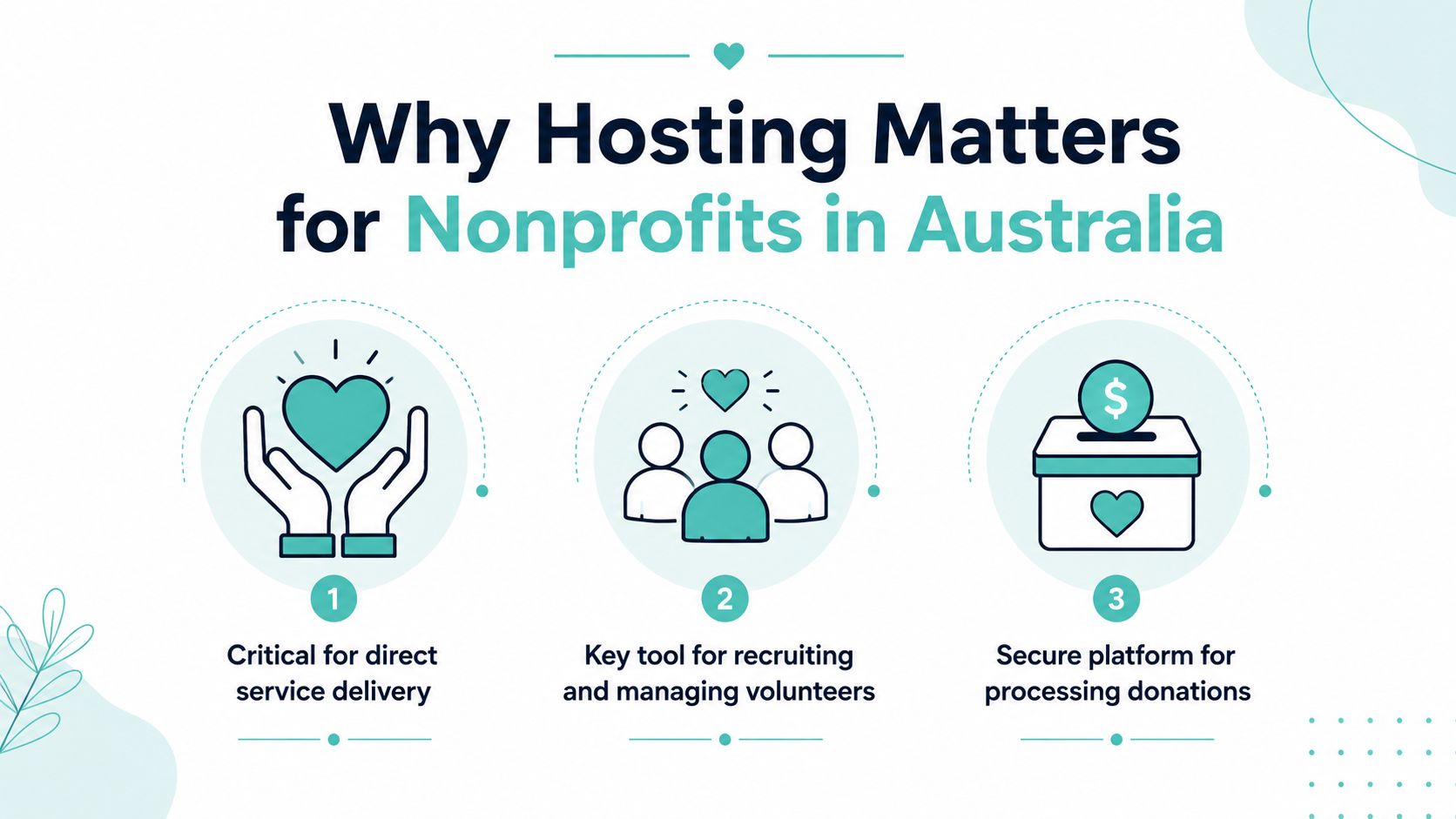
A good rule for boards is simple, free hosting is only cheap until it costs you trust, uptime, or time. If you're already thinking about how different teams work together, the practical framing in integrating tools for your church is a useful parallel, because the website, email, and support systems all need to behave like one controlled environment. For a straightforward local option, even a general small business hosting overview can help directors understand the difference between marketing claims and usable infrastructure.
Table of Contents
- Understanding Nonprofit Hosting Needs in Australia
- Essential Security and Performance Features
- The Case for Local Australian Hosting
- Managing Email and Continuity for Volunteer Teams
- Migration and Setup Checklist for Nonprofits
- Navigating Compliance and Domain Eligibility

Performance you can feel, backed by clients who depend on it. Read how our support and uptime create long‑term customer success.Power Your Business with Better Hosting
Understanding Nonprofit Hosting Needs in Australia
A nonprofit website has to do three jobs at once. It has to look credible to donors, stay usable for volunteers, and keep working when a campaign or crisis pushes traffic higher than usual. That is why web hosting for nonprofit organisations cannot be judged only by storage space or price. It has to support public trust and daily operations in the Australian context.
The website is part of service delivery
For many Australian charities and community groups, the website is the front door. People use it to find services, register for events, donate, and contact staff, often without speaking to anyone first. If the site is slow, unreliable, or awkward on mobile, the organisation shuts the door on part of its audience.
The technical baseline matters because nonprofit websites are commonly built on WordPress.org. Nonprofit Tech for Good reports that 55% of nonprofits use it, 94% already have mobile-optimised sites, and 25% of visitors leave if a site takes more than 4 seconds to load (WordPress, mobile, and load-time data). Those figures point to a practical conclusion, the hosting platform has to support fast page delivery and easy updates, not just keep the site nominally online.
Practical rule: if the site matters to fundraising or service delivery, treat slow hosting as a governance issue, not a technical inconvenience.
Volunteer-led teams feel this pressure first. A board member who can approve a campaign should not also have to troubleshoot caching, reset permissions, or chase down a broken contact form after hours.
Cheap hosting usually shifts the cost elsewhere
A low-cost plan can work for a static brochure site with almost no change. It does not work well for a volunteer-run charity that updates events, posts emergency appeals, and manages enquiries through the website. The hidden cost shows up in staff time, broken forms, and the scramble to recover access when one volunteer moves on.
Australian procurement also has to be more specific than the generic “nonprofit” label that dominates global search results. Local buyers need clarity around charity status, incorporated associations, GST, AU-based support, and whether the provider includes .au domain handling in the base price. That detail matters because a board needs a service that fits Australian legal and operational realities, not a U.S. template dressed up as nonprofit advice (Australian context and pricing clarity).
For a nonprofit, the right hosting platform is the one that keeps email and donation tools under organisational control, reduces dependence on whichever volunteer happens to be available, and fits local compliance and support expectations. A practical starting point is a host that can be evaluated against a plain-English small business hosting overview, then checked against the organisation's own risk, budget, and admin capacity.
Essential Security and Performance Features
A charity site that handles donations, member logins, or volunteer forms needs proper security from day one. If the host leaves gaps around defacement, malware, or account loss, the board is accepting avoidable risk. For an Australian nonprofit, that risk sits alongside volunteer turnover, weak handover practices, and the pressure to keep donor data and enquiry channels under organisational control.
Start with the protections that actually matter
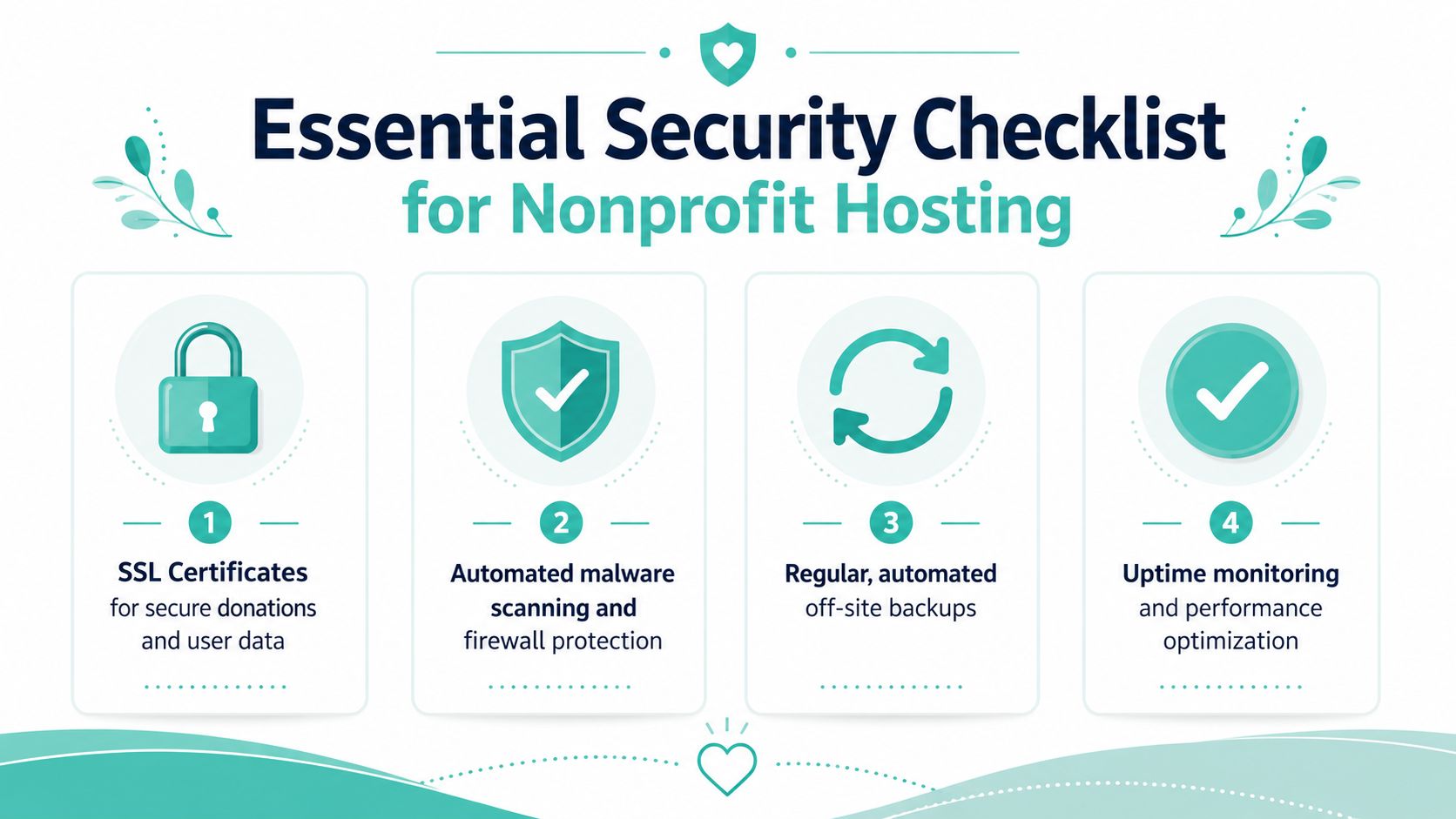
SSL certificates should be included by default, not treated as a paid extra. They protect donation and form data in transit, and they tell visitors the organisation takes privacy seriously. If a host makes SSL hard to find or bundles it behind an add-on, choose a different provider.
The same applies to automated malware scanning, firewall protection, regular backups, and uptime monitoring. These controls matter because the Australian Cyber Security Centre reported 87,400 cybercrime reports in 2023–24, and volunteer-led teams are more exposed to misconfiguration and account loss than larger organisations (cyber risk in Australia). A charity does not need a complicated enterprise stack. It needs a host that cuts down the number of ways a website can fail.
The cybersecurity guide for businesses reinforces the same point. For nonprofit boards, the question is simple, does the host protect donor records, forms, and email accounts well enough to avoid turning a routine issue into a recovery job.
Speed is part of donor conversion
Performance is a board issue, not just a developer concern. Nonprofit Tech for Good notes that visitors abandon a site if it takes more than 4 seconds to load, which makes speed a conversion issue as much as a technical one (load-time abandonment data). If a campaign page loads slowly on mobile, donations can disappear before the appeal is even read.
Choose hosting that keeps the site fast without constant intervention. If the provider needs weekly babysitting just to stay responsive, it is the wrong fit for a volunteer team.
For charities, better plans usually include CloudLinux and LiteSpeed, plus caching, clean backups, and monitoring. Those features matter because they reduce the chance that a busy campaign or one broken plugin takes the whole site offline. If the host cannot explain how it handles traffic spikes, restores backups, and isolates one site from another, that is a warning sign.
Use secure web hosting for nonprofits as the baseline. Every donation page, contact form, and member area should be protected by default, fast on mobile, and recoverable without guesswork.
Host your website with our 5-star rated, cPanel website hosting plans.
Super fast servers, with security included and hosted in your choice of Australian Data Center.
View cPanel Plans
The Case for Local Australian Hosting
Hosting in Australia is the better default for most local nonprofits. You get lower latency for Australian visitors, support in the same time zone, and cleaner alignment with local domain and procurement requirements. Overseas hosting can work, but it usually adds friction where a charity least needs it.
Speed and support favour local infrastructure
Australian visitors don't need their charity website served from the other side of the world if a local data centre can do the job better. The operational advantage is simple, less distance usually means less delay, and less delay matters when a supporter is trying to donate, register, or contact the team during a campaign. That's especially relevant for boards that rely on a site for public-facing service information and crisis communication.
Local hosting also changes the support experience. If the site goes down on a weekday morning, your team wants a provider that answers in Australian hours and understands local expectations around business operations, .au domains, and GST-inclusive billing. That saves time, and for volunteer-led organisations, time is usually the scarcer resource.
For a local perspective on hosting choices, the Australian web hosting overview is the kind of practical reference many boards need before they compare providers. You don't need the fanciest platform. You need one that performs predictably for Australian users and is reachable when something breaks.
Data control and day-to-day governance are easier
A local host is also easier to govern. The board knows where the site lives, who has access, and how quickly the provider can act when a domain or email issue needs attention. That matters for donor data, membership details, and volunteer records, especially when the people maintaining the site are not full-time IT staff.
Local hosting doesn't remove all risk, but it reduces avoidable complexity. For an Australian nonprofit, that's usually the better trade-off than chasing the cheapest offshore plan and hoping support wakes up when you need it.
Managing Email and Continuity for Volunteer Teams
Volunteer-led organisations lose control in the same place over and over, when the website or email account sits in one person's name instead of the organisation's. That's why domain-based email and formal backups are not admin luxuries. They are continuity controls.
Use organisational email, not personal inboxes
A board should insist on role-based email addresses tied to the organisation's domain. That keeps ownership inside the charity, and it stops a departing volunteer from taking years of correspondence with them. Personal Gmail addresses may feel easy at the start, but they create dependency, confusion, and handover risk.
The same rule applies to account management. The charity should control passwords, two-factor authentication, and recovery details, not a single helper who “just set it up.” When a volunteer leaves, the next person should be able to step in without rebuilding the communication stack from scratch.
The email hosting guidance is worth reviewing because the technical needs don't change just because the organisation is nonprofit. The mailbox still needs spam filtering, stable delivery, and enough structure that the board can treat it as an asset rather than a personal favour.
Backups and filtering keep a small team resilient
Backups matter because mistakes happen. A form gets deleted, a plugin update breaks the site, or a ransomware incident locks the account. Encrypted off-site backups turn those events from disasters into recovery tasks.
Spam filtering matters for a different reason, phishing often targets the people least prepared to recognise it. In a charity, that usually means a treasurer, secretary, or volunteer admin who doesn't live in email all day. A good host reduces that exposure by filtering junk before it lands in an inbox and by making restores simple when someone makes a mistake.
If only one person can recover the website, the organisation does not really control the website.
The board should ask one question before approving a host, can the site and email survive a staff handover without drama? If the answer is no, the hosting setup is too fragile for a nonprofit.
Migration and Setup Checklist for Nonprofits
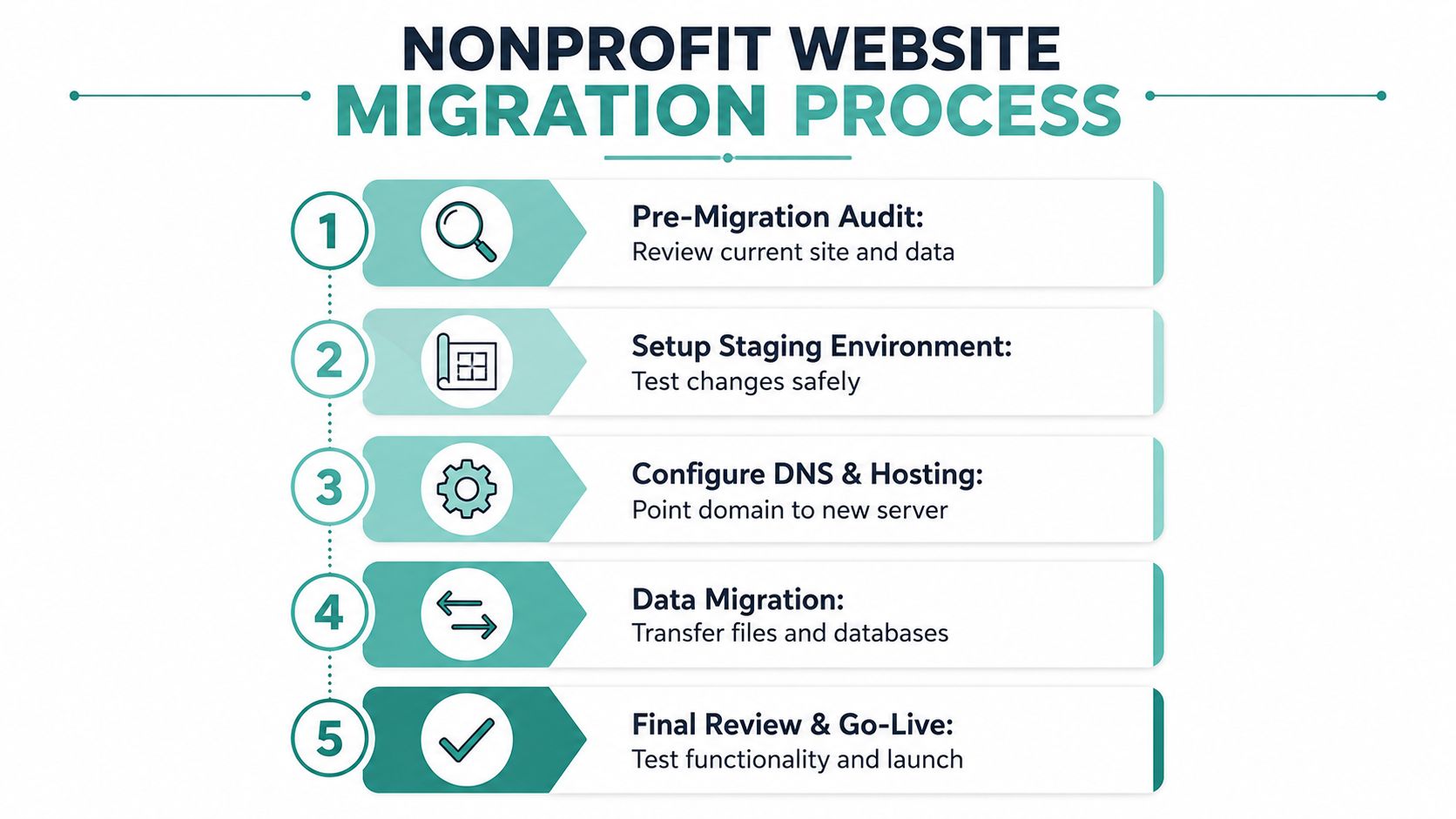
Moving a charity site is less about “launch day” and more about not breaking donations, forms, or email in the process. A calm migration starts with a clean inventory, a test environment, and a provider that can explain what happens before and after the cutover. If the host is vague here, expect problems later.
Check the site before anything moves
Start with a pre-migration audit. List every form, donation page, member area, newsletter signup, and contact route. If the current site has old pages or unused plugins, remove them before the move, because clutter makes troubleshooting harder.
Then confirm who owns the domain, who controls hosting access, and where backups sit. For a volunteer-run charity, those three items are the difference between a controlled migration and a guessing game. If an external contractor built the original site, ask for admin access and handover notes before agreeing to any move.
Test in staging, then verify the live site
A staging environment is essential. It lets you check theme changes, plugin updates, and page layouts without risking the public site. For a charity, that matters because even a small layout issue can break a donation button or confuse a supporter trying to complete a form.
Use this practical checklist during the migration:
- Audit all critical pages: Make sure donation, contact, volunteer, and emergency pages are accounted for before the transfer.
- Test forms in staging: Submit them yourself and confirm the messages arrive in the right mailbox.
- Check mobile display: Confirm the site still reads clearly on a phone, since most visitors won't be on desktop.
- Verify redirects and old links: Don't leave broken links pointing supporters to dead pages.
- Review backups before go-live: Make sure there's a restore point before the final switch.
A sensible host should be able to explain the migration path in plain English. The website hosting requirements guide is a good example of the kind of clarity boards should expect when reviewing domain and hosting responsibilities.
Don't launch until the basics are verified
Before going live, test the site after the DNS change, confirm email routing, and check that donation and member workflows still function. If the new host can't give you a clean handover process, the migration isn't ready. A charity site should not go live with broken forms and crossed fingers.
Register your new domain name at competitive market prices including free domain add-ons like privacy, DNS Hosting, Custom Nameservers and Forwarding.
Always the best price and no nasty renewal price hikes.
Register A Domain Name
Navigating Compliance and Domain Eligibility
Australian nonprofits need hosting that fits both the technical setup and the legal structure behind the site. That means checking .au eligibility, thinking about donor-facing trust signals, and making sure the website can support Google Ad Grants requirements without constant fixes. A good host won't create compliance for you, but it should make compliance easier to maintain.
Get the domain right before you lock the host
auDA rules require a real and substantial connection to Australia for .au domain eligibility, such as an Australian registered business number, company number, registered trademark, or an Australian partnership or incorporated association. In many cases, the domain name also has to match the registrant's eligibility basis closely enough to satisfy the rules (auDA eligibility and naming requirements). That means the board should confirm the legal entity details before the domain is registered, not after.
Domain management and hosting need to work together. If the registrar or host makes DNS changes slow, messy, or dependent on one person, the organisation loses control over its own public identity. A clean setup keeps the domain under the charity's control and makes handovers far easier.
Don't ignore Google Ad Grants requirements
Google Ad Grants brings value only if the site is functional, easy to use, and filled with substantial original content that clearly describes the organisation's mission and activities. The site also can't be built mainly around commercial advertising or affiliate links (Google Ad Grants website policy summary). For Australian charities that depend on grant traffic for volunteers, events, or fundraising, that makes hosting performance and content management part of the grant strategy.
A broken or thin site doesn't just look bad, it can undercut the organisation's visibility when grant traffic matters most.
A host that supports stable uptime, quick page loads, and frequent updates gives the content team a better chance of staying compliant. That's the practical link between hosting and fundraising, the infrastructure has to help the site stay useful, not just online.
The right choice for an Australian nonprofit is the host that fits its legal entity, supports its domain needs, protects donor trust, and reduces volunteer burden. That combination is what keeps the website useful after the launch hype fades.
If your organisation wants hosting that's built for Australian conditions, local support, and the realities of volunteer-led administration, take a hard look at UpTime Web Hosting. You'll get Australian-based infrastructure, GST-inclusive pricing, security features that belong on a serious nonprofit site, and the kind of support a board can rely on. Visit the site and compare it against your current setup before the next campaign exposes the gaps.