Choosing the best website builder for small business Australia comes down to finding that sweet spot between ease of use, local features, and what it costs. For most Aussie businesses just starting out, an all-in-one builder with local hosting, support for Australian payment gateways, and clear GST pricing is the perfect launchpad. Below you'll find a comparison of the leading platforms, a quick decision matrix, and a five-step launch guide.
The Critical Need For A Website In The Australian Market
Here in Australia, a surprising digital divide still exists, and it's created a massive opportunity for small and medium-sized businesses (SMBs). Heaps of operators, particularly in regional areas, are getting by without any online presence at all. This puts them at a major disadvantage, but it also lights up a clear path to growth for anyone ready to get online.

The numbers really tell the story. The most recent Australian Small Business and Family Enterprise Ombudsman data highlights how central small businesses are to the national economy, and separate 2024 survey reporting found 59% of Australian small businesses still don't have a website — a figure that jumps to 65% in regional spots. This means providers like UpTime Web Hosting are perfectly placed to help businesses in Sydney, Melbourne, Brisbane, and Perth get online without breaking the bank. With only 41% of SMBs having a site, the rest are missing out, especially since 75% of Aussie consumers say they prefer to buy from businesses that have a proper website.
Unlocking Growth With An Online Presence
Getting a digital home for your business is about so much more than just being found online. A professional website is your 24/7 storefront. It builds credibility and trust with potential customers before they’ve even picked up the phone. It becomes the central hub for all your marketing, from your social media posts to your local business listings.
Here are the tangible benefits of getting your business online:
- Boosted Credibility: A well-designed website signals that you're professional and legit, making customers far more likely to trust you and choose your services.
- Increased Revenue: Being online opens up completely new sales channels, whether that's through direct e-commerce or by generating quality leads for your service-based business.
- Enhanced Customer Access: Your site gives customers all the essential info they need—like your hours, services, and contact details—making it dead simple for them to engage with you.
For so many business owners, the biggest things holding them back are the perceived high costs and technical headaches. But modern DIY website builders have been specifically designed to tear down those barriers.
Overcoming Common Obstacles
The thought of building a website can feel a bit overwhelming, but today's tools have made it easier than ever. Concerns about the budget are totally valid, but you can check out our guide on how much you need to build and manage your website to see just how affordable modern solutions really are.
Platforms like Sitejet, which we offer with local Australian hosting, give you intuitive drag-and-drop tools and pre-designed templates — no coding required to create a professional-looking site in hours, not weeks. Simple touches like an enquiry form do a lot of the lead-capture work for you; this Formbricks guide to adding a contact form to any website walks through how to get notified of enquiries for free. These tools are built for the local market, making now the perfect time to finally get online.

Performance you can feel, backed by clients who depend on it. Read how our support and uptime create long‑term customer success.Power Your Business with Better Hosting
How We Selected These Website Builders
To keep this comparison useful, each builder was evaluated against the criteria a small business owner needs when choosing a platform.
The criteria used to score every platform:
- Local performance: Whether the site could be served from Australian data centres.
- AUD pricing and GST transparency: Whether the price you see is the price you pay, with no surprise currency conversion.
- Australian payments: Afterpay, Zip, and local bank gateway support.
- .au domain handling: How smoothly you can register or connect a .com.au or .au domain.
- Exit flexibility: How easily you could move your content elsewhere if you outgrow the platform.
One context note worth knowing: the website-builder market has shifted fast. According to W3Techs' 2025 technology comparison, WordPress dominated website building throughout the 2010s, ranking as the leading web technology in every year from 2010 through 2021. Wix then took the top position in 2022, while Elementor ranked first in both 2023 and 2024. In the 2025 comparison, Elementor remained in first place, followed by Wix and Shopify. This progression reflects three different approaches to building online businesses, which is why this comparison weighs both self-hosted and managed platforms.
How To Choose The Right Website Builder In Australia
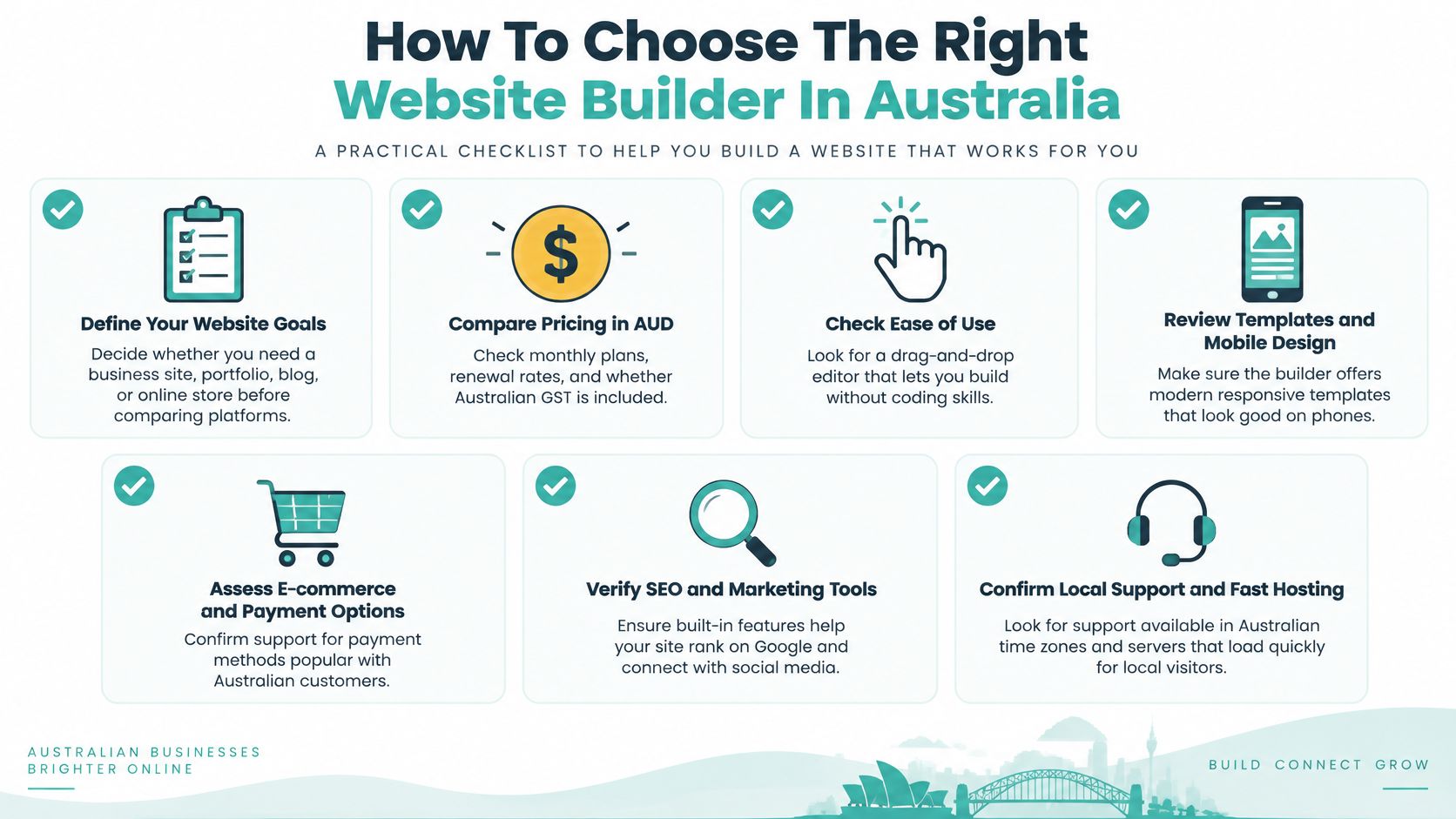
Choosing the right website builder for your Aussie small business isn't about chasing the flashiest templates. It's a strategic choice that hinges on local factors which can make or break your sales, customer trust, and search rankings. Look past the drag-and-drop editor and dig into how a platform really performs here.
Secure Your Aussie Digital Identity With A .au Domain
Your domain name is the first signal you send that you're a legitimate Aussie business. A .com.au or .au domain builds instant trust and tells shoppers you're based right here. When sizing up a builder, check how easily you can register or connect a .au domain — if it makes this a chore or keeps pushing generic .com domains, it isn't properly set up for this market.
Accept Payments The Australian Way
If you're selling online, payment gateways are everything. Look for one-click integrations with Afterpay, Zip, and direct connections to major Australian banks. If a customer can't pay their preferred way, you're inviting cart abandonment.
Understand The True Cost With GST-Inclusive Pricing
Many international builders quote in USD and forget GST, creating a nasty shock on your first invoice. A provider focused on Australia shows pricing in AUD with GST included, so the price you see is the price you pay. Our own WordPress plans, for instance, are priced in Australian dollars with GST built in.
Boost Speed And SEO With Local Data Centres
Where your data physically lives has a huge impact on performance. A server in the US or Europe adds latency on every request from an Aussie visitor. Choosing hosting in local data centres — Sydney, Melbourne, Brisbane or Perth — slashes load times and gives local SEO a boost. Getting your head around this is a key part of learning how to choose a web host that’s best for you.
Australian Business Website Builder Checklist
| Feature/Consideration | Why It Matters for Your Aussie Business | Example |
|---|---|---|
| .au Domain Support | Instantly builds trust and signals you're a local business. Essential for credibility. | The ability to easily register or transfer a .com.au or .au domain. |
| Australian Payment Gateways | Aussies love Afterpay and Zip. Not offering them can lead to lost sales at checkout. | One-click integration for Afterpay, Zip, and major Australian bank gateways. |
| AUD & GST-Inclusive Pricing | Avoids surprise fees from currency conversion and taxes. What you see should be what you pay. | Plans are clearly listed in $AUD and state that GST is included. |
| Local Data Centres | Faster website load times for local visitors, which improves user experience and SEO rankings. | Hosting servers located in Sydney or Melbourne for low latency. |
| Local Customer Support | Getting help during Australian business hours from a team that understands the local market. | Phone, email, or live chat support based in Australia. |
| E-commerce Capabilities | Tools designed for the local market, including shipping integrations with Australia Post. | Built-in features for managing inventory, orders, and local shipping options. |
Quick Decision Matrix
If you want the answer without reading everything else, here it is:
| Business Type | Best Pick | Why |
|---|---|---|
| Service business (tradie, cafe, consultant) | Sitejet | Fastest path to a professional lead-generation site with no coding, included free with cPanel or Plesk hosting plans. |
| E-commerce retailer | Shopify | Purpose-built store platform with Afterpay, Zip and Australia Post integrations out of the box. |
| Creative or content-heavy business | WordPress | Unmatched customisation and plugin ecosystem, plus full ownership of your site and data. |
Host your website with our 5-star rated, cPanel website hosting plans.
Super fast servers, with security included and hosted in your choice of Australian Data Center.
View cPanel Plans
Guide To Top Website Builders for Australian Businesses
The right builder for your small business goes beyond a feature list. What matters is how each platform handles the demands of our local market. Here's how Sitejet, WordPress, Shopify, Squarespace and Wix compare across the criteria that matter most.
Sitejet: The All-In-One For Service Businesses
Sitejet is built for service-based businesses that need a professional website without tech headaches — a local plumber, a boutique accounting firm, or a freelance photographer. The standout advantage is its straightforward setup paired with reliable support responsiveness, meaning questions are typically answered promptly rather than sitting in an overseas queue for days.
A practical example: an Adelaide cafe needing a menu, hours, location and a booking contact form can realistically build it in an afternoon. Because Sitejet requires no coding and comes with templates to start from, and it's included free with cPanel or Plesk hosting plans (eCommerce is a paid upgrade), it's the lowest-friction option for a first website.
WordPress: The Ultimate In Flexibility And Control
WordPress remains the heavyweight of the web. Per W3Techs, WordPress powers 38.5% of all websites and 57.5% of websites whose content-management system can be identified. These two percentages describe different denominators: the first includes all websites in the survey, while the second excludes sites for which no CMS is detected. As open-source software, it gives you total control over every pixel, with tens of thousands of plugins for everything from booking systems to membership portals.
The trade-off is a steeper learning curve and the need to arrange your own hosting. That's where optimised local WordPress hosting earns its keep, handling security, automatic updates and speed for you. You can read the many reasons WordPress is the best platform for a business website in our dedicated guide.
Shopify: The E-Commerce Powerhouse
If your main game is selling products, Shopify is the gold standard. Shopify is built for product-led stores, with pricing varying by plan. What you get is exactly what an online retailer needs: secure checkout, inventory tracking, and rock-solid integrations with Afterpay, Zip and Australia Post. For a broader comparison, see this detailed ecommerce platform comparison.
A practical example: a Sydney business selling handmade jewellery nationally gets the storefront, Afterpay-enabled checkout and automatic Australia Post shipping calculations out of the box — no wrestling with e-commerce logistics.
Squarespace And Wix: The Design-Focused Generalists
Squarespace and Wix win on templates and ease of use, and they're solid choices for creatives and brochure sites. The catch: their all-in-one nature locks you into their ecosystem, limiting your ability to fine-tune performance with Australian hosting or migrate away easily. Businesses with an eye on scalability or local performance may find them restrictive.
Matching A Website Builder To Your Business Type
Let's get one thing straight: there's no single "best" website builder for every Aussie small business. The right choice isn't about finding a magic bullet solution. It's about matching the right tool to your specific business model. A local tradie in Perth has completely different online needs compared to a Melbourne-based retailer shipping Aussie-made goods nationwide. What works brilliantly for one could be a frustrating dead-end for the other.
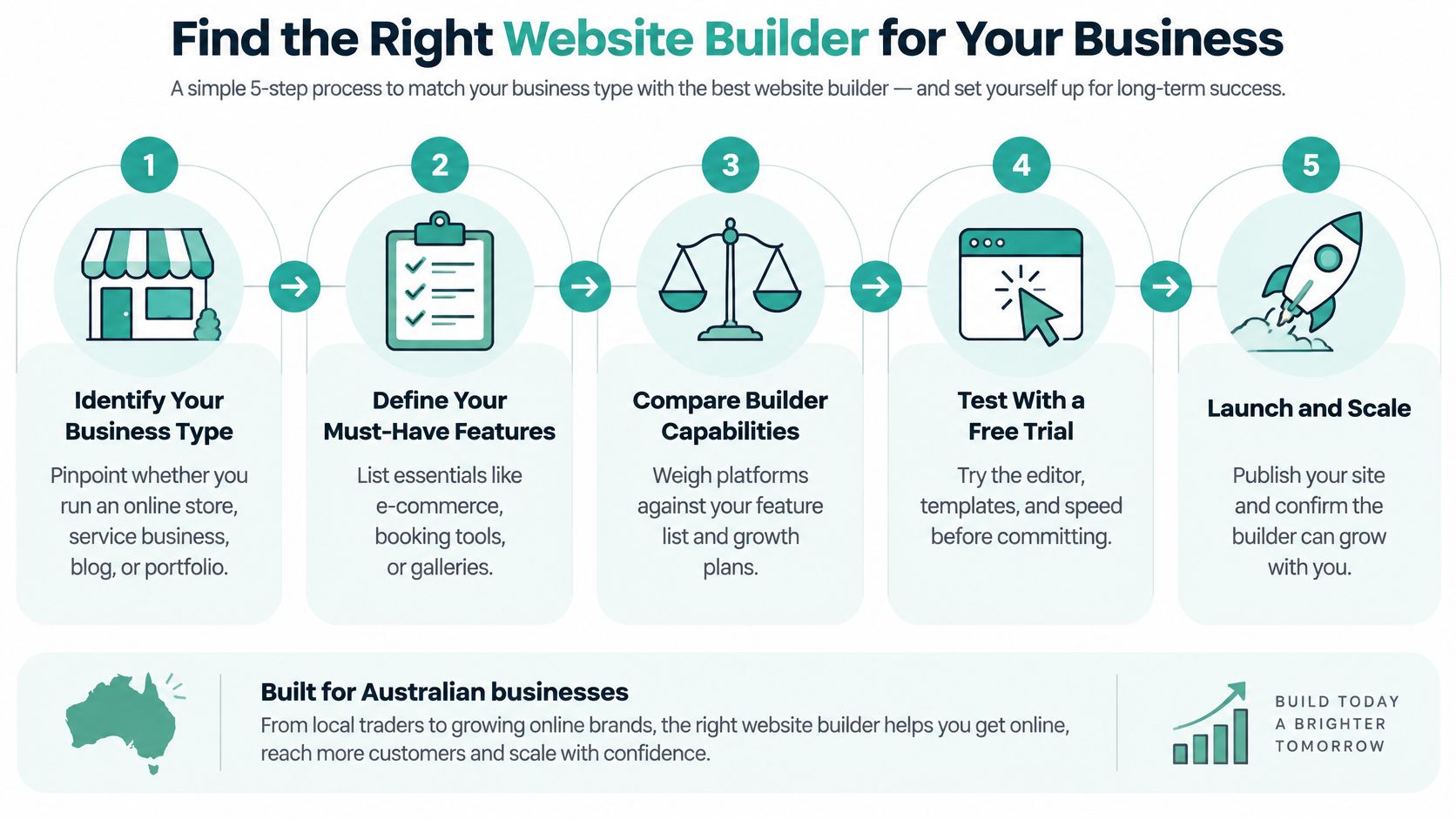
The best way to tackle this is to think in terms of business profiles. Once you're clear on what you need your website to do, you can find a builder that excels in that specific area. This approach cuts through the marketing noise and focuses on what matters for your business: getting a return on your time and money.
To help you get started, this decision tree gives you a quick visual guide to point you in the right direction.
As you can see, the first big question is whether you plan to sell products directly from your site. Answering that immediately sends you down one of two very different paths.
The Local Service Provider
This is your classic local business: the cafe, plumber, electrician, hairdresser, or consultant. Your main goal online is to look professional, build trust, show off your work, and make it ridiculously easy for local customers to find your number and book your services.
For this kind of business, a builder like Sitejet is an excellent fit. It’s built from the ground up to create clean, professional service websites without needing a tech degree. The templates are modern, the drag-and-drop editor is easy to get the hang of, and you can get a great-looking site up and running in a few hours.
When you combine Sitejet with a 100% Australian provider like UpTime Web Hosting, it gets even better. You get the simplicity of the builder with the performance and reliability of local Sydney-based servers, meaning your site will load lightning-fast for your local customers.
Practical Example: Imagine a local gardening service in Brisbane. They need a simple website showcasing their services, a gallery of recent jobs, and a big, obvious phone number. Sitejet lets them build this quickly, and local hosting helps the site perform well for nearby searches like gardening in Brisbane, driving real, qualified leads.
The E-commerce Retailer
If your business is all about selling products online—whether it’s handmade crafts, clothing, or specialty foods—your website has one primary job: to be a smooth, secure, and efficient online store. You need serious tools for managing inventory, taking payments, and handling shipping.
For Aussie online retailers, Shopify is pretty much the king of the hill. It’s a dedicated e-commerce platform, meaning every single feature is designed to help you sell more. It has built-in integrations for Australian payment gateways like Afterpay and Zip and connects directly with Australia Post for easier shipping.
Shopify is more than just a website builder; it's a complete retail operating system. While it's overkill for a simple brochure site, its powerful back-end tools are essential for any business serious about growing its online sales.
The Ambitious Creative or Consultant
This profile is for businesses that need total control, flexibility, and the room to grow. Think of a graphic designer with a huge portfolio, a business coach planning to launch online courses, or a content-heavy blog that needs a highly customised layout. You need a platform that will never hold you back.
In this situation, a self-hosted WordPress website is the ultimate solution. Because it's open-source, the possibilities for customisation are practically endless. With thousands of plugins and themes available, you can add almost any function you can dream up, from complex booking systems to full-blown membership portals. This unmatched flexibility is a huge reason why so many businesses eventually migrate to WordPress as their needs evolve.
Running WordPress on optimised local hosting gives you complete authority over your site's performance and security. It definitely requires more hands-on management, but the trade-off is a powerful foundation that can scale in any direction your business takes you.
Why Australian Hosting Is A Game-Changer For Performance
Choosing a website builder is a massive step, but it's really only half the story. The platform you build your site on is critically linked to its hosting foundation, the engine that powers your online presence. It's something a lot of businesses overlook, not realising that where their website data is physically stored can dramatically affect its speed, security, and even its Google ranking.

For an Australian business, this isn't just a minor detail. It matters. Opting for a 100% Australian provider like UpTime Web Hosting is one of the smartest moves you can make. It means your website is fast, secure, and supported by a team that understands the local market and what your customers expect.
The Need For Speed: Local Servers
Imagine your website's data is parked on a server in the United States. When a customer in Melbourne tries to visit your site, their request has to travel across the Pacific Ocean, find the data, and then zip all the way back. That physical distance creates a delay known as latency, and it’s the number one enemy of a fast-loading website.
By hosting your site on local servers in Australian cities like Sydney and Melbourne, you slash this travel time. The data only has to travel a fraction of the distance, which means significantly faster page load times for your local customers. This isn't just a nice-to-have; a snappy site directly impacts your sales and leads.
Google has been very clear that site speed is a key ranking factor. A faster website doesn't just keep your visitors happy—it helps you climb higher in local search results, putting you ahead of slower competitors.
Integrated Solutions For Peak Performance
Finding the best website builder for a small business in Australia often comes down to looking for an integrated solution. A builder like Sitejet, offered with local hosting, fits that need. You get the simplicity of a modern, intuitive builder combined with the raw performance benefits of Australian infrastructure.
It’s an all-in-one approach where you can build, launch, and manage your site from one place, all backed by local speed and support. Selecting the right website builder and hosting combination ensures your platform and infrastructure work together seamlessly.
For those who need a bit more control under the hood, optimised WordPress hosting is another powerful option. When you pair it with high-performance tools like LiteSpeed web servers and local data centres, your WordPress site can achieve incredible speeds. You can get a better sense of how your hosting service affects website speed in our detailed guide.
The Value Of Local Support
Finally, never underestimate the value of having local, 24/7 support. When something goes wrong, you don't want to be dealing with an overseas call centre in a completely different time zone.
An Australian-based support team understands your business hours and the local market, and can provide swift, relevant help right when you need it most. That level of service helps keep your business online and running smoothly.
Register your new domain name at competitive market prices including free domain add-ons like privacy, DNS Hosting, Custom Nameservers and Forwarding.
Always the best price and no nasty renewal price hikes.
Register A Domain Name
How to Make a Website in Australia: A 5-Step Guide
Once you've picked your builder, the launch itself is simpler than most owners expect. Here's the sequence to follow:
- Register your .au domain. Lock in a .com.au or .au address that matches your business name — it's the trust signal everything else builds on.
- Choose your hosting and builder. If you're a service business, Sitejet included free with cPanel or Plesk hosting plans is the fastest route. For WordPress, entry plans start at $60 for the first year (about $5/month for 12 months) on the Small WordPress Sites plan, while heavier sites can step up to plans with more CPU, NVMe storage and RAM.
- Pick a template and load your essentials. Home, services, about, contact — plus proof: reviews, project galleries, your ABN. Real photos rather than stock imagery build more credibility on a new site.
- Wire up payments and contact forms. Enable Afterpay or Zip if you sell online, and make sure enquiries reach you, not a spam folder.
- Connect analytics and go live. Hook up Google Business Profile and Search Console so you can track how local customers find you from day one.
Your hosting handles much of the technical work in the background, including automatic WordPress updates via WP Toolkit, LiteSpeed server caching for speed, and 24x7 malware scanning with automatic clean-up, all standard on our cPanel WordPress plans.
Your Top Questions About Aussie Website Builders, Answered
Jumping into the world of website builders can feel a bit overwhelming. There are so many options, and if you’re running a small business in Australia, you’ve got specific needs to think about. We get it. Before you lock anything in, you need clear, honest answers.
Here are the most common questions we hear from Aussie business owners just like you, covering everything from actual costs to why your website's address matters so much. Getting this right from the start will save you a world of pain later.
How Much Does A Small Business Website Cost In Australia?
The cost of a website for an Australian small business can swing wildly. If you hire a professional designer or an agency, you could easily be looking at thousands of dollars upfront, which just isn't realistic for most startups.
A DIY website builder really shines. A modern builder like Sitejet, especially when bundled with a local hosting plan from a provider like UpTime Web Hosting, gives you a clear, low monthly fee. These plans are built for the Aussie market, so the pricing is transparent, includes GST, and you'll often find great introductory deals. It’s the smart way to get a professional, fast website without that huge initial cash outlay.
Is A .com.au Domain Necessary For My Business?
Short answer: absolutely. For any business focused on Australian customers, grabbing a .au or .com.au domain is more than a nice-to-have. That little suffix on your web address instantly tells potential customers you’re a legitimate, local Aussie business.
This builds immediate trust and can give you a serious leg-up in local search results on Google.com.au. A good Australian hosting provider will make registering and managing your .au domain a straightforward part of your setup, keeping your digital identity firmly on home soil.
A
.com.audomain acts as a digital handshake, telling your customers you're local and trustworthy before they've even clicked on your site. It’s a small but powerful asset for winning local business.
Can I Switch My Website Builder Later On?
This is a big one, and something you need to think about from day one. Moving between website builders can be a nightmare. If you go with an all-in-one, closed platform like Wix or Squarespace, migrating away is difficult because their systems are proprietary. You're renting, not owning, the underlying structure of your site. If you decide to leave, you’re often looking at a complete rebuild from scratch.
A platform like WordPress with a separate hosting provider gives you a massive advantage. With WordPress, you have total ownership of your content and data. You can pack it all up and move to a different host whenever you like. Even if you start with an integrated builder like Sitejet on local Australian hosting, the support team can guide you on future options, offering way more flexibility than you’d ever get from a global, locked-in platform. It’s a key reason many people choose the best blogging platform with long-term growth in mind.
Does Local Australian Hosting Really Make A Difference?
Yes, it makes a massive difference. When you choose local hosting, your website's data is stored on servers physically located in Australia—think Sydney or Melbourne. That close proximity slashes latency, which is the time it takes for data to travel from the server to your visitor's screen.
Here’s why that matters:
- Blazing-Fast Load Times: A locally hosted site loads significantly faster for your Australian customers. This means a better user experience and fewer people clicking away in frustration.
- Better SEO Rankings: Google has confirmed that site speed is a ranking factor. A faster site is more likely to rank higher in local search results, putting you ahead of slower competitors.
- Support When You Need It: An Australian provider offers support during your business hours, from a team that understands the local market. This is a lifesaver when you need help, fast.
Pairing a builder with local hosting ensures your site isn't just easy to manage, but it's also properly optimised for the only audience that really matters—your fellow Aussies. Choosing a dedicated australian website builder approach guarantees your infrastructure aligns with these local expectations.
Ready to build a fast, professional website for the Australian market? UpTime Web Hosting offers an easy-to-use Sitejet builder combined with high-performance local hosting, 24/7 Aussie support, and transparent, GST-inclusive pricing. Get your business online today by visiting UpTime Web Hosting.