When your website starts to feel like it's bursting at the seams of your shared hosting plan, an affordable virtual private server (VPS) is the logical next step. It’s that perfect middle ground, giving you the dedicated resources of a private server—like CPU and RAM—without the eye-watering price tag of a fully dedicated machine. For growing Australian businesses, it's the key to better performance, security, and control.
When to Upgrade to an Affordable Virtual Private Server
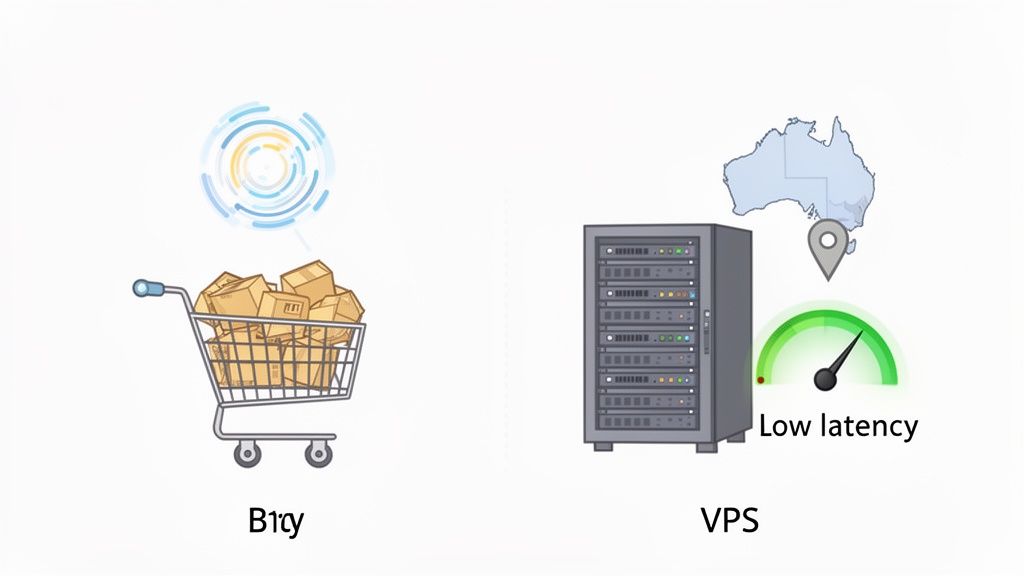
Has your shared hosting plan started to feel a bit like a crowded share house? It’s a classic growing pain for any successful online venture in Australia. One minute, everything's humming along nicely; the next, your e-commerce store is crawling during a sale, or you find you can't install that crucial piece of software your shared plan forbids.
These aren't just minor hiccups. They're clear signs you’ve outgrown your current setup and it’s time to move on up.
Beyond the Limits of Shared Hosting
Shared hosting is a brilliant starting point for many, but it has its limits. You’re essentially sharing a server's resources—CPU, RAM, and bandwidth—with dozens, sometimes hundreds, of other websites. If one of those sites suddenly gets a massive traffic spike, your site’s performance can take a nosedive. It's often called the "noisy neighbour" effect, and it's incredibly frustrating.
An affordable virtual private server neatly sidesteps this entire problem by carving out a private, walled-off section of a server just for you. This means you get:
- Guaranteed Resources: The CPU, RAM, and storage you pay for are yours and yours alone. No more fighting for resources. Your site's performance becomes consistent and predictable.
- Greater Control: With root access, you’re in the driver's seat. You can install custom software, fine-tune security settings, and shape the server environment to perfectly match your application's needs. For example, a developer might need to install a specific version of PHP or a caching tool like Redis, which is impossible on most shared plans. With a VPS from a provider like UpTime Web Hosting, you have that freedom.
- Enhanced Security: Because your VPS is an isolated environment, you're much better protected from security breaches that might affect other websites on the same physical hardware.
Think of it this way: Shared hosting is like living in a communal dorm with shared facilities. A VPS is like having your own private studio apartment in the same building. You get your own space, your own rules, and your own key, without having to buy the whole complex.
The Australian Advantage
For any business targeting a local audience, where your server is physically located matters. A lot. Hosting your website on servers physically based in Australia drastically cuts down latency—the technical term for the delay it takes for data to get from the server to your visitor's screen.
Lower latency means a faster, snappier website. And a faster website means a much better experience for your Aussie customers.
This demand for local performance is reshaping the hosting market. More and more Australian businesses are looking for the power and control of a VPS without the hefty enterprise price tag. This has opened the door for local providers with data centres in cities like Sydney and Melbourne to deliver superior speed and ensure data stays right here in Australia.
If you have a sneaking suspicion your current provider is what's holding your site back, it’s worth checking out our guide on the seven signs you need a new web hosting provider.

Performance you can feel, backed by clients who depend on it. Read how our support and uptime create long‑term customer success.Power Your Business with Better Hosting
How to Assess Your Actual VPS Resource Needs
Choosing your first virtual private server feels a bit like Goldilocks—you don't want too much, and you don't want too little. Grabbing a plan with more resources than you need is a classic way to burn cash, but skimping on the essentials will leave you with a slow, frustrating website.
Let's cut through the jargon and figure out what your project actually needs to run well.
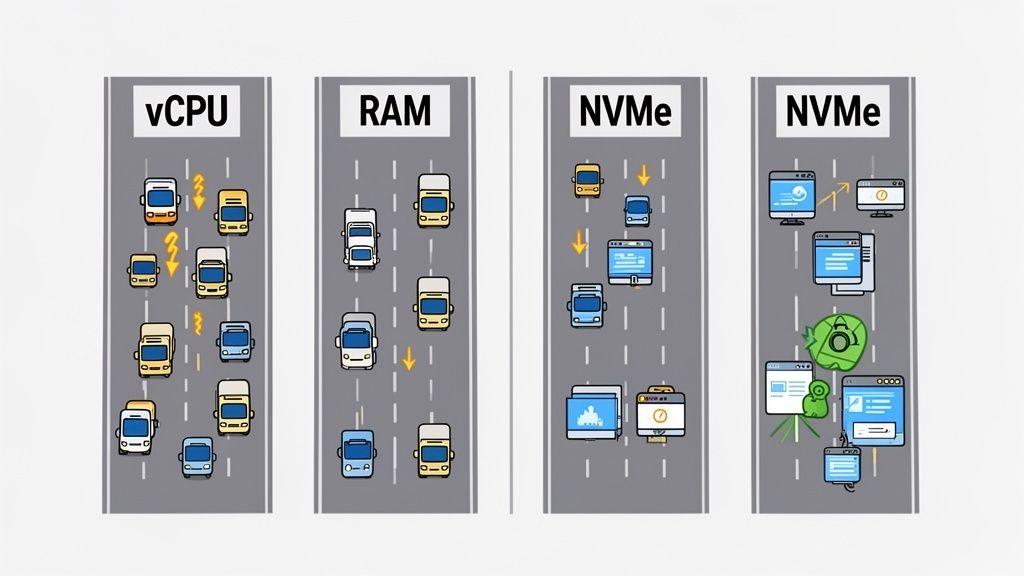
Think of your VPS resources like the engine, workspace, and storage of a high-performance vehicle. Each part does a specific job, and they all need to be in balance for a smooth ride.
Decoding Your Core Resources
Getting a handle on vCPUs, RAM, and storage is the first step. It's much simpler than it sounds.
vCPUs (Virtual Central Processing Units): These are the brains of the operation, like lanes on a highway. The more lanes you have, the more server tasks can be handled at the same time without creating a traffic jam. A simple blog might only need one or two lanes, but a busy online store definitely needs more to process all those shoppers.
RAM (Random Access Memory): Think of this as your server's short-term memory or workbench. The more RAM you have, the more applications and processes you can run at once without things slowing to a crawl while the server fetches data from storage.
NVMe Storage: This is the super-fast modern garage where your website files, images, and database are kept. NVMe (Non-Volatile Memory Express) is a huge leap forward from older SSDs, which means your site's pages snap open for visitors much, much faster.
Matching Resources to Real-World Scenarios
The real trick is lining up these specs with what you’re actually trying to build. A one-size-fits-all approach just doesn't cut it.
For instance, a small WordPress blog with a handful of plugins and a steady stream of traffic will hum along nicely on a plan with 2 vCPUs and 4GB of RAM. That gives you enough processing power to serve visitors and enough memory for WordPress and its database to operate without gasping for air.
On the other hand, a complex Magento e-commerce store loaded with extensions, big product images, and a constant flow of transactions needs a lot more grunt. Here, you’d want to start with at least 4 vCPUs and 8GB of RAM to keep the checkout process zippy and the site responsive, especially during a big sale.
Your goal is to find that sweet spot: enough power for a fantastic user experience today, with a bit of headroom for tomorrow. You can always scale up later, so there’s no need to pay for a beast of a server right out of the gate.
A Practical Checklist for Your Project
Before you jump on an affordable virtual private server plan, take a moment to run through these questions. This will give you a clear picture of what you need and help you avoid paying for power you won't use. Getting this right is a big deal, and we cover more ground on this topic in our guide on the 10 factors to consider when choosing web hosting services.
Here's a quick reference to help you gauge your needs.
Quick VPS Resource Assessment Checklist
Use this checklist to estimate the minimum VPS resources your project requires. Match your needs to the descriptions to find a suitable starting point.
| Your Project Type | Recommended vCPUs | Recommended RAM | Example Use Case |
|---|---|---|---|
| Simple Website or Blog | 1 – 2 | 2 – 4 GB | A personal blog, a small business brochure site, or a development staging server. |
| Growing E-commerce Site | 2 – 4 | 4 – 8 GB | A WooCommerce or Shopify alternative handling moderate traffic and transactions. |
| High-Traffic Web App | 4 – 8 | 8 – 16 GB | A busy SaaS application, a membership site, or a large e-commerce store with frequent sales. |
| Resource-Intensive App | 8+ | 16+ GB | A video processing service, a big data application, or a large, active online community. |
Answering these questions gives you a solid resource profile to start with:
- What applications are you running? (e.g., WordPress, Magento, a custom Node.js app)
- What's your expected traffic right now? (Hundreds of visitors per day, or thousands?)
- Will you have traffic spikes? (Think marketing campaigns or holiday sales.)
- How big is your site and database? (If you're migrating, check your current usage.)
- What are your growth plans for the next 12 months? (Are you planning to double your user base?)
Once you've got these answers, you'll find it so much easier to compare VPS plans and confidently pick one that's both powerful and budget-friendly.
Managed vs Unmanaged VPS: What's Best for You?
When you’re looking for an affordable virtual private server, you’ll quickly hit a fork in the road that has a massive impact on your wallet and, more importantly, your time. The choice is between a managed or an unmanaged VPS. Getting this right from the start is the key to avoiding some serious headaches down the track.
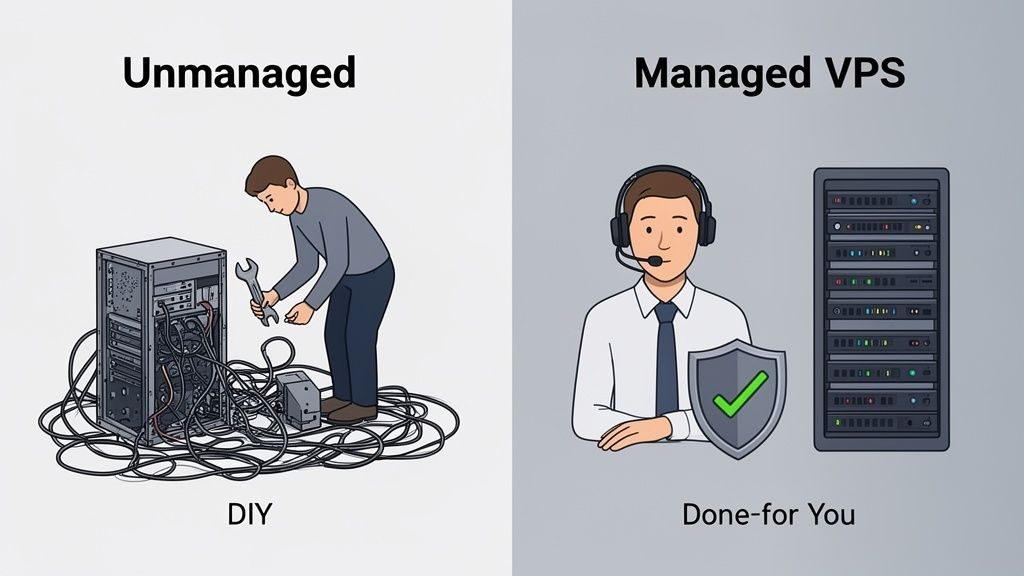
An unmanaged VPS is the ultimate DIY project. It comes with a tempting, lower price tag, but what you’re really getting are the digital keys to a completely bare-bones server. From that point on, you are the system administrator.
The Unmanaged DIY Approach
Going the unmanaged route means you're responsible for everything. We’re talking setting up the operating system, installing a control panel, configuring firewalls, applying security patches, and fixing anything that breaks.
For a seasoned developer or a sysadmin, this level of control is fantastic. For most business owners, though, it's a huge, high-risk distraction from what you should be focusing on: running your business.
An unmanaged VPS puts you in charge of all maintenance, security, and software updates. A single missed security patch can leave your entire business vulnerable, a risk that often outweighs the initial cost savings.
The Managed Done-For-You Solution
On the other hand, a managed VPS is the 'done-for-you' service. A dedicated team of experts handles all the technical heavy lifting for you. This covers the initial server setup, ongoing security monitoring, software updates, performance tuning, and being there for technical support when you need it.
When you’re weighing up managed versus unmanaged, the big question is who’s responsible for security. Taking a look at essential website security best practices can really highlight just how much work is involved in properly locking down a server yourself.
This is all part of a bigger shift we're seeing in Australia. More organisations are moving away from on-premise hardware and towards hosted infrastructure, which makes a managed VPS a really practical option for smaller budgets. The Australian private cloud server market, valued at USD 3.88 billion in 2023, is set to grow as businesses look for the control a VPS offers without needing an in-house IT team. Local providers are right on this trend, offering managed plans that bundle security, backups, and support to make advanced infrastructure accessible to everyone.
For a slightly higher monthly fee, a managed plan saves you countless hours and protects your business from expensive mistakes. While the sticker price is higher, the total cost of ownership is often much lower once you factor in your own time and the potential cost of downtime. For most small businesses, this makes a managed VPS a far smarter and more sustainable investment. It also means you have a reliable team for ongoing web maintenance and support to keep everything running smoothly.
Host your website with our 5-star rated, cPanel website hosting plans.
Super fast servers, with security included and hosted in your choice of Australian Data Center.
View cPanel Plans
Uncovering the True Cost of a 'Cheap' VPS
That rock-bottom monthly price tag on a VPS can look incredibly tempting, but it’s often just the tip of the iceberg. More often than not, the price you see advertised is rarely the final price you'll pay. Many providers use these low introductory rates to get you in the door, and that’s when the hidden costs start to appear.
A truly affordable VPS isn’t about chasing the cheapest sticker price. It's about finding a provider with predictable, transparent billing so you're never hit with a nasty surprise on your invoice. The goal is simple: the price you see should be the price you actually pay.
Spotting Common Pricing Traps
Many hosting providers play a clever game. They structure their pricing to look cheap upfront but then charge extra for features that are absolutely essential for running a modern website. This tactic can quickly turn a "budget-friendly" plan into an expensive headache.
Here are the most common add-on costs you need to watch for:
- Control Panels: A user-friendly control panel like cPanel or Plesk is vital for managing your websites, emails, and databases without pulling your hair out. A lot of "cheap" plans don't include this, adding a hefty $20 to $30 or more per month to your bill.
- Automated Backups: Think of a reliable backup system as your safety net. Budget providers often exclude it, charging a separate monthly fee for automated nightly backups. And if you actually need to restore your data? You can bet they'll charge you for that, too.
- SSL Certificates: While many hosts now offer free Let's Encrypt certificates (as they should), some still try to charge for installation or push you towards more advanced SSL types. In this day and age, an SSL certificate is non-negotiable for security and SEO.
- GST and Hidden Fees: Always, always check if the advertised price is inclusive of GST. A price that seems low can suddenly jump by 10% at the checkout. It's a classic tactic used to undercut local Australian providers who display honest, all-inclusive pricing.
We see this all the time. A small business signs up for a VPS advertised at $20/month. But once they add a cPanel licence ($25/month) and automated backups ($10/month), their true monthly cost skyrockets to $55, plus GST.
The Renewal Rate Shock
One of the most effective pricing traps is the steep introductory discount. A provider might lure you in with an incredible 50-75% off for your first year. But when it’s time to renew, the price doubles or even triples.
By that point, migrating your entire website is a massive hassle, so many business owners feel stuck and are forced to accept the huge price hike.
A genuinely affordable VPS provider has a clear, consistent pricing structure. The renewal rate should be the same as the initial price, or at least very close to it. Make sure you read the fine print before committing to any long-term plan.
The Australian web hosting market is competitive and continues to grow, with revenue projected to expand significantly from 2025 onwards. This competition is great for consumers, as it pushes local providers to bundle more essential features like SSL and backups into their plans to offer better, more transparent value.
This is exactly why Australian companies like UpTime Web Hosting can offer managed VPS plans with predictable, GST-inclusive pricing. For a small business trying to manage its cash flow, that kind of predictability is a massive advantage.
Essential Features of a High-Value Australian VPS
When you're hunting for an affordable virtual private server, it's easy to get fixated on price. But a truly high-value VPS never asks you to compromise on the core features that keep your business humming along safely.
There's a world of difference between a genuinely affordable plan and a cheap one that will inevitably cost you more down the track. Think of the features below as non-negotiables, not optional extras. A server crash or a security breach can cause far more financial damage than the few dollars you might save on a bare-bones plan.
Real value is found in a balanced package that delivers performance, security, and your own peace of mind.
Performance and Scalability
Your website's speed is often the first—and sometimes last—impression you get to make. In today's market, a slow-loading site is a guaranteed way to kill conversions. That’s where high-performance hardware becomes non-negotiable.
Fast NVMe Storage: Modern websites are hungry for data. NVMe (Non-Volatile Memory Express) storage blows older SSDs out of the water, meaning your website files and database are accessed almost instantly. For an e-commerce store, that’s the difference between snappy product pages and a checkout experience that has customers abandoning their carts.
Easy Scalability: Your business is going to grow, and your hosting shouldn't be the thing that holds you back. A good VPS lets you upgrade your resources—like adding more RAM or vCPUs—with next to no downtime. That kind of flexibility is crucial when you’re running a big marketing campaign or just enjoying a sudden surge in popularity.
Security and Reliability
A cheap VPS is no bargain if it's constantly offline or wide open to attacks. Robust security and reliability features are what protect your revenue and your reputation. They're the digital equivalent of having solid locks on your doors and a good alarm system.
Security isn't just about protecting your data; it's about maintaining your customers' trust. A single security incident can undo years of hard work, making built-in protections an invaluable part of any hosting plan.
Look for a provider that includes these security layers as part of their standard offering:
DDoS Protection and Firewalls: Distributed Denial of Service (DDoS) attacks can bring your site to its knees by flooding it with malicious traffic. Built-in DDoS protection and a well-configured firewall are your first line of defence, filtering out the bad traffic before it ever gets a chance to do damage.
Automated Nightly Backups: Things go wrong. It happens. A dodgy plugin update or a simple human error can corrupt your entire site. Automated nightly backups, stored securely off-site, are your safety net. They ensure you can restore your website quickly and get back to business without catastrophic data loss.
Beyond these basics, staying informed about digital defence can help you better evaluate providers. For those looking to dive deeper into the field, you can even explore options for a cybersecurity certification in Australia.
Local Australian Support
When something goes sideways at 2 AM, the last thing you want is to be dealing with an international call centre or a support ticket that sits unanswered for hours. This is where local support completely changes the game.
Having a 24/7 Australian-based support team you can actually get on the phone is invaluable. They understand the local context and can provide quick, effective solutions without the runaround. This focus on local infrastructure and support also ties into broader benefits, and you can learn more about why it’s important to host your website in Australia in our detailed guide.
Your Go-Live Checklist for Choosing a VPS Provider
Alright, you've made it this far. You're now equipped to see past the flashy marketing banners and find a genuinely affordable virtual private server that actually fits what you need. Before you pull the trigger, let's pull everything together into a practical checklist.
Think of this as your final filter. Use these questions to confidently stack up your final few options and pick a provider that will feel more like a partner in your business's growth, not just another monthly bill. A solid provider should be able to give you a clear and confident "yes" to every single one.
Your Core Provider Questions
Before you even think about entering your credit card details, run through this list. Getting these answers upfront will help you spot a provider offering real long-term value and sidestep the common traps that come with so-called 'cheap' hosting.
- Are your data centres actually in Australia? For the best possible speed and performance for your local customers, this is non-negotiable. The answer has to be yes.
- Is a control panel like cPanel or Plesk included in the price? A "no" on this one can sting, adding a significant and often unexpected monthly cost to your bill.
- What's the backup situation? You're looking for automated, nightly backups stored off-site. Crucially, ask how you restore your data—it should be a simple process that doesn't come with extra fees.
- Is your support team based in Australia and available 24/7? When something goes wrong at 2 AM, you want a local expert on the line, not an international call centre reading from a script.
A provider's transparency on these key points speaks volumes about how they operate. If you're getting vague answers or have to dig through pages of fine print, consider that a major red flag.
Aligning With a Trusted Provider
This whole process really boils down to three core pillars: Storage, Security, and Support. These are the foundations of a high-value VPS offering.
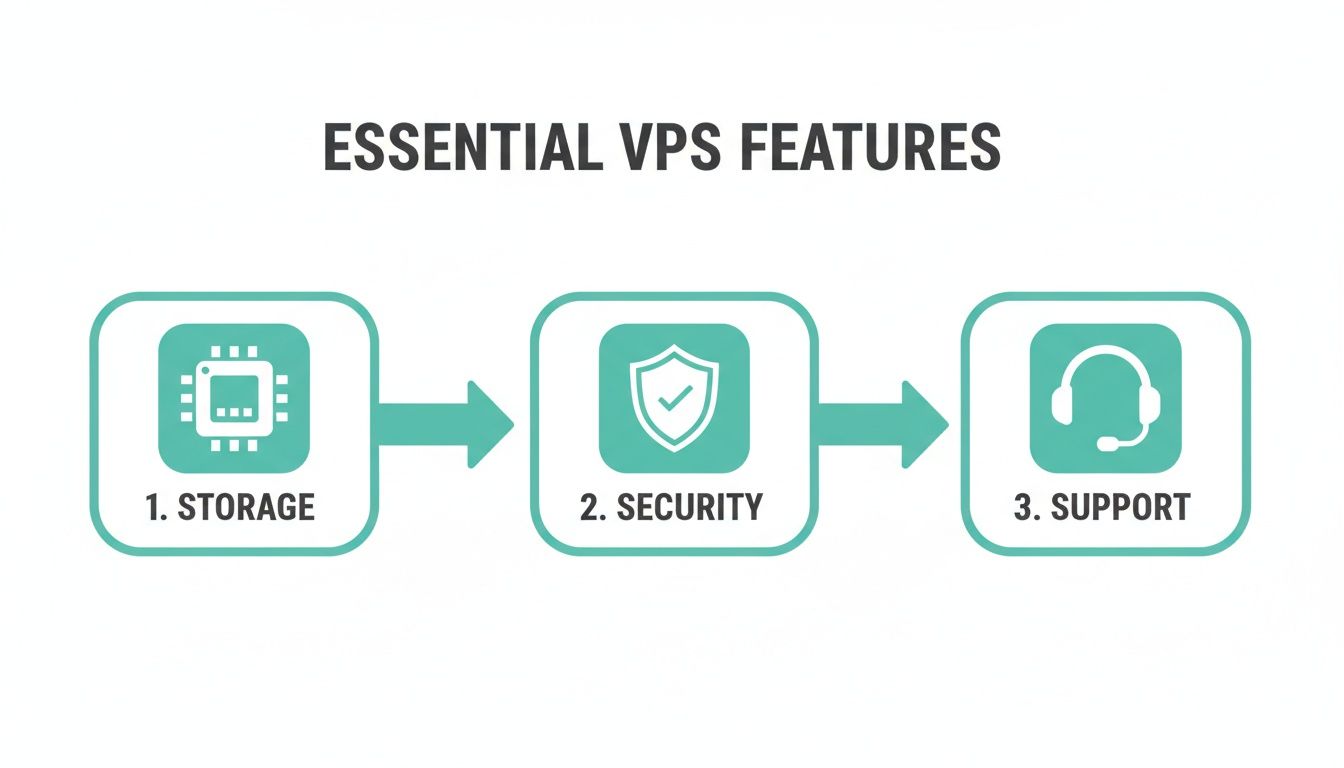
As you can see, great performance starts with fast storage, but it's not truly reliable unless it's protected by robust security and backed by real people you can actually talk to.
Putting this checklist into action makes it easy to see how a provider like UpTime Web Hosting lines up with these priorities. With data centres across Australia, all-inclusive pricing (where cPanel and GST are already factored in), and a highly-rated local 24/7 support team, they tick every box.
This approach takes the guesswork out of the equation. It allows you to select an affordable virtual private server with confidence so you can get back to what you do best: running your business. If you want to dig a bit deeper, you can explore their plans or check out their guides on getting started with cPanel.
Register your new domain name at competitive market prices including free domain add-ons like privacy, DNS Hosting, Custom Nameservers and Forwarding.
Always the best price and no nasty renewal price hikes.
Register A Domain Name
Answering Your VPS Hosting Questions
Got a few lingering questions about making the switch to an affordable VPS? You're not alone. Here are some quick, no-nonsense answers to the things we get asked most often by Aussie businesses just like yours.
Can I Actually Host More Than One Website on a VPS?
Yes, you absolutely can. In fact, that’s one of the biggest perks of a VPS. As long as your plan has enough resources to go around, you can host multiple websites without breaking a sweat.
When your VPS includes a control panel like cPanel or Plesk, managing all your different sites becomes surprisingly straightforward. It's a game-changer for agencies juggling client projects or anyone running more than one online business.
With a managed VPS that has cPanel, each website gets its own neat, separate account. You can manage everything from one central dashboard, keeping all your projects secure and organised. It’s the perfect setup for keeping things tidy. For a closer look, check out our guide on getting started with cPanel.
Do I Need to Be a Developer to Manage a VPS?
This is a big one, and the answer depends entirely on the type of VPS you choose.
An unmanaged VPS definitely requires some serious tech skills. You’re responsible for everything, from security patches to software updates. It's powerful, but it's not for the faint of heart.
A managed VPS, on the other hand, is built for business owners, not just developers. Our team handles all the tricky server admin stuff in the background—the security, the updates, the monitoring. You get all the power of a VPS with the same ease of use you'd expect from premium shared hosting.
How Is a VPS Really More Secure Than Shared Hosting?
Think of it like this: shared hosting is an open-plan office, while a VPS is your own private, locked office.
On a shared server, you're sharing resources and an operating system with many other users. A security slip-up on someone else's website could potentially create a risk for yours.
A VPS gives you a completely isolated environment. Your resources, your files, and your operating system are walled off from everyone else. This isolation, combined with dedicated firewalls and the proactive security monitoring we include on our managed plans, creates a much tougher nut for any would-be attacker to crack.
Ready to get the power, security, and local support your business deserves? UpTime Web Hosting delivers fully managed VPS plans from our Australian data centres, backed by our 24/7 expert team.