

Securing the right domain is the first real step in building your Australian business online. Think of it as your digital storefront—it’s where customers find you, trust you, and remember you. To register a domain name anywhere in Australia, you'll need a local presence, like an ABN for a .com.au address, and you must go through an accredited registrar.
Your Essential Guide to Australian Domain Names
Choosing to register a domain in Australia, especially one ending in .au, is a smart business move. It immediately tells potential customers you’re a local, which builds instant credibility and trust. This isn't just for show; it also gives your local SEO efforts a serious leg-up, helping you appear higher in search results for Aussie customers.
The entire .au namespace is managed by the .au Domain Administration (auDA). This is the official body that sets the rules to make sure the domain space remains a trusted and reliable resource for all Australians. Their policies, like needing an ABN for .com.au domains, are there to protect your brand's integrity and stop misuse.
This guide is your practical, no-fluff playbook for making your mark online. We’ll cover everything from picking a great name to getting your website live with a local provider. Consider it your roadmap for navigating the whole process with confidence. If you're curious about market trends, you can find more data on popular Australian domain names through country-specific leaderboards.
The
.audomain namespace is a genuine powerhouse, with over 4.3 million active registrations. This puts it in the top 10 largest country-code domains on the planet. The demand is relentless, with one report showing a staggering 8,145 new.audomains were registered in just a single day.
This massive popularity really highlights why securing your local online identity is such a critical first step when starting an online business in Australia. It’s more than just a technical task—it’s a foundational branding move that anchors your presence firmly in the local market. Let's walk through each stage so you can make the best choices for your business.

Performance you can feel, backed by clients who depend on it. Read how our support and uptime create long‑term customer success.Power Your Business with Better Hosting
Meeting The .AU Eligibility Requirements
Before you can even think about registering a domain name in Australia, you need to prove you have a legitimate local connection. This isn't just red tape; it's a core rule set by auDA (the .au Domain Administration) to keep the .au namespace trustworthy and distinctly Australian. Getting this right from the start ensures your customers see you as a genuine Aussie entity.
For the most common business extensions, .com.au and .net.au, this means you must have a registered Australian business. The simplest way to prove this is with an Australian Business Number (ABN) or an Australian Company Number (ACN).
Defining Your Australian Presence
It’s not just about having the right number, though. The domain name you want has to be directly related to your business.
Say your registered company is "Melbourne Coffee Roasters Pty Ltd". You could absolutely register melbournecoffeeroasters.com.au. If everyone knows you as "MCR," then registering mcr.com.au as an acronym is also perfectly fine.
What you can’t do is just pick a generic keyword like bestcoffee.com.au unless that exact phrase is your registered business name. This is what auDA calls the "close and substantial connection" rule, and it's there to stop people from squatting on valuable domains and to keep the playing field fair. You can read more about this in our knowledge base article on auDA's .AU Domain Name Rules.
Key Takeaway: You're not just buying a name; you're claiming a digital identity that must legally link back to your Australian business or organisation. Having your ABN or other relevant documentation ready before you start will make the process much smoother.
The flowchart below gives you a clear visual of the first decision you'll need to make, based on whether you're a business or a non-profit.
As you can see, the path for commercial businesses is quite different from the one for non-profit organisations, which have their own specific rules to follow.
Other .AU Extensions and Their Rules
While businesses make up the bulk of registrations, there are other options tailored for different types of organisations. It's vital to know which one fits you.
- .org.au: This is strictly for non-profit organisations, charities, and incorporated associations. You'll need to provide your official registration details to prove you qualify.
- .au (direct): This is the newest and shortest option. The eligibility here is much broader, opening the door for any Australian citizen or permanent resident to register a name, not just businesses.
Meeting these requirements isn't optional. Any accredited registrar will verify your details as part of the application process. If you want to dive deeper into the newest domain type, you can learn more about Australia's new top-level domain and see if it’s a good fit.
My best advice? Get all your documentation sorted out upfront. It's the surest way to avoid frustrating delays and lock in your ideal domain name without a hitch.
Finding And Securing Your Perfect Domain Name
This is the fun part—where your idea starts to feel real. The goal here isn't just to find a domain name that's available, but to land on one that's memorable, professional, and dead simple for your customers to find. A great domain name is a genuine business asset from day one.

As you get started, focus on clarity. A name that’s short, easy to spell, and simple to say will always beat a long, complicated one. People should be able to hear it once and type it into their browser without getting it wrong.
Brainstorming Your Ideal Domain
Before you even open a domain search tool, it pays to spend a bit of time coming up with a shortlist of names. This gives you options and keeps you from getting stuck if your first choice is already gone.
Here are a few practical tips to get you thinking:
- Keep It Short and Sweet: Shorter domains are just easier to remember and there's less chance of a typo. Think
bunnings.com.auversusbunningswarehouseandgardensupplies.com.au. - Avoid Hyphens and Numbers: While you can use them, hyphens are clumsy to say out loud ("brisbane-plumber-pro") and numbers create confusion. Is it
plumber2you.com.auorplumbertoyou.com.au? - Make It Brandable: Your domain should sound like a proper brand, not just a bunch of keywords strung together.
speedywidgets.com.auis far more memorable thanbuywidgetsonlineaustralia.com.au. - Think Long-Term: Don't box yourself in. A name like
perthshoes.com.aucould feel pretty limiting if you decide to branch out into clothing or accessories down the track.
Choosing a clean, brandable name is also a great first step for your site's long-term Domain Authority. It sets a strong foundation for building a trusted online reputation.
Checking Availability And Taking Action
Once you've got a few solid ideas, it's time for the moment of truth: seeing what's actually available. This is where a domain checker comes in. You just type in your desired name, and it'll tell you instantly if you can register it.
Let's walk through a real-world scenario. Imagine a new plumber in Brisbane starts by searching for brisbaneplumbingsolutions.com.au. The checker tool shows it’s already taken. This happens all the time, but it's not a dead end.
Instead of giving up, this is your chance to get creative. The plumber could try a more punchy alternative like
brisbaneplumberpro.auor add a local touch withplumbbrisbane.com.au. Often, the second or third idea ends up being even better than the first.
When you find an available name you love, the next step is to lock it in. If you're wondering which provider to use, our guide on finding the best domain name registrar in Australia has some great pointers.
The registration process itself is pretty straightforward: just add the domain to your cart, pop in your contact and ABN details to prove you're eligible, and complete the purchase. From there, you can easily pair it with a local hosting plan to get your website and professional emails up and running straight away.
Host your website with our 5-star rated, cPanel website hosting plans.
Super fast servers, with security included and hosted in your choice of Australian Data Center.
View cPanel Plans
Configuring Your New Domain For Success
Securing your domain name is a fantastic first step, but it's really just the beginning. To truly make it work for your business, you need to configure it correctly. This crucial stage involves pointing your domain to your website and setting up professional email, turning your new digital address into a powerful business tool.
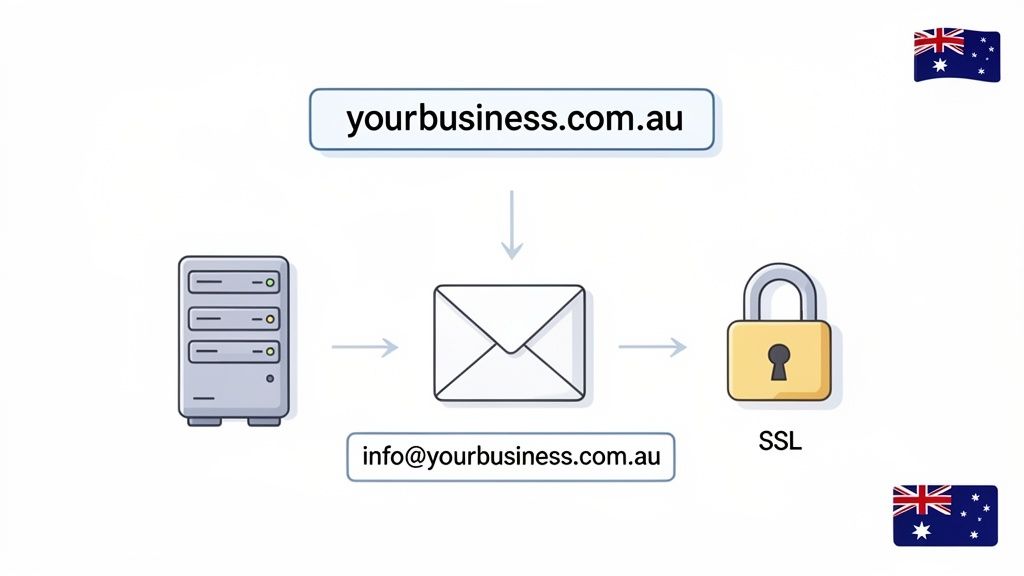
Think of the Domain Name System (DNS) as the internet's phonebook. When someone types yourbusiness.com.au into their browser, DNS looks up that name and connects them to your web hosting server where your website lives. Getting this right is non-negotiable for getting your site online.
Pointing Your Domain To Your Web Host
After you register your domain and sign up for a web hosting plan, your hosting provider will give you a set of "nameservers." These are the addresses you need to plug into your domain registrar's control panel.
For example, if you registered your domain with one company but host your website with UpTime Web Hosting, you'll need to log in to the registrar's portal and update the nameservers to point to UpTime's servers. This change tells the global DNS network where to send visitors looking for your site. For detailed, step-by-step instructions, see our knowledge base guide on how to change your domain's nameservers.
The process is usually straightforward, but fair warning: it can take a few hours for the changes to spread across the internet. This is a normal process known as DNS propagation.
Establishing Professional Email Addresses
Nothing undermines credibility faster than a business using a Gmail or BigPond address. Seriously. Setting up professional email addresses like info@yourbusiness.com.au is essential for building trust and reinforcing your brand with every message you send.
Most quality Australian hosting plans include email hosting. You can easily create new mailboxes, set up forwarders, and manage your accounts through a control panel like cPanel. It's a simple step that makes your business look established and professional from day one. To get started, you can explore our business email hosting services.
A professional email address isn't just about appearances. It separates your business communications from personal ones, makes your brand more memorable, and gives you complete control over your data. It's a small detail that has a massive impact on customer perception.
Securing Your Website With an SSL Certificate
Finally, let's talk security. An SSL (Secure Sockets Layer) certificate encrypts the connection between your website and your visitors, protecting sensitive data like login details and payment information. Modern browsers will flag sites without SSL as "Not Secure," which can scare away potential customers in an instant.
Most reliable hosting providers, including UpTime, offer free SSL certificates as standard. It's a vital feature that not only protects your customers but also provides a small boost to your Google search rankings. For businesses running eCommerce stores or handling a lot of sensitive data, exploring options like a wildcard SSL certificate can provide even broader protection across all your subdomains.
This focus on security and performance is driving significant investment in Australia. The local managed DNS market revenue is projected to hit USD 1,029.7 million by 2030, largely because small businesses and online stores demand speed and robust protection against increasing cyber threats. You can read more about the trends in the Australian managed DNS market and see why services like DDoS protection are becoming so critical.
Keeping Your Domain Safe: Renewals, Transfers, And Costs
Once you've registered your Australian domain name, the job isn't quite over. Think of your domain as a long-term business asset, one that needs active management to keep your online presence secure and stable. This means staying on top of renewals, knowing how to handle transfers, and budgeting for the costs involved.
Forgetting to renew your domain can be a catastrophe. If it expires, your website and emails go down instantly. Even worse, you risk a competitor or a cybersquatter grabbing it the moment it becomes available. The simplest way to avoid this is to enable auto-renewal with your registrar. It's usually just a single checkbox, but it can save you from a world of pain later on.
Making Domain Transfers Painless
It's common for businesses to start with one provider and decide to move later on. Transferring a .au domain to a new registrar, like us here at UpTime Web Hosting, is a straightforward process. Bringing your domain and hosting under one roof just makes sense—it simplifies billing and puts all your technical support in one place.
The process usually breaks down into a few key steps:
- First, you'll need to unlock your domain at your current registrar.
- Next, you'll get an EPP code (sometimes called a transfer key or domain password).
- Finally, you'll kick off the transfer with your new provider using that code.
This little bit of admin work really pays off. You get a single point of contact for support and a much clearer overview of all your digital assets. We've put together a detailed guide on our page explaining the complete domain name transfer process.
Think of your domain name like the lease on your physical shop. You wouldn't just let it expire without a plan. Proactive management isn't just good practice; it's essential for your business's security.
Understanding the Costs Involved
When you register a .au domain, you're not buying it forever. Instead, you're licensing it for a specific period, usually between one and five years. The good news is that the cost structure in Australia is generally transparent. Reputable registrars include GST in their advertised prices, so you won't get hit with any nasty surprises at checkout.
The Australian domain market is both strong and well-regulated. Australia's 4.3 million .au domains are part of a massive global market of 378.5 million total registrations. The .au namespace shows consistent growth that often outpaces other global domains. Thanks to auDA's oversight, standards remain high, with renewal rates consistently above 85%. You can dig into more industry insights from the domain name industry brief from DNIB.
This stability means you can count on predictable renewal costs, making it easy to budget for this critical business expense. By choosing a reliable local provider, you're ensuring your digital address stays securely under your control for years to come.
A Few Common Questions About Australian Domains
Even with a solid plan, a few questions always seem to pop up when you're ready to register a domain name in Australia. Let's run through some of the most common ones to clear up any confusion and get you moving forward.
What Is The Difference Between .com and .com.au?
The biggest difference boils down to two things: trust and local targeting.
A .com.au domain instantly tells Australian customers and search engines like Google that your business is legitimately local. This builds immediate credibility and can give you a real edge in local search results. It’s like having a local phone number – people just trust it more.
On the other hand, a .com domain is global. It doesn’t have that same automatic "Aussie" stamp of approval, which can make it tougher to stand out in a crowded local market. For any business focused on Australian customers, the .com.au is almost always the smarter move.
How Long Does It Take to Register a .au Domain Name?
It’s surprisingly quick. Once you have your eligibility sorted (like your ABN), the actual registration process is incredibly fast. Most of the time, your new .au domain will be active and ready for you to start setting things up within a few minutes to a couple of hours.
Keep in mind that DNS propagation—the time it takes for your new domain's settings to spread across the internet—can sometimes take a bit longer. But the actual registration and ownership part? That’s secured almost instantly.
Can I Register a .au Domain If My Business Is Not in Australia?
In almost all cases, the answer is no. The .au namespace is protected by a strict "local presence" rule, which is enforced by auDA. This is precisely what maintains the integrity and trust people have in Australian domains.
To register a business domain like .com.au, you absolutely must have a registered Australian entity with an active ABN or ACN. This rule is what gives customers confidence that when they see a .com.au address, they're dealing with a genuine Australian business.
What Happens If My Desired Domain Name Is Already Taken?
Hitting a roadblock where your first choice is unavailable is a super common experience. But honestly, it's more of an opportunity than a dead end. This is your chance to get a bit more creative and refine your branding.
If yourbrand.com.au is already gone, don't panic. Consider these alternatives:
- Try a slight variation: Can you add a simple, relevant word? Think
yourbrandcreative.com.auorgetyourbrand.com.au. - Add your location: This works wonders for local service businesses. Something like
yourbrandsydney.com.auis clear and great for local SEO. - Check the .au direct version: The shorter
.auextension is modern and gaining a lot of traction. You might findyourbrand.auis available and even easier for people to remember.
A Quick Tip: It's easy to get discouraged if your first idea is taken, but don't be. Often, the process of brainstorming a new name leads to something stronger and more memorable that truly sets your business apart.
Thinking through these options will almost certainly land you on a professional domain that works perfectly for your business.
Ready to secure your perfect Australian domain name? At UpTime Web Hosting, we make it easy to find, register, and manage your .au domain with fast, local support and transparent, GST-inclusive pricing. https://uptimewebhosting.com.au