You're probably in this spot right now. Your business does solid work, your customers are happy, and people who already know you keep coming back. But when someone nearby searches for your service on Google, your business either doesn't appear or shows up below weaker operators who did a better job with local visibility.
That's the primary issue with local SEO in Australia. It isn't a vanity tactic. It's the difference between being found and being ignored. If you run a café, clinic, trade business, agency, retail shop, or service-area business covering multiple suburbs, local search decides who gets the call.
Most advice on this topic is stuck in the old checklist era. Claim your profile. Add your address. Get a few citations. That still matters, but it's not enough anymore. Australian businesses now need a sharper approach that handles suburb-level intent, service areas, review quality, location content, structured data, and the growing impact of AI-generated search answers.
Table of Contents
- Why Local SEO Is a Must Win for Aussie Businesses
- Your Digital Front Door Mastering Google Business Profile
- Build Your Local Foundation On-Page and Off-Page
- Create Content That Captures Your Local Suburb
- Earn Trust with Local Links and Positive Reviews
- Measure What Matters and Prepare for Whats Next

Performance you can feel, backed by clients who depend on it. Read how our support and uptime create long‑term customer success.Power Your Business with Better Hosting
Why Local SEO Is a Must Win for Aussie Businesses
If you run the best coffee shop in Fitzroy but don't show up for “coffee near me”, quality doesn't save you. Visibility does. The same applies to accountants in Geelong, dentists in Parramatta, and electricians in Perth. If your business isn't visible at the moment someone is searching with local intent, you're losing work to whoever is.
In Australia, that opportunity is massive. 46% of all Google searches have local intent, and 94.5% of Australians use Google, according to Red Search's Australian local SEO statistics. That means local search isn't a side channel. It's tied to a huge share of how Australians discover nearby businesses and service providers.
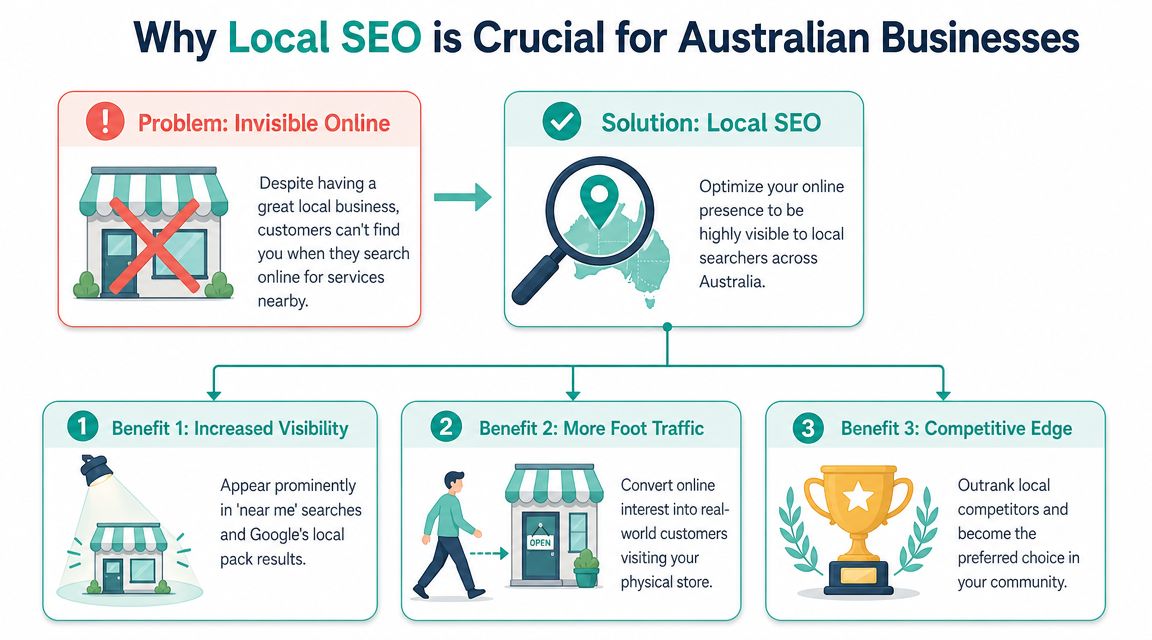
A lot of owners still treat local SEO as optional because they get referrals. That's short-sighted. Referrals often trigger a Google search anyway. People hear your name, then check your reviews, your hours, your location, your website, and whether you look active and credible. If that trail is weak, the referral leaks.
Why this matters more in Australia
Australian search results increasingly reflect practical local needs such as opening hours, nearby availability, and suburb relevance. That means generic websites struggle. Google wants strong local signals, clear business information, and content that matches how people search in Australian cities, suburbs, and service areas.
For a broader view of how this fits into paid and organic visibility together, this guide to Australian SEO SEM is worth reading.
Practical rule: If a customer can't confirm where you operate, what you do, and how to contact you within seconds, your local SEO is underperforming.
Hosting also plays into user experience more than many businesses realise. If your website is slow for Australian visitors, your conversion path gets worse. This breakdown on why local Australian hosting matters is useful if your site feels sluggish or inconsistent.
Local SEO in Australia is a must-win because it sits at the intersection of intent and timing. These people aren't browsing for entertainment. They're looking for somewhere to buy, book, call, or visit.
Your Digital Front Door Mastering Google Business Profile
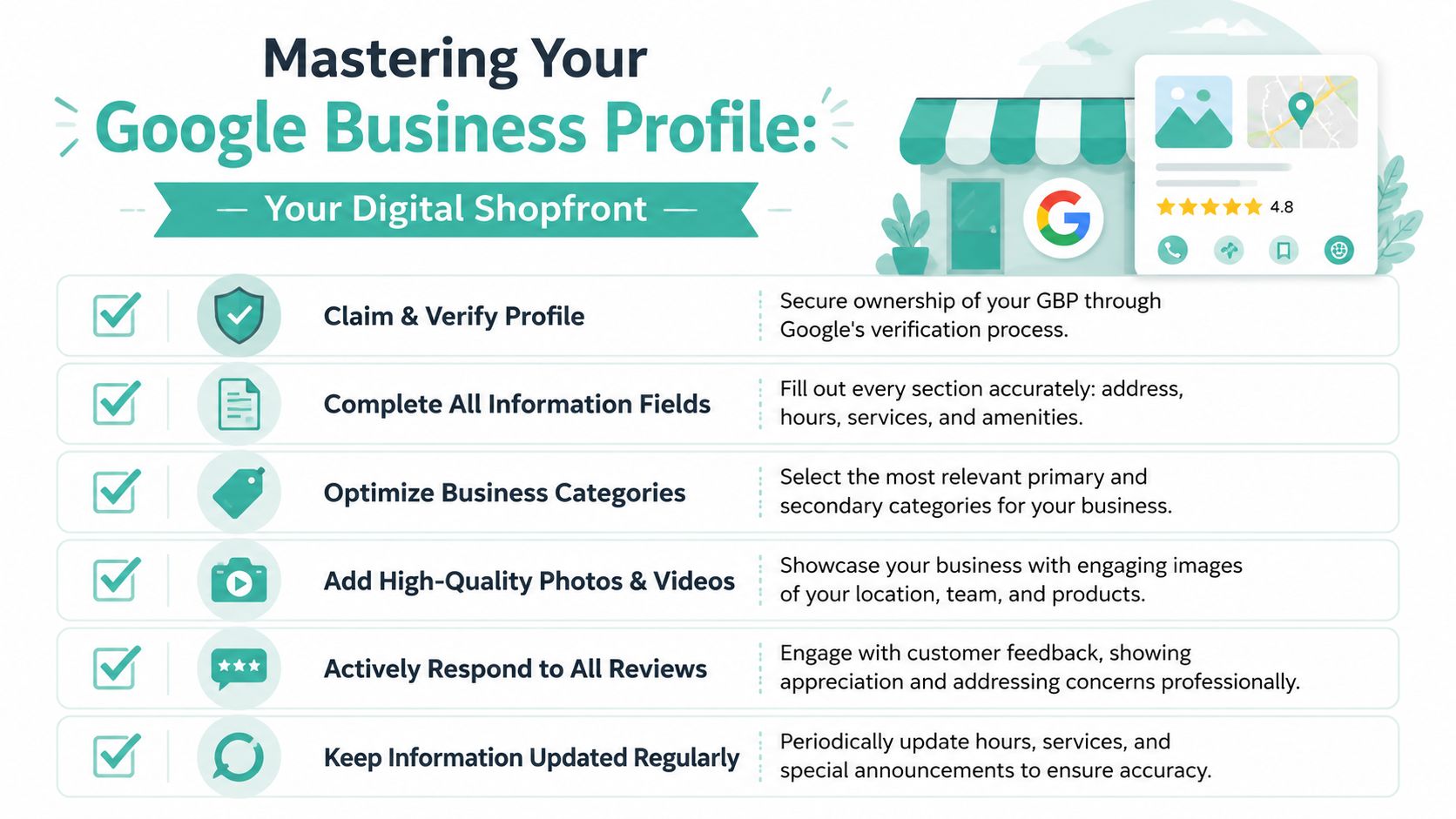
Your Google Business Profile is your digital shopfront. For plenty of local searches, it gets seen before your website does. If it's incomplete, badly categorised, or stale, you'll underperform no matter how polished your homepage looks.
A 2026 Australian local-search statistic set reported that 78% of local searches on mobile result in an offline purchase, according to Safari Digital's local SEO statistics. That's why your profile needs to do more than exist. It needs to help someone call, visit, compare, and trust you quickly.
Claim it properly and complete every field
Don't leave basic fields half done. Fill out your business name, phone number, website, hours, services, and attributes. If you operate in a service area, define it clearly and make sure it aligns with the suburbs and cities you target on your site.
A Brisbane plumber, for example, shouldn't rely on “plumbing services” alone. Add service entries that reflect real commercial intent, such as emergency plumbing, blocked drains, hot water repairs, and gas fitting if applicable. Then make sure those services are also supported by matching pages on your website.
Choose categories with intent in mind
Your primary category matters. Pick the one that most closely matches the service you want to rank for, not the broadest label available. Secondary categories should support the core offer, not dilute it.
If you run a café that also sells cakes, your primary category is likely café, not cake shop, unless cake sales are the business model. If you're a physio clinic, don't stack unrelated categories because you think more is better. It usually isn't.
Answer the obvious customer questions before they ask them. Parking, wheelchair access, booking requirements, service areas, and trading hours all belong in your profile or related content.
Photos, Q&A, posts, and review responses
Use current photos of your premises, team, vehicles, fit-out, products, or completed work. Skip stock images. Real photos build trust faster and support relevance. A Melbourne removalist should show trucks, team members, and actual jobs, not abstract icons.
The Q&A section is underused. Seed it with real questions customers ask. For example:
- Service area question: “Do you service inner west Sydney apartments?”
- Booking question: “Do I need to book ahead for Saturday?”
- Availability question: “Do you offer same-day callouts in nearby suburbs?”
Posts can also help if you use them sensibly. Share seasonal updates, trading hour changes, short offers, or service reminders. Keep them practical.
If you need a more detailed tactical walkthrough for maps visibility, this guide on how to improve Google Map Pack rankings is a solid companion read. For the website side of Google visibility, UpTime's article on Google for local business is also relevant.
Host your website with our 5-star rated, cPanel website hosting plans.
Super fast servers, with security included and hosted in your choice of Australian Data Center.
View cPanel Plans
Build Your Local Foundation On-Page and Off-Page
Google Business Profile gets attention, but your website does the heavy lifting. It confirms relevance, supports rankings, and gives searchers a place to take the next step. If your site is vague, duplicated, or technically sloppy, your local profile won't carry the whole strategy.
Start with pages built for real suburbs
A common mistake is trying to rank one generic service page for every suburb in a metro area. That rarely holds up. Recent Australian guidance recommends individual landing pages per branch or service area, unique staff bios, photos, FAQs, structured data, and links from local Australian directories and chambers of commerce for businesses serving multiple suburbs or cities, as outlined by Birdeye's local SEO Australia guide.
That means a Sydney pest control business shouldn't create twenty near-identical suburb pages with only the suburb name swapped out. Build pages that differ.
A good suburb page might include:
- Local context: common property types, service issues, or booking patterns in that suburb
- Specific proof: photos from jobs in the area, local testimonials, or named landmarks where relevant
- Useful FAQs: parking access, strata rules, response times, or area-specific service notes
If you want a practical second opinion on maps-focused on-page work, this checklist for better Google Maps rankings is a useful reference.
Get the technical basics right
Your local SEO setup doesn't need to be fancy, but it does need to be clean. Titles should match local intent. Headings should reflect the page topic. Internal links should connect service pages, suburb pages, and contact pages in a way that makes sense.
Structured data matters too. If you've got multiple locations or service areas, mark them up clearly. Add FAQ sections where they help users. Make sure your contact details, hours, and services are easy to find without hunting.
Site speed also matters because local searchers are impatient. If someone on mobile taps through from Google and your page crawls, they'll bounce and call someone else. One hosting option used by Australian businesses is UpTime Web Hosting's SEO-friendly hosting resources, which explain the relationship between hosting performance and search visibility.
Clean citations still matter
Citations aren't exciting, but messy listings create friction. Your name, address, and phone details should match across your site, your profile, and the key directories you use.
Here's a practical starting list.
| Directory Name | Website | Notes |
|---|---|---|
| Google Business Profile | business.google.com | Your core local listing and customer-facing profile |
| Yellow Pages Australia | yellowpages.com.au | Established Australian business directory |
| True Local | truelocal.com.au | Useful for local business discovery in Australia |
| Hotfrog Australia | hotfrog.com.au | Business category listings and local visibility |
| Yelp Australia | yelp.com.au | Relevant for some hospitality and service businesses |
Don't chase every directory on the internet. Prioritise accuracy, legitimacy, and Australian relevance.
If you service multiple suburbs without a storefront, your pages need to prove local relevance through detail, not repetition.
Create Content That Captures Your Local Suburb
Generic content is one of the biggest reasons local SEO stalls. Businesses publish broad service pages, toss in a suburb list, and hope Google joins the dots. It won't do enough with that.
One Australian analysis found that businesses targeting multiple locations generated 557% more traffic on average than single-location websites, while businesses publishing 2 or more pages per month averaged 326% more traffic than those without a content strategy, according to Websites That Sell's Australian local SEO statistics.

The weak version
Take a Gold Coast electrician with one service page titled “Electrical Services”. Under that, there's a paragraph saying they service Southport, Burleigh, Robina, Nerang, Helensvale, and everywhere in between. No individual pages. No local references. No examples. No suburb-specific FAQs.
That content tells Google almost nothing beyond the fact that the business exists.
The version that actually works
Now compare that with a business that creates separate pages for “Electrician Southport”, “Electrician Robina”, and “Emergency Electrician Burleigh Heads”, each with different copy and local detail.
Each page might include:
- A short local intro: common home types or commercial needs in that suburb
- Area-specific FAQs: after-hours access, body corporate approvals, parking, or switchboard issues
- Local proof: customer feedback from that area, project photos, or references to nearby landmarks
- A clear conversion path: click-to-call buttons, booking enquiry forms, and service availability notes
That feels useful because it is useful.
A strong local content calendar also helps. If you're a conveyancer in Adelaide, write suburb-focused guides around property settlement issues, council search considerations, or common buyer questions in specific areas. If you're a café in Newcastle, publish updates tied to local events, seasonal menus, or nearby attractions that influence foot traffic.
Write for the suburb, not just about the suburb.
You don't need dozens of thin pages. You need fewer pages with better detail. If you're short on ideas, this collection of blog post examples for business websites can help spark topics that are publishable.
The standard to aim for is simple. A person living in that suburb should land on the page and think, “Yes, this business works around here.”
Earn Trust with Local Links and Positive Reviews
Local SEO isn't just relevance. It's trust. Google wants evidence that your business is known, talked about, and chosen by real people in real places. That's where local links and reviews work together.
A practical Australian local SEO approach starts with a citation and Google Business Profile consistency audit. It also helps to remember what separates stronger performers from weaker ones. Top Australian performers had 35x more backlinks and 8x more reviews than bottom performers, based on the figures cited in Remote Staff's local SEO guide for Australia.

Local links prove local relevance
Good local links don't come from random SEO schemes. They come from being visibly involved in your community and industry.
Here are practical ways Australian businesses can earn them:
- Sponsor something local: junior sport, community events, school fundraisers, charity drives
- Join business groups: local chambers of commerce, precinct groups, trader associations
- Partner nearby: collaborate with non-competing businesses on guides, events, or referral resources
- Contribute expertise: provide commentary to local media, podcasts, newsletters, or community websites
A Wollongong accountant might publish a local tax-time guide with a nearby mortgage broker. A Perth physio might support a suburban running club and get listed on its sponsor page. Those links make sense because they reflect real-world trust.
Reviews turn visibility into action
Reviews influence both rankings and conversions. Beyond that, they shape what the next customer does. People compare businesses fast. If your competitor has recent, detailed reviews and you don't, you've made the decision easier for them.
Keep the ask simple:
- Ask at the right time: right after a successful job, visit, or delivery
- Use a direct request: thank the customer and send them straight to the review destination
- Respond to every review: brief, polite, and specific beats generic copy-paste replies
If a review is negative, don't get defensive. A calm, practical response often does more for your reputation than the original review hurts it.
For a related perspective on how authority-building content and site improvements support rankings, UpTime's knowledge base article on guest posts, website upgrades and getting onto page one of Google is worth a read.
Register your new domain name at competitive market prices including free domain add-ons like privacy, DNS Hosting, Custom Nameservers and Forwarding.
Always the best price and no nasty renewal price hikes.
Register A Domain Name
Measure What Matters and Prepare for Whats Next
The old set-and-forget approach to local SEO is dead. Claiming your profile once, building a few pages, and walking away isn't a strategy. It's neglect.
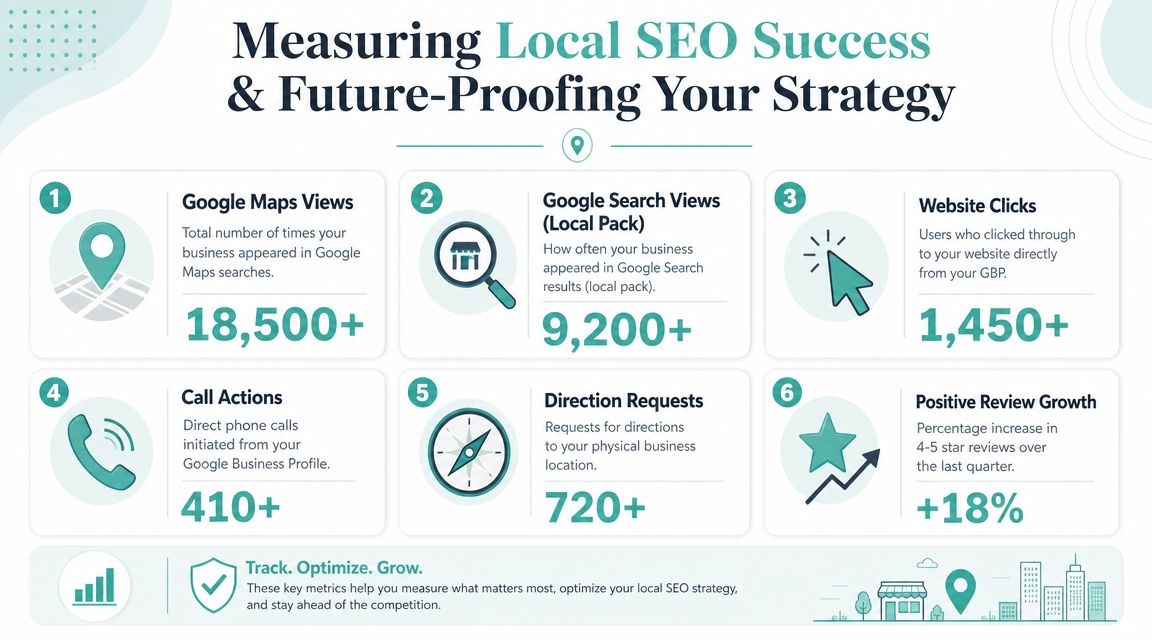
What matters is whether local visibility produces real business outcomes. Track what leads to calls, bookings, walk-ins, and qualified enquiries.
Track signals tied to enquiries
Look at metrics that tell you whether your local presence is working:
- Google Business Profile actions: website clicks, calls, direction requests, booking actions
- Location page performance: which suburb pages attract impressions, clicks, and enquiries
- Search query quality: are you appearing for the suburbs and services you want
- Review trend: are fresh reviews coming in regularly, and do they mention relevant services or locations
Use Google Search Console, Google Business Profile insights, Google Analytics, and your call or lead tracking setup. Don't obsess over vanity rankings in isolation. If a page ranks but doesn't generate action, fix the page.
A local SEO report should answer one question first. Did this bring in more qualified local enquiries?
Prepare for AI search now
This is the part many Australian businesses are ignoring. Newer Australian guidance now emphasises AI search, structured data, and conversational FAQs, not just basic profile setup, as noted in Digilari's guide for Australian businesses. That matters because AI-generated answers may reduce clicks to websites in some searches.
The response isn't panic. It's better structure.
Do these things now:
- Add structured data for LocalBusiness, services, reviews, and FAQs where appropriate.
- Write conversational answers to common customer questions, especially suburb and service-area questions.
- Tighten location pages so they answer practical local intent clearly.
- Keep facts aligned across your website, profile, and citations.
- Review search results manually for your target terms and note how Google presents local answers.
If AI search pulls summary-style answers, businesses with clean data and clear local content are more likely to be represented accurately. If your site is vague, you give search systems nothing solid to work with.
Local SEO in Australia is no longer just a map pin and a phone number. It's a system. Profile quality, suburb pages, reviews, structured data, links, speed, and ongoing measurement all feed the same outcome. More visibility from the right local searches, and more chances to turn that visibility into revenue.
If your local SEO work is being held back by a slow site, unreliable hosting, or a messy website setup, have a look at UpTime Web Hosting. They provide Australian hosting, email, WordPress hosting, and related website services that support the technical side of local visibility, especially for businesses that want their site to load well for Australian visitors and stay easy to manage.