

If you're the person in charge of content, SEO, and the website itself, you probably know the pattern. You publish a few useful blog posts, tidy up some service pages, maybe even refresh a homepage headline, then wait for enquiries that never quite arrive. The problem usually isn't effort. It's that the work hasn't been organised into a real seo content strategy, so the site is busy but not pointed at a business outcome.
For most Australian SMBs, the pressure is practical, not theoretical. There's one marketer, maybe a freelancer on call, a WordPress site, and a long list of things that also need attention, like hosting, support emails, and sales follow-up. A content plan only works if it respects that reality and focuses on pages that can win visibility, earn clicks, and support revenue in the Australian search market.
Table of Contents
- Why Most Australian SMBs Get SEO Content Strategy Wrong
- Setting One Business Goal Before You Write a Single Page
- Keyword and Audience Research Built for the Australian Market
- Auditing Existing Content and Mapping Topic Clusters
- On-Page and Technical Essentials for Australian WordPress Sites
- Editorial Calendar and Workflow for a Small Team
- Measurement, KPIs and the Optimisation Loop

Performance you can feel, backed by clients who depend on it. Read how our support and uptime create long‑term customer success.Power Your Business with Better Hosting
Why Most Australian SMBs Get SEO Content Strategy Wrong
A lot of Australian businesses get stuck in a publishing loop. A founder writes one post about a service, a freelancer drafts another one about a common question, and six months later the site has a pile of content that doesn't speak to each other or to a buyer's intent. That's not a strategy, it's a backlog.
The clearest sign is when the blog sounds active but the sales inbox stays quiet. Search visibility is still heavily concentrated at the top of the results page, because organic search drove 49% of all tracked website traffic in a 2024 study and the top Google result captured an average 25.84% CTR in another benchmark cited in the brief (study summary). That means a small lift in ranking or click appeal can change outcomes materially, but only if the page matches intent and earns the click.
Content volume is not the same as content strategy
Publishing more often doesn't fix weak positioning. If a page is too generic, too broad, or aimed at the wrong stage of the buyer journey, it won't matter how polished the writing is. Google's helpful content guidance is blunt about this, content should be made for people first, with first-hand expertise and genuine usefulness, not written mainly to manipulate rankings (Google Search Central).
For Australian SMBs, that means a content plan has to do three jobs at once. It has to reflect local search intent, support trust quickly, and give the user a clear next step. A Brisbane electrician, a Melbourne accountant, and a Perth WordPress agency all need different page types, even when the topic looks similar on paper.
Local relevance beats recycled global advice
Generic SEO advice often misses how Australians search and how quickly they evaluate fit. A local customer wants to know whether the business serves their area, understands Australian conditions, and can be reached without friction. That's why content built around Australian examples, service details, and location cues usually performs better than copy that could sit on any global site.
Practical rule: if a page could be pasted onto a US, UK, or Canadian site without changing much, it probably isn't local enough for an Australian SMB.
The other thing most advice skips is the operational side of content. Search performance is affected by whether pages are fast, crawlable, mobile-friendly, and linked properly. That's not glamorous, but it's where good content either compounds or stalls. The local SEO Australia guide is useful background reading if you want to see how local signals and site setup intersect.
Setting One Business Goal Before You Write a Single Page
A content strategy gets easier the moment you stop trying to make every page do everything. Pick one business goal and let that shape the work. For a Sydney trades business, that might be quote requests. For a Melbourne eCommerce store, it might be product enquiries or higher-value category traffic. For a Brisbane accounting firm, it could be consultation bookings from small businesses.
The point is to define a measurable outcome before anyone starts drafting. Google's own starter guidance recommends a workflow built around one business goal, an audit of existing pages, a topic cluster, and ongoing measurement in Search Console and Analytics (SEO starter guide). That sequence keeps content from drifting into a publishing habit with no commercial anchor.
Turn the goal into an audience statement
A goal only becomes useful when you attach it to a specific audience and search need. A generic statement like “get more traffic” doesn't help a writer decide what to produce. “Increase enquiries from Brisbane SMEs who need BAS help” does. It narrows the topic, the wording, and the service pages that matter.
For Australian searchers, audience definition should include location, urgency, and trust signals. Ask what they search, where they search, and what they need to see before they'll click. A local buyer often wants proof that you understand their market, their timing, and the practical problem they're trying to solve.
A simple Brisbane accounting example
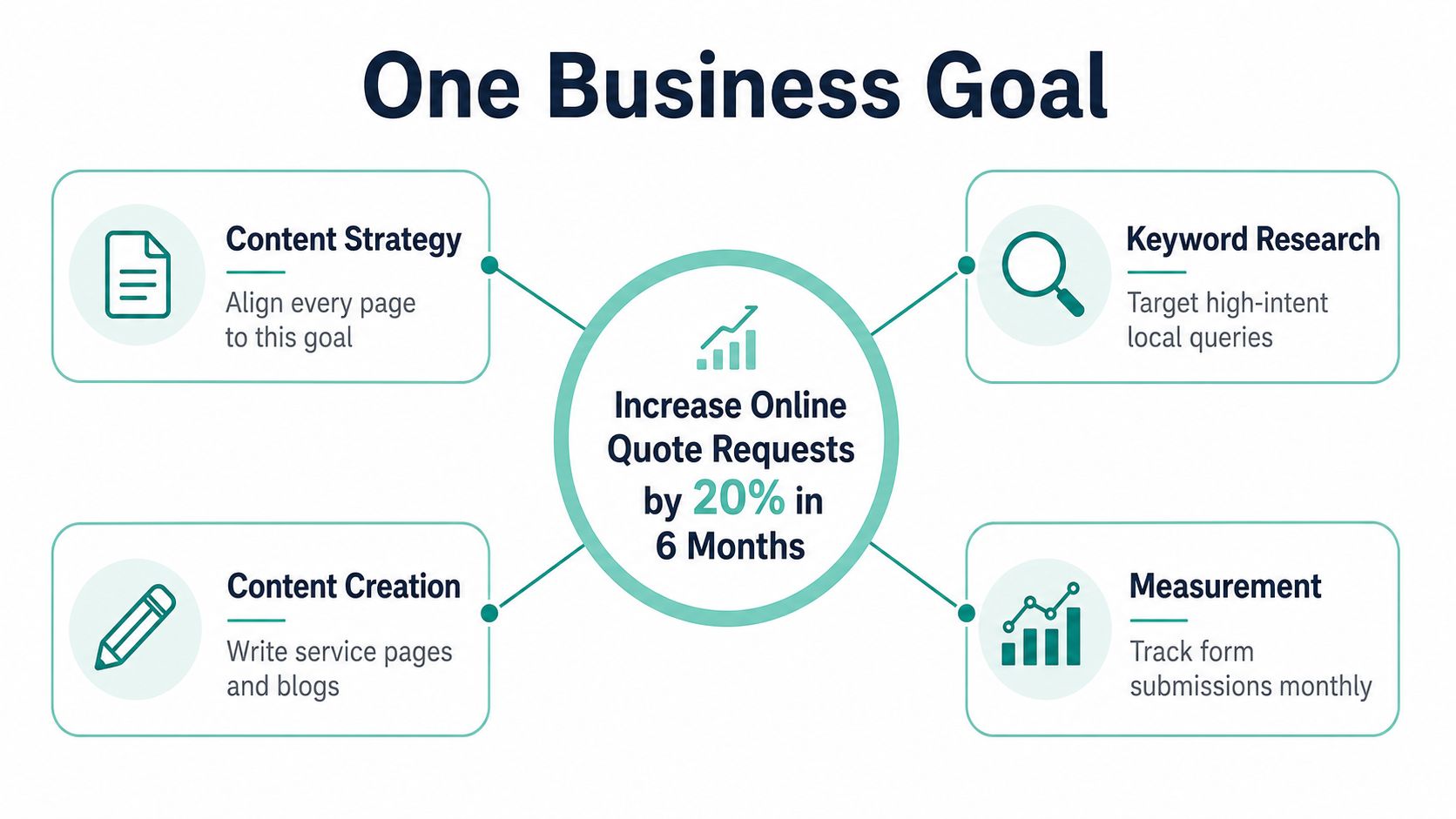
A Brisbane accounting firm doesn't need fifty blog ideas. It needs a short list of pages that support one outcome, like consultation bookings from local business owners. That usually means one strong service page, a few supporting articles that answer common questions, and content that shows the firm understands Australian compliance and small-business pressures.
If you want a useful way to keep the work tight, write a one-page brief with three fields: the business goal, the audience, and the primary conversion action. Anything that doesn't help one of those three gets parked. That discipline matters more than clever headlines.
A good brief protects time. It also stops the site from filling up with articles that feel helpful but don't move a single commercial metric.
Host your website with our 5-star rated, cPanel website hosting plans.
Super fast servers, with security included and hosted in your choice of Australian Data Center.
View cPanel Plans
Keyword and Audience Research Built for the Australian Market
The right keyword list for an Australian SMB rarely starts with a giant spreadsheet. It starts with the phrases real customers use, then strips out anything too broad, too imported, or too detached from buying intent. A local host, a local suburb, or even an Australian abbreviation can change the meaning of a query enough to make the traffic much more qualified.
Free tools are enough to start. Google Search Console shows what you already appear for, autocomplete reveals natural phrasing, and “People Also Ask” surfaces the questions searchers want answered. Competitor gap analysis is still useful, but only if you ignore the temptation to copy every term a rival ranks for. The better question is whether the topic matches your business goal.
Classify every keyword by intent
Not every query deserves the same effort. Informational searches are useful when you need awareness and education. Commercial searches show comparison behaviour, while transactional terms signal readiness to act. Support queries matter too, especially for businesses selling services, hosting, or WordPress help.
That last category is where many Australian SMBs leave value on the table. Someone searching for migration help, safe updates, or troubleshooting is often already a customer or a near-customer. Those pages can support retention, reduce support load, and capture high-intent demand that blog-heavy strategies usually ignore.
Australian modifiers change the value of a term
A generic term like “hosting” is too broad to build a plan around. Add a location, a service type, or a local commercial cue, and the search tells you much more. Queries framed with suburb names, state abbreviations, or .com.au language often carry stronger local relevance because the searcher is trying to identify a nearby or Australian provider.
The guide to mattress SEO keywords is a useful example of how keyword thinking can move from broad product wording into practical intent grouping. The format matters less than the principle. Good research doesn't stop at the term. It asks what the term says about urgency, location, and purchase stage.
Prioritise by value, not volume
Volume alone is a poor way to rank your to-do list. A smaller keyword with clear commercial intent can be worth more than a larger phrase that attracts students, competitors, or people looking for definitions. Use business value and realistic difficulty as the filter, then group the winning terms into a small set of themes you can maintain.
- High-intent local queries: queries that include service, suburb, or Australian framing and align with enquiries.
- Support-intent queries: questions from existing customers who need help, updates, or troubleshooting.
- Top-of-funnel education: broad informational topics that support trust, but don't carry the immediate conversion load.
The Google ranking guide is a useful companion if you're matching keyword research to ranking opportunities on an AU site. The quarterly habit here is simple, check Search Console, refine the list, and drop anything that's not tied to business value.
Auditing Existing Content and Mapping Topic Clusters
Most sites already have enough content to improve. The first job is to find what's helping, what's duplicating itself, and what's just taking up crawl space. On a WordPress site, that means exporting URLs, reading titles and H1s side by side, and flagging pages that are thin, outdated, or competing with each other.
The decision is usually one of four actions. Keep it, improve it, merge it, or retire it. That sounds basic, but it prevents teams from creating new content to solve problems that already exist in the archive.
What to look for in a fast audit
Thin pages often have a narrow topic and no real reason to rank. Duplicate or near-duplicate posts waste authority, especially when they target the same intent. Cannibalisation happens when two or more pages chase the same query, which makes it harder for Google to understand which page should represent the topic.
The blog post examples guide is handy if you want to compare how a live site can turn a loose collection of posts into clearer intent groups. The core idea is not to write more. It's to remove noise and strengthen the page that deserves to win.
Build clusters around one pillar page
A topic cluster works because it gives every page a job. The pillar page covers the main subject broadly, and the supporting articles go deeper into subtopics. Internal links hold the cluster together so users can move through the topic and search engines can understand the hierarchy.
For the Brisbane accounting firm, the pillar might be one service or one broad guide, with supporting articles for tax dates, bookkeeping basics, common compliance mistakes, and local small-business questions. That structure is easier to maintain than a sprawling blog because every new post has a place to live.
Practical rule: if you can't explain how a page supports the pillar, it probably doesn't belong in the cluster.
Keep the map small enough to manage
A cluster map that's too big becomes a liability. Start with a narrow set of services or customer problems, then add only the supporting articles you can update. Service pages usually sit at the centre of commercial clusters, while blog posts and guides fill in the research and education layer.
Once the map is drawn, assign each page one action. Some pages need a refresh, some need consolidation, and some need to be removed. That decision is where a real seo content strategy starts to look like operations rather than content for content's sake.
On-Page and Technical Essentials for Australian WordPress Sites
A strong cluster won't perform if the page itself is sloppy. On-page basics still matter, especially on Australian WordPress sites where theme bloat, plugin clutter, and slow hosting can flatten good work. The fix isn't complicated, but it does need consistency.
Start with alignment. The title tag, H1, opening paragraph, and internal links should all point to the same intent. If the page promises one thing and the body delivers another, users bounce and search engines get mixed signals. That's especially risky on service pages where the buyer is trying to decide quickly.
Make the page easy to read and easy to crawl
Headers should break the content into clear sections. Short paragraphs help both users and crawlers. Image alt text should describe the image honestly, not stuff keywords into it. Structured data only helps when it matches the page type, so use it where it's relevant, like FAQ, LocalBusiness, or Product.
The WordPress SEO plugins guide is useful for teams deciding how much of this to handle in the CMS versus in the template. The important part is not the plugin itself, it's that titles, metadata, and internal links are controlled instead of left to chance.
Treat speed and mobile performance as content issues
Search performance is affected by how fast a page loads and how well it works on mobile. Siteimprove's SEO content strategy guidance recommends mobile-friendliness, fast loading, structured data, broken-link fixes, duplicate-content cleanup, and crawl monitoring as operational requirements, not optional extras (Siteimprove). That's the right mindset for Australian SMBs too.
Local hosting matters here because the infrastructure behind the site affects uptime and delivery. A Sydney or Melbourne data centre, LiteSpeed, CloudLinux, free SSL, and DDoS-protected firewalls are not just feature-list items. They influence how reliably a WordPress site serves pages, especially when the theme stack is heavy or the site is updated often.
Watch the stack, not just the page
A common mistake is running a resource-hungry theme and half a dozen overlapping plugins on a plan that can't support them cleanly. The content may be good, but the user experience still suffers. Managed WordPress setups reduce that friction because caching, security, and core maintenance are handled more consistently.
- Fix broken links quickly: every dead internal link weakens navigation and can make audits messier.
- Clean up sitemaps: keep crawl paths simple so important pages are easier to discover.
- Match schema to reality: don't add markup that isn't supported by the page content.
- Test on mobile first: most local buyers will see the page there before they ever open a desktop.
Register your new domain name at competitive market prices including free domain add-ons like privacy, DNS Hosting, Custom Nameservers and Forwarding.
Always the best price and no nasty renewal price hikes.
Register A Domain Name
Editorial Calendar and Workflow for a Small Team
A workable calendar for a small Australian team looks boring in the best way. It has fewer moving parts, fewer surprises, and clearer ownership. One marketer can manage it if the briefs are sharp and the publishing rhythm is realistic.
The fastest way to make the calendar useful is to tie each post to a cluster, a target intent, and a business outcome. That way, a freelancer isn't guessing what to write, and a developer only gets pulled in when the page needs technical support, layout changes, or something the writer can't handle alone.
Use a brief template that actually gets used
Every brief should name the primary keyword, the intent, the supporting links, and the definition of done. A good brief also says what the article is not. That's especially useful when you're trying to keep a post focused on a specific customer scenario rather than drifting into broad SEO commentary.
For Australian hosting and WordPress audiences, support and after-purchase content often punches above its weight. Migration guides, safe update instructions, and troubleshooting articles can reduce support tickets and keep customers from churning. Those pages may not look flashy in a content dashboard, but they're commercially valuable.
A quarterly rhythm works well for lean teams
A simple quarterly pattern keeps the workload manageable. Month one is for core service pages and foundational cluster pages. Month two fills out the supporting articles. Month three is for promotion, internal linking, and refreshes. That sequence gives you enough time to publish, watch what happens, and correct weak pages before they harden into a habit.
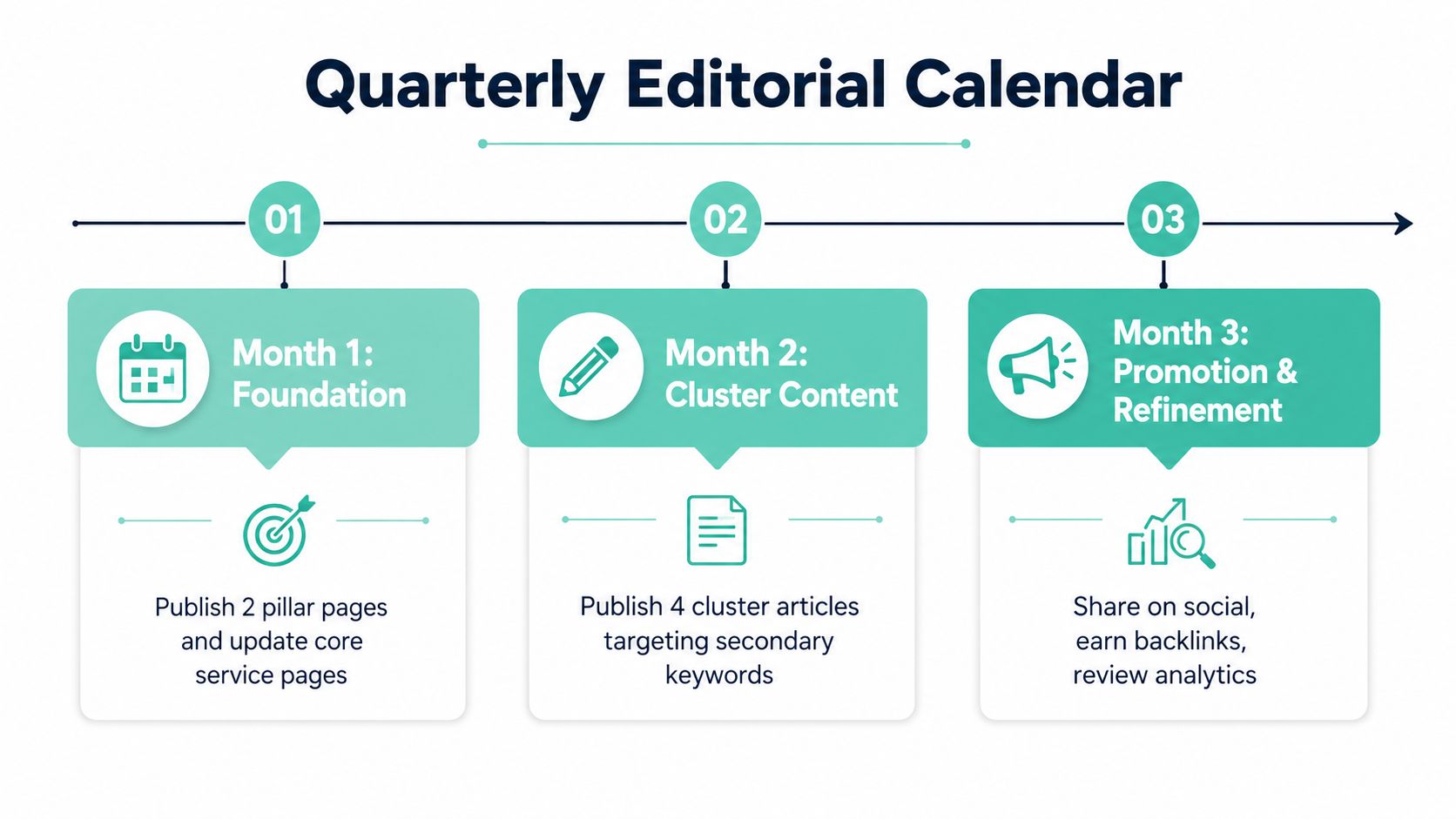
A spreadsheet and WordPress editorial tools are usually enough for tracking. Keep columns for page type, owner, status, target query, and internal links. If a page needs a developer, flag it early instead of discovering the problem after the copy is finished.
The best small-team workflow is the one that keeps publishing moving without turning the marketer into a project manager for every task.
Measurement, KPIs and the Optimisation Loop
A content strategy only earns the name when it has a review loop. That means measuring what matters, deciding what changed, and improving pages instead of endlessly replacing them. For an Australian SMB, the useful metrics are the ones tied to enquiries, conversions, and content quality, not vanity traffic.
Set a baseline before launch. Then track the pages that matter in Search Console and Analytics so you can see how non-brand discovery behaves over time. The goal isn't to stare at dashboards, it's to know which pages deserve another round of work.
Core KPIs for an Australian SMB SEO Content Strategy
| KPI | Why it matters | Where to find it |
|---|---|---|
| Non-brand organic clicks | Shows whether new audiences are finding the site through search | Google Search Console |
| Enquiries or conversions from content pages | Connects content work to business outcomes | Google Analytics and form tracking |
| Pages in the position 6 to 20 range | Identifies pages close to stronger visibility | Google Search Console |
| Support-content impact on retention | Shows whether help content is reducing friction after purchase | Support logs and Analytics patterns |
Diagnose before you rewrite
If a page is stuck, don't rush into a full rewrite. Check whether the problem is intent mismatch, shallow depth, weak internal links, or a technical issue. The fastest wins often come from improving the title, tightening the answer, or linking the page into a stronger cluster.
That quarterly audit loop is where many pages recover. Look at the content sitting near the middle of the results, improve the sections that answer the query poorly, and refresh anything stale. You're not trying to reinvent the topic each time, just make the existing page more useful and more complete.
Build for AI overviews by adding what summaries can't
AI-mediated search changes the value of the page, but not the need for it. Content that includes first-hand expertise, local scenarios, and practical detail is harder to flatten into a generic summary. That's where Australian examples, service-specific knowledge, and customer situations matter most.
The earlier note on information gain is the right lens here. If the page repeats consensus advice, it's easy to summarise away. If it contains local process details, lived examples, or operational nuance, it has a stronger chance of earning the click because the user still needs the full version.
Practical rule: refresh pages with better evidence, sharper examples, and clearer next steps, don't just add more words.
For a hosting or WordPress business, that often means updating support articles, adding local process notes, and clarifying what a customer should do next. The how to increase your website ranking on Google guide fits well here if you want a practical companion to your quarterly review process.
If you want a hosting partner that understands how SEO performance, site speed, and WordPress reliability fit together, take a look at UpTime Web Hosting. It's built for Australian businesses that need local support, secure infrastructure, and a site that can keep up with a serious content plan. When you're ready to turn your content strategy into a faster, cleaner WordPress setup, visit them and see what matches your site.