In short
An ASP.NET ecommerce website should usually start with nopCommerce when standard store features and faster launch matter, a custom ASP.NET Core MVC build when workflows are genuinely unique, or an API-first design when several front ends need the same commerce services. The host must match the runtime, database, IIS, SSL, storage and deployment model.
Key takeaways
- nopCommerce is usually the quickest route when the store needs conventional catalogue, cart, checkout and administration features.
- The nopCommerce release notes listed 4.90.8 as the stable release when checked on 13 October 2026, and the 4.90 branch targets .NET 9. (nopcommerce.com)
- On 14 October 2026, .NET 8 and .NET 9 have 27 days of Microsoft support remaining, compared with 762 days for .NET 10 LTS. (dotnet.microsoft.com)
- ASP.NET Core does not require Windows, but Windows hosting is often the simpler choice for applications built around IIS, Plesk, Web Deploy and SQL Server.
- Hosting compatibility must be checked against the exact application release, database, plugins, deployment mode and background tasks, not just the ASP.NET label.
Table of contents
- Which ASP.NET ecommerce approach should you choose?
- Why is the .NET version the first hosting check?
- Does an ASP.NET ecommerce site have to use Windows hosting?
- What hosting features must the plan include?
- How much hosting capacity should you start with?
- How do you deploy without breaking checkout?
- What should you decide before buying hosting?
- What else do people ask about ecommerce websites?
- What should you do next?
The platform and hosting decisions belong in the same conversation. A store can be well designed and still fail at launch because its host lacks the required runtime, database edition, file permissions, process controls or deployment access.
Which ASP.NET ecommerce approach should you choose?
Use nopCommerce for a conventional store that needs to launch sooner, custom ASP.NET Core MVC for business rules that genuinely justify a bespoke application, and an API-first design for several front ends or integration-heavy commerce. The safest default is the option that leaves the least custom code to build, secure and maintain.
How do the three options compare?
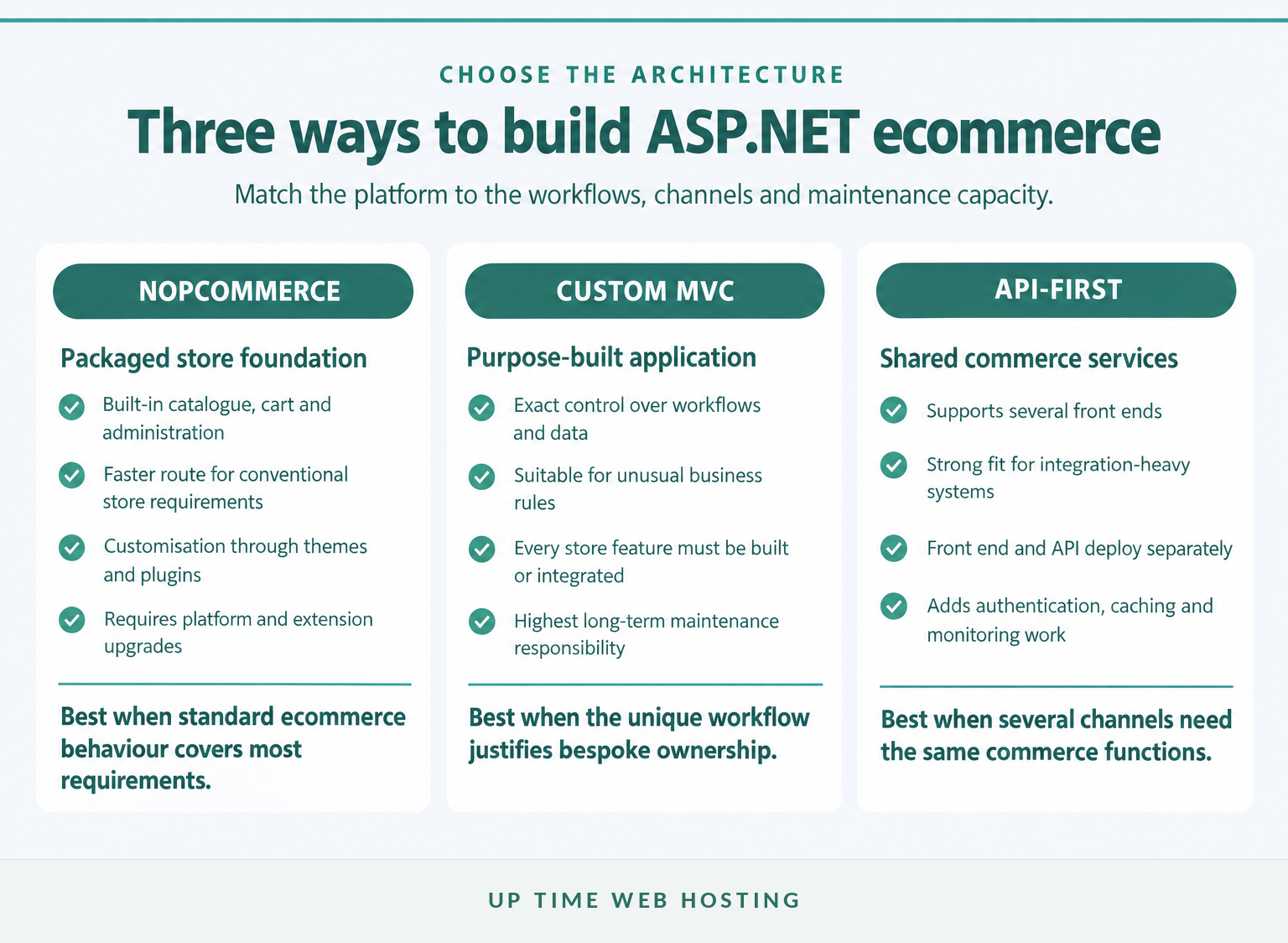
Choose nopCommerce when the store mostly needs known ecommerce functions. nopCommerce provides a storefront, product catalogue, customer and order administration, checkout and an extension model for themes and custom plugins. The official download and release pages identify it as an open-source ASP.NET Core ecommerce application, but implementation, customisation, upgrades and hosting still require work. (nopcommerce.com)
nopCommerce is a practical fit when the requirements can be met through configuration, a theme and a limited number of maintained extensions. It becomes less attractive when a team must replace large parts of the checkout, catalogue or order model to make the platform behave like a different application.
Choose custom ASP.NET Core MVC when the workflow is the product. A custom build can be justified by unusual pricing, approvals, subscriptions, quoting, fulfilment, customer permissions or links with existing business systems. The trade-off is ownership of every feature that a packaged platform would otherwise provide, including administration, search, promotions, order history, security testing and upgrades.
Custom development should solve a named business constraint. It should not be selected merely because a development team prefers starting from an empty project.
Choose an API-first design when several channels need the same commerce services. This approach can serve a web storefront, mobile application, customer portal or other authorised client from shared catalogue, cart, customer and order APIs. It also adds more moving parts, including API authentication, front-end hosting, caching, versioning, monitoring and deployment coordination.
Before choosing, answer four questions:
- Can a packaged store meet the requirements without replacing its core behaviour?
- Which workflows are genuinely different from a normal online shop?
- Will more than one front end consume the same commerce services?
- Who will maintain the application, extensions and integrations after launch?
Choose the least custom architecture that can support the business rules already known.

Performance you can feel, backed by clients who depend on it. Read how our support and uptime create long‑term customer success.Power Your Business with Better Hosting
Why is the .NET version the first hosting check?
Check the application's target framework before comparing CPU, storage or price. The host, the deployed runtime, the platform release and every critical plugin must support the same production combination.
What do the support dates mean on 14 October 2026?
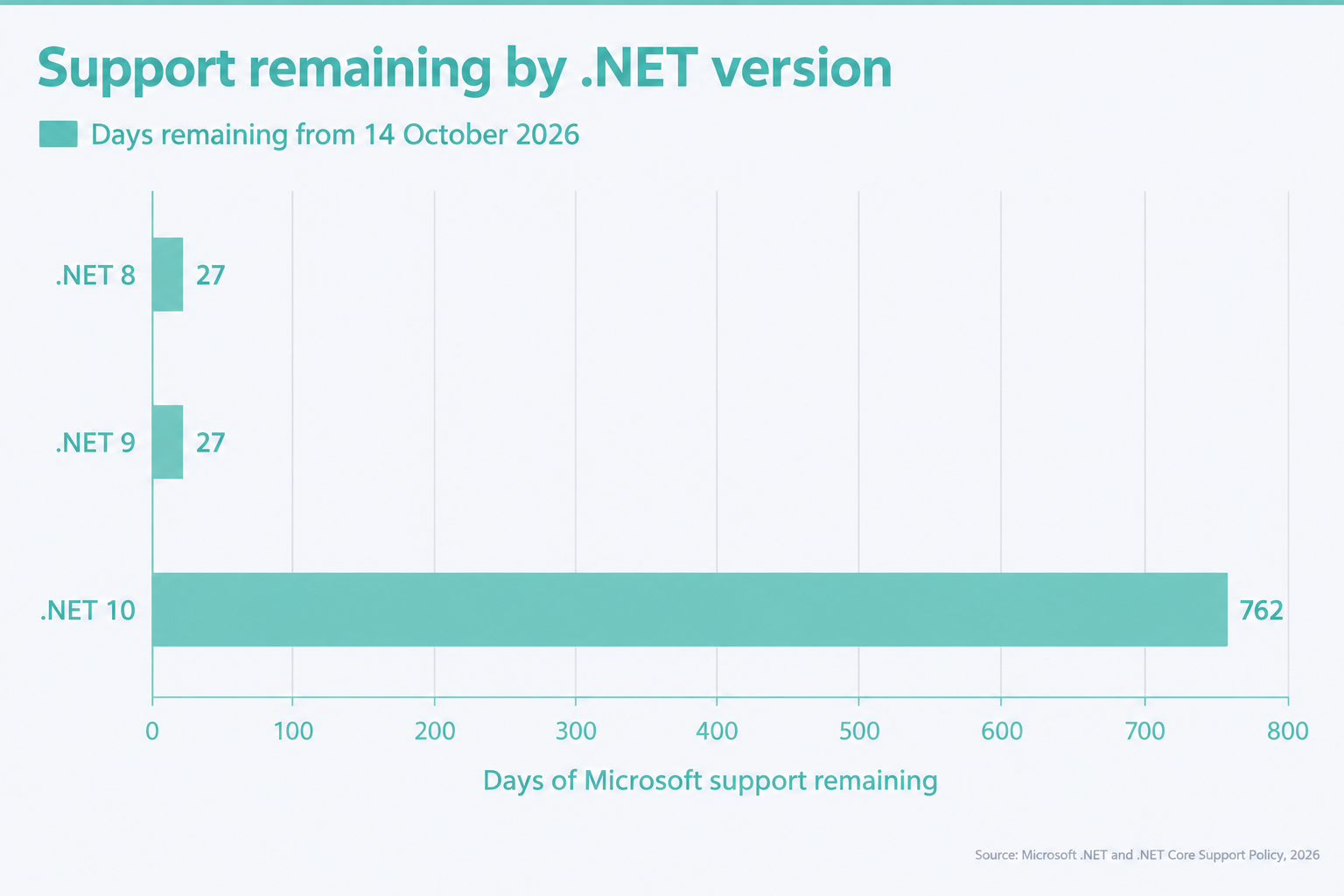
The official nopCommerce release notes list version 4.90.8 as the stable release checked on 13 October 2026, while nopCommerce 4.90 targets .NET 9. The Microsoft .NET support policy ends support for .NET 8 and .NET 9 on 10 November 2026, while .NET 10 LTS remains supported until 14 November 2028. That leaves 27 days for .NET 8 and .NET 9, and 762 days for .NET 10, from the scheduled publication date. (nopcommerce.com)
A new custom application should normally target .NET 10 LTS unless a required dependency prevents it. A nopCommerce project needs a different decision: confirm that the host supports the current 4.90 runtime, then establish how and when the store, theme and plugins will move to a stable release on .NET 10.
Hosting advertisements can also hide the deployment model. Microsoft's .NET application publishing overview explains that framework-dependent deployments use the runtime installed on the server, while self-contained deployments include their own runtime. Framework-dependent applications receive the host's installed runtime patches; self-contained applications require the application owner to publish a new build when updating the bundled runtime. (learn.microsoft.com)
Runtime support dates belong in launch planning, not in a later maintenance backlog.
Does an ASP.NET ecommerce site have to use Windows hosting?
No. ASP.NET Core is cross-platform, although Windows hosting is often the simpler fit when the application expects IIS, Plesk, Web Deploy or SQL Server. Choose the operating system from the whole application stack, not from ASP.NET in the project name.
Why can both Windows and Linux work?
The official nopCommerce technology and system requirements list supported Windows and Linux environments and support SQL Server, MySQL and PostgreSQL. A custom ASP.NET Core application can also run behind different supported web servers, provided the runtime, native dependencies, permissions and process management are configured correctly. (github.com)
Windows is usually the straightforward route when the application team wants IIS integration, Web Deploy, a Plesk control panel or close alignment with SQL Server. This Windows web hosting guide provides more context on that hosting model.
For IIS, the server needs the correct .NET Hosting Bundle, which installs the runtime and ASP.NET Core Module used to run the application behind IIS. The practical deployment steps are covered in the guide to host an ASP.NET Core application in IIS. (learn.microsoft.com)
Linux or container hosting can be suitable when the team already operates that environment, the application has no Windows-only dependency and the chosen database and deployment tools are supported. It is not automatically simpler or cheaper once monitoring, patching, backups and operational skills are included.
Legacy ASP.NET Framework applications need separate treatment. They normally depend on Windows and IIS and should not be assessed as though they were a current ASP.NET Core build.
Use Windows because the application stack benefits from IIS and SQL Server, not because ASP.NET Core itself requires Windows.
Host your website with our 5-star rated, cPanel website hosting plans.
Super fast servers, with security included and hosted in your choice of Australian Data Center.
View cPanel Plans
What hosting features must the plan include?
A production plan must support the exact runtime, web server, database, HTTPS configuration, writable storage, backups and operational tools the store uses. A plan that merely says ASP.NET compatible is not specific enough.
What does the production stack contain?
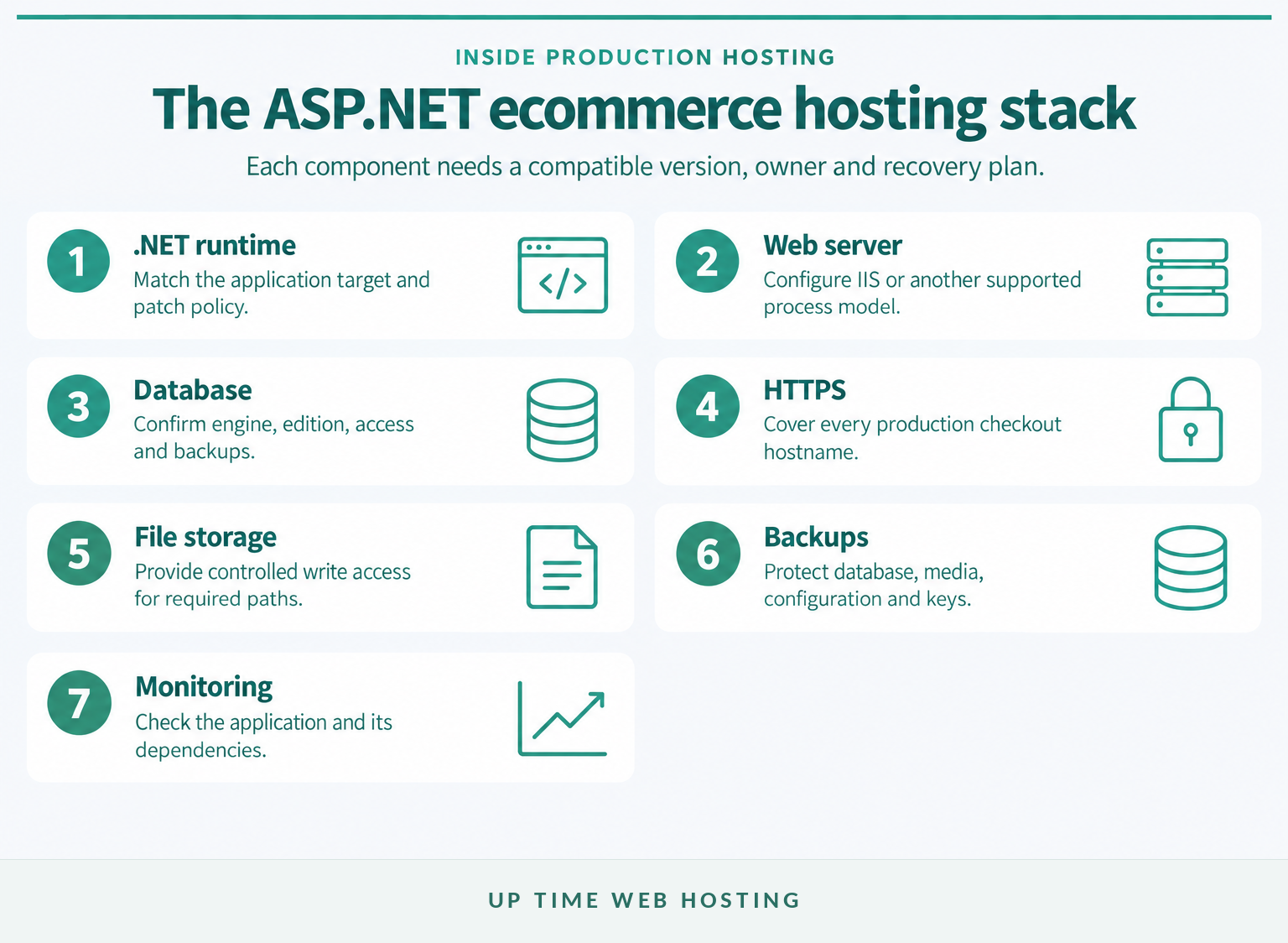
- The exact runtime and patch process. Confirm the major .NET version, supported patch level and who installs security updates. For self-contained deployment, confirm that the release process replaces the bundled runtime when required.
- A supported web server and process model. IIS hosting requires the ASP.NET Core Module and a correctly configured application pool. The process must restart after a crash or server reboot, and operational staff need access to useful application and server logs.
- A compatible database. Confirm the engine, release, edition, storage allowance, connection limits, authentication method and backup process. When SQL Server is selected, review the wider MSSQL database hosting requirements rather than checking only that one database is included.
- HTTPS for every production hostname. A valid certificate enables encrypted browser connections, but TLS is only one control. This guide to SSL certificates explains hostname coverage, including situations involving several subdomains.
Payment design also affects the security boundary. PCI SSC guidance on outsourced payment processing explains that outsourcing payment processing can reduce which controls apply directly to the merchant environment, but it does not remove the merchant's responsibility to validate compliance and manage the provider relationship. (pcisecuritystandards.org)
- Writable application and media locations. Product images, logs, plugins, exports and application data may need controlled write access. The official nopCommerce installation guide identifies required writable paths, including
App_Data, logs, plugins, uploaded files and Data Protection keys. (docs.nopcommerce.com)
- Support for background work and integrations. Order emails, stock imports, webhooks, scheduled jobs, search indexing and catalogue feeds may continue after the browser request ends. Confirm how scheduled processes run, how failures are logged and whether outbound connections required by payment, shipping and business systems are permitted.
- Backups, restoration and monitoring. Back up the database, uploaded media, configuration and any persistent cryptographic keys required by the application. Monitoring should distinguish a working web server from a working store by checking dependencies such as the database and critical external endpoints.
A suitable plan is defined by compatibility, recoverability and operational access, not just storage and price.
How much hosting capacity should you start with?
Start with enough headroom to pass a realistic load test, not a generic RAM number copied from another store. Catalogue size, search, image processing, concurrent checkout, integrations and background work can change resource use more than the framework name.
A useful test workload should include:
- customers browsing categories and filtering products;
- several carts and checkouts running at the same time;
- administrators processing orders while customers shop;
- catalogue imports, image generation and scheduled tasks;
- payment, shipping, tax and inventory calls under realistic latency;
- cold application starts and process recycling;
- a short traffic burst representing a promotion or email campaign.
Measure response time, failed requests, CPU, memory, process restarts, database waits and job duration. A store that appears fast for one browser session may still stall when a product import and several checkouts compete for the same resources.
Microsoft's ASP.NET Core health checks can expose application availability and test dependencies such as databases or external services. Health checks should feed monitoring and deployment decisions rather than being treated as a public status page. (learn.microsoft.com)
Scaling to several application instances introduces shared-state requirements. Microsoft's Data Protection key guidance explains that instances need access to a suitable shared key ring when protected data must work across machines. The official nopCommerce web-farm guidance also covers distributed cache, shared content and primary-node decisions. (learn.microsoft.com)
Size hosting from a repeatable load test, then keep a clear upgrade path for real traffic.
How do you deploy without breaking checkout?
Deploy from a tested artefact through staging, backup, release, database change and verification steps. A production deployment also needs a rollback decision made before files or schema are changed.
What release sequence reduces risk?
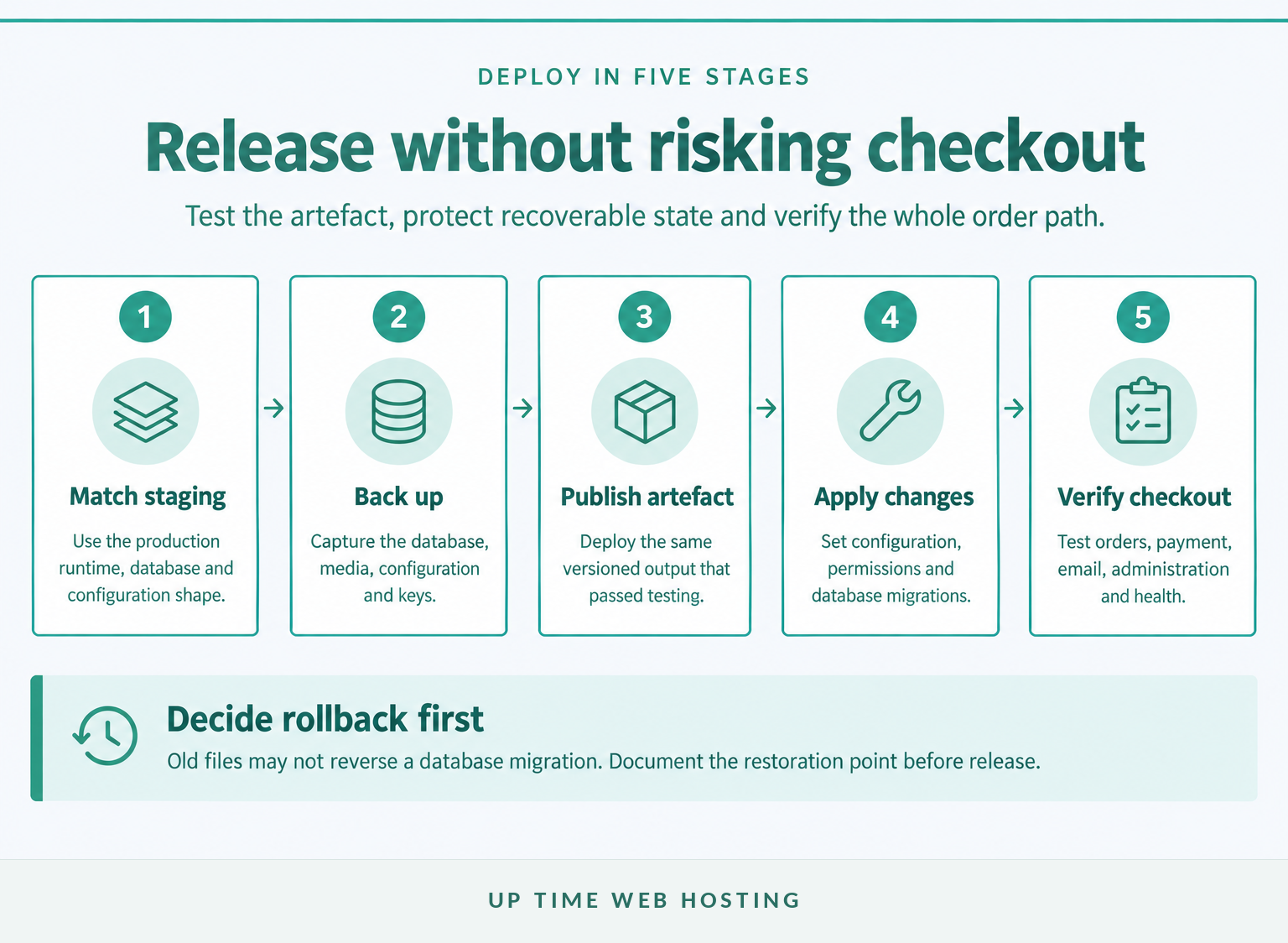
- Match staging to production. Use the same runtime family, database engine, configuration shape and important integrations. Sanitise production data if it is copied into a non-production environment.
- Back up the recoverable state. Capture the database, uploaded media, configuration and persistent key material. Record how long restoration takes and who can authorise it.
- Publish one versioned artefact. Build the release once and deploy that tested output. Microsoft's ASP.NET Core IIS publishing guidance describes folder publishing and the generated
web.configused by IIS. (learn.microsoft.com)
- Apply configuration and database changes deliberately. Keep production secrets outside source control, verify write permissions and understand whether database migrations can be reversed. Restoring old application files may not undo a changed schema.
- Run a checkout smoke test before declaring success. Check catalogue browsing, search, cart updates, customer sign-in, a payment-provider test transaction, order creation, confirmation email, administration and the health endpoint. Monitor error rates and background jobs after traffic returns.
The general ASP.NET Core deployment guidance also requires a process manager, published application files and an appropriate reverse-proxy configuration where one is used. (learn.microsoft.com)
A safe deployment is a tested release process with a rollback path, not a file copy performed on the live store.
Register your new domain name at competitive market prices including free domain add-ons like privacy, DNS Hosting, Custom Nameservers and Forwarding.
Always the best price and no nasty renewal price hikes.
Register A Domain Name
What should you decide before buying hosting?
Ask the host to confirm the full production stack in writing before ordering. The answers should cover compatibility, limits, restore procedures, deployment access and the path to more resources.
Send a short technical brief containing:
- the ecommerce option and exact application release;
- the target .NET runtime and deployment mode;
- the database engine, edition and expected size;
- required domains, subdomains and certificates;
- the deployment method, such as Web Deploy or a provider-supported alternative;
- writable folders and media-storage requirements;
- scheduled jobs, email, webhooks and outbound services;
- backup retention and the required recovery time;
- expected traffic, catalogue size and launch events;
- the process for increasing CPU, memory, storage or database capacity.
Also define the responsibility boundary. The host may manage the operating system, runtime and backups while the developer remains responsible for application code, extensions, database migrations and security defects. Vague ownership creates long outages when each party expects the other to act.
Buy hosting only after the application version, database and deployment path are written down.
What else do people ask about ecommerce websites?
These questions cover the basic ecommerce decisions that sit underneath the ASP.NET choice. Each answer applies to both packaged and custom builds.
What is an e-commerce web site?
An e-commerce web site is a website that lets a business or individual present products or services, accept orders and usually take payment online. A complete ecommerce site also handles catalogue data, pricing, stock, customer accounts, tax, shipping, order records and post-purchase communication.
How do I create my own e-commerce website?
To create your own e-commerce website, define the catalogue, checkout, payment, shipping and integration requirements first. Then choose a platform, build and test in staging, arrange compatible hosting and a database, configure TLS and backups, run payment and order tests, and launch with monitoring and a rollback plan.
Which type of website is best for eCommerce?
The best type of website for ecommerce is the least complex option that meets the store's real requirements. A packaged platform suits standard retail features, a custom MVC application suits unusual workflows, and an API-first design suits several front ends or heavy integration needs. Hosting must match whichever architecture is chosen.
The best ecommerce answer is the one that ties the store's business model to a supportable application and hosting design.
Experience Microsoft 365 Business Standard for free for 30 days.
Up to 25 users with full access to email, OneDrive and Teams. Includes full versions of desktop apps of Outlook, Word, Excel, PowerPoint and more.
Try Microsoft 365
What should you do next?
Turn the chosen architecture into a one-page deployment brief and send it to the developer and host. No plan should be ordered until both confirm the same runtime, database, payment and release design.
If nopCommerce is the selected platform, compare those requirements with Up Time Web Hosting's nopcommerce hosting and ask for current-version confirmation before ordering.
Do not order the plan until the host has confirmed the exact runtime and database combination the build will use.