
You're probably staring at two browser tabs right now, one for Wix, one for WooCommerce, and trying to work out which one will hurt less six months from now. Maybe you want to launch fast, keep the budget tight, and avoid becoming your own developer. Maybe you already run WordPress and don't want to hand over control just to get a store live.
That's the choice behind Wix Ecommerce vs WooCommerce. It isn't a feature checklist. It's a decision between hosted convenience and self-hosted control, and for Australian SMEs that difference shows up in hosting, GST, payments, SEO, maintenance, and what happens when you want to grow.
Australian ecommerce is big enough that the platform call matters. The U.S. International Trade Administration says ecommerce accounted for 18% of all Australian retail spending, reaching US$45 billion (trade.gov). If you're building a store for an Australian market that already expects fast checkout, local tax handling, and reliable uptime, you need to choose the platform that matches how you operate, not just the one with the friendlier demo. If you want a broader local comparison that includes another common option, this Australian Wix vs WooCommerce vs Shopify comparison is useful background.
Table of Contents
- Introduction
- Understanding Wix Ecommerce and WooCommerce at a Glance
- Ease of Use Customisation and Ongoing Maintenance Compared
- True Cost of Ownership for Australian Businesses
- Performance Security SEO and Payments in Australia
- Which Platform Fits Your Australian Business Scenario
- Our Recommendation and Next Steps for Your Store

Performance you can feel, backed by clients who depend on it. Read how our support and uptime create long‑term customer success.Power Your Business with Better Hosting
Introduction
A Sydney café owner I've worked with wanted to sell beans online, keep the menu on the same site, and avoid hiring a developer for every change. Wix looked attractive because the site could be launched quickly, managed in one place, and kept visually tidy without much technical work. A Perth-based retailer in the same position chose WooCommerce because they already lived in WordPress, needed more control over product structure, and didn't want the site trapped inside a builder they couldn't easily grow out of.
That split is why this comparison matters. Wix is a hosted website builder, which means the hosting, updates, and core platform are bundled into the service. WooCommerce is an open-source WordPress plugin, so you own the site stack, choose the hosting, and manage more of the moving parts yourself. If you want a short primer on how the plugin works, the WooCommerce basics guide is a good starting point.
The Australian market backs up the reality that both platforms matter, just in different ways. Independent Australian tracking has repeatedly shown WooCommerce with a larger local merchant footprint than Wix, while Wix still has a meaningful place among smaller businesses that want simpler site management (Plug2Data Australia, ShopRank Australia, WM Tips Australia). That's the pattern I see on the ground too, larger content-led stores tend to lean WooCommerce, while lighter catalogues and service businesses often start on Wix.
The questions that matter are simple. Who owns the site? How much do you want to manage yourself? How will GST, shipping, and payment gateways work in Australia? And what happens when your catalogue gets bigger or your SEO strategy gets serious?
Understanding Wix Ecommerce and WooCommerce at a Glance
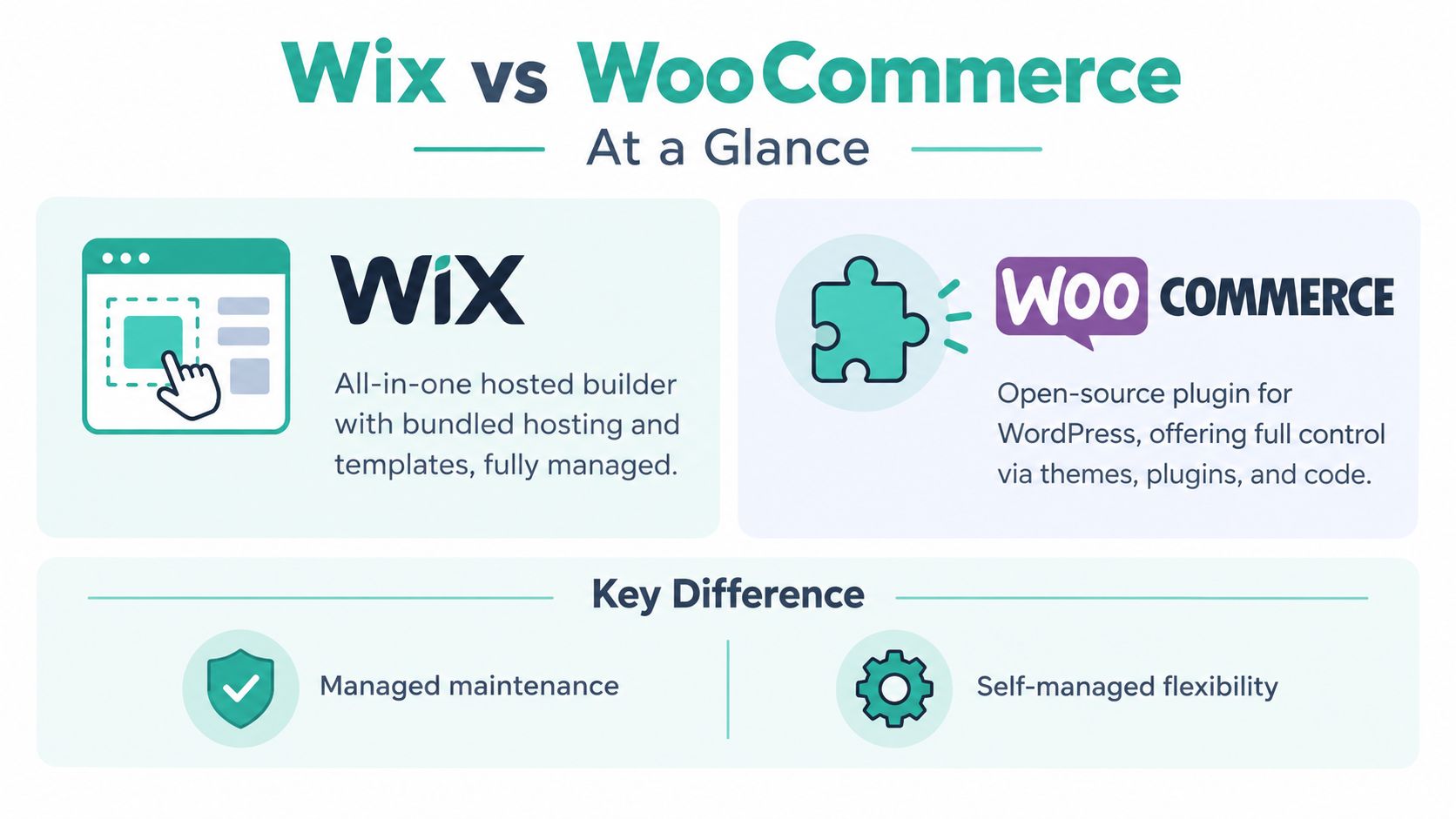
A store owner in Australia usually hits the same fork in the road fast. Wix gives you an all-in-one setup, with hosting, templates, updates, and the builder bundled together. WooCommerce sits on WordPress, so you choose the hosting, pick the theme, add plugins, and keep control of the stack yourself.
That difference drives the whole decision. Wix lets the platform handle more of the moving parts. WooCommerce gives you more control, but you also carry more responsibility. For local businesses, this is not just a design choice. It affects ownership versus convenience, plus how much you need to worry about hosting, maintenance, and what happens when the store grows.
A practical way to view it is simple. Wix works like leasing a ready-made shopfront. WooCommerce works like owning the building and fitting it out yourself. The first is quicker to start. The second is easier to reshape.
Australian market data shows both platforms have a real place. Independent tracking has put WooCommerce ahead on merchant footprint, while Wix still has strong use among smaller businesses that want simpler site management (Plug2Data Australia, UpTime Web Hosting comparison). That matches what I see in practice, larger content-led stores usually lean WooCommerce, while lighter catalogues and service businesses often start on Wix.
The numbers are only part of it. A store also needs to handle GST cleanly, work with local payment options, and avoid getting boxed in by platform rules. Wix can be fine if its payment availability suits your setup. WooCommerce gives you more freedom there because you own the site and can choose the hosting and integrations that fit your business. If you want the technical basics of the plugin itself, the What is WooCommerce guide is a useful primer.
For broader planning, the Crescade industries ecommerce page is a sensible reference point when you want to map the store against wider ecommerce needs.
Practical rule: choose the platform that matches your tolerance for ownership. If you want less maintenance, Wix wins. If you want more control, WooCommerce wins.
Host your website with our 5-star rated, cPanel website hosting plans.
Super fast servers, with security included and hosted in your choice of Australian Data Center.
View cPanel Plans
Ease of Use Customisation and Ongoing Maintenance Compared
Wix gets you moving quickly. You drag, drop, publish, and keep going. For a solo operator with a small product range, that speed can be the difference between launching and sitting on the idea for another month. A service business with a light catalogue, such as skincare consultations plus a few products, will usually find Wix easier to get live without technical drag.
WooCommerce asks for more setup, and that extra work buys you more control. You choose hosting, pick a theme, install extensions, and manage the build with more intention. The process takes more effort because the store is not locked inside one builder's rules. You decide how product data, tax setup, and site structure should work.
Wix lowers the barrier to launch. WooCommerce lowers the ceiling on what you can build.
That difference shows up in day-to-day edits. Adding products in Wix is quick and straightforward. Adding products in WooCommerce is still simple, but you are more likely to think about variations, tax classes, shipping rules, and where the product fits in the wider site. If you want custom checkout behaviour, WooCommerce gives you the room to do it. If you need booking tools or other store integrations, the plugin model gives you more options than a closed builder.
The WordPress side also opens practical integration paths. If you need to connect Google Maps visibility to WooCommerce, the plugin approach makes that kind of setup realistic for local service businesses and retailers with physical locations. That matters when online discovery and in-store visits both count.
Maintenance separates the two platforms even more clearly. Wix handles platform maintenance for you. WooCommerce puts update work on you or your developer, including plugin updates, backups, and conflict checks. If you do not want that responsibility, be honest about it. Store owners who hate maintenance often end up resenting WooCommerce unless they pay for support.
For a wider platform comparison, the WordPress vs Wix comparison is a useful reference if you are weighing how much control you want over the site stack.
True Cost of Ownership for Australian Businesses
| Cost Component | Wix Ecommerce | WooCommerce |
|---|---|---|
| Platform core | Bundled in the subscription | WooCommerce core is free software |
| Hosting | Included | Separate hosting required |
| SSL | Included | Usually included with good hosting, but still part of the stack |
| Themes and design | Included templates, with plan limits | Free or paid WordPress themes |
| Extensions and add-ons | Limited to Wix ecosystem | Plugins may be free or paid |
| Maintenance | Mostly managed by Wix | Managed by you, your staff, or your developer |
| Payment setup | External processors in Australia, since Wix Payments is not yet available here (Mobile Transaction Australia) | External gateways plus local plugin options |
| Growth flexibility | Good for smaller stores | Stronger for bigger, more custom stores |
The cheap option is rarely the cheaper option after twelve months. Wix bundles hosting and support, so the invoice looks tidy and predictable. WooCommerce starts with free software, but the cost sits around it, hosting, premium extensions, security, maintenance, and the time someone spends keeping the store healthy. If you want to understand that stack before you commit, the WooCommerce hosting guide lays out what sits underneath a typical setup.
For Australian businesses, control is the cost question. If you want a simple store and do not want to manage infrastructure, Wix keeps the overhead low. If you already run WordPress content, want tighter SEO control, or expect the store to change over time, WooCommerce makes more sense over the long run, even if the first setup takes more work.
Payments complicate the bill. AU-focused guidance notes that Wix Payments is not yet available in Australia, so merchants need external processors such as Stripe, PayPal, eWay, Fat Zebra, or Braintree (Mobile Transaction Australia). WooCommerce uses gateways too, but the WordPress ecosystem gives you more room to choose a checkout setup that suits local buying habits. That matters when customers expect familiar payment methods and a clean mobile checkout.
GST is another cost that glossy comparisons usually skip. With WooCommerce, Australian tax setup can be explicit. Omnivore's guide for AU merchants specifies country code AU, tax rate 10, tax name GST, and the shipping checkbox ticked (Omnivore tax setup guide). Australian WooCommerce tax guidance also points to Shipping tax class = Based on cart items and using an Australia shipping zone with taxable methods such as flat rate or courier plugins (PressPilot AU tax rules guide).
Cost truth: if your store will stay small, Wix usually stays simpler. If your store keeps changing, WooCommerce buys you more room.
One practical option for local businesses is to pair WooCommerce with Australian hosting from a provider that handles the operational basics, including cPanel, SSL, backups, and support. An Australian provider that includes cPanel, SSL, backups and 24×7 support can reduce the operational burden of WooCommerce hosting.
Performance Security SEO and Payments in Australia
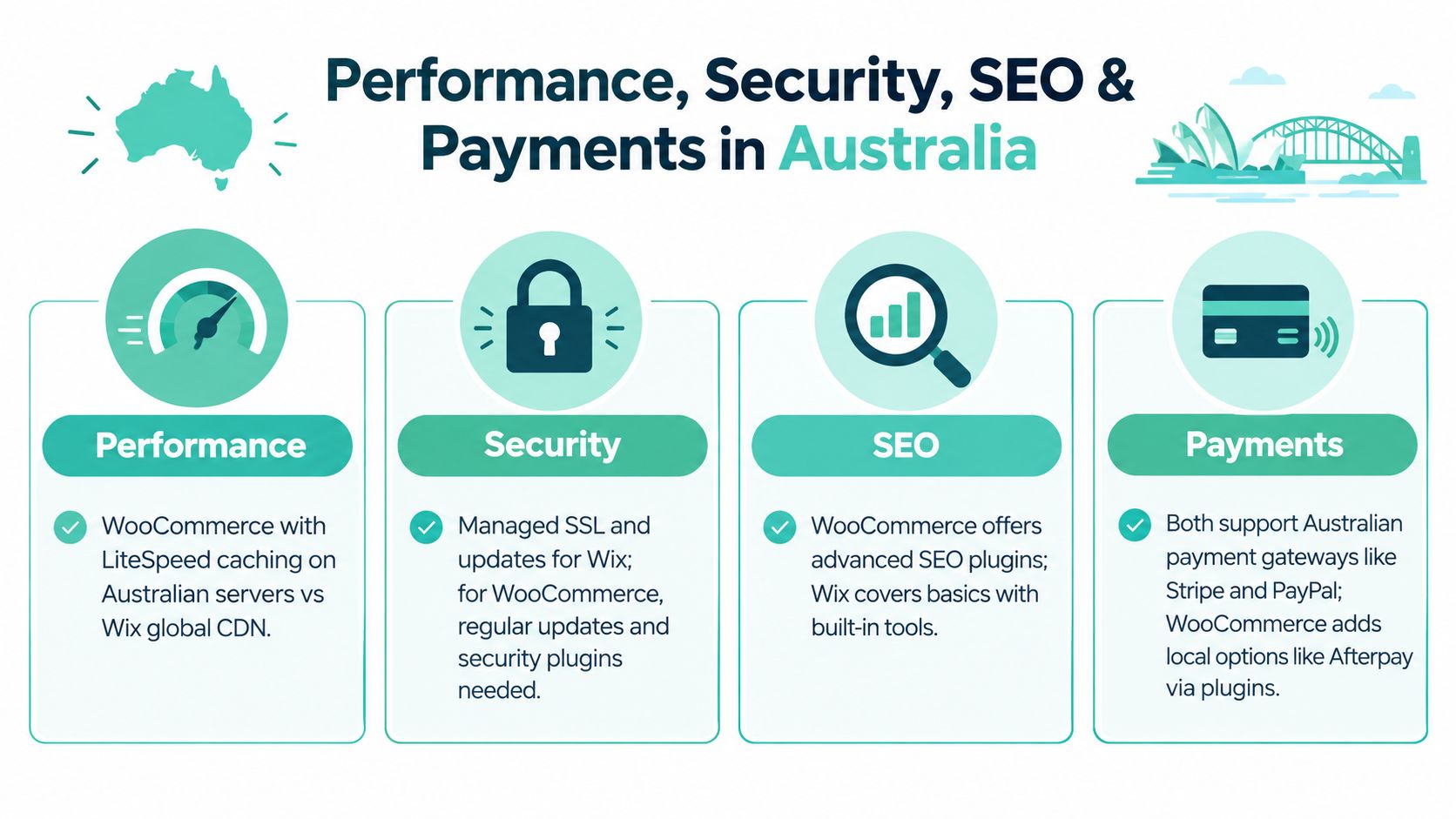
A store can look fine on the front end and still crawl at checkout. That usually comes down to hosting, optimisation, and how much control you have. Wix runs the platform side for you and uses its own delivery setup. WooCommerce performance depends on the host, theme, plugins, caching, and image handling. For Australian stores, platform choice and hosting choice are tied together.
Security follows the same split. Wix manages core updates and a lot of the underlying protection. WooCommerce can be secure too, but you need to keep up with updates, backups, malware scanning, and firewall layers. If you want those controls handled at the hosting level, an Australian provider like UpTime Web Hosting includes free SSL, malware scanning, DDoS-protected firewalls, CloudLinux, LiteSpeed, AccelerateWP, and encrypted off-site nightly backups in the hosting environment.
WooCommerce also gives you more room on SEO. WordPress lets you shape site structure, product copy, plugins, and the way the store supports broader content marketing. Wix covers the basics well enough for smaller stores, but it is still a builder first. If your business depends on landing pages, editorial content, or a larger search strategy, WooCommerce usually holds up better over time.
Payments and tax are where Australian merchants feel the difference fast. Wix Payments is not yet available in Australia, so merchants must plan around external processors from day one. WooCommerce handles Australian store requirements with more configurability, which is why local setup guides focus on GST tables and shipping tax classes rather than just switching payments on.
Australian merchant data backs up the point that WooCommerce is a serious local option. In one 2026 snapshot, it showed 106,237 Australian stores and 31.98% share in that dataset, while Shopify led with 117,625 stores and 35.41% (ShopRank Australia). That does not make WooCommerce the automatic winner, but it does mean it is widely used and well understood here.
If you want to improve the whole stack, not just checkout, the ecommerce site optimisation guide is worth using alongside your platform decision.
Register your new domain name at competitive market prices including free domain add-ons like privacy, DNS Hosting, Custom Nameservers and Forwarding.
Always the best price and no nasty renewal price hikes.
Register A Domain Name
Which Platform Fits Your Australian Business Scenario
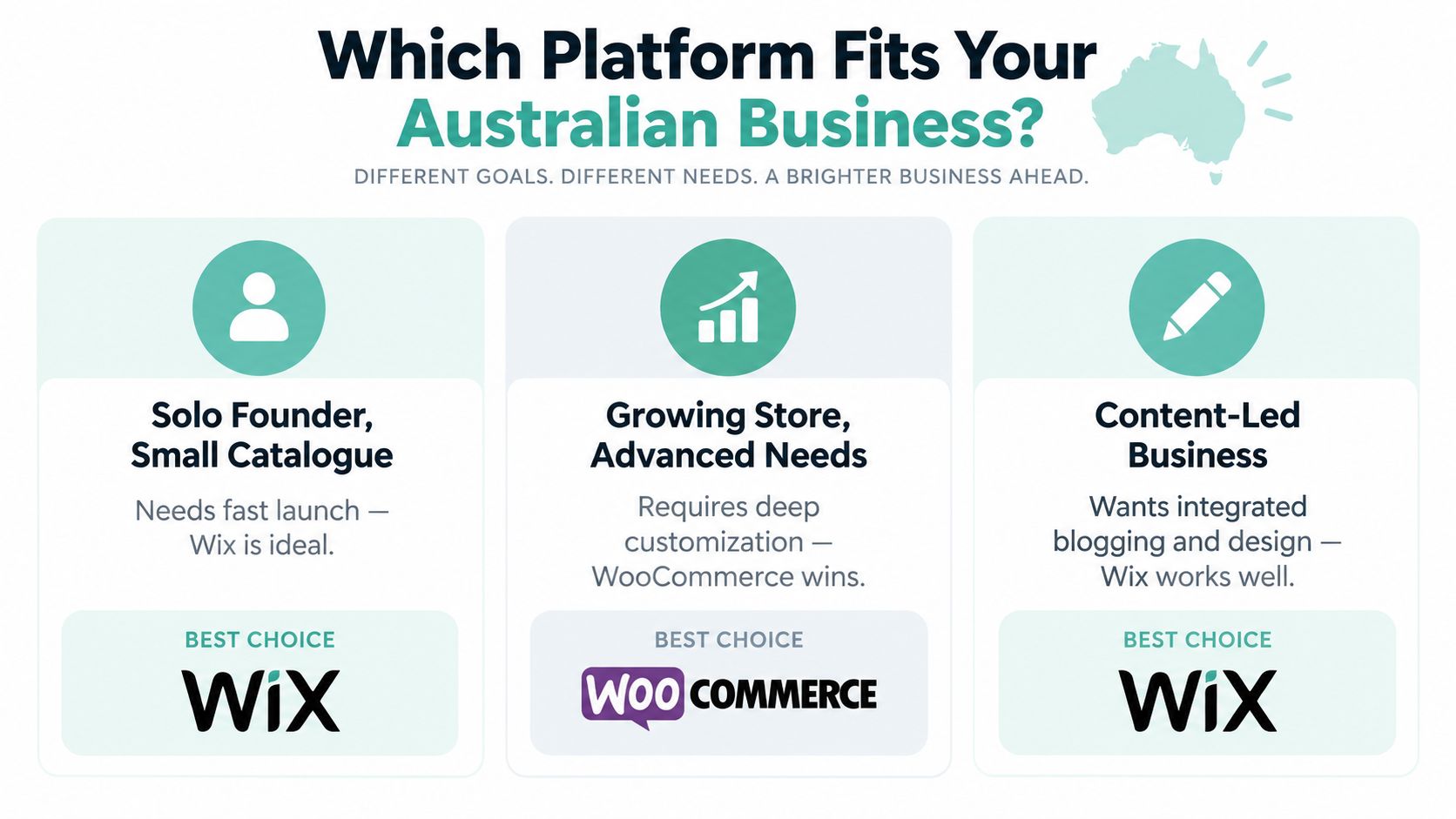
A solo founder with a small catalogue should start with Wix if speed matters most. It is the cleaner path when you need to test demand, keep admin light, and avoid early technical overhead. The trade-off is simple. You give up future flexibility in the back end.
A content-led business already running WordPress should choose WooCommerce. The reason is continuity. If your site already depends on articles, landing pages and SEO, keeping the store inside WordPress usually makes more sense than shifting into a closed builder just to simplify setup. That matters even more when one team needs to manage the whole site without platform-hopping.
A growing retailer with custom integrations should also choose WooCommerce. It fits better when the store needs to connect to other systems, handle more complex shipping logic, or support a bigger growth plan. Yes, the maintenance load is higher. The control is higher too.
An agency managing multiple client stores will usually prefer WooCommerce for the same reason. It is easier to extend, standardise, and hand over in a controlled way. Wix can suit simpler projects, but once clients want deeper integration, it starts to feel restrictive.
If the business will stay simple, use the simpler platform. If the business is likely to change, pick the platform that won't trap you.
Australian store data shows why WooCommerce gets this role so often. Local datasets have measured it in the tens of thousands of stores, while Wix remains smaller but still relevant among SMBs. That does not make WooCommerce right for every case. It does mean it is the safer choice when the site matters more than the shortcut.
For Australian SMEs, the decision is not just features. It is total cost, control, GST setup, local payment limits, and whether you want to own the hosting stack or rent the whole thing.
Our Recommendation and Next Steps for Your Store
My view is direct. Pick Wix if your store is small, you want the least technical hassle, and you're happy to trade control for convenience. Pick WooCommerce if you already use WordPress, care about SEO ownership, or expect the store to grow in complexity. For most Australian SMEs with content, products, and future plans in the same business, WooCommerce is the stronger long-term base.
If you're leaning WooCommerce, don't underbuy the hosting. Use Australian hosting with cPanel, free SSL, backups, and support, because those are the pieces that keep the site from turning into a maintenance headache. If you're leaning Wix, go in with clear eyes about payment constraints, because Australia still relies on external processors rather than Wix Payments.
Before you commit, check three things. First, how GST and shipping will be set up. Second, which payment gateway you'll use in Australia. Third, whether you want to own the site stack or just rent it. Answer those properly, and the platform choice usually becomes obvious.
If you want a local WooCommerce environment built around Australian support and hosting, take a look at UpTime Web Hosting. If you're leaning WooCommerce, local Australian hosting with cPanel, free SSL, nightly backups and 24×7 support will keep the site running smoothly without requiring you to manage the stack from scratch.