In short
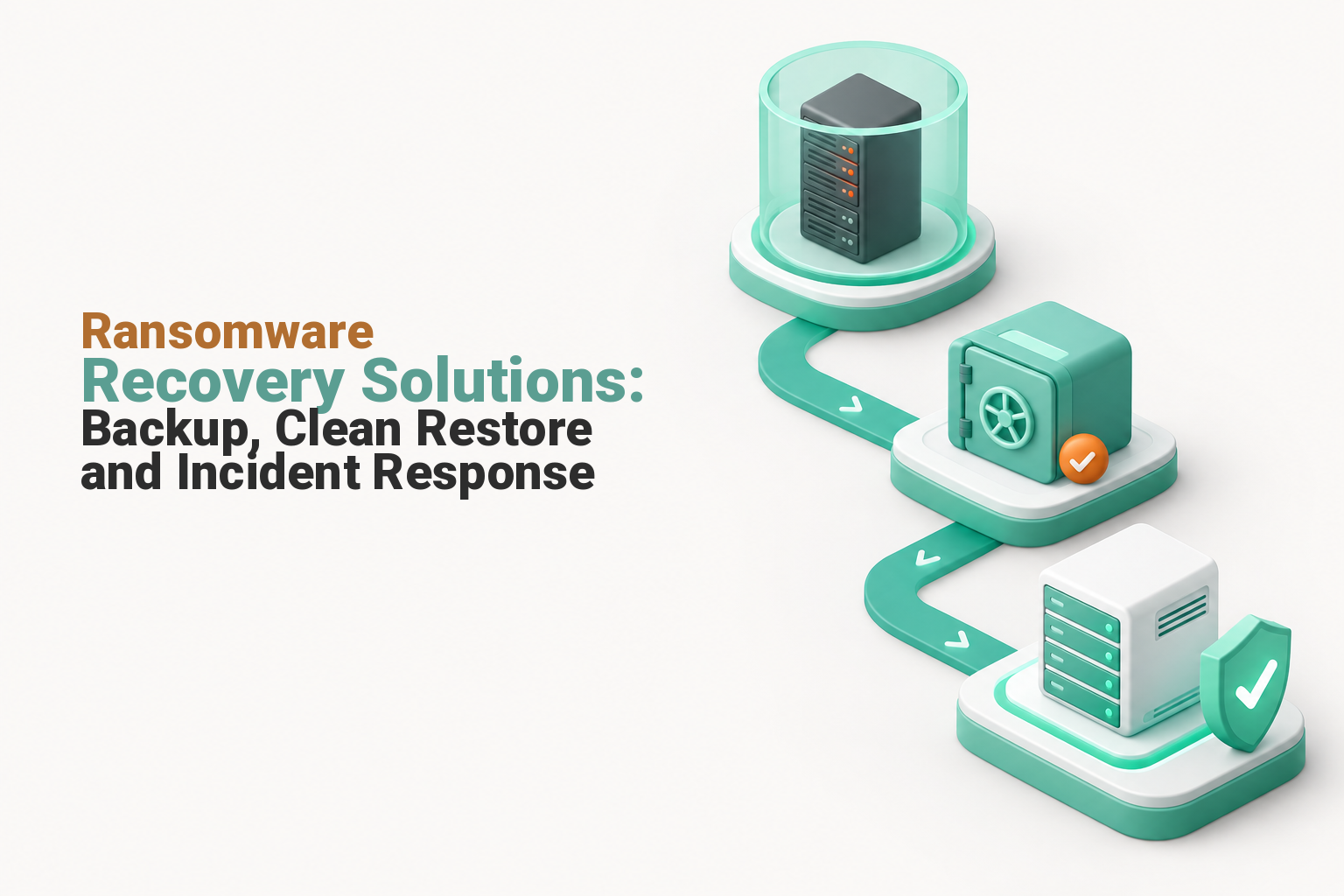
Ransomware recovery solutions work best as a layered system: isolated or immutable backups, a clean restoration environment, endpoint rebuilding, and specialist incident response when the attack scope is unclear. The safest option is the one that restores tested data without reconnecting malware, compromised credentials or vulnerable systems to production. (cyber.gov.au)
Key takeaways
- A recent backup is useful only when its integrity has been checked and the restore process has been tested. (cyber.gov.au)
- Immutable or offline backups should use administration and authentication separated from the production environment. (cyber.gov.au)
- A clean restore may require rebuilding systems, resetting credentials and removing persistence before business data is returned. (cisa.gov)
- Decryption tools work only for supported ransomware variants and should be used after the malware has been removed. (nomoreransom.org)
- Australian privacy assessments and any applicable ransomware-payment reporting must proceed alongside technical recovery. (oaic.gov.au)
Table of contents
- Which ransomware recovery solution is right for your business?
- What should happen before any restore begins?
- How do the main ransomware recovery options compare?
- What does a safe clean restore actually involve?
- How should an Australian business choose a provider?
- What Australian reporting duties can affect recovery?
- Frequently asked questions about ransomware recovery solutions
- What should you do next?
The question is not which product can decrypt every ransomware infection. No such universal product exists. The practical question is which combination of backups, clean infrastructure, endpoint rebuilding and specialist support can return the business to a trustworthy operating state.
This guide compares those recovery paths. It does not replace live incident-response, legal or privacy advice during an active attack.
Which ransomware recovery solution is right for your business?
Choose the combination that can return critical services to a trusted state within the business’s recovery targets. For most organisations, that means verified backups plus clean-system rebuilding and incident response, not a single tool.
Start with two business targets. The recovery point objective, or RPO, is the maximum acceptable gap between the last clean recovery point and the incident. The recovery time objective, or RTO, is the target time for returning a usable service.
Those targets belong in business continuity planning and should determine the order used for disaster recovery. A payroll system, identity service or customer database may need priority over an archive that can remain unavailable for several days. (tsapps.nist.gov)
Use these questions to narrow the choice:
- Is the incident limited to one or two endpoints, or could an attacker still control accounts and servers?
- Is there a recent backup that predates the initial compromise, not merely the start of encryption?
- Can the backup be restored without using compromised production credentials?
- Does the business have a clean environment where systems can be rebuilt and tested?
- Is there evidence that personal or sensitive information was accessed or removed?
A simple endpoint rebuild may suit a contained workstation incident. A broader identity, network or server compromise usually needs a clean recovery environment and specialist investigation before restored data can be trusted.
Choose the solution by the recovery outcome it can prove, not by the number of features it lists.

Performance you can feel, backed by clients who depend on it. Read how our support and uptime create long‑term customer success.Power Your Business with Better Hosting
What should happen before any restore begins?

Contain the attack, preserve useful evidence and identify which systems and accounts may be compromised. Connecting backups or restored systems too early can expose the recovery copy to the same attacker or malware.
Disconnect affected devices from networks where this can be done safely. Do not connect backup media to an infected device, and do not erase affected systems before responders decide what evidence is needed. The ASD ransomware emergency response guide says information should be restored only when the backup is believed to be free from ransomware. (cyber.gov.au)
The initial assessment should identify affected endpoints, servers, cloud services, administrator accounts and backup consoles. It should also look for evidence of earlier access, because ransomware encryption may be the final visible stage of a longer intrusion.
Management, the incident-response lead, the insurer and relevant legal or privacy advisers may need to be contacted early. The recovery team should record decisions, timestamps and affected assets so that technical restoration, customer communication and reporting do not work from conflicting information.
Contain first; restoring into an active compromise can turn a recoverable incident into a second outage.
How do the main ransomware recovery options compare?
Secure backup restoration is normally the preferred path, but it is not always sufficient by itself. The right recovery path depends on the available clean data, the level of attacker access and the systems that must be rebuilt.
| Recovery path | Best fit | Main strength | Main limitation |
|---|---|---|---|
| Verified backup restore | A recent, isolated and tested recovery point exists | Returns known business data without relying on an attacker | Can restore malware or compromised settings if the recovery point is not clean |
| Clean-environment rebuild | Identity, servers or network administration may be compromised | Removes untrusted systems and persistence before data returns | Requires planning, clean infrastructure and skilled coordination |
| Endpoint rebuilding | The incident is limited to workstations or devices | Replaces affected operating systems and applications quickly | Does not resolve compromised servers, cloud accounts or central identity systems |
| Specialist incident response and data recovery | The scope is unclear, backups are damaged or sensitive data may be exposed | Combines investigation, containment and complex recovery work | Cost and timing cannot be confirmed until the environment is assessed |
| Trusted decryptor | The ransomware variant is identified and a supported tool exists | May recover files without paying the attacker | Only works for supported variants and does not clean the environment |
Verified backup restoration. The backup should include the data, applications and configuration settings needed to return a service, with related repositories synchronised to a usable point in time. Strong off-site backup solutions also separate the recovery copy from production access and site-level failures.
ASD’s September 2026 backup controls include technically enforced immutability during the retention period and separate authentication for backup infrastructure. The guidance also limits the ability of production and backup administrators to modify or delete retained copies. (cyber.gov.au)
Clean-environment rebuilding. This is necessary when attackers may still control administrator accounts, identity services, remote-access tools or network equipment. Business data can be restored after trusted systems, access paths and credentials have been rebuilt.
Endpoint recovery. Reimaging or replacing a laptop can be suitable when investigation confirms the incident is genuinely contained. Rebuilding endpoints alone is unsafe when the same stolen credentials or central management tools can infect them again.
Specialist recovery. Incident responders are appropriate when the intrusion path is unknown, backups may be contaminated, regulated data is involved or complex databases must be reconstructed. A provider should not promise a recovery time before understanding the scope.
Decryption tools. Check trusted sources such as the No More Ransom decryption tools after identifying the ransomware variant. Preserve the encrypted originals, remove the malware first and follow the tool instructions rather than experimenting on the only copy of affected data. (europol.europa.eu)
Practical rule: a backup is not a recovery solution until a clean restore has been tested.
Backups are the preferred recovery source, but clean rebuilding and specialist response determine whether the restored business can be trusted.
Host your website with our 5-star rated, cPanel website hosting plans.
Super fast servers, with security included and hosted in your choice of Australian Data Center.
View cPanel Plans
What does a safe clean restore actually involve?
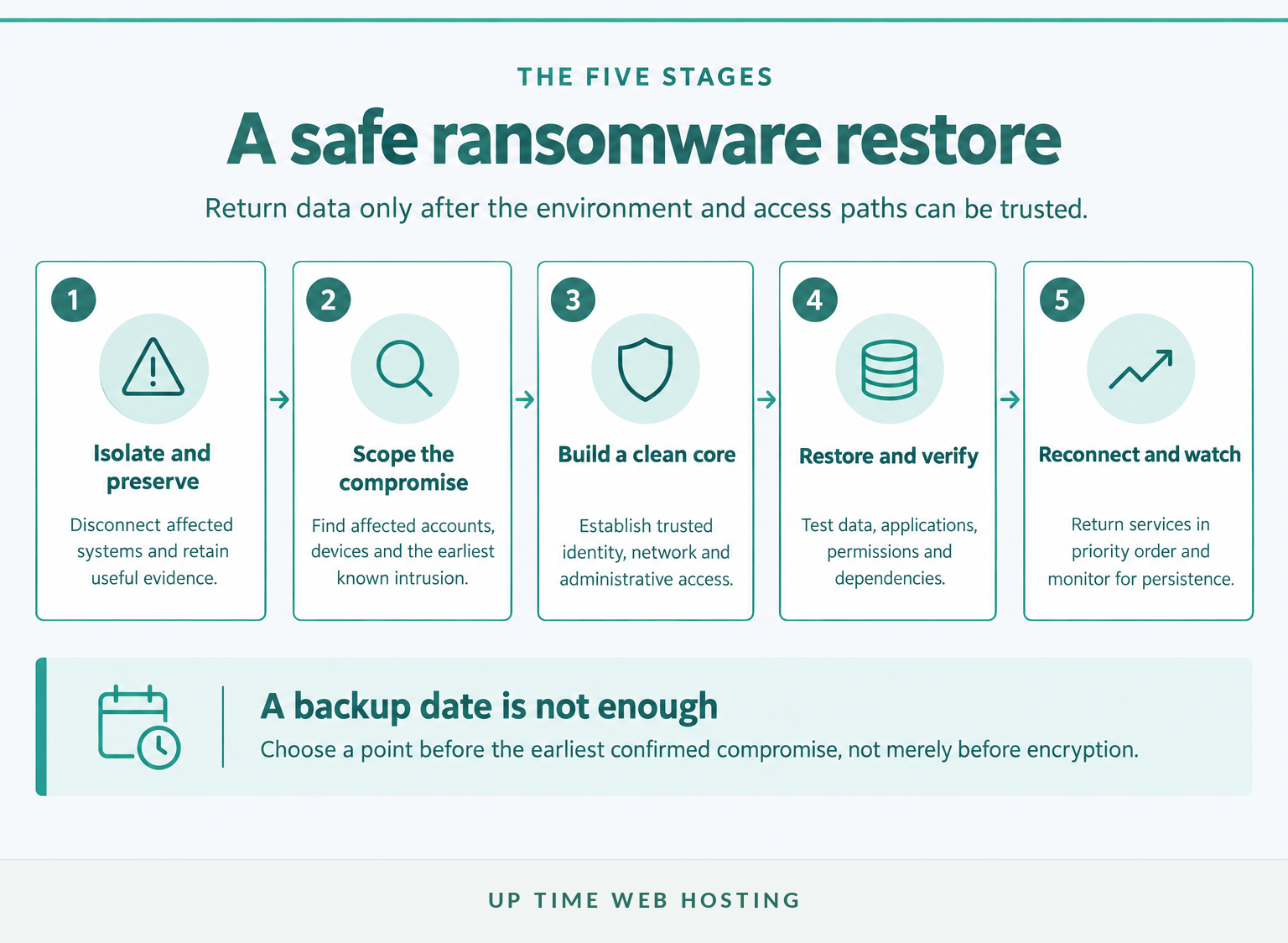
A clean restore rebuilds trusted systems before returning business data to production. It verifies the recovery point, resets compromised access and reconnects services in controlled stages rather than restoring everything at once.
- Isolate and preserve. Separate affected systems, protect logs and retain representative evidence. Use clean communication methods if business email or collaboration systems may be monitored.
- Scope the compromise. Identify affected accounts, devices, cloud services and network segments. Select a recovery point from before the earliest confirmed compromise, not simply before files became encrypted.
- Build a trusted core. Establish clean identity, administration and network services. Apply relevant updates, remove persistence and replace exposed passwords, tokens, certificates and keys.
- Restore and validate. Restore critical services in priority order. Check data integrity, application behaviour, permissions, dependencies and security controls before users return.
- Reconnect and monitor. Return systems in stages while watching authentication, endpoint and network activity for renewed access or abnormal behaviour.
The NIST Cybersecurity Framework 2.0 requires organisations to verify both recovery assets and restored systems. The CISA ransomware response checklist likewise recommends prioritising critical systems on a clean network and rebuilding from trusted images where possible. (cisa.gov)
A prepared disaster recovery hosting environment can provide somewhere separate to rebuild and validate services. It still needs clean credentials, current configurations and a tested cutover process.
A clean restore is complete only when data, systems, identities and monitoring have all passed validation.
How should an Australian business choose a provider?
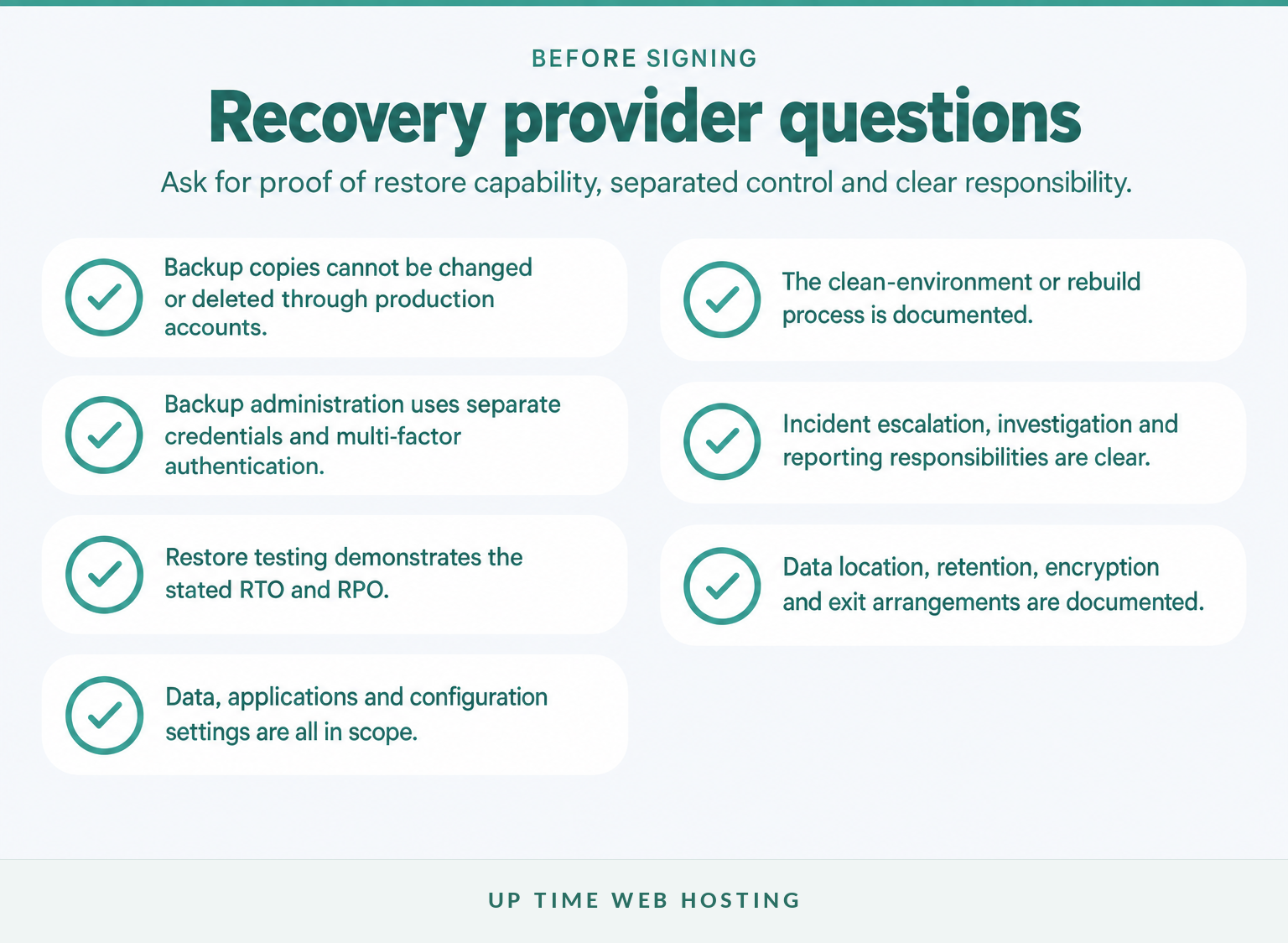
Choose a provider that can explain and demonstrate how restoration works during a real compromise. Product names and backup success notifications matter less than separated access, restore-test evidence and clear incident responsibilities.
Ask when the provider last completed a full restore for a workload similar to yours. The test should record the recovery point used, the time taken, missing dependencies, errors and the point at which the service was declared usable.
Check how backup administration is separated. Production administrators should not automatically be able to delete recovery copies, and backup accounts should use separate authentication and multi-factor authentication. Immutability should be technically enforced for the agreed retention period rather than relying on a policy document.
Confirm the scope in writing. A server backup may not include cloud data, email, endpoint files, network configurations, identity systems or encryption keys. Database recovery may also require transaction logs and application-consistent restore points.
The provider should explain who investigates the incident, who builds the clean environment, who validates the data and who decides that production can reopen. It should also document data location, encryption, retention, exit arrangements and after-hours escalation.
Recovery should connect with broader website protection and security work. Rebuilding an unchanged vulnerable system can recreate the conditions that allowed the original compromise.
Choose a provider on proven restore outcomes, separated control and clear incident responsibilities.
What Australian reporting duties can affect recovery?
Australian reporting duties depend on the organisation, the information involved and whether a ransomware or cyber-extortion payment is made. Technical containment should begin immediately, while legal and privacy advisers assess which notification rules apply.
As at 1 October 2026, organisations covered by the Privacy Act must assess a suspected eligible data breach reasonably and quickly. The OAIC Notifiable Data Breaches guidance says all reasonable steps must be taken to complete an assessment within 30 calendar days, with eligible breaches notified promptly once established. (oaic.gov.au)
Ransomware-payment reporting is a separate obligation. Under the Cyber Security (Ransomware Payment Reporting) Rules 2025, the regime generally covers Australian businesses whose previous-year turnover exceeds AU$3 million and certain critical infrastructure entities. A covered entity must report within 72 hours of making a payment or becoming aware that one was made on its behalf. (cyber.gov.au)
The Australian Government strongly discourages ransom payments because payment does not guarantee recovery or prevent publication of stolen data. The DFAT cyber sanctions guidance also states that making or facilitating a payment to a sanctioned person or entity can contravene Australian sanctions law. Obtain legal advice before any funds move. (dfat.gov.au)
Technical recovery and Australian reporting assessment must run in parallel from the start.
Register your new domain name at competitive market prices including free domain add-ons like privacy, DNS Hosting, Custom Nameservers and Forwarding.
Always the best price and no nasty renewal price hikes.
Register A Domain Name
Frequently asked questions about ransomware recovery solutions
Ransomware recovery depends on the scope of the compromise and the quality of the recovery preparation completed before the incident. These answers provide a starting point, but an active attack may require specialist technical and legal advice.
What is the best method to recover from a ransomware attack?
The best method is to isolate affected systems, investigate the scope, rebuild or clean the environment, and restore verified data from a recent uncorrupted backup. Recovery should occur on a clean network, with compromised credentials reset and restored systems monitored before they return to normal production. (cisa.gov)
What is the best solution for ransomware?
The best solution is a layered recovery design rather than one product. It combines protected backups, separate backup administration, tested restore procedures, endpoint rebuilding, incident response and clear business priorities. The right mix depends on the systems affected, the clean recovery points available and the organisation’s required recovery time. (cyber.gov.au)
Can you recover ransomware files?
Ransomware files can sometimes be recovered from clean backups or with a trusted decryptor for the specific variant. Recovery is not guaranteed. Keep original encrypted files, remove the malware before using a decryptor, and have a specialist check whether restoration could overwrite evidence or reintroduce the compromise. (europol.europa.eu)
What is the average time to recover from a ransomware attack?
There is no dependable average recovery time for a ransomware attack. A single laptop may be rebuilt quickly, while a compromised identity system, server fleet or database environment can take much longer. Recovery time depends on scope, backup integrity, data volume, investigation needs, staffing and tested recovery objectives. (cyber.gov.au)
Recovery time and recoverability depend on clean evidence, tested backups and the scope of compromise.
What should you do next?
Start by running a controlled restore of one critical service and recording the real recovery point, recovery time and missing dependencies. Use the result to correct the backup design, access separation and recovery sequence before the next test.
Ask UpTime Networks for a backup and recovery review covering the servers, workstations, databases and email that keep the business operating. (uptimewebhosting.com.au)
Test the restore before an attacker does.